REVIEW 4 major objections 5 minor 5 cited by
From nuclear star clusters to Little Red Dots: black hole growth, mergers, and tidal disruptions
T0 review · 4 major / 5 minor · reviewed 2026-08-04 · deepseek-v4-flash
Pith's one-line read Dense nuclear star clusters can turn a thousand-solar-mass black hole seed into a supermassive black hole in tens of millions of years, the authors argue — explaining JWST's Little Red Dots.
desk verdict A usable semi-analytic NSC framework with testable LRD TDE/EMRI rate predictions, but the headline growth story leans on an unmeasured density and the reported rates are internally inconsistent. read the letter →
The pith
A machine-rendered reading of the paper's core claim, the machinery that carries it, and where it could break.
The reading
What carries the argument
The model uses a two-mass broken power-law density profile for a nuclear star cluster: one population of stars, one more compact population of stellar-mass black holes, each with its own break radius. The authors analytically integrate the Jeans equation to get velocity dispersions, then treat the loss cone (the phase-space region that feeds the central black hole) to compute tidal disruption and gravitational-wave capture rates, add evaporation and gas accretion capped at a fixed Eddington ratio, and evolve the cluster radii under energy conservation. The loss cone is the key mechanism: it sets both the black hole growth rate and the predicted transient rates.
What would settle it
A dedicated survey of tidal disruption events at redshift 4–6 that finds no events at the predicted rate of tens per year — or a high-resolution observation showing that Little Red Dots lack dense central stellar clusters — would falsify the model's growth channel and rate predictions.
Extended reading notes
Core claim
The paper's central claim is that a nuclear star cluster with central density ~10^8 solar masses per cubic parsec can grow a 10^3 solar-mass intermediate-mass black hole seed to ~2×10^7 solar masses in a few tens of millions of years via tidal disruptions, stellar-mass black hole captures, and episodic gas accretion — with about 80% of the final mass assembled from stars and black holes, not gas. This channel, the authors argue, produces the Little Red Dots seen at z~5. From the observed number density of LRDs, they predict tens of tidal disruption events per year and a few captured EMRIs per year at z=4–6, in a 10-to-1 ratio. They also attribute the low X-ray luminosity of LRDs to hard X-ra
Load-bearing premise
The predictions rest on the unverified assumption that Little Red Dots contain dense, relaxed nuclear star clusters of about 10^6–10^7 solar masses, since the cluster mass sets the rate scale and is admitted to be an 'educated guess'.
Editorial extensions
If this is right
- If LRDs host such clusters, a large fraction of their supermassive black hole mass is assembled by swallowing stars and stellar-mass black holes, not just gas accretion.
- The model predicts an observer-frame rate of about 40 tidal disruption events per year and about 4 extreme-mass-ratio inspirals per year in redshift 4–6, with a fixed 10-to-1 ratio.
- These rates are lower limits: the LRD number densities used are lower bounds, and lower-mass black holes are harder to observe.
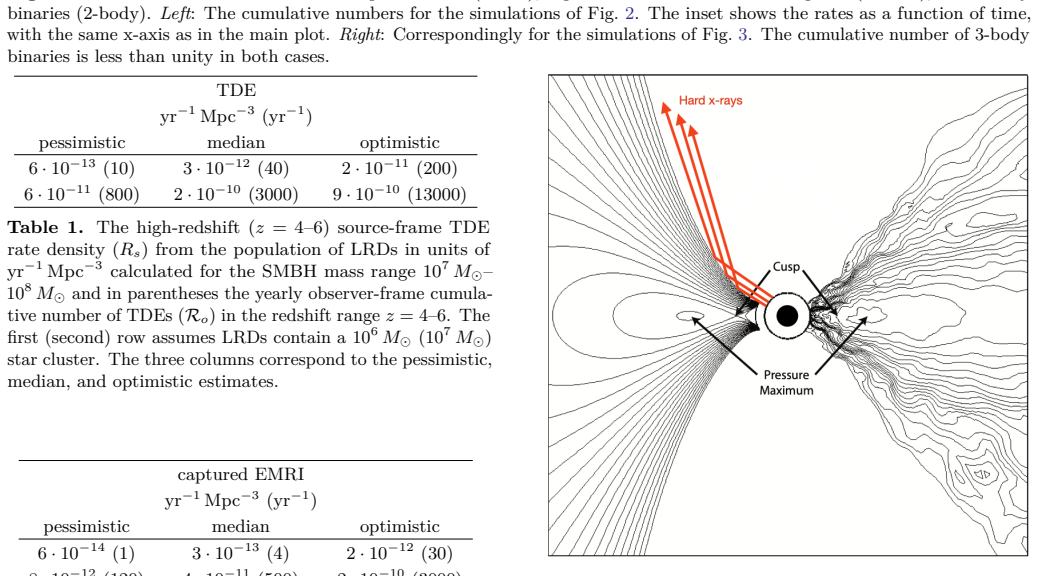
- The low X-ray luminosity of LRDs may be caused by scattering of hard X-rays in a thick accretion-disk funnel, producing high X-ray polarization and unassociated X-ray sources.
- A residual population of stellar-mass black holes around the central supermassive black hole should lead to later black-hole mergers and micro-tidal disruptions.
Reading between the lines
- The model implies that the seed mass of the first black holes matters less than the density of the nuclear star cluster; even a 10^3 solar-mass seed can reach supermassive scales if the cluster is dense enough.
- The 10-to-1 TDE-to-EMRI ratio is a sharp, testable prediction, but it hinges on the assumed cluster mass; a factor of 10 in cluster mass changes the rates by a factor of ~100, so the ratio (not the absolute rates) may be the more robust observable.
- If LRDs continue to grow via tidal disruptions after their gas is expelled, then dormant LRDs should still be sources of TDEs and EMRIs — a prediction that could be checked by looking for variability and transients in inactive LRDs.
- The funnel-scattering X-ray explanation suggests that high X-ray polarization, not just low X-ray flux, is a signature of Little Red Dots; if future X-ray polarimetry detects 10–20% polarization from these sources, it would support the super-Eddington scenario.
Editorial analysis
A structured set of objections, weighed in public.
Referee Report
Summary. The paper presents a semi-analytic two-component (stars + stellar-mass black holes) broken-power-law model for nuclear star clusters harboring a central seed black hole. It evolves the system under loss-cone tidal disruption events (TDEs), captured extreme-mass-ratio inspirals (EMRIs), stellar evaporation, two- and three-body BH binary formation, and episodic gas accretion. Two NSC examples are integrated: a 'typical' case with n1=n2=10^5 pc^-3 and an 'extremely massive and compact' case with n1=n2=10^8 pc^-3. In the extreme case a 10^3 Msun seed grows to ~2x10^7 Msun within a few tens of Myr, which the authors associate with the z~5 little red dot (LRD) population. Using LRD number densities from Matthee et al. (2024) and assuming the MBH-sigma relation at z~5, the paper derives source-frame and observer-frame TDE and captured-EMRI rates at z=4-6, reporting a TDE-to-EMRI ratio of about 10:1 and median cumulative rates of roughly tens to hundreds per year depending on the assumed NSC mass. The paper also discusses the low X-ray luminosity of LRDs via a Cygnus X-3-like funnel-scattering model. The authors are candid in Sec. 1 and Sec. 5 that the NSC input parameters are 'subjective' and that the NSC properties are the dominant source of uncertainty, but the abstract and Conclusions state the extreme-density growth and the rate predictions more assertively.
Significance. If the assumptions hold, the paper offers a self-contained dynamical channel for early SMBH assembly in dense NSCs and makes concrete, testable predictions for high-redshift TDEs and EMRIs, including a predicted rate ratio and possible LISA/UVEX signatures. The extension of analytic Jeans and loss-cone calculations to a two-mass broken-power-law cluster with gas accretion is useful and goes beyond existing single-mass treatments. The paper is also honest about the subjective input choices and flags the dominant uncertainty. However, the headline LRD-formation claim and the TDE/EMRI predictions rest on an unobserved, extreme NSC density (10^8 pc^-3) and on an assumed NSC mass scale (10^6 or 10^7 Msun) that changes the rates by two orders of magnitude. The internal rate summary is inconsistent between Sec. 5 and the Conclusions. These issues are load-bearing because they directly control the central claims, but they are not fatal to the framework if the paper is revised to present the extreme branch as a speculative upper envelope and to report rates consistently with stated assumptions.
major comments (4)
- [Sec. 4.3 / Conclusions] The central growth claim -- that a 10^3 Msun IMBH seed reaches ~2x10^7 Msun within a few tens of Myr and 'gives rise to the z~5 population of LRDs' -- is obtained only for n1=n2=10^8 pc^-3. The typical case of Sec. 4.2 reaches only ~3x10^5 Msun without gas and barely exceeds 10^6 Msun with 20 gas episodes over 10 Gyr, far below the 10^7-10^8 Msun LRD masses. The 10^8 pc^-3 density is not measured in LRDs; the high-z lensed clusters cited for motivation (Vanzella et al. 2023; Adamo et al. 2024) have masses ~10^6 Msun and effective radii <1 pc, implying average densities ~10^6 pc^-3. Since the paper itself states that cluster density controls the growth rate, the abstract's 'reasonable assumptions' should be replaced by an explicit statement that the LRD-formation scenario is demonstrated only in an extreme, observationally unconstrained density branch, with the 10^6 pc^-3 case presented a
- [Sec. 5, Tables 1-2 vs Sec. 7] The reported rate summary is internally inconsistent. Table 1 gives median observer-frame TDE rates of ~40 yr^-1 for 10^6 Msun NSCs and ~3000 yr^-1 for 10^7 Msun NSCs; Table 2 gives median captured-EMRI rates of ~4 yr^-1 and ~500 yr^-1, respectively. The Conclusions state median TDE and EMRI rates of ~500 yr^-1 and ~4 yr^-1, which mix the 10^7 Msun EMRI value with the 10^6 Msun EMRI value and do not correspond to any single column of Tables 1-2. This must be corrected: the authors should specify which NSC mass assumption is used for each headline rate and avoid mixing assumptions across the two tables.
- [Sec. 5, rate calculation] The cumulative TDE and EMRI rates are lower limits only in the limited sense that the LRD number densities from Matthee et al. (2024) are lower limits. The per-LRD rates are derived from assumed NSC masses (10^6 vs 10^7 Msun, a factor ~100), from the assumed MBH-sigma relation at z~5, and from the assumption that all LRDs contain collisionally relaxed NSCs. The paper acknowledges that NSC properties are the dominant source of uncertainty, but the abstract and Conclusions present the rates as robust predictions. Please add a summary table or statement that the rates are conditional on these three assumptions, and quantify how the 'at least' claim changes if, for example, the MBH-sigma relation has larger scatter at high redshift or if LRDs do not host relaxed NSCs.
- [Sec. 5, Hills mass] The sentence 'we assume that all SMBHs in our examined mass range can produce an observable TDE' ignores the Hills mass, which for lower-spin black holes can be below 10^8 Msun. Since the LRD SMBH mass bins extend to 10^8 Msun, the assumption may overestimate the observable TDE rate. The authors note that spin is not known, but the 'at least' framing is not conservative unless the spin-dependence is either quantified or the rate is restricted to the mass range where the Hills mass is not limiting. A simple estimate of the fraction of TDEs lost due to the Hills mass for representative spin values should be included.
minor comments (5)
- [Fig. 1 caption] The caption lists only 'Left', 'Middle', and 'Right', but the figure appears to have four panels (number density, enclosed mass, velocity dispersion, loss-cone/evaporation rates). Please label all panels consistently.
- [Sec. 4.3] Typo: 'LDRs' should be 'LRDs' in the sentence describing the three-dimensional model cartoon.
- [Eq. (17)] The second argument of the min function has units of mass per time; please state explicitly that this is the free-fall / Bondi-like rate and define all symbols in the equation (rho_g, c_s, frad) in the text.
- [Tables 1-2] Please define what 'pessimistic', 'median', and 'optimistic' correspond to in terms of propagated errors (LRD density uncertainty, MBH-sigma scatter, etc.). Currently the table columns are not tied to a stated error prescription.
- [Sec. 4.2 / Sec. 4.3] The choice of 20 gas episodes in Sec. 4.2 and 10 episodes in Sec. 4.3 is not motivated. A one-line justification or a test of sensitivity to the number and timing of gas episodes would improve reproducibility.
Circularity Check
No significant circularity: the predicted TDE/EMRI rates and BH growth are forward-modeled outputs, not inputs; the NSC parameters are admittedly unconstrained and drive the uncertainty, but no equation reduces a prediction to a fitted parameter.
full rationale
The derivation chain is self-contained. The paper chooses an NSC two-mass broken-power-law model (Eq. 1), solves Jeans' equation for velocity dispersions (Eqs. 3-5), computes evaporation and loss-cone fluxes (Eqs. 8-16), integrates BH growth through Eq. (18), and then converts per-system rates into cosmic rates using observed LRD number densities from Matthee et al. (2024) via Eq. (27). The central growth result (Sec. 4.3) is an integrated output of the model dynamics for an explicitly stated initial density n1=n2=10^8 pc^-3, not a restatement of that input: the final SMBH mass is not set equal to the cluster mass or to any fitted parameter. Likewise, the cosmological TDE and captured-EMRI rates are computed as a sum over SMBH mass bins of observed LRD number densities times per-system model rates (Sec. 5), so no prediction appears as an input anywhere. The paper candidly labels the NSC parameters as a relatively subjective choice of parameters (Sec. 1) and calls the unknown NSC properties the dominant source of uncertainty (Sec. 5), which is a robustness limitation rather than circularity. Self-citations to Kritos et al. (2023, 2024a, 2024b, 2025) are motivational or comparative and are not used as an unverified uniqueness theorem or ansatz; the key supporting observations (JWST cluster masses/radii, LRD number densities, MBH-sigma at high z) are external. The only notable internal issue is a numerical inconsistency between the Sec. 5 median cumulative TDE rate (~40 yr^-1) and the Conclusions value (~500 yr^-1), which affects the headline number's robustness but is not a circular step. Therefore no circularity is found.
Assumptions & free parameters
free parameters (8)
- Number densities n1=n2 at break radius =
1e5 pc^-3 (typical); 1e8 pc^-3 (extreme)
- Break radii R1, R2 =
1 pc / 0.2 pc (typical); 0.4 pc / 0.1 pc (extreme)
- Power-law indices α1, α2, β1, β2 =
-0.5, -1.0, -5.0, -5.0 (typical); -1.0, -1.5, -5.0, -5.0 (extreme)
- Seed BH mass =
1e3 M_sun
- NSC mass for rate calculation =
1e6 M_sun or 1e7 M_sun
- Gas inflow episodes =
20x8e4 M_sun (typical); 10x1e6 M_sun (extreme)
- Fraction of star mass accreted per TDE, f_lc,1 =
0.5
- Eddington cap and radiative efficiency =
cap = 0.1/frad, frad ~0.1
assumptions (9)
- standard math Collisionless Jeans equation (neglect of Fokker-Planck collision term on crossing timescale)
- domain assumption Maxwell-Boltzmann velocity distribution and two-body relaxation refills the high-velocity tail
- domain assumption Loss-cone formalism of Syer & Ulmer (1999) and Quinlan & Shapiro (1989) applies
- domain assumption MBH-σ relation holds up to z~9 and is used at z=4-6
- domain assumption Energy equipartition between stars and stellar-mass BHs sets R2 ≈ 0.1 R1
- domain assumption LRD number densities from Matthee et al. (2024) are lower limits and constant over z=4-6
- ad hoc to paper Little Red Dots contain collisionally relaxed nuclear star clusters of mass 10^6-10^7 M_sun
- ad hoc to paper All SMBHs in the 10^7-10^8 M_sun range can produce observable TDEs (Hills mass not limiting)
- domain assumption Bondi-based gas accretion capped at Eddington ratio with radiative efficiency frad
Cite this review
Pith. "Pith review of From nuclear star clusters to Little Red Dots: black hole growth, mergers, and tidal disruptions." pith.science (2026). https://pith.science/paper/XE6ENE7V
@misc{pith2026251021709,
  author       = {Pith},
  title        = {Pith review of: From nuclear star clusters to Little Red Dots: black hole growth, mergers, and tidal disruptions},
  year         = {2026},
  howpublished = {\url{https://pith.science/paper/XE6ENE7V}},
  note         = {Machine review of arXiv:2510.21709}
}
read the original abstract
Little Red Dots, discovered by the James Webb Space Telescope, are hypothesized to be active galactic nuclei containing a supermassive black hole, possibly surrounded by a dense stellar cluster, large amounts of gas, and likely by a population of stellar-mass black holes. We develop a simple nuclear star cluster model to evolve the rapid mass growth of black hole seeds into the supermassive regime. The combined processes of tidal disruption events, black hole captures, and gas accretion are accounted for self-consistently in our model. Given the observed number density of Little Red Dots, and under reasonable assumptions, we predict at least a few tens of tidal disruption events and at least a few black hole captures at z=4-6, with a tidal disruption event rate an order of magnitude larger than the black hole capture rate. We also estimate the uncertainties in these estimates. Finally, we comment on the low x-ray luminosity of Little Red Dots.
Figures


Figures from the paper (2 more)

Forward citations
Cited by 5 Pith papers
-
Memoirs of the curvaton: non-perturbative non-Gaussianity and supermassive primordial black holes
Curvaton self-interactions in non-quadratic potentials produce a local non-Gaussian map that enables supermassive primordial black hole formation at peak amplitudes of order 10^{-5} while remaining consistent with μ-d...
-
Smoluchowski Coagulation Equation and the Evolution of Primordial Black Hole Clusters
Monte Carlo solutions to the Smoluchowski coagulation equation yield runaway timescales and mass evolution for primordial black hole clusters at different redshifts based on cluster properties.
-
Smoluchowski Coagulation Equation and the Evolution of Primordial Black Hole Clusters
Monte Carlo solutions of the Smoluchowski equation for PBH clusters yield finite runaway timescales and evolving mass distributions that form high-redshift SMBHs, shortened further by mass segregation.
-
Tidal disruption event rates across cosmic time: forecasts for LSST, Roman, and JWST and their constraints on the supermassive black hole mass function
TDE rates across redshift are predicted to be highly sensitive to the evolution of the low-mass supermassive black hole mass function, with LSST, Roman, and JWST able to test this.
-
The quasi-star model for Little Red Dots: potential and challenges
Quasi-star models using Cloudy radiative transfer reproduce the UV-NIR continuum shape, Balmer break, and hydrogen line luminosities in some LRDs when combined with host galaxy emission, but fail to account for broad ...
Reference graph
Works this paper leans on
-
[1]
Adamo, A., Bradley, L. D., Vanzella, E., et al. 2024, Bound star clusters observed in a lensed galaxy 460 Myr after the Big Bang, Nature, 632, 513, doi: 10.1038/s41586-024-07703-7
-
[2]
2009, Strong mass segregation around a massive black hole, Astrophys
Alexander, T., & Hopman, C. 2009, Strong mass segregation around a massive black hole, Astrophys. J., 697, 1861, doi: 10.1088/0004-637X/697/2/1861
-
[3]
Hickox, R. C. 2024, X-Ray View of Little Red Dots: Do They Host Supermassive Black Holes?, Astrophys. J. Lett., 969, L18, doi: 10.3847/2041-8213/ad5669
-
[4]
2017, Science with the space-based interferometer LISA
Babak, S., Gair, J., Sesana, A., et al. 2017, Science with the space-based interferometer LISA. V: Extreme mass-ratio inspirals, Phys. Rev. D, 95, 103012, doi: 10.1103/PhysRevD.95.103012
-
[5]
Baggen, J. F. W., van Dokkum, P., Brammer, G., et al. 2024, The Small Sizes and High Implied Densities of “Little Red Dots” with Balmer Breaks Could Explain Their Broad Emission Lines without an Active Galactic Nucleus, ApJL, 977, L13, doi: 10.3847/2041-8213/ad90b8
-
[6]
Bardeen, J. M. 1970, Kerr Metric Black Holes, Nature, 226, 64, doi: 10.1038/226064a0
doi:10.1038/226064a0 1970
-
[7]
Begelman, M. C., & Dexter, J. 2025, Little Red Dots As Late-stage Quasi-stars. https://arxiv.org/abs/2507.09085
arXiv 2025
-
[8]
2020, Gravitational wave background from extreme mass ratio inspirals, Phys
Bonetti, M., & Sesana, A. 2020, Gravitational wave background from extreme mass ratio inspirals, Phys. Rev. D, 102, 103023, doi: 10.1103/PhysRevD.102.103023
Show all 103 references
-
[9]
2025, Constraints on the early growth of massive black holes from PTA and JWST with L-GalaxiesBH, arXiv e-prints, arXiv:2509.12325
Bonoli, S., Izquierdo-Villalba, D., Spinoso, D., et al. 2025, Constraints on the early growth of massive black holes from PTA and JWST with L-GalaxiesBH, arXiv e-prints, arXiv:2509.12325. https://arxiv.org/abs/2509.12325
2025
-
[10]
Y., & Li, H
Choksi, N., Volonteri, M., Colpi, M., Gnedin, O. Y., & Li, H. 2019, The star clusters that make black hole binaries across cosmic time, Astrophys. J., 873, 100, doi: 10.3847/1538-4357/aaffde
2019 doi
-
[11]
2025, Formation of supermassive stars and dense star clusters in metal-poor clouds exposed to strong FUV radiation, MNRAS, 539, 2561, doi: 10.1093/mnras/staf598
Chon, S., & Omukai, K. 2025, Formation of supermassive stars and dense star clusters in metal-poor clouds exposed to strong FUV radiation, MNRAS, 539, 2561, doi: 10.1093/mnras/staf598
2025 doi
-
[12]
M., & Simon, J
Comerford, J. M., & Simon, J. 2025, Preferential Accretion onto the Secondary Black Hole Strengthens Gravitational Wave Signals. https://arxiv.org/abs/2510.06325 de Graaff, A., Rix, H.-W., Naidu, R. P., et al. 2025, A remarkable Ruby: Absorption in dense gas, rather than evolv...
2025
-
[13]
Dokuchaev, V. I. 1991, Joint evolution of a galactic nucleus and central massive black hole., MNRAS, 251, 564, doi: 10.1093/mnras/251.4.564
1991 doi
-
[14]
2021, Observational Support for Massive Black Hole Formation Driven by Runaway Stellar Collisions in Galactic Nuclei, ApJ, 908, 57, doi: 10.3847/1538-4357/abd93c
Escala, A. 2021, Observational Support for Massive Black Hole Formation Driven by Runaway Stellar Collisions in Galactic Nuclei, ApJ, 908, 57, doi: 10.3847/1538-4357/abd93c
2021 doi
-
[15]
2025, On the Fate of Little Red Dots
Escala, A., Zimmermann, L., Valdebenito, S., et al. 2025, On the Fate of Little Red Dots. https://arxiv.org/abs/2509.20453
2025
-
[16]
2022, Nuclear star cluster formation in star-forming dwarf galaxies, A&A, 667, A101, doi: 10.1051/0004-6361/202244932
Fahrion, K., Bulichi, T.-E., Hilker, M., et al. 2022, Nuclear star cluster formation in star-forming dwarf galaxies, A&A, 667, A101, doi: 10.1051/0004-6361/202244932
2022 doi
-
[17]
Frank, J., & Rees, M. J. 1976, Effects of massive black holes on dense stellar systems., MNRAS, 176, 633, doi: 10.1093/mnras/176.3.633
1976 doi
-
[18]
J., Secunda, A
Furtak, L. J., Secunda, A. R., Greene, J. E., et al. 2025, Investigating photometric and spectroscopic variability in the multiply imaged little red dot A2744-QSO1, A&A, 698, A227, doi: 10.1051/0004-6361/202554110
2025 doi
-
[19]
Garcia, F. A. B., Ricotti, M., & Sugimura, K. 2025, Seeding Cores: A Pathway for Nuclear Star Clusters from Bound Star Clusters in the First Billion Years, arXiv e-prints, arXiv:2503.08779, doi: 10.48550/arXiv.2503.08779
2025 doi
-
[20]
2025, JADES reveals a large population of low mass black holes at high redshift, arXiv e-prints, arXiv:2506.22147, doi: 10.48550/arXiv.2506.22147
Geris, S., Maiolino, R., Isobe, Y., et al. 2025, JADES reveals a large population of low mass black holes at high redshift, arXiv e-prints, arXiv:2506.22147, doi: 10.48550/arXiv.2506.22147
2025 doi
-
[21]
2021, Tidal Disruption Events, Ann
Gezari, S. 2021, Tidal Disruption Events, Ann. Rev. Astron. Astrophys., 59, 21, doi: 10.1146/annurev-astro-111720-030029
2021 doi
-
[22]
1993, Binary–Single-Star Scattering
Goodman, J., & Hut, P. 1993, Binary–Single-Star Scattering. V. Steady State Binary Distribution in a Homogeneous Static Background of Single Stars, ApJ, 403, 271, doi: 10.1086/172200
1993 doi
-
[23]
E., Strader, J., & Ho, L
Greene, J. E., Strader, J., & Ho, L. C. 2020, Intermediate-Mass Black Holes, ARA&A, 58, 257, doi: 10.1146/annurev-astro-032620-021835
2020 doi
-
[24]
E., et al
Greene, J. E., et al. 2024, UNCOVER Spectroscopy Confirms the Surprising Ubiquity of Active Galactic Nuclei in Red Sources at z>5, Astrophys. J., 964, 39, doi: 10.3847/1538-4357/ad1e5f
2024 doi
-
[25]
M., Quataert, E., & Springel, V
Guo, M., Stone, J. M., Quataert, E., & Springel, V. 2025, Cyclic Zoom: Multi-scale GRMHD Modeling of Black Hole Accretion and Feedback. https://arxiv.org/abs/2504.16802
2025 arXiv
- [26]
-
[27]
Hills, J. G. 1980, The effect of mass loss on the dynamical evolution of a stellar system - Analytic approximations, ApJ, 235, 986, doi: 10.1086/157703
1980 doi
-
[28]
2025, Little Red Dots as the Very First Activity of Black Hole Growth, Astrophys
Inayoshi, K. 2025, Little Red Dots as the Very First Activity of Black Hole Growth, Astrophys. J. Lett., 988, L22, doi: 10.3847/2041-8213/adea66
2025 doi
-
[29]
Inayoshi, K., & Maiolino, R. 2025, Extremely Dense Gas around Little Red Dots and High-redshift Active Galactic Nuclei: A Nonstellar Origin of the Balmer Break and Absorption Features, ApJL, 980, L27, doi: 10.3847/2041-8213/adaebd
2025 doi
-
[30]
2025, Spectral Uniformity of Little Red Dots: A Natural Outcome of Coevolving Seed Black Holes and Nascent Starbursts, arXiv e-prints, arXiv:2509.19422
Inayoshi, K., Murase, K., & Kashiyama, K. 2025, Spectral Uniformity of Little Red Dots: A Natural Outcome of Coevolving Seed Black Holes and Nascent Starbursts, arXiv e-prints, arXiv:2509.19422. https://arxiv.org/abs/2509.19422
2025 arXiv
-
[31]
2020, The Assembly of the First Massive Black Holes, Ann
Inayoshi, K., Visbal, E., & Haiman, Z. 2020, The Assembly of the First Massive Black Holes, Ann. Rev. Astron. Astrophys., 58, 27, doi: 10.1146/annurev-astro-120419-014455
2020 doi
-
[32]
2025, BlackTHUNDER – A non-stellar Balmer break in a black hole-dominated little red dot at z = 7.04, arXiv e-prints, arXiv:2501.13082, doi: 10.48550/arXiv.2501.13082
Ji, X., Maiolino, R., ¨Ubler, H., et al. 2025, BlackTHUNDER – A non-stellar Balmer break in a black hole-dominated little red dot at z = 7.04, arXiv e-prints, arXiv:2501.13082, doi: 10.48550/arXiv.2501.13082
2025 doi
-
[33]
C., ¨Ubler, H., Maiolino, R., et al
Jones, G. C., ¨Ubler, H., Maiolino, R., et al. 2025, BlackTHUNDER: Shedding light on a dormant and extreme little red dot at z=8.50, arXiv e-prints, arXiv:2509.20455, doi: 10.48550/arXiv.2509.20455 Juodˇ zbalis, I., Maiolino, R., Baker, W. M., et al. 2024, A dormant overmassiv...
2025 doi
-
[34]
2025, JWST Discovery of a High-redshift Tidal Disruption Event Candidate in COSMOS-Web, Astrophys
Karmen, M., et al. 2025, JWST Discovery of a High-redshift Tidal Disruption Event Candidate in COSMOS-Web, Astrophys. J., 990, 149, doi: 10.3847/1538-4357/adf216
2025 doi
-
[35]
2025, Semianalytical Fokker–Planck Models for Nuclear Star Clusters, Astrophys
Kaur, K., Rom, B., & Sari, R. 2025, Semianalytical Fokker–Planck Models for Nuclear Star Clusters, Astrophys. J., 980, 150, doi: 10.3847/1538-4357/ada8a8 From NSCs to LRDs: BH growth, mergers, and TDEs17
2025 doi
-
[36]
2024, The black hole masses of high-redshift QSOs, Mon
King, A. 2024, The black hole masses of high-redshift QSOs, Mon. Not. Roy. Astron. Soc., 531, 550, doi: 10.1093/mnras/stae1171
2024 doi
-
[37]
E., et al
Kovacs, O. E., et al. 2024, A Candidate Supermassive Black Hole in a Gravitationally Lensed Galaxy at Z≈10, Astrophys. J. Lett., 965, L21, doi: 10.3847/2041-8213/ad391f
2024 doi
-
[38]
Krause, M. G. H., et al. 2025, Evidence for Supermassive Black Hole Binaries. https://arxiv.org/abs/2510.07534
2025
-
[39]
L., Lachat, M., & Rasio, F
Kremer, K., Lu, W., Rodriguez, C. L., Lachat, M., & Rasio, F. 2019, Tidal Disruptions of Stars by Black Hole Remnants in Dense Star Clusters, doi: 10.3847/1538-4357/ab2e0c
2019 doi
-
[40]
S., Silk, J., et al
Kritos, K., Beckmann, R. S., Silk, J., et al. 2024a, Supermassive black hole growth in hierarchically merging nuclear star clusters. https://arxiv.org/abs/2412.15334
-
[41]
2023, Massive black hole assembly in nuclear star clusters, Phys
Kritos, K., Berti, E., & Silk, J. 2023, Massive black hole assembly in nuclear star clusters, Phys. Rev. D, 108, 083012, doi: 10.1103/PhysRevD.108.083012 —. 2024b, Supermassive black holes from runaway mergers and accretion in nuclear star clusters, Mon. Not. Roy. Astron. Soc....
2023 doi
-
[42]
2024c, Minimum gas mass accreted by spinning intermediate-mass black holes in stellar clusters, Phys
Kritos, K., Reali, L., Gerosa, D., & Berti, E. 2024c, Minimum gas mass accreted by spinning intermediate-mass black holes in stellar clusters, Phys. Rev. D, 110, 123017, doi: 10.1103/PhysRevD.110.123017
-
[43]
Kritos, K., Reali, L., Ng, K. K. Y., Antonini, F., & Berti, E. 2025, Gravitational wave inference of star cluster properties from intermediate-mass black hole mergers, Phys. Rev. D, 111, 063056, doi: 10.1103/PhysRevD.111.063056
2025 doi
-
[44]
R., et al
Kulkarni, S. R., et al. 2021, Science with the Ultraviolet Explorer (UVEX). https://arxiv.org/abs/2111.15608 Labb´ e, I., van Dokkum, P., Nelson, E., et al. 2023, A population of red candidate massive galaxies 600 Myr after the Big Bang, Nature, 616, 266, doi: 10.1038/s41586-0...
2021 arXiv
-
[45]
2024, The Case for Super-Eddington Accretion: Connecting Weak X-ray and UV Line Emission in JWST Broad-Line AGN During the First Gyr of Cosmic Time
Lambrides, E., et al. 2024, The Case for Super-Eddington Accretion: Connecting Weak X-ray and UV Line Emission in JWST Broad-Line AGN During the First Gyr of Cosmic Time. https://arxiv.org/abs/2409.13047
2024 arXiv
-
[46]
A., Aftab, A., Whalen, D
Latif, M. A., Aftab, A., Whalen, D. J., & Mezcua, M. 2025, Radio emission from little red dots may reveal their true nature, Astron. Astrophys., 694, L14, doi: 10.1051/0004-6361/202453194
2025 doi
-
[47]
R., Ajhar, E
Lauer, T. R., Ajhar, E. A., Byun, Y. I., et al. 1995, The Centers of Early-Type Galaxies with HST.I.An Observational Survey, AJ, 110, 2622, doi: 10.1086/117719
1995 doi
-
[48]
A., Fragile, P
Lei, Q., Abramowicz, M. A., Fragile, P. C., et al. 2009, The Polish doughnuts revisited I. The angular momentum distribution and equipressure surfaces, Astron. Astrophys., 498, 471, doi: 10.1051/0004-6361/200811518
2009 doi
-
[49]
Madau, P. 2025, Chasing the Light: Shadowing, Collimation, and the Super-Eddington Growth of Infant Black Holes in JWST-Discovered AGNs, arXiv e-prints, arXiv:2501.09854, doi: 10.48550/arXiv.2501.09854
2025 doi
-
[50]
2024, X-Ray Weak Active Galactic Nuclei from Super-Eddington Accretion onto Infant Black
Madau, P., & Haardt, F. 2024, X-Ray Weak Active Galactic Nuclei from Super-Eddington Accretion onto Infant Black
2024
-
[51]
Holes, Astrophys. J. Lett., 976, L24, doi: 10.3847/2041-8213/ad90e1
-
[52]
2024a, JADES - The diverse population of infant black holes at 4<z<11: Merging, tiny, poor, but mighty, Astron
Maiolino, R., et al. 2024a, JADES - The diverse population of infant black holes at 4<z<11: Merging, tiny, poor, but mighty, Astron. Astrophys., 691, A145, doi: 10.1051/0004-6361/202347640 —. 2024b, A small and vigorous black hole in the early
-
[53]
2025a, A black hole in a near-pristine galaxy 700 million years after the Big Bang
Universe, Nature, 627, 59, doi: 10.1038/s41586-024-07494-x —. 2025a, A black hole in a near-pristine galaxy 700 million years after the Big Bang. https://arxiv.org/abs/2505.22567 —. 2025b, JWST meets Chandra: a large population of Compton thick, feedback-free, and intrinsicall...
1921 arXiv
-
[54]
2024, Little Red Dots: An Abundant Population of Faint Active Galactic Nuclei at z∼5 Revealed by the EIGER and FRESCO JWST Surveys, Astrophys
Matthee, J., et al. 2024, Little Red Dots: An Abundant Population of Faint Active Galactic Nuclei at z∼5 Revealed by the EIGER and FRESCO JWST Surveys, Astrophys. J., 963, 129, doi: 10.3847/1538-4357/ad2345
2024 doi
-
[55]
Adamo, A. 2025, In Situ Formation of Star Clusters at z ¿ 7 via Galactic Disk Fragmentation: Shedding Light on Ultracompact Clusters and Overmassive Black Holes Seen by JWST, ApJL, 981, L28, doi: 10.3847/2041-8213/adadfe
2025 doi
-
[56]
2025, Overmassive black holes in the early Universe can be explained by gas-rich, dark matter-dominated galaxies, arXiv e-prints, arXiv:2506.13852, doi: 10.48550/arXiv.2506.13852
McClymont, W., Tacchella, S., Ji, X., et al. 2025, Overmassive black holes in the early Universe can be explained by gas-rich, dark matter-dominated galaxies, arXiv e-prints, arXiv:2506.13852, doi: 10.48550/arXiv.2506.13852
2025 doi
-
[57]
2013, Dynamics and evolution of galactic nuclei (Princeton, NJ: Princeton University Press)
Merritt, D. 2013, Dynamics and evolution of galactic nuclei (Princeton, NJ: Princeton University Press)
2013
-
[58]
2002, Runaway merging of black holes: analytical constraint on the timescale, Astrophys
Mouri, H., & Taniguchi, Y. 2002, Runaway merging of black holes: analytical constraint on the timescale, Astrophys. J. Lett., 566, L17, doi: 10.1086/339472 18K. Kritos & J. Silk
2002 doi
-
[59]
2024, Formation of a low-mass galaxy from star clusters in a 600-million-year-old Universe, Nature, 636, 332, doi: 10.1038/s41586-024-08293-0
Mowla, L., Iyer, K., Asada, Y., et al. 2024, Formation of a low-mass galaxy from star clusters in a 600-million-year-old Universe, Nature, 636, 332, doi: 10.1038/s41586-024-08293-0
2024 doi
-
[60]
2023, The maximum mass of a black hole which can tidally disrupt a star: measuring black hole spins with tidal disruption events, Mon
Mummery, A. 2023, The maximum mass of a black hole which can tidally disrupt a star: measuring black hole spins with tidal disruption events, Mon. Not. Roy. Astron. Soc., 527, 6233, doi: 10.1093/mnras/stad3636
2023 doi
-
[61]
P., et al
Naidu, R. P., et al. 2025, A ”Black Hole Star” Reveals the Remarkable Gas-Enshrouded Hearts of the Little Red Dots. https://arxiv.org/abs/2503.16596
2025 arXiv
-
[62]
2020, Nuclear star clusters, Astron
Neumayer, N., Seth, A., & Boeker, T. 2020, Nuclear star clusters, Astron. Astrophys. Rev., 28, 4, doi: 10.1007/s00159-020-00125-0 O’Leary, R. M., Kocsis, B., & Loeb, A. 2009, Gravitational waves from scattering of stellar-mass black holes in galactic nuclei, Mon. Not. Roy. Ast...
2020
-
[63]
2025, Little Red Dots Are Nurseries of Massive Black Holes
Pacucci, F., Hernquist, L., & Fujii, M. 2025, Little Red Dots Are Nurseries of Massive Black Holes. https://arxiv.org/abs/2509.02664
2025
-
[64]
2024, Mildly Super-Eddington Accretion onto Slowly Spinning Black Holes Explains the X-Ray Weakness of the Little Red Dots, Astrophys
Pacucci, F., & Narayan, R. 2024, Mildly Super-Eddington Accretion onto Slowly Spinning Black Holes Explains the X-Ray Weakness of the Little Red Dots, Astrophys. J., 976, 96, doi: 10.3847/1538-4357/ad84f7
2024 doi
-
[65]
2019, Direct N-body simulation of the Galactic centre, MNRAS, 484, 3279, doi: 10.1093/mnras/stz208
Panamarev, T., Just, A., Spurzem, R., et al. 2019, Direct N-body simulation of the Galactic centre, MNRAS, 484, 3279, doi: 10.1093/mnras/stz208
2019 doi
-
[66]
B., Hopman, C., & Alexander, T
Perets, H. B., Hopman, C., & Alexander, T. 2007, Massive perturber-driven interactions of stars with a massive black hole, Astrophys. J., 656, 709, doi: 10.1086/510377
2007 doi
-
[67]
B., Li, Z., Lombardi, J
Perets, H. B., Li, Z., Lombardi, J. C., & Milcarek, S. R. 2016, Micro - tidal disruption events by stellar compact objects and the production of ultra-long GRBs, Astrophys. J., 823, 113, doi: 10.3847/0004-637X/823/2/113
2016 doi
-
[68]
2025, Deep silence: Radio properties of little red dots, A&A, 693, L2, doi: 10.1051/0004-6361/202452422
Perger, K., Fogasy, J., Frey, S., & Gab´ anyi, K.´E. 2025, Deep silence: Radio properties of little red dots, A&A, 693, L2, doi: 10.1051/0004-6361/202452422
2025 doi
-
[69]
L., Volonteri, M., et al
Pfister, H., Dai, J. L., Volonteri, M., et al. 2021, Tidal disruption events in the first billion years of a galaxy, MNRAS, 500, 3944, doi: 10.1093/mnras/staa3471
2021 doi
-
[70]
S., et al
Polak, B., Mac Low, M.-M., Klessen, R. S., et al. 2024, Massive star cluster formation: I. High star formation efficiency while resolving feedback of individual stars, A&A, 690, A94, doi: 10.1051/0004-6361/202348840
2024 doi
-
[71]
2024, Demographics of tidal disruption events with L-Galaxies: I
Polkas, M., Bonoli, S., Bortolas, E., et al. 2024, Demographics of tidal disruption events with L-Galaxies: I. Volumetric TDE rates and the abundance of nuclear star clusters, A&A, 689, A204, doi: 10.1051/0004-6361/202449470
2024 doi
-
[72]
G., & Abolmasov, P
Poutanen, J., Fabrika, S., Butkevich, A. G., & Abolmasov, P. 2007, Supercritically accreting stellar mass black holes as ultraluminous X-ray sources, Mon. Not. Roy. Astron. Soc., 377, 1187, doi: 10.1111/j.1365-2966.2007.11668.x
2007
-
[73]
D., & Shapiro, S
Quinlan, G. D., & Shapiro, S. L. 1989, Dynamical Evolution of Dense Clusters of Compact Stars, ApJ, 343, 725, doi: 10.1086/167745
1989 doi
-
[74]
2025, A rapid channel for the collisional formation and gravitational wave driven mergers of supermassive black hole seeds at high redshift, arXiv e-prints, arXiv:2503.21879
Rantala, A., & Naab, T. 2025, A rapid channel for the collisional formation and gravitational wave driven mergers of supermassive black hole seeds at high redshift, arXiv e-prints, arXiv:2503.21879. https://arxiv.org/abs/2503.21879
2025 arXiv
-
[75]
2025, Micro-Tidal Disruption Events in Young Star Clusters
Rastello, S., Iorio, G., Gieles, M., & Wang, L. 2025, Micro-Tidal Disruption Events in Young Star Clusters. https://arxiv.org/abs/2509.07067
2025
-
[76]
Rees, M. J. 1988, Tidal disruption of stars by black holes of 106-108 solar masses in nearby galaxies, Nature, 333, 523, doi: 10.1038/333523a0
1988 doi
-
[77]
Reynolds, C. S. 2021, Observational Constraints on Black Hole Spin, Ann. Rev. Astron. Astrophys., 59, 117, doi: 10.1146/annurev-astro-112420-035022
2021 doi
-
[78]
2018, The Observational Signatures of Supermassive Black Hole Seeds, Mon
Ricarte, A., & Natarajan, P. 2018, The Observational Signatures of Supermassive Black Hole Seeds, Mon. Not. Roy. Astron. Soc., 481, 3278, doi: 10.1093/mnras/sty2448
2018 doi
-
[79]
P., Naab, T., Rantala, A., et al
Rizzuto, F. P., Naab, T., Rantala, A., et al. 2023, The growth of intermediate mass black holes through tidal captures and tidal disruption events, Mon. Not. Roy. Astron. Soc., 521, 2930, doi: 10.1093/mnras/stad734
2023 doi
-
[80]
L., Chatterjee, S., & Rasio, F
Rodriguez, C. L., Chatterjee, S., & Rasio, F. A. 2016, Binary Black Hole Mergers from Globular Clusters: Masses, Merger Rates, and the Impact of Stellar Evolution, Phys. Rev. D, 93, 084029, doi: 10.1103/PhysRevD.93.084029
2016 doi
-
[81]
2025, Stellar Distributions around Supermassive Black Holes in Gas-rich Nuclear Star
Rozner, M., & Ramirez-Ruiz, E. 2025, Stellar Distributions around Supermassive Black Holes in Gas-rich Nuclear Star
2025
-
[82]
Clusters, Astrophys. J. Lett., 988, L21, doi: 10.3847/2041-8213/adeca7 Sch¨ odel, R., Feldmeier, A., Kunneriath, D., et al. 2014, Surface brightness profile of the Milky Way’s nuclear star cluster, A&A, 566, A47, doi: 10.1051/0004-6361/201423481
-
[83]
Shapiro, S. L. 1977, The dissolution of globular clusters containing massive black holes., ApJ, 217, 281, doi: 10.1086/155577
1977 doi
-
[84]
C., & Frank, J
Shlosman, I., Begelman, M. C., & Frank, J. 1990, The fuelling of active galactic nuclei, Nature, 345, 679, doi: 10.1038/345679a0
1990 doi
-
[85]
Shlosman, I., Frank, J., & Begelman, M. C. 1989, Bars within bars: a mechanism for fuelling active galactic nuclei, Nature, 338, 45, doi: 10.1038/338045a0 From NSCs to LRDs: BH growth, mergers, and TDEs19
1989 doi
-
[86]
C., Norman, C., Nusser, A., & Wyse, R
Silk, J., Begelman, M. C., Norman, C., Nusser, A., & Wyse, R. F. G. 2024, Which Came First: Supermassive Black Holes or Galaxies? Insights from JWST, Astrophys. J. Lett., 961, L39, doi: 10.3847/2041-8213/ad1bf0
2024 doi
-
[87]
C., Barnes, A
Sormani, M. C., Barnes, A. T., Sun, J., et al. 2023, Fuelling the nuclear ring of NGC 1097, MNRAS, 523, 2918, doi: 10.1093/mnras/stad1554
2023 doi
-
[88]
2023, Probing Accretion Physics with Gravitational Waves, Phys
Speri, L., Antonelli, A., Sberna, L., et al. 2023, Probing Accretion Physics with Gravitational Waves, Phys. Rev. X, 13, 021035, doi: 10.1103/PhysRevX.13.021035
2023 doi
-
[89]
C., K¨ upper, A
Stone, N. C., K¨ upper, A. H. W., & Ostriker, J. P. 2017, Formation of Massive Black Holes in Galactic Nuclei: Runaway Tidal Encounters, Mon. Not. Roy. Astron. Soc., 467, 4180, doi: 10.1093/mnras/stx097
2017 doi
-
[90]
1999, Tidal disruption rates of stars in observed galaxies, Mon
Syer, D., & Ulmer, A. 1999, Tidal disruption rates of stars in observed galaxies, Mon. Not. Roy. Astron. Soc., 306, 35, doi: 10.1046/j.1365-8711.1999.02445.x
1999
-
[91]
L., Fan, X., Wang, F., & Yang, J
Tee, W. L., Fan, X., Wang, F., & Yang, J. 2025, Lack of Rest-frame Ultraviolet Variability in Little Red Dots Based on HST and JWST Observations, ApJL, 983, L26, doi: 10.3847/2041-8213/adc5e3
2025 doi
-
[92]
Toubiana, A., Sberna, L., Volonteri, M., et al. 2025, Reconciling PTA and JWST, and preparing for LISA with POMPOCO: a Parametrisation Of the Massive black hole POpulation for Comparison to Observations, A&A, 700, A135, doi: 10.1051/0004-6361/202453027 van Donkelaar, F., Mayer...
2025 doi
-
[93]
2023, JWST/NIRCam Probes Young Star Clusters in the Reionization Era Sunrise Arc, ApJ, 945, 53, doi: 10.3847/1538-4357/acb59a
Vanzella, E., Claeyssens, A., Welch, B., et al. 2023, JWST/NIRCam Probes Young Star Clusters in the Reionization Era Sunrise Arc, ApJ, 945, 53, doi: 10.3847/1538-4357/acb59a
2023 doi
-
[94]
2024, Ultrasoft state of microquasar Cygnus X-3: X-ray polarimetry reveals the geometry of the astronomical puzzle, A&A, 688, L27, doi: 10.1051/0004-6361/202451356
Veledina, A., Poutanen, J., Bocharova, A., et al. 2024, Ultrasoft state of microquasar Cygnus X-3: X-ray polarimetry reveals the geometry of the astronomical puzzle, A&A, 688, L27, doi: 10.1051/0004-6361/202451356
2024 doi
-
[95]
C., Escala, A., Schleicher, D
Vergara, M. C., Escala, A., Schleicher, D. R. G., & Reinoso, B. 2023, Global instability by runaway collisions in nuclear stellar clusters: numerical tests of a route for massive black hole formation, MNRAS, 522, 4224, doi: 10.1093/mnras/stad1253
2023 doi
-
[96]
C., Askar, A., Flammini Dotti, F., et al
Vergara, M. C., Askar, A., Flammini Dotti, F., et al. 2025, Efficient black hole seed formation in low metallicity and dense stellar clusters with implications for JWST sources, arXiv e-prints, arXiv:2508.14260, doi: 10.48550/arXiv.2508.14260
2025 doi
-
[97]
2025, The Missing Hard Photons of Little Red Dots: Their Incident Ionizing Spectra Resemble Massive Stars, arXiv e-prints, arXiv:2508.18358, doi: 10.48550/arXiv.2508.18358
Wang, B., Leja, J., Katz, H., et al. 2025, The Missing Hard Photons of Little Red Dots: Their Incident Ionizing Spectra Resemble Massive Stars, arXiv e-prints, arXiv:2508.18358, doi: 10.48550/arXiv.2508.18358
-
[98]
R., Boresta, M., et al
Zana, T., Capelo, P. R., Boresta, M., et al. 2025, Super-Eddington accretion in protogalactic cores. https://arxiv.org/abs/2508.21114
2025 arXiv
-
[99]
Zhang, F., & Seoane, P. A. 2025, Co-evolution of Nuclear Star Clusters and Massive Black Holes: Extreme Mass-Ratio Inspirals. https://arxiv.org/abs/2510.10821
2025
-
[100]
M., Mullen, P
Zhang, L., Stone, J. M., Mullen, P. D., et al. 2025, Radiation GRMHD Models of Accretion onto Stellar-Mass Black Holes: I. Survey of Eddington Ratios. https://arxiv.org/abs/2506.02289
2025 arXiv
-
[101]
Zhou, S., Sun, M., Zhang, Z., Chen, J., & Ho, L. C. 2025, On the Variability Features of Active Galactic Nuclei in Little Red Dots, ApJ, 991, 137, doi: 10.3847/1538-4357/adfd5f
2025 doi
-
[102]
Zhou, Y., & Zhong, X. G. 1990, The Core Evolution of a Globular Cluster Containing Massive Black-Holes, Ap&SS, 168, 233, doi: 10.1007/BF00636869
1990 doi
-
[103]
2025, Little Red Dots as self-gravitating discs accreting on supermassive stars: Spectral appearance and formation pathway of the progenitors to direct collapse black holes
Zwick, L., Tiede, C., & Mayer, L. 2025, Little Red Dots as self-gravitating discs accreting on supermassive stars: Spectral appearance and formation pathway of the progenitors to direct collapse black holes. https://arxiv.org/abs/2507.22014
2025
Reviewed August 4, 2026 · model on record in the stance chip above.
Discussion (0). Sign in to comment.