The quasi-star model for Little Red Dots: potential and challenges
Pith reviewed 2026-06-28 00:24 UTC · model grok-4.3
The pith
A quasi-star model with a low-mass accreting black hole and surrounding dense gas shell reproduces the UV-to-NIR continuum shape including the Balmer break and hydrogen line luminosities of some Little Red Dots when combined with host galax
A machine-rendered reading of the paper's core claim, the machinery that carries it, and where it could break.
Core claim
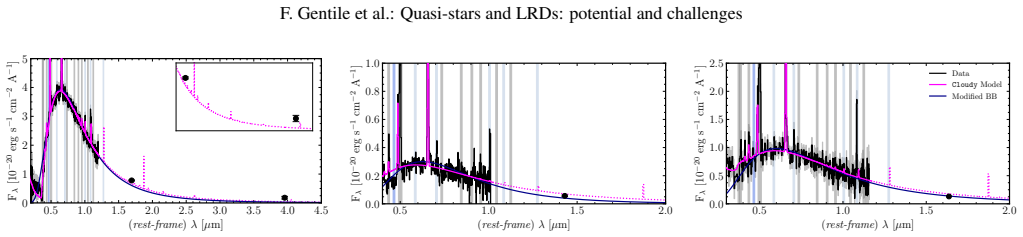
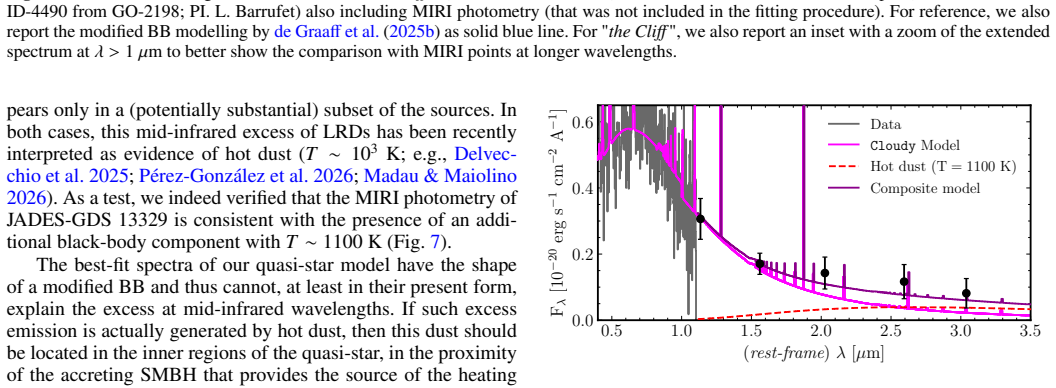
The quasi-star model consists of an accreting SMBH (M_BH ~10^{5-6} M_⊙) surrounded by a convective layer producing a black-body spectrum with T~5000 K and L~10^{44.4} erg s^{-1}, which is reprocessed by a concentric thick (ΔR~1000 AU) shell of dense (n_H~10^{11} cm^{-3}) gas partially ionised by thermal collisions and further reprocessed by a diffuse clumpy medium; once coupled with UV emission from a host galaxy this configuration reproduces the UV-to-NIR continuum shape including the Balmer break as well as the luminosity of the hydrogen emission lines, although it does not natively account for the presence of broad helium lines and the possible presence of hot dust.
What carries the argument
Quasi-star: accreting low-mass black hole whose blackbody emission is reprocessed by a thick dense partially ionized gas shell and outer clumpy medium.
If this is right
- Some LRDs can be modeled as quasi-stars.
- The model reproduces the UV-to-NIR continuum and hydrogen line luminosities when host galaxy UV is included.
- Broad helium lines and hot dust require additional components.
- Significant degeneracy exists among different LRD models.
- The degeneracy affects understanding of black hole growth mechanisms in the early Universe.
Where Pith is reading between the lines
- If a substantial fraction of LRDs are quasi-stars, this would favor a particular channel for rapid early black hole assembly.
- Multi-wavelength data targeting helium lines or mid-infrared dust emission could distinguish quasi-star models from other AGN or star-formation interpretations.
- The narrow range of required physical parameters implies that statistical samples from future surveys could test how common such conditions are at high redshift.
Load-bearing premise
The black hole mass, blackbody temperature, luminosity, gas density, shell thickness, and clumpy medium properties must be tuned to specific values to match the observed spectra.
What would settle it
Detection of strong broad helium lines or significant hot dust emission in LRDs that cannot be reproduced without adding separate components to the quasi-star model.
Figures

read the original abstract
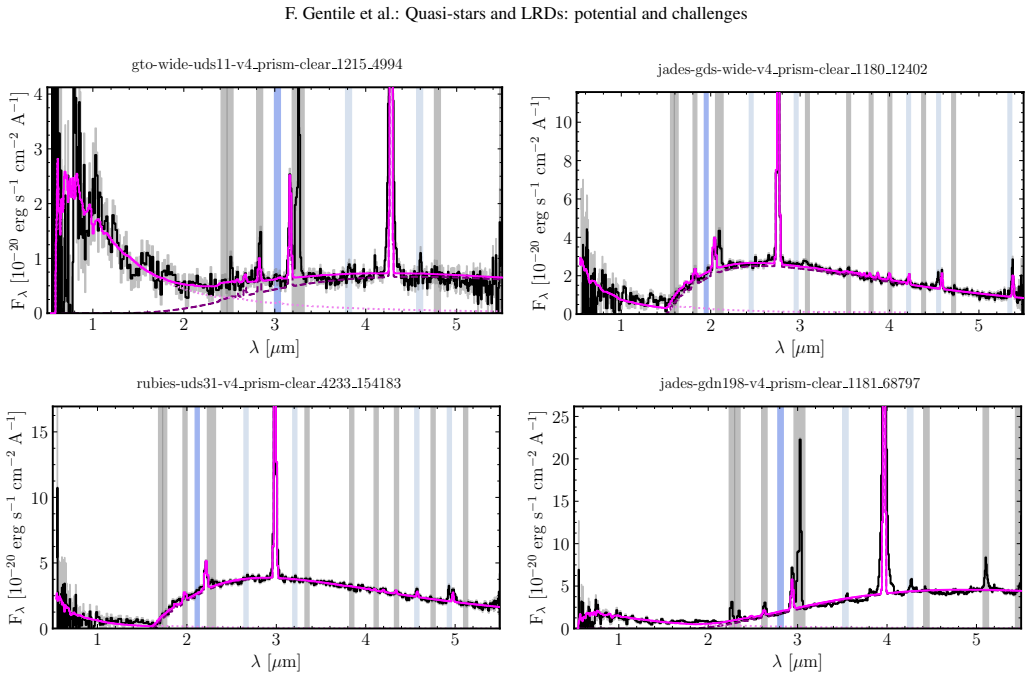
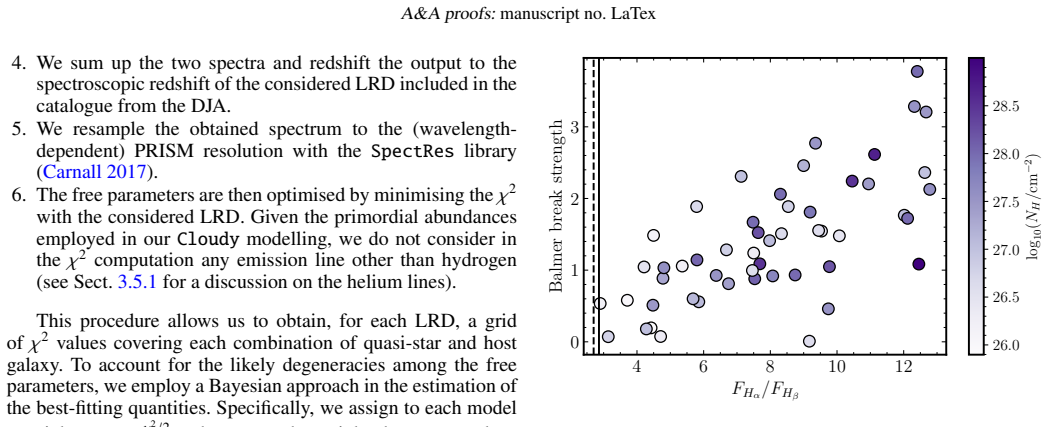
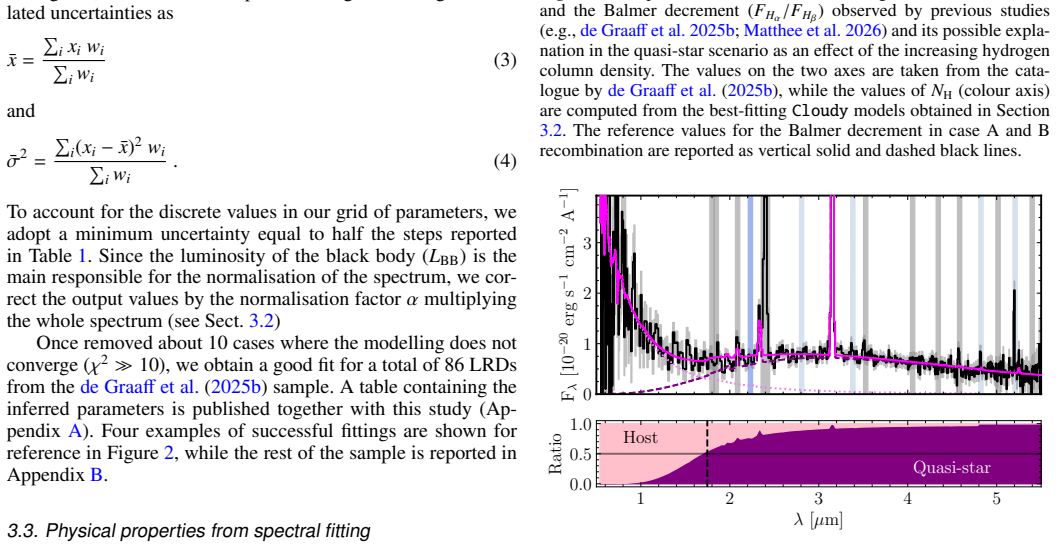
(Abridged) Little Red Dots (LRDs) are a class of sources discovered by JWST observationally defined by a "V-shaped" rest-frame UV-Optical SED, a compact or unresolved morphology, and for having, frequently, broad hydrogen emission lines. Among various models, those involving a quasi-star interpret LRDs as an intermediate stage in the evolution of a super-massive black hole (SMBH) seed into a classic AGN. In this paper, we employ the radiative-transfer code \texttt{Cloudy} to study whether this model is able to reproduce the spectral features commonly observed in LRDs. The model consists of an accreting SMBH ($M_{\rm BH}\sim10^{5-6} \ M_\odot$) surrounded by a convective layer where a black-body (BB) spectrum with $T\sim5000 \ {\rm K}$ and $L\sim10^{44.4} \ {\rm erg \ s}^{-1}$ is produced. This BB is then reprocessed by a concentric thick ($\Delta R\sim1000 \ {\rm AU}$) shell of dense ($n_{\rm H}\sim10^{11} \ {\rm cm}^{-3}$) gas partially ionised by thermal collisions. The emerging radiation is further reprocessed by a diffuse clumpy medium surrounding the quasi-star. We fit this model to JWST/NIRSpec spectra of LRDs from the literature, deriving the main physical parameters and the SMBH masses. Once coupled with the UV emission from a host galaxy, this model is able to reproduce the shape of the UV-to-NIR continuum, including the presence of a Balmer break, as well as the luminosity of the hydrogen emission lines. However, this quasi-star model does not natively account for the presence of broad helium lines and for the possible presence of hot dust, needing additional components to match these observables. Our main result is to show how some LRDs can be modeled as quasi-stars, highlighting that a significant degeneracy exists among different LRD models. This has important consequences for our understanding of the mechanisms driving black hole growth in the early Universe.
Editorial analysis
A structured set of objections, weighed in public.
Referee Report
Summary. The paper models Little Red Dots (LRDs) as quasi-stars: an accreting SMBH (M_BH ~10^5-6 M_⊙) surrounded by a convective layer emitting a ~5000 K blackbody (L ~10^44.4 erg s^-1), reprocessed by a thick (ΔR ~1000 AU), dense (n_H ~10^11 cm^-3) partially ionized shell and a surrounding clumpy medium. Using Cloudy, the authors fit this setup to JWST/NIRSpec spectra of LRDs, add host-galaxy UV light, and report that the model reproduces the UV-to-NIR continuum shape (including Balmer break) and hydrogen-line luminosities. It does not reproduce broad He lines or hot dust without extra components. The conclusion is that some LRDs can be explained as quasi-stars and that significant degeneracy exists among LRD models.
Significance. If the reproduction holds after addressing parameter provenance, the work usefully demonstrates that a quasi-star reprocessing shell plus host UV can match selected LRD observables, thereby illustrating model degeneracy relevant to early SMBH growth. The explicit use of Cloudy and the listing of fitted parameters provide a concrete, reproducible starting point for future comparisons, though the current implementation does not yet deliver parameter-free predictions from quasi-star structure equations.
major comments (2)
- [Abstract / model description] Abstract and model-description paragraph: the reproduction of the UV-NIR continuum, Balmer break, and H-line luminosities is achieved only after choosing/fitting the five parameters M_BH, T_BB, L_BB, n_H, and ΔR (plus clumpy-medium properties) to the observed spectra. No derivation of these values from quasi-star envelope structure, accretion rate, or convective-layer equations is provided; the agreement is therefore partly by construction rather than an independent test of the quasi-star scenario.
- [Abstract] Abstract: the statement that the model 'derives the main physical parameters and the SMBH masses' requires clarification on how the fitted values are distinguished from the input choices, and whether any posterior uncertainties or degeneracy analysis (e.g., between shell density and host-galaxy contribution) are reported.
minor comments (2)
- [Abstract] The abstract states that the model 'does not natively account for' He lines and hot dust; a brief quantitative statement on the magnitude of the mismatch (e.g., line ratios or 3-5 μm excess) would help readers assess how severe the additional components must be.
- [Model description] Notation: the symbols M_BH, T, L, n_H, and ΔR are introduced without an explicit table or equation defining their adopted ranges and priors; adding such a summary would improve clarity.
Simulated Author's Rebuttal
We thank the referee for their constructive comments, which help clarify the scope and presentation of our modeling. We address each major comment below and indicate the revisions we will make.
read point-by-point responses
-
Referee: [Abstract / model description] Abstract and model-description paragraph: the reproduction of the UV-NIR continuum, Balmer break, and H-line luminosities is achieved only after choosing/fitting the five parameters M_BH, T_BB, L_BB, n_H, and ΔR (plus clumpy-medium properties) to the observed spectra. No derivation of these values from quasi-star envelope structure, accretion rate, or convective-layer equations is provided; the agreement is therefore partly by construction rather than an independent test of the quasi-star scenario.
Authors: We agree that the listed parameters are fitted to the spectra within ranges motivated by quasi-star expectations rather than computed from the full set of envelope structure or accretion equations. The present work tests the viability of the reprocessing configuration using Cloudy, not a parameter-free prediction. We will revise the abstract and model-description sections to state explicitly that the parameters are obtained by fitting and that the exercise demonstrates the potential of the quasi-star picture while underscoring remaining degeneracies with other models. revision: yes
-
Referee: [Abstract] Abstract: the statement that the model 'derives the main physical parameters and the SMBH masses' requires clarification on how the fitted values are distinguished from the input choices, and whether any posterior uncertainties or degeneracy analysis (e.g., between shell density and host-galaxy contribution) are reported.
Authors: The phrasing 'deriving' was intended to indicate that best-fit values for the physical quantities are obtained from the spectral fits. We will replace it with 'constraining via spectral fitting' to remove ambiguity. The manuscript already notes the necessity of an additional host-galaxy UV component and discusses parameter choices, but we will add a short paragraph on the main degeneracies (including between shell density and host contribution) and the absence of formal posterior uncertainties in this exploratory study. revision: yes
Circularity Check
Reproduction of LRD spectra achieved by fitting 5+ free parameters (M_BH, T, L, n_H, ΔR) rather than deriving them from quasi-star structure
specific steps
-
fitted input called prediction
[Abstract]
"We fit this model to JWST/NIRSpec spectra of LRDs from the literature, deriving the main physical parameters and the SMBH masses. Once coupled with the UV emission from a host galaxy, this model is able to reproduce the shape of the UV-to-NIR continuum, including the presence of a Balmer break, as well as the luminosity of the hydrogen emission lines."
The five quantities (M_BH, T, L, n_H, ΔR) plus clumpy-medium properties are supplied as inputs to Cloudy and varied to match the target spectra; the claimed reproduction of continuum shape, Balmer break, and line luminosities is therefore the direct output of that fitting step rather than a quantity computed from quasi-star equations.
full rationale
The paper's central result is that the quasi-star model reproduces the UV-to-NIR continuum shape, Balmer break, and H-line luminosities. This is shown by running Cloudy with parameters chosen to match JWST spectra and adding a host-galaxy UV component. Because the listed values are inputs that are adjusted during the fit, the reported agreement reduces to the fitting procedure itself. No equations derive the parameter values from envelope structure, accretion rate, or convection; the exercise therefore demonstrates feasibility of a tuned reprocessor rather than an independent prediction. No self-citation chains or other enumerated circularity patterns appear in the abstract or model description.
Axiom & Free-Parameter Ledger
free parameters (5)
- Black hole mass
- Blackbody temperature
- Blackbody luminosity
- Gas density
- Shell thickness
axioms (2)
- domain assumption Radiative transfer through partially ionized dense gas can be accurately modeled by Cloudy under the assumed geometry and ionization sources.
- ad hoc to paper The quasi-star consists of an accreting SMBH surrounded by a convective layer and a thick partially ionized shell.
invented entities (1)
-
Quasi-star structure (convective layer + dense shell + clumpy medium)
no independent evidence
Forward citations
Cited by 2 Pith papers
-
Little Red Dots as Intermediate Mass, Super-Eddington Engines: Insights from Type IIn Supernovae and The 1837-1856 Great Eruption of $\eta$ Carinae
LRDs are reinterpreted as intermediate-mass super-Eddington systems with wind-driven pseudo-photospheres that explain their spectra and imply engine masses below 10^5 solar masses rather than overmassive black holes.
-
JWST Reveals Compact Nuclear Starbursts Masquerading as AGNs in Metal-Poor Dwarfs: Where Are the Accreting Intermediate-Mass Black Holes?
Compact nuclear starbursts in metal-poor dwarfs produce AGN-like mid-IR colors without accretion, as revealed by JWST observations of two such galaxies.
Reference graph
Works this paper leans on
-
[1]
Adams, W. M. & Petrosian, V . 1974, ApJ, 192, 199
1974
-
[2]
2024, ApJ, 976, 224
Alberts, S., Lyu, J., Shivaei, I., et al. 2024, ApJ, 976, 224
2024
-
[3]
& Netzer, H
Almog, Y . & Netzer, H. 1989, MNRAS, 238, 57
1989
-
[4]
T., Bogdán, Á., Kovács, O
Ananna, T. T., Bogdán, Á., Kovács, O. E., Natarajan, P., & Hickox, R. C. 2024, ApJ, 969, L18
2024
-
[5]
Baggen, J. F. W., Scoggins, M. T., van Dokkum, P., et al. 2026, arXiv e-prints, arXiv:2602.02702
Pith/arXiv arXiv 2026
-
[6]
Baggen, J. F. W., van Dokkum, P., Brammer, G., et al. 2024, ApJ, 977, L13
2024
-
[7]
Barro, G., Perez-Gonzalez, P. G., Kocevski, D., et al. 2025, arXiv e-prints, arXiv:2512.15853
arXiv 2025
-
[8]
G., Kocevski, D
Barro, G., Pérez-González, P. G., Kocevski, D. D., et al. 2026, ApJ, 997, 48
2026
-
[9]
1987, ApJ, 320, 537
Barvainis, R. 1987, ApJ, 320, 537
1987
-
[10]
Begelman, M. C. & Dexter, J. 2026, ApJ, 996, 48
2026
-
[11]
C., Rossi, E
Begelman, M. C., Rossi, E. M., & Armitage, P. J. 2008, MNRAS, 387, 1649
2008
-
[12]
E., et al
Bezanson, R., Labbe, I., Whitaker, K. E., et al. 2024, ApJ, 974, 92
2024
-
[13]
2026, arXiv e-prints, arXiv:2604.11677
Billand, J.-B., Elbaz, D., Franco, M., et al. 2026, arXiv e-prints, arXiv:2604.11677
Pith/arXiv arXiv 2026
-
[14]
2025, arXiv e-prints, arXiv:2507.04011
Billand, J.-B., Elbaz, D., Gentile, F., et al. 2025, arXiv e-prints, arXiv:2507.04011
arXiv 2025
-
[15]
2023, msaexp: NIRSpec analyis tools
Brammer, G. 2023, msaexp: NIRSpec analyis tools
2023
-
[16]
C., et al
Calzetti, D., Armus, L., Bohlin, R. C., et al. 2000, ApJ, 533, 682
2000
-
[17]
Carnall, A. C. 2017, arXiv e-prints, arXiv:1705.05165
Pith/arXiv arXiv 2017
-
[18]
M., Akins, H
Casey, C. M., Akins, H. B., Kokorev, V ., et al. 2024, ApJ, 975, L4
2024
-
[19]
2003, PASP, 115, 763
Chabrier, G. 2003, PASP, 115, 763
2003
-
[20]
2025, arXiv e-prints, arXiv:2508.08768
Chang, S.-J., Gronke, M., Matthee, J., & Mason, C. 2025, arXiv e-prints, arXiv:2508.08768
arXiv 2025
-
[21]
Chisholm, J., Berg, D. A., Boylan-Kolchin, M., et al. 2026, arXiv e-prints, arXiv:2602.15935
arXiv 2026
-
[22]
Cloonan, A. P., Whitaker, K. E., Manning, S. M., et al. 2026, arXiv e-prints, arXiv:2603.24700
arXiv 2026
-
[23]
& Gunn, J
Conroy, C. & Gunn, J. E. 2010, ApJ, 712, 833
2010
-
[24]
E., & White, M
Conroy, C., Gunn, J. E., & White, M. 2009, ApJ, 699, 486
2009
-
[25]
Coughlin, E. R. & Begelman, M. C. 2024, ApJ, 970, 158
2024
-
[26]
Dayal, P. & Maiolino, R. 2026, A&A, 706, A72 de Graaff, A., Brammer, G., Weibel, A., et al. 2025a, A&A, 697, A189 de Graaff, A., Hviding, R. E., Naidu, R. P., et al. 2025b, arXiv e-prints, arXiv:2511.21820 de Graaff, A., Rix, H.-W., Naidu, R. P., et al. 2025c, A&A, 701, A168
arXiv 2026
-
[27]
2025, A&A, 704, A313 D’Eugenio, F., Nelson, E., Ji, X., et al
Delvecchio, I., Daddi, E., Magnelli, B., et al. 2025, A&A, 704, A313 D’Eugenio, F., Nelson, E., Ji, X., et al. 2025, arXiv e-prints, arXiv:2510.00101
arXiv 2025
-
[28]
J., Willott, C., Alberts, S., et al
Eisenstein, D. J., Willott, C., Alberts, S., et al. 2026, ApJS, 283, 6 Euclid Collaboration: Bisigello, L., Rodighiero, G., Fotopoulou, S., et al. 2025, arXiv e-prints, arXiv:2503.15323
arXiv 2026
-
[29]
J., Korista, K
Ferland, G. J., Korista, K. T., Verner, D. A., et al. 1998, PASP, 110, 761
1998
-
[30]
L., Bagley, M
Finkelstein, S. L., Bagley, M. B., Arrabal Haro, P., et al. 2025, ApJ, 983, L4
2025
-
[31]
H., Culhane, J
Gabriel, A. H., Culhane, J. L., Patchett, B. E., et al. 1995, Advances in Space Research, 15, 63
1995
-
[32]
2026, A&A, 706, A364
Gandolfi, G., Rodighiero, G., Castellano, M., et al. 2026, A&A, 706, A364
2026
-
[33]
Greene, J. E. & Ho, L. C. 2005, ApJ, 630, 122
2005
-
[34]
E., Labbe, I., Goulding, A
Greene, J. E., Labbe, I., Goulding, A. D., et al. 2024, ApJ, 964, 39
2024
-
[35]
E., Setton, D
Greene, J. E., Setton, D. J., Furtak, L. J., et al. 2026, ApJ, 996, 129
2026
-
[36]
Gunasekera, C. M., van Hoof, P. A. M., Dehghanian, M., et al. 2025, arXiv e- prints, arXiv:2508.01102
arXiv 2025
-
[37]
E., Brammer, G
Heintz, K. E., Brammer, G. B., Watson, D., et al. 2025, A&A, 693, A60
2025
-
[38]
E., de Graaff, A., Miller, T
Hviding, R. E., de Graaff, A., Miller, T. B., et al. 2025, A&A, 702, A57
2025
-
[39]
R., D’Eugenio, F., Maiolino, R., et al
Ivey, L. R., D’Eugenio, F., Maiolino, R., et al. 2026, arXiv e-prints, arXiv:2604.09177
Pith/arXiv arXiv 2026
-
[40]
2025, MNRAS, 544, 3900
Ji, X., Maiolino, R., Übler, H., et al. 2025, MNRAS, 544, 3900
2025
-
[41]
2026, arXiv e-prints, arXiv:2604.03370
Ji, X., Pezzulli, G., D’Eugenio, F., et al. 2026, arXiv e-prints, arXiv:2604.03370
Pith/arXiv arXiv 2026
-
[42]
Jones, B. L., Kocevski, D. D., Pacucci, F., et al. 2025, arXiv e-prints, arXiv:2510.07376
arXiv 2025
-
[43]
Kido, D., Ioka, K., Hotokezaka, K., Inayoshi, K., & Irwin, C. M. 2025, MNRAS, 544, 3407
2025
-
[44]
D., Finkelstein, S
Kocevski, D. D., Finkelstein, S. L., Barro, G., et al. 2025, ApJ, 986, 126
2025
-
[45]
D., Onoue, M., Inayoshi, K., et al
Kocevski, D. D., Onoue, M., Inayoshi, K., et al. 2023, ApJ, 954, L4
2023
-
[46]
& Harikane, Y
Kokubo, M. & Harikane, Y . 2025, ApJ, 995, 24
2025
- [47]
-
[48]
E., Bezanson, R., et al
Labbe, I., Greene, J. E., Bezanson, R., et al. 2025, ApJ, 978, 92 Labbé, I., van Dokkum, P., Nelson, E., et al. 2023, Nature, 616, 266
2025
-
[49]
2024, arXiv e-prints, arXiv:2409.13047
Lambrides, E., Garofali, K., Larson, R., et al. 2024, arXiv e-prints, arXiv:2409.13047
Pith/arXiv arXiv 2024
-
[50]
2026a, arXiv e-prints, arXiv:2605.21574
Lin, X., Fan, X., Cai, Z., et al. 2026a, arXiv e-prints, arXiv:2605.21574
-
[51]
2026a, arXiv e-prints, arXiv:2603.02317
Liu, H., Jiang, Y .-F., Quataert, E., et al. 2026a, arXiv e-prints, arXiv:2603.02317
-
[52]
Liu, Z., Naidu, R. P., Secunda, A., et al. 2026b, arXiv e-prints, arXiv:2604.13000
-
[53]
2026, arXiv e-prints, arXiv:2601.15962
Ma, Z., Egami, E., Zhu, Y ., et al. 2026, arXiv e-prints, arXiv:2601.15962
arXiv 2026
- [54]
-
[55]
2025, MNRAS, 538, 1921
Maiolino, R., Risaliti, G., Signorini, M., et al. 2025, MNRAS, 538, 1921
2025
-
[56]
P., Brammer, G., et al
Matthee, J., Naidu, R. P., Brammer, G., et al. 2024, ApJ, 963, 129
2024
-
[57]
P., Kotiwale, G., et al
Matthee, J., Naidu, R. P., Kotiwale, G., et al. 2025, ApJ, 988, 246
2025
-
[58]
2026, arXiv e-prints, arXiv:2603.17667
Matthee, J., Torralba, A., Pezzulli, G., et al. 2026, arXiv e-prints, arXiv:2603.17667
arXiv 2026
-
[59]
D., Antonucci, E., Newmark, J., et al
Moses, J. D., Antonucci, E., Newmark, J., et al. 2020, Nature Astronomy, 4, 1134
2020
-
[60]
P., Matthee, J., Katz, H., et al
Naidu, R. P., Matthee, J., Katz, H., et al. 2025, arXiv e-prints, arXiv:2503.16596
Pith/arXiv arXiv 2025
-
[61]
Osterbrock, D. E. 1989, Astrophysics of gaseous nebulae and active galactic nu- clei
1989
-
[62]
Osterbrock, D. E. & Ferland, G. J. 2006, Astrophysics of gaseous nebulae and active galactic nuclei
2006
-
[63]
Pacucci, F., Ferrara, A., & Kocevski, D. D. 2026, arXiv e-prints, arXiv:2601.14368
arXiv 2026
-
[64]
2023, ApJ, 957, L3
Pacucci, F., Nguyen, B., Carniani, S., Maiolino, R., & Fan, X. 2023, ApJ, 957, L3
2023
-
[65]
2026, arXiv e-prints, arXiv:2605.14233 Pérez-González, P
Park, K., Torralba, A., Matthee, J., et al. 2026, arXiv e-prints, arXiv:2605.14233 Pérez-González, P. G., Barro, G., Carniani, S., et al. 2026, arXiv e-prints, arXiv:2602.20247 Pérez-González, P. G., Barro, G., Rieke, G. H., et al. 2024, ApJ, 968, 4 Pérez-González, P. G., Östlin, G., Costantin, L., et al. 2025, ApJ, 991, 179
Pith/arXiv arXiv 2026
-
[66]
F., Schaye, J., et al
Pizzati, E., Hennawi, J. F., Schaye, J., et al. 2025, MNRAS, 539, 2910 Planck Collaboration: Aghanim, N., Akrami, Y ., Ashdown, M., et al. 2020, A&A, 641, A6
2025
-
[67]
Reines, A. E. & V olonteri, M. 2015, ApJ, 813, 82
2015
-
[68]
H., Alberts, S., Shivaei, I., et al
Rieke, G. H., Alberts, S., Shivaei, I., et al. 2024, ApJ, 975, 83
2024
-
[69]
Riffel, R., Rodríguez-Ardila, A., & Pastoriza, M. G. 2006, A&A, 457, 61
2006
-
[70]
H., et al
Rinaldi, P., Bonaventura, N., Rieke, G. H., et al. 2025, ApJ, 992, 71
2025
-
[71]
2026, ApJ, 1003, 234
Ronayne, K., Papovich, C., Kirkpatrick, A., et al. 2026, ApJ, 1003, 234
2026
- [72]
-
[73]
Sun, W. Q., Naidu, R. P., Matthee, J., et al. 2026, arXiv e-prints, arXiv:2601.20929
Pith/arXiv arXiv 2026
-
[74]
Takasao, S. & Inayoshi, K. 2026, arXiv e-prints, arXiv:2605.21589
Pith/arXiv arXiv 2026
-
[75]
J., Kokorev, V ., Kocevski, D
Taylor, A. J., Kokorev, V ., Kocevski, D. D., et al. 2025, ApJ, 989, L7
2025
-
[76]
2026, arXiv e-prints, arXiv:2603.28335
Torralba, A., Matthee, J., Weibel, A., et al. 2026, arXiv e-prints, arXiv:2603.28335
Pith/arXiv arXiv 2026
-
[77]
2025, Nature Communications, 16, 9830
Tripodi, R., Martis, N., Markov, V ., et al. 2025, Nature Communications, 16, 9830
2025
-
[78]
2026, ApJ, 999, 183
Umeda, H., Inayoshi, K., Harikane, Y ., & Murase, K. 2026, ApJ, 999, 183
2026
-
[79]
C., Alberts, S., Ji, Z., et al
Williams, C. C., Alberts, S., Ji, Z., et al. 2024, ApJ, 968, 34
2024
-
[80]
A., Bing, L., et al
Xiao, M., Oesch, P. A., Bing, L., et al. 2025, A&A, 700, A231
2025
discussion (0)
Sign in with ORCID, Apple, or X to comment. Anyone can read and Pith papers without signing in.