The First Upper Bound on the Non-Stationary Gravitational Wave Background and its Implication on the High Redshift Binary Black Hole Merger Rate
Pith reviewed 2026-05-21 20:32 UTC · model grok-4.3
The pith
Analysis of LIGO-Virgo-KAGRA data yields the first upper bound on the non-stationary stochastic gravitational wave background and limits high-redshift primordial black hole merger rates.
A machine-rendered reading of the paper's core claim, the machinery that carries it, and where it could break.
Core claim
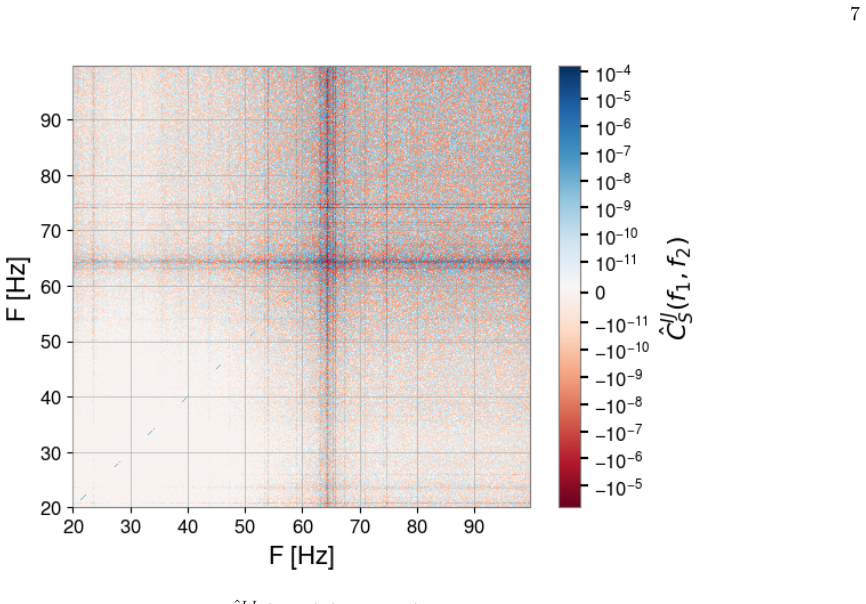
Our analysis indicates that the current spectral correlation is consistent with non-stationary noise, yielding no detection and providing only upper bounds over the frequency range of 20 Hz to 100 Hz. This upper bound on the spectral correlation translates into a mass-distribution-dependent upper bound on the merger rate of PBHs. This provides a stringent upper bound on the PBH merger rate at high redshift and hence puts constraints on the PBH formation scenarios.
What carries the argument
The spectral correlation of the stochastic gravitational wave background, which is non-zero due to the sporadic and non-Gaussian nature of high-redshift binary black hole mergers and depends on their merger rate and mass distribution.
If this is right
- This provides a stringent upper bound on the PBH merger rate at high redshift.
- It puts constraints on the PBH formation scenarios.
- In the future, detection of this signal will provide a new avenue to probe the high-redshift black hole population using gravitational waves.
Where Pith is reading between the lines
- Future detectors with higher sensitivity could convert these upper bounds into measurements of the merger rate.
- This approach offers an independent gravitational-wave check on high-redshift rates that can be compared with electromagnetic observations.
- Combining the method with traditional power-spectrum analyses may improve the ability to separate primordial from astrophysical black hole populations.
Load-bearing premise
The established relation between the spectral correlation and the high-redshift merger rate and mass distribution of compact objects holds without significant contamination from other non-stationary sources or modeling inaccuracies in the data.
What would settle it
A future measurement showing spectral correlation above the reported upper bounds in the 20-100 Hz range with more data or independent analysis would indicate either a detection or unaccounted contamination, directly testing the no-detection result and the derived merger-rate limits.
Figures




read the original abstract
The high redshift merger rate and mass distribution of black hole binaries provide a direct probe to distinguish astrophysical black holes (ABHs) and primordial black holes (PBHs), which can be studied using the Stochastic Gravitational-Wave Background (SGWB). The conventional analyses solely based on the power spectrum are limited in constraining the properties of the underlying source population under the assumption of a non-sporadic Gaussian distribution. However, recent studies have shown that SGWB is expected to be sporadic and non-Gaussian in nature, which gives rise to non-zero \textit{spectral correlation} that depends on the high redshift merger rate and mass distribution of the compact objects. In this work, we present the first spectral covariance analysis of the SGWB using data from the LIGO--Virgo--KAGRA collaboration during the third and the first part of the fourth observing runs. Our analysis indicates that the current spectral correlation is consistent with non-stationary noise, yielding no detection and providing only upper bounds over the frequency range of 20 Hz to 100 Hz. This upper bound on the spectral correlation translates into a mass-distribution-dependent upper bound on the merger rate of PBHs. This provides a stringent upper bound on the PBH merger rate at high redshift and hence puts constraints on the PBH formation scenarios. In the future, detection of this signal will provide a new avenue to probe the high-redshift black hole population using gravitational waves.
Editorial analysis
A structured set of objections, weighed in public.
Referee Report
Summary. The manuscript reports the first spectral covariance analysis of the stochastic gravitational wave background (SGWB) using LIGO-Virgo-KAGRA data from the third observing run and the initial segment of the fourth. It concludes that the measured spectral correlation in the 20-100 Hz band is consistent with non-stationary noise, yielding no detection but frequency-dependent upper bounds. These bounds are mapped, under an assumed mass distribution, to an upper limit on the high-redshift primordial black hole (PBH) binary merger rate, thereby constraining PBH formation scenarios.
Significance. If the quantitative results hold, the work is significant as the first application of spectral correlation methods to place observational limits on the non-stationary SGWB component. This approach is sensitive to the sporadic, non-Gaussian character of high-redshift mergers and therefore offers a complementary probe to power-spectrum analyses for distinguishing primordial from astrophysical black hole populations. The derived mass-distribution-dependent rate bound provides a new constraint on high-redshift PBH models that is difficult to obtain by other means.
major comments (2)
- The central claim that the observed spectral correlation is consistent with non-stationary noise (and therefore supplies only upper bounds) rests on the data-analysis pipeline. The manuscript should provide the explicit test statistic, its null distribution, and the numerical significance level (e.g., p-value or equivalent) used to establish consistency with noise; without these, the strength of the 'no detection' statement cannot be independently verified.
- The translation from the measured spectral-correlation upper bound to the PBH merger-rate limit (performed in the implications section) inherits modeling assumptions from earlier theoretical works on non-Gaussian SGWB. A quantitative assessment of how the derived rate bound changes under plausible variations in the mass function or under modest additional non-stationary contamination in the 20-100 Hz band is needed to confirm that the constraint on high-redshift PBH scenarios is robust.
minor comments (2)
- The abstract should specify the exact calendar interval or run label (e.g., O4a) covered by 'the first part of the fourth observing runs' for clarity.
- Figure captions and axis labels should explicitly state the frequency resolution and the precise definition of the spectral correlation estimator used.
Simulated Author's Rebuttal
We are grateful to the referee for their insightful comments, which have helped us improve the clarity and robustness of our analysis. We address each major comment in turn below, and have made revisions to the manuscript as indicated.
read point-by-point responses
-
Referee: The central claim that the observed spectral correlation is consistent with non-stationary noise (and therefore supplies only upper bounds) rests on the data-analysis pipeline. The manuscript should provide the explicit test statistic, its null distribution, and the numerical significance level (e.g., p-value or equivalent) used to establish consistency with noise; without these, the strength of the 'no detection' statement cannot be independently verified.
Authors: We agree that a more explicit description of the statistical procedure is warranted to allow independent verification. In the revised manuscript, we have expanded the description of the data-analysis pipeline in Section 3 to include the definition of the test statistic (the spectral covariance integrated over frequency bins), the derivation of its null distribution under the assumption of stationary Gaussian noise, and the numerical p-value obtained from the data, which confirms consistency with the noise model. These details are now provided to strengthen the no-detection claim. revision: yes
-
Referee: The translation from the measured spectral-correlation upper bound to the PBH merger-rate limit (performed in the implications section) inherits modeling assumptions from earlier theoretical works on non-Gaussian SGWB. A quantitative assessment of how the derived rate bound changes under plausible variations in the mass function or under modest additional non-stationary contamination in the 20-100 Hz band is needed to confirm that the constraint on high-redshift PBH scenarios is robust.
Authors: We thank the referee for this suggestion. To address the robustness, we have added a quantitative sensitivity analysis in the revised implications section. This includes varying the assumed mass distribution parameters within observationally motivated ranges and introducing a small additional non-stationary noise component. The results demonstrate that the upper bound on the high-redshift PBH merger rate changes by at most a factor of a few, preserving the overall constraint on PBH formation scenarios. We have included this assessment and an accompanying figure in the updated manuscript. revision: yes
Circularity Check
Data-driven upper bound on spectral correlation mapped via external prior relations without internal reduction
full rationale
The paper conducts a new spectral covariance analysis on LIGO-Virgo-KAGRA O3 and O4 data, finding the observed spectral correlation consistent with non-stationary noise and deriving an upper bound in the 20-100 Hz range. This observational bound is then translated to a mass-distribution-dependent upper limit on high-redshift PBH merger rate using relations established in prior studies on sporadic non-Gaussian SGWB. No step in the provided derivation chain reduces a claimed prediction or result to a fitted input or self-citation by the paper's own equations; the central output remains an independent data constraint rather than a quantity forced by construction or renamed ansatz.
Axiom & Free-Parameter Ledger
free parameters (1)
- PBH mass distribution
axioms (1)
- domain assumption SGWB from compact-object mergers at high redshift is sporadic and non-Gaussian, producing non-zero spectral correlation that depends on merger rate and mass distribution
Reference graph
Works this paper leans on
-
[1]
by including the non-stationary aspect of the sig- 10 20 40 60 80 100 120 Mc [M ] 103 104 Upper limit on (z = 1) [Gpc 3 yr 1] PBH ABH 40 60 80 100 120 140 M [M ] FIG. 8:Upper limits on the merger rate atz = 1as a function ofMµfor the ABH population andMc for the PBH population. These limits are based on the upper limit on the spectral covariance obtained ...
-
[2]
A. Buonanno, G. Sigl, G. G. Raffelt, H.-T. Janka, and E. Müller, Physical Review D72, 084001 (2005)
work page 2005
-
[3]
S. R. Chowdhury and M. Khlopov, Universe7, 381 (2021)
work page 2021
-
[4]
T. Damour and A. Vilenkin, Physical Review D—Particles, Fields, Gravitation, and Cosmology 71, 063510 (2005)
work page 2005
-
[5]
X. Siemens, V. Mandic, and J. Creighton, Physical Review Letters98, 111101 (2007)
work page 2007
- [6]
-
[7]
L. Tsukada, T. Callister, A. Matas, and P. Meyers, Phys- ical Review D99, 103015 (2019)
work page 2019
- [8]
- [9]
- [10]
- [11]
- [12]
- [13]
-
[14]
J. Lawrence, K. Turbang, A. Matas, A. I. Renzini, N. van Remortel, and J. Romano, Physical Review D107, 103026 (2023)
work page 2023
-
[15]
S. Mukherjee and J. Silk, Monthly Notices of the Royal Astronomical Society491, 4690 (2020)
work page 2020
-
[16]
M. R. Sah and S. Mukherjee, Monthly Notices of the Royal Astronomical Society527, 4100 (2024)
work page 2024
- [17]
- [18]
- [19]
-
[20]
Open data from the third observing run of LIGO, Virgo, KAGRA and GEO
R. Abbott, H. Abe, F. Acernese, K. Ackley, S. Adhicary, N. Adhikari, R. Adhikari, V. Adkins, V. Adya, C. Affeldt, et al., arXiv preprint arXiv:2302.03676 (2023)
work page internal anchor Pith review arXiv 2023
-
[21]
L. S. Collaboration, V. Collaboration, K. Collaboration, et al., arXiv preprint arXiv:2508.18079 (2025)
work page internal anchor Pith review Pith/arXiv arXiv 2025
- [22]
-
[23]
S. Mukherjee and J. Silk, Monthly Notices of the Royal Astronomical Society506, 3977 (2021)
work page 2021
-
[24]
A. Abac, I. Abouelfettouh, F. Acernese, K. Ackley, C. Adamcewicz, S. Adhicary, D. Adhikari, N. Ad- hikari, R. Adhikari, V. Adkins,et al., arXiv preprint arXiv:2508.18083 (2025)
work page internal anchor Pith review Pith/arXiv arXiv 2025
-
[25]
2014, ARA&A, 52, 415, doi: 10.1146/annurev-astro-081811-125615
P. Madau and M. Dickinson, arXiv preprint arXiv:1403.0007 (2014)
work page internal anchor Pith review Pith/arXiv arXiv 2014
- [26]
-
[27]
B. Carr, M. Raidal, T. Tenkanen, V. Vaskonen, and H. Veermäe, Physical Review D96, 023514 (2017)
work page 2017
- [28]
- [29]
- [30]
-
[31]
S. Clesse and J. Garcia-Bellido, Physics of the Dark Uni- verse38, 101111 (2022)
work page 2022
- [32]
-
[33]
A Practical Theorem on Gravitational Wave Backgrounds
E. Phinney, arXiv preprint astro-ph/0108028 (2001)
work page internal anchor Pith review Pith/arXiv arXiv 2001
-
[34]
Christensen, Reports on Progress in Physics82, 016903 (2018)
N. Christensen, Reports on Progress in Physics82, 016903 (2018)
work page 2018
-
[35]
I. Mandel and R. O’Shaughnessy, Classical and Quantum Gravity27, 114007 (2010)
work page 2010
- [36]
-
[37]
I. Dvorkin, J.-P. Uzan, E. Vangioni, and J. Silk, Monthly Notices of the Royal Astronomical Society479, 121 (2018)
work page 2018
-
[38]
S. Mukherjee and J. Silk, Phys. Rev. D104, 063518 (2021), arXiv:2008.01082 [astro-ph.HE]
-
[39]
Y. B. Ginat, V. Desjacques, R. Reischke, and H. B. Perets, Physical Review D102, 083501 (2020)
work page 2020
-
[40]
M. Braglia, J. Garcia-Bellido, and S. Kuroyanagi, Mon. Not. Roy. Astron. Soc.519, 6008 (2023), arXiv:2201.13414 [astro-ph.CO]
- [41]
-
[42]
J. D. Romano and N. J. Cornish, Living reviews in rela- tivity20, 1 (2017)
work page 2017
-
[43]
A. I. Renzini, B. Goncharov, A. C. Jenkins, and P. M. Meyers, Galaxies10, 34 (2022)
work page 2022
-
[44]
G. Vajente, Y. Huang, M. Isi, J. C. Driggers, J. S. Kissel, M. Szczepańczyk, and S. Vitale, Physical Review D101, 042003 (2020)
work page 2020
- [45]
- [46]
-
[47]
S. Mukherjee, M. S. P. Meinema, and J. Silk, Mon. Not. Roy. Astron. Soc.510, 6218 (2022), arXiv:2107.02181 [astro-ph.CO]
-
[48]
E. D. Hall, K. Kuns, J. R. Smith, Y. Bai, C. Wipf, S. Bis- cans, R. X. Adhikari, K. Arai, S. Ballmer, L. Barsotti, et al., Physical Review D103, 122004 (2021)
work page 2021
-
[49]
A Horizon Study for Cosmic Explorer: Science, Observatories, and Community
M. Evans, R. X. Adhikari, C. Afle, S. W. Ballmer, S. Bis- coveanu, S. Borhanian, D. A. Brown, Y. Chen, R. Eisen- stein, A. Gruson,et al., arXiv preprint arXiv:2109.09882 (2021)
work page internal anchor Pith review Pith/arXiv arXiv 2021
-
[50]
M. Punturo, M. Abernathy, F. Acernese, B. Allen, N. An- dersson, K. Arun, F. Barone, B. Barr, M. Barsuglia, M. Beker,et al., Classical and Quantum Gravity27, 194002 (2010)
work page 2010
-
[51]
M. Maggiore, C. Van Den Broeck, N. Bartolo, E. Bel- gacem, D. Bertacca, M. A. Bizouard, M. Branchesi, S. Clesse, S. Foffa, J. García-Bellido,et al., Journal of Cosmology and Astroparticle Physics2020(03), 050
-
[52]
S. Van Der Walt, S. C. Colbert, and G. Varoquaux, Com- puting in science & engineering13, 22 (2011)
work page 2011
-
[53]
C. R. Harris, K. J. Millman, S. J. van der Walt, R. Gom- mers, P. Virtanen, D. Cournapeau, E. Wieser, J. Taylor, S. Berg, N. J. Smith, R. Kern, M. Picus, S. Hoyer, M. H. van Kerkwijk, M. Brett, A. Haldane, J. Fernández del Río, M. Wiebe, P. Peterson, P. Gérard-Marchant, K. Sheppard, T. Reddy, W. Weckesser, H. Abbasi, C. Gohlke, and T. E. Oliphant, Nature5...
work page 2020
- [54]
-
[55]
P. Virtanen, R. Gommers, T. E. Oliphant, M. Haber- land, T. Reddy, D. Cournapeau, E. Burovski, P. Peterson, W. Weckesser, J. Bright,et al., Nature methods17, 261 (2020)
work page 2020
-
[56]
J. D. Hunter, Computing in science & engineering9, 90 (2007)
work page 2007
-
[57]
T. P. Robitaille, E. J. Tollerud, P. Greenfield, M. Droett- boom, E. Bray, T. Aldcroft, M. Davis, A. Ginsburg, A. M. Price-Whelan, W. E. Kerzendorf,et al., Astronomy & Astrophysics558, A33 (2013)
work page 2013
-
[58]
A. M. Price-Whelan, B. Sipőcz, H. Günther, P. Lim, S. Crawford, S. Conseil, D. Shupe, M. Craig, N. Dencheva, A. Ginsburg,et al., The Astronomical Journal156, 123 (2018)
work page 2018
- [59]
-
[60]
D. M. Macleod, J. S. Areeda, S. B. Coughlin, T. J. Massinger, and A. L. Urban, SoftwareX13, 100657 (2021)
work page 2021
-
[61]
McKinneyet al., Python for high performance and scientific computing14, 1 (2011)
W. McKinneyet al., Python for high performance and scientific computing14, 1 (2011). Appendix A: Derivation of spectral covariance noise The Stochastic gravitational wave background (SGWB) is defined as gravitational wave (GW) energy density per unit logarithmic frequency interval, normalized by the 13 critical energy density of the Universe. Mathematical...
work page 2011
discussion (0)
Sign in with ORCID, Apple, or X to comment. Anyone can read and Pith papers without signing in.