Tensor Computation of Euler Characteristic Functions and Transforms
Pith reviewed 2026-05-18 00:33 UTC · model grok-4.3
The pith
A tensor-based framework computes the weighted Euler characteristic transform and Euler characteristic function on GPUs for simplicial and cubical complexes of arbitrary dimension.
A machine-rendered reading of the paper's core claim, the machinery that carries it, and where it could break.
Core claim
The authors present a tensor-based framework for computing the WECT and ECF that is optimized for GPU architectures and maintains full generality across simplicial and cubical complexes of arbitrary dimension.
What carries the argument
Tensor encoding of the filtration followed by matrix operations that extract the topological descriptors.
If this is right
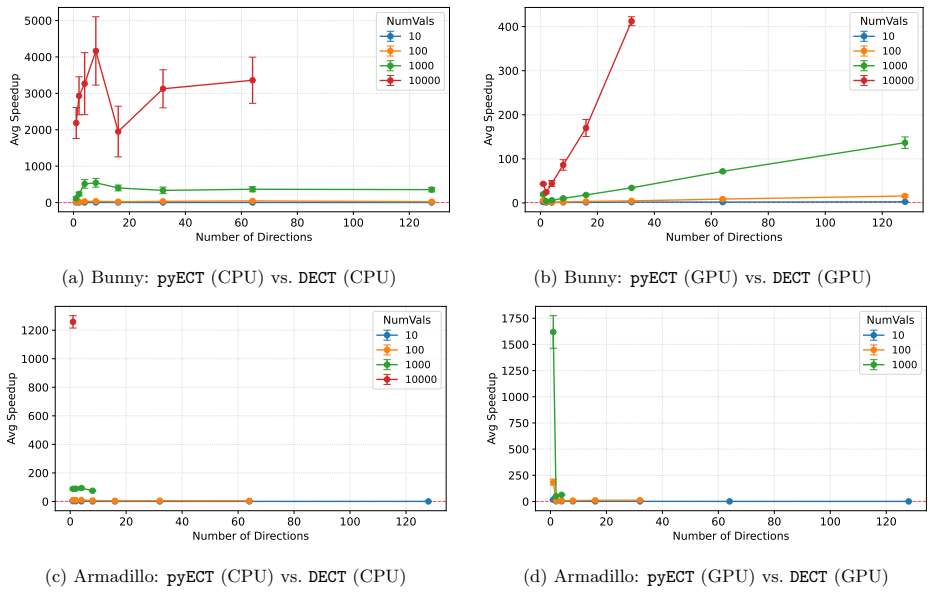
- Measured speedups appear over prior methods when computing the WECT and ECF on two- and three-dimensional data.
- The same code handles both simplicial and cubical complexes without separate implementations.
- Computation extends to arbitrary dimension without loss of generality.
- The full method is distributed as the pyECT package for direct use.
Where Pith is reading between the lines
- The uniform GPU approach could support topological feature extraction inside large-scale machine-learning pipelines that process high-dimensional point clouds.
- Similar tensor encodings might be adapted to compute other persistent-homology summaries on the same hardware.
- Domains that already use Euler descriptors, such as shape analysis, could now process denser or higher-dimensional inputs in practical time.
Load-bearing premise
The tensor encoding of the filtration and the subsequent matrix operations preserve the exact topological invariants without introducing numerical instability or requiring dimension-specific adjustments that would break generality.
What would settle it
Apply the tensor method to a small known simplicial complex whose Euler characteristic is independently verified by hand and check whether the output matches exactly in both low and high dimensions.
Figures



read the original abstract
The weighted Euler characteristic transform (WECT) and Euler characteristic function (ECF) have proven to be useful tools in a variety of applications. However, current methods for computing these functions are either not optimized for GPU computation or do not scale to higher-dimensional settings. In this work, we present a tensor-based framework for computing such topological descriptors which is highly optimized for GPU architectures and works in full generality across simplicial and cubical complexes of arbitrary dimension. Experimentally, the framework demonstrates significant speedups over existing methods when computing the WECT and ECF across a variety of two- and three-dimensional datasets. Computation of these transforms is implemented in a publicly available Python package called pyECT.
Editorial analysis
A structured set of objections, weighed in public.
Referee Report
Summary. The manuscript presents a tensor-based framework for computing the weighted Euler characteristic transform (WECT) and Euler characteristic function (ECF) on simplicial and cubical complexes. The framework is claimed to be highly optimized for GPU architectures and to work in full generality for complexes of arbitrary dimension. Experiments report significant speedups over prior methods on a variety of 2D and 3D datasets, and the implementation is released as the open-source Python package pyECT.
Significance. If the tensor encoding of filtrations and subsequent matrix operations indeed preserve exact topological invariants without dimension-specific adjustments or numerical instability, the work would offer a scalable GPU-accelerated approach to these descriptors that could benefit high-dimensional topological data analysis. The public release of reproducible code in pyECT is a clear strength that enables direct verification and extension.
major comments (2)
- [Abstract] Abstract: the central claim that the framework 'works in full generality across simplicial and cubical complexes of arbitrary dimension' is load-bearing for the contribution, yet the experimental results are reported only for 2D and 3D datasets. No 4D+ examples, formal invariance argument, or analysis of how the filtration tensor and boundary-matrix construction scale or encode higher-dimensional cells are provided, leaving open whether the multi-indexing or flattening operations implicitly require dimension-dependent adjustments.
- [Experimental section] Experimental section: the reported speedups are presented without accompanying error analysis, pseudocode for the tensor operations, or scaling measurements beyond 3D. This makes it impossible to verify whether the performance gains are robust or whether the matrix operations introduce instability that would violate exactness of the Euler characteristic for general inputs.
minor comments (2)
- The manuscript would benefit from an explicit diagram or small worked example illustrating the tensor encoding of a simple filtration for both a simplicial and a cubical complex.
- A short discussion of related GPU-accelerated topological methods would help situate the novelty of the tensor approach.
Simulated Author's Rebuttal
We thank the referee for their constructive and detailed comments. We address each major comment below and indicate the revisions planned for the next version of the manuscript.
read point-by-point responses
-
Referee: [Abstract] Abstract: the central claim that the framework 'works in full generality across simplicial and cubical complexes of arbitrary dimension' is load-bearing for the contribution, yet the experimental results are reported only for 2D and 3D datasets. No 4D+ examples, formal invariance argument, or analysis of how the filtration tensor and boundary-matrix construction scale or encode higher-dimensional cells are provided, leaving open whether the multi-indexing or flattening operations implicitly require dimension-dependent adjustments.
Authors: The tensor framework encodes filtrations and boundary relations using multi-index tensors and general contraction operations that apply uniformly to cells of any dimension; the flattening and indexing steps follow the standard combinatorial representation of the complex and do not embed dimension-specific logic. We agree that explicit higher-dimensional verification strengthens the claim. In the revised manuscript we add a 4D cubical-complex experiment and a concise invariance argument in Section 3 showing equivalence to the classical alternating-sum definition of the Euler characteristic. revision: yes
-
Referee: [Experimental section] Experimental section: the reported speedups are presented without accompanying error analysis, pseudocode for the tensor operations, or scaling measurements beyond 3D. This makes it impossible to verify whether the performance gains are robust or whether the matrix operations introduce instability that would violate exactness of the Euler characteristic for general inputs.
Authors: All core operations use exact integer arithmetic on the tensor representation, so the Euler characteristic is computed combinatorially with no floating-point approximation or instability. To improve verifiability we will include pseudocode for the principal tensor routines and extend the scaling experiments to 4D complexes, confirming that run-time remains governed by cell count rather than explicit dimension. revision: yes
Circularity Check
No circularity: tensor framework is an independent algorithmic contribution
full rationale
The paper introduces a tensor-based computational method for WECT and ECF, claiming GPU optimization and generality across simplicial/cubical complexes of arbitrary dimension. No derivation chain reduces any reported result to a fitted parameter or self-citation that is itself unverified; the speedups are demonstrated on 2D/3D data via direct implementation rather than statistical prediction from the same inputs. The public pyECT package allows independent verification of the tensor encoding and matrix operations. The generality claim for higher dimensions is an untested assertion rather than a circular reduction, and the central contribution remains self-contained as a new implementation strategy.
Axiom & Free-Parameter Ledger
Lean theorems connected to this paper
-
IndisputableMonolith/Foundation/RealityFromDistinction.leanreality_from_one_distinction unclear?
unclearRelation between the paper passage and the cited Recognition theorem.
we present a tensor-based framework for computing such topological descriptors which is highly optimized for GPU architectures and works in full generality across simplicial and cubical complexes of arbitrary dimension
What do these tags mean?
- matches
- The paper's claim is directly supported by a theorem in the formal canon.
- supports
- The theorem supports part of the paper's argument, but the paper may add assumptions or extra steps.
- extends
- The paper goes beyond the formal theorem; the theorem is a base layer rather than the whole result.
- uses
- The paper appears to rely on the theorem as machinery.
- contradicts
- The paper's claim conflicts with a theorem or certificate in the canon.
- unclear
- Pith found a possible connection, but the passage is too broad, indirect, or ambiguous to say the theorem truly supports the claim.
Reference graph
Works this paper leans on
-
[1]
Erik J. Am´ ezquita, Michelle Y. Quigley, Tim Ophelders, Jacob B. Landis, Daniel Koenig, Elizabeth Munch, and Daniel H. Chitwood. Measuring hidden phenotype: quantifying the shape of barley seeds using the Euler characteristic transform.in silico Plants, 4(1):diab033, 2022
work page 2022
-
[2]
Jason Ansel, Edward Yang, Horace He, Natalia Gimelshein, Animesh Jain, Michael Voznesensky, Bin Bao, Peter Bell, David Berard, Evgeni Burovski, Geeta Chauhan, Anjali Chourdia, Will Constable, Alban Des- maison, Zachary DeVito, Elias Ellison, Will Feng, Jiong Gong, Michael Gschwind, Brian Hirsh, Sherlock Huang, Kshiteej Kalambarkar, Laurent Kirsch, Michael...
work page 2024
-
[3]
The weighted Euler charac- teristic transform for image shape classification
Jessi Cisewski-Kehe, Brittany Terese Fasy, Dhanush Giriyan, and Eli Quist. The weighted Euler charac- teristic transform for image shape classification. arXiv preprint: 2307.13940, 2023
-
[4]
Jeffrey A. Clark and Contributors. Pillow: the friendly pil fork.https://python-pillow.github.io/,
-
[5]
Lorin Crawford, Anthea Monod, Andrew X Chen, Sayan Mukherjee, and Ra´ ul Rabad´ an. Predicting clinical outcomes in glioblastoma: an application of topological and functional data analysis.Journal of the American Statistical Association, 115(531):1139–1150, 2020
work page 2020
-
[6]
Justin Curry, Sayan Mukherjee, and Katharine Turner. How many directions determine a shape and other sufficiency results for two topological transforms.Transactions of the American Mathematical Society, Series B, 9(32):1006–1043, 2022
work page 2022
-
[7]
ImageNet: A large-scale hierarchical image database
Jia Deng, Wei Dong, Richard Socher, Li-Jia Li, Kai Li, and Li Fei-Fei. ImageNet: A large-scale hierarchical image database. In2009 IEEE Conference on Computer Vision and Pattern Recognition, pages 248–255, 2009
work page 2009
-
[8]
Unlock gpu performance: Global memory access in cuda, 2025
Rajeshwari Devaramani, Jonathan Bentz, and Tony Scudiero. Unlock gpu performance: Global memory access in cuda, 2025. Accessed on October 31, 2025. URL:https://developer.nvidia.com/blog/ unlock-gpu-performance-global-memory-access-in-cuda/
work page 2025
-
[9]
Topological persistence and simplification
Herbert Edelsbrunner, David Letscher, and Afra Zomorodian. Topological persistence and simplification. Discrete & Computational Geometry, 28(4):511–533, 2002
work page 2002
-
[10]
Leonhard Euler. Elementa doctrinae solidorum.Novi Commentarii Academiae Scientiarum Petropolitanae, pages 109–140, 1758. 15
-
[11]
Persistent homology and Euler integral transforms
Robert Ghrist, Rachel Levanger, and Huy Mai. Persistent homology and Euler integral transforms. Journal of Applied and Computational Topology, 2(1):55–60, 2018. URL:https://doi.org/10.1007/ s41468-018-0017-1
work page 2018
-
[12]
Score-cam: Score-weighted visual explanations for convolutional neural net- works
Qitong Jiang, Sebastian Kurtek, and Tom Needham. The weighted Euler curve transform for shape and image analysis. In2020 IEEE/CVF Conference on Computer Vision and Pattern Recognition Workshops (CVPRW), pages 3685–3694, Los Alamitos, CA, USA, June 2020. IEEE Computer Society. URL:https: //doi.ieeecomputersociety.org/10.1109/CVPRW50498.2020.00430
-
[13]
Daniel J. Laky and Victor M. Zavala. A fast and scalable computational topology framework for the Euler characteristic.Digital Discovery, 3:392–409, 2024
work page 2024
-
[14]
Efficient Computation of Topological Integral Trans- forms
Vadim Lebovici, Steve Oudot, and Hugo Passe. Efficient Computation of Topological Integral Trans- forms. In Leo Liberti, editor,22nd International Symposium on Experimental Algorithms (SEA 2024), vol- ume 301 ofLeibniz International Proceedings in Informatics (LIPIcs), pages 22:1–22:19. Schloss Dagstuhl - Leibniz-Zentrum f¨ ur Informatik, 2024. URL:https:...
work page 2024
-
[15]
Elizabeth Munch. An invitation to the Euler characteristic transform.The American Mathematical Monthly, 132(1):15–25, 2025
work page 2025
-
[16]
Automatic differentiation in PyTorch
Adam Paszke, Sam Gross, Soumith Chintala, Gregory Chanan, Edward Yang, Zachary DeVito, Zeming Lin, Alban Desmaison, Luca Antiga, and Adam Lerer. Automatic differentiation in PyTorch. InNIPS Autodiff Workshop, 2017
work page 2017
-
[17]
Differentiable Euler characteristic transforms for shape classification
Ernst R¨ oell and Bastian Rieck. Differentiable Euler characteristic transforms for shape classification. In The Twelfth International Conference on Learning Representations, 2024. URL:https://openreview. net/forum?id=MO632iPq3I
work page 2024
-
[18]
Udit Saxena. Scalable gpu-accelerated Euler characteristic curves: Optimization and differentiable learning for pytorch. 2025
work page 2025
-
[19]
Eli Schwartz. imagenet-sample-images: 1000 images, one per imagenet class.https://github.com/ EliSchwartz/imagenet-sample-images, 2020. GitHub repository, accessed 24 Nov 2025
work page 2020
-
[20]
Jean Serra.Image Analysis and Mathematical Morphology. Academic Press, London, 1982
work page 1982
-
[21]
Stanford 3d scanning repository.https://graphics
Stanford University Computer Graphics Laboratory. Stanford 3d scanning repository.https://graphics. stanford.edu/data/3Dscanrep/. Accessed: December 16, 2025
work page 2025
-
[22]
Yang, Sayan Mukherjee, Brenda Rubenstein, and Lorin Crawford
Wai Shing Tang, Gabriel Monteiro da Silva, Henry Kirveslahti, Erin Skeens, Bibo Feng, Timothy Sudi- jono, Kevin K. Yang, Sayan Mukherjee, Brenda Rubenstein, and Lorin Crawford. A topological data analytic approach for discovering biophysical signatures in protein dynamics.PLOS Computational Biol- ogy, 18(5):1–42, 05 2022. URL:https://doi.org/10.1371/journ...
-
[23]
Katharine Turner, Sayan Mukherjee, and Doug M. Boyer. Persistent homology transform for modeling shapes and surfaces.Information and Inference: A Journal of the IMA, 3(4):310–344, 2014
work page 2014
-
[24]
Fan Wang, Hubert Wagner, and Chao Chen. GPU computation of the Euler characteristic curve for imaging data.Journal of Computational Geometry, 14(2):3–25, 2023. URL:https://jocg.org/index. php/jocg/article/view/4470
work page 2023
-
[25]
Fashion-MNIST: a Novel Image Dataset for Benchmarking Machine Learning Algorithms
Han Xiao, Kashif Rasul, and Roland Vollgraf. Fashion-MNIST: A novel image dataset for benchmarking machine learning algorithms. arXiv preprint: 1708.07747, 2017. 16 A Examples of Tensor Operations In this appendix, we provide a few examples to illustrate the tensor operations defined in Section 2.4. Consider the following tensors: T= 1 2 3 4 5 6 ,...
work page internal anchor Pith review Pith/arXiv arXiv 2017
-
[26]
For the first row (i= 0), the index fromUisU[0,0] = 1, and the value fromVis 5. Thus, we add the value 5 to the element at position (i, U[i, k]) = (0, U[0,0]) = (0,1), so the first row ofDis [0,5,0]
-
[27]
For the second row (i= 1), the index fromUisU[1,0] = 2, and the value fromVis 5. Thus, we add the value 5 to the element at position (i, U[i, k]) = (1, U[1,0]) = (1,2), so the second row ofDis [0,0,5]. Thus, the difference tensor is D= 0 5 0 0 0 5 , and we have ScatterAdd(U, V)(S) =S+D= 1 + 0 3 + 5 5 + 0 2 + 0 4 + 0 6 + 5 = 1 8 5 2 4 11 . Recall that theS...
discussion (0)
Sign in with ORCID, Apple, or X to comment. Anyone can read and Pith papers without signing in.