statmorph-lsst: Quantifying and correcting morphological biases in galaxy surveys
Pith reviewed 2026-05-17 22:02 UTC · model grok-4.3
The pith
Observational biases in resolution and depth fully account for apparent changes in galaxy concentration measured in JWST data.
A machine-rendered reading of the paper's core claim, the machinery that carries it, and where it could break.
Core claim
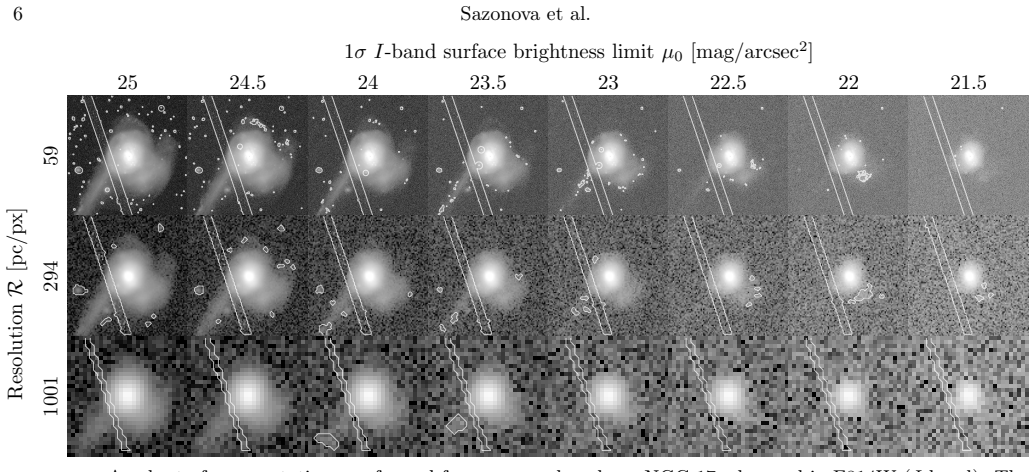
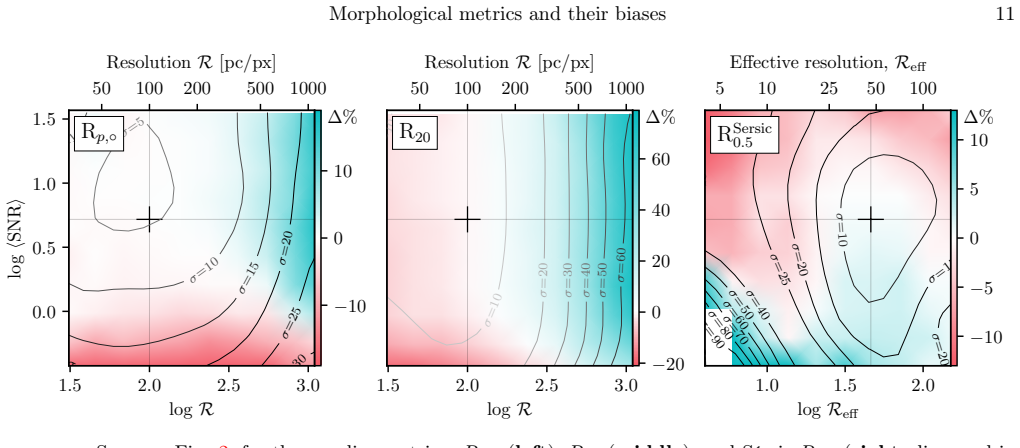
Morphological metrics measured by statmorph and Galfit vary with resolution, depth, and signal-to-noise in ways that can be quantified on simulated images; empirical correction functions remove most of the bias, and the observed decline in concentration C with redshift in JWST galaxies is reproduced by the same resolution dependence.
What carries the argument
Empirical correction functions that map each statmorph parameter to resolution, depth, and signal-to-noise using simulated LSST-like images.
If this is right
- Geometrical parameters such as ellipticity and Petrosian radius remain reliable to better than 10 percent across most depths and resolutions.
- Concentration, Gini, and M20 must be corrected before low-mass or high-redshift bulge galaxies can be distinguished from disks.
- Sersic index carries 20-40 percent uncertainty from fitting degeneracies even when unbiased on average.
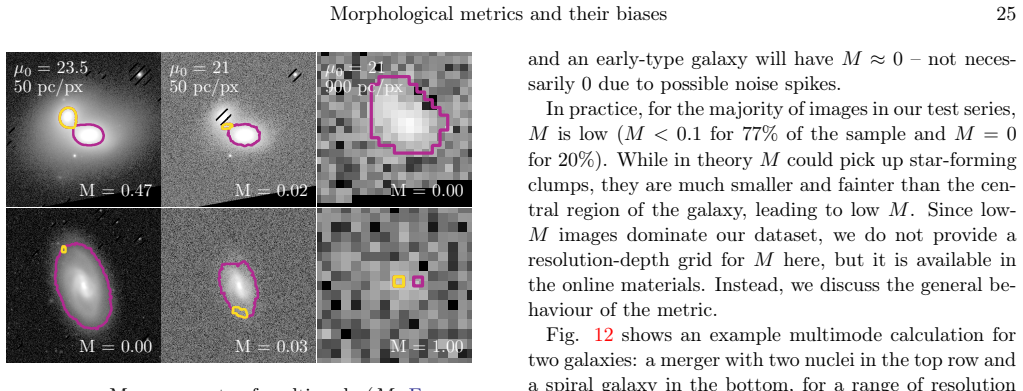
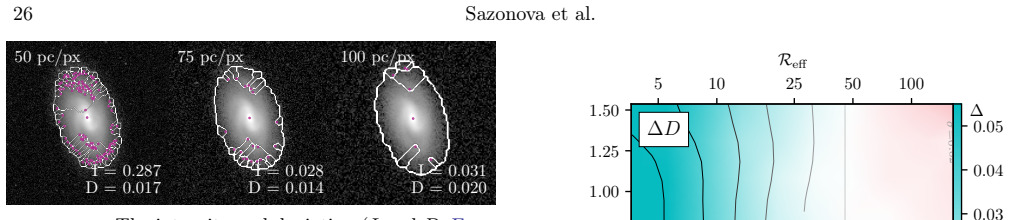
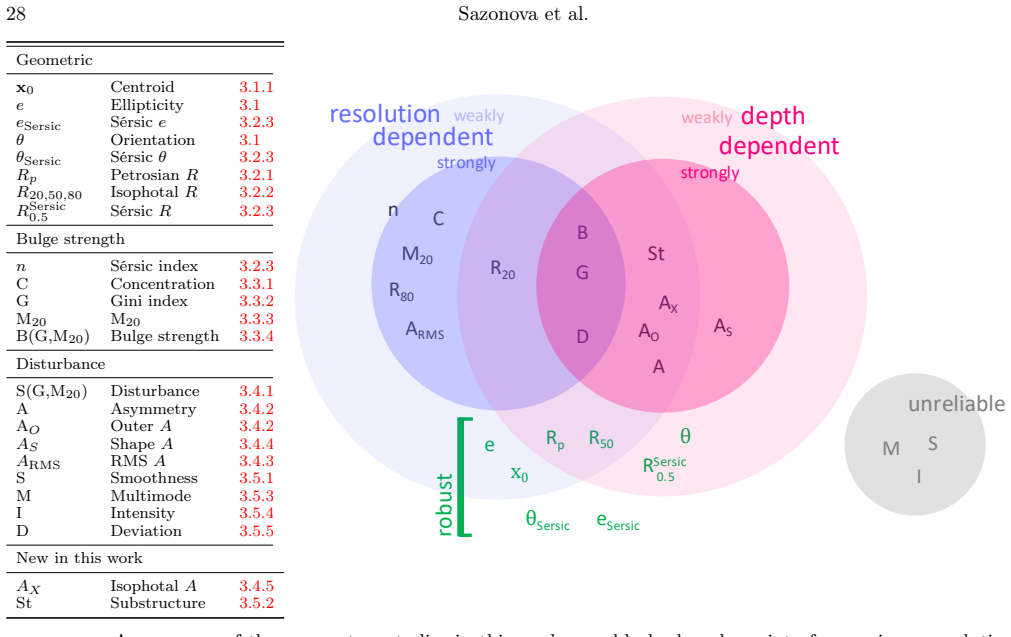
- Standard asymmetry and disturbance indices are noise-sensitive and improve when replaced by the new isophotal asymmetry A_X and substructure St measures.
Where Pith is reading between the lines
- The same bias maps could be used to re-interpret morphological trends reported from other high-redshift imaging surveys.
- Public release of the correction functions and the accompanying test dataset allows any future survey pipeline to apply identical adjustments.
Load-bearing premise
The simulated images used to derive the bias trends and correction functions match the actual range of LSST observing conditions and galaxy types well enough that the corrections apply to real survey data.
What would settle it
Apply the published correction functions to a large set of real LSST early-data galaxies and check whether the corrected concentration values still show the same redshift trend reported from JWST.
Figures







read the original abstract
Quantitative morphology provides a key probe of galaxy evolution across cosmic time and environments. However, these metrics can be biased by changes in imaging quality - resolution and depth - either across the survey area or the sample. To prepare for the upcoming Rubin LSST data, we investigate this bias for all metrics measured by statmorph and single-component S\'ersic fitting with Galfit. We find that geometrical measurements (ellipticity, axis ratio, Petrosian radius, and effective radius) are robust within 10% at most depths and resolutions. Light concentration measurements ($C$, Gini, $M_{20}$) systematically decrease with resolution, leading low-mass or high-redshift bulge-dominated sources to appear indistinguishable from disks. S\'ersic index $n$, while unbiased, suffers from a 20-40% uncertainty due to degeneracies in the S\'ersic fit. Disturbance measurements ($A$, $A_S$, $D$) depend on signal-to-noise and are thus affected by noise and surface-brightness dimming. We quantify this dependence for each parameter, offer empirical correction functions, and show that the evolution in $C$ observed in JWST galaxies can be explained purely by observational biases. We propose two new measurements - isophotal asymmetry $A_X$ and substructure $St$ - that aim to resolve some of these biases. Finally, we provide a Python package statmorph-lsst implementing these changes and a full dataset that enables tests of custom functions (see text for links).
Editorial analysis
A structured set of objections, weighed in public.
Referee Report
Summary. The paper investigates biases in quantitative morphological parameters (from statmorph and single-component Sérsic fits with Galfit) induced by variations in imaging resolution and depth, with a focus on preparing for Rubin LSST data. Using test images, it quantifies robustness of geometrical parameters (ellipticity, axis ratio, radii), systematic decreases in concentration metrics (C, Gini, M20) with poorer resolution, uncertainties in Sérsic index n, and S/N dependence of asymmetry/disturbance metrics (A, As, D). Empirical correction functions are derived, the apparent redshift evolution of C in JWST galaxies is attributed entirely to observational biases, two new metrics (isophotal asymmetry A_X and substructure St) are proposed, and the statmorph-lsst package plus supporting dataset are released.
Significance. If the test images faithfully reproduce the joint distribution of LSST-like PSFs, noise, surface-brightness dimming, and galaxy morphological diversity, the work provides a practical, immediately usable framework for correcting morphological biases in large surveys. The explicit demonstration that JWST C trends can be reproduced by resolution/depth effects alone has direct implications for interpreting high-redshift galaxy evolution. The open release of the package and dataset is a clear strength for reproducibility and community adoption.
major comments (2)
- [§3 (simulation/test-image generation)] §3 (or equivalent Methods section on test-image generation): The manuscript provides insufficient detail on the simulation setup used to derive the bias dependencies and empirical corrections. It is not stated how the joint distributions of PSF sizes, noise properties, surface-brightness dimming, redshift sampling, and galaxy morphological mix (including low-mass/high-z bulge systems) were constructed or validated against real LSST-like conditions. Because the central claims rest on these corrections generalizing beyond the tested cases, this omission is load-bearing.
- [§5 (JWST C-evolution attribution)] §5 (or equivalent section on JWST comparison): The claim that the observed evolution in C for JWST galaxies can be explained purely by observational biases requires explicit demonstration that the resolution, depth, and sample properties applied to the test images match those of the actual JWST data used for comparison. Without a quantitative matching or sensitivity test, the attribution remains incompletely supported.
minor comments (2)
- [Abstract] Abstract: The phrase 'see text for links' for the statmorph-lsst package and dataset should be replaced with direct URLs or DOIs to improve immediate accessibility.
- [Definitions of new metrics] Notation and definitions: The new metrics A_X and St are introduced without accompanying equations or precise algorithmic descriptions in the main text; adding these would clarify how they differ from existing A and D parameters.
Simulated Author's Rebuttal
We thank the referee for their constructive and detailed review. The comments have helped us identify areas where additional clarity is needed, particularly regarding the simulation methodology and the JWST comparison. We address each point below and have revised the manuscript accordingly to strengthen these sections.
read point-by-point responses
-
Referee: §3 (or equivalent Methods section on test-image generation): The manuscript provides insufficient detail on the simulation setup used to derive the bias dependencies and empirical corrections. It is not stated how the joint distributions of PSF sizes, noise properties, surface-brightness dimming, redshift sampling, and galaxy morphological mix (including low-mass/high-z bulge systems) were constructed or validated against real LSST-like conditions. Because the central claims rest on these corrections generalizing beyond the tested cases, this omission is load-bearing.
Authors: We agree that the original description in §3 was too concise and that more explicit documentation of the simulation setup is required for reproducibility and to support generalization of the corrections. In the revised manuscript we have substantially expanded this section. We now detail the construction of the joint distributions: PSF sizes are sampled from a distribution matching expected LSST seeing variations (0.6–1.2 arcsec FWHM); noise properties are drawn from realistic sky background levels and exposure times consistent with the LSST wide-fast-deep survey; surface-brightness dimming is applied using standard cosmological parameters; redshift sampling follows the expected distribution for LSST-detectable galaxies; and the morphological mix incorporates observed fractions of bulge- and disk-dominated systems from HST and JWST catalogs, with explicit inclusion of low-mass and high-redshift bulge systems. We have also added a validation subsection comparing key statistical properties of the simulated images to available LSST precursor data. These additions directly address the load-bearing concern. revision: yes
-
Referee: §5 (or equivalent section on JWST comparison): The claim that the observed evolution in C for JWST galaxies can be explained purely by observational biases requires explicit demonstration that the resolution, depth, and sample properties applied to the test images match those of the actual JWST data used for comparison. Without a quantitative matching or sensitivity test, the attribution remains incompletely supported.
Authors: We acknowledge that the original presentation of the JWST comparison would benefit from a more quantitative link between the test images and the actual JWST observations. In the revised §5 we have added a dedicated paragraph and accompanying table that directly compares the distributions of PSF FWHM, 5σ limiting surface brightness, and redshift range between the simulated test images and the JWST sample used for the C-evolution analysis. We further include results from sensitivity tests in which we vary resolution and depth parameters across the observed JWST range and demonstrate that the recovered trend in C remains consistent with the reported observational bias. These additions provide the explicit matching and robustness checks requested. revision: yes
Circularity Check
No significant circularity: empirical bias corrections derived from test images remain independent of claimed outputs
full rationale
The paper quantifies morphological parameter biases using simulated or test images under varying resolution and depth, then fits empirical correction functions and applies them to interpret JWST C evolution as observational. No equations, derivations, or self-citations are shown that reduce the correction functions, new metrics (A_X, St), or the 'purely observational' explanation to fitted inputs or prior author results by construction. The central claims rest on external fidelity of the test images to real LSST conditions rather than internal self-definition or renaming. This is a standard empirical workflow with no load-bearing circular steps.
Axiom & Free-Parameter Ledger
Forward citations
Cited by 1 Pith paper
-
The Hubble sequence in JWST CEERS from unbiased galaxy morphologies
A Hubble-like sequence of galaxy morphologies exists by redshift 4, with low-mass galaxies as persistent star-forming disks and massive galaxies following either stable disk or rapid compaction-quenching paths.
Reference graph
Works this paper leans on
-
[1]
, " * write output.state after.block = add.period write newline
ENTRY address archivePrefix author booktitle chapter doi edition editor eprint howpublished institution journal key month number organization pages publisher school series title misctitle type volume year version url label extra.label sort.label short.list INTEGERS output.state before.all mid.sentence after.sentence after.block FUNCTION init.state.consts ...
-
[2]
" write newline "" before.all 'output.state := FUNCTION format.url url empty "" new.block "" url * "" * if FUNCTION format.eprint eprint empty "" archivePrefix empty "" archivePrefix "arXiv" = new.block " " eprint * " " * new.block " " eprint * " " * if if if FUNCTION format.doi doi empty "" " " doi * " " * if FUNCTION format.pid doi empty eprint empty ur...
-
[3]
G., et al., 2003, @doi [ ] 10.1086/373919 , 588, 218
Abraham R. G., et al., 2003, @doi [ ] 10.1086/373919 , 588, 218
-
[4]
Aguilar-Arg \"u ello G., et al., 2025, @doi [ ] 10.1093/mnras/staf085 , 537, 876
-
[5]
2006, MNRAS, 370, 773, doi: 10.1111/j.1365-2966.2006.10501.x
Allen P. D., et al., 2006, @doi [ ] 10.1111/j.1365-2966.2006.10586.x , 371, 2
-
[6]
Andrae R., et al., 2011, @doi [ ] 10.1111/j.1365-2966.2010.17690.x , 411, 385
-
[7]
C., et al., 1995, @doi [ ] 10.1093/mnras/275.3.874 , 275, 874
Andredakis Y. C., et al., 1995, @doi [ ] 10.1093/mnras/275.3.874 , 275, 874
-
[8]
J., et al., 2018, @doi [ ] 10.1093/mnras/sty1691 , 479, 3076
Argyle J. J., et al., 2018, @doi [ ] 10.1093/mnras/sty1691 , 479, 3076
-
[9]
Arnouts S., et al., 2007, @doi [ ] 10.1051/0004-6361:20077632 , 476, 137
-
[10]
Astropy Collaboration et al., 2013, @doi [ ] 10.1051/0004-6361/201322068 , 558, A33
-
[11]
Astropy Collaboration et al., 2018, @doi [ ] 10.3847/1538-3881/aabc4f , 156, 123
-
[12]
Bellhouse C., et al., 2022, @doi [ ] 10.3847/1538-4357/ac8b6e , 937, 18
-
[13]
A., et al., 2000, @doi [ ] 10.1086/301386 , 119, 2645
Bershady M. A., et al., 2000, @doi [ ] 10.1086/301386 , 119, 2645
-
[14]
527, Astronomical Data Analysis Software and Systems XXIX
Bertin E., et al., 2020, in Pizzo R., et al., eds, Astronomical Society of the Pacific Conference Series Vol. 527, Astronomical Data Analysis Software and Systems XXIX. p. 461, https://ui.adsabs.harvard.edu/abs/2020ASPC..527..461B
work page 2020
-
[15]
Birrer S., et al., 2021, @doi [The Journal of Open Source Software] 10.21105/joss.03283 , 6, 3283
-
[16]
Bonfini P., 2014, @doi [ ] 10.1086/678566 , 126, 935
-
[17]
Bottrell C., et al., 2019, @doi [ ] 10.1093/mnras/stz2934 , 490, 5390
-
[18]
Bradley L., et al., 2020, astropy/photutils: 1.0.1, @doi 10.5281/zenodo.596036 , https://ui.adsabs.harvard.edu/abs/2020zndo....596036B
-
[19]
A., et al., 2014, @doi [ ] 10.1093/mnras/stu1478 , 444, 1001
Bruce V. A., et al., 2014, @doi [ ] 10.1093/mnras/stu1478 , 444, 1001
-
[20]
Casura S., et al., 2022, @doi [ ] 10.1093/mnras/stac2267 , 516, 942
-
[21]
Chamba N., et al., 2022, @doi [ ] 10.1051/0004-6361/202243612 , 667, A87
-
[22]
Collaboration A., et al., 2022, @doi [ ] 10.3847/1538-4357/ac7c74 , 935, 167
work page internal anchor Pith review doi:10.3847/1538-4357/ac7c74 2022
-
[23]
J., 2003, @doi [ ] 10.1086/375001 , 147, 1
Conselice C. J., 2003, @doi [ ] 10.1086/375001 , 147, 1
-
[24]
J., et al., 2000, @doi [ ] 10.1086/308300 , 529, 886
Conselice C. J., et al., 2000, @doi [ ] 10.1086/308300 , 529, 886
-
[25]
Cook R. H. W., et al., 2025, @doi [ ] 10.1093/mnras/staf575 , 539, 2829
-
[26]
Costantin L., et al., 2025, @doi [ ] 10.1051/0004-6361/202451330 , 699, A360
-
[27]
Interpretable Machine Learning for Science with PySR and SymbolicRegression.jl
Cranmer M., 2023, @doi [arXiv e-prints] 10.48550/arXiv.2305.01582 , p. arXiv:2305.01582
work page internal anchor Pith review Pith/arXiv arXiv doi:10.48550/arxiv.2305.01582 2023
-
[28]
Deg N., et al., 2023, @doi [ ] 10.1093/mnras/stad1693 , 523, 4340
-
[29]
Dimauro P., et al., 2018, @doi [ ] 10.1093/mnras/sty1379 , 478, 5410
-
[30]
Ding X., et al., 2020, @doi [The Astrophysical Journal] 10.3847/1538-4357/ab5b90 , 888, 37
-
[31]
Djorgovski S., Davis M., 1987, @doi [ ] 10.1086/164948 , 313, 59
-
[32]
Dressler A., 1980, @doi [ ] 10.1086/157753 , 236, 351
-
[33]
Dreyer J. L. E., 1888, , 49, 1
-
[34]
Dreyer J. L. E., 1910, , 59, 105
work page 1910
-
[35]
M., et al., 2025, @doi [ ] 10.1051/0004-6361/202554725 , 700, A42
Espejo Salcedo J. M., et al., 2025, @doi [ ] 10.1051/0004-6361/202554725 , 700, A42
-
[36]
Ferreira L., et al., 2022a, @doi [ ] 10.3847/1538-4357/ac66ea , 931, 34
-
[37]
Ferreira L., et al., 2022b, @doi [ ] 10.3847/2041-8213/ac947c , 938, L2
-
[38]
Ferreira L., et al., 2023, @doi [ ] 10.3847/1538-4357/acec76 , 955, 94
-
[39]
M., et al., 2025, @doi [ ] 10.3847/1538-4357/adb8dc , 982, 120
Foster L. M., et al., 2025, @doi [ ] 10.3847/1538-4357/adb8dc , 982, 120
-
[40]
E., et al., 2013, @doi [ ] 10.1093/mnras/stt1016 , 434, 282
Freeman P. E., et al., 2013, @doi [ ] 10.1093/mnras/stt1016 , 434, 282
-
[41]
H., Guo Y., Hertzberg J., Katz N., Mo H
Gadotti D. A., 2009, @doi [ ] 10.1111/j.1365-2966.2008.14257.x , 393, 1531
-
[42]
Galametz A., et al., 2013, @doi [ ] 10.1088/0067-0049/206/2/10 , 206, 10
-
[43]
Graham A. W., 1998, @doi [ ] 10.1046/j.1365-8711.1998.01430.x , 295, 933
-
[44]
W., 2001, @doi [ ] 10.1086/318767 , 121, 820
Graham A. W., 2001, @doi [ ] 10.1086/318767 , 121, 820
-
[45]
Graham A. W., Driver S. P., 2005, @doi [ ] 10.1071/AS05001 , 22, 118
-
[46]
Graham A., et al., 1996, @doi [ ] 10.1086/177440 , 465, 534
-
[47]
W., et al., 2001, @doi [ ] 10.1086/323090 , 122, 1707
Graham A. W., et al., 2001, @doi [ ] 10.1086/323090 , 122, 1707
-
[48]
W., et al., 2005, @doi [ ] 10.1086/444475 , 130, 1535
Graham A. W., et al., 2005, @doi [ ] 10.1086/444475 , 130, 1535
-
[49]
Harris C. R., et al., 2020, @doi [Nature] 10.1038/s41586-020-2649-2 , 585, 357
-
[50]
H \"a u ler B., et al., 2022, @doi [ ] 10.1051/0004-6361/202142935 , 664, A92
-
[51]
Hogg D. W., et al., 2002, @doi [arXiv e-prints] 10.48550/arXiv.astro-ph/0210394 , pp astro--ph/0210394
work page internal anchor Pith review Pith/arXiv arXiv doi:10.48550/arxiv.astro-ph/0210394 2002
-
[52]
P., et al., 2007, @doi [ ] 10.1086/521777 , 670, 190
Holden B. P., et al., 2007, @doi [ ] 10.1086/521777 , 670, 190
-
[53]
Holwerda B. W., et al., 2011, @doi [ ] 10.1111/j.1365-2966.2011.18938.x , 416, 2401
-
[54]
W., et al., 2025, @doi [ ] 10.1017/pasa.2025.5 , 42, e028
Holwerda B. W., et al., 2025, @doi [ ] 10.1017/pasa.2025.5 , 42, e028
-
[55]
D., 2007, @doi [Computing in Science & Engineering] 10.1109/mcse.2007.55 , 9, 90
Hunter J. D., 2007, @doi [Computing in Science & Engineering] 10.1109/mcse.2007.55 , 9, 90
-
[56]
Hunter D. A., Elmegreen B. G., 2006, @doi [ ] 10.1086/498096 , 162, 49
-
[57]
S., et al., 2025a, @doi [ ] 10.1093/mnras/stae2781 , 536, 3090
Kalita B. S., et al., 2025a, @doi [ ] 10.1093/mnras/stae2781 , 536, 3090
-
[58]
S., et al., 2025b, @doi [ ] 10.1093/mnras/staf031 , 537, 402
Kalita B. S., et al., 2025b, @doi [ ] 10.1093/mnras/staf031 , 537, 402
-
[59]
S., et al., 2023, @doi [ ] 10.3847/2041-8213/acad01 , 946, L15
Kartaltepe J. S., et al., 2023, @doi [ ] 10.3847/2041-8213/acad01 , 946, L15
-
[60]
M., 1985, @doi [ ] 10.1086/191066 , 59, 115
Kent S. M., 1985, @doi [ ] 10.1086/191066 , 59, 115
-
[61]
E., et al., 2011, 20 years of Hubble Space Telescope optical modeling using Tiny Tim
Krist J. E., et al., 2011, 20 years of Hubble Space Telescope optical modeling using Tiny Tim. p. 81270J, @doi 10.1117/12.892762 , https://ui.adsabs.harvard.edu/abs/2011SPIE.8127E..0JK
-
[62]
Lange R., et al., 2016, @doi [ ] 10.1093/mnras/stw1495 , 462, 1470
-
[63]
M., Sobral, D., Smail, I., et al
Lanyon-Foster M. M., et al., 2012, @doi [ ] 10.1111/j.1365-2966.2012.21287.x , 424, 1852
-
[64]
R., et al., 2012, @doi [ ] 10.1088/0004-637X/745/1/85 , 745, 85
Law D. R., et al., 2012, @doi [ ] 10.1088/0004-637X/745/1/85 , 745, 85
-
[65]
Lima-Dias C., et al., 2024, @doi [ ] 10.1093/mnras/stad3571 , 527, 5792
-
[66]
Lisker T., 2008, @doi [ ] 10.1086/591795 , 179, 319
-
[67]
M., et al., 2004, @doi [ ] 10.1086/421849 , 128, 163
Lotz J. M., et al., 2004, @doi [ ] 10.1086/421849 , 128, 163
-
[68]
H., Guo Y., Hertzberg J., Katz N., Mo H
Lotz J. M., et al., 2008, @doi [ ] 10.1111/j.1365-2966.2008.14004.x , 391, 1137
-
[69]
A., et al., 2003, @doi [ ] 10.1086/344506 , 582, 689
MacArthur L. A., et al., 2003, @doi [ ] 10.1086/344506 , 582, 689
-
[70]
A., et al., 2018, @doi [ ] 10.3847/1538-4357/aad59e , 864, 123
Mager V. A., et al., 2018, @doi [ ] 10.3847/1538-4357/aad59e , 864, 123
-
[71]
Martin G., et al., 2025, @doi [ ] 10.1093/mnras/staf1092 , 541, 1831
-
[72]
Martorano M., et al., 2025, @doi [ ] 10.1051/0004-6361/202452919 , 694, A76
-
[73]
Matthee J., et al., 2024, @doi [ ] 10.3847/1538-4357/ad2345 , 963, 129
-
[74]
T., et al., 2014, @doi [ ] 10.1088/0067-0049/210/1/3 , 210, 3
Mendel J. T., et al., 2014, @doi [ ] 10.1088/0067-0049/210/1/3 , 210, 3
-
[75]
R., et al., 2024, @doi [ ] 10.1051/0004-6361/202449225 , 691, A20
Morgan C. R., et al., 2024, @doi [ ] 10.1051/0004-6361/202449225 , 691, A20
-
[76]
Morishita T., et al., 2024, @doi [ ] 10.3847/1538-4357/ad1404 , 963, 9
-
[77]
Mortlock A., et al., 2013, @doi [ ] 10.1093/mnras/stt793 , 433, 1185
-
[78]
Mukundan K., et al., 2024, @doi [ ] 10.1093/mnras/stae1684 , 533, 292
-
[79]
V., et al., 2024, @doi [ ] 10.1093/mnras/stae1702 , 532, 3747
Nedkova K. V., et al., 2024, @doi [ ] 10.1093/mnras/stae1702 , 532, 3747
-
[80]
Nelson D., et al., 2019, @doi [Computational Astrophysics and Cosmology] 10.1186/s40668-019-0028-x , 6, 2
discussion (0)
Sign in with ORCID, Apple, or X to comment. Anyone can read and Pith papers without signing in.