Jet fragmentation function and groomed substructure of bottom quark jets in proton-proton collisions at 5.02 TeV
Pith reviewed 2026-05-17 23:27 UTC · model grok-4.3
The pith
Bottom quark jets display suppressed small-angle emissions compared to inclusive jets, matching the dead-cone effect from quark mass.
A machine-rendered reading of the paper's core claim, the machinery that carries it, and where it could break.
Core claim
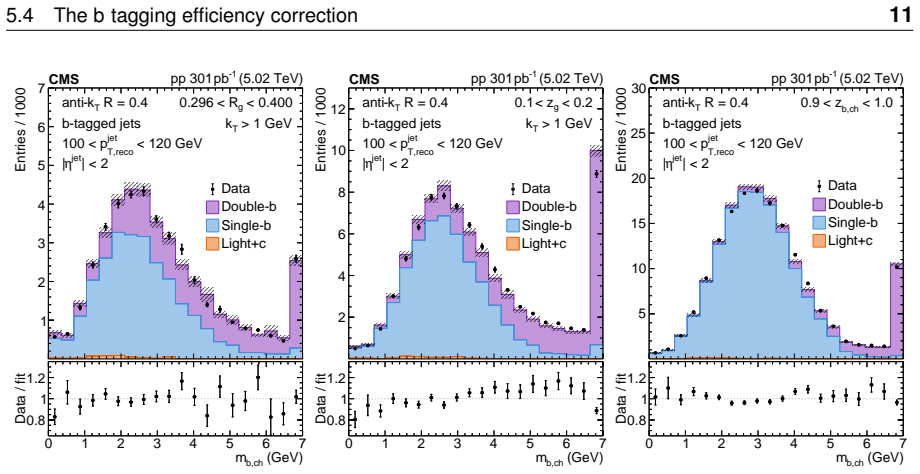
By developing an algorithm to cluster charged decay daughters of b hadrons and applying iterative Cambridge-Aachen declustering with soft-drop grooming, the analysis reveals a strong suppression of emissions at small R_g values in b jets relative to inclusive jets. This difference is consistent with the dead-cone effect arising from the finite mass of the b quark and provides the first such substructure measurement that explicitly clusters b hadron decay products. The distributions are unfolded to the charged-particle level and compared with Monte Carlo predictions.
What carries the argument
The algorithm that identifies and clusters charged decay daughters of b hadrons, enabling soft-drop grooming to isolate the gluon radiation pattern while accounting for b quark mass effects.
If this is right
- The R_g and z_g distributions can directly test perturbative QCD calculations that incorporate heavy-quark mass corrections.
- The fragmentation function z_b,ch quantifies momentum sharing between the b hadron and the rest of the jet at the charged-particle level.
- The same clustering technique can be applied to larger datasets or different collision systems to study mass-dependent jet evolution.
- Comparisons with event generators constrain modeling of heavy-flavor fragmentation and radiation.
Where Pith is reading between the lines
- This approach may help separate heavy-quark jets from light jets in searches that rely on jet substructure.
- Extending the method to charm jets could map how the dead-cone size scales with quark mass.
- The observed suppression offers a benchmark for theoretical calculations of medium-induced modifications in heavy-ion collisions.
Load-bearing premise
The algorithm clusters charged b hadron decay daughters with low contamination and without efficiency biases that would distort the measured R_g or z_g distributions.
What would settle it
A high-precision follow-up measurement showing identical small-R_g emission rates for b jets and inclusive jets after correcting for detector effects and background would undermine the dead-cone interpretation.
Figures




read the original abstract
A measurement of the substructure of bottom quark jets (b jets) in proton-proton (pp) collisions is presented. The measurement uses data collected in pp collisions at $\sqrt{s}$ = 5.02 TeV, with a low number of simultaneous interactions per bunch crossing, recorded by the CMS experiment in 2017, corresponding to an integrated luminosity of 301 pb$^{-1}$. An algorithm to identify and cluster the charged decay daughters of b hadrons is developed for this analysis, which facilitates the exposure of the gluon radiation pattern of b jets using iterative Cambridge$-$Aachen declustering. The soft-drop-groomed jet radius, $R_\mathrm{g}$, and momentum balance, $z_\mathrm{g}$, of b quark jets are presented. These observables can be used to test perturbative quantum chromodynamics predictions that account for mass effects. Because the b hadron is partially reconstructed from its charged decay daughters, only charged particles are used for the jet substructure studies. In addition, a jet fragmentation function, $z_\text{b,ch}$, is measured, which is defined as the distribution of the ratio of the transverse momentum ($p_\mathrm{T}$) of the partially reconstructed b hadron with respect to the charged-particle component of the jet $p_\mathrm{T}$. The substructure variable distributions are unfolded to the charged-particle level. The b jet substructure is compared to the substructure of jets in an inclusive jet sample that is dominated by light-quark and gluon jets in order to assess the role of the b quark mass. A strong suppression of emissions at small $R_\mathrm{g}$ values is observed for b jets when compared to inclusive jets, consistent with the dead-cone effect. The measurement is also compared with theoretical predictions from Monte Carlo event generators. This is the first substructure measurement of b jets that clusters together the b hadron decay daughters.
Editorial analysis
A structured set of objections, weighed in public.
Referee Report
Summary. The manuscript reports a measurement of groomed substructure observables (soft-drop R_g and z_g) and the charged fragmentation function z_b,ch for b jets in 5.02 TeV pp collisions with the CMS detector (301 pb^{-1}). A custom algorithm clusters the charged decay daughters of b hadrons to enable Cambridge-Aachen declustering and soft-drop grooming on charged particles only. Distributions are unfolded to the charged-particle level and compared to an inclusive jet sample (light-quark/gluon dominated) and to Monte Carlo generators. A strong suppression of small-R_g emissions is observed for b jets relative to inclusive jets and is interpreted as consistent with the dead-cone effect.
Significance. If the central observation holds, this constitutes the first direct measurement of groomed substructure in b jets at the LHC and supplies a data-driven test of pQCD mass effects in heavy-quark fragmentation. The result is relevant for heavy-flavor modeling in both pp and heavy-ion environments. The paper ships an explicit unfolding procedure and direct MC comparisons, which are positive elements for reproducibility.
major comments (2)
- [algorithm description (likely §3 or §4)] Section describing the b-hadron decay-daughter clustering algorithm: the central claim of dead-cone suppression at small R_g rests on this algorithm correctly isolating true charged daughters without angle-dependent efficiency losses or light-jet contamination. No dedicated efficiency or purity study versus R_g (or versus the inclusive-jet sample) is presented; without it the observed suppression cannot be unambiguously attributed to the b-quark mass rather than reconstruction bias.
- [unfolding and systematics] Unfolding and systematic-uncertainty section: the regularization choice and the propagation of b-tagging efficiency uncertainties into the small-R_g tail are not shown in sufficient detail to confirm that they do not artificially enhance the reported suppression relative to inclusive jets.
minor comments (2)
- [figures] Figure captions and axis labels should explicitly state that only charged particles are used after the custom clustering step.
- [abstract] A reference to the soft-drop grooming parameters (z_cut, β) is missing in the abstract and should be added for completeness.
Simulated Author's Rebuttal
We thank the referee for the careful review and for recognizing the potential significance of this first measurement of groomed substructure observables in b jets. We address each major comment below and have revised the manuscript accordingly where the concerns identify areas that can be strengthened with additional detail.
read point-by-point responses
-
Referee: Section describing the b-hadron decay-daughter clustering algorithm: the central claim of dead-cone suppression at small R_g rests on this algorithm correctly isolating true charged daughters without angle-dependent efficiency losses or light-jet contamination. No dedicated efficiency or purity study versus R_g (or versus the inclusive-jet sample) is presented; without it the observed suppression cannot be unambiguously attributed to the b-quark mass rather than reconstruction bias.
Authors: We agree that explicit validation of the clustering algorithm against angle-dependent biases is important for the interpretation. The algorithm is described in Section 3 of the manuscript, and its performance was validated through Monte Carlo closure tests that compare reconstructed to generator-level charged daughters. To directly address the referee's point, the revised manuscript now includes a dedicated efficiency and purity study as a function of R_g (new Figure in Section 3). This study demonstrates that the efficiency remains flat across the small-R_g region for b jets and that light-jet contamination after b tagging is below 5% with no significant R_g dependence. These results support that the observed suppression is not driven by reconstruction effects. revision: yes
-
Referee: Unfolding and systematic-uncertainty section: the regularization choice and the propagation of b-tagging efficiency uncertainties into the small-R_g tail are not shown in sufficient detail to confirm that they do not artificially enhance the reported suppression relative to inclusive jets.
Authors: The unfolding is performed using the iterative Bayesian method with regularization chosen via the L-curve criterion to minimize bias while controlling statistical fluctuations, as stated in Section 5. B-tagging efficiency uncertainties are propagated by varying the scale factors within their uncertainties and re-deriving the response matrices. In the revised manuscript we have expanded Section 5 to include explicit plots of the regularization parameter scan and a breakdown of the b-tagging systematic contribution to the small-R_g bins for both the b-jet and inclusive-jet samples. These additions show that the b-tagging uncertainty is sub-dominant in the tail and does not preferentially enhance the reported suppression. revision: partial
Circularity Check
No circularity: direct experimental measurement with external benchmarks
full rationale
This is a CMS experimental measurement of groomed substructure and fragmentation in b jets at 5.02 TeV. The analysis develops a clustering algorithm for charged b-hadron daughters, applies soft-drop grooming on Cambridge-Aachen declustering, unfolds the observables to charged-particle level, and compares the resulting R_g and z_g distributions directly to an inclusive jet sample and to Monte Carlo generators. No derivation, ansatz, or prediction is presented that reduces by construction to a fitted parameter, self-citation chain, or renamed input; the central observation of small-R_g suppression is extracted from data after standard unfolding and is tested against independent simulations. The paper is therefore self-contained against external data and generators, with no load-bearing circular steps.
Axiom & Free-Parameter Ledger
axioms (2)
- domain assumption Standard CMS detector response and particle-flow reconstruction accurately model charged-particle tracking and calorimetry for jets.
- domain assumption Monte Carlo event generators correctly simulate b-hadron decays and parton showering for comparison.
Lean theorems connected to this paper
-
IndisputableMonolith/Foundation/Atomicityatomic_tick unclear?
unclearRelation between the paper passage and the cited Recognition theorem.
An algorithm to identify and cluster the charged decay daughters of b hadrons is developed... using iterative Cambridge–Aachen declustering... soft-drop-groomed jet radius R_g
What do these tags mean?
- matches
- The paper's claim is directly supported by a theorem in the formal canon.
- supports
- The theorem supports part of the paper's argument, but the paper may add assumptions or extra steps.
- extends
- The paper goes beyond the formal theorem; the theorem is a base layer rather than the whole result.
- uses
- The paper appears to rely on the theorem as machinery.
- contradicts
- The paper's claim conflicts with a theorem or certificate in the canon.
- unclear
- Pith found a possible connection, but the passage is too broad, indirect, or ambiguous to say the theorem truly supports the claim.
Reference graph
Works this paper leans on
-
[1]
A. J. Larkoski, I. Moult, and B. Nachman, “Jet substructure at the Large Hadron Collider: a review of recent advances in theory and machine learning”,Phys. Rept.841(2020) 1, doi:10.1016/j.physrep.2019.11.001,arXiv:1709.04464
-
[2]
Looking inside jets: an introduction to jet substructure and boosted-object phenomenology
S. Marzani, G. Soyez, and M. Spannowsky, “Looking inside jets: an introduction to jet substructure and boosted-object phenomenology”,Lect. Notes Phys.958(2019) 1, doi:10.1007/978-3-030-15709-8,arXiv:1901.10342
work page internal anchor Pith review Pith/arXiv arXiv doi:10.1007/978-3-030-15709-8 2019
-
[3]
R. Kogler, “Advances in jet substructure at the LHC: algorithms, measurements and searches for new physical phenomena”, volume 284 ofSpringer Tracts Mod. Phys. Springer, 2021.doi:10.1007/978-3-030-72858-8, ISBN 978-3-030-72857-1, 978-3-030-72858-8
-
[4]
Deep inelastic electron-proton scattering in perturbation theory
V . N. Gribov and L. N. Lipatov, “Deep inelastic electron-proton scattering in perturbation theory”,Sov. J. Nucl. Phys.15(1972) 438
work page 1972
-
[5]
Y. L. Dokshitzer, “Calculation of the structure functions for deep inelastic scattering and e+e− annihilation by perturbation theory in quantum chromodynamics”,Sov. Phys. JETP46(1977) 641
work page 1977
-
[6]
Asymptotic freedom in parton language
G. Altarelli and G. Parisi, “Asymptotic freedom in parton language”,Nucl. Phys. B126 (1977) 298,doi:10.1016/0550-3213(77)90384-4
-
[7]
One-loop Singular Behaviour of QCD and SUSY QCD Amplitudes with Massive Partons
S. Catani, S. Dittmaier, and Z. Trocsanyi, “One loop singular behavior of QCD and SUSY QCD amplitudes with massive partons”,Phys. Lett. B500(2001) 149, doi:10.1016/S0370-2693(01)00065-X,arXiv:hep-ph/0011222
work page internal anchor Pith review Pith/arXiv arXiv doi:10.1016/s0370-2693(01)00065-x 2001
-
[8]
Disentangling Heavy Flavor at Colliders
P . Ilten, N. L. Rodd, J. Thaler, and M. Williams, “Disentangling heavy flavor at colliders”, Phys. Rev. D96(2017) 054019,doi:10.1103/PhysRevD.96.054019, arXiv:1702.02947
work page internal anchor Pith review Pith/arXiv arXiv doi:10.1103/physrevd.96.054019 2017
-
[9]
On specific QCD properties of heavy quark fragmentation (’dead cone’)
Y. L. Dokshitzer, V . A. Khoze, and S. I. Troian, “On specific QCD properties of heavy quark fragmentation (’dead cone’)”,J. Phys. G17(1991) 1602, doi:10.1088/0954-3899/17/10/023
-
[10]
Direct observation of the dead-cone effect in quantum chromodynamics
ALICE Collaboration, “Direct observation of the dead-cone effect in quantum chromodynamics”,Nature605(2022) 440,doi:10.1038/s41586-022-04572-w, arXiv:2106.05713. [Erratum:doi:10.1038/s41586-022-05026-z]
-
[11]
Identification of heavy-flavour jets with the CMS detector in pp collisions at 13 TeV
CMS Collaboration, “Identification of heavy-flavor jets with the CMS detector in pp collisions at 13 TeV”,JINST13(2018) P05011, doi:10.1088/1748-0221/13/05/P05011,arXiv:1712.07158. 22
work page internal anchor Pith review Pith/arXiv arXiv doi:10.1088/1748-0221/13/05/p05011 2018
-
[12]
Jet substructure at the Large Hadron Collider: experimental review
R. Kogler, B. Nachman, A. Schmidt (editors) and others, “Jet substructure at the Large Hadron Collider: experimental review”,Rev. Mod. Phys.91(2019) 045003, doi:10.1103/RevModPhys.91.045003,arXiv:1803.06991
-
[13]
Evidence of b-jet quenching in PbPb collisions at sqrt(s[NN]) = 2.76 TeV
CMS Collaboration, “Evidence of b jet quenching in PbPb collisions at √sNN =2.76 TeV”, Phys. Rev. Lett.113(2014) 132301,doi:10.1103/PhysRevLett.113.132301, arXiv:1312.4198. [Erratum:doi:10.1103/PhysRevLett.115.029903]
work page internal anchor Pith review Pith/arXiv arXiv doi:10.1103/physrevlett.113.132301 2014
-
[14]
ATLAS Collaboration, “Measurement of the nuclear modification factor of b jets in 5.02 TeV PbPb collisions with the ATLAS detector”,Eur. Phys. J. C83(2023) 438, doi:10.1140/epjc/s10052-023-11427-9,arXiv:2204.13530
-
[15]
CMS Collaboration, “Comparing transverse momentum balance of b jet pairs in pp and PbPb collisions at √sNN =5.02 TeV”,JHEP03(2018) 181, doi:10.1007/JHEP03(2018)181,arXiv:1802.00707
work page internal anchor Pith review Pith/arXiv arXiv doi:10.1007/jhep03(2018)181 2018
-
[16]
Overview of high-density QCD studies with the CMS experiment at the LHC
CMS Collaboration, “Overview of high-density QCD studies with the CMS experiment at the LHC”,Phys. Rept.1115(2025) 219,doi:10.1016/j.physrep.2024.11.007, arXiv:2405.10785
-
[17]
Searching for the dead-cone effects with iterative declustering of heavy-flavor jets
L. Cunqueiro and M. Płosko ´n, “Searching for the dead-cone effects with iterative declustering of heavy-flavor jets”,Phys. Rev. D99(2019) 074027, doi:10.1103/PhysRevD.99.074027,arXiv:1812.00102
-
[18]
Dead-cone searches in heavy-ion collisions using the jet tree
L. Cunqueiro, D. Napoletano, and A. Soto-Ontoso, “Dead-cone searches in heavy-ion collisions using the jet tree”,Phys. Rev. D107(2023) 094008, doi:10.1103/PhysRevD.107.094008,arXiv:2211.11789
-
[19]
Search for medium effects using jets from bottom quarks in PbPb collisions at √sNN =5.02 TeV
CMS Collaboration, “Search for medium effects using jets from bottom quarks in PbPb collisions at √sNN =5.02 TeV”,Phys. Lett. B844(2023) 137849, doi:10.1016/j.physletb.2023.137849,arXiv:2210.08547
-
[20]
Predictions for energy correlators probing substructure of groomed heavy-quark jets
C. Lee, P . Shrivastava, and V . Vaidya, “Predictions for energy correlators probing substructure of groomed heavy-quark jets”,JHEP09(2019) 045, doi:10.1007/JHEP09(2019)045,arXiv:1901.09095
-
[21]
DELPHI Collaboration, “A study of the b-quark fragmentation function with the DELPHI detector at LEP I and an averaged distribution obtained at the Z pole”,Eur. Phys. J. C71(2011) 1557,doi:10.1140/epjc/s10052-011-1557-x, arXiv:1102.4748
work page internal anchor Pith review Pith/arXiv arXiv doi:10.1140/epjc/s10052-011-1557-x 2011
-
[22]
Inclusive Analysis of the b Quark Fragmentation Function in Z Decays at LEP
OPAL Collaboration, “Inclusive analysis of the b quark fragmentation function in Z decays at LEP”,Eur. Phys. J. C29(2003) 463,doi:10.1140/epjc/s2003-01229-x, arXiv:hep-ex/0210031
work page internal anchor Pith review Pith/arXiv arXiv doi:10.1140/epjc/s2003-01229-x 2003
-
[23]
Observation of the dead-cone effect in charm and bottom quark jets and its QCD explanation
S. Kluth, W. Ochs, and R. Perez Ramos, “Observation of the dead-cone effect in charm and bottom quark jets and its QCD explanation”,Phys. Rev. D107(2023) 094039, doi:10.1103/PhysRevD.107.094039,arXiv:2303.13343
-
[24]
A. J. Larkoski, S. Marzani, G. Soyez, and J. Thaler, “Soft drop”,JHEP05(2014) 146, doi:10.1007/JHEP05(2014)146,arXiv:1402.2657
work page internal anchor Pith review Pith/arXiv arXiv doi:10.1007/jhep05(2014)146 2014
-
[25]
Towards an understanding of jet substructure
M. Dasgupta, A. Fregoso, S. Marzani, and G. P . Salam, “Towards an understanding of jet substructure”,JHEP09(2013) 029,doi:10.1007/JHEP09(2013)029, arXiv:1307.0007. References 23
work page internal anchor Pith review Pith/arXiv arXiv doi:10.1007/jhep09(2013)029 2013
-
[26]
Better Jet Clustering Algorithms
Y. L. Dokshitzer, G. D. Leder, S. Moretti, and B. R. Webber, “Better jet clustering algorithms”,JHEP08(1997) 001,doi:10.1088/1126-6708/1997/08/001, arXiv:hep-ph/9707323
work page internal anchor Pith review Pith/arXiv arXiv doi:10.1088/1126-6708/1997/08/001 1997
-
[27]
On heavy-flavor jets with soft drop
S. Caletti, A. Ghira, and S. Marzani, “On heavy-flavor jets with soft drop”,Eur. Phys. J. C 84(2024) 212,doi:10.1140/epjc/s10052-024-12562-7,arXiv:2312.11623
-
[28]
Study of the fragmentation of b quarks into B mesons at the Z peak
ALEPH Collaboration, “Study of the fragmentation of b quarks into B mesons at the Z peak”,Phys. Lett. B512(2001) 30,doi:10.1016/S0370-2693(01)00690-6, arXiv:hep-ex/0106051
work page internal anchor Pith review Pith/arXiv arXiv doi:10.1016/s0370-2693(01)00690-6 2001
-
[29]
ATLAS Collaboration, “Measurement of b-quark fragmentation properties in jets using the decayB ± →J/ψK ± in pp collisions at √s=13 TeV with the ATLAS detector”,JHEP 12(2021) 131,doi:10.1007/JHEP12(2021)131,arXiv:2108.11650
-
[30]
ATLAS Collaboration, “Measurements of jet observables sensitive to b-quark fragmentation in tt events at the LHC with the ATLAS detector”,Phys. Rev. D106(2022) 032008,doi:10.1103/PhysRevD.106.032008,arXiv:2202.13901
-
[31]
HEPData record for this analysis, 2025.doi:10.17182/hepdata.156184
-
[32]
The CMS experiment at the CERN LHC
CMS Collaboration, “The CMS experiment at the CERN LHC”,JINST3(2008) S08004, doi:10.1088/1748-0221/3/08/S08004
-
[33]
Development of the CMS detector for the CERN LHC Run 3
CMS Collaboration, “Development of the CMS detector for the CERN LHC Run 3”, JINST19(2024), no. 05, P05064,doi:10.1088/1748-0221/19/05/P05064, arXiv:2309.05466
-
[34]
Technical proposal for the Phase-II upgrade of the Compact Muon Solenoid
CMS Collaboration, “Technical proposal for the Phase-2 upgrade of the Compact Muon Solenoid”, CMS Technical Proposal CERN-LHCC-2015-010, CMS-TDR-15-02, 2015. doi:10.17181/CERN.VU8I.D59J
-
[35]
Particle-flow reconstruction and global event description with the CMS detector
A. M. Sirunyan et al., “Particle-flow reconstruction and global event description with the CMS detector”,JINST12(2017) P10003,doi:10.1088/1748-0221/12/10/P10003, arXiv:1706.04965
work page internal anchor Pith review Pith/arXiv arXiv doi:10.1088/1748-0221/12/10/p10003 2017
-
[36]
The anti-k_t jet clustering algorithm
M. Cacciari, G. P . Salam, and G. Soyez, “The anti-kT jet clustering algorithm”,JHEP04 (2008) 063,doi:10.1088/1126-6708/2008/04/063,arXiv:0802.1189
work page internal anchor Pith review Pith/arXiv arXiv doi:10.1088/1126-6708/2008/04/063 2008
-
[37]
M. Cacciari, G. P . Salam, and G. Soyez, “FastJet user manual”,Eur. Phys. J. C72(2012) 1896,doi:10.1140/epjc/s10052-012-1896-2,arXiv:1111.6097
work page internal anchor Pith review Pith/arXiv arXiv doi:10.1140/epjc/s10052-012-1896-2 2012
-
[38]
Pileup mitigation at CMS in 13 TeV data
CMS Collaboration, “Pileup mitigation at CMS in 13 TeV data”,JINST15(2020) P09018, doi:10.1088/1748-0221/15/09/P09018,arXiv:2003.00503
-
[39]
Jet energy scale and resolution in the CMS experiment in pp collisions at 8 TeV
CMS Collaboration, “Jet energy scale and resolution in the CMS experiment in pp collisions at 8 TeV”,JINST12(2017) P02014, doi:10.1088/1748-0221/12/02/P02014,arXiv:1607.03663
work page internal anchor Pith review Pith/arXiv arXiv doi:10.1088/1748-0221/12/02/p02014 2017
-
[40]
ParticleNet: jet tagging via particle clouds
H. Qu and L. Gouskos, “ParticleNet: jet tagging via particle clouds”,Phys. Rev. D101 (2020), no. 5, 056019,doi:10.1103/PhysRevD.101.056019,arXiv:1902.08570
-
[41]
The CMS Phase-1 pixel detector upgrade
CMS Tracker Group, “The CMS Phase-1 pixel detector upgrade”,JINST16(2021) P02027,doi:10.1088/1748-0221/16/02/P02027,arXiv:2012.14304. 24
-
[42]
CMS Collaboration, “Track impact parameter resolution for the full pseudorapidity coverage in the 2017 dataset with the CMS Phase-1 pixel detector”, CMS Detector Performance Note CMS-DP-2020-049, 2020
work page 2017
-
[43]
Performance of the CMS Level-1 trigger in proton-proton collisions at √s=13 TeV
CMS Collaboration, “Performance of the CMS Level-1 trigger in proton-proton collisions at √s=13 TeV”,JINST15(2020) P10017,doi:10.1088/1748-0221/15/10/P10017, arXiv:2006.10165
-
[44]
CMS Collaboration, “The CMS trigger system”,JINST12(2017) P01020, doi:10.1088/1748-0221/12/01/P01020,arXiv:1609.02366
work page internal anchor Pith review Pith/arXiv arXiv doi:10.1088/1748-0221/12/01/p01020 2017
-
[45]
Luminosity measurement in proton-proton collisions at 5.02 TeV in 2017 at CMS
CMS Collaboration, “Luminosity measurement in proton-proton collisions at 5.02 TeV in 2017 at CMS”, CMS Physics Analysis Summary CMS-PAS-LUM-19-001, 2021
work page 2017
-
[46]
T. Sj ¨ostrand et al., “An introduction toPYTHIA8.2”,Comput. Phys. Commun.191(2015) 159,doi:10.1016/j.cpc.2015.01.024,arXiv:1410.3012
work page internal anchor Pith review Pith/arXiv arXiv doi:10.1016/j.cpc.2015.01.024 2015
-
[47]
Extraction and validation of a new set of CMSPYTHIA8 tunes from underlying-event measurements
CMS Collaboration, “Extraction and validation of a new set of CMSPYTHIA8 tunes from underlying-event measurements”,Eur. Phys. J. C80(2020) 4, doi:10.1140/epjc/s10052-019-7499-4,arXiv:1903.12179
-
[48]
QCD Radiation off Heavy Particles
E. Norrbin and T. Sj ¨ostrand, “QCD radiation off heavy particles”,Nucl. Phys. B603 (2001) 297,doi:10.1016/S0550-3213(01)00099-2,arXiv:hep-ph/0010012
work page internal anchor Pith review Pith/arXiv arXiv doi:10.1016/s0550-3213(01)00099-2 2001
-
[49]
A comprehensive guide to the physics and usage of PYTHIA 8.3
C. Bierlich et al., “A comprehensive guide to the physics and usage ofPYTHIA8.3”, SciPost Phys. Codeb.2022(2022) 8,doi:10.21468/SciPostPhysCodeb.8, arXiv:2203.11601
work page internal anchor Pith review Pith/arXiv arXiv doi:10.21468/scipostphyscodeb.8 2022
-
[50]
Parton fragmentation and string dynamics
B. Andersson, G. Gustafson, G. Ingelman, and T. Sj ¨ostrand, “Parton fragmentation and string dynamics”,Phys. Rept.97(1983) 31,doi:10.1016/0370-1573(83)90080-7
-
[51]
T. Sj ¨ostrand, “The merging of jets”,Phys. Lett. B142(1984) 420, doi:10.1016/0370-2693(84)91354-6
-
[52]
e +e− production of heavy quarks in the string model
M. G. Bowler, “e +e− production of heavy quarks in the string model”,Z. Phys. C11 (1981) 169,doi:10.1007/BF01574001
-
[53]
J. Bellm et al., “HERWIG7.1 Release Note”, 2017.arXiv:1705.06919
work page internal anchor Pith review Pith/arXiv arXiv 2017
-
[54]
Development and validation ofHERWIG7 tunes from CMS underlying-event measurements
CMS Collaboration, “Development and validation ofHERWIG7 tunes from CMS underlying-event measurements”,Eur. Phys. J. C81(2021) 312, doi:10.1140/epjc/s10052-021-08949-5,arXiv:2011.03422
-
[55]
New formalism for QCD parton showers
S. Gieseke, P . Stephens, and B. Webber, “New formalism for QCD parton showers”,JHEP 12(2003) 045,doi:10.1088/1126-6708/2003/12/045,arXiv:hep-ph/0310083
work page internal anchor Pith review Pith/arXiv arXiv doi:10.1088/1126-6708/2003/12/045 2003
-
[56]
Simulation of QCD coherence in heavy quark production and decay
G. Marchesini and B. R. Webber, “Simulation of QCD coherence in heavy quark production and decay”,Nucl. Phys. B330(1990) 261, doi:10.1016/0550-3213(90)90310-A
-
[57]
A QCD model for jet fragmentation including soft gluon interference
B. R. Webber, “A QCD model for jet fragmentation including soft gluon interference”, Nucl. Phys. B238(1984) 492,doi:10.1016/0550-3213(84)90333-X
-
[58]
Parton distributions for the LHC Run II
NNPDF Collaboration, “Parton distributions for the LHC Run 2”,JHEP04(2015) 040, doi:10.1007/JHEP04(2015)040,arXiv:1410.8849. References 25
work page internal anchor Pith review Pith/arXiv arXiv doi:10.1007/jhep04(2015)040 2015
-
[59]
GEANT4 Collaboration, “GEANT4—a simulation toolkit”,Nucl. Instrum. Meth. A506 (2003) 250,doi:10.1016/S0168-9002(03)01368-8
-
[60]
Hadronization Corrections to Jet Cross Sections in Deep-Inelastic Scattering
M. Wobisch and T. Wengler, “Hadronization corrections to jet cross sections in deep inelastic scattering”, inWorkshop on Monte Carlo generators for HERA physics, p. 270. 1998. arXiv:hep-ph/9907280.doi:10.48550/arXiv.hep-ph/9907280
work page internal anchor Pith review Pith/arXiv arXiv doi:10.48550/arxiv.hep-ph/9907280 1998
-
[61]
F. A. Dreyer, G. P . Salam, and G. Soyez, “The Lund jet plane”,JHEP12(2018) 064, doi:10.1007/JHEP12(2018)064,arXiv:1807.04758
work page internal anchor Pith review Pith/arXiv arXiv doi:10.1007/jhep12(2018)064 2018
-
[62]
ALICE Collaboration, “Measurement of the groomed jet radius and momentum splitting fraction in pp and PbPb collisions at √sNN =5.02 TeV”,Phys. Rev. Lett.128(2022) 102001,doi:10.1103/PhysRevLett.128.102001,arXiv:2107.12984
-
[63]
Measurement of soft-drop jet observables in pp collisions with the ATLAS detector at √s=13 TeV
ATLAS Collaboration, “Measurement of soft-drop jet observables in pp collisions with the ATLAS detector at √s=13 TeV”,Phys. Rev. D101(2020) 052007, doi:10.1103/PhysRevD.101.052007,arXiv:1912.09837
-
[64]
Study of quark and gluon jet substructure in Z+jet and dijet events from pp collisions
CMS Collaboration, “Study of quark and gluon jet substructure in Z+jet and dijet events from pp collisions”,JHEP01(2022) 188,doi:10.1007/JHEP01(2022)188, arXiv:2109.03340
-
[65]
CMS Collaboration, “Measurements of the differential jet cross section as a function of the jet mass in dijet events from proton-proton collisions at √s=13 TeV”,JHEP11 (2018) 113,doi:10.1007/JHEP11(2018)113,arXiv:1807.05974
work page internal anchor Pith review Pith/arXiv arXiv doi:10.1007/jhep11(2018)113 2018
-
[66]
ATLAS Collaboration, “Measurement of jet-substructure observables in top quark, W boson and light jet production in proton-proton collisions at √s=13 TeV with the ATLAS detector”,JHEP08(2019) 033,doi:10.1007/JHEP08(2019)033, arXiv:1903.02942
-
[67]
ATLAS Collaboration, “Measurements of Lund subjet multiplicities in 13 TeV proton-proton collisions with the ATLAS detector”,Phys. Lett. B859(2024) 139090, doi:10.1016/j.physletb.2024.139090,arXiv:2402.13052
-
[68]
ATLAS Collaboration, “Measurement of the Lund jet plane using charged particles in 13 TeV proton-proton collisions with the ATLAS detector”,Phys. Rev. Lett.124(2020) 222002,doi:10.1103/PhysRevLett.124.222002,arXiv:2004.03540
-
[69]
Measurement of the primary Lund jet plane density in proton-proton collisions at √s=13 TeV
CMS Collaboration, “Measurement of the primary Lund jet plane density in proton-proton collisions at √s=13 TeV”,JHEP05(2024) 116, doi:10.1007/JHEP05(2024)116,arXiv:2312.16343
-
[70]
ATLAS Collaboration, “Measurement of the Lund jet plane in hadronic decays of top quarks and W bosons with the ATLAS detector”,Eur. Phys. J. C85(2025), no. 4, 416, doi:10.1140/epjc/s10052-025-13924-5,arXiv:2407.10879
-
[71]
ALICE Collaboration, “Measurements of groomed-jet substructure of charm jets tagged by D0 mesons in proton-proton collisions at √s=13 TeV”,Phys. Rev. Lett.131(2023) 192301,doi:10.1103/PhysRevLett.131.192301,arXiv:2208.04857
-
[72]
Navas, et al., Review of particle physics, Phys
Particle Data Group Collaboration, “Review of particle physics”,Phys. Rev. D110(2024) 030001,doi:10.1103/PhysRevD.110.030001. 26
-
[73]
CMS Collaboration, “Measurement of jet substructure observables in t t events from proton-proton collisions at √s=13 TeV”,Phys. Rev. D98(2018) 092014, doi:10.1103/PhysRevD.98.092014,arXiv:1808.07340
work page internal anchor Pith review Pith/arXiv arXiv doi:10.1103/physrevd.98.092014 2018
-
[74]
Measurement of b jet shapes in proton-proton collisions at√s=5.02 TeV
CMS Collaboration, “Measurement of b jet shapes in proton-proton collisions at√s=5.02 TeV”,JHEP05(2021) 054,doi:10.1007/JHEP05(2021)054, arXiv:2005.14219
-
[75]
Study of $J/\psi$ production in jets
LHCb Collaboration, “Study of J/ψproduction in jets”,Phys. Rev. Lett.118(2017) 192001, doi:10.1103/PhysRevLett.118.192001,arXiv:1701.05116
work page internal anchor Pith review Pith/arXiv arXiv doi:10.1103/physrevlett.118.192001 2017
-
[76]
Identification of b-quark jets with the CMS experiment
CMS Collaboration, “Identification of b quark jets with the CMS experiment”,JINST8 (2013) P04013,doi:10.1088/1748-0221/8/04/P04013,arXiv:1211.4462
work page internal anchor Pith review Pith/arXiv arXiv doi:10.1088/1748-0221/8/04/p04013 2013
-
[77]
Comparison of unfolding methods using RooFitUnfold
L. Brenner et al., “Comparison of unfolding methods using RooFitUnfold”,Int. J. Mod. Phys. A35(2020) 2050145,doi:10.1142/S0217751X20501456, arXiv:1910.14654
-
[78]
Unfolding algorithms and tests using RooUnfold
T. Adye, “Unfolding algorithms and tests using RooUnfold”, inPHYSTAT 2011, p. 313. CERN, Geneva, 2011.arXiv:1105.1160.doi:10.5170/CERN-2011-006.313
work page internal anchor Pith review Pith/arXiv arXiv doi:10.5170/cern-2011-006.313 2011
-
[79]
M. Cacciari et al., “The t t cross section at 1.8 TeV and 1.96 TeV: a study of the systematics due to parton densities and scale dependence”,JHEP04(2004) 068, doi:10.1088/1126-6708/2004/04/068,arXiv:hep-ph/0303085
work page internal anchor Pith review Pith/arXiv arXiv doi:10.1088/1126-6708/2004/04/068 2004
-
[80]
Soft-gluon resummation for Higgs boson production at hadron colliders
S. Catani, D. de Florian, M. Grazzini, and P . Nason, “Soft-gluon resummation for Higgs boson production at hadron colliders”,JHEP07(2003) 028, doi:10.1088/1126-6708/2003/07/028,arXiv:hep-ph/0306211
work page internal anchor Pith review Pith/arXiv arXiv doi:10.1088/1126-6708/2003/07/028 2003
discussion (0)
Sign in with ORCID, Apple, or X to comment. Anyone can read and Pith papers without signing in.