The Impact of Supermassive Black Holes on Exoplanet Habitability. I. Spanning the Natural Mass Range
Pith reviewed 2026-05-17 21:49 UTC · model grok-4.3
The pith
Supermassive black holes above 100 million solar masses drive near-total ozone loss across galactic exoplanet atmospheres through their winds.
A machine-rendered reading of the paper's core claim, the machinery that carries it, and where it could break.
Core claim
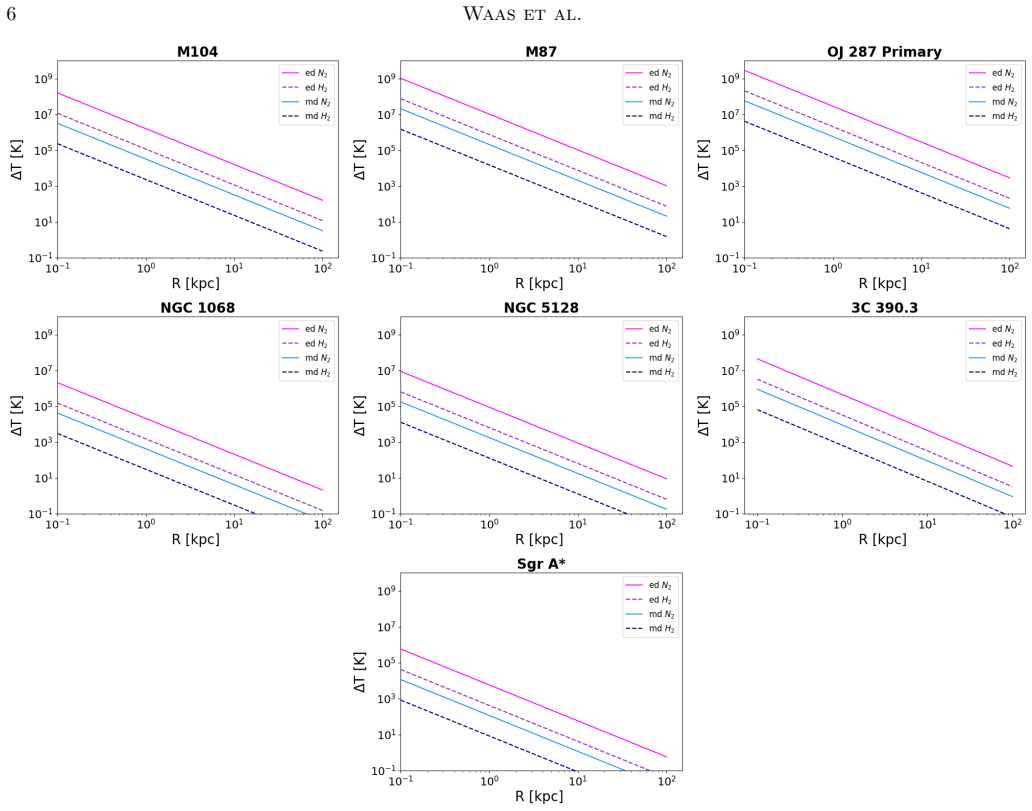
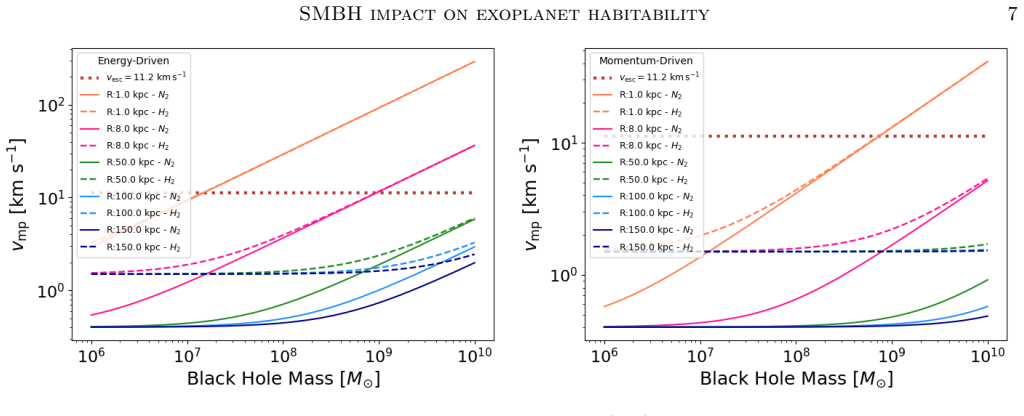
Through simplified models that relate distance from the galactic center to supermassive black hole mass, the study shows that higher black hole masses increase atmospheric heating and temperatures, which in turn raise molecular thermal velocities and enhance mass loss from planetary atmospheres. These effects are consistently stronger for energy-driven winds than for momentum-driven winds and fall off with greater distance from the center. Ozone depletion rises with black hole mass and decreases with distance, reaching nearly complete loss of about 100 percent across galactic scales for black hole masses of at least 10^8 solar masses in the energy-driven scenario. The authors conclude that a
What carries the argument
Simplified models of AGN winds and ultrafast outflows from supermassive black holes, parameterized by black hole mass and distance from the galactic center, that quantify heating, mass loss, and ozone depletion in exoplanet atmospheres.
If this is right
- Higher supermassive black hole masses produce greater atmospheric heating, elevated temperatures, faster molecular velocities, and increased mass loss on exoplanets.
- Ozone depletion increases with supermassive black hole mass and decreases with distance from the galactic center.
- Energy-driven winds consistently affect planetary atmospheres more strongly than momentum-driven winds.
- Habitability conditions vary with location inside a galaxy and with the mass of the central black hole.
- Supermassive black hole growth over cosmic time produces different impacts on habitability in galaxies depending on central black hole mass and planetary position.
Where Pith is reading between the lines
- Galaxies with smaller central black holes may maintain more widespread habitable conditions at a wider range of orbital distances.
- Atmospheric observations of exoplanets at different galactic radii could directly test for wind-driven ozone loss signatures.
- Incorporating full hydrodynamical wind-planet simulations would likely refine the critical distances where atmospheres remain intact.
- The results link central black hole activity to the spatial and temporal distribution of potentially life-supporting planets across cosmic history.
Load-bearing premise
The simplified models used here capture the relationships between supermassive black hole mass, distance, wind driving mechanism, and atmospheric response without needing detailed hydrodynamical simulations or observational calibration.
What would settle it
Finding exoplanets with substantial remaining ozone layers in galaxies that host central black holes of 10^8 solar masses or larger, at a range of distances from the center, would contradict the predicted near-total ozone depletion.
Figures



read the original abstract
While the influence of supermassive black hole (SMBH) activity on habitability has garnered attention, the specific effects of active galactic nucleus (AGN) winds, particularly ultrafast outflows (UFOs), on planetary atmospheres remain largely unexplored. This study aims to fill this gap by investigating the relationship between SMBH mass at the galactic center and exoplanetary habitability, given that SMBH masses are empirically confirmed to span approximately 5 orders of magnitude in galaxies. Through simplified models, we account for various results involving the relationships between the distance from the planet to the central SMBH and the mass of the SMBH. Specifically, we show that increased SMBH mass leads to higher atmospheric heating and elevated temperatures, greater molecular thermal velocities, and enhanced mass loss, all of which diminish with distance from the galactic center. Energy-driven winds consistently have a stronger impact than momentum-driven ones. Crucially, ozone depletion is shown to rise with SMBH mass and decrease with distance from the galactic center, with nearly complete ozone loss ($\sim100\%$) occurring across galactic scales for SMBH masses $\geq 10^8 M_\odot$ in the energy-driven case. This study emphasizes that SMBH growth over cosmic time may have produced markedly different impacts on galactic habitability, depending on both the mass of the central black hole (BH) and the location of planetary systems within their host galaxies.
Editorial analysis
A structured set of objections, weighed in public.
Referee Report
Summary. This manuscript investigates the impact of supermassive black holes (SMBHs) on exoplanet habitability through the effects of AGN winds, particularly ultrafast outflows, across a range of SMBH masses spanning five orders of magnitude. Using simplified models, the authors demonstrate that increased SMBH mass results in higher atmospheric heating, elevated temperatures, greater molecular thermal velocities, enhanced mass loss, and increased ozone depletion, with these effects diminishing at larger distances from the galactic center. They highlight that energy-driven winds have a stronger impact than momentum-driven ones, leading to nearly complete ozone loss (~100%) across galactic scales for SMBH masses of 10^8 solar masses or greater in the energy-driven case.
Significance. Should the findings be confirmed with more detailed modeling, this study would represent a novel contribution to the field of galactic habitability by quantifying the role of central SMBH activity in eroding planetary atmospheres and depleting ozone. It underscores the potential for SMBH growth to have varied impacts on habitability depending on galaxy type and planetary location, which could have implications for the distribution of life in the universe and the interpretation of exoplanet observations in AGN-active galaxies. The use of both energy- and momentum-driven wind scenarios provides a useful comparative framework.
major comments (2)
- The claim that nearly complete ozone loss (~100%) occurs across galactic scales for SMBH masses ≥10^8 M_⊙ in the energy-driven case (abstract and corresponding results section) depends on simplified analytic relations for wind kinetic power, atmospheric temperature rise, and photochemistry. This is load-bearing for the central habitability conclusion, yet the manuscript does not include validation against hydrodynamical simulations or sensitivity analyses to assumptions about uniform energy deposition, which could affect the quantitative ozone depletion percentages.
- The relationships between SMBH mass, distance, and atmospheric response are captured via simplified models without detailed hydrodynamical simulations or observational calibration of the wind-planet interaction (as described in the methods and model sections). This assumption is central to the reported trends in heating, mass loss, and ozone depletion and requires further justification or testing to support the quantitative claims.
minor comments (2)
- The abstract mentions 'simplified models' but does not specify the key equations or assumptions used for heating and ozone loss calculations; adding a brief description would improve clarity for readers.
- Consider including a table or figure summarizing ozone depletion percentages as a function of SMBH mass and galactocentric distance for both wind driving mechanisms to better illustrate the quantitative results.
Simulated Author's Rebuttal
We thank the referee for their detailed and constructive report. We address each major comment below and will revise the manuscript to incorporate additional justification, caveats, and sensitivity tests while preserving the scope of this initial analytic study.
read point-by-point responses
-
Referee: The claim that nearly complete ozone loss (~100%) occurs across galactic scales for SMBH masses ≥10^8 M_⊙ in the energy-driven case (abstract and corresponding results section) depends on simplified analytic relations for wind kinetic power, atmospheric temperature rise, and photochemistry. This is load-bearing for the central habitability conclusion, yet the manuscript does not include validation against hydrodynamical simulations or sensitivity analyses to assumptions about uniform energy deposition, which could affect the quantitative ozone depletion percentages.
Authors: We agree that the quantitative ozone depletion result is sensitive to the chain of analytic approximations. In the revised manuscript we will add an explicit sensitivity analysis subsection that varies the wind kinetic power coupling efficiency, the radial deposition profile, and the assumed atmospheric scale height. We will also insert a clear statement that the ~100% depletion figure is an upper-limit estimate under the uniform-deposition assumption and should be regarded as indicative rather than definitive. Full hydrodynamical validation lies outside the present scope but is now flagged as a priority for follow-up work. revision: yes
-
Referee: The relationships between SMBH mass, distance, and atmospheric response are captured via simplified models without detailed hydrodynamical simulations or observational calibration of the wind-planet interaction (as described in the methods and model sections). This assumption is central to the reported trends in heating, mass loss, and ozone depletion and requires further justification or testing to support the quantitative claims.
Authors: We will expand the Methods section with additional literature-based justification for the adopted wind scaling relations and the one-dimensional energy-deposition approximation. A new paragraph will discuss the absence of direct observational calibration for AGN-wind–planet interactions and will cite analogous studies of stellar-wind erosion as supporting context. While new hydrodynamical simulations cannot be performed within this paper, the revised text will explicitly state the modeling limitations and the conditions under which the reported trends are expected to hold. revision: partial
Circularity Check
No significant circularity; results are direct consequences of stated simplified models
full rationale
The paper explicitly frames its findings as outputs from simplified analytic models relating SMBH mass and galactocentric distance to atmospheric heating, thermal velocities, mass loss, and ozone depletion. These relationships are presented as model consequences rather than independent first-principles derivations that reduce to the inputs by construction. No equations are shown to be tautological (e.g., a fitted parameter relabeled as a prediction), and the abstract contains no load-bearing self-citations or uniqueness theorems imported from prior author work. The derivation chain remains self-contained as an exploration of model implications, consistent with the default expectation for non-circular modeling papers.
Axiom & Free-Parameter Ledger
axioms (1)
- domain assumption Simplified analytic or semi-analytic models can adequately capture the dominant effects of AGN winds on exoplanet atmospheres across galactic scales.
Lean theorems connected to this paper
-
IndisputableMonolith/Cost/FunctionalEquation.leanwashburn_uniqueness_aczel unclear?
unclearRelation between the paper passage and the cited Recognition theorem.
increased SMBH mass leads to higher atmospheric heating... ozone depletion is shown to rise with SMBH mass... nearly complete ozone loss (~100%)... for SMBH masses ≥10^8 M_⊙ in the energy-driven case
-
IndisputableMonolith/Foundation/RealityFromDistinction.leanreality_from_one_distinction unclear?
unclearRelation between the paper passage and the cited Recognition theorem.
ΔT = ε L_Edd Δt_Salp / (4 m_atm C) (R_p/R)^2
What do these tags mean?
- matches
- The paper's claim is directly supported by a theorem in the formal canon.
- supports
- The theorem supports part of the paper's argument, but the paper may add assumptions or extra steps.
- extends
- The paper goes beyond the formal theorem; the theorem is a base layer rather than the whole result.
- uses
- The paper appears to rely on the theorem as machinery.
- contradicts
- The paper's claim conflicts with a theorem or certificate in the canon.
- unclear
- Pith found a possible connection, but the passage is too broad, indirect, or ambiguous to say the theorem truly supports the claim.
Reference graph
Works this paper leans on
-
[1]
S., Barnes, R., Cohen, O., et al
Airapetian, V. S., Barnes, R., Cohen, O., et al. 2020, International Journal of Astrobiology, 19, 136, doi: 10.1017/S1473550419000132
-
[2]
First M87 Event Horizon Telescope Results. VI. The Shadow and Mass of the Central Black Hole
Akiyama, K., Alberdi, A., Alef, W., et al. 2019, The Astrophysical Journal Letters, 875, L6, doi: 10.3847/2041-8213/ab1141
-
[3]
2019, Journal of Cosmology and Astroparticle Physics, 2019, 056, doi: 10.1088/1475-7516/2019/12/056
Amaro-Seoane, P., & Chen, X. 2019, Journal of Cosmology and Astroparticle Physics, 2019, 056, doi: 10.1088/1475-7516/2019/12/056
-
[4]
2022, Monthly Notices of the Royal Astronomical Society, 512, 505, doi: 10.1093/mnras/stac542
Perlman, E. 2022, Monthly Notices of the Royal Astronomical Society, 512, 505, doi: 10.1093/mnras/stac542
-
[5]
2018, ApJ, 852, 37, doi: 10.3847/1538-4357/aa9b7c
Auchettl, K., Ramirez-Ruiz, E., & Guillochon, J. 2018, ApJ, 852, 37, doi: 10.3847/1538-4357/aa9b7c
-
[6]
2017, Scientific Reports, 7, 16626, doi: 10.1038/s41598-017-16110-0
Balbi, A., & Tombesi, F. 2017, Scientific Reports, 7, 16626, doi: 10.1038/s41598-017-16110-0
-
[7]
2011, Ap&SS, 336, 287, doi: 10.1007/s10509-011-0873-9
Beech, M. 2011, Ap&SS, 336, 287, doi: 10.1007/s10509-011-0873-9
-
[8]
Boehle, A., Ghez, A. M., Sch¨ odel, R., et al. 2016, ApJ, 830, 17, doi: 10.3847/0004-637X/830/1/17
-
[9]
Brain, D. A., Bagenal, F., Ma, Y. J., Nilsson, H., & Stenberg Wieser, G. 2016, Journal of Geophysical Research (Planets), 121, 2364, doi: 10.1002/2016JE005162
-
[10]
Brunton, I. R., O’Mahoney, C., Fields, B. D., Melott, A. L., & Thomas, B. C. 2023, ApJ, 947, 42, doi: 10.3847/1538-4357/acc728
-
[11]
Canfield, D. E., Glazer, A. N., & Falkowski, P. G. 2010, Science, 330, 192, doi: 10.1126/science.1186120
-
[12]
Cappellari, M., Neumayer, N., Reunanen, J., et al. 2009, Monthly Notices of the Royal Astronomical Society, 394, 660, doi: 10.1111/j.1365-2966.2008.14377.x
-
[13]
Catling, D. C., & Kasting, J. F. 2017, Atmospheric Evolution on Inhabited and Lifeless Worlds
work page 2017
-
[14]
2021, ApJ, 920, 24, doi: 10.3847/1538-4357/ac0ef2
Chartas, G., Cappi, M., Vignali, C., et al. 2021, ApJ, 920, 24, doi: 10.3847/1538-4357/ac0ef2
-
[15]
Chen, H., Forbes, J. C., & Loeb, A. 2018, The Astrophysical Journal Letters, 855, L1, doi: 10.3847/2041-8213/aaab46
-
[16]
Cramer, E. S., Briggs, M. S., Liu, N., et al. 2017, Geophysical Research Letters, 44, 5240, doi: https://doi.org/10.1002/2017GL073215 Crnojevi´ c, D., Sand, D. J., Spekkens, K., et al. 2016, ApJ, 823, 19, doi: 10.3847/0004-637X/823/1/19
-
[17]
Crutzen, P. J. 1971, J. Geophys. Res., 76, 7311, doi: 10.1029/JC076i030p07311
-
[18]
Crutzen, P. J., Isaksen, I. S. A., & Reid, G. C. 1975, Science, 189, 457, doi: 10.1126/science.189.4201.457
- [19]
-
[20]
Dartnell, L. R. 2011, Astrobiology, 11, 551, doi: 10.1089/ast.2010.0528
-
[21]
2009, A&A, 502, 771, doi: 10.1051/0004-6361/200811532
Doherty, M., Arnaboldi, M., Das, P., et al. 2009, A&A, 502, 771, doi: 10.1051/0004-6361/200811532
-
[22]
Dolgov, A. D. 2020, Journal of Physics: Conference Series, 1690, 012183, doi: 10.1088/1742-6596/1690/1/012183
-
[23]
2018a, Proceedings of the National Academy of Science, 115, 260, doi: 10.1073/pnas.1708010115
Dong, C., Jin, M., Lingam, M., et al. 2018a, Proceedings of the National Academy of Science, 115, 260, doi: 10.1073/pnas.1708010115
-
[24]
2018b, ApJL, 859, L14, doi: 10.3847/2041-8213/aac489
Dong, C., Lee, Y., Ma, Y., et al. 2018b, ApJL, 859, L14, doi: 10.3847/2041-8213/aac489
-
[25]
Elkins-Tanton, L. T., & Seager, S. 2008, ApJ, 685, 1237, doi: 10.1086/591433
-
[26]
Ellis, J., & Schramm, D. N. 1995, Proceedings of the National Academy of Sciences, 92, 235, doi: 10.1073/pnas.92.1.235 Event Horizon Telescope Collaboration, Akiyama, K.,
-
[27]
The Astrophysical Journal , publisher =
Alberdi, A., et al. 2022, ApJL, 930, L12, doi: 10.3847/2041-8213/ac6674
-
[28]
Forbes, J. C., & Loeb, A. 2018, MNRAS, 479, 171, doi: 10.1093/mnras/sty1433
-
[29]
Gehrels, N., Laird, C. M., Jackman, C. H., et al. 2003, ApJ, 585, 1169, doi: 10.1086/346127
-
[30]
Ghez, A. M., Salim, S., Weinberg, N. N., et al. 2008, ApJ, 689, 1044, doi: 10.1086/592738
-
[31]
Gillessen, S., Eisenhauer, F., Trippe, S., et al. 2009, ApJ, 692, 1075, doi: 10.1088/0004-637X/692/2/1075
-
[32]
Gofford, J., Reeves, J. N., Tombesi, F., et al. 2013, MNRAS, 430, 60, doi: 10.1093/mnras/sts481
-
[33]
W.\ 2017, Handbook of Supernovae, Type Iax Supernovae, 375
Hanslmeier, A. 2017, Supernovae, Our Solar System, and Life on Earth, ed. A. W. Alsabti & P. Murdin (Cham: Springer International Publishing), 2489–2506, doi: 10.1007/978-3-319-21846-5 114
-
[34]
2022, Monthly Notices of the Royal Astronomical Society, 513, 4669, doi: 10.1093/mnras/stac1152
Heinz, S. 2022, Monthly Notices of the Royal Astronomical Society, 513, 4669, doi: 10.1093/mnras/stac1152
-
[35]
Hewett, P. C., & Foltz, C. B. 2003, AJ, 125, 1784, doi: 10.1086/368392
-
[36]
Igo, Z., Parker, M. L., Matzeu, G. A., et al. 2020, Monthly Notices of the Royal Astronomical Society, 493, 1088, doi: 10.1093/mnras/staa265
-
[37]
2024, MNRAS, 533, 455, doi: 10.1093/mnras/stae1840
Ishibashi, W. 2024, MNRAS, 533, 455, doi: 10.1093/mnras/stae1840
-
[38]
Kennard, E. H. E. H. 1938, Kinetic Theory of Gases: With an Introduction to Statistical Mechanics, first edition edn. (New York: McGraw-Hill Book Company, inc.) 18W aas et al
work page 1938
-
[39]
Kormendy, J., Bender, R., Ajhar, E. A., et al. 1996, The Astrophysical Journal, 473, L91, doi: 10.1086/310399
-
[40]
Laha, S., Reynolds, C. S., Reeves, J., et al. 2021, Nature Astronomy, 5, 13, doi: 10.1038/s41550-020-01255-2
-
[41]
Lineweaver, C. H. 2025, in Oxford Research Encyclopedia of Planetary Science, 305, doi: 10.1093/acrefore/9780190647926.013.305
-
[42]
Lineweaver, C. H., Fenner, Y., & Gibson, B. K. 2004, Science, 303, 59, doi: 10.1126/science.1092322
-
[43]
2019, The Astrophysical Journal Letters, 874, L28, doi: 10.3847/2041-8213/ab12eb
Lingam, M. 2019, The Astrophysical Journal Letters, 874, L28, doi: 10.3847/2041-8213/ab12eb
-
[44]
Lingam, M., & Balbi, A. 2024, From Stars to Life: A Quantitative Approach to Astrobiology (Cambridge: Cambridge University Press)
work page 2024
-
[45]
Lingam, M., Dong, C., Fang, X., Jakosky, B. M., & Loeb, A. 2018, ApJ, 853, 10, doi: 10.3847/1538-4357/aa9fef
-
[46]
2019, ApJ, 877, 62, doi: 10.3847/1538-4357/ab1b2f
Lingam, M., Ginsburg, I., & Bialy, S. 2019, ApJ, 877, 62, doi: 10.3847/1538-4357/ab1b2f
-
[47]
2019, Reviews of Modern Physics, 91, 021002, doi: 10.1103/RevModPhys.91.021002
Lingam, M., & Loeb, A. 2019, Reviews of Modern Physics, 91, 021002, doi: 10.1103/RevModPhys.91.021002
-
[48]
2020, ApJL, 901, L11, doi: 10.3847/2041-8213/abb608
Lingam, M., & Loeb, A. 2020, ApJL, 901, L11, doi: 10.3847/2041-8213/abb608
-
[49]
2021, Life in the Cosmos: From Biosignatures to Technosignatures
Lingam, M., & Loeb, A. 2021, Life in the Cosmos: From Biosignatures to Technosignatures
work page 2021
-
[50]
Lister, M. L., Homan, D. C., Kellermann, K. I., et al. 2021, ApJ, 923, 30, doi: 10.3847/1538-4357/ac230f
-
[51]
2020, The Astrophysical Journal, 899, 92, doi: 10.3847/1538-4357/aba758
Liu, C., Chen, X., & Du, F. 2020, The Astrophysical Journal, 899, 92, doi: 10.3847/1538-4357/aba758
-
[52]
2015, A&A, 579, A135, doi: 10.1051/0004-6361/201525773
Longobardi, A., Arnaboldi, M., Gerhard, O., & Hanuschik, R. 2015, A&A, 579, A135, doi: 10.1051/0004-6361/201525773
-
[53]
2021, A&A, 646, A111, doi: 10.1051/0004-6361/202039396
Luminari, A., Nicastro, F., Elvis, M., et al. 2021, A&A, 646, A111, doi: 10.1051/0004-6361/202039396
-
[54]
Madhusudhan, N., Piette, A. A. A., & Constantinou, S. 2021, ApJ, 918, 1, doi: 10.3847/1538-4357/abfd9c
-
[55]
Magnabosco, C., Lin, L. H., Dong, H., et al. 2018, Nature Geoscience, 11, 707, doi: 10.1038/s41561-018-0221-6
-
[56]
Marconi, A., Risaliti, G., Gilli, R., et al. 2004, MNRAS, 351, 169, doi: 10.1111/j.1365-2966.2004.07765.x
-
[57]
Martini, P., & Weinberg, D. H. 2001, ApJ, 547, 12, doi: 10.1086/318331
-
[58]
Melott, A. L., & Thomas, B. C. 2011, Astrobiology, 11, 343, doi: 10.1089/ast.2010.0603
-
[59]
Melott, A. L., Thomas, B. C., Kachelrieß, M., Semikoz, D. V., & Overholt, A. C. 2017, The Astrophysical Journal, 840, 105, doi: 10.3847/1538-4357/aa6c57
-
[60]
Moe, M., Arav, N., Bautista, M. A., & Korista, K. T. 2009, ApJ, 706, 525, doi: 10.1088/0004-637X/706/1/525
-
[61]
Owen, J. E. 2019, Annual Review of Earth and Planetary Sciences, 47, 67, doi: 10.1146/annurev-earth-053018-060246
-
[62]
2020, Monthly Notices of the Royal Astronomical Society, 498, 3153, doi: 10.1093/mnras/staa2535
Pacetti, E., Balbi, A., Lingam, M., Tombesi, F., & Perlman, E. 2020, Monthly Notices of the Royal Astronomical Society, 498, 3153, doi: 10.1093/mnras/staa2535
-
[63]
Pounds, K. A., King, A. R., Page, K. L., & O’Brien, P. T. 2003, Monthly Notices of the Royal Astronomical Society, 346, 1025, doi: 10.1111/j.1365-2966.2003.07164.x
-
[64]
2008, SSRv, 135, 313, doi: 10.1007/s11214-007-9236-9
Prantzos, N. 2008, SSRv, 135, 313, doi: 10.1007/s11214-007-9236-9
-
[65]
Rankine, A. L., Hewett, P. C., Banerji, M., & Richards, G. T. 2020, MNRAS, 492, 4553, doi: 10.1093/mnras/staa130
-
[66]
2024, Astrobiology, 24, e916, doi: 10.1089/ast.2023.0076
Scherf, M., Lammer, H., & Spross, L. 2024, Astrobiology, 24, e916, doi: 10.1089/ast.2023.0076
-
[67]
Schwartz, S. E. 2007, Journal of Geophysical Research: Atmospheres, 112, doi: https://doi.org/10.1029/2007JD008746
-
[68]
2013, ApJ, 777, 95, doi: 10.1088/0004-637X/777/2/95
Seager, S., Bains, W., & Hu, R. 2013, ApJ, 777, 95, doi: 10.1088/0004-637X/777/2/95
-
[69]
Seager, S., Huang, J., Petkowski, J. J., & Pajusalu, M. 2020, Nature Astronomy, 4, 802, doi: 10.1038/s41550-020-1069-4
-
[70]
Sergeev, S. G., Nazarov, S. V., & Borman, G. A. 2016, Monthly Notices of the Royal Astronomical Society, 465, 1898–1909, doi: 10.1093/mnras/stw2857
-
[71]
Shen, Y. 2013, Bulletin of the Astronomical Society of India, 41, 61, doi: 10.48550/arXiv.1302.2643
work page internal anchor Pith review Pith/arXiv arXiv doi:10.48550/arxiv.1302.2643 2013
-
[72]
Sippy, K. I., Eager-Nash, J. K., Hickox, R. C., Mayne, N. J., & Brumback, M. C. 2025, ApJ, 980, 221, doi: 10.3847/1538-4357/adac5d
-
[73]
Thomas, B. C. 2018, Astrobiology, 18, 481, doi: 10.1089/ast.2017.1730
-
[74]
Thomas, B. C., & Yelland, A. M. 2023, ApJ, 950, 41, doi: 10.3847/1538-4357/accf8a
-
[75]
Thomas, B. C., Melott, A. L., Jackman, C. H., et al. 2005, ApJ, 634, 509, doi: 10.1086/496914
-
[76]
Tombesi, F., Cappi, M., Reeves, J. N., et al. 2013, MNRAS, 430, 1102, doi: 10.1093/mnras/sts692
-
[77]
Tombesi, F., Cappi, M., Reeves, J. N., et al. 2011, ApJ, 742, 44, doi: 10.1088/0004-637X/742/1/44
-
[78]
Tombesi, F., Cappi, M., Reeves, J. N., et al. 2010, A&A, 521, A57, doi: 10.1051/0004-6361/200913440
-
[79]
2015, Nature, 519, 436, doi: 10.1038/nature14261
Tombesi, F., Mel´ endez, M., Veilleux, S., et al. 2015, Nature, 519, 436, doi: 10.1038/nature14261
-
[80]
Tombesi, F., Tazaki, F., Mushotzky, R. F., et al. 2014, MNRAS, 443, 2154, doi: 10.1093/mnras/stu1297 SMBH impact on exoplanet habitability19
discussion (0)
Sign in with ORCID, Apple, or X to comment. Anyone can read and Pith papers without signing in.