REVIEW 5 major objections 5 minor 39 references
From Attention to Frequency: Integration of Vision Transformer and FFT-ReLU for Enhanced Image Deblurring
T0 review · 5 major / 5 minor · reviewed 2026-08-03 · deepseek-v4-flash
Pith's one-line read A dual-domain deblurring pipeline pairs a Vision Transformer with FFT-ReLU sparsity and claims state-of-the-art results on RealBlur-R and HIDE.
desk verdict A cascade of Restormer and the authors' own FFT-ReLU that shows no meaningful gain over the baseline and never specifies how the two stages actually connect. read the letter →
The pith
A machine-rendered reading of the paper's core claim, the machinery that carries it, and where it could break.
The reading
What carries the argument
The load-bearing machinery is the FFT-ReLU sparsity prior: an iterative blind-deconvolution loop that alternates latent-image estimation via L0 gradient minimization with fast total variation regularization and PSF estimation in the Fourier domain, followed by a non-blind ringing-artifact removal stage. The Vision Transformer acts as a preprocessor meant to shrink the space of possible blur kernels before this frequency-domain optimization runs.
What would settle it
Take a synthetic blurred image generated by convolving a sharp image with a known kernel, feed the Transformer's output into Algorithm 1, and compare the estimated kernel to the ground-truth kernel; if the estimate does not resemble the true kernel, the FFT stage is not doing the deblurring the paper attributes to it.
Extended reading notes
Core claim
In the author's own terms, the contribution is the first tightly coupled hybrid model that unifies spatial-domain attention with frequency-domain sparsity for deblurring: a Vision Transformer preprocesses the blurred image to reduce kernel ambiguity, then FFT-based blind and non-blind deconvolution with ReLU sparsity restores the sharp image. The authors claim this two-phase design outperforms existing deblurring models on RealBlur-R and HIDE by PSNR and SSIM, matches the best results on GoPro and RealBlur-J, and produces images that human viewers prefer by a wide margin.
Load-bearing premise
The claimed spatial–frequency synergy assumes that the Vision Transformer's output can still be treated as a blurred image with a reduced blur kernel when it enters the blind-deconvolution stage, even though that output is itself a deblurred image.
Editorial extensions
If this is right
- If the pipeline works as claimed, spatially-aware Transformers can be paired with cheap frequency-domain deconvolution to sharpen edges without greatly increasing memory use.
- The near-linear memory scaling of the FFT-ReLU stage suggests the hybrid can be extended to high-resolution images where pure Transformer deblurring is impractical.
- The human-preference result implies pixel-based metrics understate perceptual gains; future deblurring evaluations could combine metrics with structured human assessment.
- Reported performance on HIDE, which features non-uniform human motion blur, indicates the frequency prior is not limited to uniform blur, though the paper does not provide an ablation isolating this factor.
Reading between the lines
- A testable extension: replace the Transformer preprocessor with a cheaper kernel-reduction method, such as a small CNN or a hand-crafted edge detector, and compare results; if performance holds, the advantage may come from the frequency prior rather than long-range attention.
- The same dual-domain recipe could transfer to other restoration tasks such as denoising or super-resolution, where high-frequency detail recovery is also limited by purely spatial models.
- If the Transformer truly only narrows the kernel space, then the method should handle spatially varying blur gracefully; analyzing the estimated PSF across image regions would clarify whether the underlying uniform-kernel model is realistic.
Editorial analysis
A structured set of objections, weighed in public.
Referee Report
Summary. The paper proposes a two-stage image deblurring pipeline: a Vision Transformer (specifically Restormer) first preprocesses the blurred image and is claimed to 'narrow down the blur kernel values', and then an FFT-based blind/non-blind deconvolution stage with ReLU sparsity (the authors' own WACV 2025 method) restores the sharp image. The authors claim this is the first tightly coupled hybrid of spatial attention and frequency-domain sparsity, and report superior PSNR/SSIM over state-of-the-art on GoPro, HIDE, RealBlur, and Kohler, supplemented by a human preference study and runtime/memory analysis.
Significance. If the claimed integration were real and the gains were reproducible, a lightweight frequency-domain postprocessor that improves a strong ViT baseline would be a useful practical contribution, especially given the reported small added runtime and memory cost. The paper also provides code, a human evaluation, and explicit discussion of the limitations of pixel-wise metrics. However, the central quantitative claim is not supported by the reported numbers, and the connection between the two stages is not specified, so the contribution is currently unsubstantiated. The novelty claim of being the first spatial-frequency hybrid is also weakened by prior work cited in the paper itself.
major comments (5)
- [Table 1, Section 4.3.1] The claim that the proposed method 'generates superior results in terms of PSNR and SSIM' is not supported by Table 1. The 'Ours' row is identical to Restormer on HIDE (31.22/0.942) and GoPro (32.92/0.961), and exceeds it by only 0.03 dB PSNR on RealBlur-R and 0.02 dB on RealBlur-J. The average PSNR gain over Restormer is 0.0125 dB. No error bars, standard deviations, or significance tests are provided, and the gains are far below typical benchmark noise. This does not establish superiority.
- [Section 3, Figure 1, Algorithm 1] The pipeline's input to Algorithm 1 is never specified. Algorithm 1's input B is used as the blurred observation in a single-convolution forward model B = S * k. Figure 1 labels the intermediate signal 'Blurred Image With Reduced Kernel', implying B is the ViT output. If so, the ViT output is not a blurred image satisfying the forward model, making the kernel estimate meaningless. If instead B is the original blurred image, the ViT output is not used in the FFT stage, and the claimed 'tightly coupled' integration disappears. The manuscript must state which input is used and provide an ablation; without this, the reported numbers cannot be attributed to the proposed integration.
- [Section 3.1] The mechanism by which the ViT 'narrows down the blur kernel values' is not described or validated. The ViT is a standard deblurring network trained to output sharp images; there is no explanation of how its output constrains the PSF estimate in Algorithm 1. This is a load-bearing step for the claimed synergy, and no experiment isolates its effect.
- [Section 4.3.4] The paper itself concedes that quantitative gains are 'small' and repositions the contribution as 'practically superior' based on the human preference study. However, the human study in Section 4.3.3 reports only mean ranks from a small set of 76 participants over 10 image sets, with no error bars, no statistical test, and no information about participant selection or image diversity. A 9.67/10 mean for 'Ours' with no variance measure does not substantiate perceptual superiority over methods scoring 3.84–5.91.
- [Section 1 and Related Works (Section 2)] The claim that this is 'the first to present a tightly coupled hybrid model that combines both [spatial and frequency]' is contradicted by prior work cited in the paper, including [4] (CNN–Transformer combination), [19] (frequency selection for deblurring), and [33] (inverted residual Fourier transformation for deblurring). The novelty statement should be narrowed to the specific ViT-plus-FFT-ReLU architecture and should acknowledge existing spatial–frequency deblurring hybrids.
minor comments (5)
- [Table 1] Formatting error: '36.190.957' should read '36.19 0.957'. The caption says 'highlighted' but no rows are bolded. Also, the 'Average' column uses inconsistent arithmetic precision.
- [Algorithm 1] The algorithm uses undefined variables 'weight' and 'opts.xk_iter'. Procedure 1's findM and threshold_pxpy_v1 are mentioned but not defined, making the algorithm not self-contained.
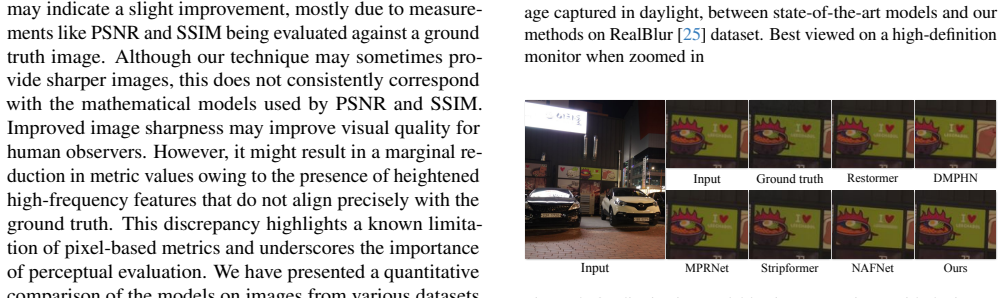
- [Figure 1] The figure caption is confusing: subfigures (a) and (b) are labeled 'Vision Transformer' and 'FFT with ReLU Sparsity', but the text in the figure seems mismatched with the caption. Please clarify the flow and labels.
- [Section 4.2] The experimental setup only states that 'Restormer is trained on GoPro' but does not give training details, hyperparameters, or how the FFT stage parameters (λ_ftr, λ_grad, λ_tv, λ_L0, weight_ring, etc.) are set. This makes reproduction difficult.
- [Section 4.3.5] Runtime analysis reports total time as the sum of the two stages, but no comparison is made to a state-of-the-art end-to-end model other than Restormer. The claim that FFT-ReLU scales with 'near-linear memory' needs a plot or reference.
Circularity Check
Claimed ViT+FFT gain rests on self-cited FFT-ReLU module rather than an isolated comparison; Table 1 shows Ours = Restormer on HIDE/GoPro.
-
self citation load bearing
[Section 2 (Related Works), with Table 1 and Section 4.3.5]
""Recent work on FFT-ReLU sparsity priors has demonstrated that frequency-domain constraints can enable efficient and competitive blind deblurring across diverse image types [1]. However, such approaches lacked the ability to capture complex spatial dependencies, limiting their robustness for spatially varying blur. In this paper, we extend the scope of FFT-ReLU by integrating it with Vision Transformers, creating an explicit spatial–frequency framework." Reference [1] is the authors' own WACV 2025 paper. In Table 1, Restormer and Ours are identical on HIDE (31.22/0.942) and GoPro (32.92/0.961)"
The paper's central added-value claim—that the FFT-ReLU module improves deblurring when integrated with a ViT—is grounded in the authors' own prior WACV paper [1]. Section 4.3.5 provides only runtime and memory numbers for standalone FFT-ReLU, never deblurring quality on the benchmark datasets, so the paper does not independently measure what the module contributes. Moreover, the paper's own Table 1 shows 'Ours' numerically equal to the Restormer preprocessor on two of four datasets, so the reported superiority is not evidence of a measurable FFT-stage improvement. The small average PSNR gain (0.0125 dB over Restormer) is within rounding magnitude. This makes the self-citation load-bearing: the frequency-domain benefit is imported from [1] rather than demonstrated here.
full rationale
The paper is not formally circular in the sense that no equation defines the predicted metric in terms of fitted parameters, and the benchmark comparisons are against external methods. However, the key step—that adding the FFT-ReLU module to a Vision Transformer yields superior deblurring—is supported primarily by the authors' own prior work [1], and the current paper never isolates the module's effect with an ablation or standalone quality metrics. Table 1 shows Ours identical to Restormer on HIDE and GoPro and within 0.02-0.03 dB on RealBlur-R/J, so the central claim of integration-driven improvement is not established by the reported numbers. There is also an unresolved pipeline ambiguity: Fig. 1 labels the FFT stage input 'Blurred Image With Reduced Kernel' while Algorithm 1 assumes a blurred observation B; if B is the ViT output, the forward model B = S * k is violated, and if B is the original blurred image, the ViT stage is disconnected. That is a correctness/ablation concern rather than a by-construction circularity, but it reinforces that the claimed spatial–frequency synergy is not independently measured. Given the load-bearing self-citation and the absence of a module-isolating comparison, a score of 4 is appropriate: some self-citation, with the central benchmark claim still having independent content.
Assumptions & free parameters
free parameters (7)
- lambda_ftr (λ_ftr)
- lambda_grad (λ_grad)
- threshold
- alpha, beta, kappa (α, β, κ)
- lambda_tv (λ_tv)
- lambda_L0 (λ_L0)
- weight_ring
assumptions (4)
- domain assumption Blur model B = S * k with a single, spatially uniform kernel k
- standard math FFT convolution theorem and Tikhonov regularization for PSF estimation
- ad hoc to paper The ViT (Restormer) output 'narrows down the blur kernel values' without a specified mechanism
- domain assumption Human 1–10 quality ratings are comparable across raters and image sets
Cite this review
Pith. "Pith review of From Attention to Frequency: Integration of Vision Transformer and FFT-ReLU for Enhanced Image Deblurring." pith.science (2026). https://pith.science/paper/W5JHSQRM
@misc{pith2026251110806,
  author       = {Pith},
  title        = {Pith review of: From Attention to Frequency: Integration of Vision Transformer and FFT-ReLU for Enhanced Image Deblurring},
  year         = {2026},
  howpublished = {\url{https://pith.science/paper/W5JHSQRM}},
  note         = {Machine review of arXiv:2511.10806}
}
read the original abstract
Image deblurring is vital in computer vision, aiming to recover sharp images from blurry ones caused by motion or camera shake. While deep learning approaches such as CNNs and Vision Transformers (ViTs) have advanced this field, they often struggle with complex or high-resolution blur and computational demands. We propose a new dual-domain architecture that unifies Vision Transformers with a frequency-domain FFT-ReLU module, explicitly bridging spatial attention modeling and frequency sparsity. In this structure, the ViT backbone captures local and global dependencies, while the FFT-ReLU component enforces frequency-domain sparsity to suppress blur-related artifacts and preserve fine details. Extensive experiments on benchmark datasets demonstrate that this architecture achieves superior PSNR, SSIM, and perceptual quality compared to state-of-the-art models. Both quantitative metrics, qualitative comparisons, and human preference evaluations confirm its effectiveness, establishing a practical and generalizable paradigm for real-world image restoration.
Figures


Figures from the paper (4 more)


Reference graph
Works this paper leans on
-
[4]
Image deblurring based on an improved cnn- transformer combination network.Applied Sciences, 13(1),
Xiaolin Chen, Yuanyuan Wan, Donghe Wang, and Yuqing Wang. Image deblurring based on an improved cnn- transformer combination network.Applied Sciences, 13(1),
-
[19]
Intriguing findings of frequency selection for image deblurring
Xintian Mao, Yiming Liu, Fengze Liu, Qingli Li, Wei Shen, and Yan Wang. Intriguing findings of frequency selection for image deblurring. InProceedings of the AAAI Conference on Artificial Intelligence, pages 1905–1913, 2023. 1
1905
-
[33]
Inverted residual fourier transformation for lightweight single image deblurring.IEEE Access, 11:29175–29182, 2023
Shunsuke Yae and Masaaki Ikehara. Inverted residual fourier transformation for lightweight single image deblurring.IEEE Access, 11:29175–29182, 2023. 1
2023
-
[1]
Mosaddek Khan
Abdul Mohaimen Al Radi, Prothito Shovon Majumder, and Md. Mosaddek Khan. Blind image deblurring with fft-relu sparsity prior. In2025 IEEE/CVF Winter Conference on Applications of Computer Vision (WACV), pages 3447–3456,
-
[2]
Estimating an image’s blur kernel using natural image statis- tics, and deblurring it: An analysis of the goldstein-fattal method.Image Processing On Line, 8:282–304, 2018
Jérémy Anger, Gabriele Facciolo, and Mauricio Delbracio. Estimating an image’s blur kernel using natural image statis- tics, and deblurring it: An analysis of the goldstein-fattal method.Image Processing On Line, 8:282–304, 2018. 1
2018
-
[3]
Simple baselines for image restoration
Liangyu Chen, Xiaojie Chu, Xiangyu Zhang, and Jian Sun. Simple baselines for image restoration. InEuropean Con- ference on Computer Vision, pages 17–33. Springer, 2022. 2
2022
-
[5]
Nbnet: Noise basis learning for image denoising with subspace projection
Shen Cheng, Yuzhi Wang, Haibin Huang, Donghao Liu, Haoqiang Fan, and Shuaicheng Liu. Nbnet: Noise basis learning for image denoising with subspace projection. In 2021 IEEE/CVF Conference on Computer Vision and Pattern Recognition (CVPR), pages 4894–4904, 2021. 1
2021
-
[6]
Rethinking coarse-to-fine approach in single image deblurring
Sung-Jin Cho, Seo-Won Ji, Jun-Pyo Hong, Seung-Won Jung, and Sung-Jea Ko. Rethinking coarse-to-fine approach in single image deblurring. In2021 IEEE/CVF International Conference on Computer Vision (ICCV), pages 4621–4630,
Show all 39 references
-
[7]
Nafssr: Stereo image super-resolution using nafnet
Xiaojie Chu, Liangyu Chen, and Wenqing Yu. Nafssr: Stereo image super-resolution using nafnet. InProceedings of the IEEE/CVF Conference on Computer Vision and Pattern Recognition (CVPR) Workshops, pages 1239–1248, 2022. 6, 8
2022
-
[8]
Image deblurring by sparsity constraint on the fourier coefficients.Numerical Algorithms, 72, 2016
Marco Donatelli, Thomas Huckle, Mariarosa Mazza, and Debora Sesana. Image deblurring by sparsity constraint on the fourier coefficients.Numerical Algorithms, 72, 2016. 1
2016
-
[9]
Image super-resolution using deep convolutional net- works.IEEE transactions on pattern analysis and machine intelligence, 38(2):295–307, 2016
Chao Dong, Chen Change Loy, Kaiming He, and Xiaoou Tang. Image super-resolution using deep convolutional net- works.IEEE transactions on pattern analysis and machine intelligence, 38(2):295–307, 2016. 2
2016
-
[10]
An image is worth 16x16 words: Trans- formers for image recognition at scale.arXiv preprint arXiv:2010.11929, 2020
Alexey Dosovitskiy, Lucas Beyer, Alexander Kolesnikov, Dirk Weissenborn, Xiaohua Zhai, Thomas Unterthiner, Mostafa Dehghani, Matthias Minderer, Georg Heigold, Syl- vain Gelly, et al. An image is worth 16x16 words: Trans- formers for image recognition at scale.arXiv preprint ar...
2010 arXiv
-
[11]
Dy- namic scene deblurring with parameter selective sharing and nested skip connections
Hongyun Gao, Xin Tao, Xiaoyong Shen, and Jiaya Jia. Dy- namic scene deblurring with parameter selective sharing and nested skip connections. InProceedings of the IEEE Con- ference on Computer Vision and Pattern Recognition, pages 3848–3856, 2019. 1
2019
-
[12]
A survey on vision transformer.IEEE Transactions on Pattern Analysis and Machine Intelligence, PP:1–1, 2020
Kai Han, Yunhe Wang, Hanting Chen, Xinghao Chen, Jianyuan Guo, Zhenhua Liu, Yehui Tang, An Xiao, Chunjing Xu, Yixing Xu, Zhaohui Yang, Yiman Zhang, and Dacheng Tao. A survey on vision transformer.IEEE Transactions on Pattern Analysis and Machine Intelligence, PP:1–1, 2020. 1
2020
-
[13]
Reddy, Balaswamy Chintha- guntla, Senthil Jagatheesaperumal, Silvia Gaftandzhieva, and Rositsa Doneva
Ch Kameswari, Kavitha J, T. Reddy, Balaswamy Chintha- guntla, Senthil Jagatheesaperumal, Silvia Gaftandzhieva, and Rositsa Doneva. An overview of vision transformers for im- age processing: A survey.International Journal of Advanced Computer Science and Applications, 14, 2023. 1
2023
-
[14]
Deblurgan: Blind mo- tion deblurring using conditional adversarial networks.ArXiv e-prints, 2017
Orest Kupyn, V olodymyr Budzan, Mykola Mykhailych, Dmytro Mishkin, and Jiri Matas. Deblurgan: Blind mo- tion deblurring using conditional adversarial networks.ArXiv e-prints, 2017. 6
2017
-
[15]
Deblurgan-v2: Deblurring (orders-of-magnitude) faster and better
Orest Kupyn, Tetiana Martyniuk, Junru Wu, and Zhangyang Wang. Deblurgan-v2: Deblurring (orders-of-magnitude) faster and better. InThe IEEE International Conference on Computer Vision (ICCV), 2019. 6
2019
-
[16]
Recording and playback of camera shake: Benchmarking blind deconvolution with a real-world database
Rolf Köhler, Michael Hirsch, Betty Mohler, Bernhard Schölkopf, and Stefan Harmeling. Recording and playback of camera shake: Benchmarking blind deconvolution with a real-world database. pages 27–40, 2012. 5, 6, 7
2012
-
[17]
Swinir: Image restoration using swin transformer
Jingyun Liang, Jiezhang Cao, Guolei Sun, Kai Zhang, Luc Van Gool, and Radu Timofte. Swinir: Image restoration using swin transformer. InProceedings of the IEEE/CVF international conference on computer vision, pages 1833– 1844, 2021. 2
2021
-
[18]
De- blurdinat: A lightweight and effective transformer for image deblurring, 2024
Hanzhou Liu, Binghan Li, Chengkai Liu, and Mi Lu. De- blurdinat: A lightweight and effective transformer for image deblurring, 2024. 6
2024
-
[20]
Deep multi-scale convolutional neural network for dynamic scene deblurring
Seungjun Nah, Tae Hyun Kim, and Kyoung Mu Lee. Deep multi-scale convolutional neural network for dynamic scene deblurring. InProceedings of the IEEE conference on com- puter vision and pattern recognition, pages 3883–3891, 2017. 5, 6
2017
-
[21]
Deep multi-scale convolutional neural network for dynamic scene deblurring
Seungjun Nah, Tae Hyun Kim, and Kyoung Mu Lee. Deep multi-scale convolutional neural network for dynamic scene deblurring. In2017 IEEE Conference on Computer Vision and Pattern Recognition (CVPR), pages 257–265, 2017. 1
2017
-
[22]
Multi-temporal recurrent neural networks for progres- sive non-uniform single image deblurring with incremental temporal training
Dongwon Park, Dong Un Kang, Jisoo Kim, and Se Young Chun. Multi-temporal recurrent neural networks for progres- sive non-uniform single image deblurring with incremental temporal training. InEuropean Conference on Computer Vision, pages 327–343. Springer, 2020. 6
2020
-
[23]
Rajagopalan, and Vishnu Boddeti
Kuldeep Purohit, Maitreya Suin, A. Rajagopalan, and Vishnu Boddeti. Spatially-adaptive image restoration using distortion- guided networks. pages 2289–2299, 2021. 6
2021
-
[24]
Global filter networks for image classification
Yongming Rao, Wenliang Zhao, Yansong Zhu, Jiwen Lu, and Jie Zhou. Global filter networks for image classification. In 9 Advances in Neural Information Processing Systems, pages 980–993, 2021. 2
2021
-
[25]
Real-world blur dataset for learning and benchmarking deblur- ring algorithms
Jaesung Rim, Haeyun Lee, Jucheol Won, and Sunghyun Cho. Real-world blur dataset for learning and benchmarking deblur- ring algorithms. InProceedings of the European Conference on Computer Vision (ECCV), 2020. 5, 6
2020
-
[26]
Human-aware motion deblur- ring
Ziyi Shen, Wenguan Wang, Jianbing Shen, Haibin Ling, Tingfa Xu, and Ling Shao. Human-aware motion deblur- ring. InIEEE International Conference on Computer Vision,
-
[27]
Scale-recurrent network for deep image deblurring
Xin Tao, Hongyun Gao, Xiaoyong Shen, Jue Wang, and Jiaya Jia. Scale-recurrent network for deep image deblurring. In IEEE Conference on Computer Vision and Pattern Recogni- tion (CVPR), 2018. 2, 6
2018
-
[28]
Stripformer: Strip transformer for fast image deblurring
Fu-Jen Tsai, Yan-Tsung Peng, Yen-Yu Lin, Chung-Chi Tsai, and Chia-Wen Lin. Stripformer: Strip transformer for fast image deblurring. InECCV, 2022. 6, 8
2022
-
[29]
Attention is all you need.Advances in neural information processing systems, 30, 2017
Ashish Vaswani, Noam Shazeer, Niki Parmar, Jakob Uszko- reit, Llion Jones, Aidan N Gomez, Łukasz Kaiser, and Illia Polosukhin. Attention is all you need.Advances in neural information processing systems, 30, 2017. 1
2017
-
[30]
A fast algorithm for image deblurring with total variation regularization
Yilun Wang, Wotao Yin, and Yin Zhang. A fast algorithm for image deblurring with total variation regularization. 2007. 1
2007
-
[31]
Zhihao Wang, Jian Chen, and Steven C. H. Hoi. Deep learning for image super-resolution: A survey.IEEE Transactions on Pattern Analysis and Machine Intelligence, 43(10):3365– 3387, 2021. 1
2021
-
[32]
Two-phase kernel estimation for ro- bust motion deblurring
Li Xu and Jiaya Jia. Two-phase kernel estimation for ro- bust motion deblurring. InComputer Vision – ECCV 2010, pages 157–170, Berlin, Heidelberg, 2010. Springer Berlin Heidelberg. 1
2010
-
[34]
Fda: Fourier do- main adaptation for semantic segmentation.arXiv preprint arXiv:2004.05498, 2020
Yanchao Yang and Stefano Soatto. Fda: Fourier do- main adaptation for semantic segmentation.arXiv preprint arXiv:2004.05498, 2020. 2
2004 arXiv
-
[35]
Multi-stage progressive image restoration
Syed Waqas Zamir, Aditya Arora, Salman Khan, Munawar Hayat, Fahad Shahbaz Khan, Ming-Hsuan Yang, and Ling Shao. Multi-stage progressive image restoration. InCVPR,
-
[36]
Restormer: Efficient transformer for high-resolution image restoration
Syed Waqas Zamir, Aditya Arora, Salman Khan, Mu- nawar Hayat, Fahad Shahbaz Khan, and Ming-Hsuan Yang. Restormer: Efficient transformer for high-resolution image restoration. InCVPR, 2022. 2, 5, 6, 8
2022
-
[37]
Event-guided multi-patch network with self-supervision for non-uniform motion deblurring.In- ternational Journal of Computer Vision, pages 1–18, 2022
Hongguang Zhang, Limeng Zhang, Yuchao Dai, Hongdong Li, and Piotr Koniusz. Event-guided multi-patch network with self-supervision for non-uniform motion deblurring.In- ternational Journal of Computer Vision, pages 1–18, 2022. 6, 8
2022
-
[38]
Deblurring by realistic blurring
Kaihao Zhang, Wenhan Luo, Yiran Zhong, Lin Ma, Bjorn Stenger, Wei Liu, and Hongdong Li. Deblurring by realistic blurring. InProceedings of the IEEE/CVF conference on computer vision and pattern recognition, pages 2737–2746,
-
[39]
Image super-resolution using very deep residual channel attention networks
Yulun Zhang, Kunpeng Li, Kai Li, Lichen Wang, Bineng Zhong, and Yun Fu. Image super-resolution using very deep residual channel attention networks. InProceedings of the European conference on computer vision (ECCV), pages 286– 301, 2018. 2 10
2018
Reviewed August 3, 2026 · model on record in the stance chip above.
Discussion (0). Continue with ORCID to comment.