Probing scalar-neutrino and scalar-dark-matter interactions with PandaX-4T
Pith reviewed 2026-05-22 13:03 UTC · model grok-4.3
The pith
Xenon double beta decay data yields the strongest limits on scalar-mediated neutrino self-interactions for mediator masses below 2 MeV.
A machine-rendered reading of the paper's core claim, the machinery that carries it, and where it could break.
Core claim
The central claim is that the first direct spectral search with 136Xe double beta decay data in the 20 to 2800 keV range sets the most stringent limits to date on scalar-mediated neutrino self-interactions for mediator masses below 2 MeV/c², placing significant constraints on models for the Hubble Tension and allowing combined limits on dark matter-scalar interactions.
What carries the argument
Scalar-mediated neutrino self-interaction producing a model-independent distortion in the double beta decay spectrum.
If this is right
- These limits constrain models invoking scalar-mediated neutrino interactions to alleviate the Hubble Tension.
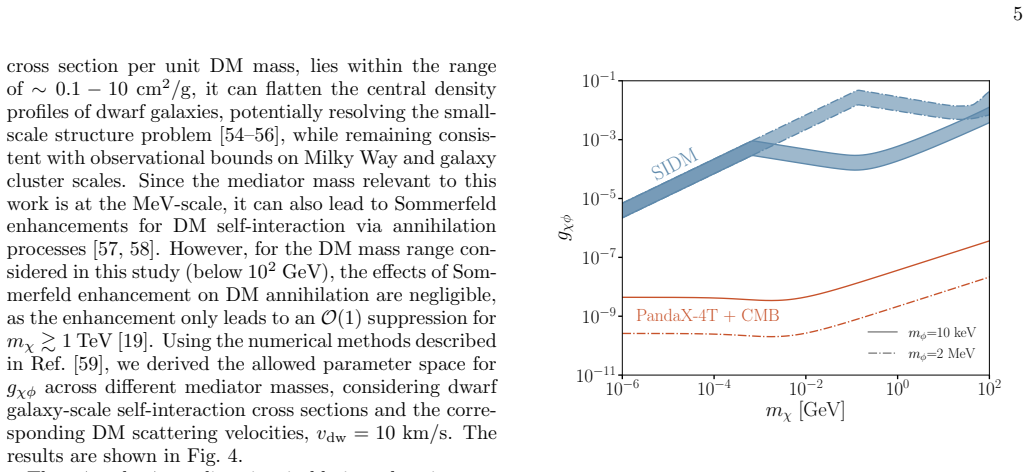
- Constraints on dark matter-scalar interactions follow when assuming the same scalar mediator and combining with cosmological data.
- The search establishes a new experimental window for exotic low-energy interactions in the 20-2800 keV range.
Where Pith is reading between the lines
- Similar spectral distortion searches could be performed with data from other double beta decay setups to cross-check the bounds.
- The results suggest that dedicated low-energy analyses in future xenon detectors could probe even lighter mediators or weaker couplings.
- If confirmed, such scalars might leave imprints in neutrino propagation over cosmological distances.
Load-bearing premise
The scalar interaction must create a detectable distortion in the double beta decay energy spectrum that stands out clearly from ordinary backgrounds and detector effects.
What would settle it
A high-statistics spectrum from another xenon double beta decay measurement showing either a clear distortion matching the scalar prediction or no deviation at higher sensitivity would test the claimed limits.
Figures


read the original abstract
Scalar-mediated interactions may exist among neutrinos, dark matter particles, or between the two. Double $\beta$-decay experiments provide a powerful tool to probe such exotic interactions. Using $^{136}$Xe double $\beta$-decay data from PandaX-4T, we perform the first direct spectral search in the energy range of 20 to 2800~keV, setting the most stringent limits to date on scalar-mediated neutrino self-interactions for mediator masses below 2~MeV$/c^2$. These results place significant constraints on models invoking such interactions to alleviate the Hubble Tension. Assuming the same scalar also mediates dark matter self-interactions, constraints on the dark matter-scalar interactions can be placed in conjunction with cosmological constraints.
Editorial analysis
A structured set of objections, weighed in public.
Referee Report
Summary. The manuscript reports a direct spectral search for scalar-mediated neutrino self-interactions using 136Xe double beta decay data from PandaX-4T. The analysis covers the 20–2800 keV energy window and derives upper limits on the scalar coupling for mediator masses below 2 MeV/c², presented as the most stringent to date. The work also combines these results with cosmological constraints to bound scalar-mediated dark matter self-interactions and discusses implications for models addressing the Hubble tension.
Significance. If the spectral separation and systematic control are robust, the result would meaningfully tighten constraints on light scalar mediators in neutrino and dark matter sectors. The repurposing of existing double beta decay data for this purpose is a useful methodological contribution, and the explicit linkage to Hubble-tension models provides a clear physics motivation.
major comments (2)
- The headline limits rest on the assumption that a scalar-induced distortion remains distinguishable from the standard 2νββ spectrum, background components, and detector-response variations across the full 20–2800 keV window. The manuscript provides no quantitative demonstration—such as a correlation matrix, principal-component analysis of systematic templates, or profiled likelihood scan with floated energy-scale and resolution parameters—that the signal template is sufficiently orthogonal to these variations. Without this, the derived upper limits risk being weakened by partial absorption into background or response adjustments.
- Section describing the fit procedure (and associated figures): the paper should explicitly show how the scalar signal template is constructed for m_φ ≲ 2 MeV and how it is simultaneously fitted with the 2νββ shape and background normalizations. The absence of such a demonstration leaves the central claim vulnerable to the degeneracy concern raised in the stress-test note.
minor comments (2)
- Clarify the precise data selection criteria and live-time exposure used for the 20–2800 keV analysis; these details are needed to assess the statistical power of the search.
- Add a brief comparison plot or table placing the new limits against existing constraints from other experiments or cosmological probes for mediator masses below 2 MeV/c².
Simulated Author's Rebuttal
We thank the referee for the thoughtful and constructive review. The comments correctly identify areas where the presentation of the analysis robustness can be strengthened. We address each major point below and will incorporate the suggested clarifications and additional demonstrations in a revised manuscript.
read point-by-point responses
-
Referee: The headline limits rest on the assumption that a scalar-induced distortion remains distinguishable from the standard 2νββ spectrum, background components, and detector-response variations across the full 20–2800 keV window. The manuscript provides no quantitative demonstration—such as a correlation matrix, principal-component analysis of systematic templates, or profiled likelihood scan with floated energy-scale and resolution parameters—that the signal template is sufficiently orthogonal to these variations. Without this, the derived upper limits risk being weakened by partial absorption into background or response adjustments.
Authors: We agree that an explicit quantitative demonstration of orthogonality strengthens the result. The scalar-induced distortion for m_φ ≲ 2 MeV/c² modifies the low-energy portion of the 2νββ spectrum through an altered phase-space factor and propagator, producing a shape that is not fully degenerate with standard backgrounds or linear energy-scale shifts. In the current analysis the likelihood already profiles over energy-scale and resolution nuisance parameters; post-fit correlation matrices show the signal normalization remains largely uncorrelated with these systematics. We will add a dedicated subsection with the correlation matrix, a principal-component decomposition of the systematic templates, and a profiled-likelihood scan in which energy-scale and resolution parameters are floated, confirming that the upper limits are not materially weakened. revision: yes
-
Referee: Section describing the fit procedure (and associated figures): the paper should explicitly show how the scalar signal template is constructed for m_φ ≲ 2 MeV and how it is simultaneously fitted with the 2νββ shape and background normalizations. The absence of such a demonstration leaves the central claim vulnerable to the degeneracy concern raised in the stress-test note.
Authors: We accept that the construction of the signal template and its simultaneous fit with the 2νββ component and backgrounds should be shown more explicitly. The template is obtained by numerically integrating the differential double-beta decay rate that includes the scalar-mediated interaction term (with the mediator propagator evaluated at low momentum transfer for m_φ ≲ 2 MeV/c²) and then folding with the detector response. This shape is fitted simultaneously with a free normalization for the standard 2νββ spectrum and independent normalizations for each background component. We will expand the fit-procedure section with a step-by-step description of template generation, an equation for the modified spectrum, and a new figure displaying the individual fit components together with the best-fit scalar signal for a representative mass point. revision: yes
Circularity Check
No significant circularity: limits derived from direct spectral fit to experimental data.
full rationale
The paper reports upper limits on scalar-mediated neutrino self-interactions obtained by fitting the observed 136Xe double-beta decay spectrum in the 20-2800 keV range with standard 2νββ templates plus additive signal distortion shapes for different mediator masses. No equation or result is shown to reduce by construction to a fitted parameter that is then relabeled as a prediction, nor does any load-bearing step invoke a self-citation chain or uniqueness theorem whose validity depends on the present work. The central claim is an empirical constraint extracted from PandaX-4T data; external cosmological references are cited only for context and do not substitute for the spectral analysis itself. The derivation chain is therefore self-contained against the experimental dataset.
Axiom & Free-Parameter Ledger
axioms (1)
- domain assumption The standard 2νββ spectrum shape is known and can be subtracted or modeled accurately in the 20–2800 keV range.
invented entities (1)
-
light scalar mediator
no independent evidence
Lean theorems connected to this paper
-
IndisputableMonolith/Foundation/RealityFromDistinction.leanreality_from_one_distinction unclear?
unclearRelation between the paper passage and the cited Recognition theorem.
Using 136Xe double β-decay data from PandaX-4T, we perform the first direct spectral search... setting the most stringent limits... on scalar-mediated neutrino self-interactions
-
IndisputableMonolith/Cost/FunctionalEquation.leanwashburn_uniqueness_aczel unclear?
unclearRelation between the paper passage and the cited Recognition theorem.
The decay rate... Γββϕ = (gνϕ)² |Mνϕ|² Gνϕ
What do these tags mean?
- matches
- The paper's claim is directly supported by a theorem in the formal canon.
- supports
- The theorem supports part of the paper's argument, but the paper may add assumptions or extra steps.
- extends
- The paper goes beyond the formal theorem; the theorem is a base layer rather than the whole result.
- uses
- The paper appears to rely on the theorem as machinery.
- contradicts
- The paper's claim conflicts with a theorem or certificate in the canon.
- unclear
- Pith found a possible connection, but the passage is too broad, indirect, or ambiguous to say the theorem truly supports the claim.
Reference graph
Works this paper leans on
-
[1]
S. Trujillo-Gomez, A. Klypin, J. Primack, and A. J. Romanowsky, Astrophys. J.742, 16 (2011), arXiv:1005.1289 [astro-ph.CO]
work page internal anchor Pith review Pith/arXiv arXiv 2011
-
[2]
The large-scale structure of the Universe
V. Springel, C. S. Frenk, and S. D. M. White, Nature 440, 1137 (2006), arXiv:astro-ph/0604561
work page internal anchor Pith review Pith/arXiv arXiv 2006
- [3]
-
[4]
A. G. Riess, S. Casertano, D. Kenworthy, D. Scolnic, and L. Macri, (2018), arXiv:1810.03526 [astro-ph.CO]
work page internal anchor Pith review Pith/arXiv arXiv 2018
-
[5]
Planck 2018 results. VI. Cosmological parameters
N. Aghanim et al. (Planck), Astron. Astrophys.641, A6 (2020), [Erratum: Astron.Astrophys. 652, C4 (2021)], arXiv:1807.06209 [astro-ph.CO]
work page internal anchor Pith review Pith/arXiv arXiv 2020
-
[6]
A. G. Riess, S. Casertano, W. Yuan, L. M. Macri, and D. Scolnic, Astrophys. J.876, 85 (2019), arXiv:1903.07603 [astro-ph.CO]
work page internal anchor Pith review Pith/arXiv arXiv 2019
-
[7]
GAIA Cepheid parallaxes and 'Local Hole' relieve $H_0$ tension
T. Shanks, L. Hogarth, and N. Metcalfe, Mon. Not. Roy. Astron. Soc.484, L64 (2019), arXiv:1810.02595 [astro- ph.CO]
work page internal anchor Pith review Pith/arXiv arXiv 2019
-
[8]
A. G. Riess et al., Astrophys. J.826, 56 (2016), arXiv:1604.01424 [astro-ph.CO]
work page internal anchor Pith review Pith/arXiv arXiv 2016
-
[9]
Limits on Neutrino-Neutrino Scattering in the Early Universe
F.-Y. Cyr-Racine and K. Sigurdson, Phys. Rev. D90, 123533 (2014), arXiv:1306.1536 [astro-ph.CO]
work page internal anchor Pith review Pith/arXiv arXiv 2014
- [10]
-
[11]
A tale of two modes: Neutrino free-streaming in the early universe
L. Lancaster, F.-Y. Cyr-Racine, L. Knox, and Z. Pan, JCAP07, 033 (2017), arXiv:1704.06657 [astro-ph.CO]
work page internal anchor Pith review Pith/arXiv arXiv 2017
-
[12]
I. M. Oldengott, T. Tram, C. Rampf, and Y. Y. Y. Wong, JCAP11, 027 (2017), arXiv:1706.02123 [astro-ph.CO]
work page internal anchor Pith review Pith/arXiv arXiv 2017
-
[13]
H. M. Georgi, S. L. Glashow, and S. Nussinov, Nucl. Phys. B193, 297 (1981)
work page 1981
- [14]
-
[15]
S. L. Glashow, NATO Sci. Ser. B61, 687 (1980)
work page 1980
-
[16]
R. N. Mohapatra and G. Senjanovic, Phys. Rev. Lett. 44, 912 (1980)
work page 1980
- [17]
-
[18]
J. L. Feng, M. Kaplinghat, and H.-B. Yu, Phys. Rev. Lett.104, 151301 (2010), arXiv:0911.0422 [hep-ph]
work page internal anchor Pith review Pith/arXiv arXiv 2010
-
[19]
Beyond Collisionless Dark Matter: Particle Physics Dynamics for Dark Matter Halo Structure
S. Tulin, H.-B. Yu, and K. M. Zurek, Phys. Rev. D87, 115007 (2013), arXiv:1302.3898 [hep-ph]
work page internal anchor Pith review Pith/arXiv arXiv 2013
-
[20]
Self-interacting scalar dark matter with local $Z_{3}$ symmetry
P. Ko and Y. Tang, JCAP05, 047 (2014), arXiv:1402.6449 [hep-ph]
work page internal anchor Pith review Pith/arXiv arXiv 2014
-
[21]
K. K. Boddy, J. L. Feng, M. Kaplinghat, and T. M. P. Tait, Phys. Rev. D89, 115017 (2014), arXiv:1402.3629 [hep-ph]
work page internal anchor Pith review Pith/arXiv arXiv 2014
-
[22]
Dark Matter Self-interactions and Small Scale Structure
S. Tulin and H.-B. Yu, Phys. Rept.730, 1 (2018), arXiv:1705.02358 [hep-ph]
work page internal anchor Pith review Pith/arXiv arXiv 2018
-
[23]
Thermal Dark Matter Through the Dirac Neutrino Portal
B. Batell, T. Han, D. McKeen, and B. Shams Es Haghi, Phys. Rev. D97, 075016 (2018), arXiv:1709.07001 [hep- ph]
work page internal anchor Pith review Pith/arXiv arXiv 2018
-
[24]
Dark matter-neutrino interactions through the lens of their cosmological implications
A. Olivares-Del Campo, C. Bœhm, S. Palomares-Ruiz, and S. Pascoli, Phys. Rev. D97, 075039 (2018), arXiv:1711.05283 [hep-ph]
work page internal anchor Pith review Pith/arXiv arXiv 2018
-
[25]
M. Blennow, E. Fernandez-Martinez, A. Olivares- Del Campo, S. Pascoli, S. Rosauro-Alcaraz, and A. V. Titov, Eur. Phys. J. C79, 555 (2019), arXiv:1903.00006 [hep-ph]
-
[26]
M. R. Buckley and P. J. Fox, Phys. Rev. D81, 083522 (2010), arXiv:0911.3898 [hep-ph]
work page internal anchor Pith review Pith/arXiv arXiv 2010
-
[27]
Cores in Dwarf Galaxies from Dark Matter with a Yukawa Potential
A. Loeb and N. Weiner, Phys. Rev. Lett.106, 171302 (2011), arXiv:1011.6374 [astro-ph.CO]
work page internal anchor Pith review Pith/arXiv arXiv 2011
-
[28]
M. Doi, T. Kotani, and E. Takasugi, Prog. Theor. Phys. Suppl.83, 1 (1985)
work page 1985
-
[29]
M. Doi, T. Kotani, and E. Takasugi,37, 2575
- [30]
-
[31]
K. A. Olive et al. (Particle Data Group), Chin. Phys. C 38, 090001 (2014)
work page 2014
-
[32]
J. B. Albert et al. (EXO-200), Phys. Rev. D90, 092004 (2014), arXiv:1409.6829 [hep-ex]
work page internal anchor Pith review Pith/arXiv arXiv 2014
-
[33]
Limits on Majoron-emitting double-beta decays of Xe-136 in the KamLAND-Zen experiment
A. Gando et al. (KamLAND-Zen), Phys. Rev. C86, 021601 (2012), arXiv:1205.6372 [hep-ex]
work page internal anchor Pith review Pith/arXiv arXiv 2012
-
[34]
M. T. Mustonen and J. Engel, Phys. Rev. C87, 064302 (2013), arXiv:1301.6997 [nucl-th]
work page internal anchor Pith review Pith/arXiv arXiv 2013
-
[35]
The 0nbb-decay nuclear matrix elements with self-consistent short-range correlations
F. Simkovic, A. Faessler, H. Muther, V. Rodin, and M. Stauf, Phys. Rev. C79, 055501 (2009), arXiv:0902.0331 [nucl-th]
work page internal anchor Pith review Pith/arXiv arXiv 2009
- [36]
-
[37]
Y. Meng et al. (PandaX-4T), Phys. Rev. Lett.127, 261802 (2021), arXiv:2107.13438 [hep-ex]
- [38]
- [39]
- [40]
-
[41]
Majoron Dark Matter and Constraints on the Majoron-Neutrino Coupling
T. Brune and H. P¨ as, Phys. Rev. D99, 096005 (2019), arXiv:1808.08158 [hep-ph]
work page internal anchor Pith review Pith/arXiv arXiv 2019
- [42]
-
[43]
J. M. Berryman, A. De Gouvˆ ea, K. J. Kelly, and Y. Zhang, Phys. Rev. D97, 075030 (2018), arXiv:1802.00009 [hep-ph]
work page internal anchor Pith review Pith/arXiv arXiv 2018
-
[44]
E. W. Kolb and M. S. Turner, Phys. Rev. D36, 2895 (1987)
work page 1987
-
[45]
S. Shalgar, I. Tamborra, and M. Bustamante, Phys. Rev. D103, 123008 (2021), arXiv:1912.09115 [astro-ph.HE]
- [46]
-
[47]
R. Abbasi et al. (IceCube), Science378, 538 (2022), arXiv:2211.09972 [astro-ph.HE]
- [48]
- [49]
-
[50]
Low-energy electronic recoil in xenon detectors by solar neutrinos
J.-W. Chen, H.-C. Chi, C. P. Liu, and C.-P. Wu, Phys. 7 Lett. B774, 656 (2017), arXiv:1610.04177 [hep-ex]
work page internal anchor Pith review Pith/arXiv arXiv 2017
- [51]
- [52]
- [53]
-
[54]
D. N. Spergel and P. J. Steinhardt, Phys. Rev. Lett.84, 3760 (2000), arXiv:astro-ph/9909386
work page internal anchor Pith review Pith/arXiv arXiv 2000
-
[55]
M. Rocha, A. H. G. Peter, J. S. Bullock, M. Kapling- hat, S. Garrison-Kimmel, J. Onorbe, and L. A. Mous- takas, Mon. Not. Roy. Astron. Soc.430, 81 (2013), arXiv:1208.3025 [astro-ph.CO]
work page internal anchor Pith review Pith/arXiv arXiv 2013
-
[56]
Subhaloes in Self-Interacting Galactic Dark Matter Haloes
M. Vogelsberger, J. Zavala, and A. Loeb, Mon. Not. Roy. Astron. Soc.423, 3740 (2012), arXiv:1201.5892 [astro- ph.CO]
work page internal anchor Pith review Pith/arXiv arXiv 2012
-
[57]
Non-Perturbative Effect on Dark Matter Annihilation and Gamma Ray Signature from Galactic Center
J. Hisano, S. Matsumoto, M. M. Nojiri, and O. Saito, Phys. Rev. D71, 063528 (2005), arXiv:hep-ph/0412403
work page internal anchor Pith review Pith/arXiv arXiv 2005
-
[58]
N. Arkani-Hamed, D. P. Finkbeiner, T. R. Slatyer, and N. Weiner, Phys. Rev. D79, 015014 (2009), arXiv:0810.0713 [hep-ph]
work page internal anchor Pith review Pith/arXiv arXiv 2009
-
[59]
B. Colquhoun, S. Heeba, F. Kahlhoefer, L. Sagun- ski, and S. Tulin, Phys. Rev. D103, 035006 (2021), arXiv:2011.04679 [hep-ph]
- [60]
-
[61]
Cosmological bounds on dark matter-neutrino interactions
G. Mangano, A. Melchiorri, P. Serra, A. Cooray, and M. Kamionkowski, Phys. Rev. D74, 043517 (2006), arXiv:astro-ph/0606190
work page internal anchor Pith review Pith/arXiv arXiv 2006
-
[62]
R. J. Wilkinson, C. Boehm, and J. Lesgourgues, JCAP 05, 011 (2014), arXiv:1401.7597 [astro-ph.CO]
work page internal anchor Pith review Pith/arXiv arXiv 2014
- [63]
- [64]
-
[65]
M. Agostini, E. Bossio, A. Ibarra, and X. Marcano, Phys. Lett. B815, 136127 (2021), arXiv:2012.09281 [hep-ph]
-
[66]
Probing Dark Sector Particles Coupling to Neutrinos with Double Beta Decay
N.-I. Boudjema, F. F. Deppisch, A. Herrero- Brocal, C. Majumdar, and S. Senapati, (2025), arXiv:2511.13606 [hep-ph]
work page internal anchor Pith review Pith/arXiv arXiv 2025
-
[67]
Status and Future of Nuclear Matrix Elements for Neutrinoless Double-Beta Decay: A Review
J. Engel and J. Men´ endez, Rept. Prog. Phys.80, 046301 (2017), arXiv:1610.06548 [nucl-th]
work page internal anchor Pith review Pith/arXiv arXiv 2017
-
[68]
M. Doi, T. Kotani, and E. Takasugi, Phys. Rev. D37, 2575 (1988)
work page 1988
-
[69]
W. C. Haxton and G. J. Stephenson, Prog. Part. Nucl. Phys.12, 409 (1984). 8 Supplementary material I. THE PHASE SP ACE F ACTOR The factorG νχ is defined as Gνϕ = a0ν (meR0)2 Z F0(Zf , p1)F0(Zf , p2)dΩνϕ.(6) Here the normalization factora 0ν is given by: a0ν = (GF cosθ CgA)4m9 e 64π5 ,(7) whereG F is the Fermi constant,θ C is the Cabibbo angle,g A is the a...
work page 1984
discussion (0)
Sign in with ORCID, Apple, or X to comment. Anyone can read and Pith papers without signing in.