Stripped-Envelope Supernovae for QCD Axion Detection
Pith reviewed 2026-05-17 21:33 UTC · model grok-4.3
The pith
Type Ibc supernovae could let gamma-ray telescopes discover QCD axions down to masses of 10^{-4} eV.
A machine-rendered reading of the paper's core claim, the machinery that carries it, and where it could break.
Core claim
QCD axions would be copiously produced in the proto-neutron star formed in a core-collapse supernova. After escaping, they would convert into gamma rays in the Galactic magnetic field and, as recently shown, in that of the progenitor star itself. Type Ibc SNe, whose progenitors have lost their hydrogen or even helium envelopes, are the optimal targets for this search. The stripped progenitors are much more compact, and they show larger magnetic fields than both red and blue supergiants, the progenitors of Type IIP/L SNe. If the next galactic SN is of Type Ibc, Fermi-LAT or a similar gamma-ray satellite might be able to discover the QCD axion down to masses as small as m_a ≃ 10^{-4} eV.
What carries the argument
Axion-photon conversion in the magnetic field of the stripped progenitor star, which is more compact and carries stronger fields than the progenitors of other core-collapse supernovae.
If this is right
- A galactic Type Ibc supernova would allow current gamma-ray satellites to probe axion masses an order of magnitude below previous limits from other supernova types.
- The same conversion mechanism applies to the Galactic magnetic field but is strengthened by the progenitor field for stripped stars.
- Targeted modeling of magnetic fields in stripped progenitors would tighten the predicted signal strength for future events.
- This approach provides an independent channel to test the QCD axion hypothesis alongside laboratory and other astrophysical searches.
Where Pith is reading between the lines
- Stellar evolution calculations that include magnetic field evolution for stripped stars could be tested or constrained by future gamma-ray observations of supernovae.
- If the next galactic supernova is not Type Ibc, the search strategy would need to shift to waiting for a rare stripped-envelope event or improving sensitivity to weaker signals from other types.
- The method could be extended to other axion-like particles that couple to photons, provided their production in the proto-neutron star is similarly efficient.
Load-bearing premise
The assumption that the progenitors of Type Ibc supernovae are substantially more compact and have significantly stronger magnetic fields than red or blue supergiants.
What would settle it
A non-detection of the expected gamma-ray signal in the 10-100 MeV range from a galactic Type Ibc supernova observed by Fermi-LAT would show that the axion mass reach does not extend to 10^{-4} eV under the stated magnetic-field and compactness assumptions.
Figures

read the original abstract
QCD axions would be copiously produced in the proto-neutron star formed in a core-collapse supernova (SN). After escaping, they would convert into gamma rays in the Galactic magnetic field and, as recently shown, in that of the progenitor star itself. Here, we show that Type Ibc SNe -- whose progenitors have lost their hydrogen or even helium envelopes -- are the optimal targets for this search. The stripped progenitors are much more compact, and they show larger magnetic fields than both red and blue supergiants, the progenitors of Type IIP/L SNe. If the next galactic SN is of Type Ibc, Fermi-LAT or a similar gamma-ray satellite might be able to discover the QCD axion down to masses as small as $m_a\simeq 10^{-4}\,\rm eV$ (Peccei-Quinn scale $f_a\simeq 10^{11} \,\rm GeV$).
Editorial analysis
A structured set of objections, weighed in public.
Referee Report
Summary. The manuscript proposes that Type Ibc supernovae (stripped-envelope progenitors) are optimal targets for QCD axion detection. Axions produced in the proto-neutron star convert to gamma rays in the progenitor's magnetic field; the authors argue that the greater compactness and stronger magnetic fields of stripped progenitors (relative to red/blue supergiants for Type IIP/L SNe) enhance the conversion probability, enabling Fermi-LAT or similar instruments to reach m_a ≃ 10^{-4} eV (f_a ≃ 10^{11} GeV) if the next galactic SN is Type Ibc.
Significance. If the astrophysical inputs on progenitor compactness and magnetic-field strength are quantitatively validated, the work identifies a new, potentially more sensitive channel for axion searches tied to galactic supernovae. It complements existing limits by exploiting progenitor-type dependence and could motivate dedicated gamma-ray follow-up strategies for stripped-envelope events.
major comments (2)
- [Abstract] Abstract: The central sensitivity claim (m_a ≃ 10^{-4} eV) rests on the assertion that stripped progenitors are 'much more compact' and 'show larger magnetic fields' than red and blue supergiants. Conversion probability scales as (g_{aγ} ∫ B_⊥ dl)^2 in the small-mixing limit; without explicit stellar-evolution tracks, dynamo models, or observed B-field distributions for Wolf-Rayet stars, the enhancement factor and resulting reach cannot be verified. Quantitative calculations with uncertainties are required.
- [§2-3] §2-3 (conversion section): The manuscript should provide explicit evaluations of the line-of-sight integral ∫ B_⊥ dl for different progenitor classes, including realistic radial profiles and error estimates, to demonstrate that the projected Fermi-LAT sensitivity is robust rather than dependent on unquantified assumptions.
minor comments (1)
- Add citations to specific stellar-evolution and magnetic-field studies for Wolf-Rayet versus supergiant progenitors to ground the qualitative statements.
Simulated Author's Rebuttal
We thank the referee for the detailed and constructive report. The comments highlight the need for more quantitative support on progenitor properties, which we address by expanding the manuscript with explicit estimates, literature references, and uncertainty discussions. These revisions strengthen the justification for the enhanced sensitivity in stripped-envelope supernovae without altering the core conclusions.
read point-by-point responses
-
Referee: [Abstract] Abstract: The central sensitivity claim (m_a ≃ 10^{-4} eV) rests on the assertion that stripped progenitors are 'much more compact' and 'show larger magnetic fields' than red and blue supergiants. Conversion probability scales as (g_{aγ} ∫ B_⊥ dl)^2 in the small-mixing limit; without explicit stellar-evolution tracks, dynamo models, or observed B-field distributions for Wolf-Rayet stars, the enhancement factor and resulting reach cannot be verified. Quantitative calculations with uncertainties are required.
Authors: We agree that the abstract claim benefits from additional quantitative backing. In the revised manuscript, we have added references to stellar evolution calculations (e.g., MESA-based models for Wolf-Rayet progenitors) and observational data on magnetic fields in massive stars, showing typical surface B-fields of 1-10 kG for stripped progenitors versus 0.1-1 kG for supergiants, combined with smaller radii leading to higher average B along the line of sight. We include a conservative estimate of the enhancement factor in conversion probability (roughly 10-100) with uncertainties from the observed scatter in B-field measurements. revision: yes
-
Referee: [§2-3] §2-3 (conversion section): The manuscript should provide explicit evaluations of the line-of-sight integral ∫ B_⊥ dl for different progenitor classes, including realistic radial profiles and error estimates, to demonstrate that the projected Fermi-LAT sensitivity is robust rather than dependent on unquantified assumptions.
Authors: We have incorporated explicit evaluations in the revised §2 and §3. Using literature-based radial profiles (e.g., magnetic field decaying as 1/r^3 in the envelope for dipole approximation, normalized to surface values from observations), we compute ∫ B_⊥ dl ≈ 10^{15} G cm for typical stripped progenitors, compared to 10^{13}-10^{14} G cm for red/blue supergiants. Error estimates (factor of ~3 uncertainty) are derived from the range of observed B-fields in O and WR stars. These show the m_a ≃ 10^{-4} eV reach remains accessible even under conservative assumptions. revision: yes
Circularity Check
No significant circularity; derivation relies on external stellar astrophysics inputs
full rationale
The paper proposes enhanced axion-photon conversion prospects for Type Ibc supernovae by invoking the greater compactness and stronger magnetic fields of stripped progenitors relative to red/blue supergiants. These properties are presented as established astrophysical facts in the abstract and are not derived, fitted, or redefined within the paper's own equations or data analysis. The conversion in the progenitor field is referenced as 'as recently shown' but serves only as background; the central sensitivity claim (down to m_a ≃ 10^{-4} eV) follows from applying that background to the new target class rather than reducing to a self-referential fit or self-citation chain. No self-definitional steps, fitted inputs renamed as predictions, or load-bearing uniqueness theorems appear. The derivation remains self-contained against external benchmarks on stellar structure.
Axiom & Free-Parameter Ledger
axioms (2)
- domain assumption QCD axions are copiously produced in the proto-neutron star of a core-collapse supernova
- standard math Axions convert to gamma rays in the Galactic and progenitor magnetic fields
Reference graph
Works this paper leans on
-
[1]
Weinberg,A New Light Boson?,Phys
S. Weinberg,A New Light Boson?,Phys. Rev. Lett.40 (1978) 223
work page 1978
-
[2]
Wilczek,Problem of Strong P and T Invariance in the Presence of Instantons,Phys
F. Wilczek,Problem of Strong P and T Invariance in the Presence of Instantons,Phys. Rev. Lett.40(1978) 279
work page 1978
-
[3]
J. E. Kim,Weak Interaction Singlet and Strong CP Invariance,Phys. Rev. Lett.43(1979) 103
work page 1979
-
[4]
M. A. Shifman, A. I. Vainshtein and V. I. Zakharov,Can Confinement Ensure Natural CP Invariance of Strong Interactions?,Nucl. Phys. B166(1980) 493
work page 1980
-
[5]
M. Dine, W. Fischler and M. Srednicki,A Simple Solution to the Strong CP Problem with a Harmless Axion,Phys. Lett. B104(1981) 199
work page 1981
-
[6]
A. R. Zhitnitsky,On Possible Suppression of the Axion Hadron Interactions. (In Russian),Sov. J. Nucl. Phys. 31(1980) 260
work page 1980
-
[7]
The landscape of QCD axion models
L. Di Luzio, M. Giannotti, E. Nardi and L. Visinelli,The landscape of QCD axion models,Phys. Rept.870(2020) 1 [2003.01100]
work page internal anchor Pith review Pith/arXiv arXiv 2020
-
[8]
R. D. Peccei and H. R. Quinn,CP Conservation in the Presence of Instantons,Phys. Rev. Lett.38(1977) 1440
work page 1977
-
[9]
R. D. Peccei and H. R. Quinn,Constraints Imposed by CP Conservation in the Presence of Instantons,Phys. Rev. D16(1977) 1791
work page 1977
-
[10]
J. Preskill, M. B. Wise and F. Wilczek,Cosmology of the Invisible Axion,Phys. Lett. B120(1983) 127
work page 1983
-
[11]
L. F. Abbott and P. Sikivie,A Cosmological Bound on the Invisible Axion,Phys. Lett. B120(1983) 133
work page 1983
-
[12]
M. Dine and W. Fischler,The Not So Harmless Axion, Phys. Lett. B120(1983) 137
work page 1983
- [13]
-
[14]
L. Di Luzio, F. Mescia, E. Nardi, P. Panci and R. Ziegler, Astrophobic Axions,Phys. Rev. Lett.120(2018) 261803 [1712.04940]
work page internal anchor Pith review Pith/arXiv arXiv 2018
-
[15]
G. Grilli di Cortona, E. Hardy, J. Pardo Vega and G. Villadoro,The QCD axion, precisely,JHEP01(2016) 034 [1511.02867]
work page internal anchor Pith review Pith/arXiv arXiv 2016
-
[16]
M. Gorghetto and G. Villadoro,Topological Susceptibility and QCD Axion Mass: QED and NNLO corrections, JHEP03(2019) 033 [1812.01008]
- [17]
-
[18]
M. Buschmann, C. Dessert, J. W. Foster, A. J. Long and B. R. Safdi,Upper Limit on the QCD Axion Mass from Isolated Neutron Star Cooling,Phys. Rev. Lett.128 (2022) 091102 [2111.09892]
-
[19]
A. Caputo and G. Raffelt,Astrophysical Axion Bounds: The 2024 Edition,PoSCOSMICWISPers(2024) 041 [2401.13728]
-
[20]
P. Carenza, M. Giannotti, J. Isern, A. Mirizzi and O. Straniero,Axion astrophysics,Phys. Rept.1117 (2025) 1 [2411.02492]
-
[21]
D. F. G. Fiorillo, ´A. Gil Muyor, H.-T. Janka, G. G. Raffelt and E. Vitagliano,Axion-photon conversion in transient compact stars: Systematics, constraints, and opportunities,2509.13322
work page internal anchor Pith review Pith/arXiv arXiv
-
[22]
Sikivie,Experimental Tests of the Invisible Axion, Phys
P. Sikivie,Experimental Tests of the Invisible Axion, Phys. Rev. Lett.51(1983) 1415. ErratumPhys. Rev. Lett.52(1984) 695
work page 1983
-
[23]
Physics potential of the International Axion Observatory (IAXO)
G. Raffelt and L. Stodolsky,Mixing of the Photon with Low Mass Particles,Phys. Rev. D37(1988) 1237. [24]IAXOCollaboration, E. Armengaud et al.,Physics potential of the International Axion Observatory (IAXO), JCAP06(2019) 047 [1904.09155]
work page internal anchor Pith review Pith/arXiv arXiv 1988
-
[24]
I. G. Irastorza and J. Redondo,New experimental approaches in the search for axion-like particles,Prog. Part. Nucl. Phys.102(2018) 89 [1801.08127]
work page internal anchor Pith review Pith/arXiv arXiv 2018
-
[25]
Ringwald,Axion dark matter (theory & experiment), PoST AUP2023(2024) 015 [2311.11660]
A. Ringwald,Axion dark matter (theory & experiment), PoST AUP2023(2024) 015 [2311.11660]
-
[26]
A. Berlin and Y. Kahn,New Technologies for Axion and Dark Photon Searches,Ann. Rev. Nucl. Part. Sci.75 (2025) 83 [2412.08704]
-
[27]
J. W. Brockway, E. D. Carlson and G. G. Raffelt,SN 1987A gamma-ray limits on the conversion of pseudoscalars,Phys. Lett. B383(1996) 439 [astro-ph/9605197]
work page internal anchor Pith review Pith/arXiv arXiv 1996
-
[28]
J. A. Grifols, E. Mass´ o and R. Toldr` a,Gamma Rays from SN 1987A due to Pseudoscalar Conversion,Phys. Rev. Lett.77(1996) 2372 [astro-ph/9606028]
work page internal anchor Pith review Pith/arXiv arXiv 1996
-
[29]
Revisiting the SN1987A gamma-ray limit on ultralight axion-like particles
A. Payez, C. Evoli, T. Fischer, M. Giannotti, A. Mirizzi and A. Ringwald,Revisiting the SN1987A gamma-ray limit on ultralight axion-like particles,JCAP02(2015) 006 [1410.3747]
work page internal anchor Pith review Pith/arXiv arXiv 2015
-
[30]
S. Hoof and L. Schulz,Updated constraints on axion-like particles from temporal information in supernova SN1987A gamma-ray data,JCAP03(2023) 054 [2212.09764]. For the associated data see https://github.com/sebhoof/snax
-
[31]
C. A. Manzari, Y. Park, B. R. Safdi and I. Savoray, Supernova Axions Convert to Gamma Rays in Magnetic Fields of Progenitor Stars,Phys. Rev. Lett.133(2024) 211002 [2405.19393]. [33]Fermi-LATCollaboration, W. B. Atwood et al.,The Large Area Telescope on the Fermi Gamma-ray Space Telescope Mission,Astrophys. J.697(2009) 1071 [0902.1089]
-
[32]
T. M. Tauris, N. Langer and P. Podsiadlowski, Ultra-stripped supernovae: progenitors and fate,Mon. Not. R. Astron. Soc.451(2015) 2123 [1505.00270]. 6
work page internal anchor Pith review Pith/arXiv arXiv 2015
- [33]
-
[34]
I. K. W. Kleiser et al.,Peculiar Type II Supernovae from Blue Supergiants,Mon. Not. R. Astron. Soc.415(2011) 372 [1101.1298]
work page internal anchor Pith review Pith/arXiv arXiv 2011
- [35]
-
[36]
O. Graur, F. B. Bianco, M. Modjaz, I. Shivvers, A. V. Filippenko, W. Li and N. Smith,LOSS Revisited. II. The Relative Rates of Different Types of Supernovae Vary between Low- and High-mass Galaxies,Astrophys. J.837 (2017) 121 [1609.02923]
work page internal anchor Pith review Pith/arXiv arXiv 2017
-
[37]
X. Ma, X. Wang, J. Mo, D. A. Howell, C. Pellegrino, J. Zhang, S. Yan, I. Arcavi, Z. Chen, J. Farah, E. Padilla Gonzalez, F. Guo, D. Hiramatsu, G. Li, H. Lin, J. Liu, C. McCully, M. Newsome, H. Sai, G. Terreran, D. Xiang, X. Zhang and T. Zhang,Supernovae at distances < 40Mpc: I. Catalogues and fractions of supernovae in a complete sample,Astron. Astrophys....
-
[38]
Supernova Neutrinos: Production, Oscillations and Detection
A. Mirizzi, I. Tamborra, H.-T. Janka, N. Saviano, K. Scholberg, R. Bollig, L. H¨ udepohl and S. Chakraborty, Supernova Neutrinos: Production, Oscillations and Detection,Riv. Nuovo Cim.39(2016) 1 [1508.00785]
work page internal anchor Pith review Pith/arXiv arXiv 2016
-
[39]
S. Al Kharusi et al.,SNEWS 2.0: A next-generation supernova early warning system for multi-messenger astronomy,New J. Phys.23(2021) 031201 [ 2011.00035]. For updates see the SNEWS webpage https://snews2.org/
- [40]
-
[41]
K. Springmann, M. Stadlbauer, S. Stelzl and A. Weiler, From supernovae to neutron stars: a systematic approach to axion production at finite density,JHEP02(2025) 138 [2410.10945]
-
[42]
G. G. Raffelt,Astrophysical axion bounds,Lect. Notes Phys.741(2008) 51 [hep-ph/0611350]
work page internal anchor Pith review Pith/arXiv arXiv 2008
-
[43]
P. Carenza, T. Fischer, M. Giannotti, G. Guo, G. Mart´ ınez-Pinedo and A. Mirizzi,Improved axion emissivity from a supernova via nucleon-nucleon bremsstrahlung,JCAP10(2019) 016 [1906.11844]. ErratumJCAP05(2020) E01
-
[44]
P. Carenza, B. Fore, M. Giannotti, A. Mirizzi and S. Reddy,Enhanced Supernova Axion Emission and its Implications,Phys. Rev. Lett.126(2021) 071102 [2010.02943]
-
[45]
T. Fischer, P. Carenza, B. Fore, M. Giannotti, A. Mirizzi and S. Reddy,Observable signatures of enhanced axion emission from protoneutron stars,Phys. Rev. D104 (2021) 103012 [2108.13726]
- [46]
-
[47]
T. E. O. Ericson and W. Weise,Pions and Nuclei. Clarendon Press, Oxford, UK, 1988
work page 1988
-
[48]
A. de la Chevroti` ere, N. St-Louis, A. F. J. Moffat and MiMeS Collaboration,Searching for Magnetic Fields in 11 Wolf-Rayet Stars: Analysis of Circular Polarization Measurements from ESPaDOnS,Astrophys. J.781 (2014) 73
work page 2014
-
[49]
Searching for a magnetic field in Wolf-Rayet stars using FORS2 spectropolarimetry
S. Hubrig, K. Scholz, W.-R. Hamann, M. Sch¨ oller, R. Ignace, I. Ilyin, K. G. Gayley and L. M. Oskinova, Searching for a magnetic field in Wolf-Rayet stars using FORS 2 spectropolarimetry,Mon. Not. R. Astron. Soc. 458(2016) 3381 [1603.01441]
work page internal anchor Pith review Pith/arXiv arXiv 2016
- [50]
- [51]
-
[52]
T. Shenar, G. A. Wade, P. Marchant, S. Bagnulo, J. Bodensteiner, D. M. Bowman, A. Gilkis, N. Langer, A. Nicolas-Chen´ e, L. Oskinova, T. Van Reeth, H. Sana, N. St-Louis, A. S. de Oliveira, H. Todt and S. Toonen,A massive helium star with a sufficiently strong magnetic field to form a magnetar,Science381(2023) 761 [2308.08591]
-
[53]
Measuring surface magnetic fields of red supergiant stars
B. Tessore, A. L` ebre, J. Morin, P. Mathias, E. Josselin and M. Auri` ere,Measuring surface magnetic fields of red supergiant stars,Astron. Astrophys.603(2017) A129 [1704.07761]
work page internal anchor Pith review Pith/arXiv arXiv 2017
-
[54]
The magnetic field of Betelgeuse: a local dynamo from giant convection cells?
M. Auri` ere, J.-F. Donati, R. Konstantinova-Antova, G. Perrin, P. Petit and T. Roudier,The magnetic field of Betelgeuse: a local dynamo from giant convection cells?, Astron. Astrophys.516(2010) L2 [1005.4845]
work page internal anchor Pith review Pith/arXiv arXiv 2010
-
[55]
S. B. F. Dorch,Magnetic activity in late - type giant stars: Numerical MHD simulations of non-linear dynamo action in Betelgeuse,Astron. Astrophys.423(2004) 1101 [astro-ph/0403321]
work page internal anchor Pith review Pith/arXiv arXiv 2004
-
[56]
L. Fossati, N. Castro, T. Morel, N. Langer, M. Briquet, T. A. Carroll, S. Hubrig, M. F. Nieva, L. M. Oskinova, N. Przybilla, F. R. N. Schneider, M. Sch¨ oller, S. Sim´ on-D´ ıaz, I. Ilyin, A. de Koter, A. Reisenegger and H. Sana,B fields in OB stars (BOB): on the detection of weak magnetic fields in the two early B-type stars β CMa andεCMa. Possible lack ...
work page internal anchor Pith review Pith/arXiv arXiv 2015
-
[57]
Magnetic fields of non-degenerate stars
J.-F. Donati and J. D. Landstreet,Magnetic Fields of Nondegenerate Stars,Ann. Rev. of Astron. and Astrop. 47(2009) 333 [0904.1938]
work page internal anchor Pith review Pith/arXiv arXiv 2009
-
[58]
Blue supergiants as descendants of magnetic main sequence stars
I. Petermann, N. Langer, N. Castro and L. Fossati,Blue supergiants as descendants of magnetic main sequence stars,Astron. Astrophys.584(2015) A54 [1509.05805]
work page internal anchor Pith review Pith/arXiv arXiv 2015
-
[59]
J. H. Grunhut, G. A. Wade, C. Neiner, M. E. Oksala, V. Petit, E. Alecian, D. A. Bohlender, J.-C. Bouret, H. F. Henrichs, G. A. J. Hussain, O. Kochukhov and MiMeS Collaboration,The MiMeS survey of Magnetism in Massive Stars: magnetic analysis of the O-type stars, Mon. Not. R. Astron. Soc.465(2017) 2432 [1610.07895]
work page internal anchor Pith review Pith/arXiv arXiv 2017
-
[60]
The weak magnetic field of the O9.7 supergiant zeta Orionis A
J.-C. Bouret, J.-F. Donati, F. Martins, C. Escolano, W. Marcolino, T. Lanz and I. D. Howarth,The weak magnetic field of the O9.7 supergiantζOrionisA,Mon. Not. R. Astron. Soc.389(2008) 75 [0806.2162]
work page internal anchor Pith review Pith/arXiv arXiv 2008
-
[61]
G. J. Feldman and R. D. Cousins,A Unified approach to the classical statistical analysis of small signals,Phys. Rev. D57(1998) 3873 [physics/9711021]
work page internal anchor Pith review Pith/arXiv arXiv 1998
-
[62]
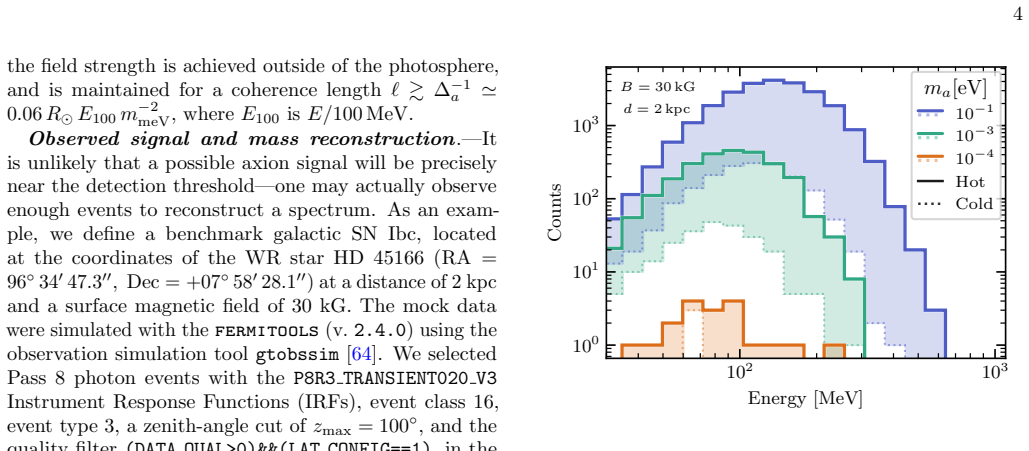
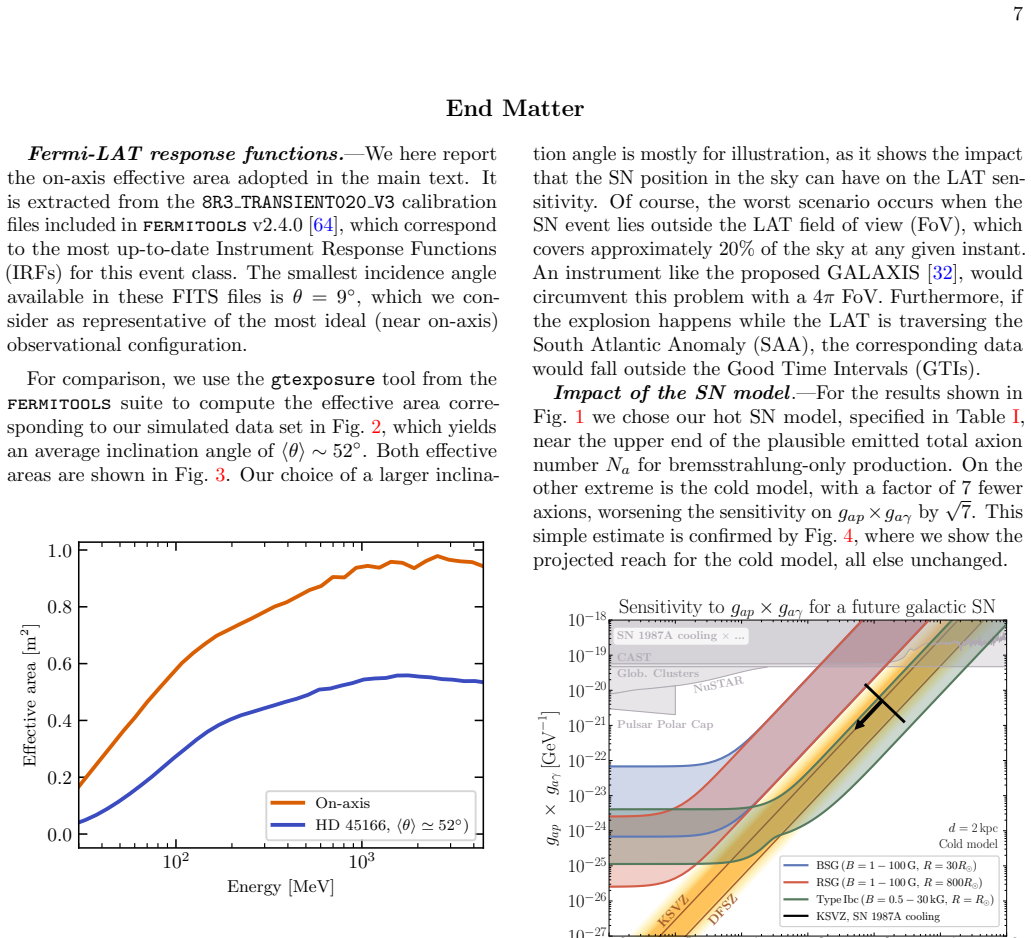
Reference page for Fermitools here, tutorial on simulating observations withgtobssimhere. 7 End Matter Fermi-LAT response functions.—We here report the on-axis effective area adopted in the main text. It is extracted from the 8R3 TRANSIENT020 V3 calibration files included in fermitools v2.4.0 [64], which correspond to the most up-to-date Instrument Respon...
-
[63]
4, where we show the projected reach for the cold model, all else unchanged
This simple estimate is confirmed by Fig. 4, where we show the projected reach for the cold model, all else unchanged. 10−6 10−5 10−4 10−3 10−2 10−1 100 Axion mass , ma [eV] 10−27 10−26 10−25 10−24 10−23 10−22 10−21 10−20 10−19 10−18 gap × gaγ [GeV−1] NuSTAR CAST Glob. Clusters Pulsar Polar Cap d = 2 kpc Cold model SN 1987A cooling × ... KSVZ DFSZ Sensiti...
discussion (0)
Sign in with ORCID, Apple, or X to comment. Anyone can read and Pith papers without signing in.