Probing Dark Matter Substructure with Image Number Anomaly in Strong Lensing Systems
Pith reviewed 2026-05-17 21:02 UTC · model grok-4.3
The pith
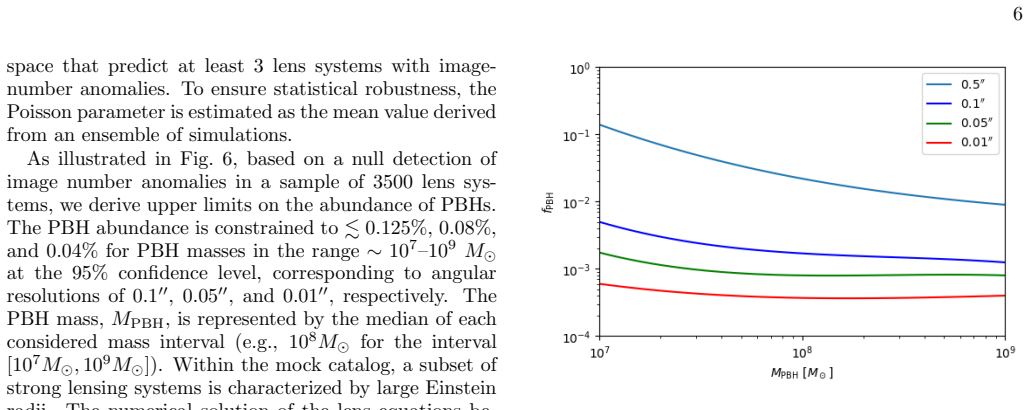
Absence of extra images in 3500 simulated strong lenses limits primordial black hole abundance below 0.125 percent.
A machine-rendered reading of the paper's core claim, the machinery that carries it, and where it could break.
Core claim
Based on a null detection of image number anomalies in a sample of 3500 lens systems generated from the Strong Lensing Halo model-based mock catalogs, the abundance of primordial black holes is constrained to ≲ 0.125%, 0.08%, and 0.04% for PBH masses in the range ∼10^7--10^9 M_⊙ at angular resolutions of 0.1'', 0.05'', and 0.01'', respectively. Similarly, particle masses below 0.4, 0.6, and 3.5 × 10^{-22} eV are excluded for fuzzy dark matter at the same confidence level. The paper also shows that PBH abundance ≲ 0.9% could be constrained at 0.5'' resolution for LSST observations.
What carries the argument
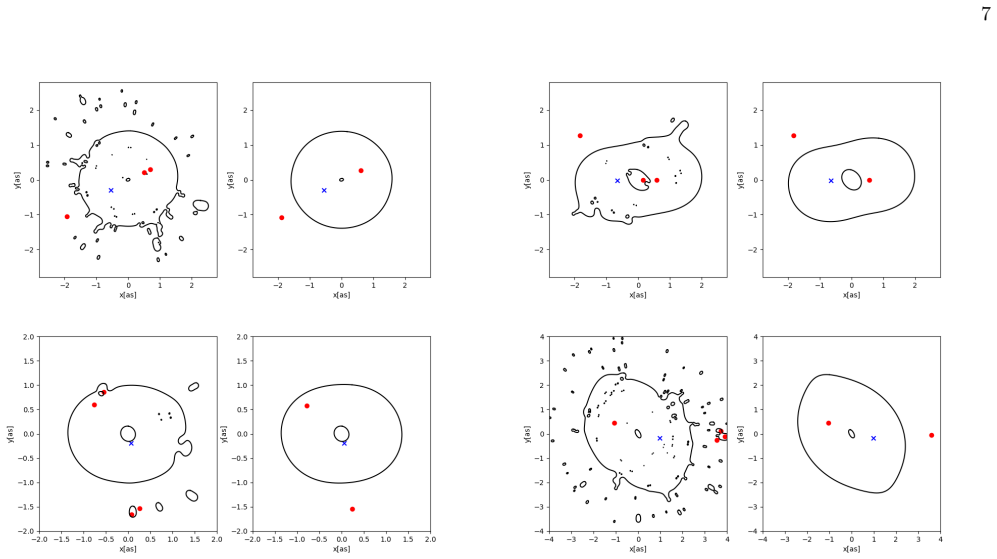
Image number anomaly, the formation of extra lensed images when dark matter substructure perturbs otherwise canonical double or quadruple systems.
If this is right
- Constraints on primordial black hole abundance tighten at higher angular resolutions.
- Legacy Survey of Space and Time observations at 0.5 arcsecond resolution can constrain the primordial black hole fraction below 0.9 percent.
- Image number anomalies in special cases can be identified using a fitting procedure on real data.
- Larger samples of observed lenses would produce correspondingly tighter bounds on dark matter substructure.
Where Pith is reading between the lines
- If high-resolution observations continue to show no anomalies, the result would favor smoother dark matter distributions over clumpy candidates such as primordial black holes.
- Pairing image-number limits with flux-ratio anomalies from the same systems could cross-check the properties of any detected substructure.
- Upcoming surveys with sub-0.1 arcsecond resolution might move from upper limits to actual detections if the primordial black hole fraction lies near the current bound.
Load-bearing premise
The mock catalogs and specific implementations of primordial black hole and fuzzy dark matter substructure accurately reproduce the frequency of extra images that would appear in real observations.
What would settle it
Detection of image number anomalies in a substantial fraction of real strong lensing systems at 0.1 arcsecond resolution or better would contradict the null result and invalidate the derived upper limits.
Figures





read the original abstract
Gravitational lensing observables, including anomalies in image positions, flux ratios, and time delays, serve as usual probes of dark matter (DM) substructure. When dark matter substructure possesses sufficient perturbations, it may lead to the formation of extra images in otherwise canonical doubly or quadruply imaged systems. With the advent of increasingly precise observational instruments, previously undetectable images may become measurable and image number anomalies therefore could be an increasingly viable method. In this paper, we utilize the gravitational lensing phenomenon of image number anomaly to derive constraints on dark matter substructure. We present the extra images induced by distinct forms of DM substructure, specifically primordial black holes (PBHs) and fuzzy dark matter (FDM) and show that higher angular resolution observations increase the probability of detecting additional lensed images. Based on a null detection of image number anomalies in a sample of 3500 lens systems generated from the \textit{Strong Lensing Halo model-based mock catalogs} (SL-Hammocks), we derive upper limits on the abundance of PBHs. At the 95\% confidence level, the PBH abundance is constrained to $\lesssim 0.125\%$, $0.08\%$, and $0.04\%$ for PBH masses in the range $\sim 10^{7}$--$10^{9}~M_{\odot}$, corresponding to angular resolutions of $0.1''$, $0.05''$, and $0.01''$, respectively. Similarly, we exclude particle masses below $0.4$, $0.6$, and $3.5 \times 10^{-22} \ \mathrm{eV}$ for FDM at the same confidence level for the respective resolutions. Furthermore, the abundance of PBHs $\lesssim 0.9\%$ could be constrained at an angular resolution of $0.5''$ for the Legacy Survey of Space and Time (LSST) Observations. Finally, we discuss methodologies for identifying image number anomalies in special cases and demonstrate feasibility using a fitting procedure.
Editorial analysis
A structured set of objections, weighed in public.
Referee Report
Summary. The manuscript proposes image number anomalies in strong lensing as a probe of dark matter substructure. Using a null result (zero anomalies) across 3500 simulated systems drawn from the SL-Hammocks mock catalogs, the authors derive 95% CL upper limits on the PBH mass fraction of ≲0.125%, 0.08%, and 0.04% for masses ∼10^7–10^9 M_⊙ at angular resolutions 0.1'', 0.05'', and 0.01'' respectively; analogous lower bounds are placed on the FDM particle mass (≳0.4, 0.6, and 3.5×10^{-22} eV). Projections for LSST at 0.5'' resolution and a discussion of practical detection methods are also included.
Significance. If the mock pipeline faithfully reproduces both baseline image multiplicities and the additional images induced by PBH point masses or FDM solitons, the work supplies a new statistical handle on substructure that is complementary to flux-ratio and time-delay anomalies. The use of a large mock sample and a Poisson null-result analysis is a clear methodological strength; the resulting limits are competitive within the stated mass and resolution windows and could be applied to forthcoming wide-field surveys.
major comments (2)
- [§3] §3 (mock catalog construction and substructure injection): The 95% CL bounds rest on the assumption that the SL-Hammocks realizations produce exactly the expected image multiplicities in the absence of added substructure and that the numerical ray-tracing of PBH/FDM perturbations correctly predicts when a new image crosses the resolution threshold. No quantitative validation (e.g., anomaly rate in pure baseline runs versus analytic expectations, or recovery tests with injected substructure) is shown; any systematic offset in either step directly rescales the inferred abundance limits.
- [§4] §4 (limit derivation): The mapping from zero observed anomalies in 3500 systems to the quoted PBH fractions and FDM mass exclusions assumes a linear Poisson relation p(anomaly|abundance). Without explicit injection-recovery tests demonstrating this linearity and the absence of contamination from line-of-sight halos or modeling choices, the robustness of the numerical prefactors in the limits cannot be assessed.
minor comments (2)
- [Abstract] The abstract states that higher resolution increases the probability of detecting extra images; a single sentence quantifying the scaling of the derived limits with resolution would improve readability.
- [§2] Notation for the angular-resolution thresholds (0.1'', 0.05'', 0.01'') is used consistently but would benefit from an explicit definition of the image-detection criterion (e.g., magnification or separation threshold) in the main text.
Simulated Author's Rebuttal
We thank the referee for their constructive comments and positive evaluation of the manuscript's significance. We address each major comment below and indicate the revisions planned for the next version.
read point-by-point responses
-
Referee: [§3] §3 (mock catalog construction and substructure injection): The 95% CL bounds rest on the assumption that the SL-Hammocks realizations produce exactly the expected image multiplicities in the absence of added substructure and that the numerical ray-tracing of PBH/FDM perturbations correctly predicts when a new image crosses the resolution threshold. No quantitative validation (e.g., anomaly rate in pure baseline runs versus analytic expectations, or recovery tests with injected substructure) is shown; any systematic offset in either step directly rescales the inferred abundance limits.
Authors: We acknowledge the referee's concern. The SL-Hammocks catalogs rely on established halo modeling validated in prior literature, and our ray-tracing follows standard lensing techniques. To directly address the point, we will add quantitative validation to the revised Section 3, including the measured anomaly rate (zero) from baseline runs without substructure and results from injection-recovery tests on a representative subset of systems to confirm additional-image detection above the resolution threshold. revision: yes
-
Referee: [§4] §4 (limit derivation): The mapping from zero observed anomalies in 3500 systems to the quoted PBH fractions and FDM mass exclusions assumes a linear Poisson relation p(anomaly|abundance). Without explicit injection-recovery tests demonstrating this linearity and the absence of contamination from line-of-sight halos or modeling choices, the robustness of the numerical prefactors in the limits cannot be assessed.
Authors: We agree that explicit tests would strengthen the robustness assessment. Our current Poisson approach is applied under the rare-event approximation appropriate for the low abundances considered. In the revised Section 4 we will include injection-recovery results showing anomaly probability versus injected abundance, discuss line-of-sight halo contributions using existing models, and clarify the modeling assumptions underlying the numerical prefactors. revision: yes
Circularity Check
Limits derived from external SL-Hammocks mocks; no load-bearing self-reference or fitted-input prediction
full rationale
The central result uses a sample of 3500 mock lens systems generated from the SL-Hammocks catalog to compute the expected frequency of extra images when PBH or FDM substructure is injected. A null count in that sample is converted to an upper limit on abundance via Poisson statistics on the anomaly probability. This chain relies on the external mock catalog and standard substructure implementations rather than any parameter fitted inside the paper or a self-citation that defines the target quantity. No equation or step reduces the reported limits to the input data by construction.
Axiom & Free-Parameter Ledger
axioms (2)
- standard math Strong lensing image positions and multiplicities are governed by the lens equation in general relativity with small perturbations from substructure.
- domain assumption The SL-Hammocks mock catalogs faithfully represent the distribution of real strong lenses and the detectability of faint extra images at given angular resolutions.
Lean theorems connected to this paper
-
IndisputableMonolith/Foundation/AbsoluteFloorClosure.leanreality_from_one_distinction unclear?
unclearRelation between the paper passage and the cited Recognition theorem.
Based on a null detection of image number anomalies in a sample of 3500 lens systems generated from the Strong Lensing Halo model-based mock catalogs (SL-Hammocks), we derive upper limits on the abundance of PBHs... Poisson statistics... P(k|λ) = λ^k e^{-λ}/k! ... λ_up ≃ 3.0
-
IndisputableMonolith/Foundation/AlexanderDuality.leanalexander_duality_circle_linking unclear?
unclearRelation between the paper passage and the cited Recognition theorem.
The NFW profile... ρ_NFW(r) = ρ_s / [(r/r_s)(1+r/r_s)^2] ... Hernquist... lenstronomy... angular resolution 0.1'', 0.05'', 0.01''
What do these tags mean?
- matches
- The paper's claim is directly supported by a theorem in the formal canon.
- supports
- The theorem supports part of the paper's argument, but the paper may add assumptions or extra steps.
- extends
- The paper goes beyond the formal theorem; the theorem is a base layer rather than the whole result.
- uses
- The paper appears to rely on the theorem as machinery.
- contradicts
- The paper's claim conflicts with a theorem or certificate in the canon.
- unclear
- Pith found a possible connection, but the passage is too broad, indirect, or ambiguous to say the theorem truly supports the claim.
Reference graph
Works this paper leans on
-
[1]
V. C. Rubin and W. K. Ford, Jr., Rotation of the An- dromeda Nebula from a Spectroscopic Survey of Emission Regions, The Astrophysical Journal159, 379 (1970)
work page 1970
- [2]
-
[3]
G. R. Blumenthal, S. M. Faber, J. R. Primack, and M. J. Rees, Formation of galaxies and large-scale struc- ture with cold dark matter., Nature311, 517 (1984)
work page 1984
-
[4]
Where are the missing galactic satellites?
A. Klypin, A. V. Kravtsov, O. Valenzuela, and F. Prada, Where Are the Missing Galactic Satellites?, The Astro- physical Journal522, 82 (1999), arXiv:astro-ph/9901240 [astro-ph]
work page internal anchor Pith review Pith/arXiv arXiv 1999
-
[5]
Dark Matter Substructure in Galactic Halos
B. Moore, S. Ghigna, F. Governato, G. Lake, T. Quinn, J. Stadel, and P. Tozzi, Dark Matter Substructure within Galactic Halos, The Astrophysical Journal Letters524, L19 (1999), arXiv:astro-ph/9907411 [astro-ph]
work page internal anchor Pith review Pith/arXiv arXiv 1999
-
[6]
W. J. G. de Blok, The Core-Cusp Problem, Advances in Astronomy2010, 789293 (2010), arXiv:0910.3538 [astro- ph.CO]
work page internal anchor Pith review Pith/arXiv arXiv 2010
-
[7]
Primordial Black Holes as Dark Matter: Recent Developments
B. Carr and F. K¨ uhnel, Primordial Black Holes as Dark Matter: Recent Developments, Annual Re- view of Nuclear and Particle Science70, 355 (2020), arXiv:2006.02838 [astro-ph.CO]
work page internal anchor Pith review Pith/arXiv arXiv 2020
- [8]
-
[9]
L. Hui, J. P. Ostriker, S. Tremaine, and E. Witten, Ul- tralight scalars as cosmological dark matter, Physical Review D95, 043541 (2017), arXiv:1610.08297 [astro- ph.CO]
work page internal anchor Pith review Pith/arXiv arXiv 2017
- [10]
-
[11]
S. Vegetti and L. V. E. Koopmans, Bayesian strong gravitational-lens modelling on adaptive grids: objective detection of mass substructure in Galaxies, Monthly No- tices of the Royal Astronomical Society392, 945 (2009), arXiv:0805.0201 [astro-ph]
work page internal anchor Pith review Pith/arXiv arXiv 2009
-
[12]
Evidence for substructure in lens galaxies?
S. Mao and P. Schneider, Evidence for substructure in lens galaxies?, Monthly Notices of the Royal Astronom- ical Society295, 587 (1998), arXiv:astro-ph/9707187 [astro-ph]
work page internal anchor Pith review Pith/arXiv arXiv 1998
- [13]
-
[14]
C. L. MacLeod, C. S. Kochanek, and E. Agol, De- tection of a Companion Lens Galaxy Using the Mid- Infrared Flux Ratios of the Gravitationally Lensed Quasar H1413+117, The Astrophysical Journal699, 1578 (2009), arXiv:0904.0275 [astro-ph.CO]
work page internal anchor Pith review Pith/arXiv arXiv 2009
-
[15]
Observations of radio-quiet quasars at 10mas resolution by use of gravitational lensing
N. Jackson, A. S. Tagore, C. Roberts, D. Sluse, H. Stacey, H. Vives-Arias, O. Wucknitz, and F. Volino, Observa- tions of radio-quiet quasars at 10-mas resolution by use of gravitational lensing, Monthly Notices of the Royal Astronomical Society454, 287 (2015), arXiv:1508.05842 [astro-ph.GA]
work page internal anchor Pith review Pith/arXiv arXiv 2015
-
[16]
C. R. Keeton and L. A. Moustakas, A New Channel for Detecting Dark Matter Substructure in Galaxies: Grav- itational Lens Time Delays, The Astrophysical Journal 699, 1720 (2009), arXiv:0805.0309 [astro-ph]
work page internal anchor Pith review Pith/arXiv arXiv 2009
- [17]
-
[18]
Gravitational lensing as a probe of cold dark matter subhalos
E. Zackrisson and T. Riehm, Gravitational Lensing as a Probe of Cold Dark Matter Subhalos, Advances in As- tronomy2010, 478910 (2010), arXiv:0905.4075 [astro- ph.CO]
work page internal anchor Pith review Pith/arXiv arXiv 2010
-
[19]
J. D. Cohn and C. S. Kochanek, The Effects of Mas- sive Substructures on Image Multiplicities in Gravita- tional Lenses, The Astrophysical Journal608, 25 (2004), arXiv:astro-ph/0306171 [astro-ph]
work page internal anchor Pith review Pith/arXiv arXiv 2004
- [20]
-
[21]
M. J. Reid and M. Honma, Microarcsecond Radio As- trometry, Annual Review of Astronomy and Astrophysics 52, 339 (2014), arXiv:1312.2871 [astro-ph.IM]
work page internal anchor Pith review Pith/arXiv arXiv 2014
-
[22]
Precision cosmology from future lensed gravitational wave and electromagnetic signals
K. Liao, X.-L. Fan, X. Ding, M. Biesiada, and Z.-H. Zhu, Precision cosmology from future lensed gravitational wave and electromagnetic signals, Nature Communica- tions8, 1148 (2017), arXiv:1703.04151 [astro-ph.CO]
work page internal anchor Pith review Pith/arXiv arXiv 2017
-
[23]
M. Oguri, Strong gravitational lensing of explosive tran- sients, Reports on Progress in Physics82, 126901 (2019), arXiv:1907.06830 [astro-ph.CO]
- [24]
-
[25]
Planck Collaborationet al., Planck 2018 results. VI. Cos- mological parameters, Astronomy & Astrophysics641, A6 (2020), arXiv:1807.06209 [astro-ph.CO]
work page internal anchor Pith review Pith/arXiv arXiv 2018
-
[26]
J. F. Navarro, C. S. Frenk, and S. D. M. White, The Structure of Cold Dark Matter Halos, The Astrophysical Journal462, 563 (1996), arXiv:astro-ph/9508025 [astro- ph]
work page internal anchor Pith review Pith/arXiv arXiv 1996
- [27]
-
[28]
L. Hernquist, An Analytical Model for Spherical Galaxies and Bulges, The Astrophysical Journal356, 359 (1990)
work page 1990
-
[29]
S. Birrer and A. Amara, Lenstronomy: Multi-purpose gravitational lens modeling software package, Astro- physics Source Code Library, record ascl:1804.012 (2018), ascl:1804.012
work page 2018
-
[30]
S. Birreret al., lenstronomy II: A gravitational lensing software ecosystem, The Journal of Open Source Soft- ware6, 3283 (2021), arXiv:2106.05976 [astro-ph.CO]
-
[31]
Understanding the Core-Halo Relation of Quantum Wave Dark Matter, $\psi$DM, from 3D Simulations
H.-Y. Schive, M.-H. Liao, T.-P. Woo, S.-K. Wong, T. Chi- ueh, T. Broadhurst, and W. Y. P. Hwang, Understanding the Core-Halo Relation of Quantum Wave Dark Mat- ter from 3D Simulations, Physical Review Letters113, 261302 (2014), arXiv:1407.7762 [astro-ph.GA]
work page internal anchor Pith review Pith/arXiv arXiv 2014
-
[32]
H.-Y. Schive, T. Chiueh, T. Broadhurst, and K.-W. Huang, Contrasting Galaxy Formation from Quantum Wave Dark Matter,ψDM, with ΛCDM, using Planck and Hubble Data, The Astrophysical Journal818, 89 (2016), arXiv:1508.04621 [astro-ph.GA]
work page internal anchor Pith review Pith/arXiv arXiv 2016
-
[33]
A. Amruth, T. Broadhurst, J. Lim, M. Oguri, G. F. Smoot, J. M. Diego, E. Leung, R. Emami, J. Li, T. Chi- ueh, H.-Y. Schive, M. C. H. Yeung, and S. K. Li, Einstein rings modulated by wavelike dark matter from anomalies in gravitationally lensed images, Nature Astronomy7, 736 (2023), arXiv:2304.09895 [astro-ph.CO]
- [34]
-
[35]
K. T. Abe, M. Oguri, S. Birrer, N. Khadka, P. J. Marshall, C. Lemon, A. More, and LSST Dark En- ergy Science Collaboration, A halo model approach for mock catalogs of time-variable strong gravitational lenses, The Open Journal of Astrophysics8, 8 (2025), arXiv:2411.07509 [astro-ph.CO]
-
[36]
Ivezi´ cet al., LSST: From Science Drivers to Reference Design and Anticipated Data Products, The Astrophysi- cal Journal873, 111 (2019), arXiv:0805.2366 [astro-ph]
work page internal anchor Pith review Pith/arXiv arXiv 2019
-
[37]
D. Foreman-Mackey, A. Conley, W. Meierjurgen Farr, D. W. Hogg, D. Lang, P. Marshall, A. Price-Whelan, J. Sanders, and J. Zuntz, emcee: The MCMC Hammer, Astrophysics Source Code Library, record ascl:1303.002 (2013), ascl:1303.002
work page 2013
discussion (0)
Sign in with ORCID, Apple, or X to comment. Anyone can read and Pith papers without signing in.