Recognition: 2 theorem links
· Lean TheoremRELiQ: Scalable Entanglement Routing via Reinforcement Learning in Quantum Networks
Pith reviewed 2026-05-17 05:01 UTC · model grok-4.3
The pith
A reinforcement learning policy trained only on random graphs routes entanglement using local messages and matches global heuristics on real topologies.
A machine-rendered reading of the paper's core claim, the machinery that carries it, and where it could break.
Core claim
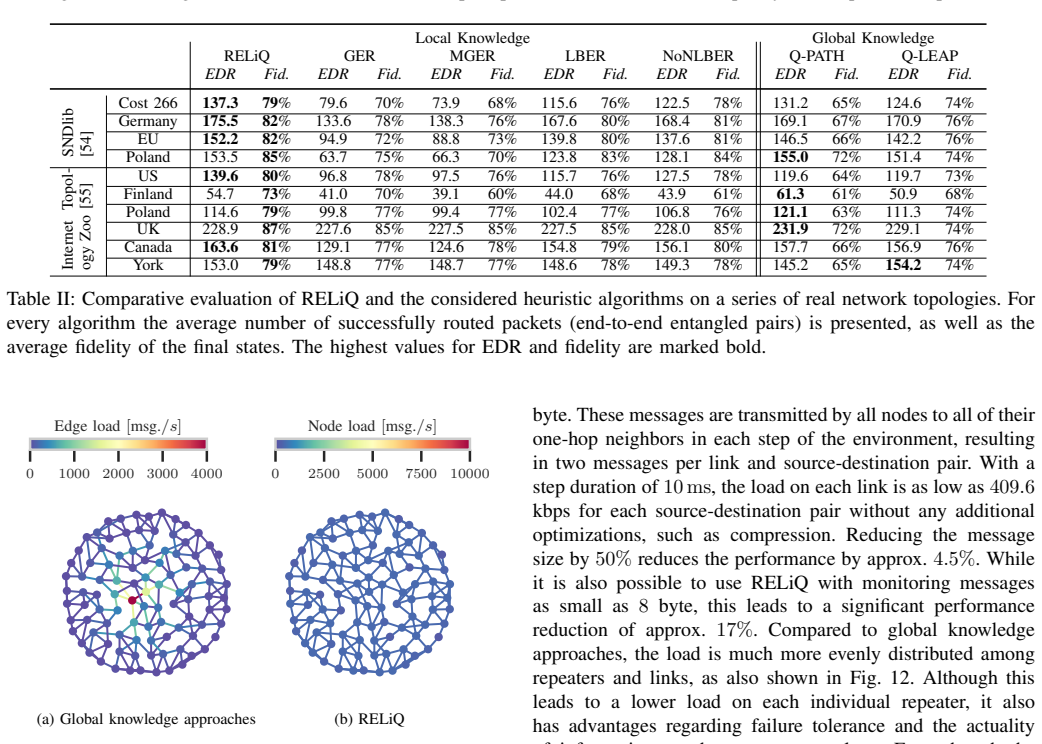
RELiQ trains a graph neural network policy via reinforcement learning on random graphs so that routing decisions rely solely on local information obtained through iterative message exchange. When evaluated on both random and real-world network topologies, this policy outperforms existing local-information heuristics and other learning methods; against global-information heuristics it reaches similar or better performance precisely because it reacts more quickly to topology changes.
What carries the argument
Graph neural network that encodes local neighborhood messages into routing actions for each node, allowing the policy to generalize across graph structures without topology-specific training.
If this is right
- Routing decisions can be made at each node without collecting the full network map at any moment.
- The same trained policy can be deployed on new quantum network layouts without retraining.
- Topology changes are handled by continued local message passing rather than recomputing a global solution.
- Performance gains appear in both static random graphs and dynamic real topologies when compared with local baselines.
Where Pith is reading between the lines
- The approach may extend to other dynamic graph routing tasks where global state is costly to maintain, such as traffic engineering in classical overlay networks.
- If the learned representations capture universal graph properties, similar local RL policies could be tested on quantum-specific metrics like end-to-end fidelity rather than only delivery rate.
- Scaling the message-passing depth or adding explicit quantum-state features might further close the remaining gap to optimal global routing.
Load-bearing premise
A policy trained only on random graphs will generalize reliably to real-world topologies and local iterative message exchange is sufficient to reach near-optimal routing under the probabilistic and dynamic conditions of quantum networks.
What would settle it
Measure average entanglement delivery rate and latency on a documented real-world topology while links are randomly added and removed; if the local RL policy falls below the best global-information heuristic by a statistically significant margin across multiple runs, the generalization claim is false.
Figures





read the original abstract
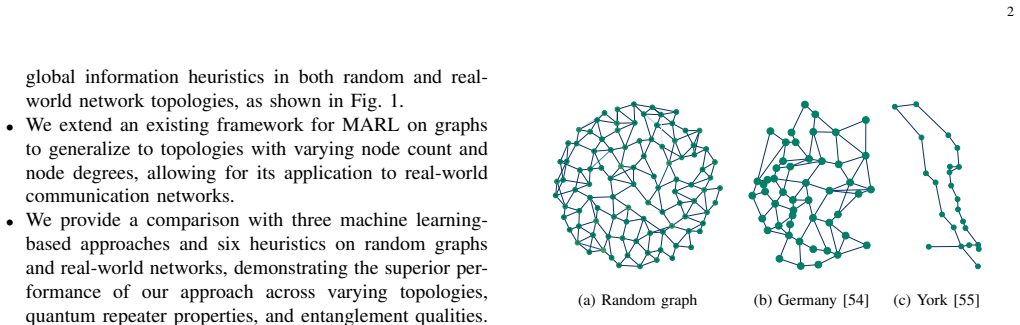
Quantum networks are becoming increasingly important because of advancements in quantum computing and quantum sensing, such as recent developments in distributed quantum computing and federated quantum machine learning. Routing entanglement in quantum networks poses several fundamental as well as technical challenges, including the high dynamicity of quantum network links and the probabilistic nature of quantum operations. Consequently, designing hand-crafted heuristics is difficult and often leads to suboptimal performance, especially if global network topology information is unavailable. In this paper, we propose RELiQ, a reinforcement learning-based approach to entanglement routing that only relies on local information and iterative message exchange. Utilizing a graph neural network, RELiQ learns graph representations and avoids overfitting to specific network topologies - a prevalent issue for learning-based approaches. Our approach, trained on random graphs, consistently outperforms existing local information heuristics and learning-based approaches when applied to random and real-world topologies. When compared to global information heuristics, our method achieves similar or superior performance because of its rapid response to topology changes.
Editorial analysis
A structured set of objections, weighed in public.
Referee Report
Summary. The manuscript proposes RELiQ, a reinforcement learning approach to entanglement routing in quantum networks that relies exclusively on local information and iterative message exchange implemented via a graph neural network. The method is trained on random graphs and is claimed to outperform existing local-information heuristics and other learning-based methods when evaluated on both random and real-world topologies; it is further claimed to achieve similar or superior performance to global-information heuristics owing to faster adaptation to topology changes.
Significance. If the reported performance gains and generalization behavior are substantiated by detailed experiments, the work would represent a meaningful advance in quantum networking by supplying a scalable, topology-agnostic routing policy that handles link dynamics and probabilistic entanglement generation without global state. The GNN-based avoidance of overfitting to particular topologies is a constructive technical choice that could influence subsequent learning-based routing designs.
major comments (2)
- [Abstract / Experimental evaluation] Abstract and experimental evaluation: the central generalization claim—that a policy trained only on random graphs produces near-optimal decisions on real-world topologies—rests on unstated details. No description is given of the random-graph ensemble parameters (node count, edge probability, etc.), the concrete real-world topologies employed, the distribution of entanglement success probabilities, or ablations that isolate the effect of topology-change frequency. These omissions make it impossible to assess whether the random-graph training distribution adequately covers the structural statistics of the target networks.
- [Abstract] Abstract: the statement that the method 'consistently outperforms' local heuristics and 'achieves similar or superior performance' to global heuristics is presented without any quantitative metrics, confidence intervals, statistical tests, or training-stability diagnostics. Because these performance numbers are load-bearing for the paper's primary contribution, their absence prevents verification of the claimed advantage.
minor comments (1)
- [Abstract / Introduction] The abstract and introduction would benefit from a concise statement of the precise reward function and the message-passing schedule used by the GNN, as these design choices directly affect reproducibility.
Simulated Author's Rebuttal
We thank the referee for their constructive and detailed feedback, which highlights important areas for improving clarity and verifiability. We address each major comment point by point below, indicating planned revisions where appropriate. We agree that additional details and quantitative support will strengthen the manuscript.
read point-by-point responses
-
Referee: [Abstract / Experimental evaluation] Abstract and experimental evaluation: the central generalization claim—that a policy trained only on random graphs produces near-optimal decisions on real-world topologies—rests on unstated details. No description is given of the random-graph ensemble parameters (node count, edge probability, etc.), the concrete real-world topologies employed, the distribution of entanglement success probabilities, or ablations that isolate the effect of topology-change frequency. These omissions make it impossible to assess whether the random-graph training distribution adequately covers the structural statistics of the target networks.
Authors: We thank the referee for this observation. The full experimental section of the manuscript does describe the random-graph generation process and the real-world topologies evaluated, but we agree that these details should be stated more explicitly and prominently to support the generalization claims. In the revised version, we will expand both the abstract and the experimental evaluation section to specify the random-graph ensemble parameters (node counts 20–100, edge probabilities 0.2–0.6), list the concrete real-world topologies (NSFNET, GEANT, and a 50-node European research network), detail the entanglement success probability distribution (uniform [0.5, 0.9]), and add ablation studies varying topology-change frequency. These additions will allow readers to assess coverage of the target networks’ structural statistics. revision: yes
-
Referee: [Abstract] Abstract: the statement that the method 'consistently outperforms' local heuristics and 'achieves similar or superior performance' to global heuristics is presented without any quantitative metrics, confidence intervals, statistical tests, or training-stability diagnostics. Because these performance numbers are load-bearing for the paper's primary contribution, their absence prevents verification of the claimed advantage.
Authors: We agree that the abstract would benefit from quantitative support for the performance claims. Due to abstract length constraints, we will revise it to include concise quantitative indicators (e.g., “outperforms local heuristics by 18–27% in average entanglement rate”) while directing readers to the experimental section for full details. In that section we will add confidence intervals, statistical significance tests, and training-stability diagnostics (e.g., variance across random seeds) to substantiate the claims. This constitutes a partial revision for the abstract itself but a full addition of the requested diagnostics in the body. revision: partial
Circularity Check
No circularity in empirical RL derivation
full rationale
The paper describes an empirical reinforcement learning method with graph neural networks for entanglement routing, trained on random graphs and tested for generalization to real-world topologies. No equations, derivations, or self-citations are presented that reduce performance claims to fitted parameters or self-referential definitions by construction. The approach relies on standard RL training and empirical evaluation rather than any closed-form derivation or uniqueness theorem, making the central claims independent of the inputs in a circular sense and self-contained against external benchmarks.
Axiom & Free-Parameter Ledger
axioms (1)
- domain assumption Reinforcement learning policies trained on random graphs can generalize to real-world quantum network topologies using only local observations.
Lean theorems connected to this paper
-
IndisputableMonolith/Cost/FunctionalEquation.leanwashburn_uniqueness_aczel unclear?
unclearRelation between the paper passage and the cited Recognition theorem.
RELiQ... reinforcement learning-based approach to entanglement routing that only relies on local information and iterative message exchange. Utilizing a graph neural network...
-
IndisputableMonolith/Foundation/RealityFromDistinction.leanreality_from_one_distinction unclear?
unclearRelation between the paper passage and the cited Recognition theorem.
Our approach, trained on random graphs, consistently outperforms existing local information heuristics...
What do these tags mean?
- matches
- The paper's claim is directly supported by a theorem in the formal canon.
- supports
- The theorem supports part of the paper's argument, but the paper may add assumptions or extra steps.
- extends
- The paper goes beyond the formal theorem; the theorem is a base layer rather than the whole result.
- uses
- The paper appears to rely on the theorem as machinery.
- contradicts
- The paper's claim conflicts with a theorem or certificate in the canon.
- unclear
- Pith found a possible connection, but the passage is too broad, indirect, or ambiguous to say the theorem truly supports the claim.
Reference graph
Works this paper leans on
-
[1]
Quantum computing 40 years later,
J. Preskill, “Quantum computing 40 years later,” pp. 06–12, 06 2021. [Online]. Available: https://arxiv.org/abs/2106.10522
-
[2]
Cyber protection applications of quantum computing: A review,
U. Ahmed, T. Sipola, and J. Hautamaki, “Cyber protection applications of quantum computing: A review,”European Conference on Cyber Warfare and Security, vol. 23, pp. 10–17, 06 2024
work page 2024
-
[3]
Review of distributed quantum computing: From single QPU to high performance quantum computing,
D. Barral, F. J. Cardama, G. D ´ıaz-Camacho, D. Fa´ıldeet al., “Review of distributed quantum computing: From single QPU to high performance quantum computing,”Computer Science Review, vol. 57, p. 100747, 2025
work page 2025
-
[4]
Verifiable blind quantum computing with trapped ions and single photons,
P. Drmota, D. P. Nadlinger, D. Main, B. C. Nicholet al., “Verifiable blind quantum computing with trapped ions and single photons,”Phys. Rev. Lett., vol. 132, pp. 01–06, Apr 2024
work page 2024
-
[5]
Demonstration of blind quantum computing,
S. Barz, E. Kashefi, A. Broadbent, J. Fitzsimonset al., “Demonstration of blind quantum computing,”Science (New York, N.Y.), vol. 335, pp. 303–8, 01 2012
work page 2012
-
[6]
Federated quantum machine learning,
S. Chen and S. Yoo, “Federated quantum machine learning,”Entropy, vol. 23, p. 460, 04 2021
work page 2021
-
[7]
Distributed quantum machine learning: Federated and model-parallel approaches,
J. Wu, T. Hu, and Q. Li, “Distributed quantum machine learning: Federated and model-parallel approaches,”IEEE Internet Computing, vol. 28, pp. 65–72, 03 2024
work page 2024
-
[8]
Federated quanvolutional neural network: a new paradigm for collaborative quantum learning,
A. Bhatia, S. Kais, and M. Alam, “Federated quanvolutional neural network: a new paradigm for collaborative quantum learning,”Quantum Science and Technology, vol. 8, pp. 03–07, 10 2023. 14
work page 2023
-
[9]
Distributed quantum computing with photons and atomic memories,
E. Oh, X. Lai, J. Wen, and S. Du, “Distributed quantum computing with photons and atomic memories,”Advanced Quantum Technologies, vol. 6, pp. 07–10, 04 2023
work page 2023
-
[10]
Compiler design for distributed quantum computing,
D. Ferrari, A. S. Cacciapuoti, M. Amoretti, and M. Caleffi, “Compiler design for distributed quantum computing,”IEEE Transactions on Quantum Engineering, vol. PP, pp. 1–1, 01 2021
work page 2021
-
[11]
Towards real-world quantum networks: A review,
S. Wei, B. Jing, X. Zhang, J. Liaoet al., “Towards real-world quantum networks: A review,”Laser and Photonics Reviews, vol. 16, pp. 03–18, 01 2022
work page 2022
-
[12]
Multiparty entanglement routing in quantum networks,
V . Mannalath and A. Pathak, “Multiparty entanglement routing in quantum networks,”Physical Review A, vol. 108, pp. 01–15, 12 2023
work page 2023
-
[13]
Multi-user entanglement distribution in quantum networks using multipath routing,
E. Sutcliffe and A. Beghelli, “Multi-user entanglement distribution in quantum networks using multipath routing,”IEEE Transactions on Quantum Engineering, vol. PP, pp. 1–16, 01 2023
work page 2023
-
[14]
Analysis of multipartite entan- glement distribution using a central quantum-network node,
G. Avis, F. Rozpedek, and S. Wehner, “Analysis of multipartite entan- glement distribution using a central quantum-network node,”Physical Review A, vol. 107, pp. 06–10, Jan. 2023
work page 2023
-
[15]
Mapping graph state orbits under local complementation,
J. C. Adcock, S. Morley-Short, A. Dahlberg, and J. W. Silverstone, “Mapping graph state orbits under local complementation,”Quantum, vol. 4, p. 305, Aug. 2020
work page 2020
-
[16]
Quantum repeaters: From quantum networks to the quantum internet,
K. Azuma, S. E. Economou, D. Elkouss, P. Hilaireet al., “Quantum repeaters: From quantum networks to the quantum internet,”Rev. Mod. Phys., vol. 95, pp. 01–75, Dec 2023
work page 2023
-
[17]
Creation of mem- ory–memory entanglement in a metropolitan quantum network,
J.-L. Liu, X.-Y . Luo, Y . Yu, C.-Y . Wanget al., “Creation of mem- ory–memory entanglement in a metropolitan quantum network,”Nature, vol. 629, pp. 579–585, 05 2024
work page 2024
-
[18]
Visually quantifying single-qubit quantum memory,
W.-G. Chang, C.-Y . Ju, G.-Y . Chen, Y .-N. Chen, and H.-Y . Ku, “Visually quantifying single-qubit quantum memory,”Phys. Rev. Res., vol. 6, pp. 01–10, Apr 2024
work page 2024
-
[19]
Event-ready- detectors bell experiment via entanglement swapping,
M. Zukowski, A. Zeilinger, M. Horne, and A. Ekert, “Event-ready- detectors bell experiment via entanglement swapping,”Physical review letters, vol. 71, pp. 4287–4290, 01 1994
work page 1994
-
[20]
Entanglement swapping over 100 km optical fiber with independent entangled photon- pair sources,
Q.-C. Sun, Y .-F. Jiang, Y .-L. Mao, L. Youet al., “Entanglement swapping over 100 km optical fiber with independent entangled photon- pair sources,”Optica, vol. 4, p. 1214, 10 2017
work page 2017
-
[21]
Z. Li, K. Xue, J. Li, L. Chenet al., “Entanglement-assisted quantum networks: Mechanics, enabling technologies, challenges, and research directions,”IEEE Communications Surveys & Tutorials, vol. PP, pp. 1– 1, 01 2023
work page 2023
-
[22]
A. Singh, K. Dev, H. Siljak, H. D. Joshi, and M. Magarini, “Quantum in- ternet – applications, functionalities, enabling technologies, challenges, and research directions,”IEEE Communications Surveys & Tutorials, vol. 23, no. 4, pp. 2218–2247, 2021
work page 2021
-
[23]
Building a large-scale and wide-area quantum internet based on an OSI-alike model,
Z. Li, K. Xue, J. Li, N. Yuet al., “Building a large-scale and wide-area quantum internet based on an OSI-alike model,”China Communications, vol. 18, no. 10, pp. 1–14, 2021
work page 2021
-
[24]
Quantum internet: An approach towards global communication,
N. Sandilya and A. K. Sharma, “Quantum internet: An approach towards global communication,” inProceedings of the 2021 Interna- tional Conference on Reliability, Infocom Technologies and Optimization (ICRITO), 2021, pp. 1–5
work page 2021
-
[25]
Quantum internet protocol stack: a comprehensive survey,
J. Illiano, M. Caleffi, A. Manzalini, and A. S. Cacciapuoti, “Quantum internet protocol stack: a comprehensive survey,”Computer Networks, p. 109092, 2022
work page 2022
-
[26]
Physics-informed quantum communication networks: A vision toward the quantum internet,
M. Chehimi and W. Saad, “Physics-informed quantum communication networks: A vision toward the quantum internet,”IEEE Network, vol. 36, no. 5, pp. 32–38, 2022
work page 2022
-
[27]
Concurrent entanglement routing for quantum networks: Model and designs,
S. Shi and C. Qian, “Concurrent entanglement routing for quantum networks: Model and designs,” ser. SIGCOMM ’20. New York, NY , USA: Association for Computing Machinery, 2020, p. 62–75
work page 2020
-
[28]
Multi-entanglement routing design over quantum networks,
Y . Zeng, J. Zhang, J. Liu, Z. Liu, and Y . Yang, “Multi-entanglement routing design over quantum networks,” inIEEE INFOCOM – IEEE Conference on Computer Communications, 2022, pp. 510–519
work page 2022
-
[29]
Multipath concurrent entanglement routing in quantum networks based on virtual circuit,
L. Zhang, S.-X. Ye, Q. Liu, and H. Chen, “Multipath concurrent entanglement routing in quantum networks based on virtual circuit,” 04 2022, pp. 01–05
work page 2022
-
[30]
Quantum network routing and local complementation,
F. Hahn, A. Pappa, and J. Eisert, “Quantum network routing and local complementation,”npj Quantum Information, vol. 5, p. 76, 2019
work page 2019
-
[31]
Optimal entanglement distribution policies in homogeneous repeater chains with cutoffs,
´A. G. I ˜nesta, G. Vardoyan, L. Scavuzzoet al., “Optimal entanglement distribution policies in homogeneous repeater chains with cutoffs,”npj Quantum Information, vol. 9, p. 46, 2023
work page 2023
-
[32]
Multipartite entanglement in quantum networks using subgraph complementations,
A. Sen, K. Goodenough, and D. Towsley, “Multipartite entanglement in quantum networks using subgraph complementations,” inIEEE Inter- national Conference on Quantum Computing and Engineering (QCE), vol. 02, 2023, pp. 252–253
work page 2023
-
[33]
Shortcuts to quantum network routing
E. Schoute, L. Mancinska, T. Islam, I. Kerenidis, and S. Wehner, “Shortcuts to quantum network routing,” 2016. [Online]. Available: https://arxiv.org/abs/1610.05238
work page internal anchor Pith review Pith/arXiv arXiv 2016
-
[34]
Distributed Routing in a Quantum Internet
K. Chakraborty, F. Rozpedek, A. Dahlberg, and S. Wehner, “Distributed routing in a quantum internet,” 2019. [Online]. Available: https://arxiv.org/abs/1907.11630
work page internal anchor Pith review Pith/arXiv arXiv 2019
-
[35]
Routing entangle- ment in the quantum internet,
M. Pant, H. Krovi, D. Towsley, L. Tassiulaset al., “Routing entangle- ment in the quantum internet,”npj Quantum Information, vol. 5, pp. 01–09, 08 2017
work page 2017
-
[36]
A multiple-entanglement routing framework for quantum networks,
T. N. Nguyen, K. J. Ambarani, L. Le, I. Djordjevic, and Z.-L. Zhang, “A multiple-entanglement routing framework for quantum networks,”
-
[37]
Available: https://arxiv.org/abs/2207.11817
[Online]. Available: https://arxiv.org/abs/2207.11817
-
[38]
Effective routing design for remote entanglement generation on quantum networks,
C. Li, T. Li, Y .-X. Liu, and P. Cappellaro, “Effective routing design for remote entanglement generation on quantum networks,”npj Quantum Information, vol. 7, pp. 03–12, 01 2021
work page 2021
-
[39]
Entan- glement purification on quantum networks,
M. Victora, S. Tserkis, S. Krastanov, A. S. de la Cerdaet al., “Entan- glement purification on quantum networks,”Physical Review Research, vol. 5, p. 033171, Sep. 2023
work page 2023
-
[40]
Entanglement routing over networks with time multiplexed repeaters,
E. A. V . Milligen, E. Jacobson, A. Patil, G. Vardoyanet al., “Entanglement routing over networks with time multiplexed repeaters,”
-
[41]
Available: https://arxiv.org/abs/2308.15028
[Online]. Available: https://arxiv.org/abs/2308.15028
-
[42]
A quantum overlay network for efficient entanglement distribution,
S. Pouryousef, N. K. Panigrahy, and D. F. Towsley, “A quantum overlay network for efficient entanglement distribution,”IEEE INFOCOM – IEEE Conference on Computer Communications, pp. 1–10, 2022
work page 2022
-
[43]
Optimal remote entanglement distri- bution,
W. Dai, T. Peng, and M. Z. Win, “Optimal remote entanglement distri- bution,”IEEE Journal on Selected Areas in Communications, vol. 38, no. 3, pp. 540–556, 2020
work page 2020
-
[44]
FENDI: Toward high-fidelity entan- glement distribution in the quantum internet,
H. Gu, Z. Li, R. Yu, X. Wanget al., “FENDI: Toward high-fidelity entan- glement distribution in the quantum internet,”IEEE/ACM Transactions on Networking, vol. 32, no. 6, pp. 5033–5048, 2024
work page 2024
-
[45]
E2E fidelity aware routing and purification for throughput maximization in quantum networks,
Y . Zhao, G. Zhao, and C. Qiao, “E2E fidelity aware routing and purification for throughput maximization in quantum networks,” inIEEE INFOCOM – IEEE Conference on Computer Communications, 2022
work page 2022
-
[46]
Redundant entanglement provisioning and selection for throughput maximization in quantum networks,
Y . Zhao and C. Qiao, “Redundant entanglement provisioning and selection for throughput maximization in quantum networks,” inIEEE INFOCOM – IEEE Conference on Computer Communications, 2021, pp. 1–10
work page 2021
-
[47]
Asynchronous entanglement provisioning and routing for distributed quantum computing,
L. Yang, Y . Zhao, L. Huang, and C. Qiao, “Asynchronous entanglement provisioning and routing for distributed quantum computing,” inIEEE INFOCOM – IEEE Conference on Computer Communications, 2023
work page 2023
-
[48]
Order matters: On the impact of swapping order on an entanglement path in a quantum network,
A. Chang and G. Xue, “Order matters: On the impact of swapping order on an entanglement path in a quantum network,” inIEEE INFOCOM WKSHPS, 2022, pp. 01–06
work page 2022
-
[49]
Packet routing in dynamically changing networks: a reinforcement learning approach,
J. A. Boyan and M. L. Littman, “Packet routing in dynamically changing networks: a reinforcement learning approach,” inProceedings of the 7th International Conference on Neural Information Processing Systems, ser. NIPS’93. San Francisco, CA, USA: Morgan Kaufmann Publishers Inc., 1993, p. 671–678
work page 1993
-
[50]
Deep reinforcement learning meets graph neural networks: Exploring a routing optimization use case,
P. Almasan, J. Su ´arez-Varela, K. Rusek, P. Barlet-Ros, and A. Cabellos- Aparicio, “Deep reinforcement learning meets graph neural networks: Exploring a routing optimization use case,”Computer Communications, vol. 196, pp. 184–194, 2022
work page 2022
-
[51]
Distributed online service coordination using deep reinforcement learning,
S. Schneider, H. Qarawlus, and H. Karl, “Distributed online service coordination using deep reinforcement learning,” inIEEE International Conference on Distributed Computing Systems (ICDCS), 2021, pp. 539– 549
work page 2021
-
[52]
Graph-based deep learning for communication networks: A survey,
W. Jiang, “Graph-based deep learning for communication networks: A survey,”Computer Communications, vol. 185, pp. 40–54, 2022
work page 2022
-
[53]
RouteNet: Leveraging graph neural networks for network modeling and optimization in sdn,
K. Rusek, J. Su ´arez-Varela, P. Almasan, P. Barlet-Ros, and A. Cabellos- Aparicio, “RouteNet: Leveraging graph neural networks for network modeling and optimization in sdn,”IEEE Journal on Selected Areas in Communications, vol. 38, no. 10, pp. 2260–2270, 2020
work page 2020
-
[54]
Learning and generating distributed routing protocols using graph-based deep learning,
F. Geyer and G. Carle, “Learning and generating distributed routing protocols using graph-based deep learning,” inBig Data Analytics and Machine Learning for Data Communication Networks, ser. Big-DAMA ’18. New York, NY , USA: Association for Computing Machinery, 2018, p. 40–45
work page 2018
-
[55]
J. Weil, Z. Bao, O. Abboud, and T. Meuser, “Towards generalizability of multi-agent reinforcement learning in graphs with recurrent mes- sage passing,” inInternational Conference on Autonomous Agents and Multiagent Systems, ser. AAMAS ’24. Richland, SC: International Foundation for Autonomous Agents and Multiagent Systems, 2024, p. 1919–1927
work page 2024
-
[56]
SNDlib 1.0 – survivable network design library,
S. Orlowski, R. Wess ¨aly, M. Pi ´oro, and A. Tomaszewski, “SNDlib 1.0 – survivable network design library,”Networks, vol. 55, no. 3, pp. 276– 286, 2010
work page 2010
-
[57]
S. Knight, H. X. Nguyen, N. Falkner, R. Bowden, and M. Roughan, “The internet topology zoo,”IEEE Journal on Selected Areas in Com- munications, vol. 29, no. 9, pp. 1765–1775, 2011. 15
work page 2011
-
[58]
M. A. Nielsen and I. L. Chuang,Quantum Computation and Quantum Information: 10th Anniversary Edition. Cambridge University Press, 2010
work page 2010
-
[59]
Entan- glement purification on quantum networks,
M. Victora, S. Tserkis, S. Krastanov, A. S. de la Cerdaet al., “Entan- glement purification on quantum networks,”Physical Review Research, vol. 5, pp. 02–03, Sep 2023
work page 2023
-
[60]
A. Javadi-Abhari, M. Treinish, K. Krsulich, C. J. Woodet al., “Quantum computing with Qiskit,” 2024. [Online]. Available: https: //arxiv.org/abs/2405.08810
work page internal anchor Pith review Pith/arXiv arXiv 2024
-
[61]
Robust multi- qubit quantum network node with integrated error detection,
P.-J. Stas, Y . Q. Huan, B. Machielse, E. N. Knallet al., “Robust multi- qubit quantum network node with integrated error detection,”Science, vol. 378, no. 6619, pp. 557–560, 2022
work page 2022
-
[62]
Fidelity-guaranteed entanglement routing in quantum networks,
J. Li, M. Wang, K. Xue, R. Liet al., “Fidelity-guaranteed entanglement routing in quantum networks,”IEEE Transactions on Communications, vol. 70, pp. 01–16, 10 2022
work page 2022
-
[63]
Ultimate low-loss single-mode fibre at1.55µm,
T. Miya, Y . Terunuma, T. Hosaka, and T. Miyashita, “Ultimate low-loss single-mode fibre at1.55µm,”Electronics Letters, vol. 15, pp. 106–108, 1979
work page 1979
-
[64]
Optical transmission fiber design evolution,
M.-J. Li and D. A. Nolan, “Optical transmission fiber design evolution,” Journal of Lightwave Technology, vol. 26, no. 9, pp. 1079–1092, 2008
work page 2008
-
[65]
Entangled photon pair generation in an integrated SiC platform,
A. Rahmouni, R. Wang, J. Li, X. Tanget al., “Entangled photon pair generation in an integrated SiC platform,”Light: Science & Applications, vol. 13, no. 1, p. 110, 2024
work page 2024
-
[66]
Distributed online service coordination using deep reinforcement learning,
S. Schneider, H. Qarawlus, and H. Karl, “Distributed online service coordination using deep reinforcement learning,” inIEEE International Conference on Distributed Computing Systems (ICDCS). IEEE, 2021, pp. 539–549
work page 2021
-
[67]
Rainbow: combining improvements in deep reinforcement learning,
M. Hessel, J. Modayil, H. van Hasselt, T. Schaulet al., “Rainbow: combining improvements in deep reinforcement learning,” inAAAI Conference on Artificial Intelligence, ser. AAAI’18. AAAI Press, 2018
work page 2018
-
[68]
Human-level control through deep reinforcement learning,
V . Mnih, K. Kavukcuoglu, D. Silver, A. A. Rusuet al., “Human-level control through deep reinforcement learning,”Nature, vol. 518, no. 7540, pp. 529–533, 2015
work page 2015
-
[69]
A closer look at invalid action masking in policy gradient algorithms,
S. Huang and S. Onta ˜n´on, “A closer look at invalid action masking in policy gradient algorithms,” inFLAIRS Conference, vol. 35, May 2022
work page 2022
-
[70]
Topohub: A repository of reference gabriel graph and real-world topologies for networking research,
P. Jurkiewicz, “Topohub: A repository of reference gabriel graph and real-world topologies for networking research,”SoftwareX, vol. 24, p. 101540, 2023
work page 2023
-
[71]
Simu- lating photonic devices with noisy optical elements,
M. Vischi, G. Di Bartolomeo, M. Proietti, S. Koudiaet al., “Simu- lating photonic devices with noisy optical elements,”Physical Review Research, vol. 6, no. 3, Sep. 2024
work page 2024
-
[72]
The capacity of the quantum depolarizing channel,
C. King, “The capacity of the quantum depolarizing channel,”IEEE Transactions on Information Theory, vol. 49, no. 1, pp. 221–229, 2003
work page 2003
-
[73]
General teleportation channel, singlet fraction, and quasidistillation,
M. Horodecki, P. Horodecki, and R. Horodecki, “General teleportation channel, singlet fraction, and quasidistillation,”Physical Review A, vol. 60, pp. 1888–1898, Sep 1999
work page 1999
-
[74]
A simple formula for the average gate fidelity of a quantum dynamical operation,
M. A. Nielsen, “A simple formula for the average gate fidelity of a quantum dynamical operation,”Physics Letters A, vol. 303, no. 4, p. 249–252, Oct. 2002. APPENDIX A. Depolarization error Various noise models prevalent in quantum photonic de- vices have previously been studied [69] [70]. In Fig. 2b, we specifically inject noise after the creation of Bell...
work page 2002
discussion (0)
Sign in with ORCID, Apple, or X to comment. Anyone can read and Pith papers without signing in.