Cosserat micropolar and couple-stress elasticity models of flexomagnetism at finite deformations
Pith reviewed 2026-05-21 18:37 UTC · model grok-4.3
The pith
Micropolar models enable flexomagnetism in centrosymmetric materials with one new constant.
A machine-rendered reading of the paper's core claim, the machinery that carries it, and where it could break.
Core claim
The central claim is that by employing the micro-dislocation tensor inherent to the micropolar theory, rather than strain gradients, flexomagnetism can be formulated at finite strains in a manner that permits centrosymmetric materials with a single new constant and cubic-symmetric materials with two constants. The flexomagnetic action functionals are postulated accordingly, and the corresponding Euler-Lagrange equations are derived in both scalar and vector potential formulations for the magnetic field.
What carries the argument
The micro-dislocation tensor of the Cosserat micropolar model, which is a second-order tensor coupled to the magnetization vector by means of a Lifshitz invariant.
If this is right
- The models support flexomagnetic effects in centrosymmetric materials with one new constant.
- Cubic-symmetric materials are described with two such constants.
- Governing equations follow from the postulated action functionals for both magnetic potential types.
- Numerical examples on nano-beams demonstrate the approach is computationally feasible.
Where Pith is reading between the lines
- This modeling choice may allow similar simplifications for other phenomena involving higher gradients, such as flexoelectricity.
- Engineers could use these models to predict and optimize flexomagnetic responses in symmetric crystal structures at large deformations.
Load-bearing premise
The magneto-mechanical interaction is captured sufficiently by coupling the micro-dislocation tensor to the magnetization via a Lifshitz invariant.
What would settle it
An experiment that measures the flexomagnetic response of a centrosymmetric material and finds it requires either zero or more than one independent constant would falsify the central prediction.
Figures





read the original abstract
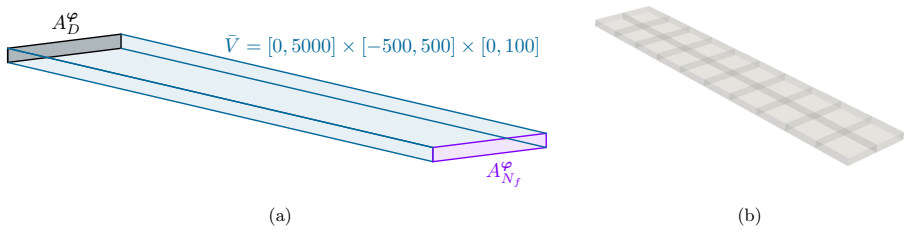
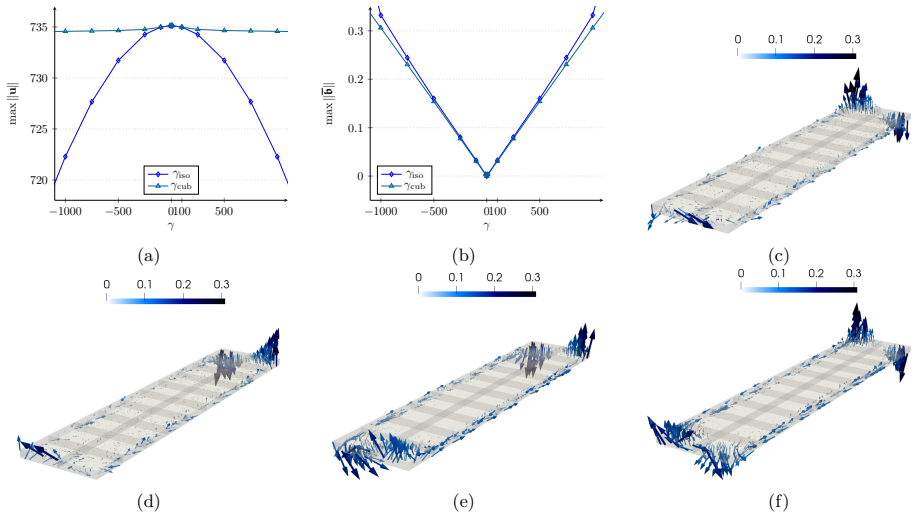
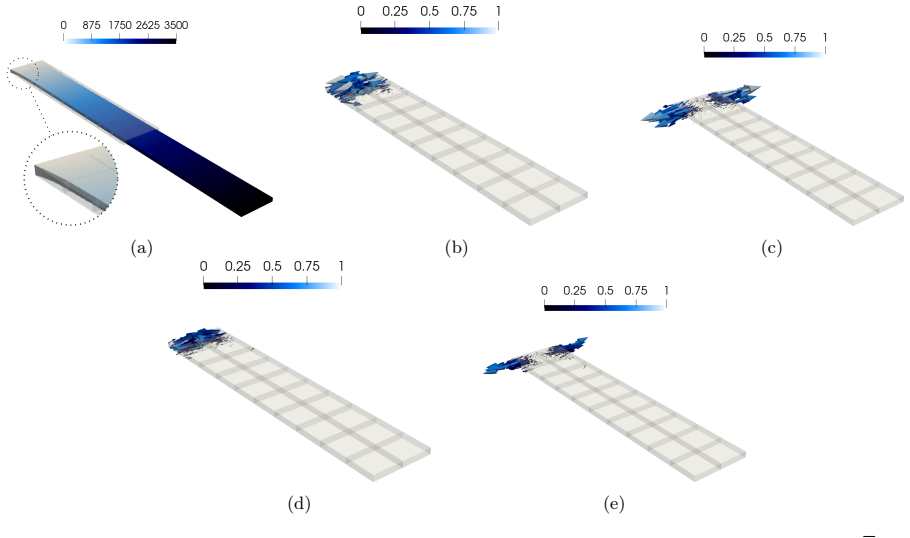
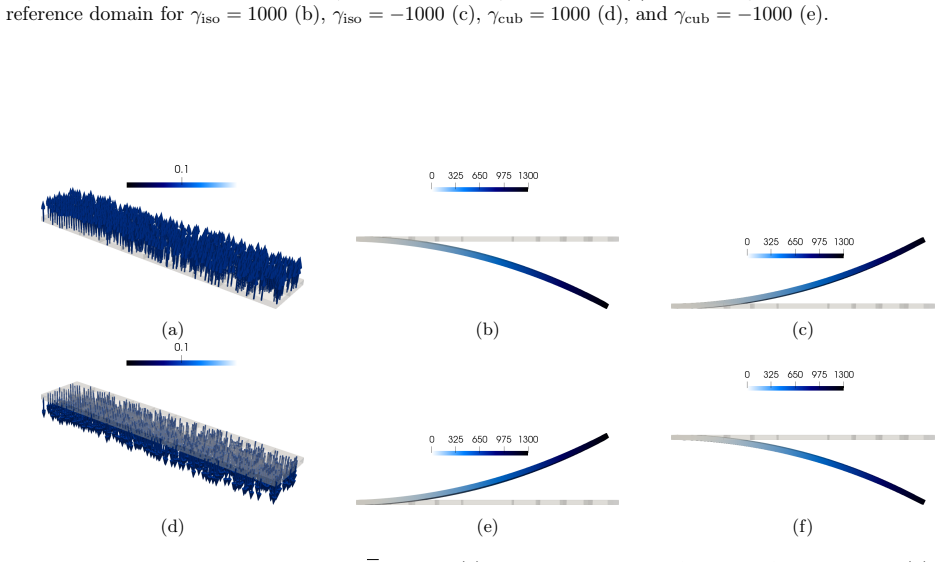
We propose geometrically nonlinear (finite) continuum models of flexomagnetism based on the Cosserat micropolar and its descendent couple-stress theory. These models introduce the magneto-mechanical interaction by coupling the micro-dislocation tensor of the micropolar model with the magnetisation vector using a Lifshitz invariant. In contrast to conventional formulations that couple strain-gradients to the magnetisation using fourth-order tensors, our approach relies on third-order tensor couplings by virtue of the micro-dislocation being a second-order tensor. Consequently, the models permit centrosymmetric materials with a single new flexomagnetic constant, and more generally allow cubic-symmetric materials with two such constants. We postulate the flexomagnetic action-functionals and derive the corresponding governing equations using both scalar and vectorial magnetic potential formulations, and present numerical results for a nano-beam geometry, confirming the physical plausibility and computational feasibility of the models.
Editorial analysis
A structured set of objections, weighed in public.
Referee Report
Summary. The manuscript proposes geometrically nonlinear continuum models of flexomagnetism based on Cosserat micropolar and couple-stress theories. Magneto-mechanical interaction is introduced by coupling the micro-dislocation tensor to the magnetization vector through a Lifshitz invariant. This yields third-order tensor couplings, which the authors claim permit centrosymmetric materials with only a single new flexomagnetic constant and cubic-symmetric materials with two such constants. The paper postulates the corresponding action functionals, derives the governing equations using scalar and vectorial magnetic potential formulations, and presents numerical results for a nano-beam geometry to illustrate physical plausibility and computational feasibility.
Significance. If the symmetry reduction for centrosymmetric materials and the consistency of the finite-strain formulation are established, the approach could provide a lower-order alternative to conventional strain-gradient flexomagnetic models, reducing the number of material constants needed for centrosymmetric and cubic crystals. The grounding in established Cosserat frameworks and the numerical demonstration on a nano-beam are positive features that support feasibility for micromagnetic simulations at finite deformations.
major comments (2)
- [Abstract and model construction] Abstract and model construction: The central claim that the Lifshitz-invariant coupling of the (second-order) micro-dislocation tensor to magnetization permits centrosymmetric materials with a single flexomagnetic constant rests on unverified transformation properties under central inversion. The manuscript must explicitly show that the coupling term remains invariant and non-vanishing when the micro-dislocation tensor (constructed from the finite Cosserat rotation and wryness) is transformed consistently with the deformation gradient and rotation field; otherwise the reduction to one constant does not follow.
- [Governing equations] Derivation of governing equations: The postulated action functionals lead to the claimed governing equations, but the finite-deformation setting requires verification that the magnetic body couples and the resulting Euler-Lagrange equations are compatible with the balance of linear and angular momentum (including the couple-stress contributions) without introducing spurious higher-order terms or violating objectivity.
minor comments (2)
- [Notation and preliminaries] The relation between the micro-dislocation tensor and the standard Cosserat curvature/wryness tensor should be stated explicitly, including any pull-back operations used at finite strains, to aid readers from the broader continuum-mechanics community.
- [Numerical results] The numerical nano-beam example would benefit from a brief statement of the boundary conditions and mesh convergence to strengthen the claim of computational feasibility.
Simulated Author's Rebuttal
We thank the referee for the careful reading and constructive comments. We address the two major comments point by point below. Revisions have been made to provide the requested explicit verifications while preserving the core modeling approach.
read point-by-point responses
-
Referee: [Abstract and model construction] Abstract and model construction: The central claim that the Lifshitz-invariant coupling of the (second-order) micro-dislocation tensor to magnetization permits centrosymmetric materials with a single flexomagnetic constant rests on unverified transformation properties under central inversion. The manuscript must explicitly show that the coupling term remains invariant and non-vanishing when the micro-dislocation tensor (constructed from the finite Cosserat rotation and wryness) is transformed consistently with the deformation gradient and rotation field; otherwise the reduction to one constant does not follow.
Authors: We agree that an explicit check of the parity properties is required. In the revised manuscript we have inserted a new paragraph (Section 2.3) that derives the transformation rules under central inversion. The micro-dislocation tensor is obtained from the difference between the wryness tensor and the spatial gradient of the Cosserat rotation; under inversion the deformation gradient maps to its inverse while the rotation tensor remains proper orthogonal. Because magnetization transforms as an axial vector, the resulting Lifshitz invariant is a true scalar that is invariant and does not vanish identically for centrosymmetric media. Consequently the third-order coupling tensor retains only a single independent constant, as originally stated. The added derivation confirms the reduction without altering the model. revision: yes
-
Referee: [Governing equations] Derivation of governing equations: The postulated action functionals lead to the claimed governing equations, but the finite-deformation setting requires verification that the magnetic body couples and the resulting Euler-Lagrange equations are compatible with the balance of linear and angular momentum (including the couple-stress contributions) without introducing spurious higher-order terms or violating objectivity.
Authors: The equations are obtained by direct variation of the postulated action, which by construction respects the underlying Cosserat balance laws. To make this compatibility explicit we have added a short verification subsection (Section 3.2). The magnetic body force and body couple generated by the Lifshitz term are objective (frame-indifferent) and enter the linear-momentum balance in the standard way. Their contribution to the angular-momentum balance is absorbed into the divergence of the couple-stress tensor; no derivatives of order higher than those already present in the micropolar theory appear. Because all kinematic fields are defined via the deformation gradient and rotation, objectivity is preserved. The added discussion confirms that the finite-strain formulation introduces no spurious terms. revision: yes
Circularity Check
No significant circularity; derivation is self-contained from standard frameworks
full rationale
The paper postulates flexomagnetic action functionals by coupling the micro-dislocation tensor (a second-order tensor from the Cosserat rotation field) to the magnetization vector via a Lifshitz invariant at finite deformations. The reduction to a single new flexomagnetic constant for centrosymmetric materials (and two for cubic symmetry) follows as a direct consequence of the resulting third-order tensor couplings and their invariance properties under central inversion, which is a standard tensorial symmetry argument rather than a fitted quantity or self-referential definition. Governing equations are then derived from the postulated functionals using scalar and vector potential formulations. No load-bearing self-citations, ansatz smuggling, or predictions that reduce to inputs by construction are present; the central claims rest on the independent tensor rank and symmetry analysis within the standard Cosserat and couple-stress setting.
Axiom & Free-Parameter Ledger
free parameters (1)
- flexomagnetic constant(s)
axioms (1)
- domain assumption Lifshitz invariant provides an appropriate magneto-mechanical interaction term for the micropolar micro-dislocation tensor
Lean theorems connected to this paper
-
IndisputableMonolith/Foundation/AlexanderDuality.leanalexander_duality_circle_linking unclear?
unclearRelation between the paper passage and the cited Recognition theorem.
coupling the micro-dislocation tensor of the micropolar model with the magnetisation vector using a Lifshitz invariant... third-order tensor couplings... centrosymmetric materials with a single new flexomagnetic constant
-
IndisputableMonolith/Cost/FunctionalEquation.leanwashburn_uniqueness_aczel unclear?
unclearRelation between the paper passage and the cited Recognition theorem.
Ψcurv(A) = μ_e L_c²/2 ⟨A, L A⟩ with A = R^T Curl R
What do these tags mean?
- matches
- The paper's claim is directly supported by a theorem in the formal canon.
- supports
- The theorem supports part of the paper's argument, but the paper may add assumptions or extra steps.
- extends
- The paper goes beyond the formal theorem; the theorem is a base layer rather than the whole result.
- uses
- The paper appears to rely on the theorem as machinery.
- contradicts
- The paper's claim conflicts with a theorem or certificate in the canon.
- unclear
- Pith found a possible connection, but the passage is too broad, indirect, or ambiguous to say the theorem truly supports the claim.
Forward citations
Cited by 1 Pith paper
-
Evaluation of External Magnetic Flux Density in Piezo-Flexomagnetic Nanobeams Using a Hybrid 1D-2D Finite Element Framework
A hybrid finite element framework combining 1D Timoshenko beam theory with 2D magnetostatics shows significant external magnetic flux density around bending piezo-flexomagnetic nanobeams even without piezomagnetic coupling.
Reference graph
Works this paper leans on
-
[1]
Springer Berlin Heidelberg (2018)
Altenbach, H.: Kontinuumsmechanik: Einführung in die materialunabhängigen und materialabhängigen Gleichungen. Springer Berlin Heidelberg (2018)
work page 2018
-
[2]
International Journal of Engineering Science217, 104369 (2025)
Berjamin, H., Rudykh, S.: Nonlineardispersivewavesinsoftelasticlaminatesunderfinitemagneto–deformations. International Journal of Engineering Science217, 104369 (2025)
work page 2025
-
[3]
Boon, W.M.: Solvers for mixed finite element problems using Poincaré operators based on spanning trees. arXiv (2024). URL https://arxiv.org/abs/2410.08830
-
[4]
Annales de l’Institut Henri Poincaré C, Analyse non linéaire40(3), 557–592 (2023)
Bresciani, M., Davoli, E., Krˇ užík, M.: Existence results in large-strain magnetoelasticity. Annales de l’Institut Henri Poincaré C, Analyse non linéaire40(3), 557–592 (2023)
work page 2023
-
[5]
Codony, D., Arias, I., Suryanarayana, P.: Transversal flexoelectric coefficient for nanostructures at finite deformations from first principles. Phys. Rev. Mater.5, L030801 (2021)
work page 2021
-
[6]
Journal of the Mechanics and Physics of Solids146, 104182 (2021)
Codony, D., Gupta, P., Marco, O., Arias, I.: Modeling flexoelectricity in soft dielectrics at finite deformation. Journal of the Mechanics and Physics of Solids146, 104182 (2021)
work page 2021
-
[7]
Journal of Applied Physics130(23), 231102 (2021)
Codony, D., Mocci, A., Barceló-Mercader, J., Arias, I.: Mathematical and computational modeling of flexoelectricity. Journal of Applied Physics130(23), 231102 (2021)
work page 2021
-
[8]
Cosserat, E., Cosserat, F.: Théorie des corps déformables. Nature81(2072), 67–67 (1909). URLhttps://www.uni-due.de/ imperia/md/content/mathematik/ag_neff/cosserat09_eng.pdf
work page 2072
-
[9]
Computer Methods in Applied Mechanics and Engineering81(2), 131–150 (1990)
Crisfield, M.: A consistent co-rotational formulation for non-linear, three-dimensional, beam-elements. Computer Methods in Applied Mechanics and Engineering81(2), 131–150 (1990)
work page 1990
-
[10]
Dorfmann, L., Ogden, R.W.: Nonlinear Theory of Electroelastic and Magnetoelastic Interactions. Springer US (2014)
work page 2014
-
[11]
Dorfmann, L., Ogden, R.W.: The nonlinear theory of magnetoelasticity and the role of the Maxwell stress: a review. Pro- ceedings of the Royal Society A: Mathematical, Physical and Engineering Sciences479(2278), 20230592 (2023)
work page 2023
-
[12]
Archive of Applied Mechanics94, 1161–1175 (2024)
El-Dhaba, A.R., Abou-Dina, M.S., Ghaleb, A.F.: Nonlinear flexoelectricity in extended thermodynamics. Archive of Applied Mechanics94, 1161–1175 (2024)
work page 2024
-
[13]
Eliseev, E.A., Morozovska, A.N., Glinchuk, M.D., Blinc, R.: Spontaneous flexoelectric/flexomagnetic effect in nanoferroics. Phys. Rev. B79, 165433 (2009)
work page 2009
-
[14]
Springer Berlin Heidelberg (2013) 28
Eremeyev, V.A., Lebedev, L.P., Altenbach, H.: Foundations of Micropolar Mechanics. Springer Berlin Heidelberg (2013) 28
work page 2013
-
[15]
Eringen, A.: Microcontinuum Field Theories. I. Foundations and Solids. Springer-Verlag New York (1999)
work page 1999
-
[16]
Journal of Engineering Mechanics 135(3), 117–131 (2009)
Forest, S.: Micromorphic approach for gradient elasticity, viscoplasticity, and damage. Journal of Engineering Mechanics 135(3), 117–131 (2009)
work page 2009
-
[17]
Insights into Imaging 12(1), 179 (2021)
Gaeta, M., Cavallaro, M., Vinci, S.L., Mormina, E., Blandino, A., Marino, M.A., Granata, F., Tessitore, A., Galletta, K., D’Angelo, T., Visalli, C.: Magnetism of materials: theory and practice in magnetic resonance imaging. Insights into Imaging 12(1), 179 (2021)
work page 2021
-
[18]
Ghiba, I.D., Rizzi, G., Madeo, A., Neff, P.: Cosserat micropolar elasticity: classical Eringen vs. dislocation form. Journal of Mechanics of Materials and Structures18, 93–123 (2023)
work page 2023
-
[19]
Gong, Q., Tang, Z., Yi, M.: Large flexomagnetic response enabled by topological magnetic textures in monolayer crn. Phys. Rev. B111, 094441 (2025)
work page 2025
-
[20]
Journal of the Mechanics and Physics of Solids183, 105477 (2024)
Greco, F., Codony, D., Mohammadi, H., Fernández-Méndez, S., Arias, I.: Topology optimization of flexoelectric metamaterials with apparent piezoelectricity. Journal of the Mechanics and Physics of Solids183, 105477 (2024)
work page 2024
-
[21]
Journal of Applied Physics138(2025)
Gupta, M., Pingale, A.D., Kundalwal, S.I.: Continuum and computational modeling of flexoelectricity in nanomaterials: A review. Journal of Applied Physics138(2025)
work page 2025
-
[22]
International Journal for Numerical Methods in Engineering124(13), 2965–2994 (2023)
Harsch, J., Sailer, S., Eugster, S.R.: AtotalLagrangian, objectiveandintrinsicallylocking-freePetrov–GalerkinSE(3)Cosserat rod finite element formulation. International Journal for Numerical Methods in Engineering124(13), 2965–2994 (2023)
work page 2023
-
[23]
Multibody System Dynamics44(1), 31–56 (2018)
Hemingway, E.G., O’Reilly, O.M.: Perspectives on Euler angle singularities, gimbal lock, and the orthogonality of applied forces and applied moments. Multibody System Dynamics44(1), 31–56 (2018)
work page 2018
-
[24]
Zeitschrift für angewandte Mathematik und Physik 68(1) (2016)
Lankeit, J., Neff, P., Osterbrink, F.: Integrability conditions between the first and second Cosserat deformation tensor in geometrically nonlinear micropolar models and existence of minimizers. Zeitschrift für angewandte Mathematik und Physik 68(1) (2016)
work page 2016
-
[25]
Lee, J.H., Kim, K.E., Jang, B.K., Ünal, A.A., Valencia, S., Kronast, F., Ko, K.T., Kowarik, S., Seidel, J., Yang, C.H.: Strain- gradient-induced magnetic anisotropy in straight-stripe mixed-phase bismuth ferrites: Insight into flexomagnetism. Phys. Rev. B96, 064402 (2017)
work page 2017
-
[26]
Li, J.L., Li, X.F.: Bending and free vibration of piezomagnetic timoshenko beams with the flexomagnetic and surface effects. Acta Mechanica (2024)
work page 2024
-
[27]
Journal of the Mechanics and Physics of Solids63, 451–480 (2014)
Liu, L.: An energy formulation of continuum magneto-electro-elasticity with applications. Journal of the Mechanics and Physics of Solids63, 451–480 (2014)
work page 2014
-
[28]
Nature Communications13(1), 6745 (2022)
Makushko, P., Kosub, T., Pylypovskyi, O.V., Hedrich, N., Li, J., Pashkin, A., Avdoshenko, S., Hübner, R., Ganss, F., Wolf, D., Lubk, A., Liedke, M.O., Butterling, M., Wagner, A., Wagner, K., Shields, B.J., Lehmann, P., Veremchuk, I., Fassbender, J., Maletinsky, P., Makarov, D.: Flexomagnetism and vertically graded Néel temperature of antiferromagnetic Cr2...
work page 2022
-
[29]
Composite Structures271, 114179 (2021)
Malikan, M., Eremeyev, V.A.: Effect of surface on the flexomagnetic response of ferroic composite nanostructures; nonlinear bending analysis. Composite Structures271, 114179 (2021)
work page 2021
-
[30]
Continuum Mechanics and Thermodynamics34(1), 1–16 (2022)
Malikan, M., Eremeyev, V.A.: Flexomagneticity in buckled shear deformable hard-magnetic soft structures. Continuum Mechanics and Thermodynamics34(1), 1–16 (2022)
work page 2022
-
[31]
International Journal of Engineering Science175, 103671 (2022)
Malikan, M., Eremeyev, V.A.: On a flexomagnetic behavior of composite structures. International Journal of Engineering Science175, 103671 (2022)
work page 2022
-
[32]
Computer Methods in Applied Mechanics and Engineering371, 113320 (2020)
McBride, A., Davydov, D., Steinmann, P.: Modelling the flexoelectric effect in solids: A micromorphic approach. Computer Methods in Applied Mechanics and Engineering371, 113320 (2020)
work page 2020
-
[33]
Archive for Rational Mechanics and Analysis16, 51–78 (1964)
Mindlin, R.: Micro-structure in linear elasticity. Archive for Rational Mechanics and Analysis16, 51–78 (1964)
work page 1964
-
[34]
Journal of the Mechanics and Physics of Solids157, 104643 (2021)
Mocci, A., Barceló-Mercader, J., Codony, D., Arias, I.: Geometrically polarized architected dielectrics with apparent piezo- electricity. Journal of the Mechanics and Physics of Solids157, 104643 (2021)
work page 2021
-
[35]
Neff, P.: Existence of minimizers for a geometrically exact Cosserat solid. Proc. Appl. Math. Mech.4(1), 548–549 (2004)
work page 2004
-
[36]
Neff, P.: The Cosserat couple modulus for continuous solids is zero viz the linearized Cauchy-stress tensor is symmetric. ZAMM86(11), 892–912 (2006)
work page 2006
-
[37]
Proceedings of the Royal Society of Edinburgh: Section A Mathematics136(5), 997–1012 (2006)
Neff, P.: Existence of minimizers for a finite-strain micromorphic elastic solid. Proceedings of the Royal Society of Edinburgh: Section A Mathematics136(5), 997–1012 (2006)
work page 2006
-
[38]
International Journal of Engi- neering Science44(8), 574–594 (2006)
Neff, P.: A finite-strain elastic–plastic Cosserat theory for polycrystals with grain rotations. International Journal of Engi- neering Science44(8), 574–594 (2006)
work page 2006
-
[39]
Journal of Elasticity121(1), 119–141 (2015)
Neff, P., Bîrsan, M., Osterbrink, F.: Existence theorem for geometrically nonlinear Cosserat micropolar model under uniform convexity requirements. Journal of Elasticity121(1), 119–141 (2015)
work page 2015
-
[40]
International Journal of Engineering Science80, 209–217 (2014)
Neff, P., Lankeit, J., Madeo, A.: On Grioli’s minimum property and its relation to Cauchy’s polar decomposition. International Journal of Engineering Science80, 209–217 (2014)
work page 2014
-
[41]
ESAIM: COCV14(1), 148–159 (2008)
Neff, P., Münch, I.: Curl bounds Grad on SO(3). ESAIM: COCV14(1), 148–159 (2008)
work page 2008
-
[42]
Perez-Garcia, C., Ortigosa, R., Martínez-Frutos, J., Garcia-Gonzalez, D.: Topology and material optimization in ultra-soft magneto-active structures: Making advantage of residual anisotropies. Advanced Materials (2025) 29
work page 2025
-
[43]
Advanced Materials37(24) (2025)
Perez-Garcia, C., Zaera, R., Aranda-Ruiz, J., Bordiga, G., Risso, G., Lopez-Donaire, M.L., Bertoldi, K., Garcia-Gonzalez, D.: Reprogrammable mechanical metamaterials via passive and active magnetic interactions. Advanced Materials37(24) (2025)
work page 2025
-
[44]
Powell, R.C.: Symmetry, Group Theory, and the Physical Properties of Crystals. Springer New York (2010)
work page 2010
-
[45]
Qiao, L., Sladek, J., Sladek, V., Kaminskiy, A.S., Pyatakov, A.P., Ren, W.: Curvature-induced magnetization in acri3 bilayer: Flexomagnetic effect enhancement in van der waals antiferromagnets. Phys. Rev. B109, 014410 (2024)
work page 2024
-
[46]
Journal of the Brazilian Society of Mechanical Sciences and Engineering47(4) (2025)
Ray, L.S., Babu, B.: Effect of strain gradient on the direct flexomagnetic transduction behavior of nanobeams. Journal of the Brazilian Society of Mechanical Sciences and Engineering47(4) (2025)
work page 2025
-
[47]
Resta, R.: Towards a bulk theory of flexoelectricity. Phys. Rev. Lett.105, 127601 (2010)
work page 2010
-
[48]
Zeitschrift für angewandte Mathematik und Physik69(3), 55 (2018)
Roubíček, T., Tomassetti, G.: A thermodynamically consistent model of magneto-elastic materials under diffusion at large strains and its analysis. Zeitschrift für angewandte Mathematik und Physik69(3), 55 (2018)
work page 2018
-
[49]
Materials at High Temperatures 28(4), 264–268 (2011)
Saeki, I., Ohno, T., Seto, D., Sakai, O., Sugiyama, Y., Sato, T., Yamauchi, A., Kurokawa, K., Takeda, M., Onishi, T.: Measurement of young’s modulus of oxides at high temperature related to the oxidation study. Materials at High Temperatures 28(4), 264–268 (2011)
work page 2011
-
[50]
Finite Elements in Analysis and Design236, 104155 (2024)
Sky, A., Muench, I.: Polytopal templates for semi-continuous vectorial finite elements of arbitrary order on triangulations and tetrahedralizations. Finite Elements in Analysis and Design236, 104155 (2024)
work page 2024
-
[51]
Journal of Computational and Applied Mathematics438, 115568 (2024)
Sky, A., Muench, I., Rizzi, G., Neff, P.: Higher order Bernstein–Bézier and Nédélec finite elements for the relaxed micromorphic model. Journal of Computational and Applied Mathematics438, 115568 (2024)
work page 2024
-
[52]
Computers & Mathematics with Applications195, 322–348 (2025)
Sky, A., Neunteufel, M., Hale, J.S., Zilian, A.: Formulae and transformations for simplicial tensorial finite elements via polytopal templates. Computers & Mathematics with Applications195, 322–348 (2025)
work page 2025
-
[53]
Tagantsev, A.K.: Piezoelectricity and flexoelectricity in crystalline dielectrics. Phys. Rev. B34, 5883–5889 (1986)
work page 1986
-
[54]
Materials Science and Engineering: R: Reports162, 100878 (2025)
Tang, Z., Gong, Q., Yi, M.: Flexomagnetism: Progress, challenges, and opportunities. Materials Science and Engineering: R: Reports162, 100878 (2025)
work page 2025
-
[55]
Progress in Materials Science106, 100570 (2019)
Wang, B., Gu, Y., Zhang, S., Chen, L.Q.: Flexoelectricity in solids: Progress, challenges, and perspectives. Progress in Materials Science106, 100570 (2019)
work page 2019
-
[56]
Wang, W., Jiang, Z., Guan, G., Sun, J., Chen, L., Li, R., Zhou, Z., Xu, X.: Nonlinear analytical buckling analysis of composite cylindrical shells under magneto-electro-mechanical coupling: The role of flexoelectric and flexomagnetic effects. ZAMM - Journal of Applied Mathematics and Mechanics / Zeitschrift für Angewandte Mathematik und Mechanik105(5), e7...
work page 2025
-
[57]
Whites, K.W.: 1 - Magnetostatics. In: W.K. CHEN (ed.) The Electrical Engineering Handbook, pp. 479–497. Academic Press, Burlington (2005)
work page 2005
-
[58]
Mechanics of Advanced Materials and Structures0(0), 1–23 (2025)
Xu, L.L., Chen, C.P., Zheng, Y.F.: Nonlinear bending responses of magneto-electro-elastic laminated nanoplates with flexo- magnetoelectric effect in hygrothermal environments. Mechanics of Advanced Materials and Structures0(0), 1–23 (2025)
work page 2025
-
[59]
Acta Mechanica232(11), 4609–4623 (2021)
Xu, M., Askes, H., Shang, X., Gitman, I.M.: Microscale size effects in piezomagnetic material for the anti-plane problem. Acta Mechanica232(11), 4609–4623 (2021)
work page 2021
-
[60]
Computers & Structures240, 106352 (2020)
Xu, M., Gitman, I.M., Wei, P., Askes, H.: Finite element implementation of a multi-scale dynamic piezomagnetic continuum model. Computers & Structures240, 106352 (2020)
work page 2020
-
[61]
Zaglmayr, S.: High order finite element methods for electromagnetic field computation. Ph.D. thesis, Johannes Kepler Universität Linz (2006). URLhttps://www.numerik.math.tugraz.at/~zaglmayr/pub/szthesis.pdf
work page 2006
-
[62]
International Journal of Solids and Structures289, 112648 (2024)
Zhang, Q., Hu, G., Rudykh, S.: Magnetoactive asymmetric mechanical metamaterial for tunable elastic cloaking. International Journal of Solids and Structures289, 112648 (2024)
work page 2024
-
[63]
Interna- tional Journal of Mechanical Sciences285, 109826 (2025)
Zhang, Q., Rudykh, S.: Magnetically tunable topological states in translational-rotational coupling metamaterials. Interna- tional Journal of Mechanical Sciences285, 109826 (2025)
work page 2025
-
[64]
Zubko, P., Catalan, G., Tagantsev, A.: Flexoelectric effect in solids. Annual Review of Materials Research43, 387–421 (2013) A Derivations and formulae In the following appendices we list helpful formulae and derivations. A.1 Material tensors One can define three isotropic fourth order tensors J=e i ⊗e j ⊗e i ⊗e j ,T=e i ⊗e j ⊗e j ⊗e i ,V= 1 3 1⊗1=e i ⊗e ...
work page 2013
discussion (0)
Sign in with ORCID, Apple, or X to comment. Anyone can read and Pith papers without signing in.