Recognition: 2 theorem links
· Lean TheoremMagnetized Shocks Mediated by Radiation from Leptonic and Hadronic Processes
Pith reviewed 2026-05-17 03:26 UTC · model grok-4.3
The pith
Magnetic fields as weak as 10 to the minus eight alter radiation-mediated shock profiles and create subshocks at higher strengths.
A machine-rendered reading of the paper's core claim, the machinery that carries it, and where it could break.
Core claim
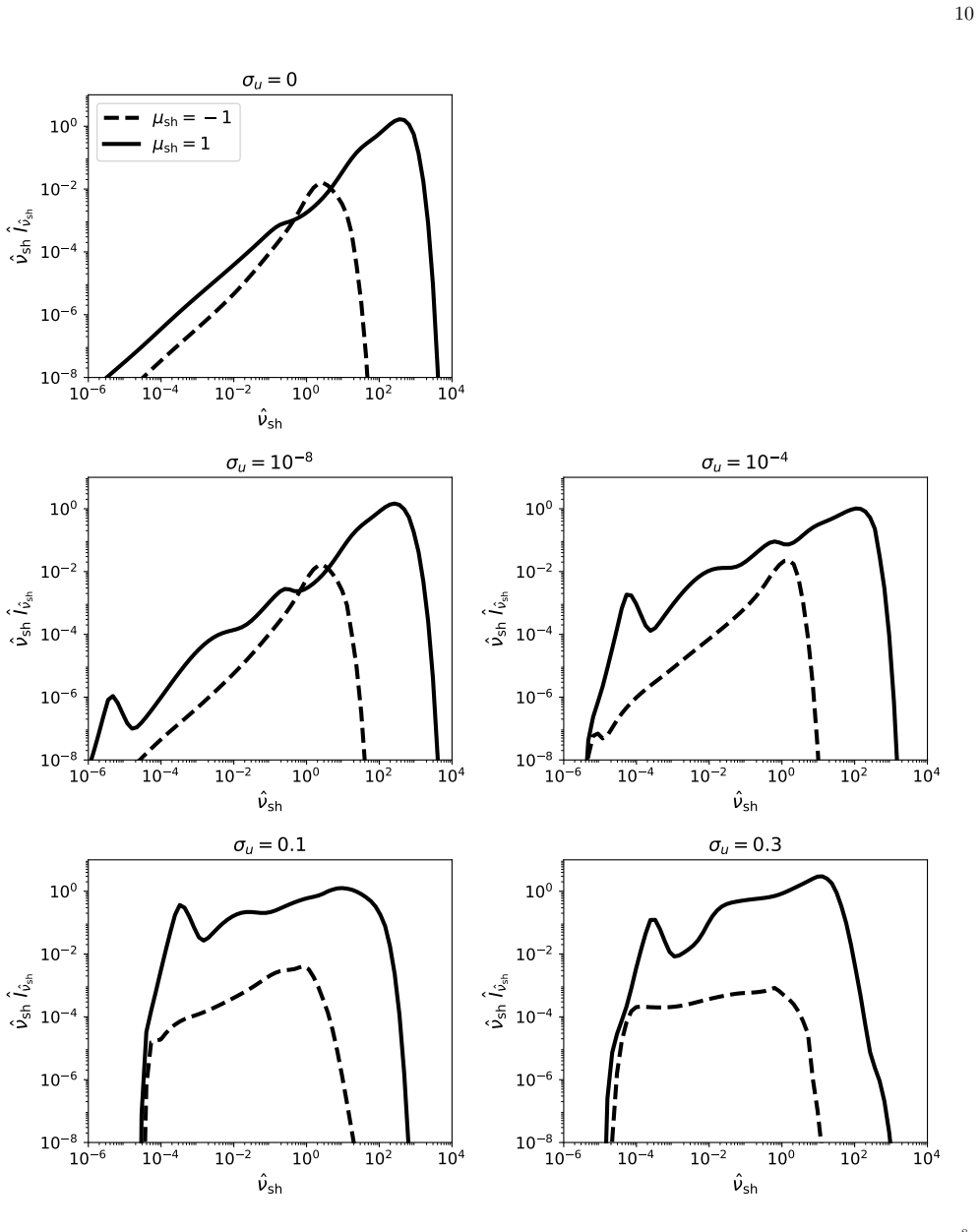
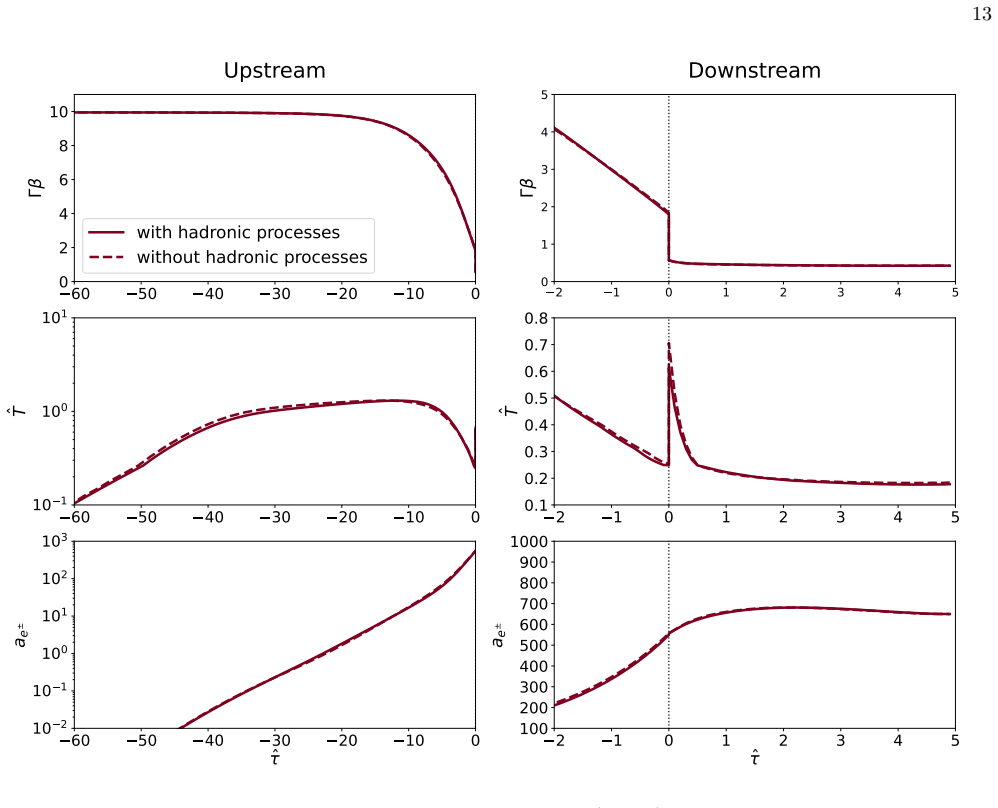
In steady-state radiation-mediated shocks with upstream Lorentz factor of 10, synchrotron self-absorption alters the shock profile for upstream magnetizations greater than or equal to 10 to the minus eight, producing changes up to 100 percent in the bulk Lorentz factor at the shock. For magnetizations of 0.1 and above a prominent subshock forms. Radiative processes tied to accelerated protons generate a high-energy tail above 10 GeV in the photon spectrum, yet the radiation flux and pressure remain negligibly affected and therefore exert only minor influence on the overall shock structure.
What carries the argument
Coupled solution of the hydrodynamic equations for a steady shock together with radiative transfer equations that include electron and proton acceleration.
If this is right
- Synchrotron self-absorption changes the shock velocity profile for magnetizations of 10 to the minus eight and above.
- A clear subshock develops once upstream magnetization reaches 0.1 or higher.
- Proton acceleration produces an additional high-energy component in the photon spectrum above 10 GeV.
- The total radiation flux and pressure experience only minor modification from hadronic and leptonic processes.
Where Pith is reading between the lines
- These changes in shock structure could shift the expected spectra and timing of high-energy emission from gamma-ray burst afterglows.
- Time-dependent or multi-dimensional extensions of the model might reveal additional variability in the emitted radiation and particle spectra.
- Coupling this framework to neutrino transport would allow direct tests against multi-messenger data from future transients.
Load-bearing premise
The model assumes a steady-state, one-dimensional shock with a fixed upstream Lorentz factor of 10 and explores only discrete magnetization values.
What would settle it
If observations or simulations of radiation-dominated astrophysical flows with magnetization near 10 to the minus eight show no measurable change in bulk Lorentz factor across the shock, the predicted alteration from synchrotron self-absorption would be ruled out.
Figures




read the original abstract
Shocks in astrophysical transients are key sites of particle acceleration. If the shock upstream is optically thick, radiation smoothens the velocity discontinuity at the shock (radiation-mediated shocks). However, in mildly magnetized outflows, a collisionless subshock can form, enhancing the efficiency of particle acceleration. We solve the hydrodynamic equations of a steady-state, radiation-mediated shock together with the radiative transfer equations accounting for electron and proton acceleration. Our goal is to explore the impact of the magnetic field and non-thermal radiation on the shock structure and the resulting spectral distribution of photons. To this purpose, we assume a relativistic upstream fluid velocity ($\Gamma_u = 10$) and investigate shock configurations with variable upstream magnetization ($\sigma_u = 0$, $10^{-8}$, $10^{-4}$, $0.1$, and $0.3$). We find that synchrotron self-absorption alters the shock profile for $\sigma_u \gtrsim 10^{-8}$, with resulting changes up to $100\%$ in the bulk Lorentz factor at the shock; for $\sigma_u \gtrsim 0.1$, a prominent subshock forms. The spectral energy distributions of upstream- and downstream-going photons are also altered. Radiative processes linked to accelerated protons are responsible for a high-energy ($\gtrsim 10$ GeV) tail in the photon spectrum; however, the radiation flux and pressure are negligibly affected with consequent minor impact on the shock structure. Our work highlights the importance of coupling the shock hydrodynamics to the transport of photons, electrons, protons, and intermediate particles to forecast the multi-messenger emission from astrophysical transients.
Editorial analysis
A structured set of objections, weighed in public.
Referee Report
Summary. The manuscript solves the steady-state hydrodynamic equations coupled with radiative transfer equations that include leptonic and hadronic particle acceleration for radiation-mediated shocks. For fixed upstream Lorentz factor Γ_u = 10 and discrete upstream magnetizations σ_u = 0, 10^{-8}, 10^{-4}, 0.1, 0.3, it reports that synchrotron self-absorption alters the shock profile for σ_u ≳ 10^{-8} (with up to 100% changes in bulk Lorentz factor), produces prominent subshocks for σ_u ≳ 0.1, and generates a high-energy (≳10 GeV) photon tail from proton-related processes that has negligible effect on radiation flux or pressure.
Significance. If the numerical results are robust, the work is significant for modeling shocks in astrophysical transients because it couples hydrodynamics to both leptonic and hadronic radiative processes and shows that magnetization effects can substantially modify shock structure even at low σ_u while hadronic contributions mainly affect the high-energy spectrum. Explicit exploration of discrete σ_u values and the finding of minor impact from hadronic radiation on overall pressure provide concrete, testable predictions for multi-messenger emission.
major comments (2)
- [Numerical methods and results] Numerical methods and results sections: the reported quantitative changes (up to 100% alteration in bulk Lorentz factor for σ_u ≳ 10^{-8} and subshock formation for σ_u ≳ 0.1) lack accompanying convergence tests, resolution studies, or error bars, which are required to establish that the coupled hydrodynamic-radiative solutions support the central structural claims.
- [Methods] Methods section on steady-state setup: the adoption of a steady-state 1D model with fixed Γ_u = 10 is load-bearing for the claims that synchrotron self-absorption alters the profile and enables subshocks; without validation against time-dependent relaxation or multi-dimensional effects, it remains unclear whether the velocity jump or absorption optical depth would persist.
minor comments (1)
- [Abstract] Abstract: the description of the numerical approach would be clearer if it briefly stated the discretization or solver method used for the coupled equations.
Simulated Author's Rebuttal
We thank the referee for their careful reading of the manuscript and for the constructive comments. We address each major comment below and indicate the revisions we will make to strengthen the presentation of our numerical results and to clarify the scope of the steady-state model.
read point-by-point responses
-
Referee: [Numerical methods and results] Numerical methods and results sections: the reported quantitative changes (up to 100% alteration in bulk Lorentz factor for σ_u ≳ 10^{-8} and subshock formation for σ_u ≳ 0.1) lack accompanying convergence tests, resolution studies, or error bars, which are required to establish that the coupled hydrodynamic-radiative solutions support the central structural claims.
Authors: We agree that explicit documentation of numerical convergence is necessary to support the reported quantitative changes. Although the original submission did not include a dedicated resolution study, we have now performed additional runs at three different grid resolutions (nominal, doubled, and halved) focused on the shock transition layer. The locations and amplitudes of the subshocks, as well as the fractional changes in bulk Lorentz factor, remain consistent to within approximately 12 percent across these resolutions. We will add a new subsection to the Numerical Methods section that describes the resolution study, presents the convergence metrics, and attaches error bars to the key quantities plotted in the results figures. revision: yes
-
Referee: [Methods] Methods section on steady-state setup: the adoption of a steady-state 1D model with fixed Γ_u = 10 is load-bearing for the claims that synchrotron self-absorption alters the profile and enables subshocks; without validation against time-dependent relaxation or multi-dimensional effects, it remains unclear whether the velocity jump or absorption optical depth would persist.
Authors: The steady-state, one-dimensional formulation is adopted to isolate the coupled effects of magnetization, synchrotron self-absorption, and hadronic processes on the shock structure, following the approach used in earlier studies of radiation-mediated shocks. We will expand the Methods section to state the underlying assumptions explicitly and to reference prior work that has examined the relaxation of similar shocks toward steady state. A comprehensive validation against time-dependent, multi-dimensional simulations lies outside the scope of the present study. revision: partial
- Full validation of the steady-state 1D solutions against time-dependent and multi-dimensional simulations
Circularity Check
No significant circularity; results follow from direct numerical solution of coupled equations
full rationale
The paper solves the steady-state hydrodynamic equations together with radiative transfer equations (including synchrotron self-absorption, leptonic and hadronic processes) for fixed upstream conditions Γ_u=10 and discrete σ_u values. The reported changes in Lorentz factor, subshock formation, and high-energy photon tail are direct numerical outputs of this setup rather than quantities fitted to the target observables or defined in terms of themselves. No load-bearing self-citations, ansatzes smuggled via prior work, or renaming of known results are used to justify the central structural or spectral claims. The derivation chain remains self-contained against the stated assumptions and does not reduce to its inputs by construction.
Axiom & Free-Parameter Ledger
free parameters (2)
- upstream Lorentz factor Γ_u
- upstream magnetization σ_u
axioms (1)
- domain assumption The shock is steady-state and radiation-mediated with collisionless subshock possible in magnetized cases
Lean theorems connected to this paper
-
IndisputableMonolith/Cost/FunctionalEquation.leanwashburn_uniqueness_aczel unclear?
unclearRelation between the paper passage and the cited Recognition theorem.
We solve the hydrodynamic equations of a steady-state, radiation-mediated shock together with the radiative transfer equations accounting for electron and proton acceleration... assume a relativistic upstream fluid velocity (Γ_u = 10) and investigate shock configurations with variable upstream magnetization (σ_u = 0, 10^{-8}, ...)
-
IndisputableMonolith/Foundation/RealityFromDistinction.leanreality_from_one_distinction unclear?
unclearRelation between the paper passage and the cited Recognition theorem.
The conservation equations for energy flux and momentum flux are: d/dz T^{0z}_sh = 0 ... radiation transfer equation ...
What do these tags mean?
- matches
- The paper's claim is directly supported by a theorem in the formal canon.
- supports
- The theorem supports part of the paper's argument, but the paper may add assumptions or extra steps.
- extends
- The paper goes beyond the formal theorem; the theorem is a base layer rather than the whole result.
- uses
- The paper appears to rely on the theorem as machinery.
- contradicts
- The paper's claim conflicts with a theorem or certificate in the canon.
- unclear
- Pith found a possible connection, but the passage is too broad, indirect, or ambiguous to say the theorem truly supports the claim.
Reference graph
Works this paper leans on
-
[1]
Compton scattering The total cross section for Compton scattering is given by [34] σc(ˆν,ˆT) =σ T 3 4 " 1 +ξ ξ3 2ξ(1 +ξ) 1 + 2ξ −ln(1 + 2ξ) +ln(1 + 2ξ) 2ξ − 1 + 3ξ (1 + 2ξ)2 # ,(A1) whereξ= ˆν(1 + 2ˆT) incorporates a correction due to the plasma temperature. The differential cross section is d˜σs dˆν′ (ˆν′ →ˆν) = 1 4π σc(ˆν′, ˆT)f d(ˆν′, ˆT ,ˆν),(A2) wher...
-
[2]
Pair production and annihilation For a given plasma temperature ˆT, thee ± annihilation rate is [35] re±( ˆT) = 3 4 1 + 2 ˆT 2 ln 2ηE ˆT+ 1.3 −1 ,(A10) whereη E = 0.5616. The spectral distribution of the re- sultant photons can be written as [35] f(ˆν, T)∝ 1 ˆνexp[x1T −0.12 7 +x 2T −0.16 7 lnˆν+x3T −0.52 7 (lnˆν)2 +x4T −1.84 7 (lnˆν)3 +x 5T −1.94 7...
-
[3]
Bremsstrahlung The numerical factorλ ff in Eqs. 26 and 27 is given by λff(ae± , T) = (1 +a e±)λep + [a2 e± + (1 +a e±)2]λee +ae±(1 +a e±)λe± (A14) whereλ ep,λ ee, andλ e± are the numerical fac- tors corresponding toe ±p,e ±e±, ande +e− thermal bremsstrahlung, respectively. For each case, the relation λ=π/(2 √ 3)gholds, and the analytical expressions for g...
-
[4]
Synchrotron radiation and self-absorption Considering an electron (positron) with energyE e, gy- rating around a magnetic field with strengthB, its radi- ation power can be calculated as [34] Pν,syn(ν, E) = √ 3e3B mec2 F ν νc ,(A15) with F(x) =x Z ∞ x K5/3(ξ)dξ ,(A16) andK 5/3(ξ) is the modified Bessel function of second kind. We assume that the random-mo...
-
[5]
Impact of leptonic processes Figures 8 and 9 show the photon spectrum in the up- stream (atˆτ=−20) forσ u = 0 andσ u = 10−8, 10−4, 0.1 as well as 0.3. In a non-magnetized or weakly magnetized shock, emission and absorption are dominated by Compton scat- tering together with pair production and annihilation, both upstream and downstream. The bremsstrahlung...
-
[6]
Fermi, On the Origin of the Cosmic Radiation, Phys- ical Review75, 1169 (1949)
E. Fermi, On the Origin of the Cosmic Radiation, Phys- ical Review75, 1169 (1949)
work page 1949
-
[7]
R. Blandford and D. Eichler, Particle acceleration at as- trophysical shocks: A theory of cosmic ray origin, Phys. Rev.154, 1 (1987)
work page 1987
-
[8]
I. Tamborra, Neutrinos from explosive transients at the dawn of multi-messenger astronomy, Nature Reviews Physics7, 285 (2025), arXiv:2412.09699 [astro-ph.HE]
- [9]
-
[10]
E. Waxman and B. Katz, Shock Breakout Theory, in Handbook of Supernovae, edited by A. W. Alsabti and P. Murdin (2017) p. 967
work page 2017
-
[11]
E. Vitagliano, I. Tamborra, and G. Raffelt, Grand unified neutrino spectrum at Earth: Sources and spectral com- ponents, Reviews of Modern Physics92, 045006 (2020), arXiv:1910.11878 [astro-ph.HE]
-
[12]
Navaset al.(Particle Data Group), Review of particle physics, Phys
S. Navaset al.(Particle Data Group), Review of particle physics, Phys. Rev. D110, 030001 (2024)
work page 2024
-
[13]
E. Guarini, I. Tamborra, R. Margutti, and E. Ramirez- Ruiz, Transients stemming from collapsing massive stars: The missing pieces to advance joint observations of photons and high-energy neutrinos, Phys. Rev. D108, 083035 (2023), arXiv:2308.03840 [astro-ph.HE]
-
[14]
A. Levinson and E. Nakar, Physics of radiation medi- ated shocks and its applications to GRBs, supernovae, and neutron star mergers, Phys. Rev.866, 1 (2020), arXiv:1909.10288 [astro-ph.HE]
-
[15]
T. A. Weaver, The structure of supernova shock waves., Astrophys. J. Supp.32, 233 (1976)
work page 1976
-
[16]
Relativistic Photon Mediated Shocks
A. Levinson and O. Bromberg, Relativistic Photon Me- diated Shocks, Phys. Rev. Lett.100, 131101 (2008), arXiv:0711.3281 [astro-ph]
work page internal anchor Pith review Pith/arXiv arXiv 2008
-
[17]
Photospheric signatures imprinted on the gamma-ray burst spectra
E. Ramirez-Ruiz, Photospheric signatures imprinted on theγ-ray burst spectra, Mon. Not. R. Astron. Soc.363, L61 (2005), arXiv:astro-ph/0509232 [astro-ph]
work page internal anchor Pith review Pith/arXiv arXiv 2005
-
[18]
Photospheric Emission in Gamma-Ray Bursts
A. Pe’Er and F. Ryde, Photospheric emission in gamma- ray bursts, International Journal of Modern Physics D 26, 1730018-296 (2017), arXiv:1603.05058 [astro-ph.HE]
work page internal anchor Pith review Pith/arXiv arXiv 2017
-
[19]
A. M. Beloborodov and P. M´ esz´ aros, Photospheric Emis- sion of Gamma-Ray Bursts, Space. Sci. Reviews.207, 87 (2017), arXiv:1701.04523 [astro-ph.HE]
work page internal anchor Pith review Pith/arXiv arXiv 2017
-
[20]
A. Rudolph, I. Tamborra, and O. Gottlieb, Subphoto- spheric Emission from Short Gamma-Ray Bursts: Pro- tons Mold the Multimessenger Signals, Astrophys. J. Let. 961, L7 (2024), arXiv:2309.08667 [astro-ph.HE]
-
[21]
A. Rudolph, I. Tamborra, and O. Gottlieb, Subpho- tospheric Emission from Short Gamma-Ray Bursts. II. Signatures of Nonthermal Dissipation in the Multi- messenger Signals, Astrophys. J.983, 34 (2025), arXiv:2410.23258 [astro-ph.HE]
-
[22]
F. Samuelsson and F. Ryde, Observational Charac- teristics of Radiation-mediated Shocks in Photospheric Gamma-Ray Burst Emission, Astrophys. J.956, 42 (2023), arXiv:2206.11701 [astro-ph.HE]
-
[23]
I. Vurm, Y. Lyubarsky, and T. Piran, On Thermaliza- tion in Gamma-Ray Burst Jets and the Peak Energies of Photospheric Spectra, Astrophys. J.764, 143 (2013), arXiv:1209.0763 [astro-ph.HE]
work page internal anchor Pith review Pith/arXiv arXiv 2013
-
[24]
Radiation-mediated shocks in gamma-ray bursts: spectral evolution
F. Alamaa and F. Daigne, Radiation-mediated shocks in gamma-ray bursts: spectral evolution, arXiv e-prints 18 10 6 10 4 10 2 100 102 104 sh 10 8 10 6 10 4 10 2 100 sh I sh u = 10 8 = 1 = 1 10 6 10 4 10 2 100 102 104 sh 10 8 10 6 10 4 10 2 100 sh sh ( sh) sh = 1 10 6 10 4 10 2 100 102 104 sh 10 8 10 6 10 4 10 2 100 sh sh ( sh) sh = 1 10 6 10 4 10 2 100 102...
work page internal anchor Pith review Pith/arXiv arXiv 2025
-
[25]
TeV-PeV Neutrinos from Low-Power Gamma-Ray Burst Jets inside Stars
K. Murase and K. Ioka, TeV-PeV Neutrinos from Low- Power Gamma-Ray Burst Jets inside Stars, Phys. Rev. Lett.111, 121102 (2013), arXiv:1306.2274 [astro-ph.HE]
work page internal anchor Pith review Pith/arXiv arXiv 2013
-
[26]
B. Katz, R. Budnik, and E. Waxman, Fast Radiation Mediated Shocks and Supernova Shock Breakouts, Astro- phys. J.716, 781 (2010), arXiv:0902.4708 [astro-ph.HE]
work page internal anchor Pith review Pith/arXiv arXiv 2010
-
[27]
Relativistic Radiation Mediated Shocks
R. Budnik, B. Katz, A. Sagiv, and E. Waxman, Rela- tivistic Radiation Mediated Shocks, Astrophys. J.725, 63 (2010), arXiv:1005.0141 [astro-ph.HE]
work page internal anchor Pith review Pith/arXiv arXiv 2010
-
[28]
Radiation mediated shocks in gamma-ray bursts: Subshock photon production
C. Lundman and A. M. Beloborodov, Radiation- mediated Shocks in Gamma-Ray Bursts: Subshock Photon Production, Astrophys. J.879, 83 (2019), arXiv:1804.03053 [astro-ph.HE]
work page internal anchor Pith review Pith/arXiv arXiv 2019
-
[29]
H. Ito, A. Levinson, B. E. Stern, and S. Na- gataki, Monte Carlo simulations of relativistic radiation- mediated shocks - I. Photon-rich regime, Mon. Not. R. Astron. Soc.474, 2828 (2018), arXiv:1709.08955 [astro- ph.HE]
work page internal anchor Pith review Pith/arXiv arXiv 2018
-
[30]
S. R. Kelner and F. A. Aharonian, Erratum: Energy spectra of gamma rays, electrons, and neutrinos pro- duced at interactions of relativistic protons with low en- ergy radiation [Phys. Rev. D 78, 034013 (2008)], Phys. Rev. D82, 099901 (2010)
work page 2008
-
[31]
S. R. Kelner, F. A. Aharonian, and V. V. Bugayov, Energy spectra of gamma rays, electrons, and neutri- nos produced at proton-proton interactions in the very high energy regime, Phys. Rev. D74, 034018 (2006), arXiv:astro-ph/0606058 [astro-ph]
work page internal anchor Pith review Pith/arXiv arXiv 2006
-
[32]
A. M. Beloborodov, Sub-photospheric Shocks in Rel- ativistic Explosions, Astrophys. J.838, 125 (2017), arXiv:1604.02794 [astro-ph.HE]
work page internal anchor Pith review Pith/arXiv arXiv 2017
-
[33]
F. J¨ uttner, Das Maxwellsche Gesetz der Geschwindigkeitsverteilung in der Relativtheorie, Annalen der Physik339, 856 (1911)
work page 1911
-
[34]
Particle Acceleration in Relativistic Magnetized Collisionless Electron-Ion Shocks
L. Sironi and A. Spitkovsky, Particle Acceleration in Rel- ativistic Magnetized Collisionless Electron-Ion Shocks, Astrophys. J.726, 75 (2011), arXiv:1009.0024 [astro- ph.HE]
work page internal anchor Pith review Pith/arXiv arXiv 2011
-
[35]
L. Sironi and A. Spitkovsky, Particle Acceleration in Relativistic Magnetized Collisionless Pair Shocks: De- pendence of Shock Acceleration on Magnetic Obliquity, Astrophys. J.698, 1523 (2009), arXiv:0901.2578 [astro- ph.HE]
work page internal anchor Pith review Pith/arXiv arXiv 2009
-
[36]
M. Klinger, A. Rudolph, X. Rodrigues, C. Yuan, G. Fichet de Clairfontaine, A. Fedynitch, W. Winter, M. Pohl, and S. Gao, AM 3: An Open-source Tool for Time-dependent Lepto-hadronic Modeling of Astro- physical Sources, Astrophys. J. Supp.275, 4 (2024), arXiv:2312.13371 [astro-ph.HE]
-
[37]
Inspecting the supernova gamma-ray burst connection with high-energy neutrinos
I. Tamborra and S. Ando, Inspecting the supernova- gamma-ray-burst connection with high-energy neutrinos, Phys. Rev. D93, 053010 (2016), arXiv:1512.01559 [astro- ph.HE]
work page internal anchor Pith review Pith/arXiv arXiv 2016
-
[38]
E. Guarini, I. Tamborra, and O. Gottlieb, State-of-the- art collapsar jet simulations imply undetectable subpho- tospheric neutrinos, Phys. Rev. D107, 023001 (2023), arXiv:2210.03757 [astro-ph.HE]
-
[39]
G. B. Rybicki and A. P. Lightman,Radiative processes in astrophysics(1979)
work page 1979
-
[40]
Svensson, Electron-Positron Pair Equilibria in Rela- tivistic Plasmas, Astrophys
R. Svensson, Electron-Positron Pair Equilibria in Rela- tivistic Plasmas, Astrophys. J.258, 335 (1982)
work page 1982
- [41]
-
[42]
High Energy Neutrinos from Cosmological Gamma-Ray Burst Fireballs
E. Waxman and J. Bahcall, High Energy Neutrinos from Cosmological Gamma-Ray Burst Fireballs, Phys. Rev. Lett.78, 2292 (1997), arXiv:astro-ph/9701231 [astro-ph]
work page internal anchor Pith review Pith/arXiv arXiv 1997
-
[43]
Y. W. Yu, Z. G. Dai, and X. P. Zheng, Neutrino emission from a gamma-ray burst afterglow shock during an inner supernova shock breakout, Mon. Not. R. Astron. Soc. 385, 1461 (2008), arXiv:0801.2076 [astro-ph]
work page internal anchor Pith review Pith/arXiv arXiv 2008
-
[44]
S. Razzaque, P. M´ esz´ aros, and E. Waxman, Neutrino tomography of gamma ray bursts and massive stellar collapses, Phys. Rev. D68, 083001 (2003), arXiv:astro- ph/0303505 [astro-ph]
discussion (0)
Sign in with ORCID, Apple, or X to comment. Anyone can read and Pith papers without signing in.