Recognition: 1 theorem link
· Lean TheoremAdS gravastar and its signatures from dual conformal field theory
Pith reviewed 2026-05-17 03:36 UTC · model grok-4.3
The pith
Echoes in dual CFT Green functions signal modified geometry inside the photon sphere
A machine-rendered reading of the paper's core claim, the machinery that carries it, and where it could break.
Core claim
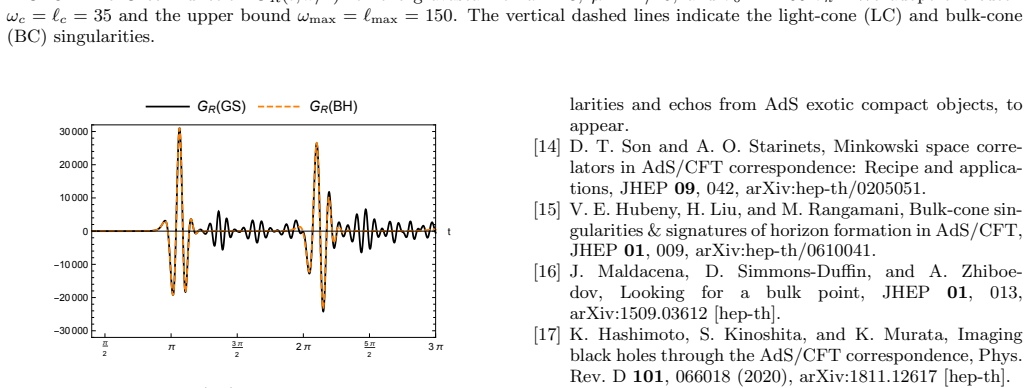
By constructing the AdS gravastar through gluing AdS-Schwarzschild and de Sitter spacetime, the retarded Green functions of the dual CFT exhibit singularities associated with null trajectories in the bulk that are specific to the horizon-less geometry, and echoes from waves reflected behind the photon sphere, implying that the geometry inside the photon sphere is modified.
What carries the argument
The glued AdS-Schwarzschild and de Sitter geometry forming the AdS gravastar, which enables the calculation of dual CFT retarded Green functions showing bulk-cone singularities and echoes.
If this is right
- Echoes would indicate that waves are reflected from a modified region inside the photon sphere rather than a horizon.
- The specific singularities distinguish the gravastar from classical black holes in the dual theory.
- Such signatures provide a way to test regularized black hole models holographically.
Where Pith is reading between the lines
- This approach might be applied to other regularized geometries to predict different echo patterns.
- Connections could be made to echo searches in gravitational wave observations if AdS results are extrapolated.
- The method highlights how boundary correlators can probe bulk modifications without specifying the full quantum gravity dynamics.
Load-bearing premise
The glued AdS-Schwarzschild plus de Sitter geometry is a physically valid regularized model whose dual CFT Green functions can be reliably computed and interpreted as signatures of quantum gravity effects.
What would settle it
A calculation of the retarded Green functions for the AdS gravastar that shows no echoes or only standard black hole-like singularities would falsify the implication that echoes mean modified geometry inside the photon sphere.
Figures


read the original abstract
Quantum gravity effects are expected to resolve the black hole singularity and the effects may deform the region near but outside the horizon. Applying AdS/CFT correspondence, we see their signatures from the viewpoint of dual conformal field theory. As a regularized geometry, we consider AdS gravastar constructed by gluing AdS-Schwarzschild and de Sitter spacetime. The retarded Green functions of dual conformal field theory have bulk-cone singularities associated with null trajectories in the bulk and we obtain the singularities specific to a horizon-less geometry. We also observe echoes coming from waves reflected behind the photon sphere. The existence of echoes implies the modification of geometry inside the photon sphere.
Editorial analysis
A structured set of objections, weighed in public.
Referee Report
Summary. The manuscript constructs an AdS gravastar by gluing AdS-Schwarzschild spacetime to de Sitter spacetime at a radius inside the photon sphere as a regularized model resolving black hole singularities. Applying AdS/CFT, it computes retarded Green functions of the dual CFT to extract bulk-cone singularities tied to null trajectories in the horizon-less bulk and echoes from reflections behind the photon sphere, concluding that such echoes imply geometric modifications inside the photon sphere.
Significance. If the glued geometry satisfies the necessary junction conditions and the Green-function computation is reliable, the work would provide a concrete AdS/CFT route to quantum-gravity signatures via observable echoes and modified bulk-cone singularities. The approach leverages standard holographic techniques and yields potentially falsifiable predictions in the dual CFT correlators.
major comments (3)
- [Abstract and gluing construction] The abstract and construction claim that singularities and echoes are obtained from the glued geometry, yet no explicit derivation of the retarded Green functions, matching conditions at the gluing surface, or error estimates appear. Without these steps it is impossible to confirm that the reported singularities follow from the stated construction rather than from the choice of gluing radius.
- [Gluing procedure and junction conditions] The central claim that echoes imply modification of geometry inside the photon sphere rests on the glued AdS-Schwarzschild/de Sitter geometry being a valid bulk dual. The manuscript does not verify the Israel junction conditions or demonstrate that the induced surface stress-energy corresponds to a stable, quantum-motivated configuration; this is load-bearing for attributing the echoes to quantum-gravity effects rather than model artifacts.
- [Retarded Green functions and echo analysis] The retarded Green functions are stated to exhibit echoes from waves reflected behind the photon sphere, but the text does not detail how reflections at the interface are incorporated into the bulk-cone singularity analysis or how the free gluing radius affects the echo timing.
minor comments (2)
- [Model parameters] Clarify the precise definition of the gluing radius and its status as a free parameter in the model.
- [References] Add explicit references to prior work on Israel junction conditions in AdS and on holographic signatures of horizon-less geometries.
Simulated Author's Rebuttal
We thank the referee for the careful reading and constructive comments. We address each major comment below and agree that additional explicit details will strengthen the manuscript.
read point-by-point responses
-
Referee: [Abstract and gluing construction] The abstract and construction claim that singularities and echoes are obtained from the glued geometry, yet no explicit derivation of the retarded Green functions, matching conditions at the gluing surface, or error estimates appear. Without these steps it is impossible to confirm that the reported singularities follow from the stated construction rather than from the choice of gluing radius.
Authors: The derivations of the retarded Green functions follow the standard holographic prescription applied to the composite geometry and are outlined in Section 3, while the matching conditions ensuring continuity of the metric and its derivatives at the interface are stated in Section 2. We acknowledge that the presentation would benefit from more explicit formulas, step-by-step matching calculations, and error estimates. These will be added in the revised manuscript to make the dependence on the gluing radius fully transparent. revision: yes
-
Referee: [Gluing procedure and junction conditions] The central claim that echoes imply modification of geometry inside the photon sphere rests on the glued AdS-Schwarzschild/de Sitter geometry being a valid bulk dual. The manuscript does not verify the Israel junction conditions or demonstrate that the induced surface stress-energy corresponds to a stable, quantum-motivated configuration; this is load-bearing for attributing the echoes to quantum-gravity effects rather than model artifacts.
Authors: We agree that an explicit check of the Israel junction conditions is required to confirm the geometry is a consistent solution. The current construction assumes a thin-shell gluing that satisfies metric continuity, but the surface stress-energy tensor and its stability properties are not computed in detail. We will include this verification, together with a brief discussion of the physical motivation for the shell, in the revised version. revision: yes
-
Referee: [Retarded Green functions and echo analysis] The retarded Green functions are stated to exhibit echoes from waves reflected behind the photon sphere, but the text does not detail how reflections at the interface are incorporated into the bulk-cone singularity analysis or how the free gluing radius affects the echo timing.
Authors: The echoes arise from additional null geodesics that reflect at the interface and contribute extra singularities to the retarded correlators; this is indicated by the modified light-cone structure in the glued spacetime. To address the request for clarity, the revised manuscript will provide an explicit account of the reflection boundary conditions used in the wave equation and show how the echo delay scales with the chosen gluing radius. revision: yes
Circularity Check
No significant circularity; derivation follows from explicit model construction and standard AdS/CFT computation
full rationale
The paper constructs a regularized AdS gravastar by gluing AdS-Schwarzschild to de Sitter spacetime, then computes retarded Green functions in the dual CFT to identify bulk-cone singularities and echoes characteristic of the horizonless geometry. These features are obtained directly from null geodesics and wave reflections in the specified bulk metric without any reduction to fitted parameters, self-definitions, or load-bearing self-citations. The statement that echoes imply geometry modification inside the photon sphere is a logical consequence of the model's horizonless property rather than a tautological rephrasing of inputs. The derivation remains self-contained against the classical gluing and holographic dictionary, with no evidence of ansatz smuggling or renaming of known results.
Axiom & Free-Parameter Ledger
free parameters (1)
- glueing radius
axioms (2)
- domain assumption AdS/CFT correspondence applies to the glued geometry
- ad hoc to paper Classical gluing conditions suffice to model quantum-gravity regularization
invented entities (1)
-
AdS gravastar
no independent evidence
Lean theorems connected to this paper
-
IndisputableMonolith/Foundation/AlexanderDuality.leanalexander_duality_circle_linking unclear?
unclearRelation between the paper passage and the cited Recognition theorem.
AdS gravastar constructed by gluing AdS-Schwarzschild and de Sitter spacetime... echoes coming from waves reflected behind the photon sphere.
What do these tags mean?
- matches
- The paper's claim is directly supported by a theorem in the formal canon.
- supports
- The theorem supports part of the paper's argument, but the paper may add assumptions or extra steps.
- extends
- The paper goes beyond the formal theorem; the theorem is a base layer rather than the whole result.
- uses
- The paper appears to rely on the theorem as machinery.
- contradicts
- The paper's claim conflicts with a theorem or certificate in the canon.
- unclear
- Pith found a possible connection, but the passage is too broad, indirect, or ambiguous to say the theorem truly supports the claim.
Forward citations
Cited by 3 Pith papers
-
Families of regular spacetimes and energy conditions
A classification of admissible energy density profiles with bounded Kretschmann scalar produces families of regular static spherically symmetric spacetimes in GR, including new closed-form solutions involving hypergeo...
-
Families of regular spacetimes and energy conditions
A classification of admissible energy density profiles with bounded Kretschmann scalar yields a unified framework for regular static spherically symmetric spacetimes satisfying the weak energy condition, recovering kn...
-
Bulk-cone singularities and echoes from AdS exotic compact objects
AdS exotic compact objects imprint bulk-cone singularities from null geodesics and echoes from trapped waves on CFT Green functions, signaling no horizon.
Reference graph
Works this paper leans on
-
[1]
However, we should empha- size that our arguments hold for generic geometries
up to an overall factor. However, we should empha- size that our arguments hold for generic geometries. In the case of pure AdS, the approximation in (20) cannot be applied and the light-cone and bulk-cone singularities coincide with each other. IV. ADS GRA V AST AR AND ECHOES We would like to apply the above analysis to the case of AdS gravastar. See [12...
-
[2]
J. M. Maldacena, The largeNlimit of superconformal field theories and supergravity, Adv. Theor. Math. Phys. 2, 231 (1998), arXiv:hep-th/9711200
work page internal anchor Pith review Pith/arXiv arXiv 1998
-
[3]
S. S. Gubser, I. R. Klebanov, and A. M. Polyakov, Gauge theory correlators from noncritical string theory, Phys. Lett. B428, 105 (1998), arXiv:hep-th/9802109
work page internal anchor Pith review Pith/arXiv arXiv 1998
-
[4]
Anti De Sitter Space And Holography
E. Witten, Anti-de Sitter space and holography, Adv. Theor. Math. Phys.2, 253 (1998), arXiv:hep-th/9802150
work page internal anchor Pith review Pith/arXiv arXiv 1998
-
[5]
Black Holes: Complementarity or Firewalls?
A. Almheiri, D. Marolf, J. Polchinski, and J. Sully, Black holes: Complementarity or firewalls?, JHEP02, 062, 6 π 2 π 3π 2 2π 5π 2 3π 7π 2 -1×10 6 -500 000 0 500 000 1×10 6 t GR(t,π/2) GR GR (BH) LC BC BC(GS) FIG. 3. The Green functionG R(t, π/2) for the gravastar ford= 3,µ= 1/15, andr 0 = 1.001r h. We adopt the cutoff ωc =ℓ c = 35 and the upper boundω ma...
work page internal anchor Pith review Pith/arXiv arXiv
-
[6]
AdS/CFT duality and the black hole information paradox
O. Lunin and S. D. Mathur, AdS/CFT duality and the black hole information paradox, Nucl. Phys. B623, 342 (2002), arXiv:hep-th/0109154
work page internal anchor Pith review Pith/arXiv arXiv 2002
-
[7]
O. Lunin and S. D. Mathur, Statistical interpretation of Bekenstein entropy for systems with a stretched hori- zon, Phys. Rev. Lett.88, 211303 (2002), arXiv:hep- th/0202072
-
[8]
Testing the nature of dark compact objects: a status report
V. Cardoso and P. Pani, Testing the nature of dark com- pact objects: A status report, Living Rev. Rel.22, 4 (2019), arXiv:1904.05363 [gr-qc]
work page internal anchor Pith review Pith/arXiv arXiv 2019
- [9]
-
[10]
Stable gravastars - an alternative to black holes?
M. Visser and D. L. Wiltshire, Stable gravastars: An alternative to black holes?, Class. Quant. Grav.21, 1135 (2004), arXiv:gr-qc/0310107
work page internal anchor Pith review Pith/arXiv arXiv 2004
-
[11]
P. Pani, E. Berti, V. Cardoso, Y. Chen, and R. Norte, Gravitational wave signatures of the absence of an event horizon. I. Nonradial oscillations of a thin-shell gravastar, Phys. Rev. D80, 124047 (2009), arXiv:0909.0287 [gr-qc]
work page internal anchor Pith review Pith/arXiv arXiv 2009
-
[12]
V. Cardoso, L. C. B. Crispino, C. F. B. Macedo, H. Okawa, and P. Pani, Light rings as observational evi- dence for event horizons: Long-lived modes, ergoregions and nonlinear instabilities of ultracompact objects, Phys. Rev. D90, 044069 (2014), arXiv:1406.5510 [gr-qc]
work page internal anchor Pith review Pith/arXiv arXiv 2014
- [13]
-
[14]
H.-Y. Chen, Y. Hikida, and Y. Koga, Bulk-cone singu- larities and echos from AdS exotic compact objects, to appear
-
[15]
D. T. Son and A. O. Starinets, Minkowski space corre- lators in AdS/CFT correspondence: Recipe and applica- tions, JHEP09, 042, arXiv:hep-th/0205051
work page internal anchor Pith review Pith/arXiv arXiv
-
[16]
V. E. Hubeny, H. Liu, and M. Rangamani, Bulk-cone sin- gularities & signatures of horizon formation in AdS/CFT, JHEP01, 009, arXiv:hep-th/0610041
work page internal anchor Pith review Pith/arXiv arXiv
-
[17]
J. Maldacena, D. Simmons-Duffin, and A. Zhiboe- dov, Looking for a bulk point, JHEP01, 013, arXiv:1509.03612 [hep-th]
work page internal anchor Pith review Pith/arXiv arXiv
-
[18]
K. Hashimoto, S. Kinoshita, and K. Murata, Imaging black holes through the AdS/CFT correspondence, Phys. Rev. D101, 066018 (2020), arXiv:1811.12617 [hep-th]
-
[19]
K. Hashimoto, S. Kinoshita, and K. Murata, Einstein rings in holography, Phys. Rev. Lett.123, 031602 (2019), arXiv:1906.09113 [hep-th]
work page internal anchor Pith review Pith/arXiv arXiv 2019
-
[20]
M. Dodelson and H. Ooguri, Singularities of thermal cor- relators at strong coupling, Phys. Rev. D103, 066018 (2021), arXiv:2010.09734 [hep-th]
-
[21]
S. Kinoshita, K. Murata, and D. Takeda, Shooting null geodesics into holographic spacetimes, JHEP10, 074, arXiv:2304.01936 [hep-th]
-
[22]
Terashima, Wave packets in AdS/CFT cor- respondence, Phys
S. Terashima, Wave packets in AdS/CFT cor- respondence, Phys. Rev. D109, 106012 (2024), arXiv:2304.08478 [hep-th]
-
[23]
K. Hashimoto, K. Sugiura, K. Sugiyama, and T. Yoda, Photon sphere and quasinormal modes in AdS/CFT, JHEP10, 149, arXiv:2307.00237 [hep-th]
-
[24]
M. Dodelson, C. Iossa, R. Karlsson, A. Lupsasca, and A. Zhiboedov, Black hole bulk-cone singularities, JHEP 07, 046, arXiv:2310.15236 [hep-th]
-
[25]
S. Caron-Huot, J. Chakravarty, and K. Namjou, Boundary imprint of bulk causality, JHEP07, 076, arXiv:2501.13182 [hep-th]
-
[26]
Is the gravitational-wave ringdown a probe of the event horizon?
V. Cardoso, E. Franzin, and P. Pani, Is the gravitational- wave ringdown a probe of the event horizon?, Phys. Rev. Lett.116, 171101 (2016), [Erratum: Phys.Rev.Lett. 117, 089902 (2016)], arXiv:1602.07309 [gr-qc]
work page internal anchor Pith review Pith/arXiv arXiv 2016
-
[27]
V. Cardoso, S. Hopper, C. F. B. Macedo, C. Palenzuela, and P. Pani, Gravitational-wave signatures of exotic com- pact objects and of quantum corrections at the horizon scale, Phys. Rev. D94, 084031 (2016), arXiv:1608.08637 [gr-qc]
work page internal anchor Pith review Pith/arXiv arXiv 2016
-
[28]
Probing microstructure of black hole spacetimes with gravitational wave echoes
N. Oshita and N. Afshordi, Probing microstructure of black hole spacetimes with gravitational wave echoes, Phys. Rev. D99, 044002 (2019), arXiv:1807.10287 [gr- qc]. 7
work page internal anchor Pith review Pith/arXiv arXiv 2019
- [29]
-
[30]
S. Terashima, Stretched horizon dissipation and the fate of echoes, JHEP10, 147, arXiv:2506.20462 [hep-th]
- [31]
-
[32]
We start from the wave function forz + < z <∞
AdS-Schwarzschild black hole We would like to solve the wave equation (6) in the WKB approximation for AdS-Schwarzschild black hole. We start from the wave function forz + < z <∞. The black hole horizon is located atz→ ∞and the ingoing boundary condition is required at the horizon, i.e., ψ(z)∼e iωz (z→ ∞).(A1) The wave function satisfying the condition is...
-
[33]
Here we consider the case with four zeros ofκ 2(z) =
AdS gravastar We examine the wave equation (6) for the AdS gravas- tar. Here we consider the case with four zeros ofκ 2(z) =
-
[34]
We set these zeros to be located atz=z b, z±, zs (0≃z b < z − < z + < z s). The wave function forz > z s is ψωℓ(z)∼ 1p q(z) e− R z zs dz′q(z ′).(A7) We connect it to the regionz + < z < z s as ψ(z)∼ e iπ 4 −iS(z+,zs) p κ(z) e i R z z+ dz′κ(z′) + e− iπ 4 +iS(z+,zs) p κ(z) e −i R z z+ dz′κ(z′) . (A8) We further continue the wave function to the region 0≃ zb...
discussion (0)
Sign in with ORCID, Apple, or X to comment. Anyone can read and Pith papers without signing in.