Recognition: 2 theorem links
· Lean TheoremThe DREAMS Project: Disentangling the Impact of Halo-to-Halo Variance and Baryonic Feedback on Milky Way Dark Matter Density Profiles
Pith reviewed 2026-05-17 01:49 UTC · model grok-4.3
The pith
Milky Way dark matter density profiles show little response to feedback and cosmology changes, with halo-to-halo variance driving most scatter.
A machine-rendered reading of the paper's core claim, the machinery that carries it, and where it could break.
Core claim
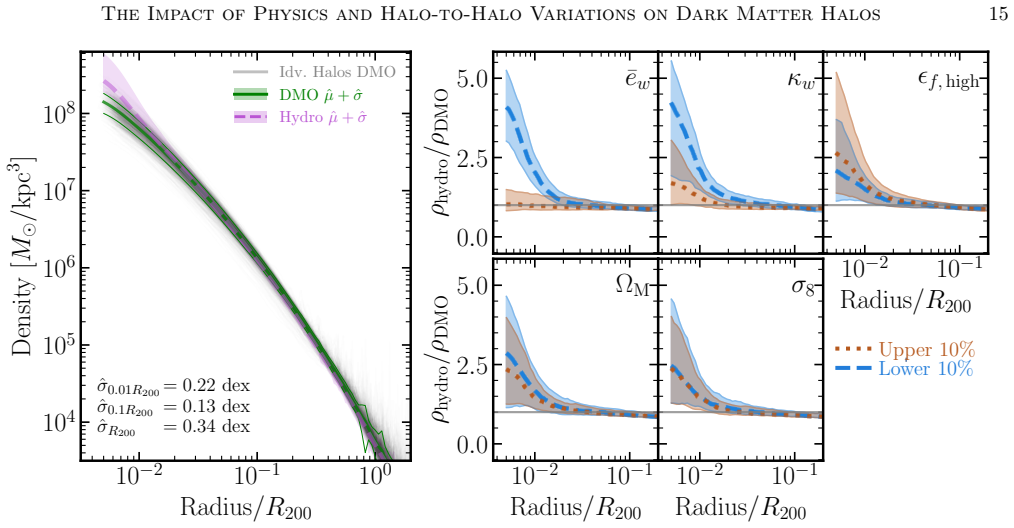
For the DREAMS parameter variations, Milky Way-mass dark matter density profiles in the IllustrisTNG model are largely insensitive to astrophysics and cosmology variations, with the dominant source of scatter instead arising from halo-to-halo variance. Most of the comparatively minor feedback-driven variations come from the changes to supernova prescriptions. By comparing to dark-matter-only simulations, the strongest supernova wind energies are found to prevent galaxy formation so effectively that the halos are nearly entirely collisionless dark matter. Regardless of physics variation, all the DREAMS halos are roughly consistent with a halo contracting adiabatically from the presence of the
What carries the argument
The DREAMS suite of 1024 Milky Way-mass halo simulations that vary IllustrisTNG supernova and black-hole feedback parameters plus two cosmological parameters, compared against dark-matter-only runs to isolate effects on the inner density profile.
If this is right
- Uncertainties in Milky Way dark matter density for particle searches are dominated by halo-to-halo variance rather than uncertainties in feedback modeling.
- Strong supernova feedback can produce halos that are essentially collisionless, matching dark-matter-only expectations.
- Dark matter profiles remain consistent with adiabatic contraction from baryons rather than the cores produced by bursty feedback.
- Systematic errors in density-profile predictions for the Milky Way can be reduced by sampling many independent halos instead of refining feedback parameters further.
Where Pith is reading between the lines
- Larger suites that sample hundreds of halos per parameter set would be needed to quantify the halo-variance contribution more precisely.
- If halo variance continues to dominate in other galaxy-formation models, the result would suggest that profile uncertainties are largely model-independent at Milky Way masses.
- Direct-detection experiments could treat the Milky Way profile uncertainty as a statistical average over many possible host halos rather than a systematic tied to feedback calibration.
Load-bearing premise
The chosen ranges of supernova and black hole feedback parameters, plus the two cosmological parameters, are sufficient to capture the full plausible impact of baryonic physics on the dark matter profiles.
What would settle it
A direct measurement or dynamical inference of the Milky Way dark matter density profile that lies well outside the range spanned by all 1024 DREAMS halos across the explored parameter variations would falsify the claim that feedback effects are subdominant.
Figures




read the original abstract
In this work, we utilize a new suite of Milky Way-mass halos from the DREAMS Project, simulated with Cold Dark Matter (CDM), to quantify the influence of baryon feedback and intrinsic halo-to-halo variance on dark matter density profiles. Our suite of 1024 halos varies over supernova and black hole feedback parameters from the IllustrisTNG model, as well as variations in two cosmological parameters. We find that, for the DREAMS parameter variations, Milky Way-mass dark matter density profiles in the IllustrisTNG model are largely insensitive to astrophysics and cosmology variations, with the dominant source of scatter instead arising from halo-to-halo variance. However, most of the (comparatively minor) feedback-driven variations come from the changes to supernova prescriptions. By comparing to dark matter-only simulations, we find that the strongest supernova wind energies are so effective at preventing galaxy formation that the halos are nearly entirely collisionless dark matter. Finally, regardless of physics variation, all the DREAMS halos are roughly consistent with a halo contracting adiabatically from the presence of baryons, unlike models that have bursty stellar feedback. This work represents a step toward assessing the uncertainty in Milky Way dark matter profiles, with direct implications for dark matter searches where systematic uncertainty in the density profile remains a major challenge.
Editorial analysis
A structured set of objections, weighed in public.
Referee Report
Summary. The manuscript describes results from the DREAMS suite of 1024 Milky Way-mass halos simulated in CDM with variations in supernova and black hole feedback parameters drawn from the IllustrisTNG model, together with two cosmological parameters. The central claim is that, within these DREAMS variations, the dark matter density profiles are largely insensitive to the astrophysics and cosmology changes, with halo-to-halo variance dominating the scatter. Most of the modest feedback-driven differences arise from supernova prescriptions; the strongest winds produce nearly collisionless halos. All halos remain consistent with adiabatic contraction from baryons, in contrast to bursty-feedback models.
Significance. If the results hold, the work is significant for quantifying systematic uncertainty in Milky Way dark matter profiles relevant to direct-detection searches. The large halo sample (1024) supplies robust statistics that support the claim that halo-to-halo variance exceeds feedback-induced scatter within the explored parameter space. The explicit comparison to dark-matter-only runs and the adiabatic-contraction consistency are useful benchmarks. Credit is given to the simulation volume that underpins the statistical conclusions.
major comments (2)
- [Abstract] Abstract: the abstract states that profiles are 'largely insensitive' to the DREAMS variations but supplies no explicit bounds, sampling density, or justification for the supernova and black hole feedback parameter ranges. Without this information it is difficult to assess whether the explored variations are broad enough to capture regimes in which baryonic effects on the inner dark matter profile could become substantial, which is load-bearing for the claim that halo-to-halo variance dominates.
- [Methods] Methods section: the manuscript must detail the radial range, binning, fitting procedure, and error estimation used to extract and compare the dark matter density profiles. These choices directly affect the quantitative conclusion of insensitivity and the comparison to the dark-matter-only runs; their absence limits independent verification of the reported scatter.
minor comments (2)
- [Figures] Figure captions should explicitly label which curves correspond to supernova variations, black-hole variations, cosmological variations, and the dark-matter-only reference runs.
- [Table 1] A short table summarizing the exact parameter values and ranges varied in the DREAMS suite would improve clarity and allow readers to judge the dynamic range of the astrophysical variations.
Simulated Author's Rebuttal
We thank the referee for their constructive review and recommendation for minor revision. Their comments identify opportunities to improve clarity in the abstract and methods, which we address below. We have prepared revisions to incorporate the requested details without altering the core scientific conclusions.
read point-by-point responses
-
Referee: The abstract states that profiles are 'largely insensitive' to the DREAMS variations but supplies no explicit bounds, sampling density, or justification for the supernova and black hole feedback parameter ranges. Without this information it is difficult to assess whether the explored variations are broad enough to capture regimes in which baryonic effects on the inner dark matter profile could become substantial.
Authors: We agree that additional context on the parameter space would aid assessment of the claim. The DREAMS variations are drawn directly from the IllustrisTNG model parameter ranges for supernova and black hole feedback, which were calibrated to reproduce observed galaxy properties. In the revised manuscript we will expand the abstract to briefly note these ranges, the two cosmological parameters varied, and the sample of 1024 halos, thereby providing the requested justification and sampling information while preserving the abstract's brevity. revision: yes
-
Referee: Methods section: the manuscript must detail the radial range, binning, fitting procedure, and error estimation used to extract and compare the dark matter density profiles. These choices directly affect the quantitative conclusion of insensitivity and the comparison to the dark-matter-only runs.
Authors: We acknowledge that the current Methods section omits explicit descriptions of these analysis choices. This was an oversight in the submitted version. In the revision we will add a concise subsection specifying the radial range (0.1–10 kpc, with emphasis on the inner profile), logarithmic binning, the procedure for constructing and comparing median density profiles, and the error estimation via halo-to-halo variance with bootstrap resampling. These additions will enable independent verification while leaving the reported results unchanged. revision: yes
Circularity Check
Direct measurements from simulation outputs with no circular derivation
full rationale
The paper's central claim follows from running 1024 Milky Way-mass halo simulations in the DREAMS suite (varying supernova, black hole feedback, and two cosmological parameters within the IllustrisTNG model) and directly extracting and comparing dark matter density profiles from the outputs, including against dark matter-only runs. No parameters are fitted to the target density profiles, no self-definitional loops or uniqueness theorems are invoked, and no ansatzes or prior self-citations are used to derive the profiles themselves. The reported insensitivity to astrophysics/cosmology variations (with halo-to-halo variance dominant) and consistency with adiabatic contraction are empirical outcomes of the simulation measurements, making the analysis self-contained against external benchmarks.
Axiom & Free-Parameter Ledger
free parameters (3)
- supernova feedback parameters
- black hole feedback parameters
- two cosmological parameters
axioms (2)
- domain assumption Cold Dark Matter cosmology governs halo formation
- domain assumption IllustrisTNG feedback prescriptions capture the dominant baryonic effects
Lean theorems connected to this paper
-
IndisputableMonolith/Cost/FunctionalEquation.leanwashburn_uniqueness_aczel unclear?
unclearRelation between the paper passage and the cited Recognition theorem.
Our suite of 1024 halos varies over supernova and black hole feedback parameters from the IllustrisTNG model, as well as variations in two cosmological parameters.
What do these tags mean?
- matches
- The paper's claim is directly supported by a theorem in the formal canon.
- supports
- The theorem supports part of the paper's argument, but the paper may add assumptions or extra steps.
- extends
- The paper goes beyond the formal theorem; the theorem is a base layer rather than the whole result.
- uses
- The paper appears to rely on the theorem as machinery.
- contradicts
- The paper's claim conflicts with a theorem or certificate in the canon.
- unclear
- Pith found a possible connection, but the passage is too broad, indirect, or ambiguous to say the theorem truly supports the claim.
Reference graph
Works this paper leans on
-
[1]
2010, MNRAS, 404, 475, doi: 10.1111/j.1365-2966.2010.16309.x
Steinmetz, M. 2010, MNRAS, 407, 435, doi: 10.1111/j.1365-2966.2010.16912.x
-
[2]
Agertz, O., Kravtsov, A. V., Leitner, S. N., & Gnedin, N. Y. 2013, ApJ, 770, 25, doi: 10.1088/0004-637X/770/1/25
-
[3]
2021, MNRAS, 503, 5826, doi: 10.1093/mnras/stab322
Agertz, O., Renaud, F., Feltzing, S., et al. 2021, MNRAS, 503, 5826, doi: 10.1093/mnras/stab322
-
[4]
Akiba, T., Sano, S., Yanase, T., Ohta, T., & Koyama, M. 2019, in Proceedings of the 25th ACM SIGKDD International Conference on Knowledge Discovery & Data Mining, KDD ’19 (New York, NY, USA: Association for Computing Machinery), 2623–2631, doi: 10.1145/3292500.3330701
-
[5]
Anbajagane, D., Evrard, A. E., & Farahi, A. 2022, MNRAS, 509, 3441, doi: 10.1093/mnras/stab3177
-
[6]
2024, MNRAS, 531, 3406, doi: 10.1093/mnras/stae1125
Bhagwat, A., Costa, T., Ciardi, B., Pakmor, R., & Garaldi, E. 2024, MNRAS, 531, 3406, doi: 10.1093/mnras/stae1125
-
[7]
2008, Galactic Dynamics: Second Edition (Princeton University Press)
Binney, J., & Tremaine, S. 2008, Galactic Dynamics: Second Edition (Princeton University Press)
work page 2008
-
[8]
Blumenthal, G. R., Faber, S. M., Flores, R., & Primack, J. R. 1986, ApJ, 301, 27, doi: 10.1086/163867
-
[9]
Brooks, A. M., & Zolotov, A. 2014, ApJ, 786, 87, doi: 10.1088/0004-637X/786/2/87
-
[10]
Bullock, J. S., & Boylan-Kolchin, M. 2017, ARA&A, 55, 343, doi: 10.1146/annurev-astro-091916-055313
-
[11]
Callingham, T. M., Cautun, M., Deason, A. J., et al. 2019, MNRAS, 484, 5453, doi: 10.1093/mnras/stz365
-
[12]
Cautun, M., Benítez-Llambay, A., Deason, A. J., et al. 2020, MNRAS, 494, 4291, doi: 10.1093/mnras/staa1017
-
[13]
2003, PASP, 115, 763, doi: 10.1086/376392
Chabrier, G. 2003, PASP, 115, 763, doi: 10.1086/376392
work page internal anchor Pith review doi:10.1086/376392 2003
-
[14]
K., Kereš, D., Oñorbe, J., et al
Chan, T. K., Kereš, D., Oñorbe, J., et al. 2015, MNRAS, 454, 2981, doi: 10.1093/mnras/stv2165
-
[15]
2019, MNRAS, 484, 476, doi: 10.1093/mnras/sty3531
Hernquist, L. 2019, MNRAS, 484, 476, doi: 10.1093/mnras/sty3531
-
[16]
2022, MNRAS, 515, 2681, doi: 10.1093/mnras/stac1897
Hernquist, L. 2022, MNRAS, 515, 2681, doi: 10.1093/mnras/stac1897
-
[17]
Crain, R. A., & van de Voort, F. 2023, ARA&A, 61, 473, doi: 10.1146/annurev-astro-041923-043618 de Blok, W. J. G. 2010, Advances in Astronomy, 2010, 789293, doi: 10.1155/2010/789293 de Blok, W. J. G., & Bosma, A. 2002, A&A, 385, 816, doi: 10.1051/0004-6361:20020080 de Blok, W. J. G., Walter, F., Brinks, E., et al. 2008, AJ, 136, 2648, doi: 10.1088/0004-62...
-
[18]
1986, ApJ, 303, 39, doi: 10.1086/164050 Di Cintio, A., Brook, C
Dekel, A., & Silk, J. 1986, ApJ, 303, 39, doi: 10.1086/164050 Di Cintio, A., Brook, C. B., Dutton, A. A., et al. 2014, MNRAS, 441, 2986, doi: 10.1093/mnras/stu729
-
[19]
2010, MNRAS, 404, 475, doi: 10.1111/j.1365-2966.2010.16309.x
Duffy, A. R., Schaye, J., Kay, S. T., et al. 2010, MNRAS, 405, 2161, doi: 10.1111/j.1365-2966.2010.16613.x
-
[20]
J., Lynden-Bell, D., & Sandage, A
Eggen, O. J., Lynden-Bell, D., & Sandage, A. R. 1962, ApJ, 136, 748, doi: 10.1086/147433
-
[21]
Fall, S. M., & Efstathiou, G. 1980, MNRAS, 193, 189, doi: 10.1093/mnras/193.2.189
-
[22]
2022, ApJ, 933, 48, doi: 10.3847/1538-4357/ac721e
Farahi, A., Nagai, D., & Anbajagane, D. 2022, ApJ, 933, 48, doi: 10.3847/1538-4357/ac721e
-
[23]
2025, arXiv e-prints, arXiv:2507.08925
Feldmann, R., & Bieri, R. 2025, arXiv e-prints, arXiv:2507.08925. https://arxiv.org/abs/2507.08925
-
[24]
Fitts, A., Boylan-Kolchin, M., Elbert, O. D., et al. 2017, MNRAS, 471, 3547, doi: 10.1093/mnras/stx1757
-
[25]
Font, A. S., McCarthy, I. G., Poole-Mckenzie, R., et al. 2020, MNRAS, 498, 1765, doi: 10.1093/mnras/staa2463
-
[26]
Foreman-Mackey, D., Hogg, D. W., Lang, D., & Goodman, J. 2013, PASP, 125, 306, doi: 10.1086/670067
-
[27]
Garcia, A. M., Torrey, P., Hemler, Z. S., et al. 2023, MNRAS, 519, 4716, doi: 10.1093/mnras/stac3749
-
[28]
M., Torrey, P., Ellison, S., et al
Garcia, A. M., Torrey, P., Ellison, S., et al. 2024a, MNRAS, 531, 1398, doi: 10.1093/mnras/stae1252
-
[29]
M., Torrey, P., Grasha, K., et al
Garcia, A. M., Torrey, P., Grasha, K., et al. 2024b, MNRAS, 529, 3342, doi: 10.1093/mnras/stae737
-
[30]
M., Torrey, P., Bhagwat, A., et al
Garcia, A. M., Torrey, P., Bhagwat, A., et al. 2025a, arXiv e-prints, arXiv:2503.03804, doi: 10.48550/arXiv.2503.03804
-
[31]
Garcia, A. M., Torrey, P., Ellison, S. L., et al. 2025b, MNRAS, 536, 119, doi: 10.1093/mnras/stae2587
-
[32]
Garcia, A. M., Torrey, P., Bhagwat, A., et al. 2025c, arXiv e-prints, arXiv:2510.26877, doi: 10.48550/arXiv.2510.26877
work page internal anchor Pith review Pith/arXiv arXiv doi:10.48550/arxiv.2510.26877
-
[33]
Genel, S., Bryan, G. L., Springel, V., et al. 2019, ApJ, 871, 21, doi: 10.3847/1538-4357/aaf4bb
-
[34]
1998, MNRAS, 300, 146, doi: 10.1046/j.1365-8711.1998.01918.x
Ghigna, S., Moore, B., Governato, F., et al. 1998, MNRAS, 300, 146, doi: 10.1046/j.1365-8711.1998.01918.x
-
[35]
Gnedin, O. Y., Kravtsov, A. V., Klypin, A. A., & Nagai, D. 2004, ApJ, 616, 16, doi: 10.1086/424914 24 Garcia et al
-
[36]
2010, Nature, 463, 203, doi: 10.1038/nature08640
Governato, F., Brook, C., Mayer, L., et al. 2010, Nature, 463, 203, doi: 10.1038/nature08640
-
[37]
Grand, R. J. J., Gómez, F. A., Marinacci, F., et al. 2017, MNRAS, 467, 179, doi: 10.1093/mnras/stx071
-
[38]
2016, MNRAS, 462, 1164, doi: 10.1093/mnras/stw1562
Hartley, B., & Ricotti, M. 2016, MNRAS, 462, 1164, doi: 10.1093/mnras/stw1562
-
[39]
1990, ApJ, 356, 359, doi: 10.1086/168845
Hernquist, L. 1990, ApJ, 356, 359, doi: 10.1086/168845
-
[40]
F., Kereš, D., Oñorbe, J., et al
Hopkins, P. F., Kereš, D., Oñorbe, J., et al. 2014, MNRAS, 445, 581, doi: 10.1093/mnras/stu1738
-
[41]
F., Wetzel, A., Kereš, D., et al
Hopkins, P. F., Wetzel, A., Kereš, D., et al. 2018, MNRAS, 480, 800, doi: 10.1093/mnras/sty1690
work page internal anchor Pith review doi:10.1093/mnras/sty1690 2018
-
[42]
F., Wetzel, A., Wheeler, C., et al
Hopkins, P. F., Wetzel, A., Wheeler, C., et al. 2023, MNRAS, 519, 3154, doi: 10.1093/mnras/stac3489
-
[43]
Huang, Y., Liu, X. W., Yuan, H. B., et al. 2016, MNRAS, 463, 2623, doi: 10.1093/mnras/stw2096
-
[44]
2025, arXiv e-prints, arXiv:2501.14868, doi: 10.48550/arXiv.2501.14868
Hussein, A., Necib, L., Kaplinghat, M., et al. 2025, arXiv e-prints, arXiv:2501.14868, doi: 10.48550/arXiv.2501.14868
-
[45]
1983, MNRAS, 202, 995, doi: 10.1093/mnras/202.4.995
Jaffe, W. 1983, MNRAS, 202, 995, doi: 10.1093/mnras/202.4.995
-
[46]
Jahn, E. D., Sales, L. V., Marinacci, F., et al. 2023, MNRAS, 520, 461, doi: 10.1093/mnras/stad109
-
[47]
Jeffrey, N., & Wandelt, B. D. 2020, arXiv e-prints, arXiv:2011.05991, doi: 10.48550/arXiv.2011.05991
-
[48]
2023, MNRAS, 526, 6103, doi: 10.1093/mnras/stad2540
Kugel, R., Schaye, J., Schaller, M., et al. 2023, MNRAS, 526, 6103, doi: 10.1093/mnras/stad2540
-
[49]
Larson, R. B. 1974, MNRAS, 169, 229, doi: 10.1093/mnras/169.2.229
-
[50]
Lazar, A., Bullock, J. S., Boylan-Kolchin, M., et al. 2020, MNRAS, 497, 2393, doi: 10.1093/mnras/staa2101
-
[51]
R., Pillepich, A., Genel, S., et al
Lovell, M. R., Pillepich, A., Genel, S., et al. 2018, MNRAS, 481, 1950, doi: 10.1093/mnras/sty2339
-
[52]
D., Schaye, J., Schaller, M., & Bower, R
Ludlow, A. D., Schaye, J., Schaller, M., & Bower, R. 2020, MNRAS, 493, 2926, doi: 10.1093/mnras/staa316
-
[53]
2018, MNRAS, 480, 5113, doi: 10.1093/mnras/sty2206
Marinacci, F., Vogelsberger, M., Pakmor, R., et al. 2018, MNRAS, 480, 5113, doi: 10.1093/mnras/sty2206
work page internal anchor Pith review doi:10.1093/mnras/sty2206 2018
-
[54]
McKeown, D., Bullock, J. S., Mercado, F. J., et al. 2022, MNRAS, 513, 55, doi: 10.1093/mnras/stac966
-
[55]
W., Moore, B., Diemand, J., & Terzić, B
Merritt, D., Graham, A. W., Moore, B., Diemand, J., & Terzić, B. 2006, AJ, 132, 2685, doi: 10.1086/508988
-
[56]
Monaghan, J. J. 1992, ARA&A, 30, 543, doi: 10.1146/annurev.aa.30.090192.002551
-
[57]
Mostow, O., Torrey, P., Rose, J. C., et al. 2024, arXiv e-prints, arXiv:2412.09566, doi: 10.48550/arXiv.2412.09566
-
[58]
L., Kereš, D., Faucher-Giguère, C.-A., et al
Muratov, A. L., Kereš, D., Faucher-Giguère, C.-A., et al. 2015, MNRAS, 454, 2691, doi: 10.1093/mnras/stv2126
-
[59]
P., Pillepich, A., Springel, V., et al
Naiman, J. P., Pillepich, A., Springel, V., et al. 2018, MNRAS, 477, 1206, doi: 10.1093/mnras/sty618
work page internal anchor Pith review doi:10.1093/mnras/sty618 2018
-
[60]
Navarro, J. F., Frenk, C. S., & White, S. D. M. 1997, ApJ, 490, 493, doi: 10.1086/304888
-
[61]
2018, MNRAS, 475, 624, doi: 10.1093/mnras/stx3040
Nelson, D., Pillepich, A., Springel, V., et al. 2018, MNRAS, 475, 624, doi: 10.1093/mnras/stx3040
work page internal anchor Pith review doi:10.1093/mnras/stx3040 2018
-
[62]
2019a, Computational Astrophysics and Cosmology, 6, 2, doi: 10.1186/s40668-019-0028-x
Nelson, D., Springel, V., Pillepich, A., et al. 2019a, Computational Astrophysics and Cosmology, 6, 2, doi: 10.1186/s40668-019-0028-x
-
[63]
2019b, MNRAS, 490, 3234, doi: 10.1093/mnras/stz2306
Nelson, D., Pillepich, A., Springel, V., et al. 2019b, MNRAS, 490, 3234, doi: 10.1093/mnras/stz2306
work page internal anchor Pith review doi:10.1093/mnras/stz2306
-
[64]
Newman, A. B., Treu, T., Ellis, R. S., et al. 2013, ApJ, 765, 24, doi: 10.1088/0004-637X/765/1/24
-
[65]
2024, arXiv e-prints, arXiv:2409.02980, doi: 10.48550/arXiv.2409.02980
Nguyen, T., Villaescusa-Navarro, F., Mishra-Sharma, S., et al. 2024, arXiv e-prints, arXiv:2409.02980, doi: 10.48550/arXiv.2409.02980
-
[66]
2023, ApJ, 959, 136, doi: 10.3847/1538-4357/ad022a Oñorbe, J., Boylan-Kolchin, M., Bullock, J
Ni, Y., Genel, S., Anglés-Alcázar, D., et al. 2023, ApJ, 959, 136, doi: 10.3847/1538-4357/ad022a Oñorbe, J., Boylan-Kolchin, M., Bullock, J. S., et al. 2015, MNRAS, 454, 2092, doi: 10.1093/mnras/stv2072
-
[67]
Oman, K. A., Navarro, J. F., Fattahi, A., et al. 2015, MNRAS, 452, 3650, doi: 10.1093/mnras/stv1504
-
[68]
2025, MNRAS, 543, 1761, doi: 10.1093/mnras/staf1542
Pakmor, R., Bieri, R., Fragkoudi, F., et al. 2025, MNRAS, 543, 1761, doi: 10.1093/mnras/staf1542
-
[69]
1996, MNRAS, 281, 27, doi: 10.1093/mnras/278.1.27
Persic, M., Salucci, P., & Stel, F. 1996, MNRAS, 281, 27, doi: 10.1093/mnras/278.1.27
-
[70]
2018a, MNRAS, 473, 4077, doi: 10.1093/mnras/stx2656
Pillepich, A., Springel, V., Nelson, D., et al. 2018a, MNRAS, 473, 4077, doi: 10.1093/mnras/stx2656
work page internal anchor Pith review doi:10.1093/mnras/stx2656
-
[71]
2018b, MNRAS, 475, 648, doi: 10.1093/mnras/stx3112
Pillepich, A., Nelson, D., Hernquist, L., et al. 2018b, MNRAS, 475, 648, doi: 10.1093/mnras/stx3112
work page internal anchor Pith review doi:10.1093/mnras/stx3112
-
[72]
2019, MNRAS, 490, 3196, doi: 10.1093/mnras/stz2338 Planck Collaboration, Ade, P
Pillepich, A., Nelson, D., Springel, V., et al. 2019, MNRAS, 490, 3196, doi: 10.1093/mnras/stz2338 Planck Collaboration, Ade, P. A. R., Aghanim, N., et al. 2014, A&A, 571, A16, doi: 10.1051/0004-6361/201321591 —. 2016, A&A, 594, A13, doi: 10.1051/0004-6361/201525830
-
[73]
B., Scranton , R., M \'e nard , B., et al
Pontzen, A., & Governato, F. 2012, MNRAS, 421, 3464, doi: 10.1111/j.1365-2966.2012.20571.x
-
[74]
Qi, J., Garcia, A. M., Torrey, P., et al. 2025, arXiv e-prints, arXiv:2501.18687, doi: 10.48550/arXiv.2501.18687
-
[75]
P., Agertz, O., Starkenburg, T
Rey, M. P., Agertz, O., Starkenburg, T. K., et al. 2023, MNRAS, 521, 995, doi: 10.1093/mnras/stad513
-
[76]
C., Torrey, P., Vogelsberger, M., & O’Neil, S
Rose, J. C., Torrey, P., Vogelsberger, M., & O’Neil, S. 2023, MNRAS, 519, 5623, doi: 10.1093/mnras/stac3634
-
[77]
C., Torrey, P., Villaescusa-Navarro, F., et al
Rose, J. C., Torrey, P., Villaescusa-Navarro, F., et al. 2025a, ApJ, 982, 68, doi: 10.3847/1538-4357/adb8e5
-
[78]
C., Lisanti, M., Torrey, P., et al
Rose, J. C., Lisanti, M., Torrey, P., et al. 2025b, arXiv e-prints, arXiv:2512.00148. https://arxiv.org/abs/2512.00148
-
[79]
Rubin, V. C., Ford, Jr., W. K., & Thonnard, N. 1980, ApJ, 238, 471, doi: 10.1086/158003 The Impact of Physics and Halo-to-Halo V ariations on Dark Matter Halos 25
-
[80]
Sales, L. V., Wetzel, A., & Fattahi, A. 2022, Nature Astronomy, 6, 897, doi: 10.1038/s41550-022-01689-w
discussion (0)
Sign in with ORCID, Apple, or X to comment. Anyone can read and Pith papers without signing in.