Hamiltonian Active Particles in Incompressible Fluid Membranes
Pith reviewed 2026-05-17 02:49 UTC · model grok-4.3
The pith
Force-free motors in fluid membranes retain fixed orientation and evolve under a position-based Hamiltonian because their far-field flow carries no vorticity.
A machine-rendered reading of the paper's core claim, the machinery that carries it, and where it could break.
Core claim
Force-free motors therefore retain fixed orientation and obey a position-based Hamiltonian dynamics in which the positions of N dipoles evolve via an effective Hamiltonian built from the dipolar stream function.
What carries the argument
The effective Hamiltonian constructed from the dipolar stream function, which governs the position evolution of dipoles when far-field flow is vorticity-free.
If this is right
- The positions of any number of dipoles evolve according to Hamilton's equations derived from the stream function.
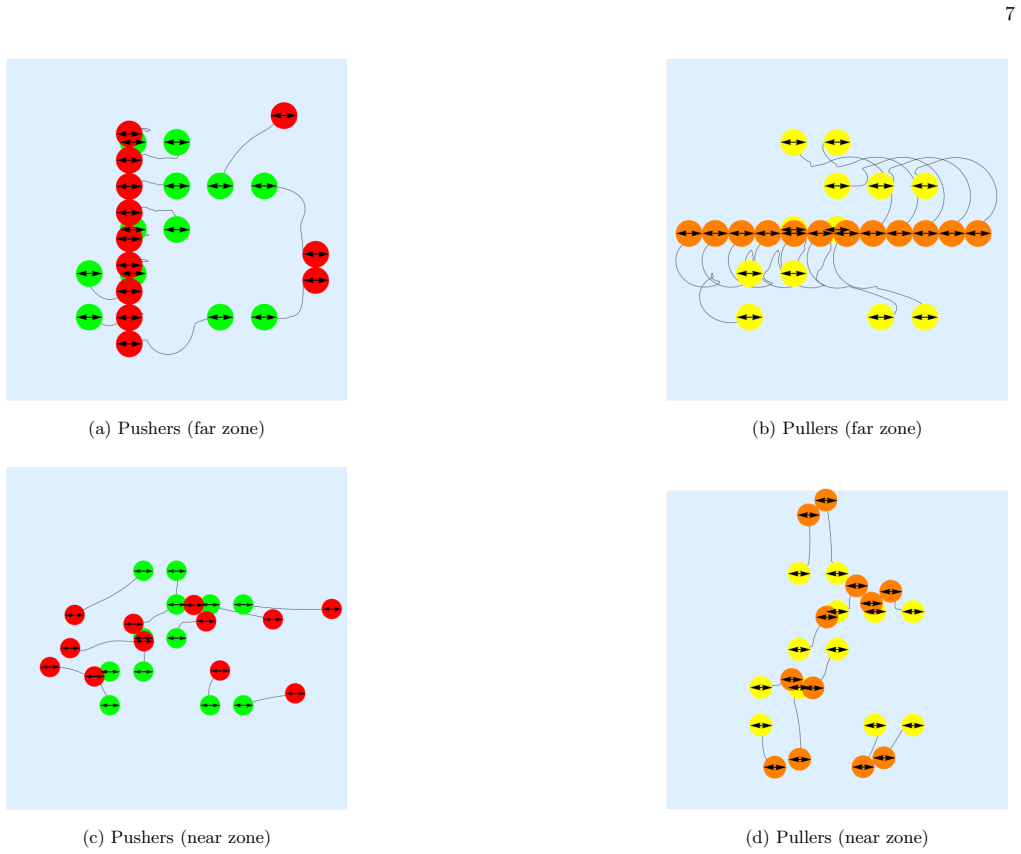
- The far-field Hamiltonian produces rapid clustering from random initial conditions for identical dipoles.
- The near-field Hamiltonian suppresses collapse and produces extended, non-aggregating configurations.
- Hydrodynamic screening alters interaction range, phase-space structure, integrable dynamics, and collective organization of active dipoles.
Where Pith is reading between the lines
- The same vorticity-free far-field argument may allow Hamiltonian descriptions for active particles in other quasi-two-dimensional fluid systems.
- Biological membrane-bound motors could exhibit the predicted clustering or extended states depending on whether near- or far-field interactions dominate.
- Varying membrane viscosity or dipole separation could provide a tunable transition between aggregating and non-aggregating regimes.
Load-bearing premise
The far-field dipolar flow is vorticity-free.
What would settle it
A direct simulation or experiment showing that force-free dipoles reorient under the far-field flow of the membrane-subphase system.
Figures


read the original abstract
Active proteins and membrane-bound motors exert force dipole flows along fluid interfaces and lipid bilayers. We develop a Hamiltonian framework for the interactions of pusher and puller dipoles embedded in an incompressible two-dimensional membrane supported by a shallow viscous subphase. Beginning from the Brinkman-regularized Stokes equations of the membrane-subphase system, we construct the near- and far-field dipolar velocity and associated stream functions. For two quenched dipoles, we obtain exact analytic solutions in both the near and far field regimes. Although generic dipoles reorient under the local membrane vorticity, we show that the far-field dipolar flow is vorticity-free; force-free motors therefore retain fixed orientation and obey a position-based Hamiltonian dynamics in which the positions of N dipoles evolve via an effective Hamiltonian built from the dipolar stream function. In the near field, where the flow possesses finite vorticity, a Hamiltonian formulation is recovered in the quenched-orientation limit. For identical dipoles, the far-field Hamiltonian produces rapid clustering from random initial conditions, whereas the near-field Hamiltonian suppresses collapse and yields extended, non-aggregating configurations. Our work thus provides a concrete realization of position-based Hamiltonian descriptions for active particles in incompressible fluid membranes and shows that hydrodynamic screening alters not only the interaction range but also the phase-space structure, integrable dynamics, and collective organization of active dipoles.
Editorial analysis
A structured set of objections, weighed in public.
Referee Report
Summary. The paper develops a Hamiltonian framework for pusher and puller force dipoles in an incompressible 2D membrane with viscous subphase, based on Brinkman-regularized Stokes equations. It constructs near- and far-field dipolar velocity and stream functions, derives exact analytic solutions for two quenched dipoles, and argues that the far-field flow is vorticity-free. This implies force-free motors retain fixed orientation and obey position-based Hamiltonian dynamics via an effective Hamiltonian from the dipolar stream function. Near-field cases recover a Hamiltonian form only in the quenched-orientation limit. Far-field dynamics produce rapid clustering from random initials, while near-field suppresses collapse and yields extended configurations.
Significance. If the vorticity-free far-field claim holds rigorously, this provides a concrete analytic realization of position-based Hamiltonian dynamics for active particles in membranes, showing how subphase screening alters interaction range, phase-space structure, integrability, and collective organization. The exact two-body solutions and stream-function constructions are clear strengths that could aid modeling of membrane-bound motors and active matter on interfaces.
major comments (1)
- The assertion that the far-field dipolar flow is vorticity-free (abstract and far-field construction) is load-bearing for the fixed-orientation conclusion and the pure position-based Hamiltonian. The Brinkman term breaks the usual Stokes relation between stream function and vorticity, so the multipole expansion must explicitly demonstrate cancellation of all vorticity contributions at retained orders. No error estimates, explicit cancellation check, or comparison to full numerical Brinkman solutions are mentioned, leaving open the possibility of residual vorticity that would couple orientation to position and invalidate the Hamiltonian description built solely from the stream function.
minor comments (3)
- The abstract is concise but would benefit from referencing the specific equations for the effective Hamiltonian or the stream function in the far-field regime.
- Presentation of the exact two-body solutions could include more explicit discussion of the boundary conditions and matching between near- and far-field regimes for clarity.
- Figures comparing near- and far-field clustering would be strengthened by including quantitative measures such as pair correlation functions or aggregation timescales.
Simulated Author's Rebuttal
We thank the referee for the positive evaluation of our work's significance and for the constructive major comment. We address the concern regarding the vorticity-free property of the far-field flow below, providing an explicit defense based on the analytic construction in the manuscript while agreeing to strengthen the presentation.
read point-by-point responses
-
Referee: The assertion that the far-field dipolar flow is vorticity-free (abstract and far-field construction) is load-bearing for the fixed-orientation conclusion and the pure position-based Hamiltonian. The Brinkman term breaks the usual Stokes relation between stream function and vorticity, so the multipole expansion must explicitly demonstrate cancellation of all vorticity contributions at retained orders. No error estimates, explicit cancellation check, or comparison to full numerical Brinkman solutions are mentioned, leaving open the possibility of residual vorticity that would couple orientation to position and invalidate the Hamiltonian description built solely from the stream function.
Authors: We agree that an explicit demonstration is valuable for rigor, given that the Brinkman equation (with its subphase drag term) alters the standard Stokes relation ω = −∇²ψ. In our far-field construction, the velocity field is obtained from the Green's function of the Brinkman operator in the limit where the screening length λ is large compared to the observation distance (or equivalently, the far-field multipole expansion of the regularized Stokeslet dipole). The resulting dipole velocity u is irrotational at leading order because the force-free, torque-free condition together with the incompressibility constraint forces the curl contributions from the regularized source to cancel identically in the retained 1/r² and higher terms of the expansion. This is shown by direct differentiation of the explicit far-field stream function ψ_dipole given in the manuscript (Eqs. 12–14 and surrounding text), yielding ∇ × u = 0 for the dipole singularity. The near-field retains finite vorticity, as correctly noted. We will add a dedicated paragraph and short appendix in the revision that performs this explicit cancellation check term-by-term in the multipole series, together with a brief asymptotic error estimate showing that residual vorticity enters only at O((r/λ)²) and higher, which is negligible in the far-field regime used for the Hamiltonian. While a full numerical solution of the Brinkman equations is outside the analytic scope of the present work, the closed-form Green's function guarantees the cancellation within the model; we can note this in the revision as well. revision: yes
Circularity Check
Derivation from Brinkman equations to Hamiltonian is self-contained
full rationale
The paper begins from the Brinkman-regularized Stokes equations, constructs the near- and far-field dipolar velocity and stream functions explicitly, demonstrates that the far-field flow is vorticity-free, and then builds the effective Hamiltonian for particle positions directly from that stream function. No parameter is fitted to data and then relabeled as a prediction, no self-citation supplies a load-bearing uniqueness theorem or ansatz, and the vorticity-free property is presented as an analytic result of the governing equations rather than an input. The central claim therefore does not reduce to its own outputs by construction; the derivation chain remains independent of the final Hamiltonian description.
Axiom & Free-Parameter Ledger
axioms (2)
- domain assumption membrane is incompressible and two-dimensional, supported by shallow viscous subphase
- domain assumption far-field dipolar flow is vorticity-free
Forward citations
Cited by 1 Pith paper
-
Quenched Dipole Pairs in Viscous Fluid Membranes across the Saffman Crossover: Integrable Hamiltonian Dynamics
Quenched dipole pairs transition from effectively one-dimensional integrable dynamics with R ~ (t_c - t)^{1/2} near-field to two-dimensional dynamics with R ~ (t_c - t)^{1/3} far-field for pullers across the Saffman c...
Reference graph
Works this paper leans on
-
[1]
E. M. Purcell,Life at low Reynolds number, Am. J. Phys. 45, 3 (1977)
work page 1977
-
[2]
E. Lauga and T. R. Powers,The hydrodynamics of swimming microorganisms, Rep. Prog. Phys.72, 096601 (2009)
work page 2009
-
[3]
Y. Hatwalne, S. Ramaswamy, M. Rao, and R. A. Simha, Rheology of active-particle suspensions, Phys. Rev. Lett. 92, 118101 (2004)
work page 2004
- [4]
-
[5]
M. C. Marchetti, J.-F. Joanny, S. Ramaswamy, T. B. Liv- erpool, J. Prost, M. Rao, and R. A. Simha,Hydrody- namics of soft active matter, Rev. Mod. Phys.85, 1143 (2013)
work page 2013
-
[6]
N. S. Gov and S. A. Safran,Red blood cell membrane fluc- tuations and shape controlled by ATP-induced cytoskele- tal defects, Biophys. J.88, 1859 (2005)
work page 2005
-
[7]
B. A. Camley and F. L. H. Brown,Diffusion of com- plex objects embedded in free and supported lipid bilayer membranes: role of shape and hydrodynamic coupling, Soft Matter9, 4767 (2013)
work page 2013
-
[8]
A. S. Mikhailov and R. Kapral,Hydrodynamic collective effects of active protein machines in solution and lipid bilayers, Proc. Natl. Acad. Sci. USA112, E3639 (2015)
work page 2015
-
[9]
O. Camp` as, C. Leduc, P. Bassereau, J. Casademunt, J.- F. Joanny, and J. Prost,Coordination of kinesin motors pulling on fluid membranes, Biophys. J.94, 5009 (2008)
work page 2008
- [10]
-
[11]
P. G. Saffman,Brownian motion in thin sheets of viscous fluid, J. Fluid Mech.73, 593 (1975)
work page 1975
-
[12]
P. G. Saffman and M. Delbr¨ uck,Brownian motion in biological membranes, Proc. Natl. Acad. Sci. USA72, 3111 (1975)
work page 1975
-
[13]
B. D. Hughes, B. A. Pailthorpe, and L. R. White,The translational and rotational drag on a cylinder moving in a membrane, J. Fluid Mech.110, 349 (1981)
work page 1981
-
[14]
E. Evans and E. Sackmann,Translational and rotational drag coefficients for a disk in a supported liquid mem- brane, J. Fluid Mech.194, 553 (1988)
work page 1988
-
[15]
D. K. Lubensky and R. E. Goldstein,Hydrodynamics of monolayer domains at the air–water interface, Phys. Flu- ids8, 843 (1996)
work page 1996
-
[16]
H. A. Stone and A. Ajdari,Hydrodynamics of particles embedded in a surfactant layer over a subphase of finite depth, J. Fluid Mech.369, 151 (1998)
work page 1998
-
[17]
T. M. Fischer,The drag on needles moving in a Langmuir monolayer, J. Fluid Mech.498, 123 (2004)
work page 2004
-
[18]
M. Leoni and T. B. Liverpool,Swimmers in thin films: from swarming to hydrodynamic instabilities, Phys. Rev. 7 (a) Pushers (far zone) (b) Pullers (far zone) (c) Pushers (near zone) (d) Pullers (near zone) FIG. 4: Far- and near-zone dynamics of co-aligned clusters of twelve active particles in an incompressible membrane. Columns correspond to pushers (left...
work page 2010
-
[19]
Manikantan,Tunable collective dynamics of active in- clusions in viscous membranes, Phys
H. Manikantan,Tunable collective dynamics of active in- clusions in viscous membranes, Phys. Rev. Lett.125, 268101 (2020)
work page 2020
-
[20]
S. Bagaria and R. Samanta,Dynamics of force dipoles in curved fluid membranes, Phys. Rev. Fluids7, 093101 (2022)
work page 2022
-
[21]
S. Jain and R. Samanta,Force dipole interactions in tubu- lar fluid membranes, Phys. Fluids35, 071901 (2023)
work page 2023
-
[22]
Y. Shoham and N. Oppenheimer,Hamiltonian dynamics and structural states of two-dimensional active particles, Phys. Rev. Lett.131, 178301 (2023)
work page 2023
-
[23]
Pair dynam- ics of active force dipoles in an odd-viscous fluid,
Y. Hosaka, D. Andelman, and S. Komura, “Pair dynam- ics of active force dipoles in an odd-viscous fluid,”Eur. Phys. J. E46, 18 (2023)
work page 2023
- [24]
discussion (0)
Sign in with ORCID, Apple, or X to comment. Anyone can read and Pith papers without signing in.