Quenched Dipole Pairs in Viscous Fluid Membranes across the Saffman Crossover: Integrable Hamiltonian Dynamics
Pith reviewed 2026-05-08 04:54 UTC · model grok-4.3
The pith
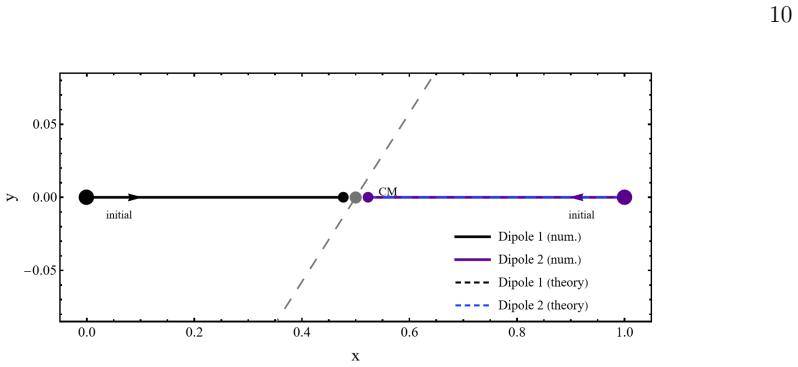
The Saffman crossover turns two quenched force-dipole interactions from effectively one-dimensional to two-dimensional integrable dynamics, with distinct near- and far-field collapse scalings.
A machine-rendered reading of the paper's core claim, the machinery that carries it, and where it could break.
Core claim
For two identical quenched dipoles the near-field dynamics is exactly solvable and effectively one-dimensional, with a fixed line of centers and linear evolution of the squared separation. In the far field the system remains integrable but becomes intrinsically two-dimensional, with coupled radial and angular dynamics and an exact first integral. For pullers the angular dynamics drives alignment toward an attracting manifold, leading to universal late-time collapse R ∼ (t_c − t)^{1/3}, in contrast to the near-field scaling R ∼ (t_c − t)^{1/2}.
What carries the argument
The Saffman crossover length that switches the hydrodynamic velocity field of a force dipole from unscreened 1/r decay to screened 1/r^2 decay, thereby reorganizing the pairwise interaction Hamiltonian.
If this is right
- The Hamiltonian phase-space structure of dipolar interactions changes qualitatively across the Saffman length.
- Near-field trajectories admit an exact closed-form solution for separation versus time.
- Far-field angular dynamics produces alignment for pullers and a universal 1/3 collapse exponent.
- The same crossover supplies a minimal model for aggregation kinetics inside biological membranes.
Where Pith is reading between the lines
- The same reorganization may appear in other hydrodynamic systems that possess a characteristic screening length, such as charged particles in electrolytes.
- Allowing orientations to evolve slowly could turn the far-field attracting manifold into a slow manifold whose stability controls long-time aggregation.
- The exact far-field integral might permit a reduced description of many-dipole clusters by treating each pair as an effective particle with conserved angular momentum.
Load-bearing premise
The dipoles are quenched with fixed orientations and the membrane obeys the standard Saffman model of an infinite two-dimensional viscous sheet coupled to three-dimensional bulk fluid at low Reynolds number.
What would settle it
Direct numerical integration of the two-dipole equations of motion across the Saffman length, checking whether the line of centers remains fixed near-field, whether an angular integral is conserved far-field, and whether puller pairs exhibit the claimed 1/3 versus 1/2 collapse exponents.
Figures




read the original abstract
We investigate an analytic theory of force-dipole hydrodynamics in a viscous membrane coupled to an infinite surrounding fluid, focusing on quenched (orientation-fixed) dipoles. While the single-dipole flow exhibits the known Saffman crossover from a near-field $v\sim r^{-1}$ to a screened far-field $v\sim r^{-2}$, we show that this crossover induces a qualitatively new reorganization of dipole--dipole interactions. For two identical quenched dipoles, the near-field dynamics is exactly solvable and effectively one-dimensional, with a fixed line of centers and linear evolution of the squared separation. In the far field, the system remains integrable but becomes intrinsically two-dimensional, with coupled radial and angular dynamics and an exact first integral. For pullers, the angular dynamics drives alignment toward an attracting manifold, leading to universal late-time collapse $R\sim (t_c-t)^{1/3}$, in contrast to the near-field scaling $R\sim (t_c-t)^{1/2}$. The Saffman crossover thus reorganizes the Hamiltonian phase-space structure of dipolar interactions and produces a transition from effectively one-dimensional to fully coupled dynamics, providing a minimal framework for aggregation in viscous fluid membranes.
Editorial analysis
A structured set of objections, weighed in public.
Referee Report
Summary. The manuscript develops an analytic theory for pairs of quenched force dipoles in viscous fluid membranes, exploiting the Saffman crossover in the hydrodynamic interaction. It demonstrates that the near-field regime yields an exactly solvable, effectively one-dimensional dynamics with linear evolution of the squared separation, while the far-field regime is integrable in two dimensions with an exact first integral. For puller dipoles, angular dynamics leads to alignment on an attracting manifold, resulting in a universal collapse scaling R ∼ (t_c − t)^{1/3} distinct from the near-field R ∼ (t_c − t)^{1/2}.
Significance. If the central derivations are verified and the crossover handled correctly, the work offers a clean example of how a hydrodynamic length scale can qualitatively alter the Hamiltonian structure of particle interactions, from 1D to 2D phase space, with concrete predictions for collapse dynamics. This could serve as a benchmark for numerical simulations of membrane hydrodynamics and inform models of active matter or colloidal aggregation in 2D fluids.
major comments (1)
- [Abstract and far-field analysis] Abstract and far-field analysis: The claimed universal late-time collapse scaling R∼(t_c−t)^{1/3} is derived under the assumption that the far-field interaction kernel remains valid throughout the collapse. However, as the separation R decreases and crosses below the fixed Saffman length, the kernel reverts to the near-field form, which has a different scaling R∼(t_c−t)^{1/2}. No matching analysis or full-kernel integration is presented to confirm that the attracting manifold and 1/3 exponent persist or that the near-field regime does not dominate before collapse.
Simulated Author's Rebuttal
We thank the referee for their careful reading and for recognizing the potential significance of the work in illustrating how the Saffman crossover can reorganize the phase-space structure of dipole interactions. We address the major comment below and will revise the manuscript to incorporate the necessary clarifications and additional analysis.
read point-by-point responses
-
Referee: [Abstract and far-field analysis] Abstract and far-field analysis: The claimed universal late-time collapse scaling R∼(t_c−t)^{1/3} is derived under the assumption that the far-field interaction kernel remains valid throughout the collapse. However, as the separation R decreases and crosses below the fixed Saffman length, the kernel reverts to the near-field form, which has a different scaling R∼(t_c−t)^{1/2}. No matching analysis or full-kernel integration is presented to confirm that the attracting manifold and 1/3 exponent persist or that the near-field regime does not dominate before collapse.
Authors: We agree with the referee that the far-field kernel applies only while R ≫ λ (Saffman length). As collapse drives R toward zero, the system must cross into the near-field regime R ≪ λ, where the dynamics reverts to the exactly solvable one-dimensional case with the R ∼ (t_c − t)^{1/2} scaling. The manuscript analyzes the pure far-field and pure near-field limits separately and does not present a matching calculation or numerical integration of the full crossover kernel. Consequently, the claim of a universal late-time 1/3 scaling requires qualification. In the revised version we will (i) add an explicit discussion of the crossover, (ii) perform and report numerical integration of the full hydrodynamic kernel to illustrate the sequence of regimes, and (iii) revise the abstract and main text to state that the 1/3 scaling characterizes the far-field regime prior to crossing λ, while the ultimate late-time behavior is governed by the near-field 1/2 scaling. revision: yes
Circularity Check
No circularity; derivations are independent mathematical analysis of standard Saffman hydrodynamics
full rationale
The paper derives the two-dipole dynamics directly from the known single-dipole velocity field with the standard Saffman crossover (near-field v ~ r^{-1}, far-field v ~ r^{-2}), as described in the abstract. Near-field exact solvability (fixed line of centers, R^2 linear in t) and far-field integrability (coupled radial/angular dynamics with first integral, puller alignment yielding R ~ (t_c - t)^{1/3}) follow from solving the resulting ODEs under the quenched-orientation assumption. These steps are self-contained mathematical reductions from the external hydrodynamic model rather than self-definitional, fitted inputs renamed as predictions, or load-bearing self-citations. No equation or claim reduces to its own inputs by construction; the reorganization and scalings have independent grounding in prior literature on membrane hydrodynamics. The skeptic concern about crossover validity during collapse addresses modeling assumptions, not circularity in the derivation chain.
Axiom & Free-Parameter Ledger
axioms (3)
- domain assumption Low Reynolds number viscous flow applies throughout
- domain assumption Infinite 2D membrane coupled to 3D bulk fluid
- ad hoc to paper Dipoles are quenched with fixed orientations
Reference graph
Works this paper leans on
-
[1]
Purcell,Life at low Reynolds number, American Journal of Physics 45, 3 (1977)
E.M. Purcell,Life at low Reynolds number, American Journal of Physics 45, 3 (1977)
work page 1977
-
[2]
E. Lauga and T.R. Powers,The hydrodynamics of swimming microorganisms, Rep. Prog. Phys. 72, 096601 (2009)
work page 2009
-
[3]
Lamb,Hydrodynamics(University Press, 1924)
H. Lamb,Hydrodynamics(University Press, 1924)
work page 1924
-
[4]
P. G. Saffman,Brownian motion in thin sheets of viscous fluid, J. Fluid Mech. 73:593–602, (1975) 26
work page 1975
-
[5]
P. G. Saffman and M. Delbr¨ uck,Brownian motion in biological membranes, Proc. Natl. Acad. Sci. USA. 72:3111–3113 (1975)
work page 1975
-
[6]
B. D. Hughes, B. A. Pailthorpe, and L. R. White,The translational and rotational drag on a cylinder moving in a membrane, J. Fluid Mech.110, 349–372 (1981)
work page 1981
-
[7]
E. Evans, and E. Sackmann,Translational and rotational drag coefficients for a disk moving in a liquid membrane associated with a rigid substrate, J. Fluid Mech.194, 553–561 (1988)
work page 1988
-
[8]
D.K. Lubensky and R.E. Goldstein,Hydrodynamics of monolayer domains at the air–water interface, Physics of Fluids8, 843 (1996)
work page 1996
-
[9]
H. A. Stone, and A. Ajdari.Hydrodynamics of particles embedded in a flat surfactant layer overlying a subphase of finite depth, Journal of Fluid Mechanics369(1998)
work page 1998
-
[10]
Fischer,The drag on needles moving in a Langmuir monolayer, J
T.M. Fischer,The drag on needles moving in a Langmuir monolayer, J. Fluid. Mech.498, 123 (2004)
work page 2004
-
[11]
N. Oppenheimer and H. Diamant,Correlated diffusion of membrane proteins and their effect on membrane viscosity, Biophys. J.96, 3041–3049 (2009)
work page 2009
-
[12]
N. Oppenheimer and H. Diamant,Correlated dynamics of inclusions in a supported membrane, Phys. Rev. E82, 041912 (2010)
work page 2010
-
[13]
N. Oppenheimer and H. Diamant,Dynamics of membranes with immobile inclusions, Phys. Rev. Lett.107, 258102 (2011)
work page 2011
-
[14]
Alexander S Mikhailov and Raymond Kapral,Hydrodynamic Collective Effects of Active Pro- tein Machines in Solution and Lipid Bilayers, Proceedings of the National Academy of Sci- ences, 112 (28): E3639 (2015)
work page 2015
-
[15]
Manikantan,Tunable Collective Dynamics of Active Inclusions in Viscous Membranes, Phys
H. Manikantan,Tunable Collective Dynamics of Active Inclusions in Viscous Membranes, Phys. Rev. Letters125, 268101 (2020)
work page 2020
- [16]
- [17]
- [18]
-
[19]
S. Bagaria and R. Samanta,Dynamics of force dipoles in curved fluid membranes, Phys. Rev. 27 Fluids7, 093101 (2022)
work page 2022
-
[20]
M. L. Henle, R. McGorty, A. B. Schofield, A. D. Dinsmore, A. J. Levine,The effect of curvature and topology on membrane hydrodynamics, EPL (Europhysics Letters),84, 48001 (2008)
work page 2008
-
[21]
M. L Henle, A. J. Levine,Hydrodynamics in curved membranes: The effect of geometry on particulate mobility, Physical Review E,81, 011905 (2010)
work page 2010
-
[22]
F. G. Woodhouse and R. E. Goldstein,Shear-Driven Circulation Patterns in Lipid Membrane Vesicles, J. Fluid Mech.705, 165 (2012)
work page 2012
-
[23]
A. R. H. Smith, F. G. Woodhouse, V. Kantsler, R. E. Goldstein,Membrane Viscosity Deter- mined from Shear-Driven Flow in Giant Vesicles, PRL111, 038103 (2013)
work page 2013
-
[24]
F. Quemeneura, J. K. Sigurdsson, M. Rennerf, P. J. Atzberger, P. Bassereaua, and D. Lacoste, Shape matters in protein mobility within membranes, Proceedings of the National Academy of Sciences (PNAS),11, No. 14, pg. 5083–5087, (2014)
work page 2014
-
[25]
J. K. Sigurdsson and P. J. Atzberger,Hydrodynamic Coupling of Particle Inclusions Embed- ded in Curved Lipid Bilayer Membranes,12, 6685-6707, Soft Matter, The Royal Society of Chemistry, (2016)
work page 2016
-
[26]
B. J. Gross and P. J. Atzberger,Hydrodynamic Flows on Curved Surfaces : Spectral Numerical Methods for radial manifold shapes, Journal of Computational Physics,371, 663 (2018)
work page 2018
- [27]
-
[28]
S. Jain and R. Samanta,Force dipole interactions in tubular fluid membranes, Phys. Fluids 35, 071901 (2023)
work page 2023
-
[29]
S. Krishnan, U. Maurya, and R. Samanta,Force Dipole Interactions in Membranes with Odd Viscosity, arXiv:2603.07830 [cond-mat.soft], 2026
-
[30]
Pair dynamics of active force dipoles in an odd- viscous fluid,
Y. Hosaka, D. Andelman, and S. Komura, “Pair dynamics of active force dipoles in an odd- viscous fluid,”Eur. Phys. J. E46, 18 (2023)
work page 2023
-
[31]
Nonreciprocal response of a two-dimensional fluid with odd viscosity,
Y. Hosaka, S. Komura, and D. Andelman, “Nonreciprocal response of a two-dimensional fluid with odd viscosity,” Phys. Rev. E103, 042610 (2021)
work page 2021
-
[32]
A. Daddi-Moussa-Ider, Y. Hosaka and S. Komura,Exact response functions for a compressible thin fluid layer with odd viscosity, arXiv:2602.18136 (2026)
work page internal anchor Pith review arXiv 2026
-
[33]
Hamiltonian Active Particles in Incompressible Fluid Membranes
S. Krishnan and R. Samanta,Hamiltonian active particles in incompressible fluid membranes, 28 arXiv:2512.03609 [cond-mat.soft] (2026)
work page internal anchor Pith review Pith/arXiv arXiv 2026
-
[34]
Y. Shoham and N. Oppenheimer,Hamiltonian dynamics and structural states of two- dimensional active particles, Phys. Rev. Lett.131, 178301 (2023)
work page 2023
discussion (0)
Sign in with ORCID, Apple, or X to comment. Anyone can read and Pith papers without signing in.