Data-Driven Predictions for Dark Photon and Millicharged Particle Production
Pith reviewed 2026-05-21 17:59 UTC · model grok-4.3
The pith
Measured dilepton events can predict dark photon and millicharged particle production rates and distributions without theoretical models.
A machine-rendered reading of the paper's core claim, the machinery that carries it, and where it could break.
Core claim
By exploiting the close correspondence between the amplitudes for emitting dark photons or millicharged particles and those for producing off-shell Standard Model photons, the authors show that fully differential dilepton data can be used to generate predictions for the rate and kinematics of new physics signals without invoking specific production models.
What carries the argument
The amplitude correspondence between A' or mCP emission and off-shell SM photon production that permits direct reuse of measured dilepton distributions.
If this is right
- Signal predictions for fixed-target dark sector searches become independent of specific hadronic production models.
- Normalizing flow models trained on real dilepton data serve as efficient generators for dark photon and mCP kinematics.
- Experimental design and result interpretation gain reduced theoretical uncertainty.
- The method applies uniformly to both dark photons and millicharged particles.
Where Pith is reading between the lines
- Existing dilepton datasets from past experiments could be reanalyzed to place new constraints on dark sector parameters.
- The approach might extend to other particles whose production couples to photons in a similar way, reducing model dependence more broadly.
- Integration with ongoing detector simulations could yield faster sensitivity estimates for planned runs.
Load-bearing premise
A close correspondence exists between the amplitudes for emission of dark photons or millicharged particles and for off-shell Standard Model photon production.
What would settle it
Direct numerical comparison of the data-driven predictions against those from a complete theoretical Monte Carlo generator on the same simulated dataset, checking for agreement in both rates and kinematic shapes.
Figures




read the original abstract
Accurate signal predictions are essential for interpreting and optimizing fixed-target searches for new physics. Even in minimal models such as the dark photon ($A'$) or millicharged particles (mCPs), theoretical uncertainties in hadronic production can be substantial. We introduce a data-driven framework that predicts both the rate and kinematic distributions of $A'$ and mCP production directly from measured dilepton events, without relying on specific theoretical production models. This method uses the close correspondence between amplitudes for emission of $A'$ or mCPs, and for off-shell Standard Model photon production, the latter being experimentally measurable in full differential form. We demonstrate that normalizing flow models can learn these distributions from data and serve as a fast, realistic Monte Carlo generator for dark sector signal simulations.
Editorial analysis
A structured set of objections, weighed in public.
Referee Report
Summary. The manuscript introduces a data-driven framework that uses normalizing flow models trained on measured dilepton events to predict both the rate and kinematic distributions of dark photon (A') and millicharged particle (mCP) production in fixed-target experiments. It relies on an assumed close correspondence between the amplitudes for A'/mCP emission and off-shell Standard Model photon production, allowing direct repurposing of experimental dilepton data without specific theoretical production models for hadronic processes.
Significance. If the amplitude correspondence and flow training hold with controlled systematics, the approach would reduce reliance on uncertain hadronic production models and provide realistic Monte Carlo generators for dark sector signals, strengthening the interpretation of fixed-target searches. The data-driven aspect and emphasis on differential distributions are positive features that could improve sensitivity estimates.
major comments (2)
- [§3] §3: The amplitude correspondence is presented as allowing direct use of off-shell dilepton data for on-shell massive A' and mCP cases, but the derivation does not explicitly show the reweighting or resampling procedure for propagator and phase-space differences at finite mass; without this, the learned distributions inherit an unquantified systematic that scales with m_A' and experimental cuts.
- [§4] §4: The demonstration that normalizing flows learn the distributions lacks quantitative validation metrics (e.g., Kolmogorov-Smirnov tests, closure tests on injected signals, or comparison to known theoretical benchmarks) and error estimates on the predicted rates, which are required to support the central claim of model-independent predictions.
minor comments (2)
- [Abstract] The abstract states the method 'demonstrates' the flows can learn distributions, but this should be supported by explicit figures or tables in the main text showing training convergence and validation.
- Notation for the flow model parameters and the precise definition of the 'close correspondence' between amplitudes should be clarified to avoid ambiguity in implementation.
Simulated Author's Rebuttal
We thank the referee for the constructive and detailed comments on our manuscript. We have addressed each major point below and revised the manuscript accordingly to improve the explicit treatment of the amplitude correspondence and to strengthen the quantitative validation of the normalizing flow approach. These changes enhance the clarity and robustness of our data-driven predictions without altering the core methodology.
read point-by-point responses
-
Referee: [§3] §3: The amplitude correspondence is presented as allowing direct use of off-shell dilepton data for on-shell massive A' and mCP cases, but the derivation does not explicitly show the reweighting or resampling procedure for propagator and phase-space differences at finite mass; without this, the learned distributions inherit an unquantified systematic that scales with m_A' and experimental cuts.
Authors: We appreciate the referee's careful reading and agree that an explicit treatment of the finite-mass corrections is necessary for full rigor. In the revised manuscript we have expanded Section 3 with a dedicated derivation that introduces the reweighting factor w(m) = |M_A'(m)|^2 / |M_γ*(q^2 = m^2)|^2 together with the Jacobian for the two-body phase-space mapping between the off-shell photon and the on-shell massive particle. The reweighting is applied after the flow samples the kinematic variables, and we quantify the residual systematic by comparing reweighted and unweighted distributions across the experimental acceptance. For the mass range and cuts relevant to typical fixed-target setups the systematic remains below 5 % and is now reported as a function of m_A' in a new figure. This addition directly addresses the concern while preserving the data-driven character of the method. revision: yes
-
Referee: [§4] §4: The demonstration that normalizing flows learn the distributions lacks quantitative validation metrics (e.g., Kolmogorov-Smirnov tests, closure tests on injected signals, or comparison to known theoretical benchmarks) and error estimates on the predicted rates, which are required to support the central claim of model-independent predictions.
Authors: We concur that quantitative validation metrics are essential to substantiate the reliability of the learned distributions. The revised manuscript now includes, in Section 4 and a new Appendix C, Kolmogorov-Smirnov statistics comparing the flow-generated marginals and joint distributions against the input dilepton data. We also present closure tests in which known signal samples (generated from standard theoretical models) are injected into the training set; the flows recover the injected rates and shapes to within the statistical precision of the data. In addition, we provide a comparison of the predicted rates to existing hadronic-production calculations for a benchmark mass point, and we report rate uncertainties obtained from an ensemble of flows trained with different random seeds. These metrics are summarized in a new table and support the model-independent claim within the stated uncertainties. revision: yes
Circularity Check
No significant circularity; derivation relies on external amplitude correspondence
full rationale
The paper claims a data-driven prediction of A' and mCP rates and distributions by training normalizing flows on measured dilepton events, justified by an external theoretical correspondence between emission amplitudes and off-shell SM photon production. This correspondence is invoked as an input assumption rather than derived internally, and no equations or steps reduce the output distributions to fitted parameters, self-definitions, or self-citation chains by construction. The framework is therefore self-contained against external benchmarks once the correspondence is granted, with no load-bearing internal reductions that would qualify as circularity.
Axiom & Free-Parameter Ledger
axioms (1)
- domain assumption Close correspondence exists between amplitudes for A' or mCP emission and off-shell SM photon production.
Forward citations
Cited by 1 Pith paper
-
A new approach to dark photon
Dark photon and hypercharge arise from two U(1) groups related by broken mirror symmetry that suppresses their kinetic mixing at one loop.
Reference graph
Works this paper leans on
-
[1]
The resulting yield per proton on target is shown in Fig
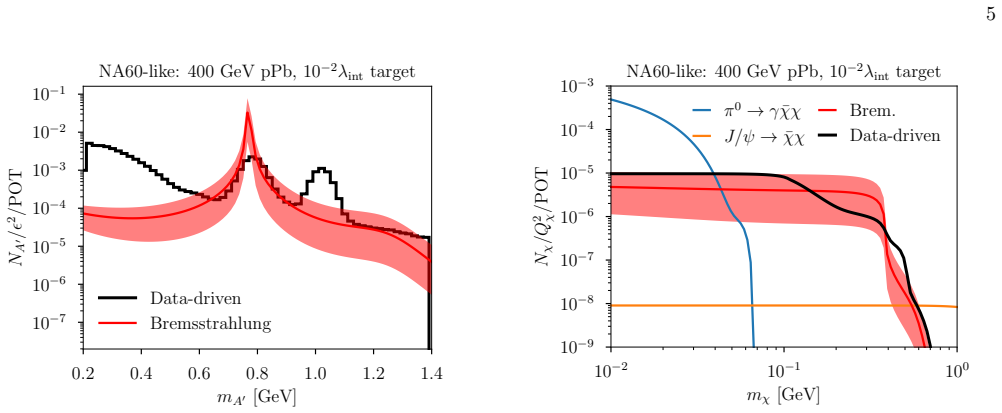
Dark Photon We compute the totalA ′ cross-section by binning our mock data inm γ and evaluatingdσ γ/dm2 γ in each bin using the weights described above. The resulting yield per proton on target is shown in Fig. 2. Thus a yield prediction can be made in situ, using the detector and target configuration specific to a given experiment. Alongside our (mock) d...
-
[2]
Millicharged Particles We obtain the mCP yield by summing the aforemen- tioned weights for events withm γ >2m χ, multiplied by the prefactor in Eq. (8). The result is shown in Fig. 3. Here we note that experimental selections (such as the focus on dimuon final states, or cuts onm µµ) can ex- clude important production mechanisms, so the (mock) data-driven...
-
[3]
good” value of this metric, we compare this “model vs data
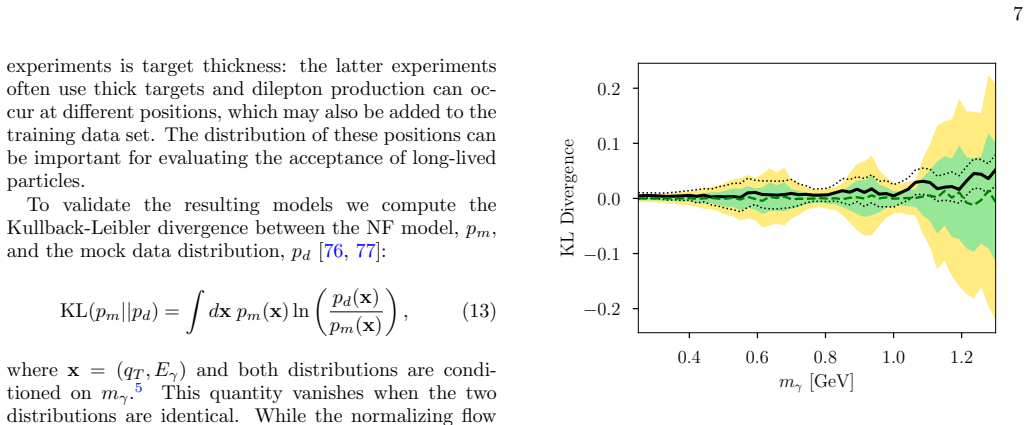
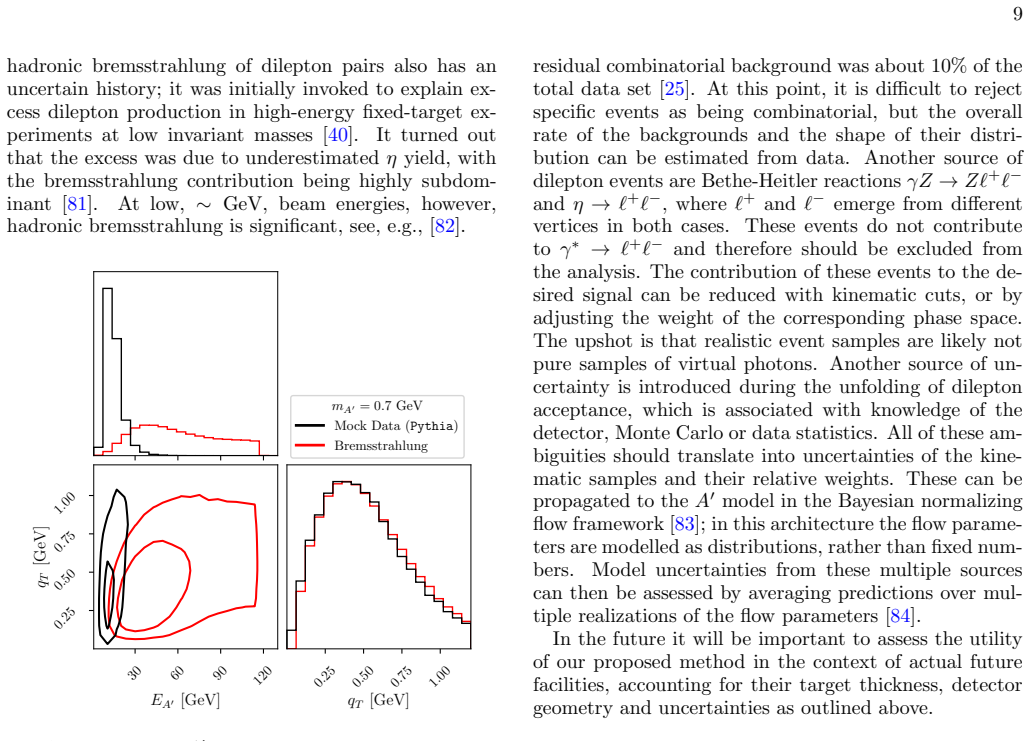
Dark Photon A measurement of the dilepton invariant mass requires knowledge of the energyq 0 and momentum of the virtual photonq. Thus such a data set should provide a fully dif- ferential estimate ofdσ γ/dm2 γd3q. To make predictions for a dark photon model with a specificm A′, however, we are interested in this distribution with the restriction mγ =m A′...
-
[4]
Normalizing flows can be used to construct a data-driven MC here as well
Millicharged Particles In contrast to the dark photon case, a wide range mγ ≥2m χ of virtual photon invariant masses contributes to mCP production. Normalizing flows can be used to construct a data-driven MC here as well. Several ap- proaches are possible. The most straightforward, is to train a different flow for eachm χ hypothesis, enforcing mγ ≥2m χ at...
-
[5]
J. Beacham et al., J. Phys. G47, 010501 (2020), arXiv:1901.09966 [hep-ex]
- [6]
-
[7]
Inclusive Dark Photon Search at LHCb
P. Ilten, Y. Soreq, J. Thaler, M. Williams, and W. Xue, Phys. Rev. Lett.116, 251803 (2016), arXiv:1603.08926 [hep-ph]
work page internal anchor Pith review Pith/arXiv arXiv 2016
-
[8]
J. D. Bjorken, R. Essig, P. Schuster, and N. Toro, Phys. Rev. D80, 075018 (2009), arXiv:0906.0580 [hep-ph]
work page internal anchor Pith review Pith/arXiv arXiv 2009
-
[9]
Resonant production of dark photons in positron beam dump experiments
E. Nardi, C. D. R. Carvajal, A. Ghoshal, D. Meloni, and M. Raggi, Phys. Rev. D97, 095004 (2018), arXiv:1802.04756 [hep-ph]
work page internal anchor Pith review Pith/arXiv arXiv 2018
-
[10]
Dark photon production through positron annihilation in beam-dump experiments
L. Marsicano, M. Battaglieri, M. Bondi’, C. D. R. Carvajal, A. Celentano, M. De Napoli, R. De Vita, E. Nardi, M. Raggi, and P. Valente, Phys. Rev. D98, 015031 (2018), arXiv:1802.03794 [hep-ex]
work page internal anchor Pith review Pith/arXiv arXiv 2018
-
[11]
A. Celentano, L. Darm´ e, L. Marsicano, and E. Nardi, Phys. Rev. D102, 075026 (2020), arXiv:2006.09419 [hep-ph]
-
[12]
Y. Kyselov and M. Ovchynnikov, Phys. Rev. D111, 015030 (2025), arXiv:2409.11096 [hep-ph]
-
[13]
A comprehensive guide to the physics and usage of PYTHIA 8.3
C. Bierlich et al., SciPost Phys. Codeb.2022, 8 (2022), arXiv:2203.11601 [hep-ph]
work page internal anchor Pith review Pith/arXiv arXiv 2022
-
[14]
P. deNiverville, C.-Y. Chen, M. Pospelov, and A. Ritz, Phys. Rev. D95, 035006 (2017), arXiv:1609.01770 [hep-ph]
work page internal anchor Pith review Pith/arXiv arXiv 2017
-
[15]
New Exclusion Limits on Dark Gauge Forces from Proton Bremsstrahlung in Beam-Dump Data
J. Bl¨ umlein and J. Brunner, Phys. Lett. B731, 320 (2014), arXiv:1311.3870 [hep-ph]
work page internal anchor Pith review Pith/arXiv arXiv 2014
-
[16]
S. Foroughi-Abari and A. Ritz, Phys. Rev. D105, 095045 (2022), arXiv:2108.05900 [hep-ph]
-
[17]
D. Gorbunov and E. Kriukova, JHEP01, 058 (2024), arXiv:2306.15800 [hep-ph]
-
[18]
S. Foroughi-Abari, P. Reimitz, and A. Ritz, Phys. Rev. D112, 015030 (2025), arXiv:2409.09123 [hep-ph]
- [19]
- [20]
-
[21]
F. del Aguila, G. D. Coughlan, and M. Quiros, Nucl. Phys. B307, 633 (1988), [Erratum: Nucl.Phys.B 312, 751 (1989)]
work page 1988
- [22]
-
[23]
Formalism for dilepton production via virtual photon bremsstrahlung in hadronic reactions
P. Lichard, Phys. Rev. D51, 6017 (1995), arXiv:hep-ph/9812211
work page internal anchor Pith review Pith/arXiv arXiv 1995
-
[24]
Dark Sectors at the Fermilab SeaQuest Experiment
A. Berlin, S. Gori, P. Schuster, and N. Toro, Phys. Rev. D98, 035011 (2018), arXiv:1804.00661 [hep-ph]
work page internal anchor Pith review Pith/arXiv arXiv 2018
- [25]
-
[26]
The hadronic light-by-light contribution to the muon's anomalous magnetic moment
I. Danilkin, C. F. Redmer, and M. Vanderhaeghen, Prog. Part. Nucl. Phys.107, 20 (2019), arXiv:1901.10346 [hep-ph]
work page internal anchor Pith review Pith/arXiv arXiv 2019
-
[27]
Exploring Portals to a Hidden Sector Through Fixed Targets
B. Batell, M. Pospelov, and A. Ritz, Phys. Rev. D80, 095024 (2009), arXiv:0906.5614 [hep-ph]
work page internal anchor Pith review Pith/arXiv arXiv 2009
-
[28]
Measurement of the $\pi^0$ electromagnetic transition form factor slope
C. Lazzeroni et al. (NA62), Phys. Lett. B768, 38 (2017), arXiv:1612.08162 [hep-ex]
work page internal anchor Pith review Pith/arXiv arXiv 2017
-
[29]
R. Arnaldi et al. (NA60), Phys. Lett. B757, 437 (2016), arXiv:1608.07898 [hep-ex]. 12
work page internal anchor Pith review Pith/arXiv arXiv 2016
-
[30]
S. L. Dubovsky, D. S. Gorbunov, and G. I. Rubtsov, JETP Lett.79, 1 (2004), arXiv:hep-ph/0311189
work page internal anchor Pith review Pith/arXiv arXiv 2004
-
[31]
S. D. McDermott, H.-B. Yu, and K. M. Zurek, Phys. Rev. D83, 063509 (2011), arXiv:1011.2907 [hep-ph]
work page internal anchor Pith review Pith/arXiv arXiv 2011
-
[32]
Making dark matter out of light: freeze-in from plasma effects
C. Dvorkin, T. Lin, and K. Schutz, Phys. Rev. D99, 115009 (2019), [Erratum: Phys.Rev.D 105, 119901 (2022)], arXiv:1902.08623 [hep-ph]
work page internal anchor Pith review Pith/arXiv arXiv 2019
-
[33]
Severely Constraining Dark Matter Interpretations of the 21-cm Anomaly
A. Berlin, D. Hooper, G. Krnjaic, and S. D. McDermott, Phys. Rev. Lett.121, 011102 (2018), arXiv:1803.02804 [hep-ph]
work page internal anchor Pith review Pith/arXiv arXiv 2018
-
[34]
J. B. Mu˜ noz and A. Loeb, Nature557, 684 (2018), arXiv:1802.10094 [astro-ph.CO]
work page internal anchor Pith review Pith/arXiv arXiv 2018
- [35]
-
[36]
A. A. Prinz et al., Phys. Rev. Lett.81, 1175 (1998), arXiv:hep-ex/9804008
work page internal anchor Pith review Pith/arXiv arXiv 1998
-
[37]
Millicharged particles in neutrino experiments,
G. Magill, R. Plestid, M. Pospelov, and Y.-D. Tsai, Phys. Rev. Lett.122, 071801 (2019), arXiv:1806.03310 [hep-ph]
-
[38]
R. Acciarri et al. (ArgoNeuT), Phys. Rev. Lett.124, 131801 (2020), arXiv:1911.07996 [hep-ex]
-
[39]
L. Barak et al. (SENSEI), Phys. Rev. Lett.133, 071801 (2024), arXiv:2305.04964 [hep-ex]
- [40]
- [41]
-
[42]
Letter of Intent: Search for sub-millicharged particles at J-PARC,
S. Choi et al., (2020), arXiv:2007.06329 [physics.ins-det]
-
[43]
R. Arnaldi et al. (NA60), Eur. Phys. J. C79, 443 (2019), arXiv:2012.14385 [hep-ex]
- [44]
-
[45]
O. Aberle et al. (SHiP), BDF/SHiP at the ECN3 high-intensity beam facility, Tech. Rep. (CERN, Geneva, 2022)
work page 2022
-
[46]
R. Albanese et al. (SHiP), BDF/SHiP at the ECN3 high-intensity beam facility, Tech. Rep. (CERN, Geneva, 2023)
work page 2023
-
[47]
Apyan et al., in Snowmass 2021 (2022) arXiv:2203.08322 [hep-ex]
A. Apyan et al., in Snowmass 2021 (2022) arXiv:2203.08322 [hep-ex]
-
[48]
The active muon shield in the SHiP experiment
A. Akmete et al. (SHiP), JINST12, P05011 (2017), arXiv:1703.03612 [physics.ins-det]
work page internal anchor Pith review Pith/arXiv arXiv 2017
- [49]
-
[50]
Uras, Low Mass Dimuon Production in p-A Collisions at 400 GeV/cwith the NA60 Detector, Ph.D
A. Uras, Low Mass Dimuon Production in p-A Collisions at 400 GeV/cwith the NA60 Detector, Ph.D. thesis, Cagliari U. (2011)
work page 2011
-
[51]
A. Andreassen, P. T. Komiske, E. M. Metodiev, B. Nachman, and J. Thaler, Phys. Rev. Lett.124, 182001 (2020), arXiv:1911.09107 [hep-ph]
-
[52]
Canelli et al., (2025), arXiv:2507.09582 [hep-ph]
F. Canelli et al., (2025), arXiv:2507.09582 [hep-ph]
- [53]
- [54]
- [55]
- [56]
-
[57]
B. Alessandro et al. (NA50), Eur. Phys. J. C48, 329 (2006), arXiv:nucl-ex/0612012
work page internal anchor Pith review Pith/arXiv arXiv 2006
-
[58]
J/psi production in proton-nucleus collisions at 158 and 400 GeV
R. Arnaldi et al. (NA60), Phys. Lett. B706, 263 (2012), arXiv:1004.5523 [nucl-ex]
work page internal anchor Pith review Pith/arXiv arXiv 2012
-
[59]
I. Kobyzev, S. J. Prince, and M. A. Brubaker, IEEE transactions on pattern analysis and machine intelligence43, 3964 (2020)
work page 2020
-
[60]
G. Papamakarios, E. Nalisnick, D. J. Rezende, S. Mohamed, and B. Lakshminarayanan, Journal of Machine Learning Research22, 1 (2021)
work page 2021
-
[61]
E. G. Tabak and E. Vanden-Eijnden, Communications in Mathematical Sciences8, 217 (2010)
work page 2010
-
[62]
E. G. Tabak and C. V. Turner, Communications on Pure and Applied Mathematics66, 145 (2013), https://onlinelibrary.wiley.com/doi/pdf/10.1002/cpa.21423
-
[63]
L. Dinh, D. Krueger, and Y. Bengio, arXiv preprint arXiv:1410.8516 (2014)
work page internal anchor Pith review Pith/arXiv arXiv 2014
-
[64]
D. Rezende and S. Mohamed, in International conference on machine learning (PMLR, 2015) pp. 1530–1538
work page 2015
-
[65]
C. Winkler, D. Worrall, E. Hoogeboom, and M. Welling, (2019), arXiv:1912.00042 [cs.LG]
-
[66]
A Living Review of Machine Learning for Particle Physics,
HEP ML Community, “A Living Review of Machine Learning for Particle Physics,”
-
[67]
B. Stienen and R. Verheyen, SciPost Phys.10, 038 (2021), arXiv:2011.13445 [hep-ph]
-
[68]
E. Bothmann, T. Janßen, M. Knobbe, T. Schmale, and S. Schumann, SciPost Phys.8, 069 (2020), arXiv:2001.05478 [hep-ph]
- [69]
- [70]
- [71]
-
[72]
N. Deutschmann and N. G¨ otz, JHEP03, 083 (2024), arXiv:2401.09069 [hep-ph]
-
[73]
E. Bothmann, T. Janßen, M. Knobbe, B. Schmitzer, and F. Sinz, (2025), arXiv:2506.18987 [hep-ph]
-
[74]
C. Krause and D. Shih, Phys. Rev. D107, 113003 (2023), arXiv:2106.05285 [physics.ins-det]
-
[75]
C. Krause and D. Shih, Phys. Rev. D107, 113004 (2023), arXiv:2110.11377 [physics.ins-det]
-
[76]
V. Stimper, D. Liu, A. Campbell, V. Berenz, L. Ryll, B. Sch¨ olkopf, and J. M. Hern´ andez-Lobato, Journal of Open Source Software8, 5361 (2023)
work page 2023
-
[77]
J. Ansel, E. Yang, H. He, N. Gimelshein, A. Jain, M. Voznesensky, B. Bao, P. Bell, D. Berard, E. Burovski, G. Chauhan, A. Chourdia, W. Constable, A. Desmaison, Z. DeVito, E. Ellison, W. Feng, J. Gong, M. Gschwind, B. Hirsh, S. Huang, K. Kalambarkar, L. Kirsch, M. Lazos, M. Lezcano, Y. Liang, J. Liang, Y. Lu, C. K. Luk, B. Maher, Y. Pan, C. Puhrsch, M. Res...
work page 2024
- [78]
-
[79]
M. Germain, K. Gregor, I. Murray, and H. Larochelle, in International conference on machine learning (PMLR, 2015) pp. 881–889
work page 2015
-
[80]
K. P. Burnham and D. R. Anderson,Model selection and multimodel inference: a practical information-theoretic approach (Springer, 2002)
work page 2002
discussion (0)
Sign in with ORCID, Apple, or X to comment. Anyone can read and Pith papers without signing in.