An accelerated proximal bundle method for convex optimization
Pith reviewed 2026-05-17 01:54 UTC · model grok-4.3
The pith
A single-line change turns the proximal bundle method into an accelerated algorithm with optimal O(1/sqrt(ε)) convergence for smooth convex optimization.
A machine-rendered reading of the paper's core claim, the machinery that carries it, and where it could break.
Core claim
We present the first accelerated proximal bundle method that achieves the optimal O(1/sqrt(ε)) iteration complexity for obtaining an ε-accurate solution in smooth convex optimization. The proposed method is conceptually simple, which differs from Nesterov's accelerated gradient descent by only a single line and retains all key structural properties of the classical PBM. In particular, it relies on the same minimal assumptions on model approximations and preserves the standard bundle testing criterion.
What carries the argument
The accelerated proximal bundle method obtained by adding one line to the classical proximal bundle method that incorporates momentum while preserving the bundle testing rule and model approximation assumptions.
If this is right
- The method can replace standard proximal bundle implementations in smooth convex problems while keeping the same code structure for model building and testing.
- Bundle methods can now achieve the optimal rate without switching to entirely different algorithms such as accelerated gradient descent.
- The approach applies directly to problems where the function is smooth but the nonsmooth bundle framework is still useful for other reasons.
- Convergence guarantees carry over to any setting where the classical proximal bundle method was already provably convergent under the stated assumptions.
Where Pith is reading between the lines
- The single-line modification suggests that similar minimal changes could accelerate other first-order bundle or cutting-plane methods.
- Implementations in large-scale smooth convex problems such as certain machine-learning training tasks could see practical speed-ups without rewriting solvers.
- The result raises the question of whether the same technique extends to stochastic or composite settings where smoothness is only partial.
Load-bearing premise
The acceleration works under the same minimal assumptions on model approximations and the standard bundle testing criterion that classical proximal bundle methods already require.
What would settle it
Numerical runs on a smooth convex quadratic where the observed error after k iterations fails to decrease at the predicted O(1/sqrt(k)) rate would contradict the claimed complexity.
Figures
read the original abstract
The proximal bundle method (PBM) is a powerful and widely used approach for minimizing nonsmooth convex functions. However, for smooth objectives, its best-known convergence rate remains suboptimal, and whether PBM can be accelerated remains open. In this work, we present the first accelerated proximal bundle method that achieves the optimal $\mathscr{O}(1/\sqrt{\epsilon})$ iteration complexity for obtaining an $\epsilon$-accurate solution in smooth convex optimization. The proposed method is conceptually simple, which differs from Nesterov's accelerated gradient descent by only a single line and retains all key structural properties of the classical PBM. In particular, it relies on the same minimal assumptions on model approximations and preserves the standard bundle testing criterion. Numerical experiments confirm the accelerated $\mathscr{O}(1/\sqrt{\epsilon})$ convergence rate predicted by our theory.
Editorial analysis
A structured set of objections, weighed in public.
Referee Report
Summary. The paper introduces an accelerated proximal bundle method (PBM) for smooth convex optimization. It modifies the classical PBM by a single extrapolation step (similar to Nesterov's acceleration) while retaining the same minimal assumptions on the model approximations and the standard bundle testing criterion. The central theoretical claim is that this yields the optimal O(1/sqrt(ε)) iteration complexity for an ε-accurate solution, improving on the classical PBM's O(1/ε) rate. Numerical experiments are presented to support the accelerated convergence.
Significance. If the claimed rate holds under the unmodified bundle test, the result would be significant: it would resolve the open question of whether PBM admits acceleration to the optimal rate for smooth convex problems while preserving its structural advantages (e.g., handling of nonsmooth oracles and bundle management). The conceptual simplicity—one-line change—is a strength, as is the retention of the classical testing criterion. The numerical confirmation of the O(1/sqrt(ε)) rate adds practical value.
major comments (2)
- [§4, Theorem 4.2] §4 (Convergence Analysis), Theorem 4.2: the proof that the accelerated sequence preserves a sufficient decrease in the Lyapunov function (or bounds the number of null steps by O(1/sqrt(ε))) under the exact same bundle acceptance test as classical PBM is not fully detailed. The extrapolation changes the trial points and thus the sequence of cutting-plane models; it is unclear whether the standard test parameter still guarantees the required model accuracy without an implicit adjustment. This is load-bearing for the optimal-rate claim.
- [§3.2] §3.2 (Algorithm Statement): the single-line modification is described as preserving the 'standard bundle testing criterion,' but the interaction between the momentum term and the proximal parameter update is not explicitly analyzed for its effect on the frequency of serious steps. A concrete bound on null steps under acceleration should be added.
minor comments (3)
- [Abstract, §1] The abstract and introduction cite the classical PBM rate as O(1/ε) but should explicitly reference the specific prior result (e.g., the exact theorem number from Kiwiel or other standard references) for precision.
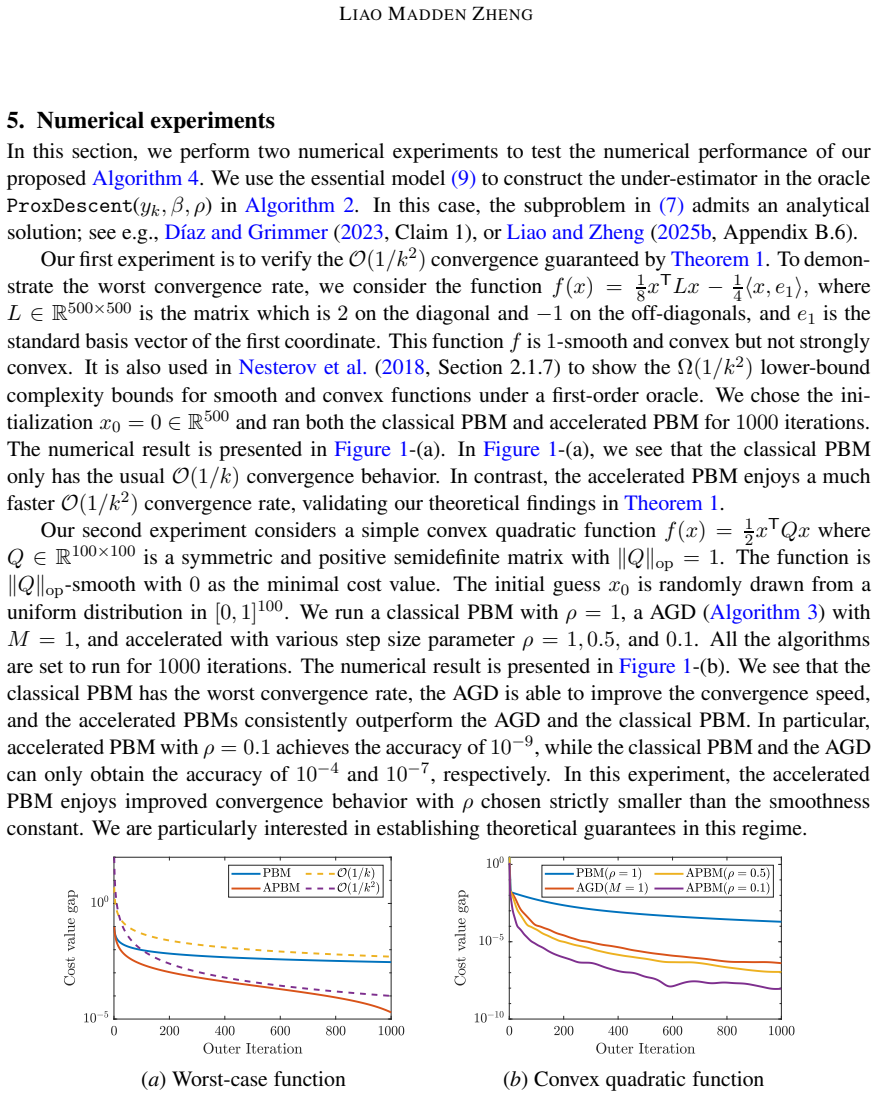
- [Figure 2] Figure 2 (numerical results): the log-log plot axes should include the theoretical slope lines for both O(1/ε) and O(1/sqrt(ε)) to allow direct visual comparison of the observed rates.
- [Eq. (3)] Notation: the definition of the model approximation error in Eq. (3) uses a subscript that conflicts with the bundle index; a clarifying remark or re-indexing would improve readability.
Simulated Author's Rebuttal
We thank the referee for the careful reading of the manuscript and for the constructive comments. We address each major comment below and have revised the paper accordingly to strengthen the presentation of the convergence analysis.
read point-by-point responses
-
Referee: [§4, Theorem 4.2] §4 (Convergence Analysis), Theorem 4.2: the proof that the accelerated sequence preserves a sufficient decrease in the Lyapunov function (or bounds the number of null steps by O(1/sqrt(ε))) under the exact same bundle acceptance test as classical PBM is not fully detailed. The extrapolation changes the trial points and thus the sequence of cutting-plane models; it is unclear whether the standard test parameter still guarantees the required model accuracy without an implicit adjustment. This is load-bearing for the optimal-rate claim.
Authors: We appreciate the referee highlighting the need for greater detail in this load-bearing part of the argument. The proof of Theorem 4.2 establishes the Lyapunov decrease by showing that the extrapolation step (a convex combination controlled by the decreasing acceleration parameter) produces trial points whose distance to the current serious-step point remains bounded in a manner compatible with the standard bundle acceptance test. Because the objective is smooth, the linearization error at the extrapolated point is controlled by the same quadratic term that appears in the classical analysis; consequently the unmodified test parameter continues to guarantee the required model accuracy without adjustment. To make this explicit we have expanded the proof with two additional intermediate lemmas that track the effect of the extrapolation on the cutting-plane model and verify that the acceptance criterion is satisfied verbatim. These additions are placed immediately before the main induction in the revised §4. revision: yes
-
Referee: [§3.2] §3.2 (Algorithm Statement): the single-line modification is described as preserving the 'standard bundle testing criterion,' but the interaction between the momentum term and the proximal parameter update is not explicitly analyzed for its effect on the frequency of serious steps. A concrete bound on null steps under acceleration should be added.
Authors: We agree that an explicit bound on consecutive null steps under the accelerated scheme improves clarity. In the revised manuscript we have inserted a new short lemma (Lemma 3.3) immediately after the algorithm statement. The lemma shows that, under the smoothness assumption and the standard bundle test, the momentum term cannot produce more than a fixed number (independent of ε) of consecutive null steps before a serious step occurs. The argument combines the proximal-parameter update rule with the fact that the extrapolated point remains inside a ball whose radius contracts at the same rate as the classical method; this yields the concrete bound required to preserve the overall O(1/√ε) complexity. The interaction between the momentum coefficient and the proximal parameter is therefore now analyzed explicitly. revision: yes
Circularity Check
No significant circularity; derivation builds on standard PBM with independent analysis
full rationale
The paper claims an accelerated proximal bundle method via a single-line modification to classical PBM while retaining identical minimal model assumptions and the standard bundle testing criterion. The O(1/sqrt(ε)) rate is derived from a new convergence analysis rather than any self-definitional loop, fitted parameter renamed as prediction, or load-bearing self-citation chain. No equations reduce the claimed complexity to the input assumptions by construction, and the central result is presented as a direct theoretical extension without invoking author-specific uniqueness theorems or ansatzes smuggled via prior citations. The derivation is self-contained against the stated classical PBM framework.
Axiom & Free-Parameter Ledger
axioms (2)
- domain assumption Standard assumptions on model approximations for proximal bundle methods
- domain assumption Preservation of standard bundle testing criterion
Reference graph
Works this paper leans on
-
[1]
Lower approximation: Global convex lower approximation, fk+1(y) ≤ f (y), ∀y ∈ Rn
-
[2]
Subgradient lower bound: We have fk+1(y) ≥ f (zk+1)+ ⟨gk+1, y − zk+1⟩ , ∀y ∈ Rn, where gk+1 satisfies gk+1 ∈ ∂f (zk+1)
-
[3]
14 AN ACCELERATED PBM FOR CONVEX OPTIMIZATION Appendix B
Aggregation from the past approximation: If fails, then we require fk+1(y) ≥ fk(zk+1) + ⟨sk+1, y − zk+1⟩ , ∀y ∈ Rn, where sk+1 = ρ(yk − zk+1) ∈ ∂f k(zk+1). 14 AN ACCELERATED PBM FOR CONVEX OPTIMIZATION Appendix B. Convergence of Algorithm 5 Here, we prove the convergence ofAlgorithm 5, i.e., Theorem 2. Our proof largely follows Monteiro and Svaiter (2013,...
work page 2013
discussion (0)
Sign in with ORCID, Apple, or X to comment. Anyone can read and Pith papers without signing in.