Recognition: 1 theorem link
· Lean TheoremTowards a Fully Automated Differential NNLO_EW Generator for Lepton Colliders
Pith reviewed 2026-05-17 01:32 UTC · model grok-4.3
The pith
The Yennie-Frautschi-Suura theorem allows fully automated differential NNLO electroweak calculations matched to resummation at lepton colliders.
A machine-rendered reading of the paper's core claim, the machinery that carries it, and where it could break.
Core claim
We present a solution to this problem, based on the Yennie-Frautschi-Suura theorem, which employs a local infrared subtraction to remove divergences and its matching to an all-order resummation of the soft and soft-collinear logarithms.
What carries the argument
Local infrared subtraction based on the Yennie-Frautschi-Suura theorem matched to all-order resummation of soft and soft-collinear logarithms.
If this is right
- Supports systematic inclusion of NNLO_EW corrections in a fully automated generator.
- Ensures correct treatment of infrared divergences for differential observables.
- Provides matching to all-order resummation without introducing uncontrolled approximations.
- Facilitates high-precision theory for lepton collider processes.
Where Pith is reading between the lines
- This could open the way for similar automated methods at even higher orders like N3LO.
- Applications might extend to specific processes at proposed colliders such as the FCC-ee or ILC.
- Improvements in computational efficiency for precision calculations could result from the local subtraction approach.
Load-bearing premise
The YFS theorem can be extended in a fully process-independent and automated manner to NNLO_EW while correctly matching to all-order resummation for differential observables without introducing uncontrolled approximations.
What would settle it
Disagreement between the automated NNLO_EW predictions and known analytic results for a benchmark process like Bhabha scattering or muon pair production at lepton colliders would indicate the method does not work as claimed.
Figures



read the original abstract
Future proposed lepton collider experiments will reach unprecedented levels of accuracy. To ensure the success of these experiments, and to fully exploit their wealth of data, the precision of theory calculations must reach comparable or even better levels. One bottleneck in achieving this precision target lies in the systematic, process-independent inclusion of higher-order corrections at Next-to-Next-to-Leading Order in the electroweak coupling $\text{NNLO}_\text{EW}$ while ensuring the correct matching with modern all-orders resummation techniques. Here, we present a solution to this problem, based on the Yennie-Frautschi-Suura theorem, which employs a local infrared (IR) subtraction to remove divergences and its matching to an all-order resummation of the soft and soft-collinear logarithms.
Editorial analysis
A structured set of objections, weighed in public.
Referee Report
Summary. The paper proposes a framework for fully automated differential NNLO_EW calculations at lepton colliders. It employs the Yennie-Frautschi-Suura theorem to implement local infrared subtraction that cancels divergences, followed by matching to an all-order resummation of soft and soft-collinear logarithms, with the goal of achieving process-independent results at the required precision.
Significance. If the local subtraction and matching can be shown to control all singular structures including weak-boson contributions without introducing process-dependent finite remainders, the approach would enable systematic, automated NNLO_EW predictions with resummation for arbitrary processes, directly addressing a central bottleneck for precision phenomenology at future lepton colliders.
major comments (2)
- [Abstract] Abstract: the central claim that the YFS-based local IR subtraction delivers NNLO_EW accuracy after matching to all-order resummation is stated without any explicit derivation, counterterm construction, or numerical validation that would confirm cancellation of the full singular structure (photonic plus massive weak exchanges) for differential observables.
- [Abstract / Introduction] The manuscript does not demonstrate that the finite remainder after local subtraction is process-independent and free of uncontrolled O(α²) terms when the YFS resummation (originally formulated for massless photons) is extended to include massive weak-boson exchanges at NNLO_EW; this is load-bearing for the automation claim.
minor comments (1)
- Clarify the precise scope of 'fully automated' (e.g., which processes have been implemented and which remain manual) and provide at least one concrete example of a differential distribution with the claimed matching.
Simulated Author's Rebuttal
We thank the referee for the careful reading and constructive comments on our manuscript. We address the major comments point by point below. Where appropriate, we have revised the text to improve clarity on the framework's construction and scope.
read point-by-point responses
-
Referee: [Abstract] Abstract: the central claim that the YFS-based local IR subtraction delivers NNLO_EW accuracy after matching to all-order resummation is stated without any explicit derivation, counterterm construction, or numerical validation that would confirm cancellation of the full singular structure (photonic plus massive weak exchanges) for differential observables.
Authors: We agree that the abstract is concise and does not contain the full technical details. The manuscript presents the YFS-based local subtraction as the core of the framework, with the construction of the subtraction terms and their matching to resummation described in the body. However, we acknowledge the absence of explicit counterterm formulae or numerical validation for the complete singular structure (including massive weak exchanges) in the current version, consistent with the 'towards' scope of the work. We will revise the abstract to include a short outline of the derivation steps and to clarify the present status of validation for differential observables. revision: yes
-
Referee: [Abstract / Introduction] The manuscript does not demonstrate that the finite remainder after local subtraction is process-independent and free of uncontrolled O(α²) terms when the YFS resummation (originally formulated for massless photons) is extended to include massive weak-boson exchanges at NNLO_EW; this is load-bearing for the automation claim.
Authors: The process independence follows from the universal soft factors in the YFS theorem, which we extend by retaining mass-dependent propagators in the subtraction kernels for weak bosons while preserving locality. This ensures the subtracted terms remove all singular contributions, leaving a finite remainder that can be integrated numerically without process-specific adjustments. We agree that a more explicit argument showing the absence of residual O(α²) singularities would strengthen the automation claim. We will expand the introduction with a concise sketch of this extension and the resulting properties of the finite remainder. revision: partial
Circularity Check
No circularity: derivation extends external YFS theorem without reduction to fitted inputs or self-citations
full rationale
The paper claims a solution to automated NNLO_EW matching for lepton colliders by extending the Yennie-Frautschi-Suura theorem to provide local IR subtraction matched to all-order soft/soft-collinear resummation. This relies on the standard YFS theorem as an independent external input rather than defining the result in terms of quantities fitted or derived within the paper itself. No load-bearing steps reduce by construction to self-citations, ansatzes smuggled via prior work by the same authors, or renaming of known results; the central claim remains an extension whose validity can be checked against external benchmarks and process-independent IR structure. The derivation chain is therefore self-contained.
Axiom & Free-Parameter Ledger
axioms (1)
- standard math Yennie-Frautschi-Suura theorem provides a valid basis for local IR subtraction at NNLO_EW
Lean theorems connected to this paper
-
IndisputableMonolith/Cost/FunctionalEquation.leanwashburn_uniqueness_aczel unclear?
unclearRelation between the paper passage and the cited Recognition theorem.
based on the Yennie-Frautschi-Suura theorem, which employs a local infrared (IR) subtraction to remove divergences and its matching to an all-order resummation of the soft and soft-collinear logarithms
What do these tags mean?
- matches
- The paper's claim is directly supported by a theorem in the formal canon.
- supports
- The theorem supports part of the paper's argument, but the paper may add assumptions or extra steps.
- extends
- The paper goes beyond the formal theorem; the theorem is a base layer rather than the whole result.
- uses
- The paper appears to rely on the theorem as machinery.
- contradicts
- The paper's claim conflicts with a theorem or certificate in the canon.
- unclear
- Pith found a possible connection, but the passage is too broad, indirect, or ambiguous to say the theorem truly supports the claim.
Forward citations
Cited by 1 Pith paper
-
Disperon QED
Disperon QED is a new technique that feeds experimental data into higher-order QED loop calculations in Monte Carlo generators via dispersion relations and threshold subtraction.
Reference graph
Works this paper leans on
- [1]
-
[2]
Real-Virtual Correction 7
-
[3]
Double Real Correction 8
-
[4]
Towards a Fully Automated Differential $\text{NNLO}_\text{EW}$ Generator for Lepton Colliders
Double-Virtual Correction 9 C. Momentum Mappings 10 III. Results 12 IV. Conclusion 15 Acknowledgements 15 References 15 We dedicated this paper to the memory of Stanisław Jadach. I. INTRODUCTION The current experiments under consideration fore+e− colliders [1–5] offer an exceptionally promising environment for future discoveries, by improving our current ...
work page internal anchor Pith review Pith/arXiv arXiv 2025
-
[5]
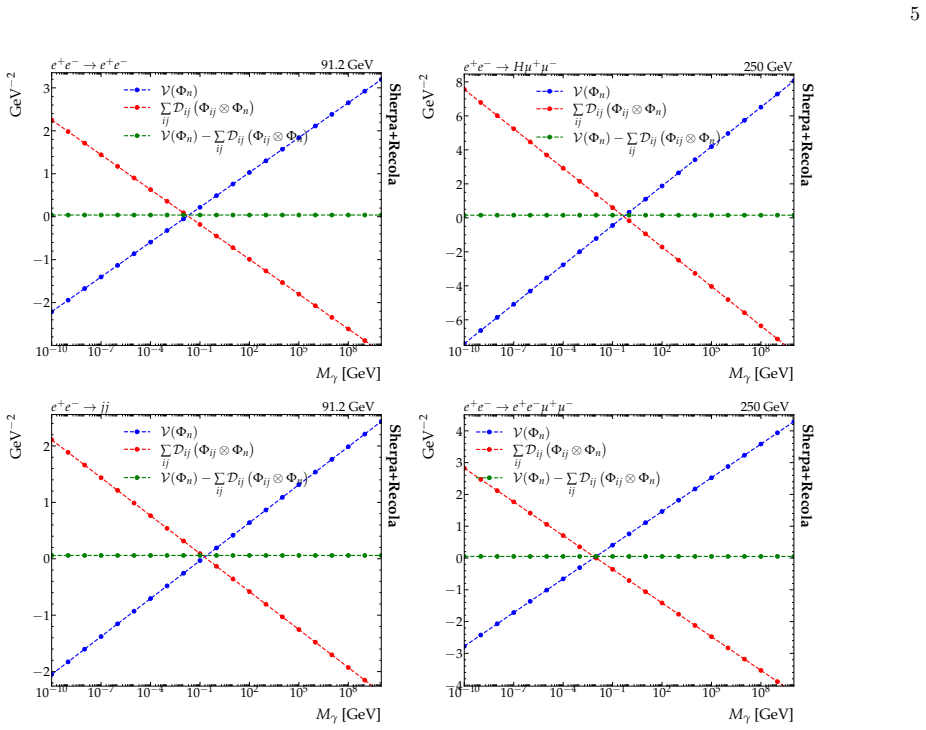
Virtual terms To see explicitly how the subtraction scheme works at NLOEW, let us isolate the IR finite residual for the unresolved emissions in eq. (1). It is given by, ˜β1 0 (Φn) =V(Φ n)− X ij Dij (Φij ⊗Φ n).(5) In eq. (5), the first term represents the full one-loop electroweak correction to an arbitrary process at leading order (Born level, LO), which...
-
[6]
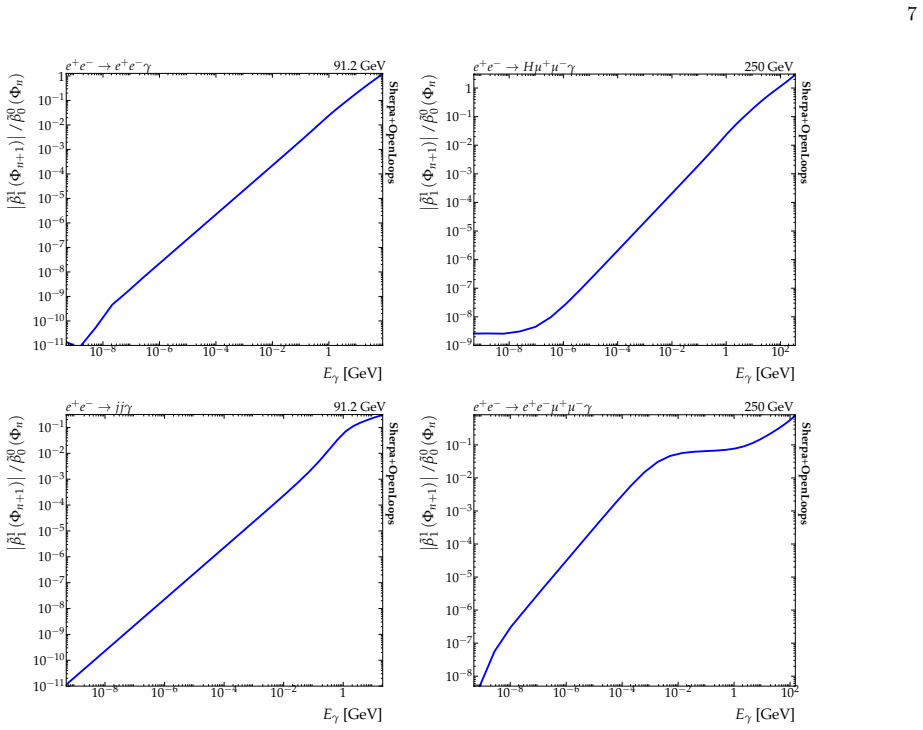
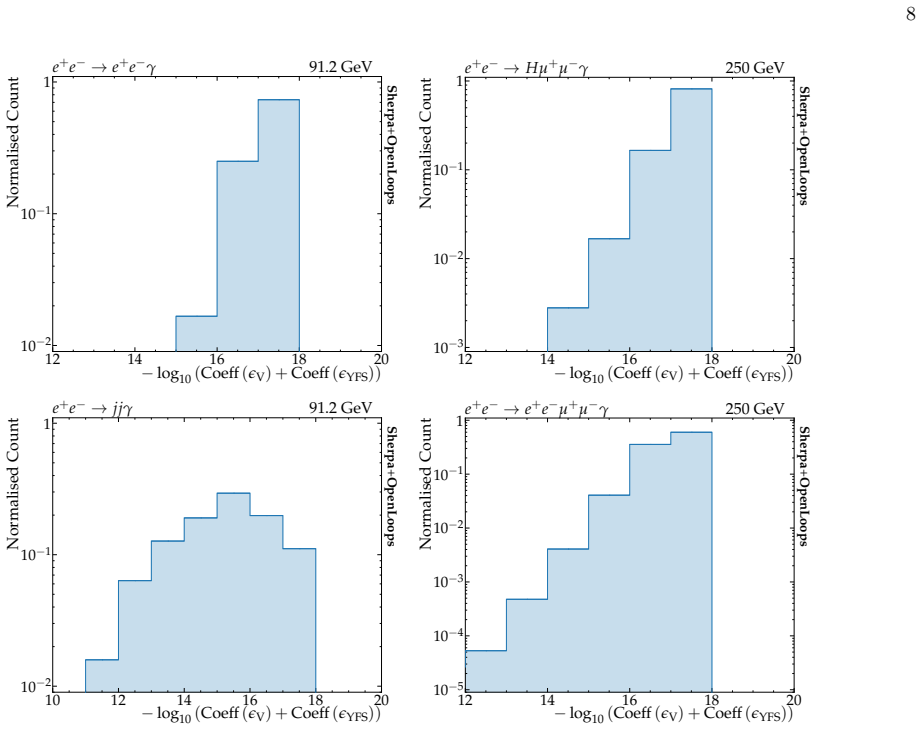
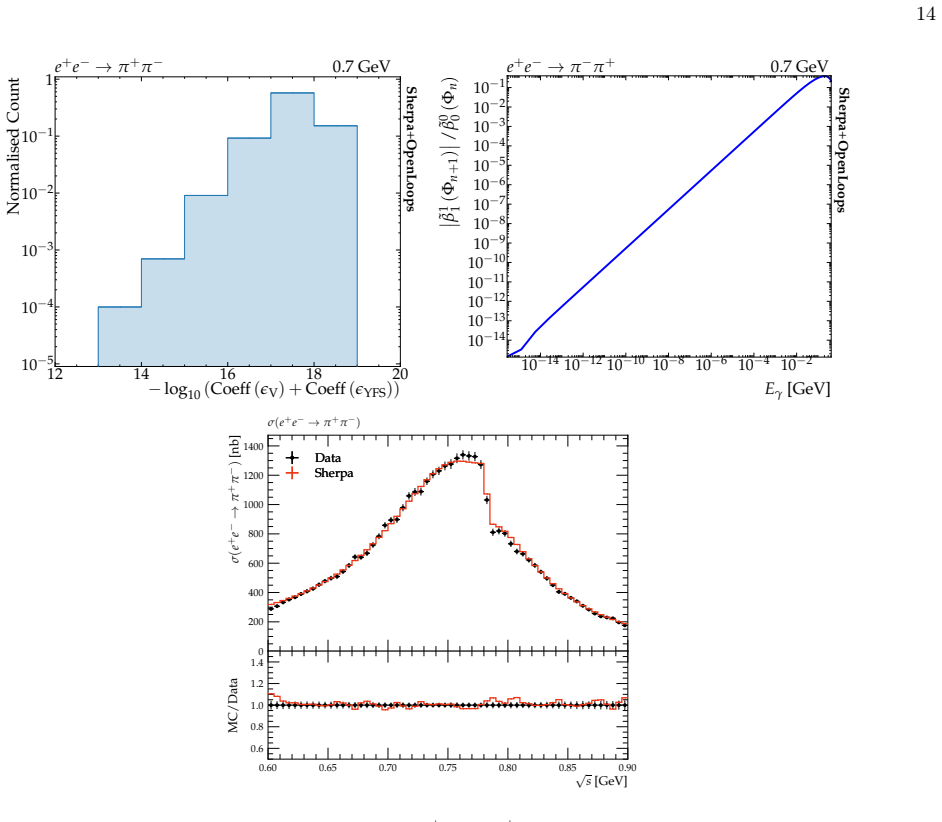
Real terms For corrections arising from resolved emissions of photons we can also define an IR subtraction term within the YFS framework as, ˜β1 1 (Φn+1) =R(Φ n+1)− X ij ˜Dij (Φij+1 ⊗Φ n),(8) R(Φ n+1) = 1 2(2π)3 M 1 2 1 (Φn+1) 2 (9) 5 10−10 10−7 10−4 10−1 102 105 108 Mγ [GeV] −2 −1 0 1 2 3 GeV−2 Sherpa+Recola e+e− → e+e− 91.2 GeV V (Φn) ∑ ij Dij ( Φij ⊗ Φ...
-
[7]
Real-Virtual Correction The first NNLOEW corrections that we will consider are the real-virtual emissions, essentially the one-loop corrections to the LO process plus an additional resolved photon emission. From the YFS theorem, we can extract these IR finite contributions as, ˜β2 1 (Φn+1) =RV(Φ n+1)− X ij D(1) ij (Φij+1 ⊗Φ n),(12) RV(Φ n+1) = 1 2(2π)3 M ...
-
[8]
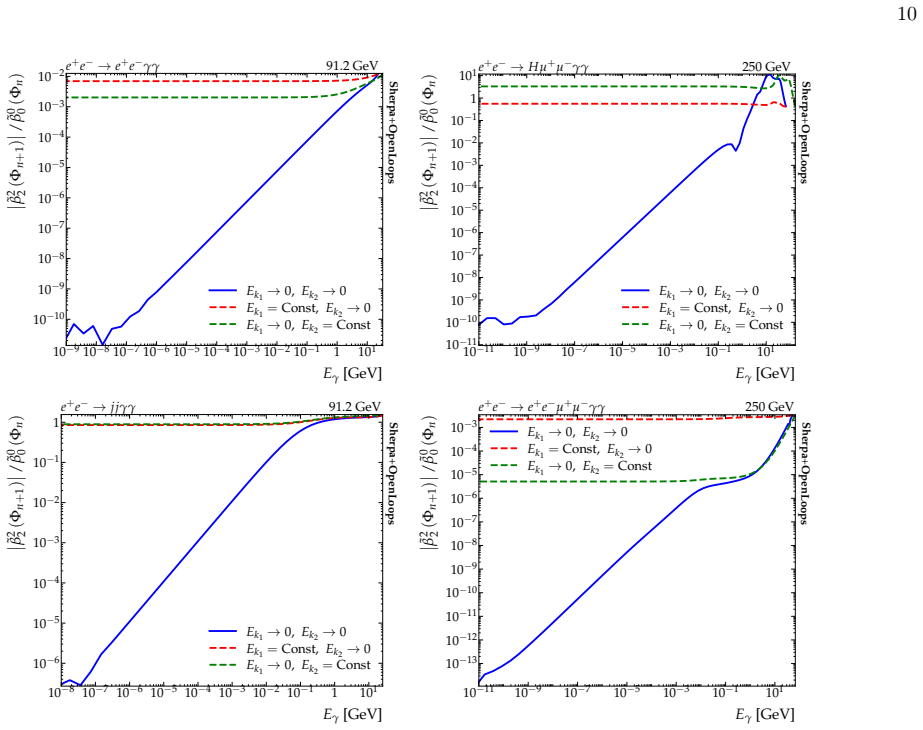
Double Real Correction The IR-finite contribution arising from the emission of two resolved photons can be written as, ˜β2 2 (Φn+2) =RR(Φ n+2)− ˜S(k 1) ˜β1 1 (Φn+1;k 2)− ˜S(k 2) ˜β1 1 (Φn+1;k 1)− ˜S(k 1) ˜S(k 2) ˜β0 0 (Φn),(15) RR(Φ n+2) = 1 2(2π)3 2 M1 2 (Φn+2) 2 .(16) 9 M1 2 (Φn+2) 2 marks the completen+ 2tree-level correction to the underlying born pro...
-
[9]
Double-Virtual Correction The final ingredient to complete our NNLOEW corrections are the two-loop contributions, which are among the most complicated contributions that have to be calculated for the matching of the full NNLOEW corrections. While there has been significant progress in the calculation of two-loop amplitudes fore+e− [52, 92–106] process, th...
work page 2023
-
[10]
(2013), arXiv:1306.6352 [hep-ph]
work page internal anchor Pith review Pith/arXiv arXiv 2013
-
[11]
(2012), 10.5170/CERN-2012-007
- [12]
-
[13]
CEPC Conceptual Design Report: Volume 2 - Physics & Detector
M. Donget al.(CEPC Study Group), (2018), arXiv:1811.10545 [hep-ex]
work page internal anchor Pith review Pith/arXiv arXiv 2018
-
[14]
Vernieriet al., JINST18, P07053 (2023), arXiv:2203.07646 [hep-ex]
C. Vernieriet al., JINST18, P07053 (2023), arXiv:2203.07646 [hep-ex]
- [15]
-
[16]
G. Aadet al.(ATLAS Collaboration), (2012), arXiv:1207.7214 [hep-ex]
work page internal anchor Pith review Pith/arXiv arXiv 2012
-
[17]
Observation of a new boson at a mass of 125 GeV with the CMS experiment at the LHC
S. Chatrchyanet al.(CMS), Phys. Lett. B716, 30 (2012), arXiv:1207.7235 [hep-ex]
work page internal anchor Pith review Pith/arXiv arXiv 2012
-
[18]
Aadet al.(ATLAS), Nature607, 52 (2022), [Erratum: Nature 612, E24 (2022)], arXiv:2207.00092 [hep-ex]
G. Aadet al.(ATLAS), Nature607, 52 (2022), [Erratum: Nature 612, E24 (2022)], arXiv:2207.00092 [hep-ex]
-
[19]
Tumasyanet al.(CMS), Nature607, 60 (2022), [Erratum: Nature 623, (2023)], arXiv:2207.00043 [hep-ex]
A. Tumasyanet al.(CMS), Nature607, 60 (2022), [Erratum: Nature 623, (2023)], arXiv:2207.00043 [hep-ex]
-
[20]
Higgs Physics at the CLIC Electron-Positron Linear Collider
H. Abramowiczet al., Eur. Phys. J. C77, 475 (2017), arXiv:1608.07538 [hep-ex]
work page internal anchor Pith review Pith/arXiv arXiv 2017
-
[21]
Updated CLIC luminosity staging baseline and Higgs coupling prospects
A. Robson and P. Roloff, (2018), arXiv:1812.01644 [hep-ex]
work page internal anchor Pith review Pith/arXiv arXiv 2018
-
[22]
J. De Blas, G. Durieux, C. Grojean, J. Gu, and A. Paul, JHEP12, 117 (2019), arXiv:1907.04311 [hep-ph]
-
[23]
Global SMEFT fits at future colliders; contribution to Snowmass 2021
J. de Blas, Y. Du, C. Grojean, J. Gu, V. Miralles, M. E. Peskin, J. Tian, M. Vos, and E. Vryonidou, inSnowmass 2021 (2022) arXiv:2206.08326 [hep-ph]
-
[24]
de Blaset al., JHEP01, 139 (2020), arXiv:1905.03764 [hep-ph]
J. de Blaset al., JHEP01, 139 (2020), arXiv:1905.03764 [hep-ph]
-
[25]
A framework for Higgs characterisation
P. Artoisenetet al., JHEP11, 043 (2013), arXiv:1306.6464 [hep-ph]
work page internal anchor Pith review Pith/arXiv arXiv 2013
-
[26]
Improved Formalism for Precision Higgs Coupling Fits
T. Barklow, K. Fujii, S. Jung, R. Karl, J. List, T. Ogawa, M. E. Peskin, and J. Tian, Phys. Rev. D97, 053003 (2018), arXiv:1708.08912 [hep-ph]
work page internal anchor Pith review Pith/arXiv arXiv 2018
- [27]
-
[28]
H. Ono and A. Miyamoto, Eur. Phys. J. C73, 2343 (2013), arXiv:1207.0300 [hep-ex]
work page internal anchor Pith review Pith/arXiv arXiv 2013
-
[29]
Alison et al.,Higgs boson potential at colliders: Status and perspectives,Rev
J. Alisonet al., Rev. Phys.5, 100045 (2020), arXiv:1910.00012 [hep-ph]. 16
-
[30]
Precision Electroweak Measurements on the Z Resonance
S. Schaelet al.(ALEPH, DELPHI, L3, OPAL, SLD, LEP Electroweak Working Group, SLD Electroweak Group, SLD Heavy Flavour Group), Phys. Rept.427, 257 (2006), arXiv:hep-ex/0509008
work page internal anchor Pith review Pith/arXiv arXiv 2006
-
[31]
A. Blondelet al., inMini Workshop on Precision EW and QCD Calculations for the FCC Studies : Methods and Techniques, CERN Yellow Reports: Monographs, Vol. 3/2019 (CERN, Geneva, 2018) arXiv:1809.01830 [hep-ph]
- [32]
-
[33]
Theoretical uncertainties for electroweak and Higgs-boson precision measurements at FCC-ee
A. Freitaset al., (2019), arXiv:1906.05379 [hep-ph]
-
[34]
S. Heinemeyer, S. Jadach, and J. Reuter, Eur. Phys. J. Plus136, 911 (2021), arXiv:2106.11802 [hep-ph]
-
[35]
An automated subtraction of NLO EW infrared divergences
M. Schönherr, Eur. Phys. J. C78, 119 (2018), arXiv:1712.07975 [hep-ph]
work page internal anchor Pith review Pith/arXiv arXiv 2018
-
[36]
R. Frederix, S. Frixione, V. Hirschi, D. Pagani, H. S. Shao, and M. Zaro, JHEP07, 185 (2018), [Erratum: JHEP 11, 085 (2021)], arXiv:1804.10017 [hep-ph]
- [37]
- [38]
-
[39]
C. M. Carloni Calame, G. Montagna, O. Nicrosini, and F. Piccinini, EPJ Web Conf.218, 07004 (2019)
work page 2019
-
[40]
P. Banerjee, T. Engel, A. Signer, and Y. Ulrich, SciPost Phys.9, 027 (2020), arXiv:2007.01654 [hep-ph]
- [41]
-
[42]
V. Bertone, M. Cacciari, S. Frixione, and G. Stagnitto, JHEP03, 135 (2020), [Erratum: JHEP 08, 108 (2022)], arXiv:1911.12040 [hep-ph]
-
[43]
Stahlhofen, JHEP11, 171 (2025), arXiv:2508.16964 [hep-ph]
M. Stahlhofen, JHEP11, 171 (2025), arXiv:2508.16964 [hep-ph]
- [44]
-
[45]
Automation of next-to-leading order computations in QCD: the FKS subtraction
R. Frederix, S. Frixione, F. Maltoni, and T. Stelzer, JHEP10, 003 (2009), arXiv:0908.4272 [hep-ph]
work page internal anchor Pith review Pith/arXiv arXiv 2009
-
[46]
S. Catani and M. H. Seymour, Nucl. Phys. B485, 291 (1997), [Erratum: Nucl.Phys.B 510, 503–504 (1998)], arXiv:hep- ph/9605323
- [47]
-
[48]
A parton shower algorithm based on Catani-Seymour dipole factorisation
S. Schumann and F. Krauss, JHEP03, 038 (2008), arXiv:0709.1027 [hep-ph]
work page internal anchor Pith review Pith/arXiv arXiv 2008
-
[49]
G. Corcella, I. G. Knowles, G. Marchesini, S. Moretti, K. Odagiri, P. Richardson, M. H. Seymour, and B. R. Webber, JHEP01, 010 (2001), arXiv:hep-ph/0011363
work page internal anchor Pith review Pith/arXiv arXiv 2001
-
[50]
C. M. Carloni Calame, C. Lunardini, G. Montagna, O. Nicrosini, and F. Piccinini, Nucl. Phys. B584, 459 (2000), arXiv:hep-ph/0003268
work page internal anchor Pith review Pith/arXiv arXiv 2000
-
[51]
Matching NLO QCD computations with Parton Shower simulations: the POWHEG method
S. Frixione, P. Nason, and C. Oleari, JHEP11, 070 (2007), arXiv:0709.2092 [hep-ph]
work page internal anchor Pith review Pith/arXiv arXiv 2007
-
[52]
Matching NLO QCD computations and parton shower simulations
S. Frixione and B. R. Webber, JHEP06, 029 (2002), arXiv:hep-ph/0204244
work page internal anchor Pith review Pith/arXiv arXiv 2002
-
[53]
J. Blümlein, A. De Freitas, C. Raab, and K. Schönwald, Nucl. Phys. B956, 115055 (2020), arXiv:2003.14289 [hep-ph]
-
[54]
J. Blümlein, A. De Freitas, C. G. Raab, and K. Schönwald, Phys. Lett. B791, 206 (2019), arXiv:1901.08018 [hep-ph]
work page internal anchor Pith review Pith/arXiv arXiv 2019
-
[55]
D. R. Yennie, S. C. Frautschi, and H. Suura, Annals Phys.13, 379 (1961)
work page 1961
- [56]
- [57]
-
[58]
E. Bothmannet al.(Sherpa), SciPost Phys.7, 034 (2019), arXiv:1905.09127 [hep-ph]
-
[59]
Bothmannet al.(Sherpa), JHEP12, 156 (2024), arXiv:2410.22148 [hep-ph]
E. Bothmannet al.(Sherpa), JHEP12, 156 (2024), arXiv:2410.22148 [hep-ph]
-
[60]
F. A. Berends, W. L. van Neerven, and G. J. H. Burgers, Nucl. Phys. B297, 429 (1988), [Erratum: Nucl.Phys.B 304, 921 (1988)]
work page 1988
-
[61]
L. Chen and A. Freitas, SciPost Phys. Codeb.2023, 18 (2023), arXiv:2211.16272 [hep-ph]
-
[62]
Coherent Exclusive Exponentiation For Precision Monte Carlo Calculations
S. Jadach, B. F. L. Ward, and Z. Was, Phys. Rev. D63, 113009 (2001), arXiv:hep-ph/0006359
work page internal anchor Pith review Pith/arXiv arXiv 2001
-
[63]
S. Jadach, W. Placzek, M. Skrzypek, B. F. L. Ward, and Z. Was, Phys. Lett. B417, 326 (1998), arXiv:hep-ph/9705429
work page internal anchor Pith review Pith/arXiv arXiv 1998
-
[64]
Soft Photon Radiation in Particle Decays in SHERPA
M. Schonherr and F. Krauss, JHEP12, 018 (2008), arXiv:0810.5071 [hep-ph]
work page internal anchor Pith review Pith/arXiv arXiv 2008
-
[65]
Three-jet cross sections to next-to-leading order
S. Frixione, Z. Kunszt, and A. Signer, Nucl. Phys. B467, 399 (1996), arXiv:hep-ph/9512328
work page internal anchor Pith review Pith/arXiv arXiv 1996
-
[66]
A. Gehrmann-De Ridder, T. Gehrmann, and E. W. N. Glover, JHEP09, 056 (2005), arXiv:hep-ph/0505111
work page internal anchor Pith review Pith/arXiv arXiv 2005
-
[67]
A subtraction scheme for NNLO computations
R. Boughezal, K. Melnikov, and F. Petriello, Phys. Rev. D85, 034025 (2012), arXiv:1111.7041 [hep-ph]
work page internal anchor Pith review Pith/arXiv arXiv 2012
-
[68]
A novel subtraction scheme for double-real radiation at NNLO
M. Czakon, Phys. Lett. B693, 259 (2010), arXiv:1005.0274 [hep-ph]
work page internal anchor Pith review Pith/arXiv arXiv 2010
-
[69]
The Dipole Formalism for Next-to-Leading Order QCD Calculations with Massive Partons
S. Catani, S. Dittmaier, M. H. Seymour, and Z. Trocsanyi, Nucl. Phys. B627, 189 (2002), arXiv:hep-ph/0201036
work page internal anchor Pith review Pith/arXiv arXiv 2002
-
[70]
Fully differential VBF Higgs production at NNLO
M. Cacciari, F. A. Dreyer, A. Karlberg, G. P. Salam, and G. Zanderighi, Phys. Rev. Lett.115, 082002 (2015), [Erratum: Phys.Rev.Lett. 120, 139901 (2018)], arXiv:1506.02660 [hep-ph]
work page internal anchor Pith review Pith/arXiv arXiv 2015
- [71]
- [72]
-
[73]
K. Fabricius, I. Schmitt, G. Kramer, and G. Schierholz, Z. Phys. C11, 315 (1981)
work page 1981
- [74]
-
[75]
N-jettiness Subtractions for NNLO QCD Calculations
J. Gaunt, M. Stahlhofen, F. J. Tackmann, and J. R. Walsh, JHEP09, 058 (2015), arXiv:1505.04794 [hep-ph]
work page internal anchor Pith review Pith/arXiv arXiv 2015
-
[76]
W. T. Giele and E. W. N. Glover, Phys. Rev. D46, 1980 (1992)
work page 1980
-
[77]
I. W. Stewart, F. J. Tackmann, and W. J. Waalewijn, Phys. Rev. Lett.105, 092002 (2010), arXiv:1004.2489 [hep-ph]
work page internal anchor Pith review Pith/arXiv arXiv 2010
-
[78]
S. Catani and M. Grazzini, Phys. Rev. Lett.98, 222002 (2007), arXiv:hep-ph/0703012
work page internal anchor Pith review Pith/arXiv arXiv 2007
- [79]
-
[80]
T. D. Lee and M. Nauenberg, Phys. Rev.133, B1549 (1964)
work page 1964
discussion (0)
Sign in with ORCID, Apple, or X to comment. Anyone can read and Pith papers without signing in.