Recognition: 2 theorem links
· Lean TheoremDisperon QED
Pith reviewed 2026-05-16 23:07 UTC · model grok-4.3
The pith
Disperon QED inserts experimental hadronic data into automated two-loop calculations via dispersion relations and threshold subtraction.
A machine-rendered reading of the paper's core claim, the machinery that carries it, and where it could break.
Core claim
We present disperon QED, a method to deal with data input in loop processes in Monte Carlo codes. It relies on dispersion relations, automated tools such as OpenLoops, effective field theory methods and a threshold subtraction. We apply it to the process ee to pi pi in McMule to deal with hadronic vacuum polarisation insertions in two-loop contributions as well as the vector form factor of the pion within the form-factor scalar QED approximation. The generality of this method for more complicated processes is emphasised.
What carries the argument
Dispersion relations with threshold subtraction and effective-field-theory approximations that convert hadronic data into integrals evaluable by automated loop tools.
If this is right
- It treats hadronic vacuum-polarisation insertions inside two-loop contributions to ee to pi pi.
- It extracts the pion vector form factor inside the scalar-QED approximation.
- It integrates directly with existing Monte Carlo frameworks such as McMule and OpenLoops.
- It extends to other processes that require data-driven hadronic inputs at loop level.
Where Pith is reading between the lines
- The same dispersion-plus-subtraction pattern could be applied to processes that feed into the muon anomalous magnetic moment.
- It offers a route to lower theoretical uncertainties in precision observables by replacing model-dependent hadronic estimates with direct data.
- The approach could be tested by extending the calculation to three-loop order or to different final states such as four pions.
Load-bearing premise
Dispersion relations combined with threshold subtraction and effective-field-theory approximations can be inserted into automated loop tools without introducing uncontrolled systematic errors when hadronic data are used.
What would settle it
A high-precision measurement of the two-loop cross section for ee to pi pi that deviates from the disperon-QED prediction by more than the quoted theoretical uncertainty would show the method introduces uncontrolled errors.
Figures


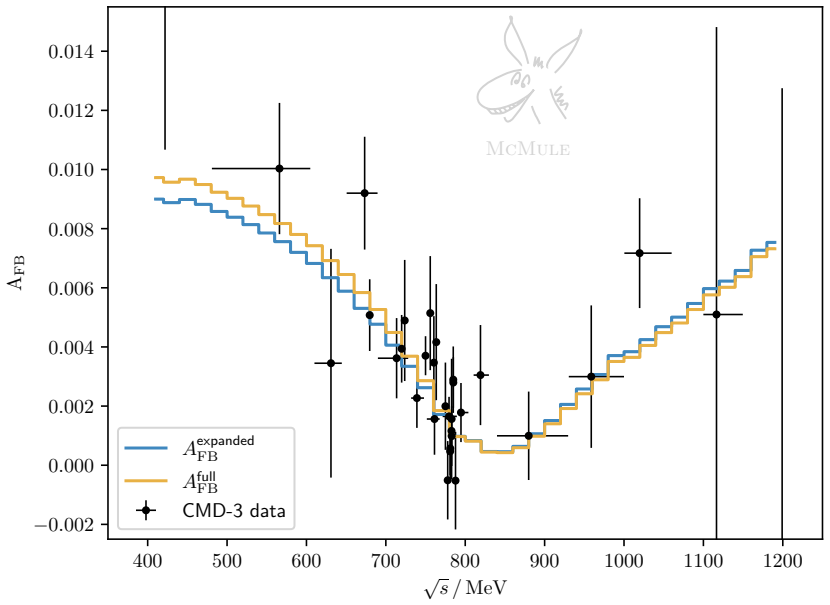
read the original abstract
We present disperon QED, a method to deal with data input in loop processes in Monte Carlo codes. It relies on dispersion relations, automated tools such as OpenLoops, effective field theory methods and a threshold subtraction. We motivate this method and apply it to the process $ee\to\pi\pi$ in McMule to deal with hadronic vacuum polarisation insertions in two-loop contributions as well as the vector form factor of the pion within the form-factor scalar QED approximation. The generality of this method for more complicated processes is emphasised.
Editorial analysis
A structured set of objections, weighed in public.
Referee Report
Summary. The paper introduces 'disperon QED', a method that combines dispersion relations, automated one-loop tools such as OpenLoops, effective-field-theory approximations, and a threshold subtraction to incorporate experimental hadronic data into loop calculations inside Monte Carlo frameworks. The method is demonstrated on the process e⁺e⁻ → π⁺π⁻ within the McMule generator, specifically for two-loop hadronic-vacuum-polarisation insertions and for the pion vector form factor evaluated in the scalar-QED approximation. The authors stress that the construction is general and can be extended to more complicated processes.
Significance. If the numerical stability of the subtracted dispersion integrals and the controlled matching to the EFT approximation can be established, the approach would provide a practical route for embedding data-driven hadronic inputs into existing automated loop infrastructures. This would be particularly useful for precision QED observables that receive hadronic corrections, such as those relevant to the muon anomalous magnetic moment.
major comments (2)
- [§4] §4 (application to two-loop HVP): the manuscript must supply an explicit error budget or direct numerical comparison against an independent evaluation of the same two-loop HVP contribution; without it the claim that the threshold subtraction renders the integrals stable remains unverified.
- [§3.2] §3.2 (scalar-QED form-factor approximation): the matching between the dispersion integral and the EFT form factor is performed at a fixed order; the paper should demonstrate that residual higher-order EFT terms do not exceed the target precision when the hadronic data are inserted into the Monte Carlo infrastructure.
minor comments (2)
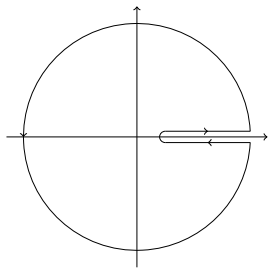
- [Figure 2] Figure 2: the caption should explicitly state the integration contour and the value of the subtraction point used in the dispersion relation.
- [§2] Notation: the symbol for the subtracted dispersion kernel is introduced without a dedicated equation; adding a numbered definition would improve readability.
Simulated Author's Rebuttal
We thank the referee for the careful reading and constructive comments on our manuscript. We address the two major points below and will revise the manuscript accordingly to strengthen the numerical validation.
read point-by-point responses
-
Referee: [§4] §4 (application to two-loop HVP): the manuscript must supply an explicit error budget or direct numerical comparison against an independent evaluation of the same two-loop HVP contribution; without it the claim that the threshold subtraction renders the integrals stable remains unverified.
Authors: We agree that an explicit numerical validation strengthens the presentation. In the revised version we will add a direct comparison of the two-loop HVP contribution obtained with the disperon-QED implementation against an independent dispersive evaluation (using the same hadronic data but without Monte-Carlo integration). We will also include a concise error budget that separates the contributions from experimental input uncertainties, the threshold-subtraction procedure, and numerical integration errors, thereby confirming the stability of the subtracted integrals. revision: yes
-
Referee: [§3.2] §3.2 (scalar-QED form-factor approximation): the matching between the dispersion integral and the EFT form factor is performed at a fixed order; the paper should demonstrate that residual higher-order EFT terms do not exceed the target precision when the hadronic data are inserted into the Monte Carlo infrastructure.
Authors: The scalar-QED framework is employed as a controlled test-bed to illustrate the method. The matching is performed at the order required by the target precision of the McMule implementation. In the revision we will add a dedicated paragraph that uses power counting and a numerical estimate of the next-to-leading EFT corrections to show that their size remains well below the precision goal for the pion vector form factor. This establishes that the fixed-order matching is sufficient for the present application while leaving open the possibility of higher-order matching for future, more demanding processes. revision: partial
Circularity Check
No significant circularity
full rationale
The paper presents disperon QED as a methodological combination of dispersion relations, threshold subtraction, EFT approximations, OpenLoops automation and McMule for inserting hadronic data into loop integrals. The ee→ππ application is described as a concrete demonstration within the scalar-QED form-factor approximation; no derivation chain, equations or self-citations are shown that reduce any claimed prediction or result to a fitted input or prior self-result by construction. The construction is therefore self-contained against external benchmarks and receives the default non-circularity finding.
Axiom & Free-Parameter Ledger
axioms (2)
- domain assumption Dispersion relations can be used to incorporate experimental data into loop amplitudes
- domain assumption Threshold subtraction removes singularities without affecting physical results
Lean theorems connected to this paper
-
IndisputableMonolith/Cost/FunctionalEquation.leanwashburn_uniqueness_aczel unclear?
unclearRelation between the paper passage and the cited Recognition theorem.
We write Πh(k²)/k² = −1/π ∫ ds1 ImΠh(s1)/(s1 (k²−s1+iδ)) ... new propagator 1/(k²−s1) looks like ... massive photon, a disperon
-
IndisputableMonolith/Foundation/AlphaCoordinateFixation.leanalpha_pin_under_high_calibration unclear?
unclearRelation between the paper passage and the cited Recognition theorem.
DET Lagrangian with dimension-6/8 operators ... C[6,ππ]1 = 4πα/s1 ... matching at tree level to diagrams in Figure 1
What do these tags mean?
- matches
- The paper's claim is directly supported by a theorem in the formal canon.
- supports
- The theorem supports part of the paper's argument, but the paper may add assumptions or extra steps.
- extends
- The paper goes beyond the formal theorem; the theorem is a base layer rather than the whole result.
- uses
- The paper appears to rely on the theorem as machinery.
- contradicts
- The paper's claim conflicts with a theorem or certificate in the canon.
- unclear
- Pith found a possible connection, but the passage is too broad, indirect, or ambiguous to say the theorem truly supports the claim.
Reference graph
Works this paper leans on
-
[1]
The anomalous magnetic moment of the muon in the Standard Model: an update
R. Aliberti et al.,The anomalous magnetic moment of the muon in the Standard Model: an update,Phys. Rept.1143(2025) 1 [2505.21476]
work page internal anchor Pith review Pith/arXiv arXiv 2025
-
[2]
S. Borsanyi et al.,Leading hadronic contribution to the muon magnetic moment from lattice QCD,Nature593(2021) 51 [2002.12347]. [3]RBC, UKQCDcollaboration, T. Blum et al.,Update of Euclidean windows of the hadronic vacuum polarization,Phys. Rev. D108(2023) 054507 [2301.08696]
-
[3]
D. Djukanovic, G. von Hippel, S. Kuberski, H. B. Meyer, N. Miller, K. Ottnad et al.,The hadronic vacuum polarization contribution to the muong−2at long distances,JHEP04 (2025) 098 [2411.07969]
-
[4]
Afanasev et al.,Radiative corrections: from medium to high energy experiments,Eur
A. Afanasev et al.,Radiative corrections: from medium to high energy experiments,Eur. Phys. J. A60(2024) 91 [2306.14578]
-
[5]
Pohl et al.,The size of the proton,Nature466(2010) 213
R. Pohl et al.,The size of the proton,Nature466(2010) 213
work page 2010
-
[6]
R. Aliberti et al.,Radiative corrections and Monte Carlo tools for low-energy hadronic cross sections ine +e− collisions,SciPost Phys. Comm. Rep.2025(2025) 9 [2410.22882]
-
[7]
R. D. Bucoveanu and H. Spiesberger,Second-Order Leptonic Radiative Corrections for Lepton-Proton Scattering,Eur. Phys. J. A55(2019) 57 [1811.04970]
work page internal anchor Pith review Pith/arXiv arXiv 2019
-
[8]
P. Banerjee, T. Engel, A. Signer and Y. Ulrich,QED at NNLO with McMule,SciPost Phys.9(2020) 027 [2007.01654]
- [9]
-
[10]
P. Banerjee, T. Engel, N. Schalch, A. Signer and Y. Ulrich,Bhabha scattering at NNLO with next-to-soft stabilisation,Phys. Lett. B820(2021) 136547 [2106.07469]
-
[11]
P. Banerjee, T. Engel, N. Schalch, A. Signer and Y. Ulrich,Møller scattering at NNLO, Phys. Rev. D105(2022) L031904 [2107.12311]
-
[12]
E. Budassi, C. M. Carloni Calame, M. Chiesa, C. L. Del Pio, S. M. Hasan, G. Montagna et al.,NNLO virtual and real leptonic corrections to muon-electron scattering,JHEP11 (2021) 098 [2109.14606]. 28
-
[13]
Broggio et al.,Muon-electron scattering at NNLO,JHEP01(2023) 112 [2212.06481]
A. Broggio et al.,Muon-electron scattering at NNLO,JHEP01(2023) 112 [2212.06481]
- [14]
-
[15]
Matching perturbative and Parton Shower corrections to Bhabha process at flavour factories
G. Balossini, C. M. Carloni Calame, G. Montagna, O. Nicrosini and F. Piccinini,Matching perturbative and parton shower corrections to Bhabha process at flavour factories,Nucl. Phys. B758(2006) 227 [hep-ph/0607181]
work page internal anchor Pith review Pith/arXiv arXiv 2006
-
[16]
Photon pair production at flavour factories with per mille accuracy
G. Balossini, C. Bignamini, C. M. C. Calame, G. Montagna, O. Nicrosini and F. Piccinini, Photon pair production at flavour factories with per mille accuracy,Phys. Lett. B663 (2008) 209 [0801.3360]
work page internal anchor Pith review Pith/arXiv arXiv 2008
-
[17]
E. Budassi, C. M. Carloni Calame, M. Ghilardi, A. Gurgone, G. Montagna, M. Moretti et al.,Pion pair production ine +e− annihilation at next-to-leading order matched to Parton Shower,JHEP05(2025) 196 [2409.03469]
-
[18]
Towards a Fully Automated Differential $\text{NNLO}_\text{EW}$ Generator for Lepton Colliders
A. Price and F. Krauss,Towards a Fully Automated Differential NNLO EW Generator for Lepton Colliders,2512.04959
work page internal anchor Pith review Pith/arXiv arXiv
-
[19]
Muon-electron scattering at NLO
M. Alacevich, C. M. Carloni Calame, M. Chiesa, G. Montagna, O. Nicrosini and F. Piccinini,Muon-electron scattering at NLO,JHEP02(2019) 155 [1811.06743]
work page internal anchor Pith review Pith/arXiv arXiv 2019
-
[20]
A. Arbuzov, S. Bondarenko, Y. Dydyshka, L. Kalinovskaya, L. Rumyantsev, R. Sadykov et al.,Effects of Electroweak Radiative Corrections in Polarized Low-Energy Electron–Positron Annihilation into Lepton Pairs,JETP Lett.116(2022) 199 [2206.09469]
-
[21]
S. Kollatzsch and Y. Ulrich,Lepton pair production at NNLO in QED with EW effects, SciPost Phys.15(2023) 104 [2210.17172]
-
[22]
S. Kollatzsch, D. Moreno, D. Radic and A. Signer,Parity violation in Møller scattering within low-energy effective field theory,JHEP09(2025) 196 [2507.17652]
- [23]
- [24]
- [25]
-
[26]
P. Petit Ros` as and W. J. Torres Bobadilla,Fast evaluation of Feynman integrals for Monte Carlo generators,JHEP09(2025) 210 [2507.12548]
-
[27]
Virtual photon-photon scattering
M. Hoferichter, G. Colangelo, M. Procura and P. Stoffer,Virtual photon-photon scattering, Int. J. Mod. Phys. Conf. Ser.35(2014) 1460400 [1309.6877]
work page internal anchor Pith review Pith/arXiv arXiv 2014
-
[28]
Dispersion relation for hadronic light-by-light scattering: theoretical foundations
G. Colangelo, M. Hoferichter, M. Procura and P. Stoffer,Dispersion relation for hadronic light-by-light scattering: theoretical foundations,JHEP09(2015) 074 [1506.01386]
work page internal anchor Pith review Pith/arXiv arXiv 2015
-
[29]
M. Hoferichter and P. Stoffer,Dispersion relations forγ ∗γ∗ →ππ: helicity amplitudes, subtractions, and anomalous thresholds,JHEP07(2019) 073 [1905.13198]. 29
work page internal anchor Pith review Pith/arXiv arXiv 2019
-
[30]
L. W. Mo and Y.-S. Tsai,Radiative Corrections to Elastic and Inelasticepandµp Scattering,Rev. Mod. Phys.41(1969) 205
work page 1969
-
[31]
L. C. Maximon and J. A. Tjon,Radiative corrections to electron proton scattering,Phys. Rev. C62(2000) 054320
work page 2000
-
[32]
Emilis Kaziuk˙ enas,Dispersive definition ofγ ∗γ∗γ→π +π− for muong−2applications, in RadioMonteCarLow 2 Satellite 2025, (Liverpool), 2025, https://indico.ph.liv.ac.uk/event/2169/contributions/10215/
work page 2025
-
[33]
Muon-electron scattering at NNLO: the hadronic corrections
M. Fael and M. Passera,Muon-Electron Scattering at Next-To-Next-To-Leading Order: The Hadronic Corrections,Phys. Rev. Lett.122(2019) 192001 [1901.03106]
work page internal anchor Pith review Pith/arXiv arXiv 2019
-
[34]
Hadronic corrections to $\mu$-$e$ scattering at NNLO with space-like data
M. Fael,Hadronic corrections toµ-escattering at NNLO with space-like data,JHEP02 (2019) 027 [1808.08233]
work page internal anchor Pith review Pith/arXiv arXiv 2019
-
[35]
E. Balzani, S. Laporta and M. Passera,Hadronic vacuum polarization contributions to the muong−2in the space-like region,Phys. Lett. B834(2022) 137462 [2112.05704]
-
[36]
J. J. Sakurai and D. Schildknecht,Generalized vector dominance and inelastic electron - proton scattering,Phys. Lett. B40(1972) 121
work page 1972
-
[37]
F. Ignatov and R. N. Lee,Charge asymmetry ine +e− →π +π− process,Phys. Lett. B833 (2022) 137283 [2204.12235]
-
[38]
A. V. Gramolin, V. S. Fadin, A. L. Feldman, R. E. Gerasimov, D. M. Nikolenko, I. A. Rachek et al.,A new event generator for the elastic scattering of charged leptons on protons,J. Phys.G41(2014) 115001
work page 2014
-
[39]
R. E. Gerasimov and V. S. Fadin,Analysis of approximations used in calculations of radiative corrections to electron-proton scattering cross section,Phys. Atom. Nucl.78 (2015) 69
work page 2015
-
[40]
Y. Bystritskiy, E. Kuraev and E. Tomasi-Gustafsson,Structure function method applied to polarized and unpolarized electron-proton scattering: A solution of theG E(p)/GM(p) discrepancy,Phys. Rev.C75(2007) 015207
work page 2007
-
[41]
P. Choudhary, U. Raha, F. Myhrer and D. Chakrabarti,Analytical evaluation of elastic lepton-proton two-photon exchange in chiral perturbation theory,Eur. Phys. J. A60(2024) 69 [2306.09454]
-
[42]
S. P. Dye, M. Gonderinger and G. Paz,Elements of QED-NRQED effective field theory: NLO scattering at leading power,Phys. Rev. D94(2016) 013006 [1602.07770]
work page internal anchor Pith review Pith/arXiv arXiv 2016
- [43]
-
[44]
O. Tomalak, B. Pasquini and M. Vanderhaeghen,Two-photon exchange corrections to elastice −-proton scattering: Full dispersive treatment ofπNstates at low momentum transfers,Phys. Rev. D95(2017) 096001 [1612.07726]
work page internal anchor Pith review Pith/arXiv arXiv 2017
-
[45]
O. Tomalak, B. Pasquini and M. Vanderhaeghen,Two-photon exchange contribution to elastice − -proton scattering: Full dispersive treatment ofπNstates and comparison with data,Phys. Rev. D96(2017) 096001 [1708.03303]. 30
work page internal anchor Pith review Pith/arXiv arXiv 2017
- [46]
-
[47]
C. E. Carlson and M. Vanderhaeghen,Two-Photon Physics in Hadronic Processes,Ann. Rev. Nucl. Part. Sci.57(2007) 171 [hep-ph/0701272]
work page internal anchor Pith review Pith/arXiv arXiv 2007
-
[48]
Review of two-photon exchange in electron scattering
J. Arrington, P. G. Blunden and W. Melnitchouk,Review of two-photon exchange in electron scattering,Prog. Part. Nucl. Phys.66(2011) 782 [1105.0951]
work page internal anchor Pith review Pith/arXiv arXiv 2011
-
[49]
Two-photon exchange in elastic electron-proton scattering
A. Afanasev, P. G. Blunden, D. Hasell and B. A. Raue,Two-photon exchange in elastic electron–proton scattering,Prog. Part. Nucl. Phys.95(2017) 245 [1703.03874]
work page internal anchor Pith review Pith/arXiv arXiv 2017
-
[50]
D. Borisyuk and A. Kobushkin,Two-Photon Exchange in Elastic Electron Scattering on Hadronic Systems,Ukr. J. Phys.66(2021) 3 [1911.10956]
-
[51]
N. Cabibbo and R. Gatto,Electron Positron Colliding Beam Experiments,Phys. Rev.124 (1961) 1577
work page 1961
-
[52]
G. Colangelo, M. Hoferichter, J. Monnard and J. R. de Elvira,Radiative corrections to the forward-backward asymmetry ine +e− →π +π−,JHEP08(2022) 295 [2207.03495]. [54]CMD-3collaboration, F. V. Ignatov et al.,Measurement of thee +e− →π +π− cross section from threshold to 1.2 GeV with the CMD-3 detector,Phys. Rev. D109(2024) 112002 [2302.08834]. [55]CMD-3co...
-
[53]
Pion Pair Production with Higher Order Radiative Corrections in Low Energy e+e- Collisions
A. Hoefer, J. Gluza and F. Jegerlehner,Pion pair production with higher order radiative corrections in low energye +e− collisions,Eur. Phys. J. C24(2002) 51 [hep-ph/0107154]
work page internal anchor Pith review Pith/arXiv arXiv 2002
-
[54]
Tracz,Radiative corrections to hadrons-photons interactions, Ph.D
S. Tracz,Radiative corrections to hadrons-photons interactions, Ph.D. thesis, University of Silesia, 2018
work page 2018
- [55]
-
[56]
Dispersive approach to hadronic light-by-light scattering
G. Colangelo, M. Hoferichter, M. Procura and P. Stoffer,Dispersive approach to hadronic light-by-light scattering,JHEP09(2014) 091 [1402.7081]
work page internal anchor Pith review Pith/arXiv arXiv 2014
-
[57]
The radiative return at phi- and B-factories: FSR at next-to-leading order
H. Czy˙ z, A. Grzelinska, J. H. Kuhn and G. Rodrigo,The Radiative return atΦand B factories: FSR at next-to-leading order,Eur. Phys. J. C33(2004) 333 [hep-ph/0308312]
work page internal anchor Pith review Pith/arXiv arXiv 2004
-
[58]
F. Campanario, H. Czy˙ z, J. Gluza, T. Jeli´ nski, G. Rodrigo, S. Tracz et al.,Standard model radiative corrections in the pion form factor measurements do not explain thea µ anomaly, Phys. Rev. D100(2019) 076004 [1903.10197]. [62]McMuleTeam, “McMulemanual.”https://doi.org/10.5281/zenodo.6046769
- [59]
-
[60]
On-the-fly reduction of open loops
F. Buccioni, S. Pozzorini and M. Zoller,On-the-fly reduction of open loops,Eur. Phys. J. C 78(2018) 70 [1710.11452]
work page internal anchor Pith review Pith/arXiv arXiv 2018
-
[61]
Buccioni et al.,OpenLoops 2, Eur
F. Buccioni, J.-N. Lang, J. M. Lindert, P. Maierh¨ ofer, S. Pozzorini, H. Zhang et al., OpenLoops 2,Eur. Phys. J. C79(2019) 866 [1907.13071]
-
[62]
Jegerlehner,The Anomalous Magnetic Moment of the Muon, vol
F. Jegerlehner,The Anomalous Magnetic Moment of the Muon, vol. 274. Springer, Cham, 2017, 10.1007/978-3-319-63577-4
-
[63]
H. H. Patel,Package-X: A Mathematica package for the analytic calculation of one-loop integrals,Comput. Phys. Commun.197(2015) 276 [1503.01469]
work page internal anchor Pith review Pith/arXiv arXiv 2015
-
[64]
H. H. Patel,Package-X 2.0: A Mathematica package for the analytic calculation of one-loop integrals,Comput. Phys. Commun.218(2017) 66 [1612.00009]
work page internal anchor Pith review Pith/arXiv arXiv 2017
-
[65]
Martin Hoferichter,Rescattering corrections to the pion Compton tensor, in RadioMonteCarLow 2 Satellite 2025, (Liverpool), 2025, https://indico.ph.liv.ac.uk/event/2169/contributions/10214/
work page 2025
-
[66]
J. Monnard,Radiative corrections for the two-pion contribution to the hadronic vacuum polarization contribution to the muong−2, Ph.D. thesis, Bern U., 2021
work page 2021
-
[67]
G. R. Farrar and D. R. Jackson,The Pion Form-Factor,Phys. Rev. Lett.43(1979) 246
work page 1979
-
[68]
G. ’t Hooft and M. J. G. Veltman,Regularization and Renormalization of Gauge Fields, Nucl. Phys. B44(1972) 189
work page 1972
-
[69]
On the Rational Terms of the one-loop amplitudes
G. Ossola, C. G. Papadopoulos and R. Pittau,On the Rational Terms of the one-loop amplitudes,JHEP05(2008) 004 [0802.1876]
work page internal anchor Pith review Pith/arXiv arXiv 2008
-
[70]
M. V. Garzelli, I. Malamos and R. Pittau,Feynman rules for the rational part of the Electroweak 1-loop amplitudes,JHEP01(2010) 040 [0910.3130]
work page internal anchor Pith review Pith/arXiv arXiv 2010
-
[71]
Z. Bern, A. De Freitas, L. J. Dixon and H. L. Wong,Supersymmetric regularization, two loop QCD amplitudes and coupling shifts,Phys. Rev. D66(2002) 085002 [hep-ph/0202271]
work page internal anchor Pith review Pith/arXiv arXiv 2002
-
[72]
W. B. Kilgore,The Four Dimensional Helicity Scheme Beyond One Loop,Phys. Rev. D86 (2012) 014019 [1205.4015]
work page internal anchor Pith review Pith/arXiv arXiv 2012
-
[73]
The Infrared Structure of QCD Amplitudes and $H\to g g$ in FDH and DRED
C. Gnendiger, A. Signer and D. St¨ ockinger,The infrared structure of QCD amplitudes and H→ggin FDH and DRED,Phys. Lett. B733(2014) 296 [1404.2171]
work page internal anchor Pith review Pith/arXiv arXiv 2014
-
[74]
To $d$, or not to $d$: Recent developments and comparisons of regularization schemes
C. Gnendiger et al.,Tod, or not tod: recent developments and comparisons of regularization schemes,Eur. Phys. J. C77(2017) 471 [1705.01827]
work page internal anchor Pith review Pith/arXiv arXiv 2017
-
[75]
Asymptotic expansion of Feynman integrals near threshold
M. Beneke and V. A. Smirnov,Asymptotic expansion of Feynman integrals near threshold, Nucl. Phys. B522(1998) 321 [hep-ph/9711391]
work page internal anchor Pith review Pith/arXiv arXiv 1998
-
[76]
P. Nogueira,Automatic Feynman Graph Generation,J. Comput. Phys.105(1993) 279. [81]McMuleTeam, “McMuledataset.”https://doi.org/10.5281/zenodo.8188752
-
[77]
J. H. K¨ uhn and S. Uccirati,Two-loop QED hadronic corrections to Bhabha scattering, Nucl. Phys. B806(2009) 300 [0807.1284]. 32
work page internal anchor Pith review Pith/arXiv arXiv 2009
-
[78]
R. E. Cutkosky,Singularities and discontinuities of Feynman amplitudes,J. Math. Phys.1 (1960) 429
work page 1960
-
[79]
L. D. Landau,On the Analytic Properties of Vertex Parts in Quantum Field Theory,Zh. Eksp. Teor. Fiz.37(1960) 62
work page 1960
-
[80]
R. J. Eden, P. V. Landshoff, D. I. Olive and J. C. Polkinghorne,The analytic S-matrix. Cambridge Univ. Press, Cambridge, 1966
work page 1966
discussion (0)
Sign in with ORCID, Apple, or X to comment. Anyone can read and Pith papers without signing in.