Pion and Kaon PDFs from Lattice QCD via Large Momentum Effective Theory and Short-Distance Factorization
Pith reviewed 2026-05-21 17:30 UTC · model grok-4.3
The pith
Lattice QCD produces the unpolarized quark distributions inside the pion and kaon from finite-momentum matrix elements.
A machine-rendered reading of the paper's core claim, the machinery that carries it, and where it could break.
Core claim
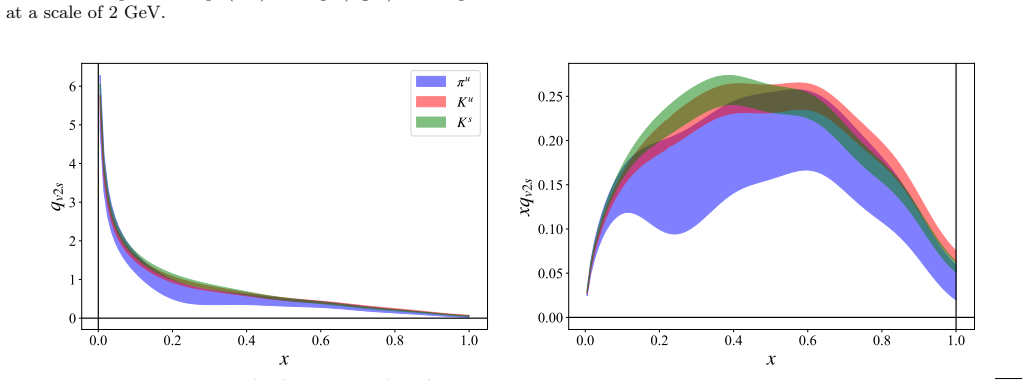
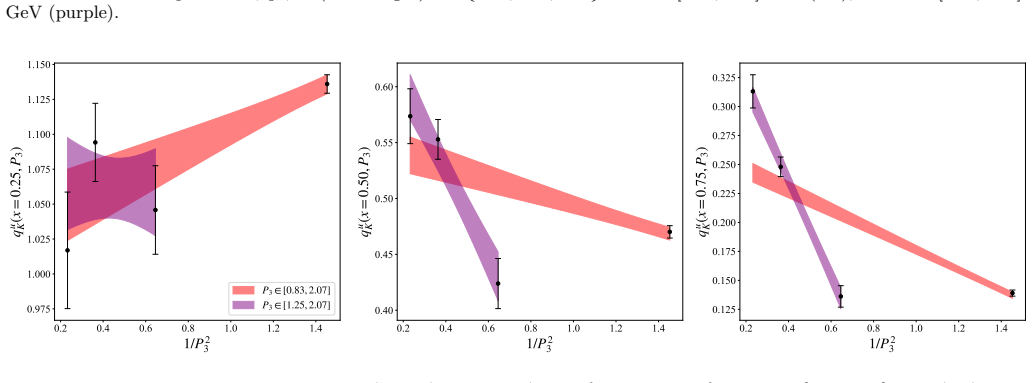
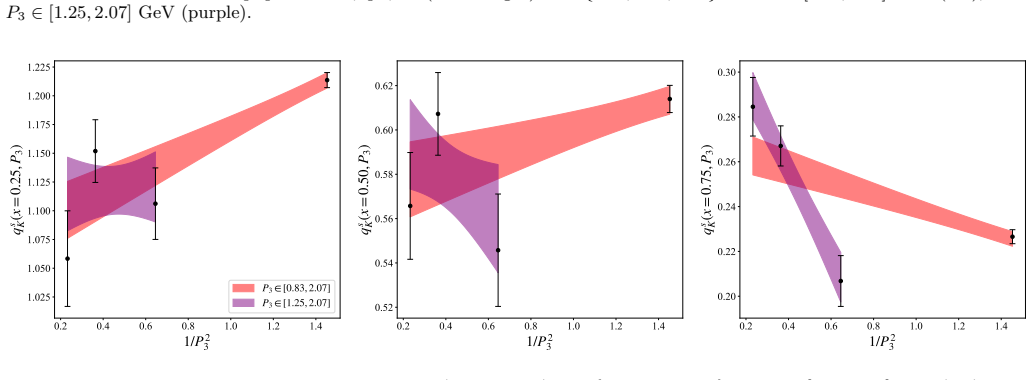
We present a first-principles lattice-QCD calculation of the unpolarized quark PDF for the pion and the kaon. The lattice data rely on matrix elements calculated for boosted mesons coupled to non-local operators containing a Wilson line on an N_f=2+1+1 ensemble with pion mass 260 MeV and boosts up to 2.07 GeV. To match to light-cone PDFs we employ LaMET and SDF in parallel, present results for standard and valence distributions, explore SU(3) breaking, and parametrize the momentum dependence for the infinite-momentum limit.
What carries the argument
Large-momentum effective theory (LaMET) and short-distance factorization (SDF) that convert finite-momentum lattice matrix elements into light-cone parton distribution functions.
If this is right
- The calculation supplies both full and valence quark distributions for the pion and kaon.
- It quantifies SU(3) flavor-symmetry-breaking effects between the two mesons.
- Parametrization of the boost dependence yields the infinite-momentum PDFs within the LaMET framework.
- Parallel use of LaMET and SDF allows direct assessment of method-dependent systematics in the same dataset.
Where Pith is reading between the lines
- The same boosted-meson technique could be applied to other light mesons to trace how quark distributions evolve with flavor and mass.
- Validation against upcoming experimental extractions from Drell-Yan or prompt-photon processes at facilities such as JLab or COMPASS would test the lattice results outside the current momentum range.
- Extension to polarized or transverse-momentum-dependent distributions would follow naturally once the unpolarized baseline is established.
Load-bearing premise
The lattice momenta up to 2.07 GeV together with the specific matching procedures in LaMET and SDF are sufficient to control higher-order corrections and produce reliable light-cone PDFs after extrapolation.
What would settle it
Direct numerical comparison of the extracted PDFs with independent global-fit results from experimental data or with new lattice calculations performed at substantially higher boosts would show whether the matching and extrapolation are accurate.
Figures



















read the original abstract
In this work, we present a first-principles lattice-QCD calculation of the unpolarized quark PDF for the pion and the kaon. The lattice data rely on matrix elements calculated for boosted mesons coupled to non-local operators containing a Wilson line. The calculations on this lattice ensemble correspond to two degenerate light, a strange, and a charm quark ($N_f=2+1+1$), using maximally twisted mass fermions with a clover term. The lattice volume is $32^3\times 64$, with a lattice spacing of 0.0934 fm, and a pion mass of 260 MeV. Matrix elements are calculated for hadron boosts of $|P_3| = 0,~0.41,~0.83,~1.25,~1.66,$ and 2.07 GeV. To match lattice QCD results to their light-cone counterparts, we employ two complementary frameworks: the large-momentum effective theory (LaMET) and the short-distance factorization (SDF). Using these approaches in parallel, we also test the lattice data to identify methodology-driven systematics. Results are presented for the standard quark PDFs, as well as the valence sector. Beyond obtaining the PDFs, we also explore the possibility of extracting information on SU(3) flavor-symmetry-breaking effects. For LaMET, we also parametrize the momentum dependence to obtain the infinite-momentum PDFs.
Editorial analysis
A structured set of objections, weighed in public.
Axiom & Free-Parameter Ledger
free parameters (2)
- lattice spacing a
- pion mass
axioms (2)
- domain assumption LaMET and SDF provide controlled matching at the simulated momenta
- domain assumption Finite-volume and discretization effects are manageable after extrapolation
Lean theorems connected to this paper
-
IndisputableMonolith/Foundation/RealityFromDistinction.leanreality_from_one_distinction unclear?
unclearRelation between the paper passage and the cited Recognition theorem.
We employ two complementary frameworks: the large-momentum effective theory (LaMET) and the short-distance factorization (SDF). ... For LaMET, we also parametrize the momentum dependence to obtain the infinite-momentum PDFs.
-
IndisputableMonolith/Cost/FunctionalEquation.leanwashburn_uniqueness_aczel unclear?
unclearRelation between the paper passage and the cited Recognition theorem.
q(x)=N x^a (1-x)^b ... χ² minimization over ν
What do these tags mean?
- matches
- The paper's claim is directly supported by a theorem in the formal canon.
- supports
- The theorem supports part of the paper's argument, but the paper may add assumptions or extra steps.
- extends
- The paper goes beyond the formal theorem; the theorem is a base layer rather than the whole result.
- uses
- The paper appears to rely on the theorem as machinery.
- contradicts
- The paper's claim conflicts with a theorem or certificate in the canon.
- unclear
- Pith found a possible connection, but the passage is too broad, indirect, or ambiguous to say the theorem truly supports the claim.
Forward citations
Cited by 3 Pith papers
-
Pion Parton Distribution Functions in the Light-Cone Quark Model and Experimental Constraints
Pion valence quark PDFs from the light-cone quark model are evolved with DGLAP and shown to match experimental data, enabling first NLO F2 predictions and Drell-Yan cross-section estimates.
-
An Analysis on the Parton Distribution Functions of Heavy Mesons
Light-cone quark model PDFs for kaon and heavy mesons are evolved via NLO DGLAP to predict EIC structure functions and COMPASS Drell-Yan cross sections while showing heavy constituents dominate momentum fractions.
-
Hadron Structure from lattice QCD in the context of the Electron-Ion Collider
Lattice QCD now delivers high-precision results on hadron internal structure that directly support the scientific program of the Electron-Ion Collider.
Reference graph
Works this paper leans on
-
[1]
quasi-distributions approach The first approach we use to reconstruct thex-dependence of the spin-0 unpolarized PDFs,q f M, is the quasi- distribution method, which utilizes large-momentum effective theory (LaMET). In this approach, we calculate the matrix elements for each individual momentum boost,P 3, and multiple values ofz. The LaMET formalism states...
-
[2]
Pion and Kaon Form Factors using Lattice QCD
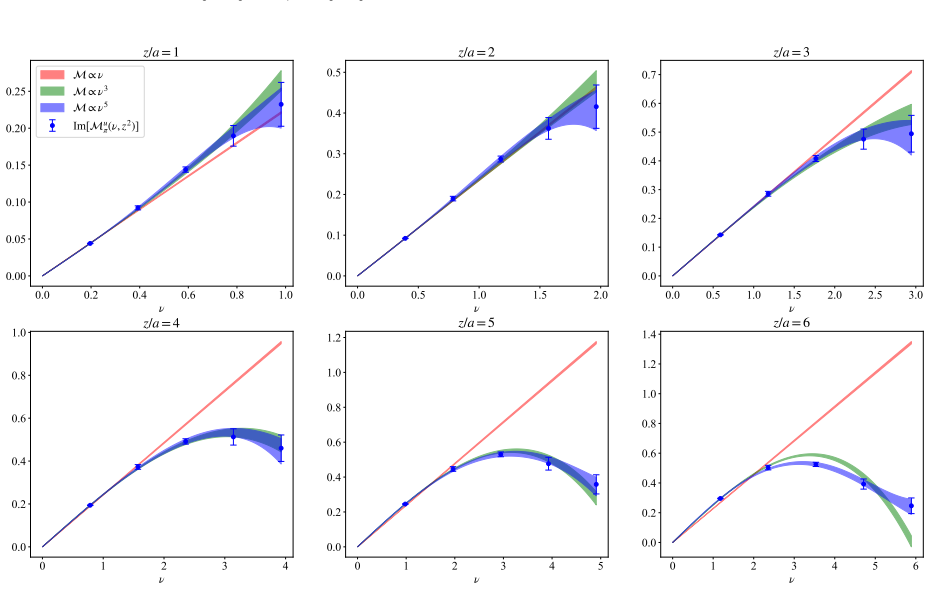
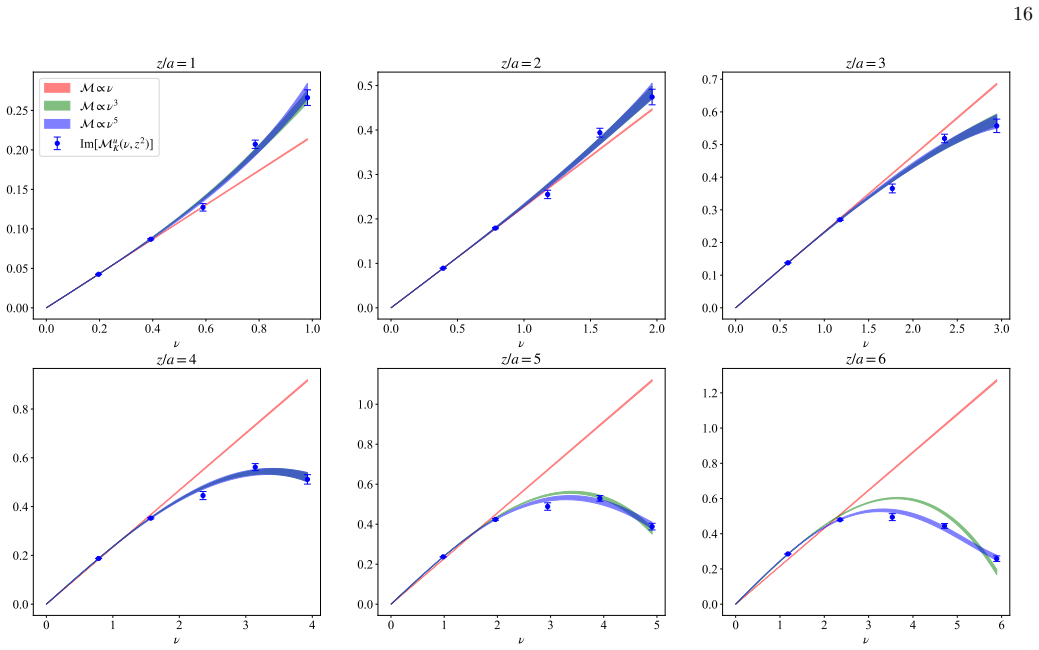
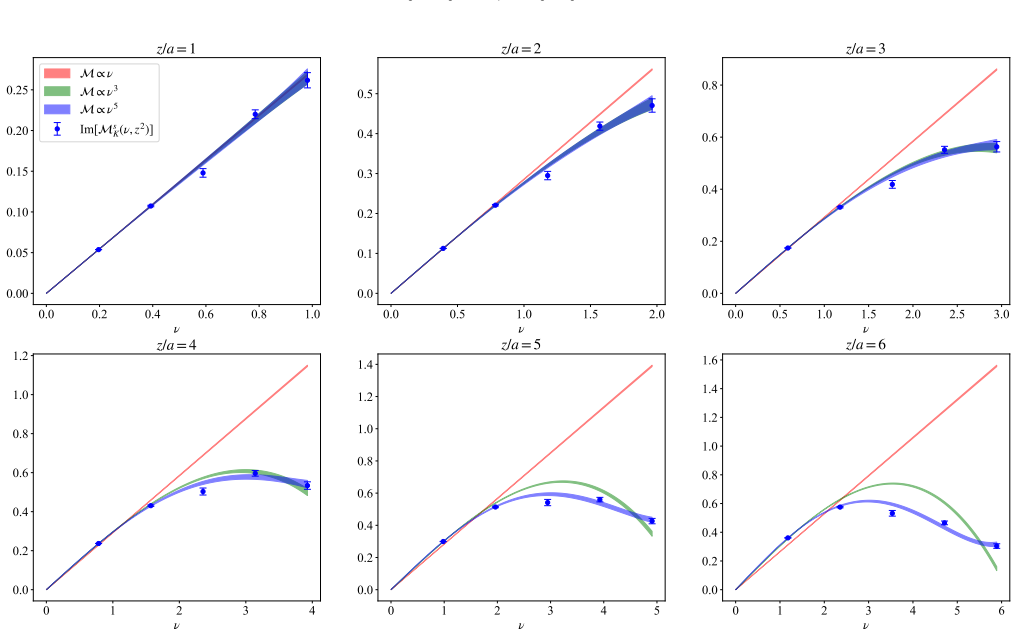
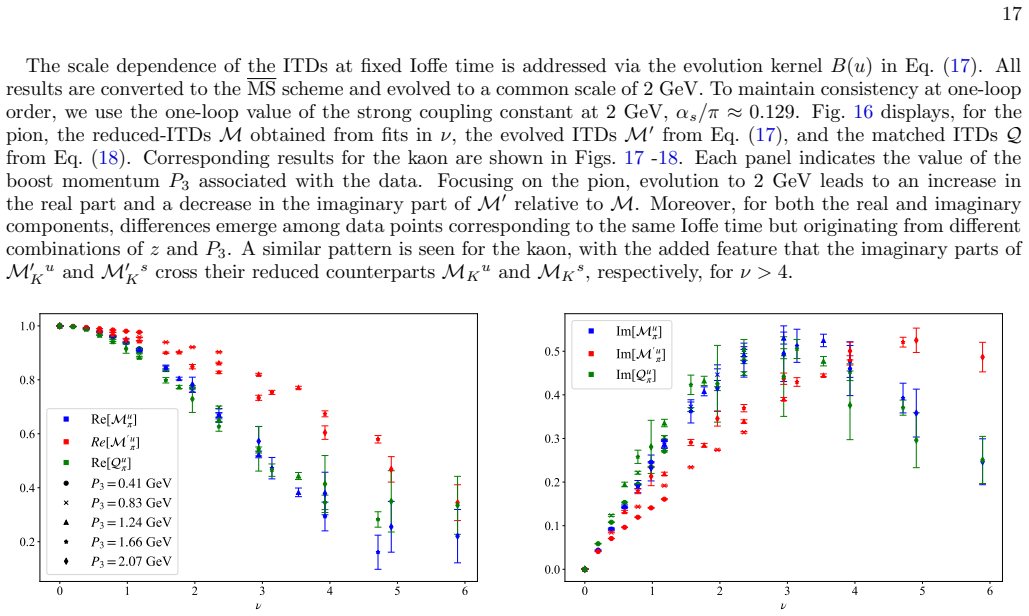
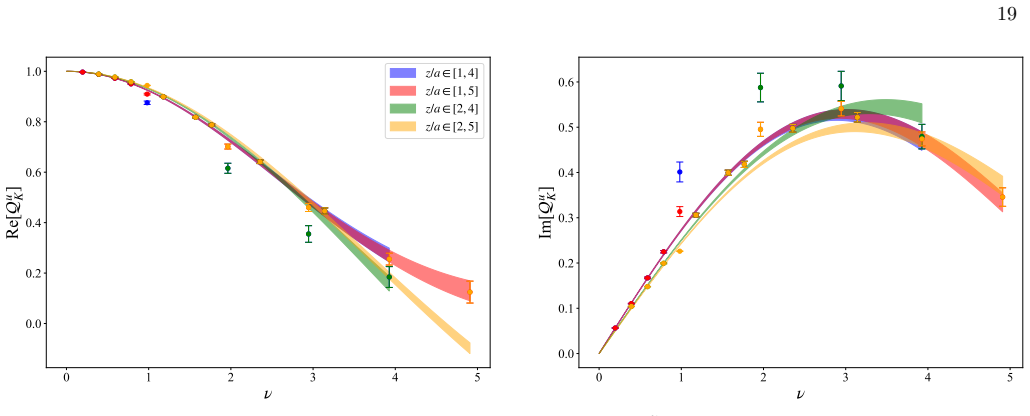
pseudo-distributions approach An alternative approach to analyzing the lattice data and reconstructing thex-dependence of the pion and kaon PDFs is the Ioffe-time pseudo-distribution method. It is useful to express the matrix elements of Eq. (1) as a function of the Lorentz invariant Ioffe time,ν=z·P, wherez µ = (0,0,0, z) andP µ = (P 0,0,0, P 3). This en...
work page 2021
-
[3]
A. W. Thomas, W. Melnitchouk, and F. M. Steffens, Phys. Rev. Lett.85, 2892 (2000), arXiv:hep-ph/0005043 [hep-ph]
work page internal anchor Pith review Pith/arXiv arXiv 2000
-
[4]
J.-W. Chen and X.-d. Ji, Phys. Lett.B523, 73 (2001), arXiv:hep-ph/0105296 [hep-ph]
work page internal anchor Pith review Pith/arXiv arXiv 2001
-
[5]
Leading Chiral Contributions to the Spin Structure of the Proton
J.-W. Chen and X.-d. Ji, Phys. Rev. Lett.88, 052003 (2002), arXiv:hep-ph/0111048 [hep-ph]
work page internal anchor Pith review Pith/arXiv arXiv 2002
-
[6]
$\bar d - \bar u$ asymmetry in the proton in chiral effective theory
Y. Salamu, C.-R. Ji, W. Melnitchouk, and P. Wang, Phys. Rev. Lett.114, 122001 (2015), arXiv:1409.5885 [hep-ph]
work page internal anchor Pith review Pith/arXiv arXiv 2015
-
[7]
P. T. P. Hutauruk, I. C. Cloet, and A. W. Thomas, Phys. Rev. C94, 035201 (2016), arXiv:1604.02853 [nucl-th]
work page internal anchor Pith review Pith/arXiv arXiv 2016
-
[8]
P. C. Barry, N. Sato, W. Melnitchouk, and C.-R. Ji, Phys. Rev. Lett.121, 152001 (2018), arXiv:1804.01965 [hep-ph]
work page internal anchor Pith review Pith/arXiv arXiv 2018
-
[9]
P. C. Barry, C.-R. Ji, N. Sato, and W. Melnitchouk (Jefferson Lab Angular Momentum (JAM)), Phys. Rev. Lett.127, 232001 (2021), arXiv:2108.05822 [hep-ph]. 1 This manuscript was prepared as an account of work sponsored by an agency of the United States Government. Neither the United States Government nor any agency thereof, nor any of their employees, makes...
- [10]
- [11]
-
[12]
C. Chen, L. Chang, C. D. Roberts, S. Wan, and H.-S. Zong, Phys. Rev. D93, 074021 (2016), arXiv:1602.01502 [nucl-th]
work page internal anchor Pith review Pith/arXiv arXiv 2016
-
[13]
C. Shi, C. Mezrag, and H.-s. Zong, Phys. Rev. D98, 054029 (2018), arXiv:1806.10232 [nucl-th]
work page internal anchor Pith review Pith/arXiv arXiv 2018
- [14]
- [15]
- [16]
- [17]
-
[18]
C. Bourrely, W.-C. Chang, and J.-C. Peng, Phys. Rev. D105, 076018 (2022), arXiv:2202.12547 [hep-ph]
- [19]
-
[20]
Kaon quark distribution functions in the chiral constituent quark model
A. Watanabe, T. Sawada, and C. W. Kao, Phys. Rev. D97, 074015 (2018), arXiv:1710.09529 [hep-ph]
work page internal anchor Pith review Pith/arXiv arXiv 2018
-
[21]
J. S. Conway et al., Phys. Rev.D39, 92 (1989)
work page 1989
-
[22]
Soft-Gluon Resummation and the Valence Parton Distribution Function of the Pion
M. Aicher, A. Schafer, and W. Vogelsang, Phys. Rev. Lett.105, 252003 (2010), arXiv:1009.2481 [hep-ph]
work page internal anchor Pith review Pith/arXiv arXiv 2010
- [23]
-
[24]
D. Brommel et al. (QCDSF-UKQCD), Proceedings, 25th International Symposium on Lattice field theory , PoSLA T- TICE2007, 140 (2007)
work page 2007
-
[25]
The pion form factor from lattice QCD with two dynamical flavours
D. Br¨ ommelet al. (QCDSF/UKQCD), Eur. Phys. J. C51, 335 (2007), arXiv:hep-lat/0608021
work page internal anchor Pith review Pith/arXiv arXiv 2007
-
[26]
G. Bali, S. Collins, B. Gl¨ assle, M. G¨ ockeler, N. Javadi-Motaghi, J. Najjar, W. S¨ oldner, and A. Sternbeck, PoSLA T- TICE2013, 447 (2014), arXiv:1311.7639 [hep-lat]
work page internal anchor Pith review Pith/arXiv arXiv 2014
-
[27]
Nucleon and pion structure with lattice QCD simulations at physical value of the pion mass
A. Abdel-Rehim et al., Phys. Rev. D92, 114513 (2015), [Erratum: Phys.Rev.D 93, 039904 (2016)], arXiv:1507.04936 [hep-lat]
work page internal anchor Pith review Pith/arXiv arXiv 2015
-
[28]
The pion vector form factor from Lattice QCD at the physical point
C. Alexandrou et al. (ETM), Phys. Rev.D97, 014508 (2018), arXiv:1710.10401 [hep-lat]
work page internal anchor Pith review Pith/arXiv arXiv 2018
- [29]
-
[30]
C. Alexandrou, S. Bacchio, I. Cloet, M. Constantinou, K. Hadjiyiannakou, G. Koutsou, and C. Lauer (ETM), Phys. Rev. D103, 014508 (2021), arXiv:2010.03495 [hep-lat]
-
[31]
C. Alexandrou, S. Bacchio, I. Clo¨ et, M. Constantinou, K. Hadjiyiannakou, G. Koutsou, and C. Lauer (ETM), Phys. Rev. D104, 054504 (2021), arXiv:2104.02247 [hep-lat]
-
[32]
C. Alexandrou, S. Bacchio, I. Cloet, M. Constantinou, J. Delmar, K. Hadjiyiannakou, G. Koutsou, C. Lauer, and A. Vaquero (ETM), Phys. Rev. D105, 054502 (2022), arXiv:2111.08135 [hep-lat]
-
[33]
Quark and gluon momentum fractions in the pion and in the kaon,
C. Alexandrou et al. (Extended Twisted Mass), Phys. Rev. Lett.134, 131902 (2025), arXiv:2405.08529 [hep-lat]
-
[34]
A. Shindler, Phys. Rev. D110, L051503 (2024), arXiv:2311.18704 [hep-lat]
-
[35]
Francis et al., (2025), arXiv:2509.02472 [hep-lat]
A. Francis et al., (2025), arXiv:2509.02472 [hep-lat]
-
[36]
Parton Physics on Euclidean Lattice
X. Ji, Phys. Rev. Lett.110, 262002 (2013), arXiv:1305.1539 [hep-ph]
work page internal anchor Pith review Pith/arXiv arXiv 2013
- [37]
-
[38]
A. V. Radyushkin, Phys. Rev. D96, 034025 (2017), arXiv:1705.01488 [hep-ph]
work page internal anchor Pith review Pith/arXiv arXiv 2017
-
[39]
A. Radyushkin, Int. J. Mod. Phys. A35, 2030002 (2020), arXiv:1912.04244 [hep-ph]
-
[40]
Extracting Parton Distribution Functions from Lattice QCD Calculations
Y.-Q. Ma and J.-W. Qiu, Phys. Rev.D98, 074021 (2018), arXiv:1404.6860 [hep-ph]
work page internal anchor Pith review Pith/arXiv arXiv 2018
-
[41]
QCD Factorization and PDFs from Lattice QCD Calculation
Y.-Q. Ma and J.-W. Qiu, Proceedings, QCD Evolution Workshop (QCD 2014): Santa Fe, USA, May 12-16, 2014, Int. J. Mod. Phys. Conf. Ser.37, 1560041 (2015), arXiv:1412.2688 [hep-ph]
work page internal anchor Pith review Pith/arXiv arXiv 2014
-
[42]
Exploring hadrons' partonic structure using ab initio lattice QCD calculations
Y.-Q. Ma and J.-W. Qiu, Phys. Rev. Lett.120, 022003 (2018), arXiv:1709.03018 [hep-ph]
work page internal anchor Pith review Pith/arXiv arXiv 2018
-
[43]
J.-H. Zhang, J.-W. Chen, L. Jin, H.-W. Lin, A. Sch¨ afer, and Y. Zhao, Phys. Rev. D100, 034505 (2019), arXiv:1804.01483 [hep-lat]
-
[44]
T. Izubuchi, L. Jin, C. Kallidonis, N. Karthik, S. Mukherjee, P. Petreczky, C. Shugert, and S. Syritsyn, Phys. Rev.D100, 034516 (2019), arXiv:1905.06349 [hep-lat]
- [45]
-
[46]
J. Holligan and H.-W. Lin, J. Phys. G51, 065101 (2024), arXiv:2404.14525 [hep-lat]
- [47]
- [48]
-
[49]
R. S. Sufian, J. Karpie, C. Egerer, K. Orginos, J.-W. Qiu, and D. G. Richards, Phys. Rev.D99, 074507 (2019), arXiv:1901.03921 [hep-lat]
work page internal anchor Pith review Pith/arXiv arXiv 2019
- [50]
- [51]
-
[52]
A guide to light-cone PDFs from Lattice QCD: an overview of approaches, techniques and results
K. Cichy and M. Constantinou, Adv. High Energy Phys.2019, 3036904 (2019), arXiv:1811.07248 [hep-lat]
work page internal anchor Pith review Pith/arXiv arXiv 2019
-
[53]
M. Constantinou, Eur. Phys. J. A57, 77 (2021), arXiv:2010.02445 [hep-lat]
-
[54]
Cichy, PoSLA TTICE2021, 017 (2022), arXiv:2110.07440 [hep-lat]
K. Cichy, PoSLA TTICE2021, 017 (2022), arXiv:2110.07440 [hep-lat]
-
[55]
Cichy, EPJ Web Conf.258, 01005 (2022), arXiv:2111.04552 [hep-lat]
K. Cichy, EPJ Web Conf.258, 01005 (2022), arXiv:2111.04552 [hep-lat]
-
[56]
Perturbative Renormalization of quasi-PDFs
M. Constantinou and H. Panagopoulos, Phys. Rev. D96, 054506 (2017), arXiv:1705.11193 [hep-lat]. 31
work page internal anchor Pith review Pith/arXiv arXiv 2017
-
[57]
A complete non-perturbative renormalization prescription for quasi-PDFs
C. Alexandrou, K. Cichy, M. Constantinou, K. Hadjiyiannakou, K. Jansen, H. Panagopoulos, and F. Steffens, Nucl. Phys. B923, 394 (2017), arXiv:1706.00265 [hep-lat]
work page internal anchor Pith review Pith/arXiv arXiv 2017
-
[58]
C. Alexandrou, K. Cichy, M. Constantinou, K. Hadjiyiannakou, K. Jansen, A. Scapellato, and F. Steffens, Phys. Rev. D99, 114504 (2019), arXiv:1902.00587 [hep-lat]
work page internal anchor Pith review Pith/arXiv arXiv 2019
-
[59]
A General Method for Non-Perturbative Renormalization of Lattice Operators
G. Martinelli, C. Pittori, C. T. Sachrajda, M. Testa, and A. Vladikas, Nucl. Phys. B445, 81 (1995), arXiv:hep-lat/9411010
work page internal anchor Pith review Pith/arXiv arXiv 1995
-
[60]
Nonperturbative Renormalisation of Composite Operators in Lattice QCD
M. Gockeler, R. Horsley, H. Oelrich, H. Perlt, D. Petters, P. E. L. Rakow, A. Schafer, G. Schierholz, and A. Schiller, Nucl. Phys.B544, 699 (1999), arXiv:hep-lat/9807044 [hep-lat]
work page internal anchor Pith review Pith/arXiv arXiv 1999
-
[61]
Renormalization functions for Nf=2 and Nf=4 Twisted Mass fermions
C. Alexandrou, M. Constantinou, and H. Panagopoulos (ETM), Phys. Rev.D95, 034505 (2017), arXiv:1509.00213 [hep- lat]
work page internal anchor Pith review Pith/arXiv arXiv 2017
-
[62]
J. Karpie, K. Orginos, A. Rothkopf, and S. Zafeiropoulos, JHEP04, 057 (2019), arXiv:1901.05408 [hep-lat]
work page internal anchor Pith review Pith/arXiv arXiv 2019
-
[63]
G. Backus and F. Gilbert, Geophysical Journal International16, 169 (1968)
work page 1968
-
[64]
C. Alexandrou, K. Cichy, M. Constantinou, K. Hadjiyiannakou, K. Jansen, A. Scapellato, and F. Steffens, Phys. Rev. D 105, 034501 (2022), arXiv:2108.10789 [hep-lat]
- [65]
-
[66]
Lattice QCD exploration of pseudo-PDFs
K. Orginos, A. Radyushkin, J. Karpie, and S. Zafeiropoulos, Phys. Rev.D96, 094503 (2017), arXiv:1706.05373 [hep-ph]
work page internal anchor Pith review Pith/arXiv arXiv 2017
-
[67]
A. V. Radyushkin, Phys. Lett. B781, 433 (2018), arXiv:1710.08813 [hep-ph]
work page internal anchor Pith review Pith/arXiv arXiv 2018
-
[68]
Moments of Ioffe time parton distribution functions from non-local matrix elements
J. Karpie, K. Orginos, and S. Zafeiropoulos, JHEP11, 178 (2018), arXiv:1807.10933 [hep-lat]
work page internal anchor Pith review Pith/arXiv arXiv 2018
-
[69]
Simulating twisted mass fermions at physical light, strange and charm quark masses
C. Alexandrou et al., Phys. Rev. D98, 054518 (2018), arXiv:1807.00495 [hep-lat]
work page internal anchor Pith review Pith/arXiv arXiv 2018
-
[70]
G. S. Bali, B. Lang, B. U. Musch, and A. Sch¨ afer, Phys. Rev. D93, 094515 (2016), arXiv:1602.05525 [hep-lat]
work page internal anchor Pith review Pith/arXiv arXiv 2016
-
[71]
Updated Lattice Results for Parton Distributions
C. Alexandrou, K. Cichy, M. Constantinou, K. Hadjiyiannakou, K. Jansen, F. Steffens, and C. Wiese, Phys. Rev. D96, 014513 (2017), arXiv:1610.03689 [hep-lat]
work page internal anchor Pith review Pith/arXiv arXiv 2017
-
[72]
Analytic Smearing of SU(3) Link Variables in Lattice QCD
C. Morningstar and M. J. Peardon, Phys. Rev. D69, 054501 (2004), arXiv:hep-lat/0311018
work page internal anchor Pith review Pith/arXiv arXiv 2004
-
[73]
S. Amendolia, B. Badelek, G. Batignani, G. Beck, F. Bedeschi, E. Bellamy, E. Bertolucci, D. Bettoni, H. Bilokon, G. Bologna, L. Bosisio, C. Bradaschia, M. Budinich, A. Codino, M. Counihan, M. Dell’Orso, B. D. Piazzoli, F. Fabbri, F. Fidecaro, L. Fo` a, E. Focardi, S. Frank, A. Giazotto, M. Giorgi, M. Green, J. Harvey, G. Heath, M. Landon, P. Laurelli, F. ...
work page 1984
-
[74]
S. Amendolia, G. Batignani, G. Beck, E. Bellamy, E. Bertolucci, G. Bologna, L. Bosisio, C. Bradaschia, M. Budinich, M. Dell’orso, B. D. Piazzoli, F. Fabbri, F. Fidecaro, L. Foa, E. Focardi, S. Frank, P. Gianetti, A. Giazzotto, M. Giorgi, M. Green, G. Heath, M. Landon, P. Laurelli, F. Liello, G. Mannocchi, P. March, P. Marrocchesi, A. Menzione, E. Meroni, ...
work page 1986
- [75]
-
[76]
J. Badier et al. (Saclay-CERN-College de France-Ecole Poly-Orsay), Phys. Lett. B93, 354 (1980)
work page 1980
-
[77]
S. Bhattacharya, K. Cichy, M. Constantinou, X. Gao, A. Metz, J. Miller, S. Mukherjee, P. Petreczky, F. Steffens, and Y. Zhao, Phys. Rev. D108, 014507 (2023), arXiv:2305.11117 [hep-lat]
-
[78]
S. Bhattacharya, K. Cichy, M. Constantinou, X. Gao, A. Metz, J. Miller, S. Mukherjee, P. Petreczky, F. Steffens, and Y. Zhao, JHEP01, 146 (2025), arXiv:2410.03539 [hep-lat]
- [79]
-
[80]
Adaptive Aggregation Based Domain Decomposition Multigrid for the Lattice Wilson Dirac Operator
A. Frommer, K. Kahl, S. Krieg, B. Leder, and M. Rottmann, SIAM J. Sci. Comput.36, A1581 (2014), arXiv:1303.1377 [hep-lat]
work page internal anchor Pith review Pith/arXiv arXiv 2014
discussion (0)
Sign in with ORCID, Apple, or X to comment. Anyone can read and Pith papers without signing in.