Recognition: no theorem link
Cosmic Duets I. High-spatial resolution spectroscopy of dual and lensed AGN with MUSE-NFM
Pith reviewed 2026-05-16 22:45 UTC · model grok-4.3
The pith
Gaia multipeak selection plus MUSE spectroscopy confirms 6 new dual AGN among 30 targets, representing 22% of all known pairs below 7 kpc at z=0.5-3.5.
A machine-rendered reading of the paper's core claim, the machinery that carries it, and where it could break.
Core claim
Among the 30 Gaia multipeak targets observed with MUSE, all show at least two spatially resolved components, yielding 6 confirmed dual AGN with projected separations below 7 kpc; this sample comprises 22% of the 27 spectroscopically confirmed dual AGN pairs in the literature at these redshifts. The observations also identify 13 lensed quasar systems and show that bright targets are mostly lensed while dual AGN fractions increase toward fainter magnitudes after selection corrections.
What carries the argument
The Gaia multipeak (GMP) technique, which flags pairs of point-like sources separated by less than 0.8 arcseconds, combined with 0.1-0.2 arcsecond resolution MUSE integral-field spectroscopy that delivers redshifts, ionization diagnostics, and line-of-sight absorption identification for each component.
If this is right
- The full program of 150 targets will support statistical studies of dual AGN occurrence and merger rates.
- The observed trend that dual AGN fractions rise at fainter magnitudes will inform how luminosity affects the detectability of close pairs.
- The confirmed lensed systems will allow tighter constraints on the mass distributions of the foreground lensing galaxies.
- The efficiency of the GMP plus MUSE combination sets a practical path for expanding the census of sub-7 kpc dual AGN.
Where Pith is reading between the lines
- The method could be extended to the full Gaia catalog to test whether the rise in dual AGN fraction at faint magnitudes is a selection artifact or reflects a physical luminosity dependence.
- Follow-up multi-epoch observations of the six new dual AGN could search for orbital motion or interaction signatures that would link them directly to the final stages of black hole mergers.
- The same selection plus spectroscopy pipeline might be applied to other wide-field catalogs to identify dual AGN at still smaller separations or higher redshifts.
Load-bearing premise
Gaia multipeak selection followed by MUSE spectroscopy correctly separates genuine dual AGN and lensed systems from contaminants and that selection effects have been fully corrected when comparing fractions by magnitude and separation.
What would settle it
High-resolution imaging or spectroscopy showing that any of the six reported dual AGN candidates consists of only a single active nucleus or a star-AGN alignment would lower the confirmed dual count and revise the claimed 22% contribution.
Figures



read the original abstract
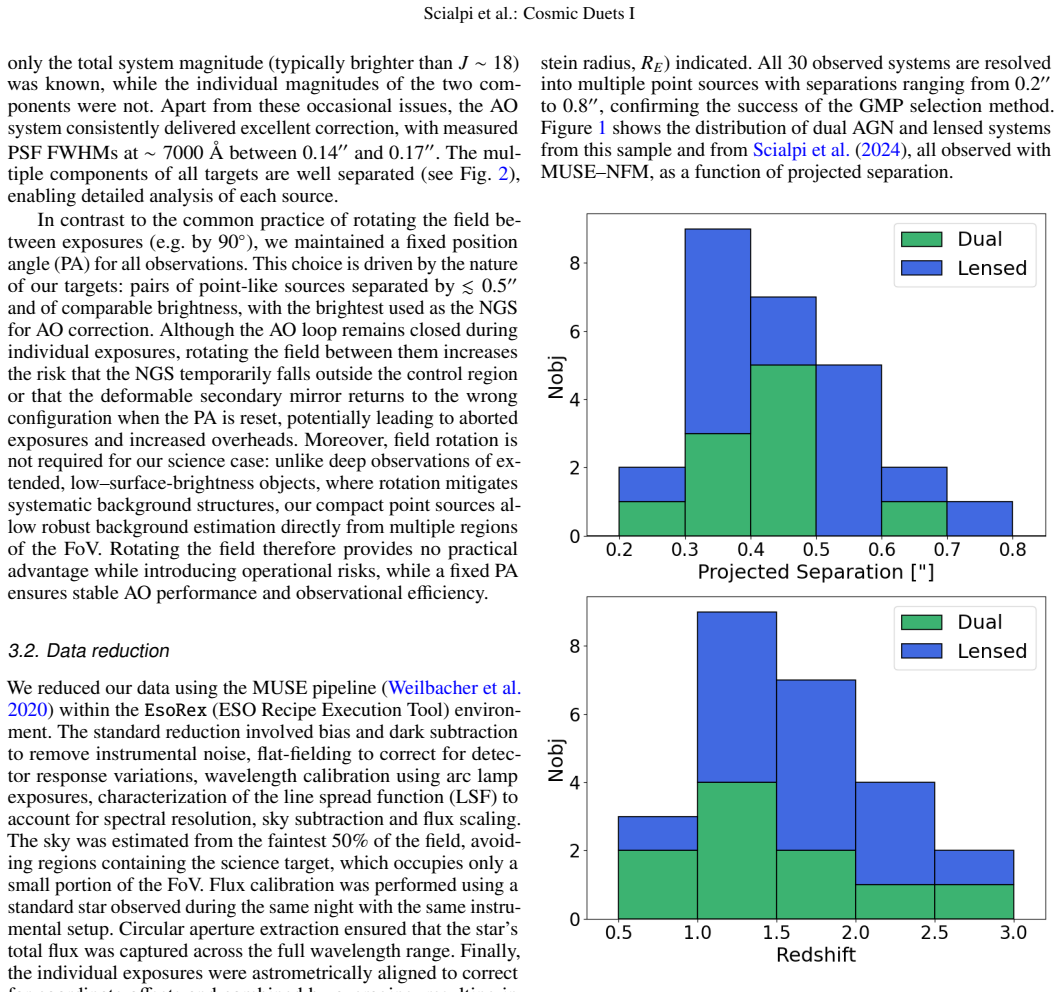
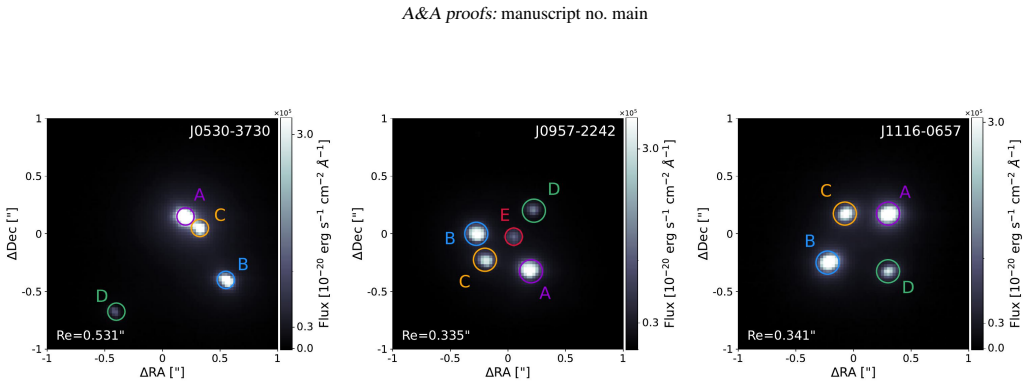
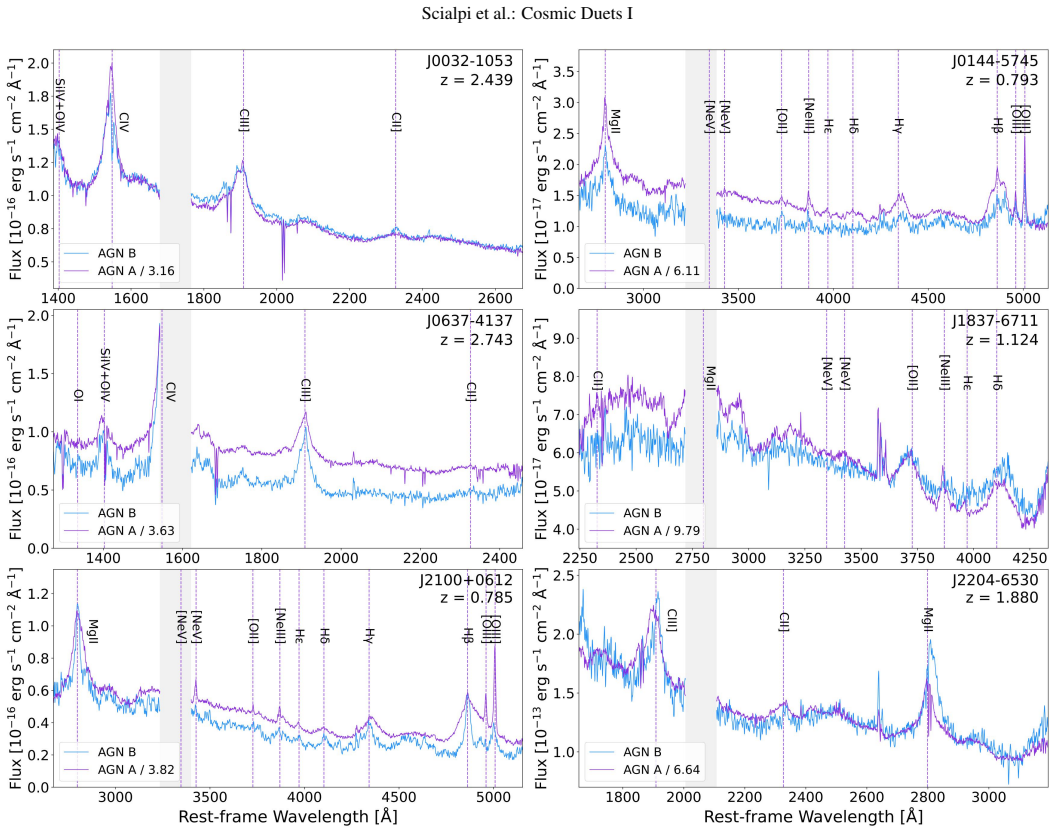
We present the first-year results of the MUSE Large Program "Cosmic Duets", whose goal is to obtain adaptive-optics assisted MUSE observations with an angular resolution of 0.1"-0.2" in order to provide integral-field spectroscopy of sub-arcsec separation dual and lensed active galactic nucleus (AGN) candidates. These observations reveal previously unexplored properties of dual and lensed systems that are key to understanding galaxy evolution, supermassive black hole mergers, and strong-lensing modeling. Targets were efficiently selected using the Gaia multipeak (GMP) technique, which identifies pairs of point-like sources with separations below 0.8" in the Gaia catalog. MUSE spatially resolved spectroscopy provides accurate redshifts, ionization diagnostics, and identification of absorption systems along the line of sight. We report results for 30 GMP targets at z=0.5-3.5. All systems show at least 2 spatially resolved components. 19 objects are confirmed as AGN multiplets, including 6 dual AGN, 10 doubly lensed quasars, and 3 quadruply lensed systems, while the remaining 11 correspond to chance alignments with foreground stars. Among all the spectroscopically confirmed dual AGN in the literature, 27 pairs have projected separations below 7kpc in this redshift regime, and our sample accounts for 22% of the total. We studied dual and lensed AGN distributions as a function of redshift, magnitude, and projected separation while accounting for selection effects, and we find that bright systems are dominated by lensed quasars, whereas the relative fraction of dual AGN increases at fainter magnitudes. This first-year sample demonstrates the high efficiency of GMP selection combined with MUSE spectroscopy for identifying sub-arcsec dual and lensed AGN. The full program, targeting 150 systems, will enable statistical studies of dual AGN and constraints on mass distribution in lensing galaxies.
Editorial analysis
A structured set of objections, weighed in public.
Referee Report
Summary. The paper presents first-year results from the MUSE Large Program 'Cosmic Duets', using Gaia multipeak (GMP) selection followed by adaptive-optics assisted MUSE-NFM integral-field spectroscopy (0.1-0.2 arcsec resolution) on 30 targets at z=0.5-3.5. All targets show at least two spatially resolved components; 19 are classified as AGN multiplets (6 dual AGN, 10 doubly lensed quasars, 3 quadruply lensed systems) while 11 are chance alignments with foreground stars. The work claims that these 6 new dual AGN bring the total spectroscopically confirmed dual AGN pairs with projected separations below 7 kpc in this redshift range to 27, with the new sample contributing 22% of that total. Distributions of dual and lensed systems versus redshift, magnitude, and separation are analyzed after accounting for selection effects, showing lensed quasars dominate at bright magnitudes while the dual-AGN fraction rises at fainter magnitudes. The GMP+MUSE combination is presented as highly efficient for identifying sub-arcsec systems.
Significance. This observational survey adds six new spectroscopically confirmed dual AGN at sub-7 kpc separations, representing a substantial (22%) increase to the known population in the z=0.5-3.5 range if the literature census is complete. The demonstrated efficiency of GMP selection plus MUSE spectroscopy for distinguishing dual AGN from lensed systems and contaminants provides a practical path for expanding samples needed to study supermassive black hole mergers and strong-lensing mass distributions. The magnitude-dependent trends, once selection effects are controlled, offer initial constraints on the relative populations of dual versus lensed systems.
major comments (2)
- [Abstract] Abstract: The central quantitative claim that the sample accounts for 22% of the total of 27 spectroscopically confirmed dual AGN pairs with projected separations below 7 kpc requires an explicit, verifiable compilation of the prior 21 literature systems (with references, redshifts, and separations). No such table or search criteria are provided, so incompleteness or duplicate counting in the literature total directly affects the reported fraction and cannot be assessed independently.
- [Classification section] Section on target classification (likely §3 or §4): The assignment of 6 systems as dual AGN versus 10 as doubly lensed quasars among the 19 AGN multiplets must rest on explicit, reproducible criteria (e.g., velocity offsets > few hundred km/s, differing ionization diagnostics, or absence of lensing signatures). Without a per-target breakdown or diagnostic diagrams showing how each of the 6 was distinguished from lensed images, the dual-AGN count and the 22% claim rest on an unverified step.
minor comments (3)
- [Abstract] Abstract: The phrase 'in this redshift regime' is ambiguous; state explicitly whether the 27-pair total and the 22% fraction are restricted to exactly z=0.5-3.5 or include a broader range.
- [Throughout] Figure captions and text: Ensure consistent terminology between 'dual AGN', 'AGN multiplets', and 'lensed quasars' to avoid reader confusion when comparing counts.
- [Results section on distributions] Selection-effects discussion: Provide a brief quantitative description (e.g., completeness curves or weighting factors) of how selection biases were corrected when deriving the magnitude- and separation-dependent fractions.
Simulated Author's Rebuttal
We thank the referee for the positive assessment and constructive comments. We address the two major comments point by point below and will revise the manuscript accordingly to enhance verifiability.
read point-by-point responses
-
Referee: [Abstract] Abstract: The central quantitative claim that the sample accounts for 22% of the total of 27 spectroscopically confirmed dual AGN pairs with projected separations below 7 kpc requires an explicit, verifiable compilation of the prior 21 literature systems (with references, redshifts, and separations). No such table or search criteria are provided, so incompleteness or duplicate counting in the literature total directly affects the reported fraction and cannot be assessed independently.
Authors: We agree that an explicit, verifiable compilation of the prior literature systems is required. In the revised manuscript we will add a new table (Table 1) that lists all 21 previously published spectroscopically confirmed dual AGN pairs with projected separations <7 kpc at 0.5<z<3.5, including references, redshifts, and separations. The literature search was performed via the NASA ADS using the keywords “dual AGN” OR “binary AGN” combined with redshift and separation filters, cross-checked against recent reviews (e.g., De Rosa et al. 2019 and subsequent updates). This compilation confirms the total of 27 systems and the 22% contribution of our sample. We will also state the exact search criteria in the text. revision: yes
-
Referee: [Classification section] Section on target classification (likely §3 or §4): The assignment of 6 systems as dual AGN versus 10 as doubly lensed quasars among the 19 AGN multiplets must rest on explicit, reproducible criteria (e.g., velocity offsets > few hundred km/s, differing ionization diagnostics, or absence of lensing signatures). Without a per-target breakdown or diagnostic diagrams showing how each of the 6 was distinguished from lensed images, the dual-AGN count and the 22% claim rest on an unverified step.
Authors: We agree that the classification criteria and per-target diagnostics must be presented explicitly. In the revised manuscript we will expand the classification section to state the quantitative criteria: dual AGN are identified when components exhibit velocity offsets >300 km s^{-1}, distinct ionization diagnostics (e.g., differing [O III]/Hβ or BPT positions), and no lensing arcs or multiple-image geometry consistent with a single source. Lensed systems are classified when redshifts match to within 100 km s^{-1}, spectra are nearly identical, and lensing features are present. We will add a new table (Table 2) giving the key diagnostics (velocity offset, line ratios, lensing indicators) for each of the 19 AGN multiplets and will include supplementary diagnostic diagrams (BPT and velocity maps) for the six dual-AGN systems. This will allow independent verification of the classifications. revision: yes
Circularity Check
No circularity: pure observational compilation with no derivations or self-referential predictions
full rationale
This is an observational survey paper reporting MUSE-NFM spectroscopy of Gaia multipeak-selected targets at z=0.5-3.5. Systems are classified as dual AGN, lensed quasars, or contaminants based on spatially resolved redshifts and ionization diagnostics. The central quantitative statement (27 literature dual AGN pairs below 7 kpc, with the new sample contributing 22%) is a direct count: 6 newly confirmed systems added to a compiled prior total of 21. No equations, model fits, predictions, ansatzes, or uniqueness theorems appear. The 22% figure is simple arithmetic (6/27) with no reduction to fitted inputs or self-citation chains. Any incompleteness in the literature census affects accuracy but does not create circularity by the paper's own methods. No load-bearing steps reduce to the paper's inputs by construction.
Axiom & Free-Parameter Ledger
Reference graph
Works this paper leans on
- [1]
-
[2]
2023, Living Reviews in Relativity, 26, 2
Amaro-Seoane, P., Andrews, J., Arca Sedda, M., et al. 2023, Living Reviews in Relativity, 26, 2
work page 2023
-
[3]
Anguita, T., Schechter, P. L., Kuropatkin, N., et al. 2018, MNRAS, 480, 5017
work page 2018
-
[4]
Arsenault, R., Madec, P. Y ., Hubin, N., et al. 2008, in Society of Photo-Optical Instrumentation Engineers (SPIE) Conference Series, V ol. 7015, Adaptive Optics Systems, ed. N. Hubin, C. E. Max, & P. L. Wizinowich, 701524
work page 2008
-
[5]
Arzoumanian, Z., Baker, P. T., Brazier, A., et al. 2018, ApJ, 859, 47
work page 2018
-
[6]
2010, in Society of Photo-Optical Instrumentation Engineers (SPIE) Conference Series, V ol
Bacon, R., Accardo, M., Adjali, L., et al. 2010, in Society of Photo-Optical Instrumentation Engineers (SPIE) Conference Series, V ol. 7735, Ground- based and Airborne Instrumentation for Astronomy III, ed. I. S. McLean, S. K. Ramsay, & H. Takami, 773508
work page 2010
-
[7]
Bacon, R., Accardo, M., Adjali, L., et al. 2010, in SPIE Proceedings, ed. I. S
work page 2010
- [8]
- [9]
-
[10]
Begelman, M. C., Blandford, R. D., & Rees, M. J. 1980, Nature, 287, 307
work page 1980
-
[11]
A., Wisotzki, L., & Schechter, P
Blackburne, J. A., Wisotzki, L., & Schechter, P. L. 2008, AJ, 135, 374
work page 2008
-
[12]
Bolton, A. S., Burles, S., Koopmans, L. V . E., et al. 2008, ApJ, 682, 964
work page 2008
-
[13]
Buzzoni, B., Delabre, B., Dekker, H., et al. 1984, The Messenger, 38, 9
work page 1984
- [14]
-
[15]
Chartas, G., Charlton, J., Eracleous, M., et al. 2009, New A Rev., 53, 128
work page 2009
-
[16]
Chen, N., Di Matteo, T., Ni, Y ., et al. 2023, MNRAS, 522, 1895
work page 2023
- [17]
-
[18]
Chen, Y .-C., Hwang, H.-C., Shen, Y ., et al. 2022, ApJ, 925, 162
work page 2022
- [19]
- [20]
-
[21]
Colpi, M., Danzmann, K., Hewitson, M., et al. 2024, arXiv e-prints, arXiv:2402.07571
work page internal anchor Pith review Pith/arXiv arXiv 2024
-
[22]
Comerford, J. M., Gerke, B. F., Newman, J. A., et al. 2009, ApJ, 698, 956
work page 2009
-
[23]
Croton, D. J., Springel, V ., White, S. D. M., et al. 2006, MNRAS, 365, 11
work page 2006
-
[24]
2020, MNRAS, 491, 944 De Rosa, A., Vignali, C., Bogdanovi ´c, T., et al
Curti, M., Mannucci, F., Cresci, G., & Maiolino, R. 2020, MNRAS, 491, 944 De Rosa, A., Vignali, C., Bogdanovi ´c, T., et al. 2020, arXiv e-prints, arXiv:2001.06293, _eprint: 2001.06293
-
[25]
Delchambre, L., Bailer-Jones, C. A. L., Bellas-Velidis, I., et al. 2023, A&A, 674, A31
work page 2023
-
[26]
Data Release 1 of the Dark Energy Spectroscopic Instrument
Delchambre, L., Krone-Martins, A., Wertz, O., et al. 2019, A&A, 622, A165 DESI Collaboration, Abdul-Karim, M., Adame, A. G., et al. 2025, arXiv e-prints, arXiv:2503.14745 Di Matteo, T., Springel, V ., & Hernquist, L. 2005, in Growing Black Holes: Accretion in a Cosmological Context, ed. A. Merloni, S. Nayakshin, & R. A. Sunyaev, 340–345
work page internal anchor Pith review Pith/arXiv arXiv 2019
-
[27]
2024, MNRAS, 528, 1895 EPTA Collaboration, InPTA Collaboration, Antoniadis, J., et al
Dutta, R., Acebron, A., Fumagalli, M., et al. 2024, MNRAS, 528, 1895 EPTA Collaboration, InPTA Collaboration, Antoniadis, J., et al. 2023, A&A, 678, A50
work page 2024
- [28]
- [29]
-
[30]
Flesch, E. W. 2023, The Open Journal of Astrophysics, 6, 49
work page 2023
-
[31]
2024, ApJS, 271, 54 Gaia Collaboration, Brown, A
Fu, Y ., Wu, X.-B., Li, Y ., et al. 2024, ApJS, 271, 54 Gaia Collaboration, Brown, A. G. A., Vallenari, A., et al. 2018, A&A, 616, A1 Gaia Collaboration, Brown, A. G. A., Vallenari, A., et al. 2021, A&A, 649, A1 Gaia Collaboration, Prusti, T., de Bruijne, J. H. J., et al. 2016, A&A, 595, A1 Gaia Collaboration, Vallenari, A., Brown, A. G. A., et al. 2022, ...
- [32]
-
[33]
Green, P. J. 2006, ApJ, 644, 733
work page 2006
- [34]
-
[35]
Hwang, H.-C., Shen, Y ., Zakamska, N., & Liu, X. 2020, ApJ, 888, 73
work page 2020
- [36]
-
[37]
2012, AJ, 143, 119 Jiménez-Vicente, J., Mediavilla, E., Kochanek, C
Inada, N., Oguri, M., Shin, M.-S., et al. 2012, AJ, 143, 119 Jiménez-Vicente, J., Mediavilla, E., Kochanek, C. S., & Muñoz, J. A. 2015, ApJ, 806, 251
work page 2012
-
[38]
Junkkarinen, V ., Shields, G. A., Beaver, E. A., et al. 2001, ApJ, 549, L155
work page 2001
-
[39]
Z., Blecha, L., & Hernquist, L
Kelley, L. Z., Blecha, L., & Hernquist, L. 2017, MNRAS, 464, 3131 Article number, page 17 of 20 A&A proofs:manuscript no. main
work page 2017
-
[40]
Kennicutt, Jr., R. C. 1998, ApJ, 498, 541
work page 1998
-
[41]
Kochanek, C. S., Mochejska, B., Morgan, N. D., & Stanek, K. Z. 2006, ApJ, 637, L73
work page 2006
-
[42]
Koss, M., Mushotzky, R., Treister, E., et al. 2012, ApJ, 746, L22
work page 2012
-
[43]
J., Blecha, L., Bernhard, P., et al
Koss, M. J., Blecha, L., Bernhard, P., et al. 2018, Nature, 563, 214
work page 2018
-
[44]
Krone-Martins, A., Graham, M. J., Stern, D., et al. 2019, arXiv e-prints, arXiv:1912.08977 Kunsági-Máté, S., Beck, R., Szapudi, I., & Csabai, I. 2022, MNRAS, 516, 2662
- [45]
-
[46]
Lemon, C., Courbin, F., More, A., et al. 2024, Space Sci. Rev., 220, 23
work page 2024
-
[47]
Lemon, C. A., Auger, M. W., McMahon, R. G., & Koposov, S. E. 2017, MNRAS, 472, 5023
work page 2017
- [48]
- [49]
- [50]
-
[51]
Maiolino, R., Scholtz, J., Curtis-Lake, E., et al. 2024, A&A, 691, A145
work page 2024
-
[52]
2022, Nature Astronomy, 6, 1185
Mannucci, F., Pancino, E., Belfiore, F., et al. 2022, Nature Astronomy, 6, 1185
work page 2022
-
[53]
Mannucci, F., Scialpi, M., Ciurlo, A., et al. 2023, A&A, 680, A53
work page 2023
-
[54]
Marconcini, C., Marconi, A., Cresci, G., et al. 2023, A&A, 677, A58
work page 2023
-
[55]
L., Scannapieco, E., Ellison, S
Martin, C. L., Scannapieco, E., Ellison, S. L., et al. 2010, ApJ, 721, 174
work page 2010
-
[56]
2010, Reports on Progress in Physics, 73, 086901
Massey, R., Kitching, T., & Richard, J. 2010, Reports on Progress in Physics, 73, 086901
work page 2010
- [57]
-
[58]
G., Banerji, M., Gonzalez, E., et al
McMahon, R. G., Banerji, M., Gonzalez, E., et al. 2013, The Messenger, 154, 35
work page 2013
- [59]
- [60]
-
[61]
Mosquera, A. M., Kochanek, C. S., Chen, B., et al. 2013, ApJ, 769, 53
work page 2013
-
[62]
Newman, A. B., Smith, R. J., Conroy, C., Villaume, A., & van Dokkum, P. 2017, ApJ, 845, 157
work page 2017
-
[63]
Osterbrock, D. E. & Ferland, G. J. 2006, Astrophysics of gaseous nebulae and active galactic nuclei
work page 2006
-
[64]
Ostrovski, F., McMahon, R. G., Connolly, A. J., et al. 2017, MNRAS, 465, 4325
work page 2017
- [65]
-
[66]
Pfeifle, R. W., Weaver, K. A., Secrest, N. J., Rothberg, B., & Patton, D. R. 2025, ApJS, 281, 25 Planck Collaboration, Aghanim, N., Akrami, Y ., et al. 2020, A&A, 641, A6
work page 2025
-
[67]
Rosas-Guevara, Y . M., Bower, R. G., McAlpine, S., Bonoli, S., & Tissera, P. B. 2019, MNRAS, 483, 2712
work page 2019
- [68]
-
[69]
2025, arXiv e-prints, arXiv:2509.02842
Salvato, M., Wolf, J., Dwelly, T., et al. 2025, arXiv e-prints, arXiv:2509.02842
-
[70]
Satyapal, S., Ellison, S. L., McAlpine, W., et al. 2014, MNRAS, 441, 1297
work page 2014
-
[71]
Schmidt, T., Treu, T., Birrer, S., et al. 2023, MNRAS, 518, 1260
work page 2023
-
[72]
Scialpi, M., Mannucci, F., Marconcini, C., et al. 2024, A&A, 690, A57
work page 2024
-
[73]
Sedda, M. A., Naoz, S., & Kocsis, B. 2023, Universe, 9, 138
work page 2023
-
[74]
Shajib, A. J., Vernardos, G., Collett, T. E., et al. 2024, Space Sci. Rev., 220, 87
work page 2024
-
[75]
Shen, Y ., Hwang, H.-C., Zakamska, N., & Liu, X. 2019, ApJ, 885, L4
work page 2019
-
[76]
Skrutskie, M. F., Cutri, R. M., Stiening, R., et al. 2006, AJ, 131, 1163
work page 2006
-
[77]
F., Hutsemekers, D., & Surdej, J
Sluse, D., Claeskens, J. F., Hutsemekers, D., & Surdej, J. 2007, A&A, 468, 885
work page 2007
-
[78]
Sluse, D., Hutsemékers, D., Courbin, F., Meylan, G., & Wambsganss, J. 2012, A&A, 544, A62
work page 2012
-
[79]
Sonnenfeld, A., Jaelani, A. T., Chan, J., et al. 2019, A&A, 630, A71
work page 2019
- [80]
discussion (0)
Sign in with ORCID, Apple, or X to comment. Anyone can read and Pith papers without signing in.