Recognition: 2 theorem links
· Lean TheoremProbing the sensitivity of dark energy dynamics to equation of state parametrization flexibility
Pith reviewed 2026-05-16 21:13 UTC · model grok-4.3
The pith
Current data mildly favor dynamical dark energy with phantom-like features, but the details depend on the chosen equation-of-state parametrization.
A machine-rendered reading of the paper's core claim, the machinery that carries it, and where it could break.
Core claim
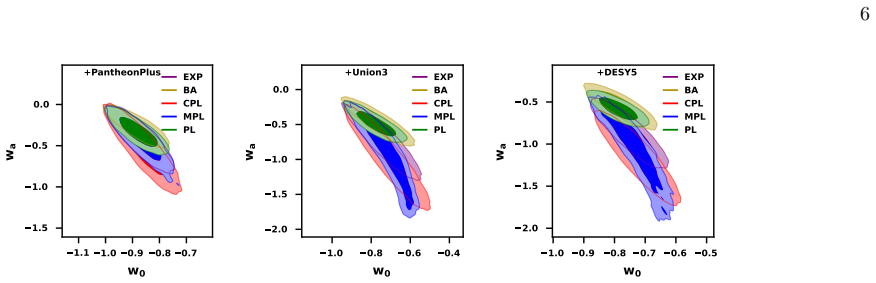
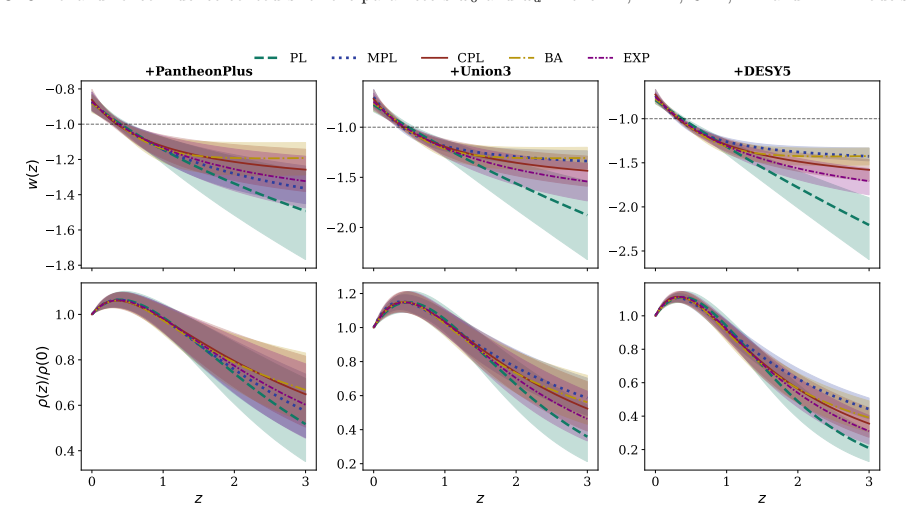
Parametrizations that allow stronger evolution of the dark energy equation of state exhibit enhanced phantom-like behavior at intermediate redshifts; however, this feature is sensitive to the assumed functional form and its extrapolation, with current data showing a consistent yet modest statistical preference for such dynamics at the approximately two-sigma level.
What carries the argument
The power-law and modified power-law parametrizations of the dark energy equation of state w(z), which provide greater low-redshift flexibility around z approximately 1 than the CPL form.
If this is right
- Current observations indicate a preference for the equation of state to cross below minus one at low to intermediate redshifts.
- Parametrizations with enhanced redshift flexibility produce mildly better fits to the data than standard forms.
- The preference for phantom-like behavior remains at the two-sigma level across different parametrizations.
- Conclusions are driven primarily by the redshift range one to two because data at higher redshifts are limited.
Where Pith is reading between the lines
- Future high-redshift measurements could test whether the apparent phantom features continue or arise from extrapolation.
- Different functional forms might be distinguished by next-generation surveys if the dynamical signal is physical.
- The mild improvement in fit suggests that tighter constraints on expansion history at z greater than two would sharpen tests of dark energy evolution.
Load-bearing premise
The chosen functional forms for the equation of state and their extrapolations beyond the measured redshift range accurately represent possible dark energy dynamics without introducing artificial features.
What would settle it
A direct measurement of the dark energy equation of state at redshifts greater than two that deviates substantially from the extrapolated behavior of the power-law models would falsify the inferred preference for phantom-like dynamics.
Figures


read the original abstract
Allowing for greater low-redshift flexibility through parametrizations such as CPL can lead to apparent deviations from $\Lambda$CDM, with the latter lying at roughly the $2\sigma$ level from the best-fit model. This motivates an investigation into whether such deviations reflect genuine dynamical dark energy or arise from parametrization choices. We investigate several dark energy parametrizations, including two new phenomenological models proposed here, the power-law and modified power-law forms, which allow greater low-redshift flexibility (around $z \sim 1$) than CPL. We find that parametrizations permitting stronger evolution of the equation of state can exhibit enhanced phantom-like behaviour at intermediate redshifts, however, this feature is sensitive to the assumed functional form and its extrapolation. The statistical preference for such behaviour remains modest, typically at the $\sim 2\sigma$ level, but is consistently observed across different parametrizations, in agreement with recent analyses. Owing to limited data at $z > 2$, this conclusion is primarily driven by the behaviour of the equation of state in the redshift range $1 \leq z \leq 2$. We show that parametrizations with enhanced redshift flexibility, such as power-law-type forms, can mildly improve the fit. Although the statistical significance, quantified using the Akaike and Bayesian information criteria, remains modest, our results indicate that current data favour dynamical dark energy with phantom-like features, although the strength and detailed evolution of this behaviour are not robustly constrained.
Editorial analysis
A structured set of objections, weighed in public.
Referee Report
Summary. The manuscript investigates the sensitivity of inferences about dark energy dynamics to the choice of equation-of-state parametrization. It introduces two new phenomenological forms (power-law and modified power-law) that allow greater flexibility at low-to-intermediate redshifts than the CPL parametrization, fits them to current cosmological data, and reports a consistent but modest (~2σ) preference for dynamical dark energy with phantom-like (w < -1) behavior around z ~ 1–2. The preference is shown to be driven primarily by data in the 1 ≤ z ≤ 2 interval, to improve mildly with more flexible forms, and to remain sensitive to the assumed functional form and its extrapolation; statistical preference is quantified via AIC/BIC.
Significance. If the central result holds after addressing extrapolation concerns, the work demonstrates that current data mildly favor dynamical dark energy over ΛCDM and illustrates how parametrization flexibility can reveal or suppress apparent phantom crossing. It provides a useful cautionary analysis for the community on the robustness of dynamical-DE claims and the need for better high-redshift constraints, though the modest significance limits its immediate impact on model selection.
major comments (2)
- [Abstract] Abstract and concluding discussion: the central claim that 'current data favour dynamical dark energy with phantom-like features' rests on a ~2σ preference that the text itself qualifies as modest, sensitive to functional form, and driven by the sparsely constrained 1 ≤ z ≤ 2 interval. This makes the interpretation vulnerable to the possibility that the w(z) < -1 feature is an extrapolation artifact of the power-law tails rather than a data-driven signal.
- [Results] Results section on power-law and modified power-law fits: the paper notes that these forms produce enhanced phantom-like behavior relative to CPL, yet provides no quantitative test (e.g., comparison of w(z) reconstructions with and without high-z anchoring or with alternative high-z priors) to show that the crossing is not induced by the specific functional extrapolation beyond z > 2 where data are limited.
minor comments (2)
- [Abstract] The abstract and main text should explicitly state the redshift range over which each parametrization is directly constrained by data versus where it is extrapolated, to help readers assess the robustness of the reported phantom feature.
- [Figures] Figure captions and text should clarify whether the plotted w(z) curves include uncertainty bands that properly propagate the limited high-z leverage, or whether they reflect only the best-fit extrapolation.
Simulated Author's Rebuttal
We thank the referee for the constructive and detailed report. The comments correctly identify the modest statistical significance of our results and the importance of testing whether the apparent phantom-like behavior is robust to high-redshift extrapolation. We address each point below and have revised the manuscript to strengthen the presentation of caveats and to include the suggested quantitative tests.
read point-by-point responses
-
Referee: [Abstract] Abstract and concluding discussion: the central claim that 'current data favour dynamical dark energy with phantom-like features' rests on a ~2σ preference that the text itself qualifies as modest, sensitive to functional form, and driven by the sparsely constrained 1 ≤ z ≤ 2 interval. This makes the interpretation vulnerable to the possibility that the w(z) < -1 feature is an extrapolation artifact of the power-law tails rather than a data-driven signal.
Authors: We agree that the phrasing in the abstract and conclusions should more explicitly reflect the modest (~2σ) significance, the sensitivity to functional form, and the limited high-redshift leverage. In the revised manuscript we have changed the abstract to state that the data 'mildly suggest a preference' for dynamical phantom-like behavior rather than 'favour', and we have added an explicit sentence noting that the feature is driven by the 1 ≤ z ≤ 2 interval and remains sensitive to extrapolation assumptions. The concluding discussion has been expanded to discuss the possibility of parametrization-induced artifacts and to stress the need for improved high-z constraints. revision: yes
-
Referee: [Results] Results section on power-law and modified power-law fits: the paper notes that these forms produce enhanced phantom-like behavior relative to CPL, yet provides no quantitative test (e.g., comparison of w(z) reconstructions with and without high-z anchoring or with alternative high-z priors) to show that the crossing is not induced by the specific functional extrapolation beyond z > 2 where data are limited.
Authors: We accept that the submitted manuscript did not contain explicit quantitative tests isolating the effect of high-redshift extrapolation. In the revised version we have added such tests: the power-law and modified power-law models were re-fitted with an additional high-z anchor (w(z=3) fixed to −1) and with an alternative prior that forces w(z>2) to approach −1. The resulting w(z) reconstructions are compared directly to the unconstrained fits. The phantom-like dip near z∼1–2 remains visible (though with reduced amplitude) under these anchors, indicating that the feature is not generated solely by the power-law tails. These comparisons are now shown in a new panel of Figure 4 and discussed in the results section. revision: yes
Circularity Check
No significant circularity; standard data-driven fitting with acknowledged model sensitivity
full rationale
The paper introduces two new phenomenological parametrizations (power-law and modified power-law) for w(z) chosen for greater low-z flexibility than CPL, then performs standard Bayesian fits to existing cosmological datasets. The reported ~2σ preference for phantom-like dynamical dark energy is the direct output of those fits and is explicitly qualified as modest, sensitive to functional form, and driven by the 1≤z≤2 interval where data are sparse. No equation reduces to its own input by construction, no fitted parameter is relabeled as an independent prediction, and no load-bearing premise rests on self-citation or an imported uniqueness theorem. The derivation chain is therefore self-contained: the models are defined independently, the data are external, and the conclusions follow from the likelihood analysis without circular reduction.
Axiom & Free-Parameter Ledger
free parameters (3)
- w0 and wa (CPL parameters)
- power-law index and normalization
- modified power-law coefficients
axioms (2)
- standard math Flat FLRW metric and standard Friedmann equations govern background expansion
- domain assumption Observational datasets (supernovae, BAO, CMB) provide unbiased constraints on w(z)
Lean theorems connected to this paper
-
IndisputableMonolith/Cost/FunctionalEquation.leanwashburn_uniqueness_aczel unclear?
unclearRelation between the paper passage and the cited Recognition theorem.
we introduce two additional two-parameter forms, the power-law (PL) parametrization,w(a) =w 0/aα, and its generalization, the modified power-law (MPL) parametrization,w(a) =w 0/(1+a α)
-
IndisputableMonolith/Foundation/RealityFromDistinction.leanreality_from_one_distinction unclear?
unclearRelation between the paper passage and the cited Recognition theorem.
The statistical preference for such behaviour remains modest, typically at the ∼2σ level... current data favour dynamical dark energy with phantom-like features
What do these tags mean?
- matches
- The paper's claim is directly supported by a theorem in the formal canon.
- supports
- The theorem supports part of the paper's argument, but the paper may add assumptions or extra steps.
- extends
- The paper goes beyond the formal theorem; the theorem is a base layer rather than the whole result.
- uses
- The paper appears to rely on the theorem as machinery.
- contradicts
- The paper's claim conflicts with a theorem or certificate in the canon.
- unclear
- Pith found a possible connection, but the passage is too broad, indirect, or ambiguous to say the theorem truly supports the claim.
Reference graph
Works this paper leans on
-
[1]
dark energy may be more phantom-like than previ- ously inferred
-
[2]
the CPL parametrization may become inadequate nearz∼1 or at higher redshifts
-
[3]
this behaviour may guide the construction of parametrizations that better capture the true dy- namics of dark energy, reducing arbitrariness in phenomenological modeling
-
[4]
Probing the sensitivity of dark energy dynamics to equation of state parametrization flexibility
such models may exhibit increased statistical ten- sion with the ΛCDM scenario. In this work, we investigate these possibilities in detail. In addition to the CPL model, we consider two well studied two-parameter parametrizations, the Barboza–Alcaniz (BA) model [10] and the exponential (EXP) model [11]. To further extend our analysis, we in- troduce two a...
work page internal anchor Pith review Pith/arXiv arXiv 2025
-
[5]
Planck 2018 results. VI. Cosmological parameters
N. Aghanimet al.(Planck), Astron. Astrophys.641, A6 (2020), [Erratum: Astron.Astrophys. 652, C4 (2021)], arXiv:1807.06209 [astro-ph.CO]
work page internal anchor Pith review Pith/arXiv arXiv 2020
-
[6]
A. G. Riesset al., Astrophys. J. Lett.934, L7 (2022), arXiv:2112.04510 [astro-ph.CO]
work page internal anchor Pith review Pith/arXiv arXiv 2022
-
[7]
Challenges for $\Lambda$CDM: An update
L. Perivolaropoulos and F. Skara, New Astron. Rev.95, 101659 (2022), arXiv:2105.05208 [astro-ph.CO]
work page internal anchor Pith review arXiv 2022
- [8]
-
[9]
A. G. Adameet al.(DESI), JCAP02, 021, arXiv:2404.03002 [astro-ph.CO]
work page internal anchor Pith review Pith/arXiv arXiv
-
[10]
DESI DR2 Results II: Measurements of Baryon Acoustic Oscillations and Cosmological Constraints
M. Abdul Karimet al.(DESI) (2025), arXiv:2503.14738 [astro-ph.CO]
work page internal anchor Pith review Pith/arXiv arXiv 2025
-
[11]
Guet al.(DESI), (2025), arXiv:2504.06118 [astro-ph.CO]
G. Guet al.(DESI) (2025), arXiv:2504.06118 [astro- ph.CO]
-
[12]
Accelerating Universes with Scaling Dark Matter
M. Chevallier and D. Polarski, Int. J. Mod. Phys. D10, 213 (2001), arXiv:gr-qc/0009008
work page internal anchor Pith review Pith/arXiv arXiv 2001
-
[13]
E. V. Linder, Phys. Rev. Lett.90, 091301 (2003), arXiv:astro-ph/0208512
work page internal anchor Pith review Pith/arXiv arXiv 2003
-
[14]
E. M. Barboza, Jr. and J. S. Alcaniz, Phys. Lett. B666, 415 (2008), arXiv:0805.1713 [astro-ph]
work page internal anchor Pith review Pith/arXiv arXiv 2008
-
[15]
General Analytic Solutions of Scalar Field Cosmology with Arbitrary Potential
N. Dimakis, A. Karagiorgos, A. Zampeli, A. Paliathana- sis, T. Christodoulakis, and P. A. Terzis, Phys. Rev. D 93, 123518 (2016), arXiv:1604.05168 [gr-qc]
work page internal anchor Pith review Pith/arXiv arXiv 2016
-
[16]
L. Feng and T. Lu, Journal of Cosmology and Astropar- ticle Physics2011(11), 034–034
-
[17]
Probing the dynamics of dark energy with novel parametrizations
J.-Z. Ma and X. Zhang, Phys. Lett. B699, 233 (2011), arXiv:1102.2671 [astro-ph.CO]
work page internal anchor Pith review Pith/arXiv arXiv 2011
- [18]
-
[19]
Beyond CPL: Evidence for dynamical dark energy in three-parameter models
S. Alam and M. W. Hossain (2025), arXiv:2510.03779 [astro-ph.CO]
work page internal anchor Pith review Pith/arXiv arXiv 2025
-
[20]
S. Akthar and M. W. Hossain, JCAP04, 024, arXiv:2411.15892 [astro-ph.CO]
-
[21]
D. Foreman-Mackey, D. W. Hogg, D. Lang, and J. Goodman, Publ. Astron. Soc. Pac.125, 306 (2013), arXiv:1202.3665 [astro-ph.IM]
work page internal anchor Pith review Pith/arXiv arXiv 2013
-
[22]
GetDist: a Python package for analysing Monte Carlo samples
A. Lewis (2019), arXiv:1910.13970 [astro-ph.IM]
work page internal anchor Pith review Pith/arXiv arXiv 2019
- [23]
-
[24]
Distance Priors from Planck Final Release
L. Chen, Q.-G. Huang, and K. Wang, jcap2019, 028 (2019), arXiv:1808.05724 [astro-ph.CO]
work page internal anchor Pith review Pith/arXiv arXiv 2019
-
[25]
Andradeet al.(DESI) (2025), arXiv:2503.14742 [astro-ph.CO]
U. Andradeet al.(DESI) (2025), arXiv:2503.14742 [astro-ph.CO]
-
[26]
M. A. K. e. al., Phys. Rev. D , (2025), arXiv:2503.14739 [astro-ph.CO]
work page internal anchor Pith review Pith/arXiv arXiv 2025
-
[27]
The Pantheon+ Analysis: The Full Dataset and Light-Curve Release
D. Scolnicet al., Astrophys. J.938, 113 (2022), arXiv:2112.03863 [astro-ph.CO]
work page internal anchor Pith review Pith/arXiv arXiv 2022
-
[28]
The Pantheon+ Analysis: Cosmological Constraints
D. Broutet al., Astrophys. J.938, 110 (2022), arXiv:2202.04077 [astro-ph.CO]
work page internal anchor Pith review Pith/arXiv arXiv 2022
-
[29]
Union Through UNITY: Cosmology with 2,000 SNe Using a Unified Bayesian Framework
D. Rubinet al.(2023), arXiv:2311.12098 [astro-ph.CO]
work page internal anchor Pith review Pith/arXiv arXiv 2023
-
[30]
T. M. C. Abbottet al.(DES), Astrophys. J. Lett.973, L14 (2024), arXiv:2401.02929 [astro-ph.CO]
work page internal anchor Pith review Pith/arXiv arXiv 2024
-
[31]
A. G´ omez-Valent and L. Amendola, jcap2018, 051 (2018), arXiv:1802.01505 [astro-ph.CO]
work page internal anchor Pith review Pith/arXiv arXiv 2018
-
[32]
S. Nesseris, G. Pantazis, and L. Perivolaropoulos, Phys. Rev. D96, 023542 (2017), arXiv:1703.10538 [astro- ph.CO]
work page internal anchor Pith review Pith/arXiv arXiv 2017
-
[33]
A. R. Liddle, P. Mukherjee, and D. Parkinson (2006), arXiv:astro-ph/0608184
work page internal anchor Pith review Pith/arXiv arXiv 2006
-
[34]
K. Shi, Y. Huang, and T. Lu, Mon. Not. Roy. Astron. Soc.426, 2452 (2012), arXiv:1207.5875 [astro-ph.CO]
work page internal anchor Pith review Pith/arXiv arXiv 2012
-
[35]
R. Trotta (2017), arXiv:1701.01467 [astro-ph.CO]
work page internal anchor Pith review Pith/arXiv arXiv 2017
-
[36]
Akaike, IEEE Transactions on Automatic Control19, 716 (1974)
H. Akaike, IEEE Transactions on Automatic Control19, 716 (1974)
work page 1974
- [37]
-
[38]
P. C. Mahalanobis, Proc. Natl. Inst. Sci. India2, 49 (1936)
work page 1936
-
[39]
S. S. Wilks, The Annals of Mathematical Statistics9, 60 (1938)
work page 1938
discussion (0)
Sign in with ORCID, Apple, or X to comment. Anyone can read and Pith papers without signing in.