REVIEW 2 major objections 4 minor 2 cited by
For a spinning source, the N-point energy correlator's full angular dependence is universal; all dynamics live in spinning correlators confined to a bounded region by unitarity and energy positivity.
Reviewed by Pith at T0; open to challenge. T0 means a machine referee read the full paper against a public rubric. the ladder, T0–T4 →
T0 review · deepseek-v4-flash
2026-08-03 15:21 UTC pith:KWFBFFLL
load-bearing objection A genuinely new framework for the angular structure of energy correlators, with clean positivity bounds and a first QCD calculation; the IR-insensitivity claim needs a sharper argument about soft multiplicity. the 2 major comments →
Energy Correlators of Spinning Sources
The pith
A machine-rendered reading of the paper's core claim, the machinery that carries it, and where it could break.
Core claim
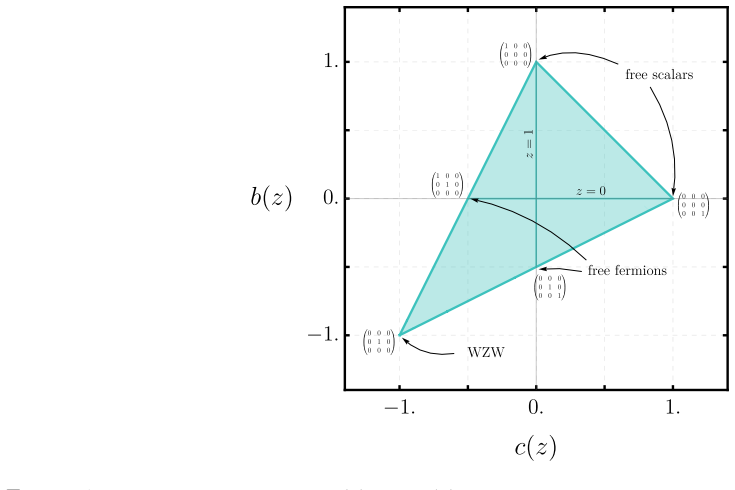
For a vector current—and by extension any spin-J source—the density matrix of the N-point energy correlator decomposes into a universal part fixed by rotational D-matrices plus a sum over spinning correlators H^J_{h'-h,m'-m}(z_ij) that carry all dynamical information. Unitarity and energy positivity confine these correlators to a bounded region whose extremal points are generated by pure spin states; in the two-point case the two independent structures c(z) and b(z) must lie in a triangle whose vertices are saturated by back-to-back or collinear configurations with definite spin projections. In QCD, the ratios of these spinning correlators to the inclusive correlator are computed at leading
What carries the argument
The central objects are the spinning energy correlators H^J_{h'-h,m'-m}(z_ij), the coefficients of the rotational D-matrix decomposition of the hadronic tensor; they carry all dynamics beyond the inclusive singlet. Positivity of the hadronic tensor, following from unitarity and energy positivity, bounds these functions inside a convex region—for the two-point correlator, a triangle in the (c(z), b(z)) plane—with pure spin states on the boundary. Soft and collinear factorization then makes the ratios H^J/H^1 infrared-insensitive, so normalized spinning correlators can be computed at fixed order in QCD.
Load-bearing premise
The claim that the normalized spinning correlators are insensitive to infrared physics assumes the energy detector annihilates the soft sector, which requires the number of soft quanta to stay below roughly 1/theta^2; the paper flags this explicitly in Section 3.1 around Eq. (59) and footnote 7, noting black-hole evaporation as a case where it can fail.
What would settle it
Measure the two-point spinning ratios a_EE^(2,0)(z) and a_EE^(2,2)(z) at high energy with precision in the mid-z bulk; if they differ systematically from the paper's fixed-order prediction beyond perturbative corrections, or if they depend visibly on the soft or hadronization cutoff, the claimed infrared insensitivity of these observables is falsified.
If this is right
- The complete Euler-angle dependence of any N-point correlator is now determined by symmetry, leaving only the 2N-3 internal detector angles as dynamical variables.
- The positivity bounds provide a spin-J, N-point generalization of the conformal-collider bounds, so any calculation or model of spinning correlators must land inside the allowed bounded region.
- Ratios of spinning to inclusive correlators are stable under hadronization and can be computed at fixed order, offering new precision observables for the hard part of electron-positron and hadron-collider processes.
- Energy-charge spinning correlators introduce J=1 structures sensitive to polarization and charge asymmetries, while the J=2 components are infrared-safe and match hadron-level simulations.
- The generalized sum rules determine lower-point spinning correlators from higher-point ones, including endpoint terms, separately in each angular-momentum channel.
Where Pith is reading between the lines
- If the same decomposition is applied to spin-2 sources such as gravitational energy flux, the positivity framework would bound gravitational correlators; the paper's collinear analysis already notes a transverse-spin h=4 candidate in gravity, suggesting the machinery extends beyond QCD.
- The spin-resolved sum rules imply that future track-based detectors could access the Euler-angle dependence without full event reconstruction, making these observables experimentally practical.
- The bounded regions for higher-spin sources could be used to constrain OPE data in conformal field theories, an application the paper leaves open.
- The infrared-insensitive ratios may provide a cleaner handle on electroweak boson polarization than conventional event-shape observables, since the hard spin structure survives hadronization.
Editorial analysis
A structured set of objections, weighed in public.
Referee Report
Summary. This paper develops a general framework for the fully differential N-point energy correlator of a spinning source. The authors show that the dependence on the Euler angles of the detector configuration is fixed by symmetry and organized in Wigner D-matrices, while the dynamical content is carried by 'spinning correlators' H^J_{h'-h,m'-m}(z_ij). They derive positivity bounds from the spectral representation, extend the one-point Hofman-Maldacena bounds to arbitrary spin and to higher points, and compute the two-point spinning energy and energy-charge correlators in perturbative QCD at first order. They also derive generalized sum rules connecting N- and (N-1)-point correlators and provide Pythia-based Monte Carlo comparisons supporting the claim that the normalized spinning correlators are insensitive to infrared dynamics.
Significance. The symmetry decomposition itself is a substantive and useful contribution: it provides a parameter-free organization of the full angular structure of energy correlators, and the positivity argument from the spectral representation (Eq. 15) is clean. The two-point positivity triangle (Eq. 36) is correctly derived. The generalized sum rules and the explicit one-loop QCD expressions, if correct, open new observables that may indeed be robustly computable. The paper's main new physical claim—that ratios of spinning to inclusive correlators directly probe the hard dynamics—is plausible and well-motivated, but as discussed below the current evidence for it is not yet fully controlled.
major comments (2)
- [§3.1, Eq. (59), footnote 7, Fig. 5] The claim that a^(2,0)_EE and a^(2,2)_EE directly probe the hard part rests on the assertion that E_n annihilates the soft sector. The stated sufficient condition is N_s ≲ 1/θ². Using the paper's own estimate N_s ∼ exp(√(16N_c/b ln(Q/Λ))) with Q=91 GeV, b=9 and Λ∼0.2 GeV gives N_s∼300, while the z-range displayed in Fig. 5 (z≳0.01, so θ≳0.2 rad) has 1/θ² ≲25. The condition is therefore violated over most of the plotted range, so the factorization argument does not parametrically cover the numerical comparison. The agreement with Pythia is encouraging, but it is a single hadronization model with only statistical uncertainties (footnote 9). To support the 'direct probe of hard dynamics' claim, either add a direct test of soft sensitivity (e.g. comparing with and without soft/hadronized particles, applying an energy cut, or varying the hadronization model), or restrict the IR-insensitivity
- [§3.1–3.3, Eqs. (63), (72), (73)] Several fixed-order coefficients appear to be typos and should be rechecked. In Eq. (63), the δ(z) coefficient 53/579 in H_c^EE has an unexplained denominator. In Eq. (72), the coefficient −7π/120 in H_x^EQ and in Eq. (73) the coefficient π/15 in H_-^EQ are surprising: one-loop QCD δ(z) coefficients are expected to be rational combinations of ζ(2), and no mechanism for a π coefficient is given. These coefficients enter the sum-rule checks in Appendix A (e.g. Eq. (98)) and the analytic predictions in Eqs. (64) and (74). Please verify all expressions, correct any typos, or provide more detail on how the calculations were validated.
minor comments (4)
- [Fig. 5 and Fig. 7] The z-axis is not labeled and the binning is not described. Please specify the range, binning, and whether the axis is linear or logarithmic.
- [Sec. 3.3, p. 37] The sentence 'the statistical uncertainty associated to the spinning energy-charge correlators is larger than the statistical uncertainty associated with the spinning energy-charge correlator' contains an apparent typo; the second instance should refer to the energy-energy correlator.
- [Eq. (59)] The factorization notation is under-specified. The soft matrix element ⟨α_s|S|0⟩ and the sum over operators O in the collinear factor should be defined more explicitly, and the relationship between the sets {p_i,j} and {p_s,j} should be stated.
- [Footnote 8] The definition of the normalized spinning correlators at the endpoints (as ratios of δ-function coefficients) is relegated to a footnote. Since the functions in Eqs. (60) and (64) are distribution-valued, it would help to state this definition in the main text.
Circularity Check
No significant circularity: the symmetry decomposition, positivity bounds and QCD spinning-correlator ratios are derived from first principles; self-citations are consistency checks and context, not inputs.
full rationale
The central derivation is self-contained. The angular structure (Eqs. 5 and 14) follows from rotational covariance: Euler-angle dependence is carried by Wigner D matrices, and the remaining coefficients are defined as the spinning correlators, so no fitted input is being relabeled as a prediction. The positivity bounds (Eqs. 36 and 39) come from the spectral representation in Eq. 15, where every weight w_{i,k} is non-negative and the source matrix elements are positive definite; the bounds are consequences of unitarity/energy positivity, not inputs that reproduce the conclusion. The QCD predictions in Eq. 60 are computed as fixed-order contractions of the hadronic tensor (Eqs. 54–58) and compared directly with an independent Pythia8 simulation in Fig. 5 without tuned parameters; the agreement is an external check, not a fit. Appendix A derives the one-point a_E and a_Q from the two-point correlators through sum rules that follow from the detector definition (Eq. 75) and momentum conservation (Eq. 79); matching known values is a consistency check, not an assumption. The self-citations [54] and [62] are used for context (UV→IR flow of one-point correlators) and for further discussion of charge-correlator IR safety, but the load-bearing arguments are restated or derived in the present text, so they do not form a self-citation chain. The explicitly flagged 'hidden assumption' around Eq. 59/footnote 7—that E_n annihilates the soft sector only if the number of soft quanta is ≲1/θ²—is a validity limitation on the claimed IR insensitivity, not a circular step: it does not make the prediction equivalent to an input or to a fit.
Axiom & Free-Parameter Ledger
axioms (5)
- domain assumption The energy flow operator action E_n|α⟩ = Σ_i E_i δ^(2)(Ω_i−Ω_n)|α⟩ and its light-ray representation as a null integral of the stress tensor accurately model calorimeter measurements (Eqs. 1–2).
- domain assumption The hadronic tensor can be written as a positive spectral sum over intermediate states: H^ab = Σ_α (2π)^4δ^4(p−p_α) w... ⟨0|J^a†|α⟩⟨α|J^b|0⟩ (Eq. 15), so the matrix is positive definite.
- domain assumption Soft and collinear factorization of the form Eq. (59) holds, and energy/charge detectors annihilate the soft sector, which requires the number of soft quanta to be ≲1/θ² (footnote 7).
- domain assumption Final-state hadrons are treated as massless, E_i ≃ |p_i|, with violations of order Λ²_QCD/Q² (Section 4, around Eq. 79).
- domain assumption The collinear OPE of energy operators is controlled by light-ray operators with transverse spin, as in Eq. (50) and Refs. [15,48].
read the original abstract
The $N$-point energy correlator measures the energy flux through $N$ detectors. We present a general framework that characterizes its full angular dependence in a series of \textit{spinning energy correlators}. These spinning correlators resurrect the angular momentum structure of both the source and the detector configuration, lost otherwise in inclusive measurements. We demonstrate that unitarity and energy positivity confine these correlators to a sharply bounded region, with the boundary realized by extremal correlators generated by pure spin states. We present a first calculation of spinning energy correlators in QCD as well as spinning energy-charge correlators. Their enhanced insensitivity to infrared dynamics opens up a new set of observables that directly probe the hard part of the scattering. Finally, we provide generalized sum rules, extended to spinning correlators and to conserved charges beyond energy.
Figures




Forward citations
Cited by 2 Pith papers
-
Bump Hunting Inside Jets with Energy Correlators
Energy correlators can convert scaling violations into angular bump hunting for new physics, yielding projected competitive LHC sensitivity for a light hadrophilic Z'.
-
Hydrodynamics and Energy Correlators
Energy-energy correlators in heavy-ion collisions exhibit classical hydrodynamic scaling from collective flow at large angles within the small-angle regime, collective modes at smaller angles, and light-ray OPE at eve...
Reference graph
Works this paper leans on
-
[1]
C. L. Basham, L. S. Brown, S. D. Ellis, and S. T. Love,Electron-positron annihilation energy pattern in quantum chromodynamics: Asymptotically free perturbation theory,Phys. Rev. D17 (May, 1978) 2298–2306
1978
-
[2]
C. L. Basham, L. S. Brown, S. D. Ellis, and S. T. Love,Energy correlations in electron-positron annihilation: Testing quantum chromodynamics,Phys. Rev. Lett.41(Dec, 1978) 1585–1588
1978
-
[3]
I. Moult and H. X. Zhu,Energy Correlators: A Journey From Theory to Experiment, arXiv:2506.09119
-
[4]
D. M. Hofman and J. Maldacena,Conformal collider physics: Energy and charge correlations, JHEP05(2008) 012, [arXiv:0803.1467]
Pith/arXiv arXiv 2008
-
[5]
N. A. Sveshnikov and F. V. Tkachov,Jets and quantum field theory,Phys. Lett. B382(1996) 403–408, [hep-ph/9512370]
Pith/arXiv arXiv 1996
-
[6]
P. S. Cherzor and N. A. Sveshnikov,Jet observables and energy momentum tensor, in12th International Workshop on High-Energy Physics and Quantum Field Theory (QFTHEP 97), pp. 402–407, 9, 1997.hep-ph/9710349
Pith/arXiv arXiv 1997
-
[7]
G. P. Korchemsky, G. Oderda, and G. F. Sterman,Power corrections and nonlocal operators, AIP Conf. Proc.407(1997), no. 1 988, [hep-ph/9708346]. 48
Pith/arXiv arXiv 1997
-
[8]
Belitsky, G
A. Belitsky, G. Korchemsky, and G. Sterman,Energy flow in qcd and event shape functions, Physics Letters B515(2001), no. 3 297–307
2001
-
[9]
C. W. Bauer, S. P. Fleming, C. Lee, and G. F. Sterman,Factorization of e+e- Event Shape Distributions with Hadronic Final States in Soft Collinear Effective Theory,Phys. Rev. D78 (2008) 034027, [arXiv:0801.4569]
Pith/arXiv arXiv 2008
-
[10]
A. V. Belitsky, S. Hohenegger, G. P. Korchemsky, E. Sokatchev, and A. Zhiboedov,Event shapes inN= 4super-Yang-Mills theory,Nucl. Phys. B884(2014) 206–256, [arXiv:1309.1424]
Pith/arXiv arXiv 2014
-
[11]
A. V. Belitsky, S. Hohenegger, G. P. Korchemsky, E. Sokatchev, and A. Zhiboedov,From correlation functions to event shapes,Nucl. Phys. B884(2014) 305–343, [arXiv:1309.0769]
Pith/arXiv arXiv 2014
-
[12]
P. Kravchuk and D. Simmons-Duffin,Light-ray operators in conformal field theory,JHEP11 (2018) 102, [arXiv:1805.00098]
Pith/arXiv arXiv 2018
-
[13]
M. Kologlu, P. Kravchuk, D. Simmons-Duffin, and A. Zhiboedov,The light-ray OPE and conformal colliders,JHEP01(2021) 128, [arXiv:1905.01311]
Pith/arXiv arXiv 2021
-
[14]
P. T. Komiske, I. Moult, J. Thaler, and H. X. Zhu,Analyzing N-Point Energy Correlators inside Jets with CMS Open Data,Phys. Rev. Lett.130(2023), no. 5 051901, [arXiv:2201.07800]
Pith/arXiv arXiv 2023
-
[15]
H. Chen, I. Moult, J. Sandor, and H. X. Zhu,Celestial blocks and transverse spin in the three-point energy correlator,JHEP09(2022) 199, [arXiv:2202.04085]
Pith/arXiv arXiv 2022
-
[16]
H. Chen, P. F. Monni, Z. Xu, and H. X. Zhu,Scaling Violation in Power Corrections to Energy Correlators from the Light-Ray Operator Product Expansion,Phys. Rev. Lett.133(2024), no. 23 231901, [arXiv:2406.06668]
Pith/arXiv arXiv 2024
-
[17]
K. Lee, A. Pathak, I. W. Stewart, and Z. Sun,Nonperturbative Effects in Energy Correlators: From Characterizing Confinement Transition to Improvingαs Extraction,Phys. Rev. Lett.133 (2024), no. 23 231902, [arXiv:2405.19396]
Pith/arXiv arXiv 2024
-
[18]
H. Chen, H. Ruan, and H. X. Zhu,Energy-Energy Correlator at Hadron Colliders: Celestial Blocks and Singularities,arXiv:2505.16753
- [19]
-
[20]
C.-H. Chang, H. Chen, X. Liu, D. Simmons-Duffin, F. Yuan, and H. X. Zhu,Quantum Scaling in Energy Correlators Beyond the Confinement Transition,arXiv:2507.15923
-
[21]
H. Chen, P. F. Monni, Z. Pang, G. Vita, and H. X. Zhu,Correlation Function/Wilson Loop Duality in Gauge Theory from EFT,arXiv:2510.07377
-
[22]
H. Chen, I. Moult, X. Zhang, and H. X. Zhu,Rethinking jets with energy correlators: Tracks, resummation, and analytic continuation,Phys. Rev. D102(2020), no. 5 054012, [arXiv:2004.11381]
Pith/arXiv arXiv 2020
-
[23]
M. Jaarsma, Y. Li, I. Moult, W. J. Waalewijn, and H. X. Zhu,From DGLAP to Sudakov: Precision Predictions for Energy-Energy Correlators,arXiv:2512.11950
-
[24]
W. Chen, J. Gao, Y. Li, Z. Xu, X. Zhang, and H. X. Zhu,NNLL resummation for projected three-point energy correlator,JHEP05(2024) 043, [arXiv:2307.07510]. [25]CMSCollaboration, A. Hayrapetyan et al.,Measurement of Energy Correlators inside Jets and Determination of the Strong CouplingαS(mZ),Phys. Rev. Lett.133(2024), no. 7 071903, 49 [arXiv:2402.13864]. [2...
Pith/arXiv arXiv 2024
-
[28]
J. Holguin, I. Moult, A. Pathak, and M. Procura,New paradigm for precision top physics: Weighing the top with energy correlators,Phys. Rev. D107(2023), no. 11 114002, [arXiv:2201.08393]
Pith/arXiv arXiv 2023
-
[29]
J. Holguin, I. Moult, A. Pathak, M. Procura, R. Sch¨ ofbeck, and D. Schwarz,Using the W Boson as a Standard Candle to Reach the Top: Calibrating Energy-Correlator-Based Top Mass Measurements,Phys. Rev. Lett.134(2025), no. 23 231903, [arXiv:2311.02157]
Pith/arXiv arXiv 2025
-
[30]
X. Liu and H. X. Zhu,Nucleon Energy Correlators,Phys. Rev. Lett.130(2023), no. 9 091901, [arXiv:2209.02080]
Pith/arXiv arXiv 2023
-
[31]
H.-Y. Liu, X. Liu, J.-C. Pan, F. Yuan, and H. X. Zhu,Nucleon Energy Correlators for the Color Glass Condensate,Phys. Rev. Lett.130(2023), no. 18 181901, [arXiv:2301.01788]
Pith/arXiv arXiv 2023
-
[32]
X. Liu and H. X. Zhu,TMDs from Semi-inclusive Energy Correlators,arXiv:2403.08874
-
[33]
H. M¨ antysaari, Y. Tawabutr, and X.-B. Tong,Nucleon energy correlators for the odderon,Phys. Rev. D112(2025), no. 11 114027, [arXiv:2503.20157]
Pith/arXiv arXiv 2025
-
[34]
M.-S. Gao, Z.-B. Kang, W. Li, and D. Y. Shao,Accessing nucleon transversity with one-point energy correlators,arXiv:2509.15809
-
[35]
Q.-H. Cao, Z. Yu, C. P. Yuan, S. Zhang, and H. X. Zhu,Collins-type fragmentation energy correlator in semi-inclusive deep inelastic lepton-hadron scattering,arXiv:2509.18892
-
[36]
Y. Huang, X.-B. Tong, and H.-L. Wang,Nucleon energy correlators as a probe of light-quark dipole operators at the EIC,arXiv:2508.08516
-
[37]
Y. J. Zhu,Energy Correlators in Semi-Inclusive Electron-Positron Annihilation, arXiv:2509.01652
-
[38]
J. Gao, H. T. Li, and Y. J. Zhu,Energy Correlators Resolving Proton Spin,arXiv:2509.17596
-
[39]
C. Andres, F. Dominguez, R. Kunnawalkam Elayavalli, J. Holguin, C. Marquet, and I. Moult, Resolving the Scales of the Quark-Gluon Plasma with Energy Correlators,Phys. Rev. Lett.130 (2023), no. 26 262301, [arXiv:2209.11236]
Pith/arXiv arXiv 2023
-
[40]
J. Barata, P. Caucal, A. Soto-Ontoso, and R. Szafron,Advancing the understanding of energy-energy correlators in heavy-ion collisions,JHEP11(2024) 060, [arXiv:2312.12527]
Pith/arXiv arXiv 2024
-
[41]
L. Ricci and M. Riembau,Energy correlators of hadronically decaying electroweak bosons,Phys. Rev. D106(2022), no. 11 114010, [arXiv:2207.03511]
Pith/arXiv arXiv 2022
-
[42]
S. Alipour-fard and W. J. Waalewijn,Energy correlators beyond angles,JHEP07(2025) 043, [arXiv:2501.17218]
arXiv 2025
-
[43]
Z.-B. Kang, K. Lee, D. Y. Shao, and F. Zhao,Probing transverse momentum dependent 50 structures with azimuthal dependence of energy correlators,JHEP03(2024) 153, [arXiv:2310.15159]
Pith/arXiv arXiv 2024
-
[44]
G. C. Fox and S. Wolfram,TWO AND THREE POINT ENERGY CORRELATIONS IN HADRONIC E+ E- ANNIHILATION,Z. Phys. C4(1980) 237–256. [45]OP ALCollaboration, G. Abbiendi et al.,Measurement of the longitudinal cross-section using the direction of the thrust axis in hadronic events at LEP,Phys. Lett. B440(1998) 393–402, [hep-ex/9808035]. [46]DELPHICollaboration, P. Ab...
Pith/arXiv arXiv 1980
-
[47]
V. Mateu and G. Rodrigo,Oriented Event Shapes at N 3LL+O(α 2 S),JHEP11(2013) 030, [arXiv:1307.3513]
Pith/arXiv arXiv 2013
-
[48]
C.-H. Chang, M. Kologlu, P. Kravchuk, D. Simmons-Duffin, and A. Zhiboedov,Transverse spin in the light-ray OPE,JHEP05(2022) 059, [arXiv:2010.04726]
Pith/arXiv arXiv 2022
-
[49]
T. Faulkner, R. G. Leigh, O. Parrikar, and H. Wang,Modular Hamiltonians for Deformed Half-Spaces and the Averaged Null Energy Condition,JHEP09(2016) 038, [arXiv:1605.08072]
Pith/arXiv arXiv 2016
-
[50]
T. Hartman, S. Kundu, and A. Tajdini,Averaged Null Energy Condition from Causality,JHEP 07(2017) 066, [arXiv:1610.05308]
Pith/arXiv arXiv 2017
-
[51]
D. M. Hofman, D. Li, D. Meltzer, D. Poland, and F. Rejon-Barrera,A Proof of the Conformal Collider Bounds,JHEP06(2016) 111, [arXiv:1603.03771]
Pith/arXiv arXiv 2016
-
[52]
D. Li, D. Meltzer, and D. Poland,Conformal Collider Physics from the Lightcone Bootstrap, JHEP02(2016) 143, [arXiv:1511.08025]
Pith/arXiv arXiv 2016
-
[53]
Zhiboedov,On Conformal Field Theories With Extremal a/c Values,JHEP04(2014) 038, [arXiv:1304.6075]
A. Zhiboedov,On Conformal Field Theories With Extremal a/c Values,JHEP04(2014) 038, [arXiv:1304.6075]
Pith/arXiv arXiv 2014
-
[54]
M. Riembau and M. Son,Flow between extremal one-point energy correlators in QCD, arXiv:2509.02669
-
[55]
S. Bhattacharya, Z.-B. Kang, D. Padilla, and J. Penttala,Probing the Sivers Asymmetry with Transverse Energy-Energy Correlators in the Small-xRegime,arXiv:2504.10475
-
[56]
S. D. Chowdhury, J. R. David, and S. Prakash,Constraints on parity violating conformal field theories ind= 3,JHEP11(2017) 171, [arXiv:1707.03007]
Pith/arXiv arXiv 2017
-
[57]
C. Cordova, J. Maldacena, and G. J. Turiaci,Bounds on OPE Coefficients from Interference Effects in the Conformal Collider,JHEP11(2017) 032, [arXiv:1710.03199]
Pith/arXiv arXiv 2017
-
[58]
Meltzer,Higher Spin ANEC and the Space of CFTs,JHEP07(2019) 001, [arXiv:1811.01913]
D. Meltzer,Higher Spin ANEC and the Space of CFTs,JHEP07(2019) 001, [arXiv:1811.01913]
Pith/arXiv arXiv 2019
-
[59]
T. Hartman and G. Mathys,Averaged null energy and the renormalization group,JHEP12 (2023) 139, [arXiv:2309.14409]
Pith/arXiv arXiv 2023
-
[60]
R. Dempsey, R. Karlsson, S. S. Pufu, Z. Zahraee, and A. Zhiboedov,Conformal collider bootstrap inN= 4SYM,arXiv:2512.10796
-
[61]
B. Me¸ caj, I. Moult, M. T. Walters, and Y. Xin,Energy Correlator Conformal Blocks and Positivity,arXiv:2512.09986. 51
-
[62]
M. Riembau and M. Son,One-point correlators of conserved and nonconserved charges in QCD, Phys. Rev. D111(2025), no. 1 014004, [arXiv:2407.12082]
Pith/arXiv arXiv 2025
-
[63]
Spencer,A note on the decomposition of tensors into traceless symmetric tensors, International Journal of Engineering Science8(1970), no
A. Spencer,A note on the decomposition of tensors into traceless symmetric tensors, International Journal of Engineering Science8(1970), no. 6 475–481
1970
-
[64]
A. Belin, D. M. Hofman, and G. Mathys,Einstein gravity from ANEC correlators,JHEP08 (2019) 032, [arXiv:1904.05892]
Pith/arXiv arXiv 2019
-
[65]
M. Kologlu, P. Kravchuk, D. Simmons-Duffin, and A. Zhiboedov,Shocks, Superconvergence, and a Stringy Equivalence Principle,JHEP11(2020) 096, [arXiv:1904.05905]
Pith/arXiv arXiv 2020
-
[66]
H. Chen, I. Moult, and H. X. Zhu,Spinning gluons from the QCD light-ray OPE,JHEP08 (2022) 233, [arXiv:2104.00009]
Pith/arXiv arXiv 2022
-
[67]
G. Panico, F. Riva, and A. Wulzer,Diboson interference resurrection,Phys. Lett. B776(2018) 473–480, [arXiv:1708.07823]
Pith/arXiv arXiv 2018
-
[68]
R. Gonzo and A. Pokraka,Light-ray operators, detectors and gravitational event shapes,JHEP 05(2021) 015, [arXiv:2012.01406]
Pith/arXiv arXiv 2021
-
[69]
L. J. Dixon, I. Moult, and H. X. Zhu,Collinear limit of the energy-energy correlator,Phys. Rev. D100(2019), no. 1 014009, [arXiv:1905.01310]
Pith/arXiv arXiv 2019
-
[70]
V. Del Duca, C. Duhr, A. Kardos, G. Somogyi, Z. Szar, Z. Trocsanyi, and Z. Tulipant,Jet production in the CoLoRFulNNLO method: event shapes in electron-positron collisions,Phys. Rev. D94(2016), no. 7 074019, [arXiv:1606.03453]
Pith/arXiv arXiv 2016
-
[71]
I. Moult and H. X. Zhu,Simplicity from Recoil: The Three-Loop Soft Function and Factorization for the Energy-Energy Correlation,JHEP08(2018) 160, [arXiv:1801.02627]
Pith/arXiv arXiv 2018
-
[72]
L. J. Dixon, M.-X. Luo, V. Shtabovenko, T.-Z. Yang, and H. X. Zhu,Analytical Computation of Energy-Energy Correlation at Next-to-Leading Order in QCD,Phys. Rev. Lett.120(2018), no. 10 102001, [arXiv:1801.03219]
Pith/arXiv arXiv 2018
-
[73]
M. A. Ebert, B. Mistlberger, and G. Vita,The Energy-Energy Correlation in the back-to-back limit at N3LO and N3LL’,JHEP08(2021) 022, [arXiv:2012.07859]
Pith/arXiv arXiv 2021
-
[74]
C. Duhr, B. Mistlberger, and G. Vita,Four-Loop Rapidity Anomalous Dimension and Event Shapes to Fourth Logarithmic Order,Phys. Rev. Lett.129(2022), no. 16 162001, [arXiv:2205.02242]
Pith/arXiv arXiv 2022
-
[75]
U. G. Aglietti and G. Ferrera,Energy-energy correlation in the back-to-back region at N3LL+NNLO in QCD,Phys. Rev. D110(2024), no. 11 114004, [arXiv:2403.04077]
Pith/arXiv arXiv 2024
-
[76]
S. Catani and M. Grazzini,Infrared factorization of tree level QCD amplitudes at the next-to-next-to-leading order and beyond,Nucl. Phys. B570(2000) 287–325, [hep-ph/9908523]
Pith/arXiv arXiv 2000
-
[77]
I. Feige and M. D. Schwartz,An on-shell approach to factorization,Phys. Rev. D88(2013), no. 6 065021, [arXiv:1306.6341]
Pith/arXiv arXiv 2013
-
[78]
N. Agarwal, L. Magnea, C. Signorile-Signorile, and A. Tripathi,The infrared structure of perturbative gauge theories,Phys. Rept.994(2023) 1–120, [arXiv:2112.07099]
Pith/arXiv arXiv 2023
-
[79]
Y. L. Dokshitzer, V. A. Khoze, A. H. Mueller, and S. I. Troian,Basics of perturbative QCD. 1991
1991
-
[80]
J. Alwall, R. Frederix, S. Frixione, V. Hirschi, F. Maltoni, O. Mattelaer, H. S. Shao, T. Stelzer, 52 P. Torrielli, and M. Zaro,The automated computation of tree-level and next-to-leading order differential cross sections, and their matching to parton shower simulations,JHEP07(2014) 079, [arXiv:1405.0301]
Pith/arXiv arXiv 2014
-
[81]
Bierlich et al.,A comprehensive guide to the physics and usage of PYTHIA 8.3,SciPost Phys
C. Bierlich et al.,A comprehensive guide to the physics and usage of PYTHIA 8.3,SciPost Phys. Codeb.2022(2022) 8, [arXiv:2203.11601]
Pith/arXiv arXiv 2022
-
[82]
S. T. Schindler, I. W. Stewart, and Z. Sun,Renormalons in the energy-energy correlator,JHEP 10(2023) 187, [arXiv:2305.19311]. [Erratum: JHEP 10, 175 (2024)]
Pith/arXiv arXiv 2023
-
[83]
P. F. Monni, G. Vita, Z. Xu, and H. X. Zhu,On the Edge of Safety: Charge-Charge Correlation in the Back-to-Back Limit,arXiv:2508.00977
-
[84]
Kats,Measuring polarization of light quarks at ATLAS and CMS,Phys
Y. Kats,Measuring polarization of light quarks at ATLAS and CMS,Phys. Rev. D92(2015) 071503, [arXiv:1505.06731]
Pith/arXiv arXiv 2015
-
[85]
Y. Kats,Kinked tracks fromΣ + baryons as a probe of light quark polarizations,JHEP07(2023) 018, [arXiv:2301.06188]
Pith/arXiv arXiv 2023
discussion (0)
Sign in with ORCID, Apple, or X to comment. Anyone can read and Pith papers without signing in.