REVIEW 3 major objections 5 minor 34 references
Category $\mathcal{O}$ for truncated shifted Yangians and the bi-infinite Bott-Samelson variety
T0 review · 3 major / 5 minor · reviewed 2026-08-02 · deepseek-v4-flash
Pith's one-line read The paper proves the Grothendieck ring of shifted-Yangian category O is isomorphic to the Cox ring of a new pro-variety, the open bi-infinite Bott-Samelson variety, and hence to a cluster algebra.
desk verdict Strong, serious paper that settles several open conjectures; the main theorem is stated unconditionally but depends on an explicit unproved associativity conjecture, and the paper must delimit where that assumption enters before it is ready. read the letter →
The pith
A machine-rendered reading of the paper's core claim, the machinery that carries it, and where it could break.
The reading
What carries the argument
The load-bearing object is the bi-infinite Bott-Samelson pro-variety $Z_\infty$ together with its open cell $Z^o_\infty$. $Z_\infty$ parametrizes collections $(x_{i,a})$ indexed by $(i,a) \in I \times 2\mathbb{Z}$ with each $x_{i,a}$ a point of the partial flag variety $G^\vee / P_i$ and with an incidence condition linking $x_{i,a}$ and $x_{j,a+1}$ whenever the Dynkin nodes $i$ and $j$ are adjacent; the Cox ring $R$ — the ring formed by all spaces of sections of line bundles on $Z^o_\infty$ — is explicitly a quotient of a polynomial ring by four families of relations. The central mechanism is the morphism $\Omega: R \to K_C(O^Z_{sh})$, built in three steps: match the fundamental line-bundle sections with the fundamental Grothendieck-ring subspaces $K_C(O^{\varpi_i}_{sh}(a))$ via
What would settle it
Produce three simple objects in $O_{sh}$ whose double tensor product depends on parenthesization (a concrete failure of Conjecture 5.14), which would collapse the monoidal categorification claims; or, for a small Lie algebra such as $\mathfrak{sl}_3$, compute the classes in an explicit truncated category and check that the four families of relations presenting the Cox ring — in particular the extended QQ-system identity $[L_{w\varpi_i,a}][L_{w s_i \varpi_i,a+2}] - [L_{w s_i \varpi_i,a}][L_{w\varpi_i,a+2}] = \prod_{j \sim i} [L_{w\varpi_j,a+1}]$ among chamber-module classes — hold in $K_0(O^Z_{sh})$; the first failure would refute the isomorphism of Theorem
Extended reading notes
Core claim
On the paper's own terms, the discovery is its Theorem 11: the morphism $\Omega$ from the Cox ring $R$ of the open bi-infinite Bott-Samelson pro-variety $Z^o_\infty$ to the complexified Grothendieck ring $K_C(O^Z_{sh})$ of the integral category $O$ for shifted Yangians is an isomorphism of C-algebras intertwining the natural actions of the Langlands dual group $G^\vee$, and it restricts to isomorphisms between spaces of sections of line bundles on the compactification $Z_\infty$ and the subspaces $K_C(O^\lambda_{sh}(R))$ attached to product monomial crystals. The map is assembled by matching the fundamental subspaces $K_C(O^{\varpi_i}_{sh}(a))$ with line-bundle sections, then proving that each of the four families of explicit relations present
Load-bearing premise
The monoidal conclusions rest on the unproved Conjecture 5.14 — that $V_1 \otimes (V_2 \otimes V_3)$ and $(V_1 \otimes V_2) \otimes V_3$ are isomorphic for all objects of $O_{sh}$, even though the shifted coproducts are known not to be co-associative — while the ring-level isomorphism leans on a quoted equivalence between the rational and trigonometric shifted frameworks whose proof is imported rather than given here.
Editorial extensions
If this is right
- The ring K_C(O^Z_sh) is now given by an explicit presentation — a quotient of a polynomial ring by four families of relations — so classes of representations in the category can in principle be computed and compared by generators and relations.
- Two standing conjectures follow: the Grothendieck ring is isomorphic to the cluster algebra generated by the Q-variables of the extended QQ-system, and the ℓ-character of every chamber module L_{wϖ_i,a} equals the corresponding Q-variable.
- Spec K_C(O^Z_sh) is a Coxeter-independent version of the scheme of bands: every choice of Coxeter element c yields an isomorphism of this spectrum with the scheme B(G^∨,c) of bi-infinite sequences (g_s) in G^∨ with g_s g_{s+1}^{-1} in the double Bruhat cell, so the scheme of bands no longer depends on an orientation.
- The Grothendieck ring carries a G^∨-action with G^∨-equivariant multiplication, and each subspace K_C(O^λ_sh(R)) is a G^∨-module isomorphic, by a Borel-Weil-type statement, to the space of sections of the corresponding line bundle on the compact pro-variety Z_∞.
- Shifted coproducts descend to truncated shifted Yangians, giving multiplication maps V(λ1,R1)⊗V(λ2,R2)→V(λ1+λ2,R1∪R2); these quantize the multiplication maps of generalized affine Grassmannian slices and make the truncated categories a directed system under inclusion.
Reading between the lines
- If the missing associativity (Conjecture 5.14) is proved, the ingredients assembled here — generic R-matrices, real and prime chamber modules, and the Corollary 5.15 criterion — look designed to complete the proof that O^Z_sh is a monoidal categorification of the cluster algebra; the paper stops short of that step.
- Because the spectrum is presented independently of any Coxeter element, the collection of height-function projections Spec R → N_−\G should glue into a universal object over the space of all orientations; a testable consequence is that the scheme of bands itself can be recovered as the total space of that atlas.
- The natural grading on parity KLRW algebras suggests a t-deformation of the Grothendieck ring; if it is compatible with the Poisson structure on Bott-Samelson varieties, it would quantize the scheme of bands and match existing quantum deformations of the cluster algebra — an identity that can be checked on generating series.
- The authors note that all constructions work over any field of characteristic zero; a concrete next experiment is to test the truncation-category comparisons in positive characteristic, where the KLRW equivalence and the characteristic-cycle arguments may fail independently.
Editorial analysis
A structured set of objections, weighed in public.
Referee Report
Summary. The paper develops a representation-theoretic and geometric framework for the Grothendieck ring of the integral category O of shifted Yangians associated to a simply-laced Lie algebra. It constructs a new pro-variety, the open bi-infinite Bott–Samelson variety Z^o_infinity, and its Cox ring R, and proves the central theorem that the map Ω : R → K_C(O^Z_sh) is a G^vee-equivariant isomorphism of C-algebras. From this isomorphism and prior work of Geiss–Hernandez–Leclerc and Francone–Leclerc, the paper derives Conjecture A (the Grothendieck ring is the GHL cluster algebra), Conjecture B (the ℓ-character of each chamber module is the corresponding Q-variable), the extended QQ-system, a G^vee-action on the Grothendieck ring, truncated shifted coproducts, and a generalization of Hernandez–Leclerc duality. The paper is very substantial and contains many auxiliary results on monomial crystals, KLRW algebras, GT-characters, and Bott–Samelson varieties.
Significance. If the central isomorphism is unconditional as stated, the paper resolves several conjectures in the representation theory of shifted Yangians and connects them to a Coxeter-independent geometric object. The construction of Z^o_infinity and the Cox-ring presentation of Spec K_C(O^Z_sh) is a significant contribution in its own right, as is the proof that chamber modules solve the extended QQ-system. The paper is careful to cite prior results and distinguishes proved statements from conjectural inputs. However, the scope of the results is currently somewhat unclear because a central structural assumption — Conjecture 5.14 on associativity of the tensor product in O_sh — is explicitly assumed in the Interlude but the main theorems are stated unconditionally.
major comments (3)
- [Interlude; Theorems 11.2/11.8; §5.2–5.4] The paper assumes Conjecture 5.14 in the Interlude ('we work under the assumption that Conjecture 5.14 holds'), yet Theorem 11 is stated as an unconditional isomorphism Ω : R → K_C(O^Z_sh). The proof of Ω uses the multiplicative structure on K_C(O^Z_sh): Theorem 2 constructs the multiplication maps (11) using generic simplicity of tensor products (Theorem 5.23), whose proof in §5.2 uses associativity isomorphisms (54)–(55), and Theorem 8.13 uses tensor products of chamber modules and Corollary 8.3. The text does not delimit which of these steps requires the full Conjecture 5.14, as opposed to only the special associators from [Zha24] or the K0-ring associativity obtained via the injective ℓ-character map (Theorem 4.13). If any step in the dependency chain of Theorems 11.2/11.8 uses the assumed monoidal structure, then the central isomorphism is conditional on an unproved conjecture. This
- [§1.1, footnoted 'interchangeable' framework] The paper freely passes between the rational (shifted Yangian) and trigonometric (quantum affine) frameworks, citing [VV25], [DK25], [GT16], [HZ25] and [Kam+19b]. This bridge is load-bearing because Conjectures A and B, the cluster algebra A of [GHL24], and Francone–Leclerc’s scheme of bands [FL25] are formulated in the trigonometric setting, while Theorem 11 is proved in the shifted Yangian setting. The compatibility is asserted informally rather than stated as a precise theorem. Please state exactly which categories, rings, ℓ-characters, simple-class correspondences, truncations, and G^vee-actions are identified by this chain, and verify that the isomorphism (4) and the identification Spec R ≅ B(G^vee,c) concern the same object after transfer. Without this, the deductions of Conjectures A and B from Theorem 11 are not fully documented.
- [Theorem 2 and Remark 5.36] Theorem 2 is stated under the non-vanishing hypotheses that V(λ1)_μ1 and V(λ2)_μ2 are non-zero, and Remark 5.36 notes the hypotheses can be dropped only in type A. Since Theorem 2 is used to define the multiplication map (11) and hence the ring structure on K_C(O^Z_sh), the paper should clarify whether the hypotheses are automatically satisfied in all cases needed for Proposition 7.8 and Theorem 7.9. If not, the proof of the multiplication map, and therefore of Theorem 11, is incomplete for arbitrary parameters R1, R2. This is a local but important point that should be addressed explicitly.
minor comments (5)
- [Remark 8.8] There is an unresolved reference 'Corollary ??' in Remark 8.8; this should be fixed before publication.
- [Notation in §1.13 and §2] The notation for C^λ and the variables R_i,s is occasionally ambiguous; for instance, 'extracts the u^s-coefficient' should be stated with the sign convention used in (35).
- [Example 5.43] The displayed matrices in Example 5.43 are difficult to read and appear to have a typographical issue in the h(u) matrix. Please reformat.
- [Corollary 5.20 and Interlude] The statement in the Interlude that O_sh^(0) is monoidal 'by Corollary 5.20' is misleading: Corollary 5.20 is a statement about Grothendieck groups, not about associativity of the categorical tensor product. This should be rephrased to avoid confusion with the assumed Conjecture 5.14.
- [Theorem 8.16 proof] The proof of Theorem 8.16 says the identity τ(Σ_{wϖ_i,a}) = Σ_{wϖ_i,a+2} follows directly from the definition of the Σ's in [FH24]. This is plausible but nontrivial; a short derivation or precise reference would help.
Circularity Check
No significant circularity: the main isomorphism is assembled from independent prior theorems and geometric computations; the explicit assumption of Conjecture 5.14 is a genuine limitation but not a circularity.
full rationale
The claimed derivation chain K_C(O^Z_sh) ≅ R ≅ coord(bands) ≅ A is not circular in construction. The map Ω is built by identifying the fundamental G^∨-modules K_C(O^{ϖ_i}_sh(a)) with V(ϖ_i) and then extending to the geometric Cox ring R, whose presentation is obtained independently from the geometry of the bi-infinite Bott–Samelson variety (Corollary 10.20). The four families of defining relations of R are verified inside K_0(O^Z_sh) using height-function subcategories (Theorem 8.6), the extended QQ-system for chamber modules (Theorem 8.13), and G∨-equivariance; injectivity is obtained either through the Geiss–Hernandez–Leclerc isomorphism (4) or through the Borel–Weil-type Theorem 4. None of these steps defines R in terms of K_0 or fits a parameter to the predicted quantity. The self-citations, notably [Kam+19b] for KLRW-truncation equivalences and crystal characterizations, [Fin+18] for shifted coproducts, and [Kam+19a] for product monomial crystals, are load-bearing but are prior published results whose stated assumptions do not include the target theorems; they therefore constitute independent evidence rather than a circular self-support chain. The main genuine weakness is the Interlude's explicit working assumption of Conjecture 5.14 (co-associativity of the shifted tensor product), which makes the monoidal structure on O^Z_sh conditional. Some intermediate arguments, such as Theorem 5.6 and generic simplicity, rely on special associator isomorphisms from [Zha24] rather than the full conjecture, and the paper does not fully delimit which uses of the tensor product require the full conjecture. This is an unresolved hypothesis and a potential correctness gap, but it is not a circularity: no theorem is being deduced from an equivalent form of itself, and the ring-level statement Theorem 11 can in principle stand independently of the categorical associativity conjecture.
Assumptions & free parameters
assumptions (7)
- domain assumption Conjecture 5.14: associativity of tensor products, V1⊗(V2⊗V3) ≅ (V1⊗V2)⊗V3, assumed from the Interlude onward.
- domain assumption Equivalence between rational (shifted Yangian) and trigonometric (shifted quantum affine) frameworks, with compatibility of l-characters, simplicity, and Grothendieck rings.
- standard math Nakajima's monomial crystal B is a normal g^vee-crystal with the stated epsilon/phi data [Kas03, Prop 3.1, Thm 4.3].
- domain assumption KLR/KLRW categorification theorems: cyclotomic KLR algebras categorify V(lambda), KLRW algebras categorify tensor products, and dual canonical bases match simple classes [Web17; VV11; Web15; KK12].
- domain assumption Hernandez-Zhang l-character machinery: injective ring morphism K0(O_sh) -> E^ell, classification of simples by highest l-weights, and the combinatorial simplicity criterion [HZ24, Thm 3.12, Thm 3.14, Cor 5.10], extended to E8 via [Neg25, Thm 1.9].
- domain assumption Faithfulness and GK-dimension results for truncated categories from [Kam+24, Prop 9.21, Lemma 4.11, Lemma 4.12] and the quantized Coulomb branch description [BFN19; Wee19].
- domain assumption Gibson's Demazure character formula [Gib21] and Bott-Samelson theory, used to compute sections of line bundles on Z_infinity.
invented entities (3)
-
Z_infinity, the bi-infinite Bott-Samelson pro-variety
independent evidence
-
Z^o_infinity and its Cox ring R
independent evidence
-
The torus A with character lattice P = B/Gamma, and its action on K_C(O^Z_sh)
independent evidence
Cite this review
Pith. "Pith review of Category $\mathcal{O}$ for truncated shifted Yangians and the bi-infinite Bott-Samelson variety." pith.science (2026). https://pith.science/paper/25E3XXHS
@misc{pith2026260704480,
  author       = {Pith},
  title        = {Pith review of: Category $\mathcalO$ for truncated shifted Yangians and the bi-infinite Bott-Samelson variety},
  year         = {2026},
  howpublished = {\url{https://pith.science/paper/25E3XXHS}},
  note         = {Machine review of arXiv:2607.04480}
}
abstract
In this paper, we study the category $\mathcal{O}$ of representations of shifted Yangians associated to a simply-laced simple Lie algebra $\mathfrak{g}$ over $\mathbb{C}$. In particular, we prove that the (complexified) Grothendieck ring of this category is isomorphic to the Cox ring of the open bi-infinite Bott-Samelson variety, which is a pro-variety we construct from Bott-Samelson varieties for alternating heaps. Using work of Francone-Leclerc, we prove a conjecture of Hernandez-Zhang by identifying the above Grothendieck ring with a cluster algebra defined by Geiss-Hernandez-Leclerc. Our methods also yield an action of the Langlands dual group $G^{\vee}$ on this Grothendieck ring, and show that the shifted coproducts defined in work of the first and fifth authors with collaborators give rise to coproducts for truncated shifted Yangians. This machinery then allows us to prove further conjectures of Frenkel-Hernandez and Geiss-Hernandez-Leclerc on extended $QQ$-systems, and to obtain a generalization of a duality defined by Hernandez-Leclerc.
Figures
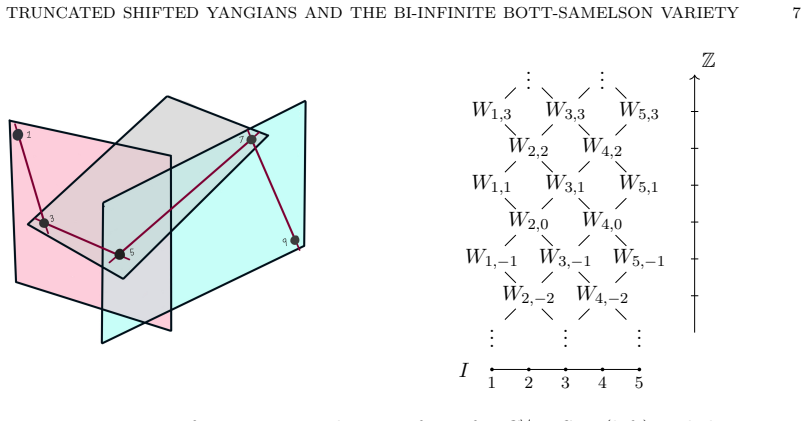


Figures from the paper (1 more)

Reference graph
Works this paper leans on
-
[19]
Highest weights for truncated shifted Yangians and product monomial crystals
[Kam+19a] Joel Kamnitzer, Peter Tingley, Ben Webster, Alex Weekes, and Oded Yacobi. “Highest weights for truncated shifted Yangians and product monomial crystals”. J. Comb. Algebra 3.3 (2019), pp. 237–303. [Kam+19b] Joel Kamnitzer, Peter Tingley, Ben Webster, Alex Weekes, and Oded Yacobi. “On categoryO for affine Grassmannian slices and categorified tenso...
2019
-
[22]
Almost dominant generalized slices and convolution diagrams over them
Graduate Studies in Mathematics. American Mathemat- ical Society, Providence, RI, 2000, pp. x+212. [KP21] Vasily Krylov and Ivan Perunov. “Almost dominant generalized slices and convolution diagrams over them”. Adv. Math. 392 (2021), Paper No. 108034,
2000
-
[24]
Representations of shifted quantum affine algebras
[Her23] David Hernandez. “Representations of shifted quantum affine algebras”. Int. Math. Res. Not. IMRN 13 (2023), pp. 11035–11126. [Her25] David Hernandez. “Symmetries of Grothendieck rings in representation theory”. arXiv preprint arXiv:2501.03024 (2025). [Her26] David Hernandez. “Representations and characters of quantum affine algebras at the crossro...
arXiv 2023
-
[34]
A functor for constructing R-matrices in the categoryO of Borel quan- tum loop algebras
[Pin24] Th´ eo Pinet. “A functor for constructing R-matrices in the categoryO of Borel quan- tum loop algebras”. J. Lond. Math. Soc. (2) 109.1 (2024), Paper No. e12815,
2024
-
[36]
q-opers, QQ-systems, and Bethe ansatz
[Fre+24] Edward Frenkel, Peter Koroteev, Daniel S. Sage, and Anton M. Zeitlin. “ q-opers, QQ-systems, and Bethe ansatz”. J. Eur. Math. Soc. (JEMS) 26.1 (2024), pp. 355–
2024
-
[42]
Weyl group symmetry of q-characters
[FH25] Edward Frenkel and David Hernandez. “Weyl group symmetry of q-characters”. Se- lecta Math. (N.S.) 31.4 (2025), Paper No. 72,
2025
-
[45]
Standard monomial theory for Bott-Samelson varieties
[LLM02] Venkatramani Lakshmibai, Peter Littelmann, and Peter Magyar. “Standard monomial theory for Bott-Samelson varieties”. Compositio Math. 130.3 (2002), pp. 293–318. [LV11] Aaron D. Lauda and Monica Vazirani. “Crystals from categorified quantum groups”. Adv. Math. 228.2 (2011), pp. 803–861. [LT04] Niels Lauritzen and Jesper Funch Thomsen. “Line bundles...
arXiv 2002
-
[46]
Inflations for representations of shifted quantum affine algebras
[Pin25] Th´ eo Pinet. “Inflations for representations of shifted quantum affine algebras”. Adv. Math. 462 (2025), Paper No. 110093,
2025
Show all 34 references
-
[47]
Hopf algebras and the quantum Yang-Baxter equation
[Dri85] Vladimir G. Drinfeld. “Hopf algebras and the quantum Yang-Baxter equation”. Dokl. Akad. Nauk SSSR 283.5 (1985), pp. 1060–1064. [Dri87] Vladimir G. Drinfeld. “A new realization of Yangians and of quantum affine algebras”. Dokl. Akad. Nauk SSSR 296.1 (1987), pp. 13–17. [...
1985
-
[51]
On algorithms for solving vector space problems. II. Tame algebras
[Pro07] Claudio Procesi. Lie groups. Universitext. An approach through invariants and rep- resentations. Springer, New York, 2007, pp. xxiv+596. [Rin80] Claus Michael Ringel. “On algorithms for solving vector space problems. II. Tame algebras”. Representation theory, I (Proc. ...
2007
-
[52]
Simple tensor products
Graduate Texts in Mathematics. Springer-Verlag, New York-Heidelberg, 1977, pp. xvi+496. [Her10] David Hernandez. “Simple tensor products”. Invent. Math. 181.3 (2010), pp. 649–675. [Her19] David Hernandez. “Cyclicity and R-matrices”. Selecta Math. (N.S.) 25.2 (2019), Paper No. 19,
1977
-
[54]
Heaps of pieces. I. Basic definitions and combinatorial lem- mas
[Vie86] G´ erard Xavier Viennot. “Heaps of pieces. I. Basic definitions and combinatorial lem- mas”. Combinatoire ´ enum´ erative (Montreal, Que., 1985). Vol
1985
-
[68]
Representations of shifted quantum affine algebras and cluster algebras I: The simply laced case
[GHL24] Christof Geiss, David Hernandez, and Bernard Leclerc. “Representations of shifted quantum affine algebras and cluster algebras I: The simply laced case”. Proc. Lond. Math. Soc. (3) 129.3 (2024), Paper No. e12630,
2024
-
[69]
Categorification of highest weight modules via Khovanov-Lauda-Rouquier algebras
[KK12] Seok-Jin Kang and Masaki Kashiwara. “Categorification of highest weight modules via Khovanov-Lauda-Rouquier algebras”. Invent. Math. 190.3 (2012), pp. 699–742. [Kan+18] Seok-Jin Kang, Masaki Kashiwara, Myungho Kim, and Se-jin Oh. “Monoidal cate- gorification of cluster ...
2012
-
[75]
On a class of representations of the Yangian and moduli space of monopoles
[Ger+05] Anton A. Gerasimov, Sergei M. Kharchev, Dmitry R. Lebedev, and Sergey V. Oblezin. “On a class of representations of the Yangian and moduli space of monopoles”.Comm. Math. Phys. 260.3 (2005), pp. 511–525. [Gib21] Joel Gibson. “A Demazure character formula for the produ...
2005 arXiv
-
[102]
Generators for Coulomb branches of quiver gauge theories
[Wee19] Alex Weekes. “Generators for Coulomb branches of quiver gauge theories”. arXiv preprint arXiv:1903.07734 (2019). [Zha20] Huafeng Zhang. “Yangians and Baxter’s relations”. Lett. Math. Phys. 110.8 (2020), pp. 2113–2141. [Zha24] Huafeng Zhang. “Theta series for quantum lo...
1903 arXiv
-
[103]
A diagrammatic approach to categorification of quantum groups I
REFERENCES 137 [KL09] Mikhail Khovanov and Aaron D. Lauda. “A diagrammatic approach to categorification of quantum groups I”. Represent. Theory 13 (2009), pp. 309–347. [KL11] Mikhail Khovanov and Aaron D. Lauda. “A diagrammatic approach to categorification of quantum groups II...
2009
-
[107]
Almost-dominant chamber modules and reverse plane partitions
Math- ematical Surveys and Monographs. American Mathematical Society, Providence, RI, 2003, pp. xiv+576. [Kac90] Victor G. Kac. Infinite-dimensional Lie algebras. Third. Cambridge University Press, Cambridge, 1990, pp. xxii+400. [Kal+26] Artem Kalmykov, Joel Kamnitzer, Alexis ...
2003
-
[110]
Borel-Weil theorem for configuration varieties and Schur modules
Progress in Mathematics. Birkh¨ auser Boston, Inc., Boston, MA, 1993, pp. xii+341. [Mag98a] Peter Magyar. “Borel-Weil theorem for configuration varieties and Schur modules”. Adv. Math. 134.2 (1998), pp. 328–366. [Mag98b] Peter Magyar. “Schubert polynomials and Bott-Samelson va...
1993
-
[144]
Baxter Q-operators and representations of Yangians
Cambridge Studies in Advanced Mathematics. Cambridge University Press, Cambridge, 2015, pp. viii+530. [Baz+11] Vladimir V. Bazhanov, Rouven Frassek, Tomasz /suppress Lukowski, Carlo Meneghelli, and Matthias Staudacher. “Baxter Q-operators and representations of Yangians”. Nucl...
2015 arXiv
-
[163]
Homogeneous representations of Khovanov- Lauda algebras
Cambridge Tracts in Mathematics. Cambridge University Press, Cambridge, 2005, pp. xiv+277. [KR10] Alexander Kleshchev and Arun Ram. “Homogeneous representations of Khovanov- Lauda algebras”. J. Eur. Math. Soc. (JEMS) 12.5 (2010), pp. 1293–1306. [KR11] Alexander Kleshchev and A...
2005
-
[166]
Shifted Yangians and finite W -algebras
[BK06] Jonathan Brundan and Alexander Kleshchev. “Shifted Yangians and finite W -algebras”. Adv. Math. 200.1 (2006), pp. 136–195. [CW19] Sabin Cautis and Harold Williams. “Cluster theory of the coherent Satake category”. J. Amer. Math. Soc. 32.3 (2019), pp. 709–778. [Cha02] Vy...
2006
-
[248]
Canonical bases in tensor products and graphical calculus for Uq(sl2)
Contemp. Math. Amer. Math. Soc., Providence, RI, 1999, pp. 163–205. [FK97] Igor B. Frenkel and Mikhail G. Khovanov. “Canonical bases in tensor products and graphical calculus for Uq(sl2)”. Duke Math. J. 87.3 (1997), pp. 409–480. REFERENCES 135 [FWW25] Noah Friesen, Alex Weekes...
1999
-
[271]
Towards a math- ematical definition of Coulomb branches of 3-dimensional N = 4 gauge theories, II
[BFN18] Alexander Braverman, Michael Finkelberg, and Hiraku Nakajima. “Towards a math- ematical definition of Coulomb branches of 3-dimensional N = 4 gauge theories, II”. Adv. Theor. Math. Phys. 22.5 (2018), pp. 1071–1147. [BFN19] Alexander Braverman, Michael Finkelberg, and H...
2018
-
[298]
Yangians and R-matrices
[CP90] Vyjayanthi Chari and Andrew Pressley. “Yangians and R-matrices”. Enseign. Math. (2) 36.3-4 (1990), pp. 267–302. [CP91a] Vyjayanthi Chari and Andrew Pressley. “Fundamental representations of Yangians and singularities of R-matrices”. J. Reine Angew. Math. 417 (1991), pp....
1990
-
[304]
Double Bruhat cells and total positivity
[FZ99] Sergey Fomin and Andrei Zelevinsky. “Double Bruhat cells and total positivity”. J. Amer. Math. Soc. 12.2 (1999), pp. 335–380. [FZ02] Sergey Fomin and Andrei Zelevinsky. “Cluster algebras. I. Foundations”. J. Amer. Math. Soc. 15.2 (2002), pp. 497–529. [FL25] Luca Francon...
1999 arXiv
-
[325]
Monoidal categori- fication and quantum affine algebras II
Contemp. Math. Amer. Math. Soc., Providence, RI, 2003, pp. 133–139. [Kas+24] Masaki Kashiwara, Myungho Kim, Se-jin Oh, and Euiyong Park. “Monoidal categori- fication and quantum affine algebras II”. Invent. Math. 236.2 (2024), pp. 837–924. [Kho97] Mikhail Khovanov. “Graphical ...
2003
-
[330]
Progr. Math. Birkh¨ auser/Springer, Cham, 2019, pp. 133–
2019
-
[405]
Combinatorics of q-characters of finite-dimensional representations of quantum affine algebras
[FM01] Edward Frenkel and Evgeny Mukhin. “Combinatorics of q-characters of finite-dimensional representations of quantum affine algebras”.Comm. Math. Phys. 216.1 (2001), pp. 23–
2001
-
[506]
Characters and blocks for finite-dimensional representations of quantum affine algebras
Contemp. Math. Amer. Math. Soc., Providence, RI, 2010, pp. 49–81. [CM05] Vyjayanthi Chari and Adriano A. Moura. “Characters and blocks for finite-dimensional representations of quantum affine algebras”. Int. Math. Res. Not. 5 (2005), pp. 257–
2010
-
[831]
2-Kac-Moody algebras
Lecture Notes in Math. Springer, Berlin, 1980, pp. 137–287. [Rou08] Rapha¨ el Rouquier. “2-Kac-Moody algebras”. arXiv preprint arXiv:0812.5023 (2008). [SW24] Turner Silverthorne and Ben Webster. “Gelfand-Tsetlin modules: canonicity and cal- culations”. Algebr. Represent. Theor...
1980 arXiv
-
[874]
Hamiltonian reduction for affine Grassmannian slices and truncated shifted Yangians
[KPW22] Joel Kamnitzer, Khoa Pham, and Alex Weekes. “Hamiltonian reduction for affine Grassmannian slices and truncated shifted Yangians”. Adv. Math. 399 (2022), Paper No. 108281,
2022
-
[1234]
Canonical bases and higher representation theory
Lecture Notes in Math. Springer, Berlin, 1986, pp. 321–350. [Web15] Ben Webster. “Canonical bases and higher representation theory”. Compos. Math. 151.1 (2015), pp. 121–166. [Web17] Ben Webster. “Knot invariants and higher representation theory”. Mem. Amer. Math. Soc. 250.1191...
1986
-
[2025]
Canonical bases and KLR-algebras
[VV11] Michela Varagnolo and Eric Vasserot. “Canonical bases and KLR-algebras”. J. Reine Angew. Math. 659 (2011), pp. 67–100. [VV25] Michela Varagnolo and Eric Vasserot. “Representations of shifted affine quantum groups and Coulomb branches”. arXiv preprint arXiv:2503.06262 (2...
2011
Reviewed August 2, 2026 · model on record in the stance chip above.
Discussion (0). Continue with ORCID to comment.