Stationary covariance spectra of discrete-time non-normal random recurrent dynamics
Pith reviewed 2026-07-01 02:03 UTC · model grok-4.3
The pith
A free-probability approach produces a closed functional equation for the moment generating function of the limiting stationary covariance spectrum in discrete-time non-normal random recurrent dynamics.
A machine-rendered reading of the paper's core claim, the machinery that carries it, and where it could break.
Core claim
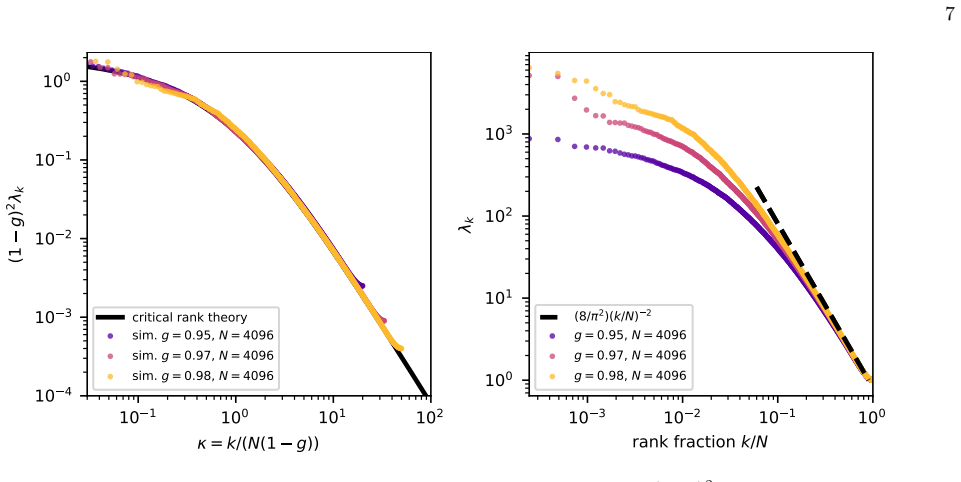
We use a free-probability approach to formally derive a closed functional equation for the moment generating function of the limiting stationary covariance spectrum of discrete-time dynamics with random non-normal Gaussian weights. This characterization allows us to analyze the behavior of tail eigenvalues in the critical regime. In contrast, applying the same approach to the analogous continuous-time dynamics leads to an infinite hierarchy of Schwinger-Dyson equations, rather than a closed scalar equation.
What carries the argument
The closed scalar functional equation for the moment generating function of the limiting stationary covariance spectrum, obtained via free probability.
Load-bearing premise
The synaptic weight matrix is drawn from a random non-normal Gaussian ensemble and the dynamics are stationary and noise-driven.
What would settle it
Direct numerical computation of the eigenvalue distribution of the stationary covariance matrix for large finite-size realizations of the discrete-time non-normal Gaussian ensemble, compared against the spectrum predicted by the functional equation.
Figures


read the original abstract
Principal component analysis is widely used to characterize structure in the dynamics of recurrent neural networks. For stationary noise-driven dynamics, the distribution of variance among the principal components is determined by the spectrum of the stationary covariance matrix. While the spectral properties of this matrix are well-understood for linear networks with normal synaptic weight matrices, our understanding of the stationary covariance spectrum for random non-normal dynamics remains incomplete. In this note, we use a free-probability approach to formally derive a closed functional equation for the moment generating function of the limiting stationary covariance spectrum of discrete-time dynamics with random non-normal Gaussian weights. This characterization allows us to analyze the behavior of tail eigenvalues in the critical regime. In contrast, applying the same approach to the analogous continuous-time dynamics leads to an infinite hierarchy of Schwinger-Dyson equations, rather than a closed scalar equation. We conclude with some comments regarding the relevance of these results to comparisons of models of non-normal dynamics to neural data.
Editorial analysis
A structured set of objections, weighed in public.
Referee Report
Summary. The paper claims that a free-probability approach yields a closed functional equation for the moment generating function of the limiting stationary covariance spectrum of discrete-time linear dynamics driven by noise and with i.i.d. non-normal Gaussian weights; the same approach applied to the continuous-time analog produces an infinite hierarchy of Schwinger-Dyson equations instead. The derivation is used to examine the tail eigenvalues of the covariance spectrum in the critical regime (spectral radius approaching 1).
Significance. If the derivation is valid and the stationarity assumption can be justified at criticality, the closed scalar equation would supply an analytic handle on the eigenvalue distribution of the stationary covariance that is currently unavailable for non-normal random matrices; this would be directly relevant to PCA-based analyses of recurrent network models and neural recordings. The contrast between discrete- and continuous-time cases is a clear technical contribution.
major comments (1)
- [Abstract / derivation section] Abstract and the section deriving the functional equation: the stationarity assumption (spectral radius of W strictly less than 1) is required for the covariance to be finite and for the free-probability derivation to apply, yet the paper invokes the same equation to analyze tail eigenvalues in the 'critical regime' where the circular law places the radius at g=1. At g=1 the largest Lyapunov exponent vanishes and variance grows linearly with time, so the limiting covariance diverges; no explicit limiting procedure or regularization is supplied to justify passage to the critical point.
Simulated Author's Rebuttal
We thank the referee for their careful reading of the manuscript and for highlighting an important point regarding the applicability of the derived functional equation. We address the major comment below and indicate the revisions we will make to strengthen the presentation.
read point-by-point responses
-
Referee: [Abstract / derivation section] Abstract and the section deriving the functional equation: the stationarity assumption (spectral radius of W strictly less than 1) is required for the covariance to be finite and for the free-probability derivation to apply, yet the paper invokes the same equation to analyze tail eigenvalues in the 'critical regime' where the circular law places the radius at g=1. At g=1 the largest Lyapunov exponent vanishes and variance grows linearly with time, so the limiting covariance diverges; no explicit limiting procedure or regularization is supplied to justify passage to the critical point.
Authors: We agree that the free-probability derivation of the closed functional equation is valid under the strict stationarity condition (spectral radius <1). The manuscript analyzes the critical regime by taking the limit g o 1^-, in which the covariance diverges but the shape of the normalized spectrum (including tail eigenvalues) remains well-defined and can be extracted from the functional equation. However, we acknowledge that the current text does not supply an explicit description of this limiting procedure. We will revise the derivation section and the critical-regime analysis to include a clear statement of the limiting process, the normalization used, and any auxiliary regularization (e.g., a small additive damping term taken to zero after the limit) needed to justify passage to g=1. revision: yes
Circularity Check
No circularity: derivation relies on external free-probability methods applied to stated assumptions
full rationale
The paper claims to derive a closed functional equation for the MGF of the stationary covariance spectrum via a free-probability approach applied to the random non-normal Gaussian weight ensemble under the explicit stationarity assumption (spectral radius of W < 1). No equations or steps in the provided text reduce the target result to a fitted parameter defined inside the paper, a self-citation chain, or an ansatz smuggled from prior author work. The derivation is presented as importing standard free-probability tools from the external literature rather than constructing the spectrum by renaming or re-fitting its own inputs. The stationarity assumption is stated upfront as a precondition, so the functional equation is conditional on it rather than tautological. This is the most common honest non-finding for papers that invoke established external mathematical machinery.
Axiom & Free-Parameter Ledger
axioms (1)
- domain assumption Free probability theory applies to the non-normal random weight matrices and yields a closed scalar equation for the moment generating function
Reference graph
Works this paper leans on
-
[1]
Then, we can solve for f(ζ) = 1− p 1−2ζ.(56) This branch ceases to be real atζ + = 1/2, hence we conclude that asδ↓0 we have λ+ ∼ 1 δ2ζ+ = 2 δ2 .(57) We therefore consider the tail density of eigenvalues on the critical scale λ= x δ2 (58) for 0< x <2. Writing the infinitesimal quantity appear- ing in the Stieltjes inversion formula asi0, we have G x δ2 −i...
-
[2]
H. Sompolinsky, A. Crisanti, and H. J. Sommers, Chaos in random neural networks, Physical Review Letters61, 259 (1988)
work page 1988
- [3]
-
[4]
G. Hennequin, T. P. Vogels, and W. Gerstner, Non- normal amplification in random balanced neuronal net- works, Physical Review E86, 011909 (2012)
work page 2012
-
[5]
T. Toyoizumi and L. F. Abbott, Beyond the edge of chaos: Amplification and temporal integration by recur- rent networks in the chaotic regime, Physical Review E 84, 051908 (2011)
work page 2011
-
[6]
F. Mastrogiuseppe, J. Carmona, and C. K. Machens, Stochastic activity in low-rank recurrent neural networks, PLOS Computational Biology21, 1 (2025)
work page 2025
-
[7]
B. Bordelon, J. Cotler, C. Pehlevan, and J. A. Zavatone- Veth, Dynamics of learning to integrate in linear recur- rent neural networks, arXiv (2026)
work page 2026
-
[8]
J. T. Chalker and B. Mehlig, Eigenvector statistics in non-Hermitian random matrix ensembles, Physical Re- view Letters81, 3367 (1998)
work page 1998
-
[9]
G. J. Tian, O. Zhu, V. Shirhatti, C. M. Greenspon, J. E. Downey, D. J. Freedman, and B. Doiron, Firing rate di- versity lowers the dimension of population covariability in neuronal networks, bioRxiv 10.1101/2024.08.30.610535 (2026)
-
[10]
R. Couillet, G. Wainrib, H. T. Ali, and H. Sevi, A ran- dom matrix approach to echo-state neural networks, in Proceedings of The 33rd International Conference on Ma- chine Learning, Proceedings of Machine Learning Re- search, Vol. 48, edited by M. F. Balcan and K. Q. Wein- berger (PMLR, New York, New York, USA, 2016) pp. 517–525
work page 2016
-
[11]
C. W. Gardiner,Handbook of stochastic methods, Vol. 3 (Springer Berlin, 1985)
work page 1985
-
[12]
M. Pachitariu, L. Zhong, A. Gracias, A. Minisi, C. Lopez, and C. Stringer, A critical initialization for biologi- cal neural networks, Nature 10.1038/s41586-026-10528-1 (2026)
-
[13]
X. Chen and W. Bialek, Searching for long timescales without fine tuning, Physical Review E110, 034407 (2024)
work page 2024
-
[14]
C. Stringer, M. Pachitariu, N. Steinmetz, M. Carandini, and K. D. Harris, High-dimensional geometry of popula- tion responses in visual cortex, Nature571, 361 (2019)
work page 2019
-
[15]
V. M. Preciado and M. A. Rahimian, Controllability Gramian spectra of random networks, in2016 American Control Conference (ACC)(2016) pp. 3874–3879
work page 2016
-
[16]
C. Godr` eche and J.-M. Luck, Characterising the nonequi- librium stationary states of Ornstein–Uhlenbeck pro- cesses, Journal of Physics A: Mathematical and Theo- retical52, 035002 (2018)
work page 2018
-
[17]
Y. V. Fyodorov, E. Gudowska-Nowak, M. A. Nowak, and W. Tarnowski, Nonorthogonal eigenvectors, fluctuation- dissipation relations, and entropy production, Physical Review Letters134, 087102 (2025)
work page 2025
-
[18]
L. S. Ferreira, F. L. Metz, and P. Barucca, Random matrix ensemble for the covariance matrix of ornstein- uhlenbeck processes with heterogeneous temperatures, Physical Review E111, 014151 (2025)
work page 2025
-
[19]
X. Shen and Y. Hu, Covariance spectrum in nonlinear recurrent neural networks, arXiv (2025)
work page 2025
-
[20]
J. A. Mingo and R. Speicher,Free Probability and Ran- dom Matrices(Springer New York, New York, NY, 2017)
work page 2017
-
[21]
Guionnet, Free analysis and random matrices, Japanese Journal of Mathematics11, 33 (2016)
A. Guionnet, Free analysis and random matrices, Japanese Journal of Mathematics11, 33 (2016)
work page 2016
-
[22]
S.-S. Byun and P. J. Forrester, Progress on the study of the Ginibre ensembles II: GinOE and GinSE, arXiv (2023)
work page 2023
-
[23]
B. Collins, T. Mai, A. Miyagawa, F. Parraud, and S. Yin, Convergence for noncommutative rational functions eval- uated in random matrices, Mathematische Annalen388, 543 (2024)
work page 2024
-
[24]
D. Mart´ ı, N. Brunel, and S. Ostojic, Correlations be- tween synapses in pairs of neurons slow down dynamics in randomly connected neural networks, Physical Review E97, 062314 (2018)
work page 2018
-
[25]
S. Belinschi, B. Ko lodziejek, and K. Szpojankowski, Free perpetuities I: Existence, subordination and tail asymp- totics, arXiv (2025)
work page 2025
-
[26]
B. Ko lodziejek and K. Szpojankowski, On the empir- ical spectral distribution of matrix perpetuities, arXiv (2026)
work page 2026
-
[27]
D. G. Clark, Linear equivalence of nonlinear recurrent neural networks, arXiv (2026)
work page 2026
-
[28]
A. J. Wakhloo, Solution of a large nonlinear recurrent neural network at fixed connectivity, arXiv (2026)
work page 2026
-
[29]
Y. M. Lu and H.-T. Yau, An equivalence principle for the spectrum of random inner-product kernel matrices with polynomial scalings, The Annals of Applied Probability 35, 2411 (2025)
work page 2025
-
[30]
A. Atanasov, J. A. Zavatone-Veth, and C. Pehlevan, Scal- ing and renormalization in high-dimensional regression, Journal of Statistical Mechanics: Theory and Experi- ment2026, 043404 (2026)
work page 2026
-
[31]
P. Virtanen, R. Gommers, T. E. Oliphant, M. Haber- land, T. Reddy, D. Cournapeau, E. Burovski, P. Pe- terson, W. Weckesser, J. Bright, S. J. van der Walt, M. Brett, J. Wilson, K. J. Millman, N. Mayorov, A. R. J. Nelson, E. Jones, R. Kern, E. Larson, C. J. Carey, ˙I. Po- lat, Y. Feng, E. W. Moore, J. VanderPlas, D. Laxalde, J. Perktold, R. Cimrman, I. Henr...
work page 2020
discussion (0)
Sign in with ORCID, Apple, or X to comment. Anyone can read and Pith papers without signing in.