REVIEW 3 major objections 5 minor 1 cited by
Mass Transfer in Eccentric Orbits with Self-consistent Stellar Evolution
T0 review · 3 major / 5 minor · reviewed 2026-08-12 · deepseek-v4-flash
Pith's one-line read Explicitly modeling eccentric Roche-lobe overflow predicts that about one third of star–compact-object binaries remain eccentric after mass transfer, and that even circularized systems differ from instant-circularization predictions.
desk verdict A solid first self-consistent implementation of eccentric mass transfer in MESA; the delta-function-periapse assumption is a real quantitative caveat that shifts the bifurcation boundary but not the qualitative conclusions. read the letter →
The pith
A machine-rendered reading of the paper's core claim, the machinery that carries it, and where it could break.
The reading
What carries the argument
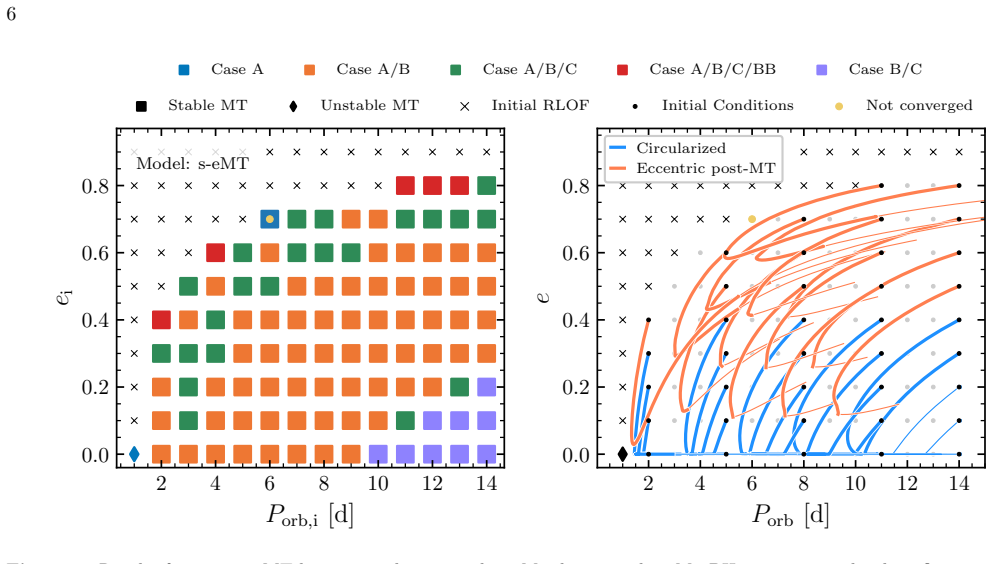
The load-bearing objects are the secular orbital-evolution equations for $da/dt$ and $de/dt$, derived from a model in which all Roche-lobe overflow occurs as a delta function at periapse. These equations are coupled to a detailed stellar evolution code so that the mass-transfer rate, donor response, tides, winds, magnetic braking, and gravitational-wave losses all feed back into the orbit. The sign of each secular rate depends on the mass ratio $q$: when $q$ drops below about 1 the semi-major axis stops shrinking and starts growing, and when $q$ drops below about 0.76 the eccentricity stops decaying and starts being pumped up. The competition between these thresholds and the time spent transferring mass produces the hook-shaped evolution in the period–eccentricity plane and the empirical bifurcation boundary $e_{\rm crit}(q)$ that separates binaries that circularize from those that remain eccentric.
What would settle it
Simulate a handful of the paper's representative binaries with three-dimensional hydrodynamics that resolve many orbits and measure the orbit-averaged $da/dt$ and $de/dt$; compare with the delta-function predictions, especially for cases near the mass-ratio thresholds $q\simeq 1$ and $q\simeq 0.76$. A systematic difference in eccentricity evolution there would falsify the bifurcation boundary. Observationally, a targeted search for post-mass-transfer binaries with stripped helium donors in eccentric ($e > 0.05$) and wide ($P\sim 10$ to $10^4$ days) orbits could test whether the predicted eccentric population exists.
Extended reading notes
Core claim
The central claim is that Roche-lobe overflow in eccentric orbits, modeled self-consistently with the star and orbit evolving together, does not universally circularize binaries. The paper implements the analytic secular rates for semi-major axis and eccentricity change under a delta-function mass transfer at periapse into a stellar evolution code and applies it both to a simplified grid and to an astrophysical population of stars with compact-object companions. It finds that about 33% of the population remains eccentric ($e > 0.05$) after mass transfer, and that among black-hole-hosting binaries roughly 64% remain eccentric, while neutron-star-hosting binaries mostly circularize. For binaries that do naturally circularize, the eccentric treatment predicts orbital periods roughly 50 to 100% larger and donor mass differences of order 20% compared to the instant-circularization assumption, with about 5% of these systems showing qualitatively different outcomes such as stable versus unstable mass transfer. The paper concludes that the initial mass ratio and eccentricity separate the two outcomes and provides a fitting function for the boundary.
Load-bearing premise
The weakest link is the assumption that all mass transfer happens in an instant at closest approach, while real hydrodynamical flows spread mass transfer over a finite fraction of the orbit; if that spread changes the secular rates, the predicted eccentricity evolution and the boundary between circularizing and eccentric outcomes could shift.
Editorial extensions
If this is right
- About one third of compact-object–star binaries in the sampled population remain eccentric after mass transfer, a population that cannot form under the standard instant-circularization assumption.
- Black-hole-hosting binaries, with low initial mass ratios, most often remain eccentric and can end up wider and more eccentric than they started; neutron-star-hosting binaries mostly circularize.
- Even binaries that circularize naturally through eccentric mass transfer have orbital periods about 50–100% larger and donor masses differing by roughly 20% relative to instant circularization.
- A small but non-negligible fraction of binaries switch between stable and unstable mass-transfer outcomes, with the eccentric treatment usually predicting stability when instant circularization predicts instability.
- The initial mass ratio and eccentricity of a binary largely determine which outcome occurs, providing a simple fitting function that population synthesis calculations can use to estimate the impact of eccentric mass transfer.
Reading between the lines
- If the delta-function assumption survives hydrodynamical checks, population-synthesis predictions for the Galactic X-ray binary population and for compact-object merger rates would need revision, because a sizable fraction of systems would follow a different orbital path than previously assumed.
- The predicted population of wide, eccentric post-mass-transfer binaries with stripped helium donors is observationally accessible: Gaia-type astrometry and wide-orbit spectroscopy could test it directly, though selection effects currently make it difficult to detect.
- Extending the same treatment to mass transfer between two non-degenerate stars would connect to observed eccentric post-mass-transfer systems such as barium stars and blue stragglers, suggesting that the qualitative remain-eccentric outcome may be common beyond compact-object binaries.
- A hydrodynamically calibrated, finite-width mass-transfer model could be checked against the paper's bifurcation boundary; if the boundary shifts, then even the direction of the current bias (more stable, wider orbits) should be re-examined.
Editorial analysis
A structured set of objections, weighed in public.
Referee Report
Summary. The paper implements the Sepinsky et al. (2009) secular eccentric mass-transfer (eMT) equations into the MESA stellar evolution code, coupling the orbital semi-major axis and eccentricity evolution with a self-consistent mass-transfer rate calculation. The study first isolates eMT effects in a simplified grid of 20 Msun donors with 10 Msun black-hole companions, then runs a full-physics grid whose initial conditions are drawn from a POSYDON binary population synthesis model of CO-hosting binaries that initiate Roche-lobe overflow in eccentric orbits. The central results are: (i) a significant fraction of binaries, especially low-mass-ratio BH-hosting systems, remain eccentric after mass transfer; (ii) the final outcome (eccentric vs circularized) is separated by a clean bifurcation in the initial mass-ratio--eccentricity plane, summarized by the polynomial fit in Eq. (10); and (iii) even binaries that naturally circularize end with systematically different donor masses and orbital periods than predicted by the standard instant-circularization treatment, with roughly 5% of systems switching between stable and unstable mass-transfer outcomes.
Significance. If the results hold, this is the first self-consistent implementation of eccentric RLO mass transfer in a detailed stellar evolution code, and it has direct implications for the interpretation of X-ray binaries, wide BH binaries, and gravitational-wave progenitors. The paper provides a concrete falsifiable prediction (the Eq. (10) bifurcation), a systematic comparison against the standard instant-circularization assumption, and a clear statement of the key assumption (delta-function MT at periapse) on which the results rest. The claimed population-level effect, with about one third of CO-hosting binaries remaining eccentric post-MT, is striking and worth pursuing. However, for the reasons detailed in the major comments, the quantitative headline figures are not yet established to the precision claimed, primarily because the load-bearing delta-function approximation is acknowledged but not tested.
major comments (3)
- [Section 2.1 and Section 5] The secular orbital evolution equations (3) and (4) assume that all RLO mass transfer occurs as a delta function at periapse. The sign of de/dt in Eq. (4) changes near q ~ 0.76 (Eq. 9), and the balance between circularization and eccentricity pumping for systems near this mass ratio determines the bifurcation boundary in Eq. (10) and hence the 33% eccentric-post-MT fraction. Hydrodynamical simulations (Lajoie & Sills 2011) show that the mass-transfer rate has a finite width (FWHM ~ 0.12 Porb), so contributions from other true anomalies are non-negligible for systems near the transition. The manuscript acknowledges this in Section 5 but does not quantify the impact on the headline numbers. I request a sensitivity test, for example re-evaluating the integrated de/dt for a Gaussian MT window of the hydrodynamically suggested width on a subset of the f-eMT models, to demonstrate that the bifurcation and the one-third fraction are robust.
- [Section 2.3.1] The procedure for determining the periapse mass-transfer rate Mdot0 used in Eqs. (3) and (4) is not specified. The text says that the 'eccentric orbit-averaged MT rate' from the MESA binary module is used, but it does not state how the orbit average is converted into the delta-function amplitude Mdot0. Since Eqs. (3) and (4) are linear in Mdot0, any mismatch between the orbit-averaged rate and the periapse-normalized rate would rescale da/dt and de/dt, shifting both the qcrit values and the fitted bifurcation of Eq. (10). Please give the exact conversion formula and verify that the total mass lost per orbital period in the secular equations matches the mass lost in the MESA MT calculation.
- [Section 4.2, Eq. (10), and Fig. 6] The polynomial fit for the critical eccentricity is presented as a predictive tool, but it is an unvalidated empirical fit from a single grid: no uncertainties are quoted, no residuals are shown, and the fit is used at the edge of or beyond its stated range (qi in [0, 5.5]). The authors note that high-qi outliers remain eccentric because of winds, indicating that the clean qi-ei separation is not universal. I recommend showing the scatter about the fit with bootstrap or cross-validation uncertainties and stating the expected error when applying Eq. (10) outside the fitted range.
minor comments (5)
- [Introduction] The sentence 'It is through this lenses that we interpret...' should read 'It is through this lens that we interpret...' (grammatical error).
- [Section 2.4] The phrase 'following a flat-in-log distribution in the range [1-0.35] days' is garbled; presumably the range should be [1, 10^3.5] days, matching the previous sentence.
- [Section 2.1] 'which is only analytical treatment currently available' should read 'which is the only analytical treatment currently available'.
- [Table A1] The row label 'Mixed TFs' should likely read 'Mixed MT'.
- [Section 4.1 and Section 5] The 33% eccentric-post-MT fraction is derived from a single POSYDON BPS realization; the paper notes in Section 5 that the division depends strongly on assumed BPS physics, but a quantitative statement of the expected sensitivity (e.g., to natal kick dispersion or supernova remnant model) would help readers gauge the robustness of the population-level claim.
Circularity Check
No significant circularity: the orbital-evolution equations are adopted from prior external work, and the headline population outcomes are new integrations of those equations.
full rationale
The load-bearing secular rates da/dt and de/dt (Equations 3 and 4) are explicitly adopted from Sepinsky et al. (2009), with the delta-function-at-periapse assumption stated in Section 2.1. This is an external analytical derivation (with overlapping authorship via co-author V. Kalogera), not a result derived in this paper, and its assumptions do not include the paper's target outcomes. The headline statistics (33% eccentric post-MT, the qi-ei bifurcation) are outputs of integrating those equations together with MESA stellar-structure physics and a POSYDON population sample; they are not restatements of the equations' inputs. Equation 10 is an empirical polynomial fit to simulation outcomes, presented as a fitting function, not as a first-principles prediction. The paper's own Section 5 limitation statement acknowledges that the delta-function approximation could alter the results, citing hydrodynamical FWHM ~0.12 Porb; that is a robustness/correctness risk rather than circularity, because the paper does not use the outcome to justify the assumption. I also note that Equation 10 as printed appears inconsistent with the text's check that ecrit ~ 0.4 at qi = 2, but this is an internal correctness concern, not a circularity. No load-bearing step in the derivation reduces by definition to its own input, so the appropriate finding is no significant circularity.
Assumptions & free parameters
free parameters (1)
- Bifurcation fit coefficients ecrit(q) =
c0=-0.210, c1=-0.729, c2=-0.1444, c3=-0.0093
assumptions (5)
- domain assumption Delta function mass transfer at periapse
- domain assumption Secular equations of Sepinsky et al. (2009) correctly describe orbital evolution
- domain assumption Accretor radius small compared to orbital separation (r_A2/a << 1)
- domain assumption Orbit-averaged MT rate from Ritter/Kolb applies in eccentric orbits
- domain assumption POSYDON BPS model provides representative initial conditions
Cite this review
Pith. "Pith review of Mass Transfer in Eccentric Orbits with Self-consistent Stellar Evolution." pith.science (2026). https://pith.science/paper/25ZNU3J6
@misc{pith2026241111840,
  author       = {Pith},
  title        = {Pith review of: Mass Transfer in Eccentric Orbits with Self-consistent Stellar Evolution},
  year         = {2026},
  howpublished = {\url{https://pith.science/paper/25ZNU3J6}},
  note         = {Machine review of arXiv:2411.11840}
}
read the original abstract
We investigate Roche lobe overflow mass transfer (MT) in eccentric binary systems between stars and compact objects (COs), modeling the coupled evolution of both the star and the orbit due to eccentric MT (eMT) in a self-consistent framework. We implement the analytic expressions for secular rates of change of the orbital semi-major axis and eccentricity, assuming a delta function MT at periapse, into the binary stellar evolution code MESA. Two scenarios are examined: (1) a simplified model isolating the effects of eMT on stellar and orbital evolution, and (2) realistic binary configurations that include angular momentum exchange (e.g., tides, mass loss, spin-orbit coupling, and gravitational wave radiation). Unlike the ad hoc approach of instant circularization that is often employed, explicit modeling of eMT reveals a large fraction of binaries can remain eccentric post-MT. Even binaries which naturally circularize during eMT have different properties (donor mass and orbital size) compared to predictions from instant circularization, with some showing fundamentally different evolutionary outcomes (e.g., stable versus unstable MT). We demonstrate that a binary's initial mass ratio and eccentricity are predictive of whether it will remain eccentric or circularize after eMT. These findings underscore the importance of eMT in understanding CO-hosting binary populations, including X-ray binaries, gravitational wave sources, and other high-energy transients.
Figures


Figures from the paper (5 more)


Forward citations
Cited by 1 Pith paper
-
Cataclysmic Variables in Triples: Formation Models and New Discoveries
Triple-star dynamics are a significant, previously neglected formation channel for cataclysmic variables, including a common-envelope-free route.
Reference graph
Works this paper leans on
-
[1]
Abbott, R., Abbott, T. D., Acernese, F., et al. 2023, Physical Review X, 13, 011048, doi: 10.1103/PhysRevX.13.011048
-
[2]
Andrews, J. J., Taggart, K., & Foley, R. 2022, arXiv e-prints, arXiv:2207.00680, doi: 10.48550/arXiv.2207.00680
-
[3]
Andrews, J. J., Bavera, S. S., Briel, M., et al. 2024, arXiv e-prints, arXiv:2411.02376, doi: 10.48550/arXiv.2411.02376
-
[4]
Asplund, M., Grevesse, N., Sauval, A. J., & Scott, P. 2009, ARA&A, 47, 481, doi: 10.1146/annurev.astro.46.060407.145222 Astropy Collaboration, Robitaille, T. P., Tollerud, E. J., et al. 2013, A&A, 558, A33, doi: 10.1051/0004-6361/201322068 Astropy Collaboration, Price-Whelan, A. M., Sip˝ ocz, B. M., et al. 2018, AJ, 156, 123, doi: 10.3847/1538-3881/aabc4f...
arXiv 2009
-
[5]
2023, in Handbook of X-ray and Gamma-ray Astrophysics, 120, doi: 10.1007/978-981-16-4544-0 94-1
Bahramian, A., & Degenaar, N. 2023, in Handbook of X-ray and Gamma-ray Astrophysics, 120, doi: 10.1007/978-981-16-4544-0 94-1
-
[6]
Bailyn, C. D. 1995, ARA&A, 33, 133, doi: 10.1146/annurev.aa.33.090195.001025
arXiv 1995
-
[7]
2023, MNRAS, 522, 1184, doi: 10.1093/mnras/stad999
Bashi, D., Mazeh, T., & Faigler, S. 2023, MNRAS, 522, 1184, doi: 10.1093/mnras/stad999
-
[8]
2020, ApJ, 898, 71, doi: 10.3847/1538-4357/ab9d85
Breivik, K., Coughlin, S., Zevin, M., et al. 2020, ApJ, 898, 71, doi: 10.3847/1538-4357/ab9d85
Show all 94 references
-
[9]
J., Siess, L., & Deschamps, R
Davis, P. J., Siess, L., & Deschamps, R. 2013, A&A, 556, A4, doi: 10.1051/0004-6361/201220391 de S´ a, L. M., Bernardo, A., Rocha, L. S., Bachega, R. R. A., & Horvath, J. E. 2024, MNRAS, doi: 10.1093/mnras/stae2388 D’Orazio, D. J., & Duffell, P. C. 2021, ApJL, 914, L21, doi: 1...
2013 doi
-
[10]
2016, ApJ, 825, 70, doi: 10.3847/0004-637X/825/1/70
Dosopoulou, F., & Kalogera, V. 2016, ApJ, 825, 70, doi: 10.3847/0004-637X/825/1/70
2016 doi
-
[11]
R., G¨ otberg, Y., Ludwig, B
Drout, M. R., G¨ otberg, Y., Ludwig, B. A., et al. 2023, Science, 382, 1287, doi: 10.1126/science.ade4970
2023 doi
-
[12]
Eggleton, P. P. 1983, ApJ, 268, 368, doi: 10.1086/160960
1983 doi
-
[13]
2022, MNRAS, 516, 3602, doi: 10.1093/mnras/stac2422
El-Badry, K., Conroy, C., Quataert, E., et al. 2022, MNRAS, 516, 3602, doi: 10.1093/mnras/stac2422
2022 doi
-
[14]
2023a, MNRAS, 518, 1057, doi: 10.1093/mnras/stac3140
El-Badry, K., Rix, H.-W., Quataert, E., et al. 2023a, MNRAS, 518, 1057, doi: 10.1093/mnras/stac3140
-
[15]
2023b, MNRAS, 521, 4323, doi: 10.1093/mnras/stad799
El-Badry, K., Rix, H.-W., Cendes, Y., et al. 2023b, MNRAS, 521, 4323, doi: 10.1093/mnras/stad799
-
[16]
J., Stanway, E
Eldridge, J. J., Stanway, E. R., Xiao, L., et al. 2017, PASA, 34, e058, doi: 10.1017/pasa.2017.51
2017 doi
-
[17]
Escorza, A., & De Rosa, R. J. 2023, A&A, 671, A97, doi: 10.1051/0004-6361/202244782
2023 doi
- [18]
-
[19]
2023, A&A, 671, A149, doi: 10.1051/0004-6361/202245236
Fortin, F., Garc ´ ıa, F., Simaz Bunzel, A., & Chaty, S. 2023, A&A, 671, A149, doi: 10.1051/0004-6361/202245236
2023 doi
-
[20]
J., Bavera, S
Fragos, T., Andrews, J. J., Bavera, S. S., et al. 2023, ApJS, 264, 45, doi: 10.3847/1538-4365/ac90c1 Gaia Collaboration, Panuzzo, P., Mazeh, T., et al. 2024, A&A, 686, L2, doi: 10.1051/0004-6361/202449763
2023 doi
-
[21]
2021, ApJ, 922, 110, doi: 10.3847/1538-4357/ac2610
Kalogera, V. 2021, ApJ, 922, 110, doi: 10.3847/1538-4357/ac2610
2021 doi
-
[22]
Rasio, F. A. 2019, ApJ, 872, 165, doi: 10.3847/1538-4357/ab0214
2019 doi
-
[23]
M., Mathieu, R
Geller, A. M., Mathieu, R. D., Harris, H. C., & McClure, R. D. 2009, AJ, 137, 3743, doi: 10.1088/0004-6256/137/4/3743
2009 doi
-
[24]
M., Mathieu, R
Geller, A. M., Mathieu, R. D., Latham, D. W., et al. 2021, AJ, 161, 190, doi: 10.3847/1538-3881/abdd23
2021 doi
-
[25]
2019, MNRAS, 482, 2234, doi: 10.1093/mnras/sty2848
Giacobbo, N., & Mapelli, M. 2019, MNRAS, 482, 2234, doi: 10.1093/mnras/sty2848
2019 doi
-
[26]
2018, MNRAS, 474, 2959, doi: 10.1093/mnras/stx2933
Giacobbo, N., Mapelli, M., & Spera, M. 2018, MNRAS, 474, 2959, doi: 10.1093/mnras/stx2933
2018 doi
-
[27]
M., Mathieu, R
Gosnell, N. M., Mathieu, R. D., Geller, A. M., et al. 2015, ApJ, 814, 163, doi: 10.1088/0004-637X/814/2/163 G¨ otberg, Y., de Mink, S. E., Groh, J. H., et al. 2018, A&A, 615, A78, doi: 10.1051/0004-6361/201732274
2015 doi
-
[28]
S., & Dosopoulou, F
Hamers, A. S., & Dosopoulou, F. 2019, ApJ, 872, 119, doi: 10.3847/1538-4357/ab001d
2019 doi
-
[29]
2009, ARA&A, 47, 211, doi: 10.1146/annurev-astro-082708-101836
Heber, U. 2009, ARA&A, 47, 211, doi: 10.1146/annurev-astro-082708-101836
2009 doi
- [31]
-
[32]
Hunter, J. D. 2007, Computing in Science Engineering, 9, 90, doi: 10.1109/MCSE.2007.55
2007 doi
-
[33]
R., Tout, C
Hurley, J. R., Tout, C. A., & Pols, O. R. 2002, MNRAS, 329, 897, doi: 10.1046/j.1365-8711.2002.05038.x
2002
-
[34]
Hwang, H.-C., Ting, Y.-S., & Zakamska, N. L. 2022, MNRAS, 512, 3383, doi: 10.1093/mnras/stac675
2022 doi
-
[35]
1991, ApJS, 76, 55, doi: 10.1086/191565
Iben, Icko, J. 1991, ApJS, 76, 55, doi: 10.1086/191565
1991 doi
-
[36]
M., & Rasio, F
Ivanova, N., Belczynski, K., Fregeau, J. M., & Rasio, F. A. 2005, MNRAS, 358, 572, doi: 10.1111/j.1365-2966.2005.08804.x
2005
-
[37]
1990, A&A, 236, 385
Kolb, U., & Ritter, H. 1990, A&A, 236, 385
1990
-
[38]
2019, NewAR, 86, 101546, doi: 10.1016/j.newar.2020.101546
Kretschmar, P., F¨ urst, F., Sidoli, L., et al. 2019, NewAR, 86, 101546, doi: 10.1016/j.newar.2020.101546
2019
-
[39]
2001, MNRAS, 322, 231, doi: 10.1046/j.1365-8711.2001.04022.x
Kroupa, P. 2001, MNRAS, 322, 231, doi: 10.1046/j.1365-8711.2001.04022.x
2001
-
[40]
Kuiper, G. P. 1941, ApJ, 93, 133, doi: 10.1086/144252
1941 doi
-
[41]
Lai, D., & Mu˜ noz, D. J. 2023, ARA&A, 61, 517, doi: 10.1146/annurev-astro-052622-022933
2023 doi
-
[42]
2011, ApJ, 726, 67, doi: 10.1088/0004-637X/726/2/67
Lajoie, C.-P., & Sills, A. 2011, ApJ, 726, 67, doi: 10.1088/0004-637X/726/2/67
2011 doi
-
[43]
B., et al
Lamberts, A., Blunt, S., Littenberg, T. B., et al. 2019, MNRAS, 490, 5888, doi: 10.1093/mnras/stz2834
2019 doi
-
[44]
2012, ARA&A, 50, 107, doi: 10.1146/annurev-astro-081811-125534
Langer, N. 2012, ARA&A, 50, 107, doi: 10.1146/annurev-astro-081811-125534
2012 doi
-
[45]
2024, ApJL, 972, L17, doi: 10.3847/2041-8213/ad70ba
Lazzati, D., Perna, R., Ryu, T., & Breivik, K. 2024, ApJL, 972, L17, doi: 10.3847/2041-8213/ad70ba
2024 doi
-
[46]
D., & Latham, D
Linck, E., Mathieu, R. D., & Latham, D. W. 2024, AJ, 168, 205, doi: 10.3847/1538-3881/ad6b1a
2024 doi
-
[47]
1988, ApJ, 329, 764, doi: 10.1086/166419 18
Livio, M., & Soker, N. 1988, ApJ, 329, 764, doi: 10.1086/166419 18
1988 doi
-
[48]
Lubow, S. H. 2022, MNRAS, 516, 5446, doi: 10.1093/mnras/stac2636
2022 doi
- [49]
-
[50]
2022, ApJ, 937, 37, doi: 10.3847/1538-4357/ac8aff
MacLeod, M., Vick, M., & Loeb, A. 2022, ApJ, 937, 37, doi: 10.3847/1538-4357/ac8aff
2022 doi
-
[51]
2024, Annual Review of Astronomy and Astrophysics, doi: https: //doi.org/10.1146/annurev-astro-052722-105936
Marchant, P., & Bodensteiner, J. 2024, Annual Review of Astronomy and Astrophysics, doi: https: //doi.org/10.1146/annurev-astro-052722-105936
2024 doi
-
[52]
Marchant, P., Pappas, K. M. W., Gallegos-Garcia, M., et al. 2021, A&A, 650, A107, doi: 10.1051/0004-6361/202039992
2021 doi
-
[53]
F., et al
Marino, A., Di Salvo, T., Gambino, A. F., et al. 2017, A&A, 603, A137, doi: 10.1051/0004-6361/201730464
2017 doi
-
[54]
Mathieu, R. D. 1994, ARA&A, 32, 465, doi: 10.1146/annurev.aa.32.090194.002341
1994
-
[55]
E., Leiner, E., Mathieu, R
Milliman, K. E., Leiner, E., Mathieu, R. D., Tofflemire, B. M., & Platais, I. 2016, AJ, 151, 152, doi: 10.3847/0004-6256/151/6/152
2016 doi
-
[56]
E., Mathieu, R
Milliman, K. E., Mathieu, R. D., Geller, A. M., et al. 2014, AJ, 148, 38, doi: 10.1088/0004-6256/148/2/38
2014 doi
-
[57]
2015, A&A, 584, L5, doi: 10.1051/0004-6361/201527515 Mu˜ noz, D
Langer, N. 2015, A&A, 584, L5, doi: 10.1051/0004-6361/201527515 Mu˜ noz, D. J., & Lithwick, Y. 2020, ApJ, 905, 106, doi: 10.3847/1538-4357/abc74c
2015 doi
-
[58]
P., & Rasio, F
Naoz, S., Fragos, T., Geller, A., Stephan, A. P., & Rasio, F. A. 2016, ApJL, 822, L24, doi: 10.3847/2041-8205/822/2/L24
2016 doi
-
[59]
2023, A&A, 677, A134, doi: 10.1051/0004-6361/202245728
Neumann, M., Avakyan, A., Doroshenko, V., & Santangelo, A. 2023, A&A, 677, A134, doi: 10.1051/0004-6361/202245728
2023 doi
-
[60]
D., Wood, P
Nie, J. D., Wood, P. R., & Nicholls, C. P. 2017, ApJ, 835, 209, doi: 10.3847/1538-4357/835/2/209
2017 doi
-
[61]
C., Mathieu, R
Nine, A. C., Mathieu, R. D., Schuler, S. C., & Milliman, K. E. 2024, ApJ, 970, 187, doi: 10.3847/1538-4357/ad534b
2024 doi
-
[62]
2018, A&A, 620, A85, doi: 10.1051/0004-6361/201833816 Paczy´ nski, B
Oomen, G.-M., Van Winckel, H., Pols, O., et al. 2018, A&A, 620, A85, doi: 10.1051/0004-6361/201833816 Paczy´ nski, B. 1971, ARA&A, 9, 183, doi: 10.1146/annurev.aa.09.090171.001151 pandas development team, T. 2020, pandas-dev/pandas: Pandas, latest, Zenodo, doi: 10.5281/zenodo.3509134
2018
-
[63]
2011, ApJS, 192, 3, doi: 10.1088/0067-0049/192/1/3
Paxton, B., Bildsten, L., Dotter, A., et al. 2011, ApJS, 192, 3, doi: 10.1088/0067-0049/192/1/3
2011 doi
-
[64]
2013, ApJS, 208, 4, doi: 10.1088/0067-0049/208/1/4
Paxton, B., Cantiello, M., Arras, P., et al. 2013, ApJS, 208, 4, doi: 10.1088/0067-0049/208/1/4
2013 doi
-
[65]
2015, ApJS, 220, 15, doi: 10.1088/0067-0049/220/1/15
Paxton, B., Marchant, P., Schwab, J., et al. 2015, ApJS, 220, 15, doi: 10.1088/0067-0049/220/1/15
2015 doi
-
[66]
B., et al
Paxton, B., Schwab, J., Bauer, E. B., et al. 2018, ApJS, 234, 34, doi: 10.3847/1538-4365/aaa5a8
2018 doi
-
[67]
2019, ApJS, 243, 10, doi: 10.3847/1538-4365/ab2241
Paxton, B., Smolec, R., Schwab, J., et al. 2019, ApJS, 243, 10, doi: 10.3847/1538-4365/ab2241
2019 doi
-
[68]
Podsiadlowski, P., Langer, N., Poelarends, A. J. T., et al. 2004, ApJ, 612, 1044, doi: 10.1086/421713
2004 doi
-
[69]
2019, ApJL, 870, L18, doi: 10.3847/2041-8213/aaf97b
Qin, Y., Marchant, P., Fragos, T., Meynet, G., & Kalogera, V. 2019, ApJL, 870, L18, doi: 10.3847/2041-8213/aaf97b
2019 doi
-
[70]
V., & Popov, S
Raguzova, N. V., & Popov, S. B. 2005, Astronomical and Astrophysical Transactions, 24, 151, doi: 10.1080/10556790500497311
2005 doi
-
[71]
A., Tout, C
Rasio, F. A., Tout, C. A., Lubow, S. H., & Livio, M. 1996, ApJ, 470, 1187, doi: 10.1086/177941
1996 doi
-
[72]
A., Andrews, J
Rocha, K. A., Andrews, J. J., Berry, C. P. L., et al. 2022, ApJ, 938, 64, doi: 10.3847/1538-4357/ac8b05
2022 doi
-
[73]
A., Kalogera, V., Doctor, Z., et al
Rocha, K. A., Kalogera, V., Doctor, Z., et al. 2024, ApJ, 971, 133, doi: 10.3847/1538-4357/ad5955
2024 doi
-
[74]
L., Weatherford, N
Rodriguez, C. L., Weatherford, N. C., Coughlin, S. C., et al. 2022, ApJS, 258, 22, doi: 10.3847/1538-4365/ac2edf
2022 doi
-
[75]
I., & Pols, O
Saladino, M. I., & Pols, O. R. 2019, A&A, 629, A103, doi: 10.1051/0004-6361/201935625
2019 doi
-
[76]
E., et al
Sana, H., de Koter, A., de Mink, S. E., et al. 2013, A&A, 550, A107, doi: 10.1051/0004-6361/201219621
2013 doi
-
[77]
2024, A&A, 681, L1, doi: 10.1051/0004-6361/202348424
Sciarini, L., Ekstr¨ om, S., Eggenberger, P., et al. 2024, A&A, 681, L1, doi: 10.1051/0004-6361/202348424
2024 doi
-
[78]
F., Willems, B., & Kalogera, V
Sepinsky, J. F., Willems, B., & Kalogera, V. 2007a, ApJ, 660, 1624, doi: 10.1086/513736
-
[79]
F., Willems, B., Kalogera, V., & Rasio, F
Sepinsky, J. F., Willems, B., Kalogera, V., & Rasio, F. A. 2007b, ApJ, 667, 1170, doi: 10.1086/520911 —. 2009, ApJ, 702, 1387, doi: 10.1088/0004-637X/702/2/1387 —. 2010, ApJ, 724, 546, doi: 10.1088/0004-637X/724/1/546 Simaz Bunzel, A., Garc ´ ıa, F., Combi, J. A., & Chaty, S. ...
2009 doi
-
[80]
2023, MNRAS, 522, 2707, doi: 10.1093/mnras/stad1131
Siwek, M., Weinberger, R., & Hernquist, L. 2023, MNRAS, 522, 2707, doi: 10.1093/mnras/stad1131
2023 doi
-
[81]
Janka, H. T. 2016, ApJ, 821, 38, doi: 10.3847/0004-637X/821/1/38
2016 doi
-
[82]
2018, ApJ, 858, 14, doi: 10.3847/1538-4357/aab9a4
Sun, M., & Arras, P. 2018, ApJ, 858, 14, doi: 10.3847/1538-4357/aab9a4
2018 doi
-
[83]
2024, ApJ, 969, 8, doi: 10.3847/1538-4357/ad47c1
Sun, M., Levina, S., Gossage, S., et al. 2024, ApJ, 969, 8, doi: 10.3847/1538-4357/ad47c1
2024 doi
-
[84]
Sun, M., & Mathieu, R. D. 2023, ApJ, 944, 89, doi: 10.3847/1538-4357/acacf7
2023 doi
-
[85]
D., Leiner, E
Sun, M., Mathieu, R. D., Leiner, E. M., & Townsend, R. H. D. 2021, ApJ, 908, 7, doi: 10.3847/1538-4357/abd402 19
2021 doi
-
[86]
2024, arXiv e-prints, arXiv:2411.02563, doi: 10.48550/arXiv.2411.02563
Tang, P., Meyer, R., & Eldridge, J. 2024, arXiv e-prints, arXiv:2411.02563, doi: 10.48550/arXiv.2411.02563
2024 doi
- [87]
-
[88]
2020, MESA SDK for Linux, 20.3.1, Zenodo, doi: 10.5281/zenodo.3706650
Townsend, R. 2020, MESA SDK for Linux, 20.3.1, Zenodo, doi: 10.5281/zenodo.3706650
2020 doi
-
[89]
2024, A&A, 688, A128, doi: 10.1051/0004-6361/202449421 van den Heuvel, E
Valli, R., Tiede, C., Vigna-G´ omez, A., et al. 2024, A&A, 688, A128, doi: 10.1051/0004-6361/202449421 van den Heuvel, E. P. J. 2019, in IAU Symposium, Vol. 346, High-mass X-ray Binaries: Illuminating the Passage from Massive Binaries to Merging Compact Objects, ed. L. M. Oski...
2024 doi
-
[90]
Verbunt, F., & Phinney, E. S. 1995, A&A, 296, 709
1995
-
[91]
E., et al
Virtanen, P., Gommers, R., Oliphant, T. E., et al. 2020, Nature Methods, 17, 261, doi: 10.1038/s41592-019-0686-2
2020 doi
- [92]
-
[93]
Webbink, R. F. 1984, ApJ, 277, 355, doi: 10.1086/161701
1984 doi
-
[94]
Zahn, J. P. 1977, A&A, 57, 383
1977
-
[95]
2024, ApJL, 970, L42, doi: 10.3847/2041-8213/ad63a8 Zi´ o lkowski, J., & Zdziarski, A
Zhu, J.-P., Liu, L.-D., Yu, Y.-W., et al. 2024, ApJL, 970, L42, doi: 10.3847/2041-8213/ad63a8 Zi´ o lkowski, J., & Zdziarski, A. A. 2018, MNRAS, 480, 1580, doi: 10.1093/mnras/sty1948 20 APPENDIX A. SUPPLEMENTARY MATERIAL To obtain realistic initial conditions for our eMT simul...
2024 doi
Reviewed August 12, 2026 · model on record in the stance chip above.
Discussion (0). Continue with ORCID to comment.