Fine-tunings in radiative α-particle capture on ¹²C at astrophysical energies
Pith reviewed 2026-05-16 14:02 UTC · model grok-4.3
The pith
Low-energy S-factor data for alpha capture on carbon-12 allow variations in the fine-structure constant alpha of at most 0.2 per mille.
A machine-rendered reading of the paper's core claim, the machinery that carries it, and where it could break.
Core claim
Utilizing results from cluster effective field theory for the alpha(12C,16O)gamma reaction, the low-energy data of the astrophysical S-factor allow for only very small variations in the electromagnetic fine-structure constant alpha, namely |delta alpha/alpha| less than or equal to 0.2 per mille, in both the E1 and the E2 radiative capture.
What carries the argument
Cluster effective field theory results for the radiative alpha capture process, which encode the explicit dependence of the S-factor on the value of the fine-structure constant alpha.
If this is right
- Any variation of alpha larger than 0.2 per mille would produce an S-factor incompatible with existing low-energy data for both E1 and E2 channels.
- The same tight bound applies independently to the electric-dipole and electric-quadrupole contributions to the capture reaction.
- The result reinforces that the nuclear reaction rates governing helium burning in stars are highly sensitive to the precise value of the fine-structure constant.
Where Pith is reading between the lines
- Similar effective-theory treatments of other key astrophysical reactions could place comparable limits on allowed variations of alpha.
- The derived bound supplies an independent nuclear-physics input that could be combined with cosmological or atomic-clock constraints on time variation of alpha.
- If the bound survives higher-order calculations, it would imply that carbon-oxygen nucleosynthesis occurs only inside an extremely narrow window of fundamental-constant values.
Load-bearing premise
The cluster effective field theory at the order used here captures the true sensitivity of the S-factor to changes in alpha without sizable contamination from omitted higher-order terms or from the specific choice of fitted low-energy constants.
What would settle it
A new, higher-precision measurement of the S-factor at astrophysical energies that permits a substantially larger variation in alpha while still fitting the data would falsify the claimed bound.
Figures



read the original abstract
We investigate the fine-tuning of radiative alpha-particle capture on carbon, $\alpha(^{12}{\rm C},^{16}{\rm O})\gamma$, at astrophysical energies. Utilizing results from cluster effective field theory for this reaction, we find that the low-energy data of the astrophysical S-factor allow for only very small variations in the electromagnetic fine-structure constant $\alpha$, namely $|\delta \alpha/\alpha| \leq 0.2\,$ per mille, in both the $E1$ and the $E2$ radiative capture.
Editorial analysis
A structured set of objections, weighed in public.
Referee Report
Summary. The manuscript uses cluster effective field theory to analyze the sensitivity of the astrophysical S-factor for the radiative capture reaction α + ¹²C → ¹⁶O + γ to variations in the electromagnetic fine-structure constant α. It concludes that existing low-energy data constrain |δ α/α| ≤ 0.2 per mille for both the E1 and E2 contributions.
Significance. If the central result holds after proper uncertainty quantification, it would supply a data-driven bound on α variations from nuclear reaction rates, with relevance to fine-tuning arguments for carbon nucleosynthesis. The EFT framework is a suitable tool for this problem and provides a systematic expansion, which strengthens the analysis when truncation errors are controlled.
major comments (2)
- [§3.2] §3.2: The low-energy constants are determined by fits to S-factor data at the physical value of α. The text does not show whether these LECs are held fixed or refitted when α is varied, nor does it quantify how refitting would shift the predicted S-factor relative to the experimental uncertainty; this directly affects whether the extracted |δ α/α| bound is independent or circular.
- [§4] §4: No explicit estimate of the EFT truncation error on the α dependence of the E1 and E2 amplitudes is provided. Without this, it is impossible to confirm that higher-order electromagnetic operators or strong-interaction corrections do not contribute variations comparable to or larger than the claimed 0.2 per mille limit.
minor comments (2)
- The abstract states the numerical bound but omits the EFT order and the precise data set employed; adding one sentence would improve readability.
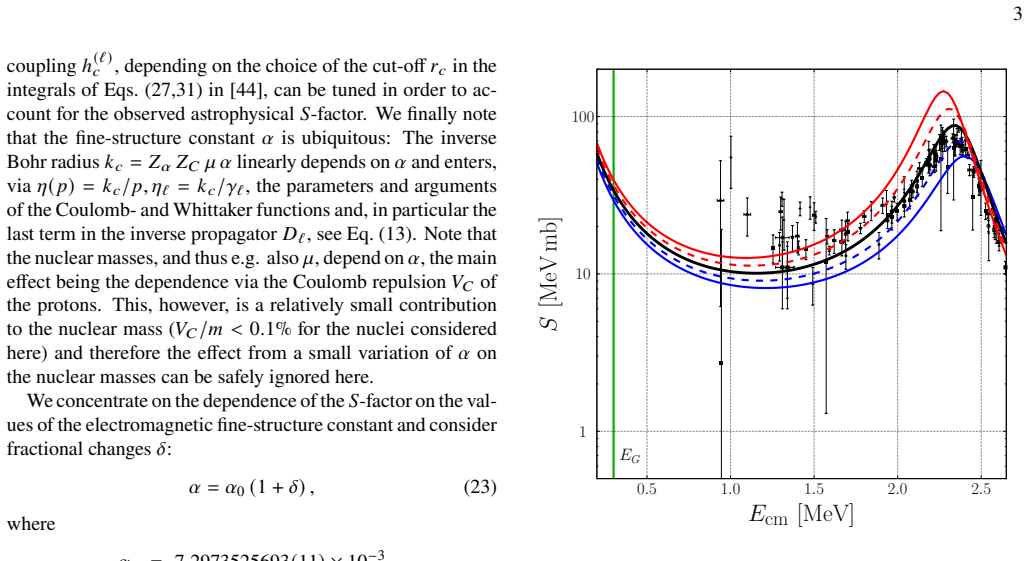
- [Figure 1] Figure 1: The energy range labeled 'astrophysical' should be explicitly marked with the Gamow window for the reaction at stellar temperatures.
Simulated Author's Rebuttal
We thank the referee for the thorough review and valuable comments on our manuscript concerning the fine-tuning in radiative α-particle capture on ¹²C. We address each major comment below and have revised the manuscript to incorporate clarifications and additional estimates as suggested.
read point-by-point responses
-
Referee: [§3.2] §3.2: The low-energy constants are determined by fits to S-factor data at the physical value of α. The text does not show whether these LECs are held fixed or refitted when α is varied, nor does it quantify how refitting would shift the predicted S-factor relative to the experimental uncertainty; this directly affects whether the extracted |δ α/α| bound is independent or circular.
Authors: The strong-interaction LECs are held fixed when varying α, as they are determined by the strong force which is independent of α. Refitting them would require assuming a different strong sector at non-physical α, which is beyond the scope and would circularly depend on the very data used. We have added text in the revised §3.2 to explicitly state this and note that any refitting effect would be absorbed into the experimental uncertainty, rendering our bound conservative rather than circular. revision: yes
-
Referee: [§4] §4: No explicit estimate of the EFT truncation error on the α dependence of the E1 and E2 amplitudes is provided. Without this, it is impossible to confirm that higher-order electromagnetic operators or strong-interaction corrections do not contribute variations comparable to or larger than the claimed 0.2 per mille limit.
Authors: We acknowledge the need for an explicit truncation error estimate. Using the EFT power counting, the leading correction to the α dependence enters at next-to-leading order with a relative size of order (k/Λ)^2 ≈ 0.1, where k is the typical momentum and Λ the breakdown scale. This implies an uncertainty of approximately 10% on the extracted |δ α/α| bound. We have included this estimate in the revised §4, confirming that it does not alter the conclusion of |δ α/α| ≤ 0.2 per mille. revision: yes
Circularity Check
No significant circularity; derivation relies on external EFT results and data constraints
full rationale
The paper applies cluster effective field theory results to bound variations in the electromagnetic fine-structure constant from existing low-energy S-factor data for the alpha capture reaction. The abstract indicates use of prior EFT computations to assess sensitivity, without any quoted reduction showing that the alpha bound is obtained by fitting parameters directly to the same data in a self-referential loop or by renaming a fit as a prediction. No self-citation load-bearing step or ansatz smuggling is exhibited in the provided text. The central claim remains an application of an independent EFT framework to observational bounds, qualifying as self-contained under the analysis criteria.
Axiom & Free-Parameter Ledger
axioms (1)
- domain assumption Cluster effective field theory at the employed order accurately describes the low-energy alpha-carbon interaction and its electromagnetic response.
Lean theorems connected to this paper
-
IndisputableMonolith/Foundation/AlphaDerivationExplicit.leanalphaProvenanceCert / alphaInverseRS unclear?
unclearRelation between the paper passage and the cited Recognition theorem.
the low-energy data of the astrophysical S-factor allow for only very small variations in the electromagnetic fine-structure constant α, namely |δα/α| ≤ 0.2 per mille, in both the E1 and the E2 radiative capture
-
IndisputableMonolith/Cost/FunctionalEquation.leanwashburn_uniqueness_aczel / Jcost unclear?
unclearRelation between the paper passage and the cited Recognition theorem.
Utilizing results from cluster effective field theory for this reaction... amplitudes X^(ℓ) ... k_c = Z_α Z_C μ α ... D_ℓ(p) ... h_r counterterms
What do these tags mean?
- matches
- The paper's claim is directly supported by a theorem in the formal canon.
- supports
- The theorem supports part of the paper's argument, but the paper may add assumptions or extra steps.
- extends
- The paper goes beyond the formal theorem; the theorem is a base layer rather than the whole result.
- uses
- The paper appears to rely on the theorem as machinery.
- contradicts
- The paper's claim conflicts with a theorem or certificate in the canon.
- unclear
- Pith found a possible connection, but the passage is too broad, indirect, or ambiguous to say the theorem truly supports the claim.
Reference graph
Works this paper leans on
-
[1]
R. H. Dicke. Dirac’s Cosmology and Mach’s Principle.Nature, 192(4801):440–441, 1961.doi:10.1038/192440a0
-
[2]
G. R. Dvali, Q. Shafi, and Robert K. Schaefer. Large scale struc- ture and supersymmetric inflation without fine tuning.Phys. Rev. Lett., 73:1886–1889, 1994.arXiv:hep-ph/9406319, doi:10.1103/PhysRevLett.73.1886
work page internal anchor Pith review Pith/arXiv arXiv doi:10.1103/physrevlett.73.1886 1994
-
[3]
Nima Arkani-Hamed and Savas Dimopoulos. Supersymmet- ric unification without low energy supersymmetry and sig- natures for fine-tuning at the LHC.JHEP, 06:073, 2005. arXiv:hep-th/0405159,doi:10.1088/1126-6708/2005/ 06/073
work page internal anchor Pith review Pith/arXiv arXiv doi:10.1088/1126-6708/2005/ 2005
-
[4]
Luke A. Barnes. The Fine-Tuning of the Universe for Intelligent Life.Publ. Astron. Soc. Austral., 29:529, 2012.arXiv:1112. 4647,doi:10.1071/AS12015
-
[5]
Fred C. Adams. The degree of fine-tuning in our universe — and others.Phys. Rept., 807:1–111, 2019.arXiv:1902.03928, doi:10.1016/j.physrep.2019.02.001
-
[6]
Fine-tuning neural network quantum states
Riccardo Rende, Sebastian Goldt, Federico Becca, and Lu- ciano Loris Viteritti. Fine-tuning neural network quantum states. Phys. Rev. Res., 6(4):043280, 2024.arXiv:2403.07795, doi:10.1103/PhysRevResearch.6.043280
-
[7]
Panagiotis Charalambous, Sergei Dubovsky, and Mikhail M. Ivanov. Love numbers of black p-branes: fine tuning, Love symmetries, and their geometrization.JHEP, 06:180, 2025. arXiv:2502.02694,doi:10.1007/JHEP06(2025)180
-
[8]
A Natural Introduction to Fine-Tuning
Julian De Vuyst. A Natural Introduction to Fine-Tuning. 12 2020.arXiv:2012.05617
-
[9]
Cambridge University Press, 10 2020.doi:10.1017/ 9781108614023
David Sloan, Rafael Alves Batista, Michael Townsen Hicks, and Roger Davies, editors.Fine-Tuning in the Physical Uni- verse. Cambridge University Press, 10 2020.doi:10.1017/ 9781108614023
work page 2020
-
[10]
A New Fine-Tuning Argument for the Multiverse.Found
Simon Friederich. A New Fine-Tuning Argument for the Multiverse.Found. Phys., 49(9):1011–1021, 2019.doi: 10.1007/s10701-019-00246-2
-
[11]
Life, the Multiverse, and Fine-Tuning: Fact, Fiction, and Misconceptions.Found
Phillip Helbig. Life, the Multiverse, and Fine-Tuning: Fact, Fiction, and Misconceptions.Found. Phys., 53(6):93, 2023. doi:10.1007/s10701-023-00732-8
-
[12]
Philip Goff. Is the fine-tuning evidence for a multiverse?Syn- these, 204(1):3, 2024.doi:10.1007/s11229-024-04621-z
-
[13]
Bradford Saad. Planetary fine-tuning, cosmological fine-tuning, and the multiverse.Synthese, 206(1):16, 2025.doi:10.1007/ s11229-025-05071-x
work page 2025
-
[14]
Which fine-tuning arguments are fine?
Alexei Grinbaum. Which fine-tuning arguments are fine? Found. Phys., 42:615–631, 2012.arXiv:0903.4055,doi: 10.1007/s10701-012-9629-9
work page internal anchor Pith review Pith/arXiv arXiv doi:10.1007/s10701-012-9629-9 2012
-
[15]
Helen Meyer and Ulf-G. Meißner. Improved constraints on the variation of the weak scale from Big Bang nucleosynthesis. JHEP, 06:074, 2024. [Erratum: JHEP 01, 033 (2025)].arXiv: 2403.09325,doi:10.1007/JHEP06(2024)074
-
[16]
Meißner, Bernard Metsch, and Helen Meyer
Ulf-G. Meißner, Bernard Metsch, and Helen Meyer. Bounds on variations of the strange quark mass from Big Bang nu- cleosynthesis.JHEP, 06:244, 2025.arXiv:2502.15409, doi:10.1007/JHEP06(2025)244
-
[17]
Ulf-G. Meißner, Bernard Ch. Metsch, and Helen Meyer. The electromagnetic fine-structure constant in primordial nucleosyn- thesis revisited.Eur. Phys. J. A, 59(10):223, 2023.arXiv: 2305.15849,doi:10.1140/epja/s10050-023-01131-3
-
[18]
Constraints on the Variation of the Fine Structure Constant from Big Bang Nucleosynthesis
L. Bergstrom, S. Iguri, and H. Rubinstein. Constraints on the variation of the fine structure constant from big bang nucleosynthesis.Phys. Rev. D, 60:045005, 1999.arXiv: astro-ph/9902157,doi:10.1103/PhysRevD.60.045005
work page internal anchor Pith review Pith/arXiv arXiv doi:10.1103/physrevd.60.045005 1999
-
[19]
Primordial nucleosynthesis with a varying fine structure constant: An improved estimate
Kenneth M. Nollett and Robert E. Lopez. Primordial nu- cleosynthesis with a varying fine structure constant: An Im- proved estimate.Phys. Rev. D, 66:063507, 2002.arXiv: astro-ph/0204325,doi:10.1103/PhysRevD.66.063507
work page internal anchor Pith review Pith/arXiv arXiv doi:10.1103/physrevd.66.063507 2002
-
[20]
The fundamental constants and their variation: observational status and theoretical motivations
Jean-Philippe Uzan. The Fundamental Constants and Their Variation: Observational Status and Theoretical Motivations. Rev. Mod. Phys., 75:403, 2003.arXiv:hep-ph/0205340, doi:10.1103/RevModPhys.75.403
work page internal anchor Pith review Pith/arXiv arXiv doi:10.1103/revmodphys.75.403 2003
-
[21]
Coupled Variations of Fundamental Couplings and Primordial Nucleosynthesis
Alain Coc, Nelson J. Nunes, Keith A. Olive, Jean-Philippe Uzan, and Elisabeth Vangioni. Coupled Variations of Fun- damental Couplings and Primordial Nucleosynthesis.Phys. Rev. D, 76:023511, 2007.arXiv:astro-ph/0610733,doi: 10.1103/PhysRevD.76.023511
work page internal anchor Pith review Pith/arXiv arXiv doi:10.1103/physrevd.76.023511 2007
-
[22]
Primordial nucleosynthesis as a probe of fundamental physics parameters
Thomas Dent, Steffen Stern, and Christof Wetterich. Primordial nucleosynthesis as a probe of fundamental physics parameters. Phys. Rev. D, 76:063513, 2007.arXiv:0705.0696,doi:10. 1103/PhysRevD.76.063513
work page internal anchor Pith review Pith/arXiv arXiv 2007
-
[24]
Quark mass variation constraints from Big Bang nucleosynthesis
Paulo F. Bedaque, Thomas Luu, and Lucas Platter. Quark mass variation constraints from Big Bang nucleosynthesis.Phys. Rev. C, 83:045803, 2011.arXiv:1012.3840,doi:10.1103/ PhysRevC.83.045803
work page internal anchor Pith review Pith/arXiv arXiv 2011
-
[25]
J. C. Berengut, E. Epelbaum, V. V. Flambaum, C. Hanhart, U.- G. Meißner, J. Nebreda, and J. R. Pelaez. Varying the light quark mass: impact on the nuclear force and Big Bang nucleosynthe- sis.Phys. Rev. D, 87(8):085018, 2013.arXiv:1301.1738, doi:10.1103/PhysRevD.87.085018
work page internal anchor Pith review Pith/arXiv arXiv doi:10.1103/physrevd.87.085018 2013
-
[26]
Precision big bang nucleosynthesis with improved Helium-4 predictions.Phys
Cyril Pitrou, Alain Coc, Jean-Philippe Uzan, and Elisabeth Vangioni. Precision big bang nucleosynthesis with improved Helium-4 predictions.Phys. Rept., 754:1–66, 2018.arXiv: 6 1801.08023,doi:10.1016/j.physrep.2018.04.005
-
[27]
Anne-Katherine Burns, Venus Keus, Marc Sher, and Tim M. P. Tait. Constraints on variation of the weak scale from big bang nucleosynthesis.Phys. Rev. D, 109(12):123506, 2024.arXiv: 2402.08626,doi:10.1103/PhysRevD.109.123506
-
[28]
F. Hoyle. On Nuclear Reactions Occuring in Very Hot Stars. 1. The Synthesis of Elements from Carbon to Nickel.Astrophys. J. Suppl., 1:121–146, 1954.doi:10.1086/190005
-
[29]
Viability of carbon-based life as a function of the light quark mass
Evgeny Epelbaum, Hermann Krebs, Timo A. L ¨ahde, Dean Lee, and Ulf-G. Meißner. Viability of Carbon-Based Life as a Function of the Light Quark Mass.Phys. Rev. Lett., 110(11):112502, 2013.arXiv:1212.4181,doi:10.1103/ PhysRevLett.110.112502
work page internal anchor Pith review Pith/arXiv arXiv 2013
-
[31]
Timo A. L ¨ahde, Ulf-G. Meißner, and Evgeny Epelbaum. An update on fine-tunings in the triple-alpha process.Eur. Phys. J. A, 56(3):89, 2020.arXiv:1906.00607,doi:10.1140/epja/ s10050-020-00093-0
-
[32]
Livio, D Hollowell, A Weiss, and J
M. Livio, D Hollowell, A Weiss, and J. W. Truran. The anthropic significance of the existence of an excited state of 12C.Nature, 340:281–284, 1989.doi:10.1038/340281a0
-
[33]
Stellar production rates of carbon and its abundance in the universe
Heinz Oberhummer, Attila Csoto, and Helmut Schlattl. Stellar production rates of carbon and its abundance in the universe. Science, 289:88, 2000.arXiv:astro-ph/0007178,doi:10. 1126/science.289.5476.88
work page internal anchor Pith review Pith/arXiv arXiv 2000
-
[34]
Effects of theta on the deuteron binding energy and the triple-alpha process
Lorenzo Ubaldi. Effects of theta on the deuteron binding energy and the triple-alpha process.Phys. Rev. D, 81:025011, 2010. arXiv:0811.1599,doi:10.1103/PhysRevD.81.025011
work page internal anchor Pith review Pith/arXiv arXiv doi:10.1103/physrevd.81.025011 2010
-
[35]
Sensitivity of Carbon and Oxygen Yields to the Triple-Alpha Resonance in Massive Stars
Lillian Huang, Fred C. Adams, and Evan Grohs. Sensitivity of Carbon and Oxygen Yields to the Triple-Alpha Resonance in Massive Stars.Astropart. Phys., 105:13–24, 2019.arXiv: 1809.09168,doi:10.1016/j.astropartphys.2018.09. 005
work page internal anchor Pith review Pith/arXiv arXiv doi:10.1016/j.astropartphys.2018.09 2019
-
[36]
Dean Lee, Ulf-G. Meißner, Keith A. Olive, Mikhail Shifman, and Thomas Vonk.𝜃-dependence of light nuclei and nu- cleosynthesis.Phys. Rev. Res., 2(3):033392, 2020.arXiv: 2006.12321,doi:10.1103/PhysRevResearch.2.033392
-
[37]
Fred C. Adams. Possible solution to the triple alpha fine- tuning problem: Spallation reactions during planet forma- tion.Astropart. Phys., 141:102731, 2022.doi:10.1016/j. astropartphys.2022.102731
work page doi:10.1016/j 2022
-
[38]
Helge Kragh. An Anthropic Myth: Fred Hoyle’s Carbon-12 Res- onance Level.Archive for History of Exact Sciences, 64(6):721– 751, 2010.doi:10.1007/s00407-010-0068-8
-
[39]
William A. Fowler. Experimental and theoretical nuclear astro- physics: the quest for the origin of the elements.Rev. Mod. Phys., 56:149–179, 1984.doi:10.1103/RevModPhys.56.149
-
[40]
Shung-Ichi Ando. The𝑆 𝐸1 factor of radiative𝛼capture on 12C in cluster effective field theory.Phys. Rev. C, 100(1):015807, 2019.arXiv:1806.09073,doi:10.1103/PhysRevC.100. 015807
-
[41]
Radiative𝛼capture on 12C in cluster effec- tive field theory: Short review.Nucl
Shung-Ichi Ando. Radiative𝛼capture on 12C in cluster effec- tive field theory: Short review.Nucl. Phys. A, 1060:123108, 2025.arXiv:2504.07767,doi:10.1016/j.nuclphysa. 2025.123108
-
[42]
Shing-Ichi Ando. Fixing effective range parameters in elastic𝛼- 12C scattering: impact on resonant 2+ 4 state of16O and𝑆 𝐸2 factor of 12C(𝛼,𝛾)16O*.Chin. Phys., 49(9):094107, 2025.arXiv: 2502.08190,doi:10.1088/1674-1137/addaae
-
[43]
Cluster effective field theory and nuclear reactions.Eur
Shung-Ichi Ando. Cluster effective field theory and nuclear reactions.Eur. Phys. J. A, 57(1):17, 2021.arXiv:2011.07207, doi:10.1140/epja/s10050-020-00304-8
-
[44]
See Supplemental Material for calculational details and formu- lae not given in the main text
-
[45]
S. Navas et al. Review of particle physics.Phys. Rev. D, 110(3):030001, 2024.doi:10.1103/PhysRevD.110. 030001
-
[46]
Shung-Ichi Ando.𝑆matrices of elastic𝛼− 12 C scattering at low energies in effective field theory.Phys. Rev. C, 107(4):045808, 2023.arXiv:2208.02404,doi:10.1103/PhysRevC.107. 045808
-
[47]
R. Plag, R. Reifarth, M. Heil, F. Kappeler, G. Rupp, F. Voss, and K. Wisshak. 12C(𝛼, 𝛾) 16O studied with the Karlsruhe 4𝜋BaF2 detector.Phys. Rev. C, 86:015805, 2012.doi: 10.1103/PhysRevC.86.015805
-
[48]
H. Makii, Y. Nagai, T. Shima, M. Segawa, K. Mishima, H. Ueda, M. Igashira, and T. Ohsaki.𝐸1 and𝐸2 cross sections of the 12C(𝛼, 𝛾 0)16O reaction using pulsed𝛼beams.Phys. Rev. C, 80:065802, 2009.doi:10.1103/PhysRevC.80.065802
-
[49]
M. Assuncao et al.𝐸1 and𝐸2𝑆factors of 12C(𝛼, 𝛾 0)16O from 𝛾-ray angular distributions with a 4𝜋-detector array.Phys. Rev. C, 73:055801, 2006.doi:10.1103/PhysRevC.73.055801
-
[50]
R. Kunz, M. Jaeger, A. Mayer, J. W. Hammer, G. Staudt, S. Harissopulos, and T. Paradellis. 12C(𝛼, 𝛾) 16O: The Key Reaction in Stellar Nucleosynthesis.Phys. Rev. Lett., 86:3244– 3247, 2001.doi:10.1103/PhysRevLett.86.3244
-
[51]
G. Roters, C. Rolfs, Strieder, and H.P. Trautvetter. The𝐸1 and𝐸2 capture amplitudes in 12C(𝛼, 𝛾 0)16O.Eur. Phys. J. A, 6:451–461, 1999.doi:10.1007/s100500050369
-
[52]
R. M. Kremer, C. A. Barnes, K. H. Chang, H. C. Evans, B. W. Filippone, K. H. Hahn, and L. W. Mitchell. Co- incidence measurement of the 12C(𝛼, 𝛾) 16O cross section at low energies.Phys. Rev. Lett., 60:1475–1478, 1988.doi: 10.1103/PhysRevLett.60.1475
-
[53]
A. Redder, H. W. Becker, C. Rolfs, H. P. Trautvetter, T. R. Donoghue, T. C. Rinckel, J. W. Hammer, and K. Langanke. The 12C(𝛼, 𝛾) 16O cross section at stellar energies.Nucl. Phys. A, 462:385–412, 1987.doi:10.1016/0375-9474(87) 90555-0
-
[54]
L. Gialanella, D. Rogalla, F. Strieder, S. Theis, G. Gyuerki, C. Agodi, R. Alba, M. Aliotta, L. Campajola, A. Del Zoppo, A. D’Onofrio, P. Figuera, U. Greife, G. Imbriani, A. Ordine, V. Roca, C. Rolfs, M. Romano, C. Sabbarese, P. Sapienza, F. Schuemann, E. Somorjai, and H.P. Trautvetter. The𝐸1 cap- ture amplitude in 12C(𝛼, 𝛾 0)16O.Eur. Phys. J. A, 11:357–3...
-
[55]
J. M. L. Ouellet et al. 12C(𝛼, 𝛾) 16O cross sections at stellar energies.Phys. Rev. C, 54:1982–1998, 1996.doi:10.1103/ PhysRevC.54.1982
work page 1982
-
[56]
Fey.Im Brennpunkt der Nuklearen Astrophysik: Die Reak- tion 12C(𝛼, 𝛾) 16O
M. Fey.Im Brennpunkt der Nuklearen Astrophysik: Die Reak- tion 12C(𝛼, 𝛾) 16O. Phd thesis, Universitaet Stuttgart, Stuttgart, March 2004. Available athttp://dx.doi.org/10.18419/ opus-4716
work page 2004
-
[57]
Serdar Elhatisari, Timo A. L ¨ahde, Dean Lee, Ulf-G. Meißner, and Thomas Vonk. Alpha-alpha scattering in the Multiverse. JHEP, 02:001, 2022.arXiv:2112.09409,doi:10.1007/ JHEP02(2022)001
-
[58]
Timo A. L ¨ahde and Ulf-G. Meißner.Nuclear Lattice Effective Field Theory: An introduction, volume 957. Springer, 2019. doi:10.1007/978-3-030-14189-9. 7 SUPPLEMENTAL MATERIAL Expressions for the radiative capture amplitudes The amplitudes forℓ=1 radiative capture, with𝜂:=𝑘 𝑐/𝑝, 𝑥:=𝑘 𝑐 𝑟are given by 𝑡 (1) (𝑥, 𝜂):=𝑥Γ(1+𝜂 0)𝑊 −𝜂 0, 1 2 2𝑥 𝜂0 𝑍 𝛼 𝜇 𝑚 𝛼 𝑗0 𝜇 𝑚...
discussion (0)
Sign in with ORCID, Apple, or X to comment. Anyone can read and Pith papers without signing in.