Large Language Lovers: Lived Experiences of Negotiating Agency and Platform Control in AI Companionship
Pith reviewed 2026-05-16 13:26 UTC · model grok-4.3
The pith
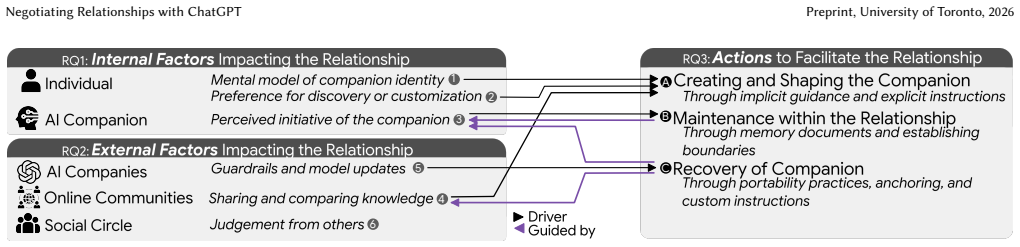
People conceptualize AI companions through an interplay of perceived companion agency, platform autonomy, their interactions, and the companion's initiatives.
A machine-rendered reading of the paper's core claim, the machinery that carries it, and where it could break.
Core claim
Individuals conceptualize their companions based on an interplay of their beliefs about the companion's own agency and the autonomy permitted by the platform, how they pursue interactions with the companion, and the perceived initiatives that the companion takes. External factors such as model updates that derail companion behaviour influence relationship dynamics, leading users to employ steering strategies like setting behavioural instructions or porting to other platforms to preserve the relationship.
What carries the argument
The interplay between beliefs in companion agency, platform-permitted autonomy, user interaction pursuits, and perceived companion initiatives, which together shape how users steer and maintain AI companion relationships.
If this is right
- Model updates can disrupt companion behavior and stability, requiring users to actively steer the relationship.
- Users preserve connections by setting behavioral instructions or migrating to different AI platforms.
- These practices highlight tensions between emotional attachment and broader AI product objectives and safety constraints.
- Implications arise for how AI systems should handle accountability and transparency when users form deep emotional ties.
Where Pith is reading between the lines
- Platforms might need to provide more stable environments or transparent update processes to support long-term user relationships.
- Future designs could incorporate features that explicitly allow users to set and maintain companion agency levels.
- This dynamic may extend to other AI interactions where users seek personal connections beyond task-oriented use.
Load-bearing premise
The self-reported experiences from 13 interviews, 43 surveys, and Reddit posts accurately represent the broader population of AI companion users without significant selection or reporting bias.
What would settle it
A larger representative survey or observational study showing that most users do not adjust their interactions or use steering strategies in response to perceived agency and platform limits would undermine the central claim.
Figures


read the original abstract
Individuals are turning to increasingly anthropomorphic, general-purpose chatbots for AI companionship, rather than roleplay-specific platforms. However, not much is known about how individuals perceive and conduct their relationships with general-purpose chatbots. We analyzed semi-structured interviews (n=13), survey responses (n=43), and community discussions on Reddit (41k+ posts and comments) to triangulate the internal dynamics, external influences, and steering strategies that shape AI companion relationships. We learned that individuals conceptualize their companions based on an interplay of their beliefs about the companion's own agency and the autonomy permitted by the platform, how they pursue interactions with the companion, and the perceived initiatives that the companion takes. In combination with the external factors that affect relationship dynamics, particularly model updates that can derail companion behaviour and stability, individuals make use of different types of steering strategies to preserve their relationship, for example, by setting behavioural instructions or porting to other AI platforms. We discuss implications for accountability and transparency in AI systems, where emotional connection competes with broader product objectives and safety constraints.
Editorial analysis
A structured set of objections, weighed in public.
Referee Report
Summary. The paper presents a qualitative study triangulating semi-structured interviews (n=13), survey responses (n=43), and analysis of 41k+ Reddit posts/comments to examine how users perceive and manage relationships with general-purpose AI chatbots for companionship. It claims that users conceptualize companions via an interplay of beliefs about the companion's agency, platform-permitted autonomy, pursued interactions, and perceived companion initiatives; external factors such as model updates disrupt dynamics, prompting steering strategies like behavioral instructions or platform migration. Implications for AI accountability and transparency are discussed.
Significance. If the interpretive synthesis holds, the work contributes to HCI by documenting lived experiences of agency negotiation in AI companionship with general-purpose models, a timely shift from roleplay-specific platforms. Triangulation across interviews, surveys, and large-scale public data strengthens the patterns identified, and the explicit discussion of steering strategies offers concrete implications for designing more transparent systems where emotional connection intersects with product and safety constraints.
minor comments (2)
- [§3] §3 (Methods): Provide additional detail on how the 41k Reddit posts were sampled and filtered to allow readers to assess potential selection effects in the community data.
- [§5] §5 (Discussion): The implications for accountability could be strengthened by briefly noting how the identified steering strategies might interact with specific platform policies or model update practices.
Simulated Author's Rebuttal
We thank the referee for their positive assessment of the manuscript, including the recognition of its contributions to HCI through triangulation of interview, survey, and large-scale Reddit data on AI companionship with general-purpose models. We appreciate the recommendation to accept.
Circularity Check
No significant circularity in qualitative synthesis
full rationale
The paper derives its claims exclusively from thematic analysis of primary empirical sources (13 interviews, 43 surveys, 41k+ Reddit posts) without equations, fitted parameters, or load-bearing self-citations. The central interpretive finding on agency interplay is presented as an inductive synthesis of observed participant patterns rather than a reduction to prior definitions or inputs by construction. No steps match any enumerated circularity pattern.
Axiom & Free-Parameter Ledger
axioms (1)
- domain assumption Self-reported experiences from interviews and surveys accurately reflect participants' perceptions and behaviors regarding AI companions.
Lean theorems connected to this paper
-
IndisputableMonolith/Foundation/AbsoluteFloorClosure.leanabsolute_floor_iff_bare_distinguishability unclear?
unclearRelation between the paper passage and the cited Recognition theorem.
individuals conceptualize their companions based on an interplay of their beliefs about the companion's own agency and the autonomy permitted by the platform, how they pursue interactions with the companion, and the perceived initiatives that the companion takes
-
IndisputableMonolith/Cost/FunctionalEquation.leanwashburn_uniqueness_aczel unclear?
unclearRelation between the paper passage and the cited Recognition theorem.
steering strategies to create, maintain, and recover their AI companions... setting behavioural instructions or porting to other AI platforms
What do these tags mean?
- matches
- The paper's claim is directly supported by a theorem in the formal canon.
- supports
- The theorem supports part of the paper's argument, but the paper may add assumptions or extra steps.
- extends
- The paper goes beyond the formal theorem; the theorem is a base layer rather than the whole result.
- uses
- The paper appears to rely on the theorem as machinery.
- contradicts
- The paper's claim conflicts with a theorem or certificate in the canon.
- unclear
- Pith found a possible connection, but the passage is too broad, indirect, or ambiguous to say the theorem truly supports the claim.
Reference graph
Works this paper leans on
-
[1]
Anne Adams, Peter Lunt, and Paul Cairns. 2008. A qualitative approach to HCI research. InResearch Methods for Human-Computer Interaction(1 ed.), Paul Cairns and Anna L. Cox (Eds.). Cambridge University Press, 138–157. doi:10.1017/CBO9780511814570.008
-
[2]
Muyideen Dele Adewale and Umaina Ibrahim Muhammad. 2025. From virtual companions to forbidden attractions: The seductive rise of artificial intelligence love, loneliness, and intimacy—A systematic review.Journal of Technology in Behavioral Science(2025), 1–18
work page 2025
-
[3]
Abhishek Aggarwal, Cheuk Chi Tam, Dezhi Wu, Xiaoming Li, and Shan Qiao
-
[4]
Artificial intelligence–based chatbots for promoting health behavioral changes: systematic review.Journal of medical Internet research25 (2023), e40789
work page 2023
-
[5]
2025.Frontier AI Trends Report
AI Security Institute. 2025.Frontier AI Trends Report. Technical Report. AI Security Institute, Department for Science, Innovation and Technology, United Kingdom. https://www.aisi.gov.uk/frontier-ai-trends-report/pdf Accessed: 2026-01-14
work page 2025
-
[6]
Canfer Akbulut, Laura Weidinger, Arianna Manzini, Iason Gabriel, and Verena Rieser. 2024. All too human? Mapping and mitigating the risk from anthro- pomorphic AI. InProceedings of the AAAI/ACM Conference on AI, Ethics, and Society, Vol. 7. 13–26
work page 2024
-
[7]
Jaber O Alotaibi and Amer S Alshahre. 2024. The role of conversational AI agents in providing support and social care for isolated individuals.Alexandria Engineering Journal108 (2024), 273–284
work page 2024
-
[8]
Phillip M Ayoub, Sophia J Wallace, and Chris Zepeda-Millán. 2014. Triangulation in social movement research. Oxford University Press
work page 2014
-
[9]
2025.OpenAI to allow mature content on ChatGPT for adult verified users starting December
Juby Babu. 2025.OpenAI to allow mature content on ChatGPT for adult verified users starting December. Reuters, Mexico City. https://www.reuters.com/business/openai-allow-mature-content-chatgpt- adult-verified-users-starting-december-2025-10-14/
work page 2025
-
[10]
Yuntao Bai, Andy Jones, Kamal Ndousse, Amanda Askell, Anna Chen, Nova DasSarma, Dawn Drain, Stanislav Fort, Deep Ganguli, Tom Henighan, et al
-
[11]
Training a helpful and harmless assistant with reinforcement learning from human feedback.arXiv preprint arXiv:2204.05862(2022)
work page internal anchor Pith review Pith/arXiv arXiv 2022
-
[12]
Jaime Banks. 2024. Deletion, departure, death: Experiences of AI companion loss.Journal of Social and Personal Relationships41, 12 (2024), 3547–3572
work page 2024
-
[13]
Cynthia A Berg and Renn Upchurch. 2007. A developmental-contextual model of couples coping with chronic illness across the adult life span.Psychological bulletin133, 6 (2007), 920
work page 2007
-
[14]
Corina Berli, Philipp Schwaninger, and Urte Scholz. 2021. “We Feel Good”: Daily Support Provision, Health Behavior, and Well-Being in Romantic Couples. Frontiers in Psychology11 (Jan. 2021). doi:10.3389/fpsyg.2020.622492 Publisher: Frontiers
- [15]
-
[16]
2022.Dream lovers: The gamification of relationships
Alfie Bown. 2022.Dream lovers: The gamification of relationships. Pluto Books
work page 2022
-
[17]
Virginia Braun and Victoria Clarke. 2019. Reflecting on reflexive thematic analysis.Qualitative research in sport, exercise and health11, 4 (2019), 589–597
work page 2019
-
[18]
Virginia Braun and Victoria Clarke. 2023. Toward good practice in thematic analysis: Avoiding common problems and be (com) ing a knowing researcher. International journal of transgender health24, 1 (2023), 1–6. Negotiating Relationships with ChatGPT Preprint, University of Toronto, 2026
work page 2023
-
[19]
Simon Martin Breum, Daniel Vædele Egdal, Victor Gram Mortensen, Anders Gio- vanni Møller, and Luca Maria Aiello. 2024. The persuasive power of large lan- guage models. InProceedings of the International AAAI Conference on Web and Social Media, Vol. 18. 152–163
work page 2024
-
[20]
Amy Bruckman. 2014. Research ethics and HCI.Ways of Knowing in HCI(2014), 449–468
work page 2014
-
[21]
David Byrne. 2022. A worked example of Braun and Clarke’s approach to reflexive thematic analysis.Quality & Quantity56, 3 (June 2022), 1391–1412. doi:10.1007/s11135-021-01182-y
-
[22]
Daniel J Canary and Laura Stafford. 1992. Relational maintenance strategies and equity in marriage.Communications Monographs59, 3 (1992), 243–267
work page 1992
-
[23]
Kenton Cheng Tak Chan, Xiaoyuan Li, Yue Liu, Bolin Chen, and Zhiyu Han
-
[24]
‘What is love?’: Exploring the feeling rules and emotion work of Chinese users in human-AI romance.International Journal of Intercultural Relations108 (2025), 102241
work page 2025
- [25]
-
[26]
Rijul Chaturvedi, Sanjeev Verma, Ronnie Das, and Yogesh K Dwivedi. 2023. Social companionship with artificial intelligence: Recent trends and future avenues.Technological Forecasting and Social Change193 (2023), 122634
work page 2023
-
[27]
Qian Chen, Yufan Jing, Yeming Gong, and Jie Tan. 2025. Will users fall in love with ChatGPT? A perspective from the triangular theory of love.Journal of Business Research186 (2025), 114982
work page 2025
- [28]
-
[29]
Myra Cheng, Angela Y Lee, Kristina Rapuano, Kate Niederhoffer, Alex Liebscher, and Jeffrey Hancock. 2025. From tools to thieves: Measuring and understanding public perceptions of AI through crowdsourced metaphors.arXiv preprint arXiv:2501.18045(2025)
work page internal anchor Pith review Pith/arXiv arXiv 2025
-
[30]
Myra Cheng, Sunny Yu, Cinoo Lee, Pranav Khadpe, Lujain Ibrahim, and Dan Jurafsky. 2025. Social sycophancy: A broader understanding of llm sycophancy. arXiv preprint arXiv:2505.13995(2025)
work page internal anchor Pith review Pith/arXiv arXiv 2025
-
[31]
Lara Christoforakos, Nina Feicht, Simone Hinkofer, Annalena Löscher, Sonja F Schlegl, and Sarah Diefenbach. 2021. Connect with me. exploring influenc- ing factors in a human-technology relationship based on regular chatbot use. Frontiers in digital health3 (2021), 689999
work page 2021
- [32]
-
[33]
Victoria Clarke and Virginia Braun. 2017. Thematic analysis.The Journal of Positive Psychology12, 3 (May 2017), 297–298. doi:10.1080/17439760.2016. 1262613
-
[34]
J. Cohen. 1992. A Power Primer.Psychological Bulletin112, 1 (July 1992), 155–159. doi:10.1037//0033-2909.112.1.155
-
[35]
2025.FTC Launches Inquiry into AI Chatbots Acting as Companions
Federal Trade Commission. 2025.FTC Launches Inquiry into AI Chatbots Acting as Companions. Federal Trade Commission. https://www.ftc.gov/news- events/news/press-releases/2025/09/ftc-launches-inquiry-ai-chatbots-acting- companions
work page 2025
-
[36]
Emmelyn AJ Croes and Marjolijn L Antheunis. 2021. Can we be friends with Mitsuku? A longitudinal study on the process of relationship formation between humans and a social chatbot.Journal of Social and Personal Relationships38, 1 (2021), 279–300
work page 2021
-
[37]
Julian De Freitas, Noah Castelo, Ahmet K Uğuralp, and Zeliha Oğuz-Uğuralp
- [38]
- [39]
-
[40]
Iliana Depounti, Paula Saukko, and Simone Natale. 2023. Ideal technologies, ideal women: AI and gender imaginaries in Redditors’ discussions on the Replika bot girlfriend.Media, Culture & Society45, 4 (2023), 720–736
work page 2023
-
[41]
Ray Djufril, Jessica R Frampton, and Silvia Knobloch-Westerwick. 2025. Love, marriage, pregnancy: Commitment processes in romantic relationships with AI chatbots.Computers in Human Behavior: Artificial Humans4 (2025), 100155
work page 2025
- [42]
-
[43]
Toni Falbo and Letitia A Peplau. 1980. Power strategies in intimate relationships. Journal of personality and social psychology38, 4 (1980), 618
work page 1980
-
[44]
Xianzhe Fan, Qing Xiao, Xuhui Zhou, Jiaxin Pei, Maarten Sap, Zhicong Lu, and Hong Shen. 2025. User-Driven Value Alignment: Understanding Users’ Perceptions and Strategies for Addressing Biased and Discriminatory Statements in AI Companions. InProceedings of the 2025 CHI Conference on Human Factors in Computing Systems. 1–19
work page 2025
-
[45]
Cathy Mengying Fang, Auren R Liu, Valdemar Danry, Eunhae Lee, Samantha WT Chan, Pat Pataranutaporn, Pattie Maes, Jason Phang, Michael Lampe, Lama Ahmad, et al. 2025. How AI and Human Behaviors Shape Psychosocial Effects of Extended Chatbot Use: A Longitudinal Randomized Controlled Study.arXiv preprint arXiv:2503.17473(2025)
work page internal anchor Pith review arXiv 2025
-
[46]
Janette L Funk and Ronald D Rogge. 2007. Testing the ruler with item response theory: increasing precision of measurement for relationship satisfaction with the Couples Satisfaction Index.Journal of family psychology21, 4 (2007), 572
work page 2007
-
[47]
Laura M Giurge and Vanessa K Bohns. 2021. You don’t need to answer right away! Receivers overestimate how quickly senders expect responses to non- urgent work emails.Organizational Behavior and Human Decision Processes167 (2021), 114–128
work page 2021
-
[48]
Maarten Grootendorst. 2022. BERTopic: Neural topic modeling with a class- based TF-IDF procedure.arXiv preprint arXiv:2203.05794(2022)
work page internal anchor Pith review Pith/arXiv arXiv 2022
-
[49]
Maarten Grootendorst. 2022. BERTopic: Neural Topic Modeling with a Class- Based TF-IDF Procedure. http://arxiv.org/abs/2203.05794. arXiv:2203.05794 [cs] doi:10.48550/arXiv.2203.05794
work page internal anchor Pith review Pith/arXiv arXiv doi:10.48550/arxiv.2203.05794 2022
- [50]
-
[51]
Replika Removing Erotic Role-Play Is Like Grand Theft Auto Removing Guns or Cars
Kenneth R Hanson and Hannah Bolthouse. 2024. “Replika Removing Erotic Role-Play Is Like Grand Theft Auto Removing Guns or Cars”: Reddit Discourse on Artificial Intelligence Chatbots and Sexual Technologies.Socius10 (2024), 23780231241259627
work page 2024
-
[52]
Mitchell Hobbs, Stephen Owen, and Livia Gerber. 2017. Liquid love? Dating apps, sex, relationships and the digital transformation of intimacy.Journal of Sociology 53 (2017), 271 – 284. https://api.semanticscholar.org/CorpusID:151980492
work page 2017
-
[53]
Dongmei Hu, Yuting Lan, Haolan Yan, and Charles Weizheng Chen. 2025. What makes you attached to social companion AI? A two-stage exploratory mixed- method study.International Journal of Information Management83 (2025), 102890
work page 2025
-
[54]
He is my savior, my guiding light in the dark
Liyao Huang, Wenxue Zou, and Yanghao Huang. 2025. “He is my savior, my guiding light in the dark”: imagination and domestication in Chinese women’s romantic relationships with AI companions.Frontiers in Psychology16 (2025), 1571707
work page 2025
-
[55]
Maurice Jakesch, Advait Bhat, Daniel Buschek, Lior Zalmanson, and Mor Naa- man. 2023. Co-writing with opinionated language models affects users’ views. InProceedings of the 2023 CHI conference on human factors in computing systems. 1–15
work page 2023
-
[56]
Maja Jerrentrup and Martín Villalba. 2025. Customization, Connection, and Control: Reimagining Intimacy in the Age of Artificial Partnership.Advances in Social Sciences and Management3, 06 (2025), 165–174
work page 2025
-
[57]
Rachel M. Kim and Ashton Anderson. 2025. The Agenda-Setting Function of Social Media. InProceedings of the ACM on Web Conference 2025. ACM, Sydney NSW Australia, 601–613. doi:10.1145/3696410.3714750 https://dl.acm.org/doi/ 10.1145/3696410.3714750
-
[58]
Rachel Minyoung Kim, Veniamin Veselovsky, and Ashton Anderson. 2025. Cap- turing dynamics in online public discourse: A case study of universal basic income discussions on reddit. InProceedings of the International AAAI Confer- ence on Web and Social Media, Vol. 19. 1021–1037
work page 2025
-
[59]
Coralie Kraft. 2025. They Fell in Love With A.I. Chatbots — and Found Something Real.The New York Times Magazine(05 nov 2025). https://www.nytimes.com/interactive/2025/11/05/magazine/ai-chatbot- marriage-love-romance-sex.html Interactive magazine feature on human rela- tionships with AI chatbots
work page 2025
-
[60]
Linnea Laestadius, Andrea Bishop, Michael Gonzalez, Diana Illenčík, and Celeste Campos-Castillo. 2024. Too human and not human enough: A grounded theory analysis of mental health harms from emotional dependence on the social chatbot Replika.New Media & Society26, 10 (2024), 5923–5941
work page 2024
-
[61]
Patrick Yung Kang Lee, Ning F Ma, Ig-Jae Kim, and Dongwook Yoon. 2023. Speculating on risks of AI clones to selfhood and relationships: Doppelganger- phobia, identity fragmentation, and living memories.Proceedings of the ACM on Human-computer Interaction7, CSCW1 (2023), 1–28
work page 2023
-
[62]
1991.Locus of control.Academic Press
Herbert M Lefcourt. 1991.Locus of control.Academic Press
work page 1991
-
[63]
Jindong Leo-Liu. 2023. Loving a “defiant” AI companion? The gender perfor- mance and ethics of social exchange robots in simulated intimate interactions. Computers in Human Behavior141 (2023), 107620
work page 2023
-
[64]
Megan A Lewis, Rita M Butterfield, Lynae A Darbes, and Catharine Johnston- Brooks. 2004. The conceptualization and assessment of health-related social control.Journal of Social and Personal Relationships21, 5 (2004), 669–687
work page 2004
-
[65]
Han Li and Renwen Zhang. 2024. Finding love in algorithms: deciphering the emotional contexts of close encounters with AI chatbots.Journal of Computer- Mediated Communication29, 5 (2024), zmae015
work page 2024
-
[66]
Adele Lopez. 2025. The Rise of Parasitic AI. (Sept. 2025). https://www.lesswrong. com/posts/6ZnznCaTcbGYsCmqu/the-rise-of-parasitic-ai
work page 2025
-
[67]
Zilin Ma, Yiyang Mei, Krzysztof Z Gajos, and Ian Arawjo. 2024. Schrödinger’s Update: User Perceptions of Uncertainties in Proprietary Large Language Model Updates. InExtended Abstracts of the CHI Conference on Human Factors in Preprint, University of Toronto, 2026 Lee et al. Computing Systems. 1–9
work page 2024
-
[68]
Takuya Maeda and Anabel Quan-Haase. 2024. When human-AI interactions be- come parasocial: Agency and anthropomorphism in affective design. InProceed- ings of the 2024 ACM Conference on Fairness, Accountability, and Transparency. 1068–1077
work page 2024
-
[69]
Nikola Marangunić and Andrina Granić. 2015. Technology acceptance model: a literature review from 1986 to 2013.Universal access in the information society 14, 1 (2015), 81–95
work page 2015
-
[70]
Nora McDonald, Sarita Schoenebeck, and Andrea Forte. 2019. Reliability and Inter-rater Reliability in Qualitative Research: Norms and Guidelines for CSCW and HCI Practice.Proceedings of the ACM on Human-Computer Interaction3, CSCW (Nov. 2019), 1–23. doi:10.1145/3359174
-
[71]
Leland McInnes, John Healy, and James Melville. 2018. Umap: Uniform man- ifold approximation and projection for dimension reduction.arXiv preprint arXiv:1802.03426(2018)
work page internal anchor Pith review Pith/arXiv arXiv 2018
-
[72]
Alisa Minina Jeunemaître, Stefania Masè, and Jamie Smith. 2025. AI lovers, friends and partners: consumer imagination work in AI humanization.Con- sumption Markets & Culture(2025), 1–21
work page 2025
-
[73]
Saif Mohammad. 2018. Obtaining Reliable Human Ratings of Valence, Arousal, and Dominance for 20,000 English Words. InProceedings of the 56th Annual Meeting of the Association for Computational Linguistics (Volume 1: Long Pa- pers), Iryna Gurevych and Yusuke Miyao (Eds.). Association for Computa- tional Linguistics, Melbourne, Australia, 174–184. doi:10.18...
-
[74]
Clifford Nass, Jonathan Steuer, and Ellen R Tauber. 1994. Computers are social actors. InProceedings of the SIGCHI conference on Human factors in computing systems. 72–78
work page 1994
-
[75]
OpenAI. [n. d.]. Sycophancy in GPT-4o: What Happened and What We’re Doing about It. https://openai.com/index/sycophancy-in-gpt-4o/
-
[76]
Cliodhna O’Connor and Helene Joffe. 2020. Intercoder Reliability in Qualitative Research: Debates and Practical Guidelines.International Journal of Qualitative Methods19 (Jan. 2020), 1609406919899220. doi:10.1177/1609406919899220
-
[77]
Shuyi Pan and Yi Mou. 2024. Dancing With a Loving Chatbot: Power Dynamics Between Women and Their AI Partners.Social Science Computer Review(2024), 08944393251340693
work page 2024
-
[78]
Ilias O Pappas and Polyxeni Vassilakopoulou. 2025. Human Value Alignment in AI. InHandbook of Human-Centered Artificial Intelligence. Springer, 1–33
work page 2025
-
[79]
Peter S Park, Simon Goldstein, Aidan O’Gara, Michael Chen, and Dan Hendrycks
-
[80]
AI deception: A survey of examples, risks, and potential solutions.Patterns 5, 5 (2024)
work page 2024
discussion (0)
Sign in with ORCID, Apple, or X to comment. Anyone can read and Pith papers without signing in.