Recognition: 2 theorem links
· Lean TheoremExplainable deep-learning detection of microplastic fibers via polarization-resolved holographic microscopy
Pith reviewed 2026-05-16 12:22 UTC · model grok-4.3
The pith
Polarization eigen-parameters from holographic microscopy let a neural network classify microplastic fibers at 96.7 percent accuracy.
A machine-rendered reading of the paper's core claim, the machinery that carries it, and where it could break.
Core claim
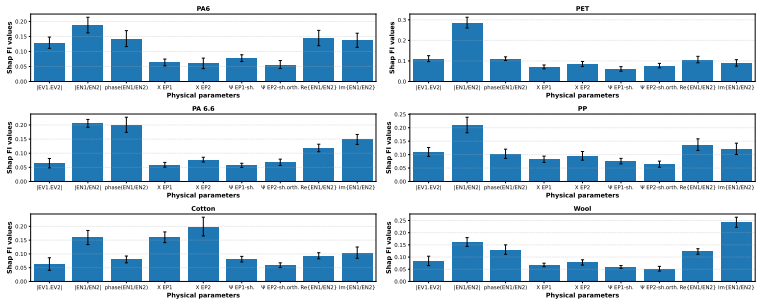
From multiplexed holograms the complex Jones matrix of each fiber is reconstructed to extract polarization eigen-parameters describing optical anisotropy. Statistical descriptors of nine polarization characteristics form a 72-dimensional feature vector for 296 fibers spanning six material classes. The fully connected deep neural network achieves 96.7 percent accuracy on validation data, surpassing common classifiers, with Shapley additive explanations identifying eigenvalue-ratio quantities as dominant predictors. A reduced-feature model using only these characteristics retains 93.3 percent accuracy.
What carries the argument
Reconstruction of the complex Jones matrix from polarization-resolved holograms to obtain eigenvalue-based descriptors of optical anisotropy that serve as material-specific fingerprints.
If this is right
- Automated identification of microplastic fibers becomes practical for routine environmental monitoring without manual inspection.
- Eigenvalue-ratio quantities alone support near-full accuracy, allowing simpler and faster models in future systems.
- The physical distinction between synthetic and natural fibers rests on measurable differences in optical anisotropy rather than on chemical composition alone.
- Explainable AI methods can be applied to polarization data to make the classification decisions transparent to regulators and analysts.
Where Pith is reading between the lines
- The same polarization fingerprints could be tested on mixed debris from real rivers or oceans to see whether accuracy holds outside controlled laboratory fibers.
- Portable holographic microscopes equipped with polarization channels might enable field deployment for rapid on-site screening of water samples.
- The approach suggests that polarization-resolved imaging could be extended to other anisotropic micro-particles such as certain pigments or biological fragments.
Load-bearing premise
The 296 laboratory-prepared fibers and the polarization properties extracted from them represent the diversity, degradation states, sizes, orientations, and surface contamination found in real environmental samples.
What would settle it
Collect fibers directly from environmental water or sediment samples, run them through the trained model, and check whether accuracy remains above 90 percent.
Figures


read the original abstract
Reliable identification of microplastic fibers is crucial for environmental monitoring but remains analytically challenging. We report an explainable deep-learning framework for classifying microplastic and natural microfibers using polarization-resolved digital holographic microscopy. From multiplexed holograms, the complex Jones matrix of each fiber was reconstructed to extract polarization eigen-parameters describing optical anisotropy. Statistical descriptors of nine polarization characteristics formed a 72-dimensional feature vector for a total of 296 fibers spanning six material classes, including polyamide 6, polyethylene terephthalate, polyamide 6.6, polypropylene, cotton and wool. The designed fully connected deep neural network achieved an accuracy of 96.7 % on the validation data, surpassing that of common machine-learning classifiers. Explainable artificial intelligence analysis with Shapley additive explanations identified eigenvalue-ratio quantities as dominant predictors, revealing the physical basis for classification. An additional reduced-feature model with the preserved architecture exploiting only these most significant eigenvalue-based characteristics retained high accuracy (93.3 %), thereby confirming their dominant role while still outperforming common machine-learning classifiers. These results establish polarization-based features as distinctive optical fingerprints and demonstrate the first explainable deep-learning approach for automated microplastic fiber identification.
Editorial analysis
A structured set of objections, weighed in public.
Referee Report
Summary. The manuscript presents an explainable deep-learning framework for classifying microplastic and natural microfibers using polarization-resolved digital holographic microscopy. Jones-matrix reconstruction yields 72-dimensional feature vectors of statistical descriptors from 296 laboratory-prepared fibers across six classes (polyamide 6, PET, polyamide 6.6, polypropylene, cotton, wool). A fully connected DNN reaches 96.7% validation accuracy, outperforming standard ML classifiers; SHAP analysis identifies eigenvalue-ratio quantities as dominant predictors. A reduced model retaining only these features achieves 93.3% accuracy while preserving the architecture.
Significance. If the performance generalizes, the work would advance automated, physically interpretable microplastic identification by linking polarization eigen-parameters directly to classification via SHAP and by demonstrating that a compact set of eigenvalue descriptors suffices. The combination of holographic Jones calculus with an explainable DNN is a constructive step for environmental optics. The reduced-feature result is a clear strength, as it both confirms the physical basis and reduces model complexity.
major comments (3)
- [Abstract] Abstract: the headline accuracies (96.7 % DNN, 93.3 % reduced model) are stated without any information on data partitioning, cross-validation folds, class balance, or error bars. Because the central performance claim rests on these numbers, the absence of these details prevents assessment of robustness against post-hoc selection.
- [Abstract] Abstract / Results: the entire evaluation uses 296 laboratory-prepared fibers. No external test set drawn from environmental samples (with weathering, surface fouling, variable diameters, or overlapping fibers) is reported. This is load-bearing for the claim of applicability to field monitoring, as the validation accuracy only measures performance on the same controlled distribution used for training and feature selection.
- [Results] Results (reduced-feature model): while the 93.3 % accuracy on the eigenvalue-based subset is encouraging, the manuscript does not specify which exact eigenvalue ratios were retained or provide a direct comparison of confusion matrices between the full 72-dimensional and reduced models. This information is needed to evaluate whether the physical interpretability claim is fully supported.
minor comments (2)
- [Abstract] Abstract: the phrasing 'microplastic fibers' versus 'natural microfibers' should be made consistent throughout to avoid reader confusion about the six-class taxonomy.
- [Methods] The manuscript would benefit from an explicit statement of the number of fibers per class and any class-imbalance mitigation strategy, even if only in supplementary material.
Simulated Author's Rebuttal
We thank the referee for the constructive and detailed comments, which have helped improve the clarity and robustness of our manuscript. We address each major comment below and have made revisions where feasible to strengthen the presentation of our results.
read point-by-point responses
-
Referee: [Abstract] Abstract: the headline accuracies (96.7 % DNN, 93.3 % reduced model) are stated without any information on data partitioning, cross-validation folds, class balance, or error bars.
Authors: We agree that these methodological details are necessary to evaluate the reliability of the reported accuracies. In the revised manuscript, we have expanded the abstract and added a dedicated paragraph in the Methods section specifying that the 296-fiber dataset was partitioned using stratified 70/30 train/validation splits to preserve class balance (approximately 49 fibers per class). We performed 5-fold cross-validation, with the reported accuracies representing mean values and standard deviations as error bars (96.7 ± 1.1% for the full model and 93.3 ± 1.4% for the reduced model). revision: yes
-
Referee: [Abstract] Abstract / Results: the entire evaluation uses 296 laboratory-prepared fibers. No external test set drawn from environmental samples (with weathering, surface fouling, variable diameters, or overlapping fibers) is reported.
Authors: We acknowledge this as a limitation of the current study. The work was designed to establish the physical basis and explainability of polarization features under controlled laboratory conditions, which enabled precise Jones-matrix reconstruction and SHAP analysis. We have revised the Discussion to explicitly state that the reported performance applies to lab-prepared samples and to outline plans for future validation on environmental samples; however, we do not possess such data in the present dataset. revision: no
-
Referee: [Results] Results (reduced-feature model): while the 93.3 % accuracy on the eigenvalue-based subset is encouraging, the manuscript does not specify which exact eigenvalue ratios were retained or provide a direct comparison of confusion matrices between the full 72-dimensional and reduced models.
Authors: We thank the referee for this observation. In the revised Results section, we now explicitly list the top three eigenvalue-ratio features retained by the SHAP analysis (λ_max/λ_min for linear retardance, circular birefringence, and diattenuation). We have added a supplementary figure showing side-by-side confusion matrices for the full 72-dimensional and reduced models, confirming that the reduced model maintains comparable per-class performance with only minor increases in confusion between polyamide variants. revision: yes
- Absence of an external test set from real environmental microplastic samples, as the study is restricted to controlled laboratory-prepared fibers and acquiring new environmental data would require additional experiments beyond the scope of this work.
Circularity Check
No circularity: standard feature extraction and empirical training on held-out lab data
full rationale
The paper reconstructs Jones matrices from holographic data via established polarization optics, computes 72-dimensional statistical descriptors of eigen-parameters, and trains a fully connected DNN on a split of the 296-fiber experimental dataset to report validation accuracy. SHAP explanations are applied after training to rank features, and the reduced model retrains on the top-ranked subset; neither step defines its output by construction from the labels or reduces to a self-citation. All performance numbers are direct empirical measurements on the controlled lab distribution, with no parameter fitted to the target accuracy itself and no uniqueness theorem or ansatz imported from prior author work.
Axiom & Free-Parameter Ledger
free parameters (1)
- Neural-network weights and hyperparameters
axioms (2)
- standard math The complex Jones matrix fully captures the polarization transformation induced by a thin fiber
- domain assumption Statistical descriptors of the polarization eigen-parameters form a discriminative feature space for material classes
Lean theorems connected to this paper
-
IndisputableMonolith/Cost/FunctionalEquation.leanwashburn_uniqueness_aczel unclear?
unclearRelation between the paper passage and the cited Recognition theorem.
From multiplexed holograms, the complex Jones matrix of each fiber was reconstructed to extract polarization eigen-parameters... eigenvalue-ratio quantities as dominant predictors
What do these tags mean?
- matches
- The paper's claim is directly supported by a theorem in the formal canon.
- supports
- The theorem supports part of the paper's argument, but the paper may add assumptions or extra steps.
- extends
- The paper goes beyond the formal theorem; the theorem is a base layer rather than the whole result.
- uses
- The paper appears to rely on the theorem as machinery.
- contradicts
- The paper's claim conflicts with a theorem or certificate in the canon.
- unclear
- Pith found a possible connection, but the passage is too broad, indirect, or ambiguous to say the theorem truly supports the claim.
Reference graph
Works this paper leans on
-
[1]
Sources, fate and effects of microplastics in the marine environment: a global assessment,
A. Koehler, A. Anderson, A. Andrady,et al., “Sources, fate and effects of microplastics in the marine environment: a global assessment,” J. Ser. GESAMP Reports Stud.90, 96 (2015)
work page 2015
-
[2]
J. Liu, J. Niu, W. Wu,et al., “Recent advances in the detection of microplastics in the aqueous environment by electrochemical sensors: A review,” Mar. pollution bulletin214, 117695 (2025)
work page 2025
-
[3]
S. Thodhal Yoganandham, N. Hamid, M. Junaid,et al., “Micro(nano)plastics in commercial foods: A review of their characterization and potential hazards to human health,” Environ. Res.236, 116858 (2023)
work page 2023
-
[4]
Z.S.Mazhandu,E.Muzenda,T.A.Mamvura,etal.,“Integratedandconsolidatedreviewofplasticwastemanagement and bio-based biodegradable plastics: Challenges and opportunities,” Sustainability12, 8360 (2020)
work page 2020
-
[5]
J. Boucher and D. Friot,Primary Microplastics in the Oceans: A Global Evaluation of Sources(IUCN, Gland, Switzerland, 2017)
work page 2017
-
[6]
Microplastics in wastewater treatment plants: Detection, occurrence and removal,
J. Sun, X. Dai, Q. Wang,et al., “Microplastics in wastewater treatment plants: Detection, occurrence and removal,” Water Res.152, 21–37 (2019)
work page 2019
-
[7]
B. Henry, K. Laitala, and I. G. Klepp, “Microfibres from apparel and home textiles: Prospects for including microplastics in environmental sustainability assessment,” Sci. The Total. Environ.652, 483–494 (2019)
work page 2019
-
[8]
Evaluation of microplastic release caused by textile washing processes of synthetic fabrics,
F. De Falco, M. P. Gullo, G. Gentile,et al., “Evaluation of microplastic release caused by textile washing processes of synthetic fabrics,” Environ. Pollut.236, 916–925 (2018)
work page 2018
-
[9]
L. Hildebrandt, N. Voigt, T. Zimmermann,et al., “Evaluation of continuous flow centrifugation as an alternative technique to sample microplastic from water bodies,” Mar. Environ. Res.151, 104768 (2019)
work page 2019
-
[10]
Gaining traction of optical modalities in the detection of microplastics,
J. Lukose, M. Sunil, E. K. Westhead,et al., “Gaining traction of optical modalities in the detection of microplastics,” Curr. Opin. Chem. Eng.47, 101086 (2025)
work page 2025
-
[11]
Pushing the frontiers of micro/nano-plastic detection with portable instruments,
Y. Yan, L. Zeng, J. Gao,et al., “Pushing the frontiers of micro/nano-plastic detection with portable instruments,” TrAC Trends Anal. Chem.181, 118044 (2024)
work page 2024
-
[12]
T. Maes, R. Jessop, N. Wellner,et al., “A rapid-screening approach to detect and quantify microplastics based on fluorescent tagging with nile red,” Sci. Reports7, 44501 (2017)
work page 2017
-
[13]
Identification methods in microplastic analysis: a review,
W. J. Shim, S. H. Hong, and S. E. Eo, “Identification methods in microplastic analysis: a review,” Anal. Methods9, 1384–1391 (2017)
work page 2017
-
[14]
C.Zarfl,“Promisingtechniquesandopenchallengesformicroplasticidentificationandquantificationinenvironmental matrices,” Anal. Bioanal. Chem.411, 3743–3756 (2019)
work page 2019
-
[15]
Comparisonofatr-ftirandnirspectroscopyforidentificationofmicroplastics in biosolids,
L.Circelli,Z.Cheng,E.Garwood,etal.,“Comparisonofatr-ftirandnirspectroscopyforidentificationofmicroplastics in biosolids,” Sci. The Total. Environ.916, 170215 (2024)
work page 2024
-
[16]
S. Primpke, C. Lorenz, R. Rascher-Friesenhausen, and G. Gerdts, “An automated approach for microplastics analysis using focal plane array (fpa) ftir microscopy and image analysis,” Anal. Methods9, 1499–1511 (2017)
work page 2017
-
[17]
S. Mintenig, I. Int-Veen, M. Löder,et al., “Identification of microplastic in effluents of waste water treatment plants using focal plane array-based micro-fourier-transform infrared imaging,” Water Res.108, 365–372 (2017)
work page 2017
-
[18]
Preparation of a reference material for microplastics in water— evaluation of homogeneity,
J. Seghers, E. A. Stefaniak, R. La Spina,et al., “Preparation of a reference material for microplastics in water— evaluation of homogeneity,” Anal. Bioanal. Chem.414, 385–397 (2021)
work page 2021
-
[19]
L. Cabernard, L. Roscher, C. Lorenz,et al., “Comparison of raman and fourier transform infrared spectroscopy for the quantification of microplastics in the aquatic environment,” Environ. Sci. & Technol.52, 13279–13288 (2018)
work page 2018
-
[20]
J. Zhang, K. Tian, C. Lei, and S. Min, “Identification and quantification of microplastics in table sea salts using micro-nir imaging methods,” Anal. Methods10, 2881–2887 (2018)
work page 2018
-
[21]
A. Nayak, E. Malkiel, M. McFarland,et al., “A review of holography in the aquatic sciences: In situ characterization of particles, plankton, and small scale biophysical interactions,” Front. Mar. Sci.7, 572147 (2021)
work page 2021
-
[22]
Identificationofmicroplasticsinalargewatervolumebyintegratedholography and raman spectroscopy,
T.Takahashi,Z.Liu,T.Thevar,etal.,“Identificationofmicroplasticsinalargewatervolumebyintegratedholography and raman spectroscopy,” Appl. Opt.59, 5073–5078 (2020)
work page 2020
-
[23]
Microplastic identification via holographic imaging and machine learning,
V. Bianco, P. Memmolo, P. Carcagnì,et al., “Microplastic identification via holographic imaging and machine learning,” Adv. Intell. Syst.2, 1900153 (2020)
work page 2020
-
[24]
Identification of microplastics based on the fractal properties of their holographic fingerprint,
V. Bianco, D. Pirone, P. Memmolo,et al., “Identification of microplastics based on the fractal properties of their holographic fingerprint,” ACS Photonics8, 2148–2157 (2021)
work page 2021
-
[25]
Identificationofmicroplasticsinwastewatersamplesbymeansofpolarized light optical microscopy,
I.Sierra,M.Rodriguez,R.Faccio,etal.,“Identificationofmicroplasticsinwastewatersamplesbymeansofpolarized light optical microscopy,” Environ. Sci. Pollut. Res.27, 7409–7419 (2020)
work page 2020
-
[26]
J. Li, H. Liu, R. Liao,et al., “Recognition of microplastics suspended in seawater via refractive index by mueller matrix polarimetry,” Mar. Pollut. Bull.188, 114706 (2023)
work page 2023
-
[27]
Snapshot polarization-sensitive holography for detecting microplastics in turbid water,
J. Huang, Y. Zhu, Y. Li, and E. Lam, “Snapshot polarization-sensitive holography for detecting microplastics in turbid water,” ACS Photonics10, 4483–4493 (2023)
work page 2023
-
[28]
M. Valentino, J. B˘ehal, V. Bianco,et al., “Intelligent polarization-sensitive holographic flow-cytometer: Towards specificity in classifying natural and microplastic fibers,” Sci. The Total. Environ.815, 152708 (2022)
work page 2022
-
[29]
Jones phase microscopy of transparent and anisotropic samples,
Z. Wang, L. J. Millet, M. U. Gillette, and G. Popescu, “Jones phase microscopy of transparent and anisotropic samples,” Opt. Lett.33, 1270 (2008)
work page 2008
-
[30]
Real-time jones phase microscopy for studying transparent and birefringent specimens,
Y. Jiao, M. Kandel, X. Liu,et al., “Real-time jones phase microscopy for studying transparent and birefringent specimens,” Opt. Express28, 34190–34200 (2020)
work page 2020
-
[31]
J. Běhal, M. Valentino, L. Miccio,et al., “Toward an all-optical fingerprint of synthetic and natural microplastic fibers by polarization-sensitive holographic microscopy,” ACS Photonics9, 694–705 (2022)
work page 2022
-
[32]
M. Valentino, J. Běhal, C. Tonetti,et al., “Discernment of textile fibers by polarization-sensitive digital holographic microscope and machine learning,” Opt. Lasers Eng.181, 108395 (2024)
work page 2024
-
[33]
S. Owen, S. Cureton, M. Szuhan,et al., “Microplastic adulteration in homogenized fish and seafood - a mid-infrared and machine learning proof of concept,” Spectrochimica Acta Part A: Mol. Biomol. Spectrosc.260, 119985 (2021)
work page 2021
-
[34]
V. H. da Silva, F. Murphy, J. M. Amigo,et al., “Classification and quantification of microplastics (<100𝜇m) using a focal plane array–fourier transform infrared imaging system and machine learning,” Anal. Chem.92, 13724–13733 (2020)
work page 2020
-
[35]
M.Kedzierski,M.Falcou-Préfol,M.E.Kerros,etal.,“Amachinelearningalgorithmforhighthroughputidentification of ftir spectra: Application on microplastics collected in the mediterranean sea,” Chemosphere234, 242–251 (2019)
work page 2019
-
[36]
Machine learning and computation-enabled intelligent sensor design,
Z. Ballard, C. Brown, A. Madni, and A. Ozcan, “Machine learning and computation-enabled intelligent sensor design,” Nat. Mach. Intell.3, 1–10 (2021)
work page 2021
-
[37]
Geometric deep optical sensing,
S. Yuan, C. Ma, E. Fetaya,et al., “Geometric deep optical sensing,” Science379, eade1220 (2023)
work page 2023
-
[38]
Artificial neural networks for photonic applications—from algorithms to implementation: tutorial,
P. Freire, E. Manuylovich, J. Prilepsky, and S. Turitsyn, “Artificial neural networks for photonic applications—from algorithms to implementation: tutorial,” Adv. Opt. Photonics15, 739–834 (2023)
work page 2023
-
[39]
On the Opportunities and Risks of Foundation Models
R. Bommasani, D. A. Hudson, E. Adeli,et al., “On the opportunities and risks of foundation models,” CoRR abs/2108.07258(2021)
work page internal anchor Pith review Pith/arXiv arXiv 2021
-
[40]
Machine learning: Algorithms, real-world applications and research directions,
I. Sarker, “Machine learning: Algorithms, real-world applications and research directions,” SN Comput. Sci.2, 160 (2021)
work page 2021
-
[41]
A comparative analysis of machine learning algorithms for classification pur- pose,
V. Sheth, U. Tripathi, and A. Sharma, “A comparative analysis of machine learning algorithms for classification pur- pose,” Procedia Comput. Sci.215, 422–431 (2022). 4th International Conference on Innovative Data Communication Technology and Application
work page 2022
-
[42]
Approximation by superpositions of a sigmoidal function,
G. Lewicki and G. Marino, “Approximation by superpositions of a sigmoidal function,” Appl. Math. Lett.17, 1147–1152 (2004)
work page 2004
-
[43]
Theexpressivepowerofneuralnetworks: Aviewfromthewidth,
Z.Lu,H.Pu,F.Wang,etal.,“Theexpressivepowerofneuralnetworks: Aviewfromthewidth,”CoRRp.6232–6240 (2017)
work page 2017
-
[44]
S. Lee, H. Jeong, S. M. Hong,et al., “Automatic classification of microplastics and natural organic matter mixtures using a deep learning moidel,” Water Res.246, 120710 (2023)
work page 2023
-
[45]
W. Zhang, W. Feng, Z. Cai,et al., “A deep one-dimensional convolutional neural network for microplastics classification using raman spectroscopy,” Vib. Spectrosc.124, 103487 (2022)
work page 2022
-
[46]
K. He, G. Gkioxari, P. Dollar, and R. Girshick, “Mask r-cnn,” in2017 IEEE International Conference on Computer Vision (ICCV),(IEEE, 2017), p. 2961–2969
work page 2017
-
[47]
P. Akkajit, A. Sukkuea, and B. Thongnonghin, “Comparative analysis of five convolutional neural networks and transfer learning classification approach for microplastics in wastewater treatment plants,” Ecol. Informatics78, 102328 (2023)
work page 2023
-
[48]
Deep learning based approach for automated characterization of large marine microplastic particles,
X.-L. Han, N.-J. Jiang, T. Hata,et al., “Deep learning based approach for automated characterization of large marine microplastic particles,” Mar. Environ. Res.183, 105829 (2023)
work page 2023
-
[49]
Microplastic pollution monitoring with holographic classification and deep learning,
Y. Zhu, C. Hang Yeung, and E. Y. Lam, “Microplastic pollution monitoring with holographic classification and deep learning,” J. Physics: Photonics3, 024013 (2021)
work page 2021
-
[50]
Deep classification of microplastics through image fusion techniques,
P. Russo and F. Di Ciaccio, “Deep classification of microplastics through image fusion techniques,” IEEE Access12, 134852–134861 (2024)
work page 2024
-
[51]
Extending quantitative phase imaging to polarization-sensitive materials,
A. Baroni, V. Chamard, and P. Ferrand, “Extending quantitative phase imaging to polarization-sensitive materials,” Phys. Rev. Appl.13, 054028 (2020)
work page 2020
-
[52]
Homogeneous and inhomogeneous jones matrices,
S.-Y. Lu and R. A. Chipman, “Homogeneous and inhomogeneous jones matrices,” J. Opt. Soc. Am. A11, 766 (1994)
work page 1994
-
[53]
I. Goodfellow, Y. Bengio, and A. Courville,Deep Learning(MIT Press, 2016). http://www.deeplearningbook.org
work page 2016
-
[54]
Dropout: A simple way to prevent neural networks from overfitting,
N. Srivastava, G. Hinton, A. Krizhevsky,et al., “Dropout: A simple way to prevent neural networks from overfitting,” J. Mach. Learn. Res.15, 1929–1958 (2014)
work page 1929
-
[55]
Adam: A Method for Stochastic Optimization
D. P. Kingma and J. Ba, “Adam: A method for stochastic optimization,” CoRRabs/1412.6980(2014)
work page internal anchor Pith review Pith/arXiv arXiv 2014
-
[56]
GitHub repository: Microfiber classification,
J. Appel, “GitHub repository: Microfiber classification,” https://github.com/JanAppelCZ/microfiber-classification (2026)
work page 2026
-
[57]
H. Peng, F. Long, and C. Ding, “Feature selection based on mutual information criteria of max-dependency, max-relevance, and min-redundancy,” IEEE Trans. on Pattern Anal. Mach. Intell.27, 1226–1238 (2005)
work page 2005
-
[58]
Minimum redundancy maximum relevance feature selection approach for temporal gene expression data,
M. Radovic, M. Ghalwash, N. Filipovic, and Z. Obradovic, “Minimum redundancy maximum relevance feature selection approach for temporal gene expression data,” BMC Bioinform.18, 9 (2017)
work page 2017
-
[59]
A unified approach to interpreting model predictions,
S. M. Lundberg and S.-I. Lee, “A unified approach to interpreting model predictions,” inNeural Information Processing Systems,vol. 20 (2017), pp. 4765–4774
work page 2017
-
[60]
From local explanations to global understanding with explainable ai for trees,
S. M. Lundberg, G. Erion, H. Chen,et al., “From local explanations to global understanding with explainable ai for trees,” Nat. Mach. Intell.2, 56–67 (2020)
work page 2020
-
[61]
A. V. Ponce Bobadilla, V. Schmitt, C. Maier,et al., “Practical guide to shap analysis: Explaining supervised machine learning model predictions in drug development,” Clin. Transl. Sci.17(2024)
work page 2024
-
[62]
Shapley explainability on the data manifold,
C. Frye, D. de Mijolla, T. Begley,et al., “Shapley explainability on the data manifold,” inInternational Conference on Learning Representations,(2021)
work page 2021
-
[63]
General pitfalls of model-agnostic interpretation methods for machine learning models,
C. Molnar, G. König, J. Herbinger,et al., “General pitfalls of model-agnostic interpretation methods for machine learning models,” inxxAI - Beyond Explainable AI: International Workshop, Held in Conjunction with ICML 2020, July 18, 2020, Vienna, Austria, Revised and Extended Papers,A. Holzinger, R. Goebel, R. Fong,et al., eds. (Springer International Publ...
work page 2020
-
[64]
El-Nemr, ed.,Textiles(Nova Science, Hauppauge, NY, 2012)
A. El-Nemr, ed.,Textiles(Nova Science, Hauppauge, NY, 2012)
work page 2012
-
[65]
I.H.Mondal,ed.,Fundamentalsofnaturalfibresandtextiles,TheTextileInstituteBookSeries(WoodheadPublishing, 2021)
work page 2021
-
[66]
A. Haji, R. S. Rahbar, and B. Kalantari, “The effect of hot multistage drawing on molecular structure and optical properties of polyethylene terephthalate fibers,” Mater. Res.15, 554–560 (2012)
work page 2012
-
[67]
Therelationbetweenmolecularorientationandbirefringenceinpetandpenfibres,
R.HuijtsandS.Peters,“Therelationbetweenmolecularorientationandbirefringenceinpetandpenfibres,”Polymer 35, 3119–3121 (1994)
work page 1994
-
[68]
Reliability of intrinsic birefringence estimated via the modified stress-optical rule,
Y. Okada, O. Urakawa, and T. Inoue, “Reliability of intrinsic birefringence estimated via the modified stress-optical rule,” Polym. J.48, 1073–1078 (2016)
work page 2016
-
[69]
Reflection and refraction by uniaxial crystals,
J. Lekner, “Reflection and refraction by uniaxial crystals,” J. Phys. Condens. Matter3, 6121–6133 (1991)
work page 1991
discussion (0)
Sign in with ORCID, Apple, or X to comment. Anyone can read and Pith papers without signing in.