Recognition: 2 theorem links
· Lean TheoremValidating the Angular Sizes of Red Clump Stars with Intensity Interferometry
Pith reviewed 2026-05-16 07:47 UTC · model grok-4.3
The pith
Intensity interferometry can validate Red Clump star angular sizes to better than 1% precision in short exposures.
A machine-rendered reading of the paper's core claim, the machinery that carries it, and where it could break.
Core claim
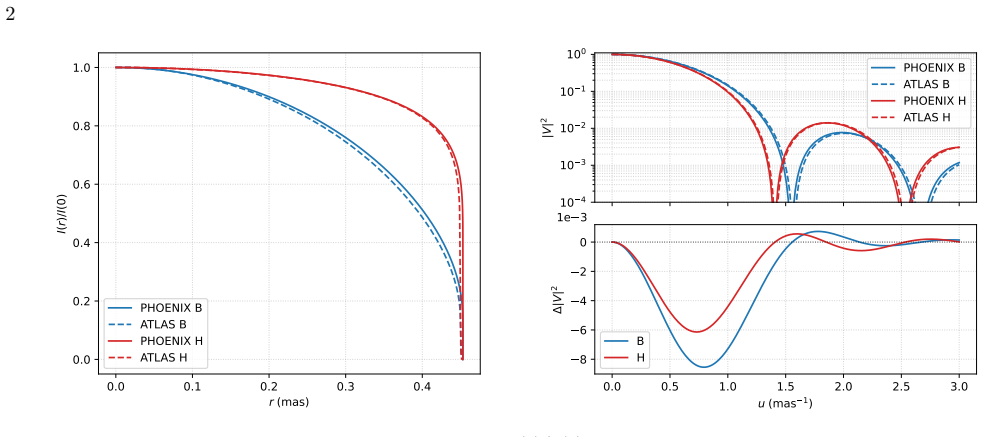
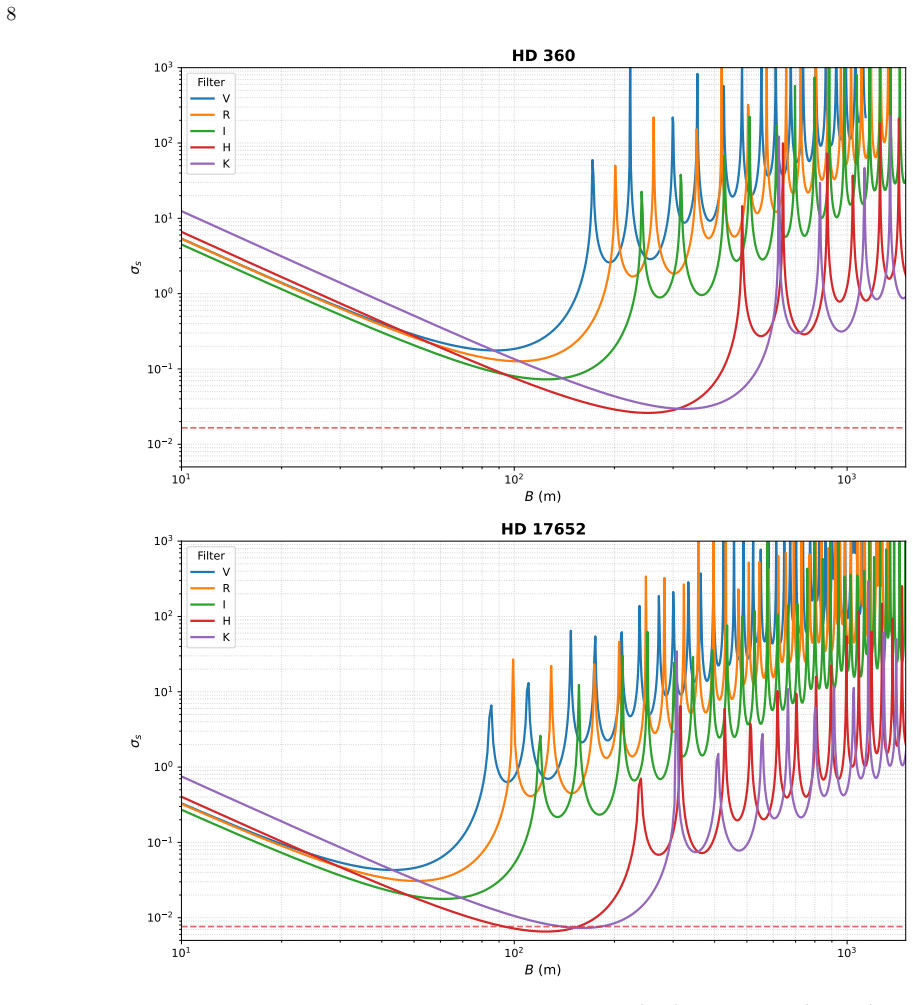
For the Red Clump star HD 17652, intensity interferometry in the H band at baselines matching PIONIER (~100 m) could achieve <1% angular size uncertainties in 2-hour exposures by measuring the primary peak of the visibility function, enabling direct comparison with existing measurements. Critically, observations at shorter wavelengths probe the secondary visibility maximum, providing independent checks of both measurement and systematic errors that are largely insensitive to limb-darkening assumptions. Exploiting the multiplex advantage of simultaneous multi-bandpass observations and the large number of baselines available with telescope arrays such as the Cherenkov Telescope Array can make
What carries the argument
The squared visibility function measured via intensity interferometry, interpreted through stellar atmosphere models to determine limb-darkened angular diameters.
Load-bearing premise
Stellar atmosphere models accurately capture the limb darkening of Red Clump stars so that visibility measurements translate to angular diameters without dominant systematic errors.
What would settle it
Observing HD 17652 with intensity interferometry in the H band at 100 m baselines and finding an angular diameter that differs by more than 1% from the value measured by PIONIER would show the method does not achieve the claimed validation precision.
Figures

read the original abstract
The surface-brightness-color (SBC) relationship for Red Clump stars provides a critical foundation for precision distance ladder measurements, including the 1\% distance determination to the Large Magellanic Cloud. Current SBC calibrations rely on angular diameter measurements of nearby Red Clump stars obtained through long-baseline optical interferometry using the Very Large Telescope Interferometer. We explore the application of intensity interferometry to measure limb-darkened angular diameters of Red Clump stars, offering a complementary approach to traditional amplitude interferometry. We describe the framework for extracting angular diameters from squared visibility measurements in intensity interferometry, accounting for limb darkening through the stellar atmosphere models. For the Red Clump star HD~17652, we show that intensity interferometry in the $H$ band at baselines matching PIONIER ($\sim$100~m) could achieve $<1$\% angular size uncertainties in 2-hour exposures by measuring the primary peak of the visibility function, enabling direct comparison with existing measurements. Critically, observations at shorter wavelengths probe the secondary visibility maximum, providing independent checks of both measurement and systematic errors that are largely insensitive to limb-darkening assumptions. Exploiting the multiplex advantage of simultaneous multi-bandpass observations and the large number of baselines available with telescope arrays such as the Cherenkov Telescope Array Observatory can reduce observing times to practical levels, making intensity interferometry a viable tool for validating the angular sizes for a subset of the Red Clump star calibration sample.
Editorial analysis
A structured set of objections, weighed in public.
Referee Report
Summary. The manuscript proposes intensity interferometry as a complementary technique to amplitude interferometry for validating limb-darkened angular diameters of Red Clump stars. It outlines a framework for extracting diameters from squared visibility measurements using stellar atmosphere models and claims that for the Red Clump star HD 17652, H-band observations at baselines of ~100 m (matching PIONIER) can achieve <1% angular size uncertainties in 2-hour exposures via the primary visibility peak, with shorter-wavelength secondary maxima providing largely limb-darkening-insensitive cross-checks. The approach exploits multiplexed multi-band observations and arrays like the Cherenkov Telescope Array Observatory to make the method practical for a subset of the calibration sample.
Significance. If the claimed <1% precision holds after full error budgeting and the secondary maxima prove insensitive at the targeted level, the work would provide an independent validation pathway for the surface-brightness-color relation of Red Clump stars. This could reduce systematic uncertainties in the distance ladder, including the 1% LMC distance calibration, by cross-checking existing VLT Interferometer measurements without relying solely on amplitude interferometry.
major comments (2)
- [Abstract] Abstract: the <1% angular size uncertainty claim for HD 17652 in 2-hour H-band exposures is presented as a performance estimate but lacks the full derivation, error budget, or numerical simulations needed to substantiate it; the abstract describes the framework and a single-star estimate without propagating photon noise, baseline coverage, or model uncertainties into the final precision.
- [Abstract] Abstract: the assertion that shorter-wavelength secondary visibility maxima provide checks 'largely insensitive to limb-darkening assumptions' is not quantitatively supported; a typical 0.05 uncertainty in the linear limb-darkening coefficient u can shift the inferred diameter by >0.5% even at the lobe peak, and no propagation of this residual sensitivity into the error budget is shown.
minor comments (1)
- The manuscript would benefit from explicit notation for the squared visibility function and the limb-darkening correction procedure in the framework section to improve clarity for readers unfamiliar with intensity interferometry.
Simulated Author's Rebuttal
We thank the referee for their careful and constructive review of our manuscript. We address the two major comments point by point below and have revised the manuscript to incorporate additional quantitative details and supporting calculations.
read point-by-point responses
-
Referee: [Abstract] Abstract: the <1% angular size uncertainty claim for HD 17652 in 2-hour H-band exposures is presented as a performance estimate but lacks the full derivation, error budget, or numerical simulations needed to substantiate it; the abstract describes the framework and a single-star estimate without propagating photon noise, baseline coverage, or model uncertainties into the final precision.
Authors: We agree that the abstract would benefit from a more explicit reference to the supporting analysis. The <1% precision estimate for HD 17652 is derived from photon-noise calculations, baseline coverage at ~100 m, and model fitting as detailed in Sections 3 and 4 of the manuscript. In the revised version we will add a concise error-budget summary to the abstract and expand the main text with explicit numerical simulations that propagate photon noise, baseline sampling, and model uncertainties into the final diameter precision. revision: yes
-
Referee: [Abstract] Abstract: the assertion that shorter-wavelength secondary visibility maxima provide checks 'largely insensitive to limb-darkening assumptions' is not quantitatively supported; a typical 0.05 uncertainty in the linear limb-darkening coefficient u can shift the inferred diameter by >0.5% even at the lobe peak, and no propagation of this residual sensitivity into the error budget is shown.
Authors: We thank the referee for this observation. Our analysis indicates that sensitivity to limb darkening is substantially reduced at the secondary maxima relative to the primary peak, but we acknowledge that a quantitative propagation was not provided. In the revised manuscript we will add a dedicated calculation quantifying the diameter shift induced by a typical Δu = 0.05 at both the primary and secondary visibility peaks, demonstrate the residual sensitivity, and fold the result into the overall error budget to support the claim that the secondary maxima provide largely insensitive cross-checks. revision: yes
Circularity Check
No circularity in proposed validation framework
full rationale
The paper applies standard interferometric visibility mathematics (squared visibility from intensity correlations) and pre-existing stellar atmosphere models for limb-darkening correction. The <1% precision claim for HD 17652 is a forward calculation from the primary visibility peak at ~100 m H-band baselines, not a fit to the target diameter. Assertions about secondary maxima at shorter wavelengths being largely insensitive are statements about the analytic form of the visibility function, which can be checked externally without reducing to the paper's inputs. No self-definitional steps, fitted inputs renamed as predictions, or load-bearing self-citations appear in the derivation chain.
Axiom & Free-Parameter Ledger
axioms (1)
- domain assumption Limb darkening in Red Clump stars is adequately described by standard stellar atmosphere models when interpreting visibility data
Lean theorems connected to this paper
-
IndisputableMonolith/Cost/FunctionalEquation.leanwashburn_uniqueness_aczel unclear?
unclearRelation between the paper passage and the cited Recognition theorem.
g(1)(u)=V(u)=∫I(θ)J0(2πuθ)θdθ / ∫I(θ)θdθ ; g(2)=1+|V(u)|^2 |g(1)(Δt)|^2 ; SNR and Fisher matrix for σ_s
-
IndisputableMonolith/Foundation/DimensionForcing.leanalexander_duality_circle_linking unclear?
unclearRelation between the paper passage and the cited Recognition theorem.
angular diameters from PIONIER H-band baselines 45-140 m fitted to SATLAS/PHOENIX models
What do these tags mean?
- matches
- The paper's claim is directly supported by a theorem in the formal canon.
- supports
- The theorem supports part of the paper's argument, but the paper may add assumptions or extra steps.
- extends
- The paper goes beyond the formal theorem; the theorem is a base layer rather than the whole result.
- uses
- The paper appears to rely on the theorem as machinery.
- contradicts
- The paper's claim conflicts with a theorem or certificate in the canon.
- unclear
- Pith found a possible connection, but the passage is too broad, indirect, or ambiguous to say the theorem truly supports the claim.
Reference graph
Works this paper leans on
-
[1]
Abe, S., Abhir, J., Acciari, V. A., et al. 2024, MNRAS, 529, 4387, doi: 10.1093/mnras/stae697
-
[2]
Acciari, V. A., Bernardos, M. I., Colombo, E., et al. 2020, MNRAS, 491, 1540, doi: 10.1093/mnras/stz3171
-
[3]
Acharyya, A., Aufdenberg, J. P., Bangale, P., et al. 2024, ApJ, 966, 28, doi: 10.3847/1538-4357/ad2b68
-
[4]
Aufdenberg, J. 2025, Probing stellar atmospheres and binary stars with Stellar Intensity Interferometry,, https://indico.ecap.work/event/129/contributions/1229/ attachments/606/1104/Probing%20stellar% 20atmospheres%20and%20binary%20stars%20with% 20SII V7.pdf
work page 2025
-
[5]
P., Ludwig, H.-G., & Kervella, P
Aufdenberg, J. P., Ludwig, H.-G., & Kervella, P. 2005, ApJ, 633, 424, doi: 10.1086/452622
-
[6]
Bertone, E., Buzzoni, A., Ch´ avez, M., & Rodr´ ıguez-Merino, L. H. 2004, AJ, 128, 829, doi: 10.1086/422486
-
[7]
Brown, R. H., & Twiss, R. Q. 1956a, Nature, 177, 27, doi: 10.1038/177027a0
-
[8]
Brown, R. H., & Twiss, R. Q. 1956b, Nature, 178, 1046, doi: 10.1038/1781046a0
-
[9]
Cifuentes, A., Acciari, V. A., Barnes, F., et al. 2024, in Society of Photo-Optical Instrumentation Engineers (SPIE) Conference Series, Vol. 13095, Optical and Infrared Interferometry and Imaging IX, ed. J. Kammerer, S. Sallum, & J. Sanchez-Bermudez, 1309527, doi: 10.1117/12.3016905
-
[10]
2023, A&A, 674, A63, doi: 10.1051/0004-6361/202346478
Claret, A., & Southworth, J. 2023, A&A, 674, A63, doi: 10.1051/0004-6361/202346478
-
[11]
Code, A. D., Davis, J., Bless, R. C., & Brown, R. H. 1976, ApJ, 203, 417, doi: 10.1086/154093
-
[12]
2024, PhRvD, 109, 123029, doi: 10.1103/PhysRevD.109.123029
Murray, N. 2024, PhRvD, 109, 123029, doi: 10.1103/PhysRevD.109.123029
-
[13]
2016, in Society of Photo-Optical Instrumentation Engineers (SPIE) Conference Series, Vol
Dravins, D. 2016, in Society of Photo-Optical Instrumentation Engineers (SPIE) Conference Series, Vol. 9907, Optical and Infrared Interferometry and Imaging V, ed. F. Malbet, M. J. Creech-Eakman, & P. G. Tuthill, 99070M, doi: 10.1117/12.2234130 Gaia Collaboration, Prusti, T., de Bruijne, J. H. J., Brown, A. G. A., et al. 2016, A&A, 595, A1, doi: 10.1051/0...
-
[14]
Galanis, M., Van Tilburg, K., Baryakhtar, M., & Weiner, N. 2025, Phys. Rev. D, 112, 083057, doi: 10.1103/wqz5-2jjs
-
[15]
2018, A&A, 616, A68, doi: 10.1051/0004-6361/201833341
Gallenne, A., Pietrzy´ nski, G., Graczyk, D., et al. 2018, A&A, 616, A68, doi: 10.1051/0004-6361/201833341
-
[16]
Graczyk, D., Pietrzy´ nski, G., Thompson, I. B., et al. 2012, ApJ, 750, 144, doi: 10.1088/0004-637X/750/2/144
-
[17]
Graczyk, D., Pietrzy´ nski, G., Thompson, I. B., et al. 2018, ApJ, 860, 1, doi: 10.3847/1538-4357/aac2bf
-
[18]
2010, in Society of Photo-Optical Instrumentation Engineers (SPIE) Conference Series, Vol
Haguenauer, P., Alonso, J., Bourget, P., et al. 2010, in Society of Photo-Optical Instrumentation Engineers (SPIE) Conference Series, Vol. 7734, Optical and Infrared Interferometry II, ed. W. C. Danchi, F. Delplancke, & J. K. Rajagopal, 773404, doi: 10.1117/12.857070 Hanbury Brown, R., Davis, J., & Allen, L. R. 1974, MNRAS, 167, 121, doi: 10.1093/mnras/16...
-
[19]
Hoyt, T. J., Freedman, W. L., Madore, B. F., et al. 2018, ApJ, 858, 12, doi: 10.3847/1538-4357/aab7ed
-
[20]
2013, A&A, 553, A6, doi: 10.1051/0004-6361/201219058
Husser, T.-O., Wende-von Berg, S., Dreizler, S., et al. 2013, A&A, 553, A6, doi: 10.1051/0004-6361/201219058
-
[21]
Kaiser, R. 2024, Intensity Correlations for Stars,, https: //lagrange.oca.eu/images/LAGRANGE/pages perso/ acpetit/Lagrange Seminars/2024/06 18 Kaiser.pdf
work page 2024
-
[22]
2019, Monthly Notices of the Royal Astronomical Society, 484, 2656, doi: 10.1093/mnras/stz114
Lachaume, R., Rabus, M., Jord´ an, A., et al. 2019, Monthly Notices of the Royal Astronomical Society, 484, 2656, doi: 10.1093/mnras/stz114
-
[23]
2011, MNRAS, 418, 583, doi: 10.1111/j.1365-2966.2011.19507.x
Laney, C. D., Joner, M. D., & Pietrzy´ nski, G. 2012, MNRAS, 419, 1637, doi: 10.1111/j.1365-2966.2011.19826.x Le Bouquin, J.-B., Berger, J.-P., Lazareff, B., et al. 2011, A&A, 535, A67, doi: 10.1051/0004-6361/201117586
-
[24]
G., Karl, S., Rivet, J.-P., & von Zanthier, J
Leopold, V. G., Karl, S., Rivet, J.-P., & von Zanthier, J. 2025, Journal of Astronomical Telescopes, Instruments, and Systems, 11, 035005, doi: 10.1117/1.JATIS.11.3.035005
-
[25]
2022, in Society of Photo-Optical Instrumentation Engineers (SPIE) Conference Series, Vol
Matthews, N., Rivet, J.-P., Hugbart, M., et al. 2022, in Society of Photo-Optical Instrumentation Engineers (SPIE) Conference Series, Vol. 12183, Optical and Infrared Interferometry and Imaging VIII, ed. A. M´ erand, S. Sallum, & J. Sanchez-Bermudez, 121830G, doi: 10.1117/12.2628561
-
[26]
2023, AJ, 165, 117, doi: 10.3847/1538-3881/acb142
Matthews, N., Rivet, J.-P., Vernet, D., et al. 2023, AJ, 165, 117, doi: 10.3847/1538-3881/acb142
-
[27]
Neilson, H. R., & Lester, J. B. 2013, A&A, 554, A98, doi: 10.1051/0004-6361/201321502 Nu˜ nez, P. D., Holmes, R., Kieda, D., & Lebohec, S. 2012, MNRAS, 419, 172, doi: 10.1111/j.1365-2966.2011.19683.x Pietrzy´ nski, G., Graczyk, D., Gallenne, A., et al. 2019, Nature, 567, 200, doi: 10.1038/s41586-019-0999-4
-
[28]
2019, The Astrophysical Journal, 876, 85, doi: 10.3847/1538-4357/ab1422
Scolnic, D. 2019, The Astrophysical Journal, 876, 85, doi: 10.3847/1538-4357/ab1422
work page internal anchor Pith review doi:10.3847/1538-4357/ab1422 2019
-
[29]
Schaefer, G. H., ten Brummelaar, T. A., Gies, D. R., et al. 2020, in Society of Photo-Optical Instrumentation Engineers (SPIE) Conference Series, Vol. 11446, Optical and Infrared Interferometry and Imaging VII, ed. P. G
work page 2020
-
[30]
Tuthill, A. M´ erand, & S. Sallum, 1144605, doi: 10.1117/12.2562665
-
[31]
2022, in Society of Photo-Optical Instrumentation Engineers (SPIE) Conference Series, Vol
Tagliaferri, G., et al. 2022, in Society of Photo-Optical Instrumentation Engineers (SPIE) Conference Series, Vol. 12182, Ground-based and Airborne Telescopes IX, ed. H. K. Marshall, J. Spyromilio, & T. Usuda, 121820K, doi: 10.1117/12.2627956 ten Brummelaar, T. A., McAlister, H. A., Ridgway, S. T., et al. 2005, ApJ, 628, 453, doi: 10.1086/430729
-
[32]
2025, MNRAS, 537, 2334, doi: 10.1093/mnras/stae2643
Vogel, N., Zmija, A., Wohlleben, F., et al. 2025, MNRAS, 537, 2334, doi: 10.1093/mnras/stae2643
-
[33]
Wesselink, A. J. 1969, MNRAS, 144, 297, doi: 10.1093/mnras/144.3.297
-
[34]
Wittkowski, M., Aufdenberg, J. P., & Kervella, P. 2004, A&A, 413, 711, doi: 10.1051/0004-6361:20034149
-
[35]
2021, MNRAS, 506, 1585, doi: 10.1093/mnras/stab1387
Barbieri, C. 2021, MNRAS, 506, 1585, doi: 10.1093/mnras/stab1387
-
[36]
2024, MNRAS, 527, 12243, doi: 10.1093/mnras/stad3676
Zmija, A., Vogel, N., Wohlleben, F., et al. 2024, MNRAS, 527, 12243, doi: 10.1093/mnras/stad3676
discussion (0)
Sign in with ORCID, Apple, or X to comment. Anyone can read and Pith papers without signing in.