REVIEW 3 major objections 5 minor 1 cited by
This paper argues that single-step retrosynthesis should be judged by chemical plausibility — whether the proposed reaction's reaction-center and functional-group context has precedent in known chemistry — rather than by whether the predict
Reviewed by Pith at T0; open to challenge. T0 means a machine referee read the full paper against a public rubric. the ladder, T0–T4 →
T0 review · deepseek-v4-flash
2026-08-03 04:54 UTC pith:B2DP64MX
load-bearing objection ChemCensor is a useful idea, but the paper's central claim that it measures chemical plausibility is unvalidated, and the C3LM results are confounded by using the same scorer for filtering, reward, and evaluation. the 3 major comments →
When Single Answer Is Not Enough: Rethinking Single-Step Retrosynthesis Benchmarks for LLMs
The pith
A machine-rendered reading of the paper's core claim, the machinery that carries it, and where it could break.
Core claim
The paper's central claim is that chemical plausibility, operationalized as precedent support for a reaction's reaction center and functional-group context, is a better measure of single-step retrosynthesis quality than exact-match Top-K accuracy. It embodies this claim in ChemCensor, which decomposes a proposed reaction into a hierarchical reaction center (five context levels) and a 515-functional-group signature, then looks up both against a library built from a large public patent reaction database; reactions without precedent get zero, and higher scores reflect broader matched context. On an out-of-domain set of 100 novel targets, the paper shows that most leading LLMs degrade sharply on
What carries the argument
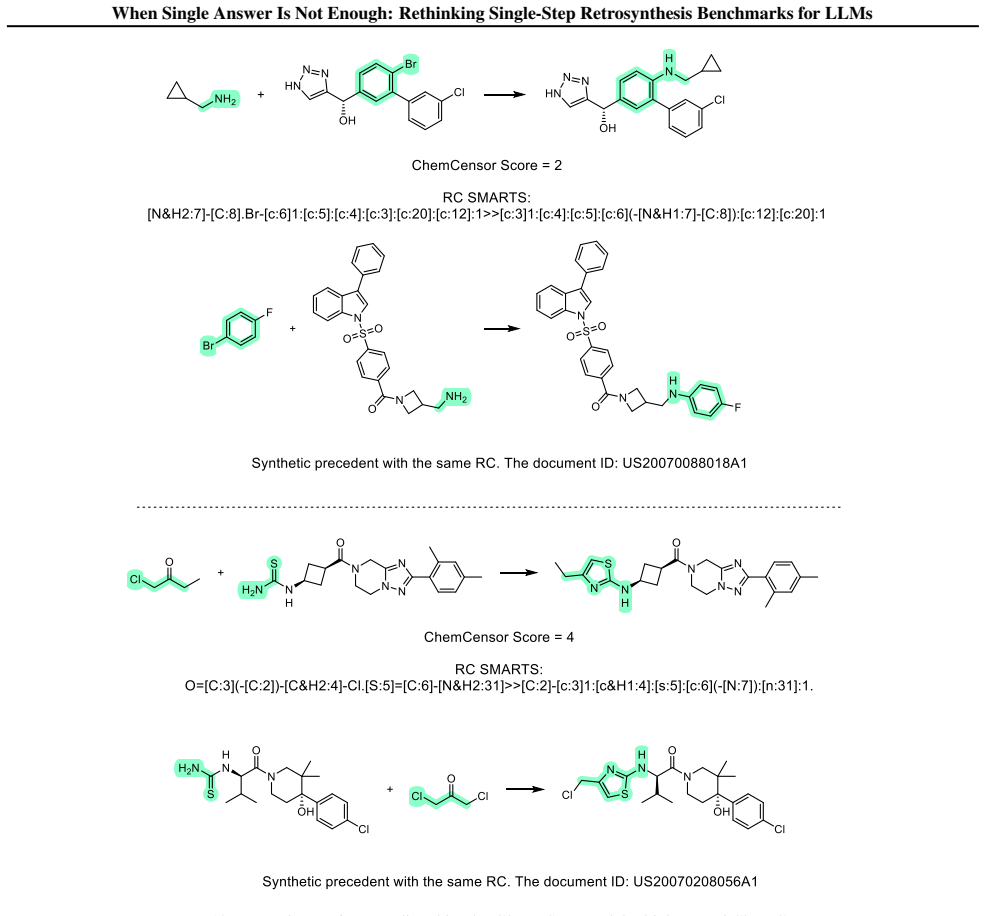
ChemCensor: a precedent-based scorer that splits a reaction into a reaction center (RC, the atoms/bonds that change, represented at five increasing context sizes RC1–RC5) and a static functional-group (FG) signature (from a curated list of 515 FG patterns). It matches these against a relational database of reaction centers and FG co-occurrences built from a large public patent reaction set, and assigns a confidence score 0–5 based on how much substructural context is supported. This score replaces exact-match accuracy in the benchmark, is used as a filter to build CREED, and serves as a reward signal in reinforcement learning for C3LM.
Load-bearing premise
A reaction is scored plausible only if its reaction center and functional-group context have a recorded precedent in the patent-based reference database; absence of a precedent is treated as zero plausibility, so reactions that are genuinely valid but undocumented get mislabeled as implausible.
What would settle it
Take a collection of reactions published after the reference database's cutoff (or sourced from non-patent literature) that expert chemists confirm as working, and run ChemCensor on them; if a substantial fraction score zero solely due to missing precedents, the metric's central equivalence between 'undocumented' and 'implausible' is refuted. A cheaper check: use the paper's own example of a chloro-Stille coupling that ChemCensor scores low despite being found in the same patent family as the ground-truth reaction, and see whether expert chemists judge it as a real synthetic route — if they do
If this is right
- Model rankings change substantially when plausibility replaces exact-match: several frontier LLMs that score well on the standard test collapse on the novel out-of-domain set, suggesting memorization inflates their Top-K numbers.
- Training on plausibility-verified multi-answer data (CREED) improves performance on novel targets without needing a larger base model; the gains come from data quality and coverage of diverse disconnections.
- Using ChemCensor as a reward in reinforcement learning reduces functional-group compatibility errors, indicating that the metric encodes chemoselectivity and regioselectivity knowledge transferable to the model.
- The benchmark exposes that even strong proprietary models fail at functional-group compatibility on specific groups like aryl halides and amines, giving a concrete diagnostic for where synthesis models need improvement.
- Exact-match ground truth is shown to be misleading: alternative disconnections that chemists would accept receive zero under Top-K but pass plausibility scoring.
Where Pith is reading between the lines
- Because ChemCensor equates 'no precedent' with 'implausible,' it will systematically downgrade genuinely new or recently invented chemistry absent from the patent corpus; as reaction space evolves, the reference library would need continuous updating, and future benchmarks should test whether this creates a false-negative bias.
- The CREED dataset is generated from a few thousand expert templates plus drug-scheme scaffolds, so its diversity is bounded by template coverage; a model trained on it might underperform on reactions outside that template space even when ChemCensor deems them plausible.
- A natural testable extension: combine ChemCensor with a forward-reaction validator (round-trip check) to catch false positives where precedent exists but the predicted reactants would not actually form the product; the paper's own experiments suggest round-trip rewards degrade out-of-domain, hinting that these two signals capture different failure modes.
- The 100-target expert-validated set is small but leakage-resistant; scaling it to a few thousand novel targets would sharpen the ranking between top models and reduce variance in the reported averages.
Editorial analysis
A structured set of objections, weighed in public.
Referee Report
Summary. The paper proposes ChemCensor, a precedent-based metric that scores single-step retrosynthesis predictions by matching their reaction centers and functional-group contexts against USPTO-full. It introduces CREED (~6.4M reactions, filtered by ChemCensor), URSA-expert-2026 (100 novel expert-validated targets), and C3LM, a Qwen3-8B model fine-tuned on CREED (and, for some variants, with ChemCensor or other rewards). The central claim is that ChemCensor provides a more meaningful plausibility-based evaluation than exact-match Top-K accuracy, and that C3LM trained on CREED outperforms a broad set of proprietary and open-weight LLMs on this benchmark.
Significance. If ChemCensor is a faithful proxy for chemical plausibility, the paper contributes a useful alternative to exact-match benchmarking, a large training dataset, and a new out-of-domain test set. The release of CREED and URSA-expert-2026 would be valuable resources for the community, and the C3LM results would suggest that large curated reaction sets improve SSRS performance beyond current baselines. However, because ChemCensor is used both as the training-filter/reward and as the evaluation metric without independent validation, the significance of these claims is currently uncertain.
major comments (3)
- [Sec. 3.1, 3.4, 4.3, 4.4] ChemCensor is used at three points in the pipeline: (i) to filter CREED (Sec. 3.4: 'only those with CC Score >0 were retained'), (ii) as the RFT reward (Sec. 4.3: 'ChemCensor Reward'), and (iii) as the evaluation metric (Sec. 4.4). This creates a closed loop: the training data, the optimization target, and the test score all derive from the same scorer. The reported superiority of C3LM (especially the ChemCensor-reward RFT variant) may reflect optimization of the metric rather than improved chemical plausibility. To support the central claim, the authors must validate ChemCensor against an external reference (e.g., human expert plausibility ratings, laboratory feasibility, or an independent forward-synthesis metric) and provide results on such a reference for the benchmarked models.
- [Sec. 3.1] The zero-score rule — 'if the algorithm cannot find supporting precedents for the RC and/or its FGs environment, the score is zero' — operationally defines chemical plausibility as 'has a precedent in USPTO-full (1976–2016 US patents)'. This conflates database coverage with feasibility and will penalize valid modern or niche chemistry outside that corpus. Since CREED is built by keeping only CC>0 reactions and the benchmark scores all predictions with ChemCensor, this assumption is load-bearing. A concrete test: take expert-validated reactions from the URSA-expert-2026 schemes (or other chemistry outside USPTO-full) and show their ChemCensor scores; if many are zero, this confirms the bias. The paper does not report such a test.
- [Sec. J, Table 4] The curation of USPTO-50K-test is described inconsistently. The main text (Sec. 3.2) says 'removing a small subset', Appendix J states 'We removed 28 entries', but Table 4 lists 20 + 4 + 5 + 3 = 32 removed entries. This discrepancy directly affects the benchmark surface and reproducibility. Please correct the count and the table, and state the exact version of the curated test set used for all reported results.
minor comments (5)
- [Table 1] In the RetroDFM-R row, '4.361.56' appears to be a formatting error; the value should likely be '4.36' or '1.56'.
- [Fig. 1 / Appendix F] The caption in Fig. 1 contains 'accriss' (likely 'across'). Similar typo in Appendix F caption.
- [Sec. 4.4] The evaluation says 15 independent responses per product; however, Table 1 reports percentages for 'Unique' but the exact definition of uniqueness (after deduplication) is only given in Sec. 3.3. Clarify whether 'Unique' refers to the fraction of targets with at least one valid unique reaction or the fraction of all generated samples.
- [Appendix K] Only one expert-validated synthesis scheme is provided as an example. Since URSA-expert-2026 is claimed to be expert-annotated, please release all 100 schemes or provide a public link; otherwise the 'expert assessment' claim is not verifiable.
- [Sec. 2.2 / References] Some references are incomplete or informal (e.g., 'Vl´eduts, 1963' spelling, and several ArXiv-only preprints). Ensure all citations have full bibliographic details.
Circularity Check
C3LM is filtered, rewarded, and scored by the same ChemCensor function; its reported benchmark superiority is largely self-confirming.
specific steps
-
fitted input called prediction
[Section 4.3 (ChemCensor Reward) vs. Section 3.3 and Table 1]
"ChemCensor Reward: Applies the confidence level of ChemCensor as a reward. For a generated reaction, the reward is the chemical plausibility between 0−5 , scaled to (0,+1) . … We used ChemCensor Score (CC) as an evaluation metric for a primary reaction."
During RFT, GRPO maximizes the ChemCensor score of generated reactants; Table 1 reports exactly this score as Av. PT-Max CC and Av. PT-Top-K CC. The paper's finding that 'RFT with the ChemCensor reward increases PT-Max CC' is therefore the definition of reward maximization, not an empirical discovery about chemical plausibility. The same function appears on both sides of the pipeline: as the reward (input) and as the headline evaluation metric (output). This is the fitted-input-called-prediction pattern: the model is optimized on the metric that is then reported as independent evidence of improvement.
-
self definitional
[Section 3.1 (ChemCensor Metric) and Section 3.4 (CREED)]
"if the algorithm cannot find supporting precedents for the RC and/or its FGs environment, the score is zero. … All candidate reactions were subsequently verified with CC, and only those with CC Score >0 were retained."
ChemCensor operationalizes 'chemical plausibility' as 'has a USPTO-full precedent for RC and FG context.' CREED is then filtered to retain only CC>0 reactions, i.e., only reactions that satisfy this definition. C3LM is trained on CREED and subsequently evaluated with the same CC function. Thus C3LM's advantage over baselines on the ChemCensor benchmark partly reduces to: 'a model trained on CC-positive reactions scores higher on CC.' No external criterion (laboratory validation, expert ratings, or an independent plausibility metric) is used to break the loop; the expert schemes in URSA-expert-2026 are provided but are not converted into the reported evaluation scores.
full rationale
ChemCensor is simultaneously the proposed scientific measure of chemical plausibility, the filter that selects CREED, the reward used in RFT, and the metric reported in Table 1. The clearest reduction is in Section 4.3: the ChemCensor Reward is the exact score later reported as Av. PT-Max/PT-Top-K CC. Thus the RFT-CC model's improvement over baselines is the GRPO objective itself — a reward maximizer will increase the metric it is trained on, without providing new information about chemical plausibility. Similarly, CREED was constructed by keeping only CC>0 reactions, so a model fine-tuned on CREED has been trained on the evaluator's positive class. The paper presents no external validation linking CC scores to laboratory feasibility or to the expert-validated schemes in URSA-expert-2026; those schemes are not used as quantitative evaluation labels. Because the training data, reward, and evaluation all reduce to the same unvalidated function, the central performance claim is substantially self-confirming. I set 7 rather than 10 because the paper does contain independent components — the CREED resource, the expert target set, and the empirical observation that baselines fail FG-compatibility checks — and the loop is an optimization/evaluation loop rather than a formal logical tautology.
Axiom & Free-Parameter Ledger
free parameters (3)
- RC context levels RC1-RC5 =
topological distances 1, 2, 3, 4, and an unspecified RC5
- 515 functional-group SMARTS patterns =
515 curated patterns
- CREED curation threshold =
ChemCensor score > 0
axioms (4)
- domain assumption USPTO-full (1976-2016 US patents) is a sufficient reference database for chemical plausibility.
- domain assumption Absence of a precedent implies the reaction is chemically implausible.
- domain assumption Reaction centers and functional-group compatibility are fully captured by SMARTS-like pattern matching at topological distances 1-4.
- domain assumption The ~3K expert-coded templates and drug-derived synthetic scheme templates generate chemically valid reactions.
read the original abstract
Recent progress has expanded the use of large language models (LLMs) in drug discovery, including synthesis planning. However, objective evaluation of retrosynthesis performance remains limited. Existing benchmarks and metrics typically rely on published synthetic procedures and Top-K accuracy based on single ground-truth, which does not capture the open-ended nature of real-world synthesis planning. We propose a new benchmarking framework for single-step retrosynthesis that evaluates both general-purpose and chemistry-specialized LLMs using ChemCensor, a novel metric for chemical plausibility. By emphasizing plausibility over exact match, this approach better aligns with human synthesis planning practices. We also introduce CREED, a novel dataset comprising millions of ChemCensor-validated reaction records for LLM training, and use it to train a model that improves over the LLM baselines under this benchmark.
Figures




Forward citations
Cited by 1 Pith paper
-
URSA: Chemistry-Aware Benchmark for Utilitarian Retrosynthesis Assessment
Specialized retrosynthesis models outperform LLMs on chemically plausible multi-step routes when scored by the new URSA Solv-2 protocol using ChemCensor.
Reference graph
Works this paper leans on
-
[1]
tBuNC, K2CO3, air, Pd(PPh3)4, toluene
-
[2]
TFA Org. Biomol. Chem. (2020), 18(26), 4936-4940 10.1039/D0OB01092H K2CO3, MeOH NH2 N O NN N tBuONa, Pd(dpa)2, toluene Cl N HN O Cl 932-22-9 25637-16-5 O Br Mg, THF Cl NN H O O Bioorganic Med. Chem. Lett. (2015), 25(5), 1030-1035 10.1016/j.bmcl.2015.01.024 O Cl Cl NN O O O 727985-37-7 Br HO TBDMSCl, DMAP Br TBDMSO TBAF, MeOH N H N O NN N OH N H N O NN N O...
-
[8]
doi: https://doi.org/10.1002/chem.201605499. URL https://chemistry-europe. onlinelibrary.wiley.com/doi/abs/10. 1002/chem.201605499. Segler, M. H. S., Preuss, M., and Waller, M. P. Planning chemical syntheses with deep neural networks and sym- bolic AI.Nature, 555(7698):604–610, March 2018. doi: 10.1038/nature25978. URL https://www.nature. com/articles/nat...
Pith/arXiv arXiv 2018
-
[9]
URL https://data.x.ai/ 2025-11-17-grok-4-1-model-card.pdf. Xia, Y ., Jin, P., Xie, S., He, L., Cao, C., Luo, R., Liu, G., Wang, Y ., Liu, Z., Chen, Y .-J., Guo, Z., Bai, Y ., Deng, P., Min, Y ., Lu, Z., Hao, H., Yang, H., Li, J., Liu, C., Zhang, J., Zhu, J., Bi, R., Wu, K., Zhang, W., Gao, K., Pei, Q., Wang, Q., Liu, X., Li, Y ., Zhu, H., Lu, Y ., Ma, M.,...
Pith/arXiv arXiv 2025
-
[14]
The URSA-expert-2026 was used as a holdout set
AcOH, H2O Figure 20.Theoretical synthesis scheme for the compound X404-135-0036 from URSA-expert-2026 set. The URSA-expert-2026 was used as a holdout set. The CREED and USPTO-full were decontaminated within URSA- expert-2026, so the training datasets for our models don’t contain reactions and product molecules from the holdout at all. L. Benchmark Models ...
2026
-
[15]
**Left Arm (N-aryl-oxadiazole- heterocycle):** ‘Nc2noc(-c3cnn4ccccc34)n2‘ 3
**Central Phenyl Core:** ‘Cc1ccc(N...)c(CO...)c1‘ 2. **Left Arm (N-aryl-oxadiazole- heterocycle):** ‘Nc2noc(-c3cnn4ccccc34)n2‘ 3. **Right Arm (Ether-linked pyrazolone derivative):** ‘COc2cnn(C(=O)C3CC3)c(=O)c2C2CCOCC2‘ Based on this, we can propose the following disconnections: **Disconnection 1: N-aryl bond formation** The N-aryl bond (‘Ar-NH-Ar’‘) is co...
-
[16]
**Hydrazine derivative:** ‘H2N-NH-C(=O)C2CC2‘ (N-cyclopropylcarbonyl hydrazine) 2. **Beta-keto ester:** ‘R-CO-CH2-COOEt‘ where ‘R‘ is ‘C1CCOCC1‘ (ethyl 3-oxo-3-(tetrahydropyran-4-yl)propanoate) <skipped reasoning> **Overall Proposed Reactants:** The most direct disconnection leads to three main fragments that are then coupled. * **Fragment 1 (central core...
-
[17]
This would yield ‘<smiles>Cc1ccc(Nc2noc(-c3cnn4ccccc34)n2)c(CO)c1</smiles >‘
Buchwald-Hartwig coupling of ‘Cc1ccc(Br)c(CO)c1‘ with ‘Nc1noc(-c2cnn3ccccc23)n1‘ to form the N- aryl bond. This would yield ‘<smiles>Cc1ccc(Nc2noc(-c3cnn4ccccc34)n2)c(CO)c1</smiles >‘. 2. Then, a Mitsunobu reaction or a Williamson ether synthesis between the benzylic alcohol (‘-CH2OH‘) from the product of step 1 and the phenolic pyrazolone (‘Oc1cnn(C(=O)C...
-
[18]
The CH2O ether linkage could be formed via Williamson ether synthesis 3
The NH-oxadiazole bond could be formed via nucleophilic aromatic substitution 2. The CH2O ether linkage could be formed via Williamson ether synthesis 3. The cyclopropylcarbonyl on the nitrogen could be an acylation Key fragments I can identify: - The oxadiazole with indazole: -c1noc(-c2cnn3ccccc23)n1 - The aromatic amine with CH2OH: Cc1ccc(N)c(CO)c1 or s...
-
[19]
A nucleophilic aromatic substitution between an aniline and a chloro-oxadiazole 2. The aniline already contains the CH2O-pyridazinone substituent **Plausible reactants:** <smiles>Clc1noc(-c2cnn3ccccc23)n1</smiles> <smiles>Cc1ccc(N)c(COc2cnn(C(=O)C3CC3)c(=O)c2C2CCOCC2)c1</smiles> The reaction would proceed via nucleophilic aromatic substitution where the a...
-
[20]
There’s a methylphenyl group (toluene derivative) with: - A -Nc2noc(-c3cnn4ccccc34)n2 substituent (an oxadiazole ring with an indazole) - A -COc2cnn(C(=O)C3CC3)c(=O)c2C2CCOCC2 substituent (a pyridazinone with cyclopropyl amide and tetrahydropyran) Looking at this structure, I can see several key components:
-
[21]
Jin, W., Coley, C., Barzilay, R., and Jaakkola, T
URL https://www.sciencedirect.com/ science/article/pii/S2095809922005665. Jin, W., Coley, C., Barzilay, R., and Jaakkola, T. Predicting organic reaction outcomes with weisfeiler-lehman 10 When Single Answer Is Not Enough: Rethinking Single-Step Retrosynthesis Benchmarks for LLMs network. In Guyon, I., Luxburg, U. V ., Bengio, S., Wallach, H., Fergus, R., ...
-
[22]
An oxadiazole ring (-noc-n-) connected to: - An aniline nitrogen - An indazole (-c3cnn4ccccc34)
-
[23]
The ether bond (C-O-C) between the benzyl and pyridazinone 2
A pyridazinone system with: - An ether linkage (COc) - A cyclopropyl carbonyl group C(=O)C3CC3 - A tetrahydropyran ring (C2CCOCC2) Possible disconnections: 1. The ether bond (C-O-C) between the benzyl and pyridazinone 2. The C-N bond between the aniline and oxadiazole For the synthesis, plausible reactants could be:
-
[24]
Guo, T., Guo, K., Nan, B., Liang, Z., Guo, Z., Chawla, N
URL https://www.sciencedirect.com/ science/article/pii/S2451929418300858. Guo, T., Guo, K., Nan, B., Liang, Z., Guo, Z., Chawla, N. V ., Wiest, O., and Zhang, X. What can large language models do in chemistry? a comprehensive benchmark on eight tasks. InProceedings of the 37th International Conference on Neural Information Processing Systems, NIPS ’23, Re...
Pith/arXiv arXiv 2023
-
[25]
A halogenated pyridazinone (like a chloropyridazinone): Clc1cnn(C(=O)C2CC2)c(=O)c1C1CCOCC1
-
[26]
A nucleophilic aromatic substitution or Williamson ether synthesis could couple these fragments together
A hydroxymethyl-substituted aniline bearing the oxadiazole group: HOCc1cc(C)ccc1Nc2noc(- c3cnn4ccccc34)n2 The key disconnections appear to be the ether linkage between the benzyl carbon and pyridazinone oxygen, and potentially the C-N bond connecting the aniline to the oxadiazole. A nucleophilic aromatic substitution or Williamson ether synthesis could co...
-
[27]
- Multiple electron-withdrawing groups activate the ring and allow substitution
**SNAr (substituent on aromatic rings)**: - Benzene substituents can undergo coupling reactions, like substitution of an existing leave group with an amine subsequent from another carbonyl or bromide source. - Multiple electron-withdrawing groups activate the ring and allow substitution
-
[28]
- Perhaps a Buchwald–Hartwig amination? Possible precursors: The first part is the source molecule, and the second component is the amine
**Benzimidazole derivatives can be formed via a C-N bond formation:** - The amine and aryl chloride or halide could attach to form a substituting amine. - Perhaps a Buchwald–Hartwig amination? Possible precursors: The first part is the source molecule, and the second component is the amine. Given the complexity, the reaction likely links these parts. **Re...
-
[70]
URL https://aclanthology.org/2023. emnlp-main.70. Rasley, J., Rajbhandari, S., Ruwase, O., and He, Y . Deep- Speed: System optimizations enable training deep learn- ing models with over 100 billion parameters. InPro- ceedings of the 26th ACM SIGKDD International Con- ference on Knowledge Discovery & Data Mining, KDD ’20, pp. 3505–3506, New York, NY , USA,...
arXiv 2023
-
[827]
Zhang, C., Lin, Q., Zhu, B., Yang, H., Lian, X., Deng, H., Zheng, J., and Liao, K
URL https://spj.science.org/doi/ abs/10.34133/research.0827. Zhang, C., Lin, Q., Zhu, B., Yang, H., Lian, X., Deng, H., Zheng, J., and Liao, K. SynAsk: unleashing the power of large language models in organic synthesis.Chem. Sci., 16:43–56, 2025a. doi: 10.1039/D4SC04757E. URL http://dx.doi.org/10.1039/D4SC04757E. Zhang, D., Liu, W., Tan, Q., Chen, J., Yan...
Pith/arXiv arXiv 2024
-
[840]
URL https://doi.org/10.24963/ijcai. 2025/840. Liu, B., Ramsundar, B., Kawthekar, P., Shi, J., Gomes, J., Luu Nguyen, Q., Ho, S., Sloane, J., Wender, P., and Pande, V . Retrosynthetic reaction prediction us- ing neural sequence-to-sequence models.ACS Cen- tral Science, 3(10):1103–1113, 2017. doi: 10.1021/ acscentsci.7b00303. URL https://doi.org/10. 1021/ac...
doi:10.24963/ijcai 2025
-
[1694]
wiley.com/doi/abs/10.1002/wcms.1694
URL https://wires.onlinelibrary. wiley.com/doi/abs/10.1002/wcms.1694. 14 When Single Answer Is Not Enough: Rethinking Single-Step Retrosynthesis Benchmarks for LLMs A. Models’ Performance no reas, CREED reas, CREED+USPTO-fullCC rewCREED MAexact matching no reas, CREED+USPTO-fullGrok-4.1 Gemini 3 Flash prev MT rew NatureLM Claude 4.5 SonnetClaude 4.5 Opus ...
-
[2017]
cc/paper_files/paper/2017/file/ ced556cd9f9c0c8315cfbe0744a3baf0-Paper
URL https://proceedings.neurips. cc/paper_files/paper/2017/file/ ced556cd9f9c0c8315cfbe0744a3baf0-Paper. pdf. Kang, C., Liu, X., and Guo, F. Retrointext: A multimodal large language model enhanced framework for retrosyn- thetic planning via in-context representation learning. In The Thirteenth International Conference on Learning Representations, 2025. UR...
arXiv 2017
-
[2025]
URL https://openreview.net/forum? id=30iBKSQMXn. Livne, M., Miftahutdinov, Z., Tutubalina, E., Kuznetsov, M., Polykovskiy, D., Brundyn, A., Jhunjhunwala, A., Costa, A., Aliper, A., Aspuru-Guzik, A., and Zhavoronkov, A. nach0: multimodal natural and chemical languages foun- dation model.Chem. Sci., 15:8380–8389, 2024. doi: 10.1039/D4SC00966E. URL http://dx...
arXiv 2024
-
[9294]
doi: https://doi.org/10.1016/j.chempr.2018.02
discussion (0)
Sign in with ORCID, Apple, or X to comment. Anyone can read and Pith papers without signing in.