REVIEW 4 major objections 5 minor 10 cited by
A lightweight RL router that picks a memory-processing budget per query can beat offline memory systems on both accuracy and cost, across three benchmarks.
Reviewed by Pith at T0; open to challenge. T0 means a machine referee read the full paper against a public rubric. the ladder, T0–T4 →
T0 review · deepseek-v4-flash
2026-08-03 04:00 UTC pith:AGHHOCHF
load-bearing objection Useful modular testbed, but the router's causal role is untested — missing a fixed-tier control; needs a major revision before the headline frontier claims are believable. the 4 major comments →
Learning Query-Aware Budget-Tier Routing for Runtime Agent Memory
The pith
A machine-rendered reading of the paper's core claim, the machinery that carries it, and where it could break.
Core claim
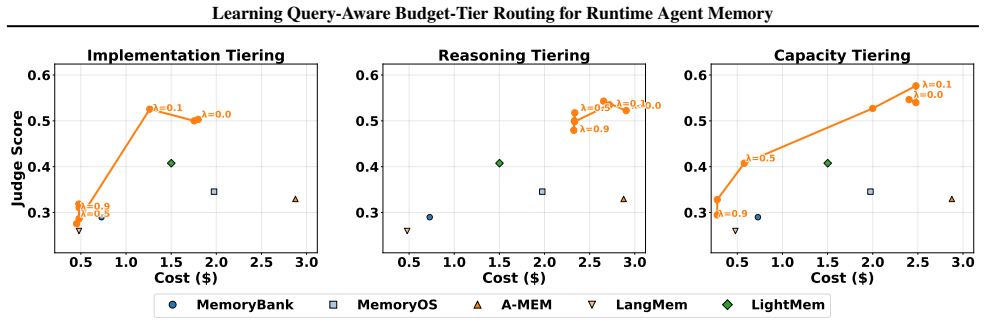
BudgetMem claims that a modular runtime memory pipeline, where each module exposes three budget tiers and a shared reinforcement-learned router selects tiers query-by-query, delivers higher answer quality and better accuracy–cost frontiers than offline, query-agnostic memory systems such as MemoryBank, A-MEM, LightMem, and others. Concretely, on LoCoMo, LongMemEval, and HotpotQA, all three BudgetMem variants—implementation tiering, reasoning tiering, and capacity tiering—surpass strong baselines in the performance-first regime, and tracing lambda from 0 to 0.9 yields smooth Pareto frontiers that envelope the baselines at both low and high cost.
What carries the argument
The central object is the budget-tiered modular pipeline: a fixed sequence of modules (filter, entity, temporal, topic, summary), each exposing a uniform LOW/MID/HIGH interface. A shared lightweight neural router, trained with PPO under a cost-aware reward that combines task accuracy and normalized extraction cost, selects a tier for every module invocation based on the query and intermediate states. The three tiering strategies instantiate the tiers along orthogonal axes—implementation (heuristics to BERT to LLM), reasoning (direct to CoT to reflection), and capacity (small to large backbone)—so the same framework can compare which axis yields the best trade-offs at different budgets.
Load-bearing premise
The claimed accuracy–cost dominance assumes that a dollar of cost means the same thing for BudgetMem as for each baseline—cheap non-LLM tiers are counted as negligible and offline construction costs of baselines are not included, so the frontier comparisons depend on that cost-accounting choice.
What would settle it
Recompute the cost column and the Pareto curves with (a) amortized serving or hardware costs for the non-LLM LOW tiers of BudgetMem, and (b) the offline summarization/indexing costs of MemoryBank, A-MEM, LightMem, etc., included for all methods; if BudgetMem's frontier no longer dominates under that accounting, the trade-off claim fails.
If this is right
- If correct, memory extraction no longer needs offline preprocessing: deferring all computation to query time can beat offline pipelines on both accuracy and cost.
- The same budget-tier interface can be dropped onto other modular agent pipelines—retrieval, planning, tool use—turning any multi-stage process into a controllable cost knob.
- A router trained on one backbone transfers to another without retraining, so deployments can swap the underlying LLM while keeping the budget policy intact.
- Implementation and capacity tiering span wider cost ranges, while reasoning tiering gives fine-grained quality gains in a narrow band—so a builder can pick the tiering axis by their operating budget regime.
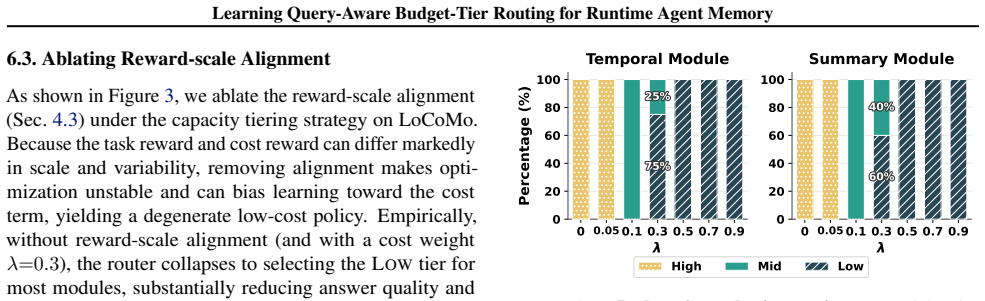
- Module-level tier selection ratios show the router responds predictably to cost pressure, qualifying BudgetMem as a controllable performance–cost mechanism rather than a fixed trade-off point.
Where Pith is reading between the lines
- The cost accounting treats non-LLM tiers as negligible; a stricter accounting that includes serving infrastructure or GPU rental for those LOW tiers would likely compress the low-cost end of the reported frontier (my inference, not the paper's).
- The transfer result hints that the routing policy captures query difficulty rather than backbone-specific quirks; an untested extension is to train the router on a small mixed-corpus set and measure cross-domain transfer directly.
- The query-aware tier choices could be inspected to produce cheap-to-check policy explanations or a 'cost contract' for API users—an interpretive step the paper leaves implicit.
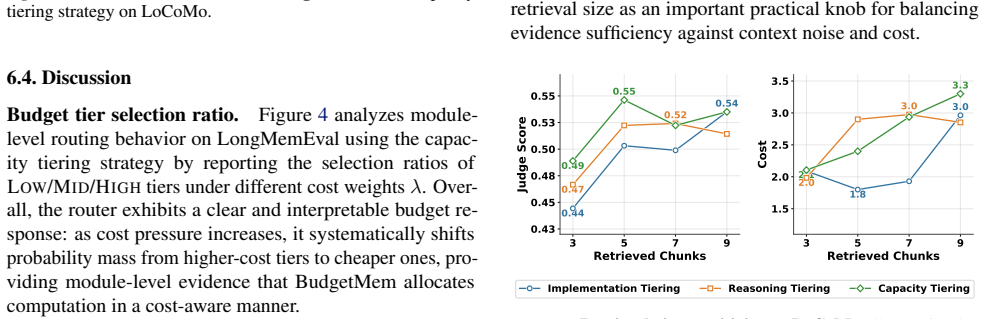
- Because the paper shows retrieval size is a separate cost knob, a natural follow-up is to let the router also decide how many chunks to retrieve, coupling evidence coverage with tier choice.
Editorial analysis
A structured set of objections, weighed in public.
Referee Report
Summary. The paper proposes BudgetMem, a runtime agent-memory framework in which memory extraction is decomposed into a modular pipeline (filter → entity/temporal/topic → summary) and each module exposes three budget tiers (LOW/MID/HIGH). A shared lightweight router selects a tier for each module at query time; it is trained with PPO under a cost-aware reward that combines task reward and a normalized cost reward (Eq. 7). Three tiering strategies are instantiated — implementation (rules → BERT → LLM), reasoning (direct → CoT → reflection), and capacity (small → medium → large LLM) — and evaluated on LoCoMo, LongMemEval, and HotpotQA against seven memory-augmented agent baselines. The paper claims that BudgetMem outperforms strong baselines in the performance-first setting and traces better accuracy–cost frontiers when the cost weight λ is varied, with additional analyses of reward-scale alignment, module-level tier selection, and retrieval-size sensitivity.
Significance. If the claims hold, BudgetMem would be a practical step toward explicit performance–cost control in runtime agent memory, and the systematic comparison of three tiering axes is a useful contribution. The paper's strengths include a broad evaluation across three benchmarks and two base LLMs, a cross-backbone transfer test (LLaMA-trained router applied to Qwen without retraining), a clean PPO formulation with robust cost normalization and reward-scale alignment, and released code. However, the central causal claim about the learned router is not isolated from the modular pipeline, and the cost comparisons rest on an accounting choice that treats non-LLM computation as free. These issues are fixable with additional experiments, but they are load-bearing for the paper's headline conclusions.
major comments (4)
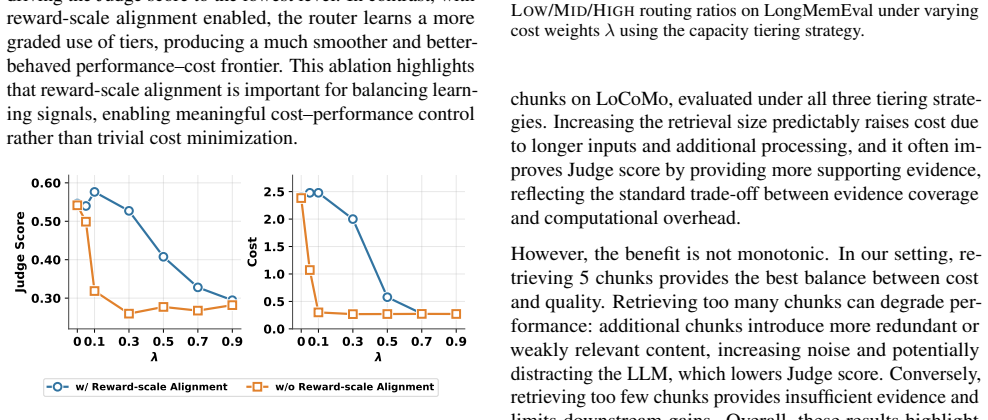
- [Sec. 6.1/6.2, Table 1, Fig. 2] The paper attributes its reported gains to the learned query-aware router, yet every comparison in Table 1 and Fig. 2 uses the full BudgetMem system (router + filter/entity/temporal/topic/summarization modules) against external memory baselines. There is no fixed-tier control (e.g., always-LOW, always-MID, always-HIGH, or random routing) and no condition that removes the router. The only ablation, Fig. 3, toggles reward-scale alignment and does not compare routing against no routing. Add fixed-tier baselines to establish the router's causal contribution; without them, the claimed accuracy–cost frontier could be produced by the modular pipeline alone.
- [Sec. 4.3, Eq. (8)–(9); Sec. 5.1; Tables 1, 5–10] Costs are not necessarily compared on a like-for-like basis. Eq. (8) assigns zero cost to non-LLM tiers, and Sec. 5.1 computes baseline costs by summing API token usage at service pricing. If baselines include offline LLM construction costs while BudgetMem's non-LLM components (heuristics, BERT-based extractors, retrieval) are treated as free, the Pareto comparisons in Fig. 2 and the cost columns in Tables 1, 5–10 are distorted. State the cost boundary explicitly and include a sensitivity analysis that assigns nonzero costs (e.g., local GPU-hours or amortized inference cost) to non-LLM tiers for both BudgetMem and baselines.
- [Appendix Table 6] The BudgetMem-REA row at COE=0.1 is internally inconsistent: the per-category Judge scores 18.24, 6.07, 11.93, 5.67 average to roughly 10.5, not the listed 55.25; the per-category F1 scores 45.17, 33.14, 40.63, 28.46 average to roughly 36.9, not 40.52. This error undermines confidence in the appendix data used for the trade-off analysis in Sec. 6.2 and must be corrected or explained.
- [Sec. 6.2, Fig. 2; Eq. (7)] The smooth performance–cost frontiers are partly a direct consequence of the training objective: Eq. (7) explicitly penalizes cost as λ increases, so the downward cost trend with increasing λ is by construction. The empirical contribution should therefore be framed as the accuracy achieved at each cost point relative to baselines, not as the existence of a monotone trade-off curve. Please clarify this framing so that the frontier claims emphasize the accuracy-at-cost comparison rather than the shape of the curve.
minor comments (5)
- [Sec. 5.2] The cross-backbone transfer (LLaMA-trained router → Qwen) is reported only as aggregated scores. It would be informative to analyze whether the router's tier selections remain semantically sensible under the new backbone (e.g., tier-selection agreement or per-module routing distributions).
- [Eq. (9)] If all raw costs in the sliding window are zero (e.g., when all selected tiers are non-LLM), then Q5 = Q95 and the denominator in the normalization is zero. A numerical safeguard or a small floor on c_raw should be specified.
- [Fig. 2] The figure shows smooth curves but does not label which λ values correspond to which points. Please add explicit λ labels or a color gradient so readers can interpret the trade-off direction.
- [Appendix C] Several prompt templates contain formatting typos: '7{9' and '1{3' should be '7–9' and '1–3'. While this does not affect the results, it makes the prompts look unpolished.
- [Table 1] The '†' footnote states 'no training using this base model' but does not specify whether all hyperparameters (including λ values for the trade-off curves) are identical across backbones. Clarify the transfer protocol.
Circularity Check
No significant circularity: BudgetMem's accuracy–cost results are comparative against external baselines, and the self-citations are not load-bearing.
full rationale
The paper's trade-off curves are generated by explicitly varying the cost weight λ in the reward r = r_task + λ·α·r_cost (Eq. 7), so the existence of a smooth accuracy–cost frontier is a direct consequence of the training objective, not an independent prediction. However, the paper's central claims are comparative: BudgetMem outperforms external memory baselines in the performance-first setting (Table 1) and its frontier is claimed to dominate baseline points (Fig. 2). These comparisons are not forced by the reward definition; they depend on the actual quality of the modular pipeline and the measured costs. The only self-citations (Router-R1 for sliding-window normalization, GraphRouter/Jin et al. as related work) are used for a normalization detail and background, not as load-bearing evidence for the main results. The absence of a fixed-tier baseline (e.g., all-LOW/all-HIGH) is a validation gap regarding the router's causal contribution, but it is not a circular reduction of the paper's claims to its inputs. No equation is self-referential in a way that makes the reported findings tautological relative to the stated assumptions.
Axiom & Free-Parameter Ledger
free parameters (7)
- Cost weight λ (COE) =
Swept over 0, 0.05, 0.1, 0.3, 0.5, 0.7, 0.9
- Reward-scale alignment α =
std(rtask)/(std(rcost)+ε), updated online
- Cost-normalization quantiles Q5/Q95 =
5th and 95th percentiles of sliding window over √cost
- Retrieval top-K =
5
- Chunk sizes =
256 tokens (LoCoMo, LongMemEval); 1024 tokens (HotpotQA)
- Capacity tier model choices =
Llama 3B/8B/70B; Qwen 7B/32B/80B
- PPO hyperparameters =
lr=3e-4, batch size 32, ≤600 steps, entropy coef 0.01
axioms (6)
- domain assumption Retrieved chunks C_q from Contriever contain the evidence needed to answer q
- domain assumption LLM-as-a-judge scores are a faithful measure of answer quality
- domain assumption Token-usage × API price is a faithful proxy for extraction cost
- ad hoc to paper Budget tiers preserve the module input-output contract
- ad hoc to paper A router trained on the LLaMA backbone transfers to Qwen without retraining
- standard math PPO is a valid optimization algorithm for this routing MDP
read the original abstract
Memory is increasingly central to Large Language Model (LLM) agents operating beyond a single context window, yet most existing systems rely on offline, query-agnostic memory construction that can be inefficient and may discard query-critical information. Although runtime memory utilization is a natural alternative, prior work often incurs substantial overhead and offers limited explicit control over the performance-cost trade-off. In this work, we present \textbf{BudgetMem}, a runtime agent memory framework for explicit, query-aware performance-cost control. BudgetMem structures memory processing as a set of memory modules, each offered in three budget tiers (i.e., \textsc{Low}/\textsc{Mid}/\textsc{High}). A lightweight router performs budget-tier routing across modules to balance task performance and memory construction cost, which is implemented as a compact neural policy trained with reinforcement learning. Using BudgetMem as a unified testbed, we study three complementary strategies for realizing budget tiers: implementation (method complexity), reasoning (inference behavior), and capacity (module model size). Across LoCoMo, LongMemEval, and HotpotQA, BudgetMem surpasses strong baselines when performance is prioritized (i.e., high-budget setting), and delivers better accuracy-cost frontiers under tighter budgets. Moreover, our analysis disentangles the strengths and weaknesses of different tiering strategies, clarifying when each axis delivers the most favorable trade-offs under varying budget regimes.
Figures

Forward citations
Cited by 10 Pith papers
-
LLM Agents Are Latent Context Managers: Eliciting Self-Managed Context via State Proprioception
Exposing per-block token, recency, and access metadata with lossless archive/recovery elicits latent context management in untrained LLM agents and roughly doubles LOCA-Bench success under pressure.
-
LLM Agents Are Latent Context Managers: Eliciting Self-Managed Context via State Proprioception
A training-free, model-agnostic dashboard that exposes per-block context state (tokens, age, budget) with lossless archive/recovery improves long-horizon tool-agent performance on LOCA-Bench, BrowseComp-Plus, and GAIA.
-
Learning What to Remember: Observability-Safe Memory Retention via Constrained Optimization for Long-Horizon Language Agents
OSL-MR is a learning-augmented framework that casts memory retention as constrained stochastic optimization under partial observability and outperforms heuristic baselines on LoCoMo and LongMemEval.
-
LLM Agents Are Latent Context Managers: Eliciting Self-Managed Context via State Proprioception
VISTA supplies LLM agents with a visible proprioceptive dashboard of typed context blocks, enabling untrained self-management that lifts performance on long-horizon tool-use benchmarks across multiple model scales.
-
LLM Agents Are Latent Context Managers: Eliciting Self-Managed Context via State Proprioception
Giving LLM agents a visible dashboard of their context blocks, plus lossless archive and recovery, sharply improves long-horizon tool-agent performance without any training.
-
Learning What to Remember: Observability-Safe Memory Retention via Constrained Optimization for Long-Horizon Language Agents
OSL-MR applies constrained stochastic optimization and learning to memory retention in long-horizon agents, outperforming recency and heuristic baselines on LoCoMo and LongMemEval under tight budgets.
-
EMBER: Efficient Memory via Budgeted Evidence Retention for Long-Horizon Agents
EMBER learns to retain budgeted, source-backed evidence capsules so long-horizon agents recover answer-relevant facts without rereading the full history.
-
EMBER: Efficient Memory via Budgeted Evidence Retention for Long-Horizon Agents
EMBER learns to retain source-backed evidence capsules under a fixed token budget, improving F1, Retain-Recall, and Read-Recall on LongMemEval-RR over budgeted baselines.
-
Exploring Cross-Scenario Generality of Agentic Memory Systems: Diagnostics and a Strong Baseline
An agentic harness letting the LLM self-manage flat text-file storage via tool calls outperforms eight prior memory systems on cross-scenario generality across QA, chat, trajectory, stress-test, and long-horizon tasks.
-
Externalization in LLM Agents: A Unified Review of Memory, Skills, Protocols and Harness Engineering
LLM agent progress depends on externalizing cognitive functions into memory, skills, protocols, and harness engineering that coordinates them reliably.
Reference graph
Works this paper leans on
-
[1]
Correctness: - Is the model answer factually consistent with ANY of the correct answers? - Does it avoid contradictions or introducing false information?
-
[2]
Relevance: - Does the answer address the question directly without unnecessary content?
-
[3]
explanation
Completeness: - Does the answer include all essential information needed to fully answer the question?,→ - Partial answers are allowed but should receive lower scores. Scoring Rules: - Score = 1.0 if the answer is fully correct. - Score = 0.5 if the answer is partially correct but incomplete or slightly inaccurate.,→ - Score = 0.0 if the answer is incorre...
-
[5]
N" [date_time=
A`<memories>`section containing individual`<memory>`elements. Each memory is formatted as: ``` <memory index="N" [date_time="..." session_id="..." dia_id="..."]> memory content text </memory> ``` Where: -`index`is the memory's position in the list. -`date_time`,`session_id`,`dia_id`are optional metadata attributes. - The text between the tags is the memor...
-
[7]
N" [date_time=
A`<memories>`section containing individual`<memory>`elements. Each memory is formatted as: ``` <memory index="N" [date_time="..." session_id="..." dia_id="..."]> memory content text </memory> ``` Where: -`index`is the memory's position in the list. -`date_time`,`session_id`,`dia_id`are optional metadata attributes. - The text between the tags is the memor...
-
[8]
A`<query>`section containing the user's question
-
[9]
N" [date_time=
A`<memories>`section containing individual`<memory>`elements. Each memory is formatted as: ``` <memory index="N" [date_time="..." session_id="..." dia_id="..."]> memory content text </memory> ``` Where: -`index`is the memory's position in the list. -`date_time`,`session_id`,`dia_id`are optional metadata attributes. - The text between the tags is the memor...
2023
-
[13]
A`<Topic Relations>`section containing one`<topic>`tag per topic relationship.,→ **Synthesis Guidelines:** - Do **not** answer the query directly. - Explain what information is available and how it should be used to formulate an answer.,→ **Output Format:** Your entire response must end with the following line: `<answer>your summary text here</answer>` Th...
-
[16]
A`<Temporal Relations>`section containing one`<temporal>`tag per temporal fact.,→
-
[17]
- Do **not** answer the query directly
A`<Topic Relations>`section containing one`<topic>`tag per topic relationship.,→ **Synthesis Guidelines:** - **Integrate** relevant entity, temporal, and topic facts into a coherent structure.,→ - **Extract** key information that directly supports or constrains the answer.,→ - **Reorganize** content for clarity and logical flow. - Do **not** answer the qu...
-
[18]
A`<query>`defining the subject and scope
-
[19]
An`<Entity Relations>`section containing one`<entity>`tag per relationship string.,→
-
[20]
An`<Temporal Relations>`section containing one`<temporal>`tag per temporal fact.,→
-
[21]
A`<Topic Relations>`section containing one`<topic>`tag per topic relationship.,→ **Synthesis Guidelines:** - Do **not** answer the query directly. - Explain what information is available and how it should be used to formulate an answer.,→ To complete the task systematically, please follow the steps reasoning framework outlined below:,→ **Reasoning Steps:*...
discussion (0)
Sign in with ORCID, Apple, or X to comment. Anyone can read and Pith papers without signing in.