Recognition: no theorem link
BadSNN: Backdoor Attacks on Spiking Neural Networks via Adversarial Spiking Neuron
Pith reviewed 2026-05-16 06:28 UTC · model grok-4.3
The pith
Spiking neural networks can be backdoored by deliberately varying the membrane threshold and time constant of their spiking neurons.
A machine-rendered reading of the paper's core claim, the machinery that carries it, and where it could break.
Core claim
BadSNN embeds backdoor behavior in spiking neural networks by deliberately varying the hyperparameters of the spiking neurons, specifically the membrane potential threshold and membrane time constant in the Leaky Integrate-and-Fire model, combined with optimized triggers, achieving superior attack success rates compared to data poisoning methods while preserving clean accuracy.
What carries the argument
Adversarial variation of spiking-neuron hyperparameters (membrane threshold and time constant) inside the LIF model to create a persistent trigger-activated backdoor.
Load-bearing premise
Deliberate changes to the membrane potential threshold and time constant of spiking neurons can embed a reliable backdoor that activates only on specific triggers without reducing accuracy on clean inputs or being removed by standard defenses.
What would settle it
Train an SNN with the proposed hyperparameter variations on MNIST or CIFAR-10, then measure whether clean accuracy remains above 90 percent while attack success rate on inputs containing the optimized trigger exceeds 90 percent, and whether fine-tuning or neuron pruning drops the attack success rate below 20 percent.
Figures
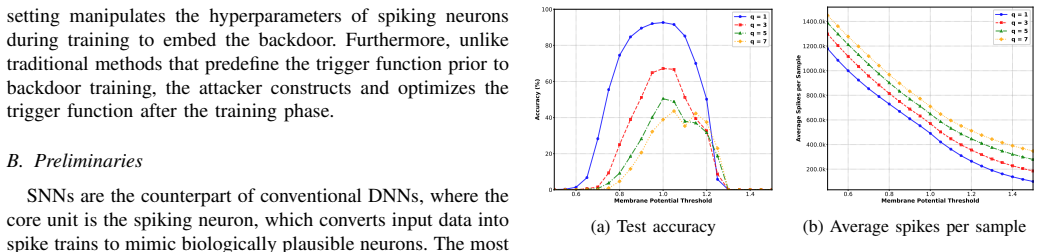


read the original abstract
Spiking Neural Networks (SNNs) are energy-efficient counterparts of Deep Neural Networks (DNNs) with high biological plausibility, as information is transmitted through temporal spiking patterns. The core element of an SNN is the spiking neuron, which converts input data into spikes following the Leaky Integrate-and-Fire (LIF) neuron model. This model includes several important hyperparameters, such as the membrane potential threshold and membrane time constant. Both the DNNs and SNNs have proven to be exploitable by backdoor attacks, where an adversary can poison the training dataset with malicious triggers and force the model to behave in an attacker-defined manner. Yet, how an adversary can exploit the unique characteristics of SNNs for backdoor attacks remains underexplored. In this paper, we propose \textit{BadSNN}, a novel backdoor attack on spiking neural networks that exploits hyperparameter variations of spiking neurons to inject backdoor behavior into the model. We further propose a trigger optimization process to achieve better attack performance while making trigger patterns less perceptible. \textit{BadSNN} demonstrates superior attack performance on various datasets and architectures, as well as compared with state-of-the-art data poisoning-based backdoor attacks and robustness against common backdoor mitigation techniques. Codes can be found at https://github.com/SiSL-URI/BadSNN.
Editorial analysis
A structured set of objections, weighed in public.
Referee Report
Summary. The paper proposes BadSNN, a backdoor attack on Spiking Neural Networks that injects malicious behavior by deliberately varying the membrane potential threshold and membrane time constant of Leaky Integrate-and-Fire neurons during training, combined with a separate trigger optimization step to improve attack success while reducing trigger perceptibility. It claims superior attack success rates and clean accuracy preservation across multiple datasets and SNN architectures relative to prior data-poisoning backdoor methods, plus resistance to common mitigation techniques.
Significance. If the empirical claims hold after proper controls, the work would identify a hyperparameter-specific attack surface in SNNs that is not directly transferable from DNN backdoor literature, with implications for the security of neuromorphic hardware. The public code release is a clear strength for reproducibility.
major comments (2)
- [Experiments (likely §4)] The experimental evaluation lacks an ablation that applies the identical optimized triggers under standard fixed LIF hyperparameters (threshold and time constant) as a control. Without this comparison, performance and robustness gains cannot be confidently attributed to the claimed adversarial spiking neuron construction rather than to trigger engineering alone.
- [Proposed Method (likely §3)] The method section does not specify the precise training procedure for embedding the backdoor via hyperparameter variation (e.g., whether thresholds are optimized jointly with weights, frozen after poisoning, or adjusted post-training) nor how this interacts with the standard data-poisoning loss.
minor comments (2)
- [Abstract] Abstract sentence 'demonstrates superior attack performance on various datasets and architectures, as well as compared with state-of-the-art' is grammatically unclear and should be rephrased.
- [Figures] Figure captions and axis labels for attack success rate and clean accuracy plots should explicitly state the number of runs and error bars used.
Simulated Author's Rebuttal
We thank the referee for the constructive feedback. We address each major comment below and will revise the manuscript to strengthen the presentation and experimental controls.
read point-by-point responses
-
Referee: The experimental evaluation lacks an ablation that applies the identical optimized triggers under standard fixed LIF hyperparameters (threshold and time constant) as a control. Without this comparison, performance and robustness gains cannot be confidently attributed to the claimed adversarial spiking neuron construction rather than to trigger engineering alone.
Authors: We agree that this control ablation is necessary to isolate the contribution of adversarial LIF hyperparameter variation from trigger optimization alone. In the revised manuscript we will add the requested experiment: the same optimized triggers will be evaluated under fixed standard LIF hyperparameters (threshold and time constant) on the same architectures and datasets, with results reported alongside the original BadSNN results. revision: yes
-
Referee: The method section does not specify the precise training procedure for embedding the backdoor via hyperparameter variation (e.g., whether thresholds are optimized jointly with weights, frozen after poisoning, or adjusted post-training) nor how this interacts with the standard data-poisoning loss.
Authors: We apologize for the omission. In BadSNN the membrane threshold and time constant are treated as learnable parameters and optimized jointly with the synaptic weights during the single backdoor training stage. The overall loss is the sum of the standard cross-entropy loss on clean data and the backdoor loss on poisoned samples; gradients flow through both the weights and the neuron hyperparameters. The hyperparameters are not frozen after poisoning nor adjusted post-training. We will expand Section 3 with a dedicated subsection that formally describes this joint optimization procedure and its interaction with the data-poisoning objective. revision: yes
Circularity Check
Empirical construction with no derivation chain or self-referential reductions
full rationale
The paper proposes BadSNN as an empirical backdoor attack method that varies LIF neuron hyperparameters (threshold and time constant) combined with a separate trigger optimization step, then reports experimental results on attack success, clean accuracy, and mitigation resistance across datasets and architectures. No equations, derivations, or first-principles claims appear in the provided text that would reduce any performance metric to a fitted parameter defined by the same metric or to a self-citation chain. The central claims rest on experimental outcomes rather than any mathematical reduction to inputs, making the work self-contained as a constructive attack design without circularity.
Axiom & Free-Parameter Ledger
Reference graph
Works this paper leans on
-
[1]
Imagenet: A large-scale hierarchical image database
Jia Deng, Wei Dong, Richard Socher, Li-Jia Li, Kai Li, and Li Fei- Fei. Imagenet: A large-scale hierarchical image database. In2009 IEEE conference on computer vision and pattern recognition, pages 248–255. Ieee, 2009
work page 2009
-
[2]
Ross Girshick. Fast r-cnn. InProceedings of the IEEE international conference on computer vision, pages 1440–1448, 2015
work page 2015
-
[3]
Bert: Pre-training of deep bidirectional transformers for language un- derstanding
Jacob Devlin, Ming-Wei Chang, Kenton Lee, and Kristina Toutanova. Bert: Pre-training of deep bidirectional transformers for language un- derstanding. InProceedings of the 2019 conference of the North American chapter of the association for computational linguistics: human language technologies, volume 1 (long and short papers), pages 4171–4186, 2019
work page 2019
-
[4]
Attention is all you need.Advances in neural information processing systems, 30, 2017
Ashish Vaswani, Noam Shazeer, Niki Parmar, Jakob Uszkoreit, Llion Jones, Aidan N Gomez, Łukasz Kaiser, and Illia Polosukhin. Attention is all you need.Advances in neural information processing systems, 30, 2017
work page 2017
-
[5]
The carbon impact of artificial intelligence, 2020
Payal Dhar. The carbon impact of artificial intelligence, 2020
work page 2020
-
[6]
Wolfgang Maass. Networks of spiking neurons: The third generation of neural network models.Neural Networks, 10(9):1659–1671, 1997
work page 1997
-
[7]
Sayantani Ghosh-Dastidar and Hojjat Adeli. Spiking neural networks. International Journal of Neural Systems, 19(4):295–308, 2009
work page 2009
-
[8]
Towards spike-based machine intelligence with neuromorphic computing.Nature, 575:607–617, 2019
Kaushik Roy, Akhilesh Jaiswal, and Priyadarshini Panda. Towards spike-based machine intelligence with neuromorphic computing.Nature, 575:607–617, 2019
work page 2019
-
[9]
Wei Fang, Yanqi Chen, Jianhao Ding, Zhaofei Yu, et al. Spikingjelly: An open-source machine learning infrastructure platform for spike-based intelligence.Science Advances, 9(42):eadi1480, 2023
work page 2023
-
[10]
Souvik Kundu, Gourav Datta, Massoud Pedram, and Peter A Beerel. Spike-thrift: Towards energy-efficient deep spiking neural networks by limiting spiking activity via attention-guided compression. InProceed- ings of the IEEE/CVF winter conference on applications of computer vision, pages 3953–3962, 2021
work page 2021
-
[11]
Jun Haeng Lee, Tobi Delbruck, and Michael Pfeiffer. Training deep spik- ing neural networks using backpropagation.Frontiers in neuroscience, 10:508, 2016
work page 2016
-
[12]
Alberto Viale, Alberto Marchisio, Maurizio Martina, Guido Masera, and Muhammad Shafique. Carsnn: An efficient spiking neural network for event-based autonomous cars on the loihi neuromorphic research processor. In2021 International Joint Conference on Neural Networks (IJCNN), pages 1–10. IEEE, 2021
work page 2021
-
[13]
Evolv- ing spiking neural networks for audiovisual information processing
Simei Gomes Wysoski, Lubica Benuskova, and Nikola Kasabov. Evolv- ing spiking neural networks for audiovisual information processing. Neural Networks, 23(7):819–835, 2010
work page 2010
-
[14]
Classifying neuromorphic datasets with tempotron and spike timing dependent plasticity
Laxmi R Iyer and Yansong Chua. Classifying neuromorphic datasets with tempotron and spike timing dependent plasticity. In2020 interna- tional joint conference on neural networks (IJCNN), pages 1–8. IEEE, 2020
work page 2020
-
[15]
Yujie Wu, Lei Deng, Guoqi Li, Jun Zhu, and Luping Shi. Spatio- temporal backpropagation for training high-performance spiking neural networks.Frontiers in neuroscience, 12:331, 2018
work page 2018
-
[16]
Deep spiking neural network: Energy efficiency through time based coding
Bing Han and Kaushik Roy. Deep spiking neural network: Energy efficiency through time based coding. InEuropean conference on computer vision, pages 388–404. Springer, 2020
work page 2020
-
[17]
Abhronil Sengupta, Yuting Ye, Robert Wang, Chiao Liu, and Kaushik Roy. Going deeper in spiking neural networks: Vgg and residual architectures.Frontiers in neuroscience, 13:95, 2019
work page 2019
-
[18]
BadNets: Identifying Vulnerabilities in the Machine Learning Model Supply Chain
Tianyu Gu, Brendan Dolan-Gavitt, and Siddharth Garg. BadNets: Identifying vulnerabilities in the machine learning model supply chain. arXiv preprint arXiv:1708.06733, 2017
work page internal anchor Pith review Pith/arXiv arXiv 2017
-
[19]
Badnets: Evaluating backdooring attacks on deep neural networks.IEEE Access, 7:47230–47244, 2019
Tianyu Gu, Kang Liu, Brendan Dolan-Gavitt, and Siddharth Garg. Badnets: Evaluating backdooring attacks on deep neural networks.IEEE Access, 7:47230–47244, 2019
work page 2019
-
[20]
Targeted Backdoor Attacks on Deep Learning Systems Using Data Poisoning
Xinyun Chen, Chang Liu, Bo Li, Kimberly Lu, and Dawn Song. Tar- geted backdoor attacks on deep learning systems using data poisoning. arXiv preprint arXiv:1712.05526, 2017
work page internal anchor Pith review Pith/arXiv arXiv 2017
-
[21]
Wanet–imperceptible warping-based back- door attack.arXiv preprint arXiv:2102.10369, 2021
Anh Nguyen and Anh Tran. Wanet–imperceptible warping-based back- door attack.arXiv preprint arXiv:2102.10369, 2021
-
[22]
Strip: A defence against trojan attacks on deep neural networks
Yansong Gao, Change Xu, Derui Wang, Shiping Chen, Damith C Ranasinghe, and Surya Nepal. Strip: A defence against trojan attacks on deep neural networks. InProceedings of the 35th annual computer security applications conference, pages 113–125, 2019
work page 2019
-
[23]
Dongxian Wu and Yisen Wang. Adversarial neuron pruning purifies backdoored deep models.Advances in Neural Information Processing Systems, 34:16913–16925, 2021
work page 2021
-
[24]
Gorka Abad, Oguzhan Ersoy, Stjepan Picek, and Aitor Urbieta. Sneaky spikes: Uncovering stealthy backdoor attacks in spiking neural networks with neuromorphic data.arXiv preprint arXiv:2302.06279, 2023
-
[25]
A 128×128 120 db 15µs latency asynchronous temporal contrast vision sensor
Patrick Lichtsteiner, Christoph Posch, and Tobi Delbr ¨uck. A 128×128 120 db 15µs latency asynchronous temporal contrast vision sensor. IEEE Journal of Solid-State Circuits, 43(2):566–576, 2008
work page 2008
-
[26]
Flashy backdoor: Real-world environment backdoor attack on snns with dvs cameras, 2024
Roberto Ria ˜no, Gorka Abad, Stjepan Picek, and Aitor Urbieta. Flashy backdoor: Real-world environment backdoor attack on snns with dvs cameras, 2024
work page 2024
-
[27]
Incorporating learnable membrane time constant to enhance learning of spiking neural networks
Wei Fang, Zhaofei Yu, Yanqi Chen, Timoth´ee Masquelier, Tiejun Huang, and Yonghong Tian. Incorporating learnable membrane time constant to enhance learning of spiking neural networks. InProceedings of the IEEE/CVF international conference on computer vision, pages 2661– 2671, 2021
work page 2021
-
[28]
Lotus: Evasive and resilient backdoor attacks through sub-partitioning
Siyuan Cheng, Guanhong Tao, Yingqi Liu, Guangyu Shen, Shengwei An, Shiwei Feng, Xiangzhe Xu, Kaiyuan Zhang, Shiqing Ma, and Xiangyu Zhang. Lotus: Evasive and resilient backdoor attacks through sub-partitioning. InProceedings of the IEEE/CVF Conference on Computer Vision and Pattern Recognition, pages 24798–24809, 2024
work page 2024
-
[29]
Zhenting Wang, Juan Zhai, and Shiqing Ma. Bppattack: Stealthy and efficient trojan attacks against deep neural networks via image quantization and contrastive adversarial learning. InProceedings of the IEEE/CVF conference on computer vision and pattern recognition, pages 15074–15084, 2022
work page 2022
-
[30]
A dual stealthy backdoor: From both spatial and frequency perspectives
Yudong Gao, Honglong Chen, Peng Sun, Junjian Li, Anqing Zhang, Zhibo Wang, and Weifeng Liu. A dual stealthy backdoor: From both spatial and frequency perspectives. InProceedings of the AAAI Conference on Artificial Intelligence, volume 38, pages 1851–1859, 2024
work page 2024
-
[31]
Abdullah Arafat Miah, Kaan Icer, Resit Sendag, and Yu Bi. Noiseattack: An evasive sample-specific multi-targeted backdoor attack through white gaussian noise.arXiv preprint arXiv:2409.02251, 2024
-
[32]
Backdoor attacks on vision transformers.arXiv preprint arXiv:2206.08477, 2022
Akshayvarun Subramanya, Aniruddha Saha, Soroush Abbasi Kooh- payegani, Ajinkya Tejankar, and Hamed Pirsiavash. Backdoor attacks on vision transformers.arXiv preprint arXiv:2206.08477, 2022
-
[33]
Baddet: Backdoor attacks on object detection
Shih-Han Chan, Yinpeng Dong, Jun Zhu, Xiaolu Zhang, and Jun Zhou. Baddet: Backdoor attacks on object detection. InEuropean conference on computer vision, pages 396–412. Springer, 2022
work page 2022
-
[34]
Badnl: Backdoor attacks against nlp models with semantic-preserving improvements
Xiaoyi Chen, Ahmed Salem, Dingfan Chen, Michael Backes, Shiqing Ma, Qingni Shen, Zhonghai Wu, and Yang Zhang. Badnl: Backdoor attacks against nlp models with semantic-preserving improvements. InProceedings of the 37th Annual Computer Security Applications Conference, pages 554–569, 2021
work page 2021
-
[35]
Hidden backdoors in human-centric language models
Shaofeng Li, Hui Liu, Tian Dong, Benjamin Zi Hao Zhao, Minhui Xue, Haojin Zhu, and Jialiang Lu. Hidden backdoors in human-centric language models. InProceedings of the 2021 ACM SIGSAC conference on computer and communications security, pages 3123–3140, 2021
work page 2021
-
[36]
Exploring clean label backdoor attacks and defense in language models
Shuai Zhao, Luu Anh Tuan, Jie Fu, Jinming Wen, and Weiqi Luo. Exploring clean label backdoor attacks and defense in language models. IEEE/ACM transactions on audio, speech, and language processing, 32:3014–3024, 2024
work page 2024
-
[37]
Prompt stealing attacks against large language models.arXiv preprint arXiv:2402.12959, 2024
Zeyang Sha and Yang Zhang. Prompt stealing attacks against large language models.arXiv preprint arXiv:2402.12959, 2024
-
[38]
Abdullah Arafat Miah and Yu Bi. Exploiting the vulnerability of large language models via defense-aware architectural backdoor.arXiv preprint arXiv:2409.01952, 2024
-
[39]
Zhaohan Xi, Ren Pang, Shouling Ji, and Ting Wang. Graph backdoor. In 30th USENIX security symposium (USENIX Security 21), pages 1523– 1540, 2021
work page 2021
-
[40]
Rethinking graph backdoor attacks: A distribution-preserving perspective
Zhiwei Zhang, Minhua Lin, Enyan Dai, and Suhang Wang. Rethinking graph backdoor attacks: A distribution-preserving perspective. InPro- ceedings of the 30th ACM SIGKDD conference on knowledge discovery and data mining, pages 4386–4397, 2024
work page 2024
-
[41]
BadImplant: Injection-based Multi-Targeted Graph Backdoor Attack
Md Nabi Newaz Khan, Abdullah Arafat Miah, and Yu Bi. Multi-targeted graph backdoor attack.arXiv preprint arXiv:2601.15474, 2026
work page internal anchor Pith review Pith/arXiv arXiv 2026
-
[42]
Shaobo Zhang, Yimeng Pan, Qin Liu, Zheng Yan, Kim-Kwang Raymond Choo, and Guojun Wang. Backdoor attacks and defenses targeting multi- domain ai models: A comprehensive review.ACM Computing Surveys, 57(4):1–35, 2024
work page 2024
-
[43]
Trojaning attack on neural networks
Yingqi Liu, Shiqing Ma, Yousra Aafer, Wen-Chuan Lee, Juan Zhai, Weihang Wang, and Xiangyu Zhang. Trojaning attack on neural networks. In25th Annual Network And Distributed System Security Symposium (NDSS 2018). Internet Soc, 2018
work page 2018
-
[44]
Hid- den trigger backdoor attacks
Anirban Saha, Akshayvarun Subramanya, and Hamed Pirsiavash. Hid- den trigger backdoor attacks. InProceedings of the AAAI Conference on Artificial Intelligence, volume 34, pages 11957–11965, 2020
work page 2020
-
[45]
Lira: Learnable, imperceptible and robust backdoor attacks
Khoa Doan, Yingjie Lao, Weijie Zhao, and Ping Li. Lira: Learnable, imperceptible and robust backdoor attacks. InProceedings of the IEEE/CVF international conference on computer vision, pages 11966– 11976, 2021
work page 2021
-
[46]
Anti-backdoor learning: Training clean models on poisoned data
Yige Li, Xixiang Lyu, Nodens Koren, Lingjuan Lyu, Bo Li, and Xingjun Ma. Anti-backdoor learning: Training clean models on poisoned data. Advances in Neural Information Processing Systems, 34:14900–14912, 2021
work page 2021
-
[47]
Neural cleanse: Identifying and miti- gating backdoor attacks in neural networks
Bolun Wang, Yuanshun Yao, Shawn Shan, Huiying Li, Bimal Viswanath, Haitao Zheng, and Ben Y Zhao. Neural cleanse: Identifying and miti- gating backdoor attacks in neural networks. In2019 IEEE symposium on security and privacy (SP), pages 707–723. IEEE, 2019
work page 2019
-
[48]
Data-free backdoor removal based on channel lipschitzness
Runkai Zheng, Rongjun Tang, Jianze Li, and Li Liu. Data-free backdoor removal based on channel lipschitzness. InEuropean Conference on Computer Vision, pages 175–191. Springer, 2022
work page 2022
-
[49]
Yige Li, Xixiang Lyu, Nodens Koren, Lingjuan Lyu, Bo Li, and Xingjun Ma. Neural attention distillation: Erasing backdoor triggers from deep neural networks.arXiv preprint arXiv:2101.05930, 2021
-
[50]
Weilin Lin, Li Liu, Shaokui Wei, Jianze Li, and Hui Xiong. Unveiling and mitigating backdoor vulnerabilities based on unlearning weight changes and backdoor activeness.Advances in Neural Information Processing Systems, 37:42097–42122, 2024
work page 2024
-
[51]
Yanxin Yang, Chentao Jia, DengKe Yan, Ming Hu, Tianlin Li, Xiaofei Xie, Xian Wei, and Mingsong Chen. Sampdetox: Black-box backdoor defense via perturbation-based sample detoxification.Advances in Neural Information Processing Systems, 37:121236–121264, 2024
work page 2024
-
[52]
Abdullah Arafat Miah and Yu Bi. Lite-bd: A lightweight black-box backdoor defense via reviving multi-stage image transformations.arXiv preprint arXiv:2602.07197, 2026
-
[53]
Yucheng Shi, Mengnan Du, Xuansheng Wu, Zihan Guan, Jin Sun, and Ninghao Liu. Black-box backdoor defense via zero-shot image purification.Advances in Neural Information Processing Systems, 36:57336–57366, 2023
work page 2023
-
[54]
Gorka Abad, Oguzhan Ersoy, Stjepan Picek, and Aitor Urbieta. Sneaky spikes: Uncovering stealthy backdoor attacks in spiking neural networks with neuromorphic data. InNDSS, 2024
work page 2024
-
[55]
Shuo Jin et al. Data-poisoning-based backdoor attack framework against supervised learning rules of spiking neural networks.arXiv preprint arXiv:2409.15670, 2024
-
[56]
Wolfgang Maass. Networks of spiking neurons: the third generation of neural network models.Neural networks, 10(9):1659–1671, 1997
work page 1997
-
[57]
Yuhang Li, Tamar Geller, Youngeun Kim, and Priyadarshini Panda. Seenn: Towards temporal spiking early exit neural networks.Advances in Neural Information Processing Systems, 36:63327–63342, 2023
work page 2023
-
[58]
Deepfool: a simple and accurate method to fool deep neural networks
Seyed-Mohsen Moosavi-Dezfooli, Alhussein Fawzi, and Pascal Frossard. Deepfool: a simple and accurate method to fool deep neural networks. InProceedings of the IEEE conference on computer vision and pattern recognition, pages 2574–2582, 2016
work page 2016
-
[59]
U-net: Convo- lutional networks for biomedical image segmentation
Olaf Ronneberger, Philipp Fischer, and Thomas Brox. U-net: Convo- lutional networks for biomedical image segmentation. InInternational Conference on Medical image computing and computer-assisted inter- vention, pages 234–241. Springer, 2015
work page 2015
-
[60]
Learning multiple layers of features from tiny images
Alex Krizhevsky, Geoffrey Hinton, et al. Learning multiple layers of features from tiny images. 2009
work page 2009
-
[61]
The german traffic sign recognition benchmark: a multi-class classifica- tion competition
Johannes Stallkamp, Marc Schlipsing, Jan Salmen, and Christian Igel. The german traffic sign recognition benchmark: a multi-class classifica- tion competition. InThe 2011 international joint conference on neural networks, pages 1453–1460. IEEE, 2011
work page 2011
-
[62]
Garrick Orchard, Ajinkya Jayawant, Gregory K Cohen, and Nitish Thakor. Converting static image datasets to spiking neuromorphic datasets using saccades.Frontiers in neuroscience, 9:437, 2015
work page 2015
-
[63]
Garrick Orchard, Ajinkya Jayawant, Gregory K. Cohen, and Nitish Thakor. Converting static image datasets to spiking neuromorphic datasets using saccades.Frontiers in Neuroscience, 9:437, 2015
work page 2015
-
[64]
Yuhang Li, Yufei Guo, Shanghang Zhang, Shikuang Deng, Yongqing Hai, and Shi Gu. Differentiable spike: Rethinking gradient-descent for training spiking neural networks.Advances in neural information processing systems, 34:23426–23439, 2021
work page 2021
-
[65]
Alexander Turner, Dimitris Tsipras, and Aleksander Madry. Clean-label backdoor attacks. 2018
work page 2018
discussion (0)
Sign in with ORCID, Apple, or X to comment. Anyone can read and Pith papers without signing in.