Recognition: no theorem link
Flow-Based Conformal Predictive Distributions
Pith reviewed 2026-05-16 06:07 UTC · model grok-4.3
The pith
Any sufficiently regular differentiable nonconformity score induces a deterministic flow on the output space whose trajectories converge to the boundary of the conformal prediction set.
A machine-rendered reading of the paper's core claim, the machinery that carries it, and where it could break.
Core claim
The central claim is that any sufficiently regular differentiable nonconformity score defines a vector field on the output space, and the integral curves of this field converge to the level set that forms the boundary of the conformal prediction region. Integrating the flow therefore provides an exact, deterministic way to reach and sample the boundary without exhaustive search. Varying the confidence level across multiple such flows yields a full predictive distribution whose regions coincide with the original conformal sets.
What carries the argument
The deterministic flow on the output space generated by the nonconformity score, whose trajectories converge to the conformal boundary.
If this is right
- High-dimensional or structured conformal sets become directly samplable by integrating the flow rather than by grid search or rejection sampling.
- Conformal predictive distributions can be obtained by combining flows at multiple confidence levels, with quantile regions matching the empirical sets.
- The approximation error of the resulting distributions decomposes into score-induced distortion, base-measure quality, and flow discretization error.
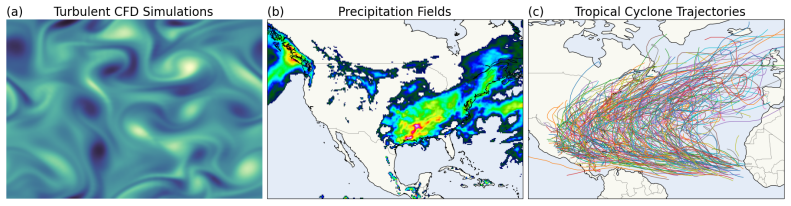
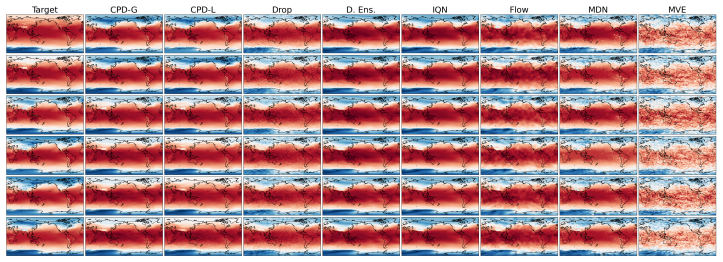
- The same flow construction applies to tasks such as PDE inverse problems, precipitation downscaling, climate debiasing, and trajectory forecasting.
Where Pith is reading between the lines
- The flow view may allow conformal methods to be composed with existing dynamical-system or ODE-based samplers in downstream modeling pipelines.
- Approximations for nondifferentiable scores could be developed by smoothing or by learning surrogate vector fields that mimic the target flow.
- The convergence property suggests a way to certify coverage for flow-based generative models by checking whether their samples lie inside the induced conformal regions.
Load-bearing premise
The nonconformity score must be sufficiently regular and differentiable so that the induced flow exists and its trajectories converge to the conformal boundary.
What would settle it
A simulation in which trajectories generated by the flow from the nonconformity score fail to reach the boundary of the conformal set computed directly from the same data and score.
Figures


read the original abstract
Conformal prediction provides a distribution-free framework for uncertainty quantification via prediction sets with exact finite-sample coverage. In low dimensions these sets are easy to interpret, but in high-dimensional or structured output spaces they are difficult to represent and use, which can limit their ability to integrate with downstream tasks such as sampling and probabilistic forecasting. We show that any sufficiently regular differentiable nonconformity score induces a deterministic flow on the output space whose trajectories converge to the boundary of the corresponding conformal prediction set. This leads to a computationally efficient, training-free method for sampling conformal boundaries in arbitrary dimensions. Mixing across confidence levels yields conformal predictive distributions whose quantile regions coincide with the empirical conformal prediction sets. We provide an approximation bound decomposing CPD predictive error into score-induced distortion, base-measure quality, and gradient flow-induced distortion. We evaluate the approach on PDE inverse problems, precipitation downscaling, climate model debiasing, and hurricane trajectory forecasting.
Editorial analysis
A structured set of objections, weighed in public.
Referee Report
Summary. The paper claims that any sufficiently regular differentiable nonconformity score induces a deterministic flow on the output space whose trajectories converge to the boundary of the corresponding conformal prediction set. This yields a training-free method for sampling conformal boundaries in arbitrary dimensions; mixing across levels produces conformal predictive distributions (CPDs) whose quantile regions coincide with empirical conformal sets. An approximation bound is given that decomposes CPD error into score-induced distortion, base-measure quality, and flow-induced distortion. The method is evaluated on PDE inverse problems, precipitation downscaling, climate model debiasing, and hurricane trajectory forecasting.
Significance. If the flow-convergence claim holds, the work supplies a practical, training-free route to representing and sampling high-dimensional conformal sets and to constructing CPDs that integrate directly with downstream sampling and forecasting tasks. The decomposed approximation bound is a constructive feature, and the breadth of the empirical evaluations (PDE, climate, forecasting) indicates potential applicability once the theoretical foundation is secured.
major comments (2)
- [§3] §3 (flow construction): the central claim that trajectories of the induced flow converge to the level set {s = q} is load-bearing for both the sampling procedure and the CPD construction. If the flow is the negative gradient flow dy/dt = −∇s(y), any interior critical point where ∇s = 0 and s < q is an equilibrium that traps trajectories inside the conformal set. Differentiability alone does not preclude such points; the manuscript must either prove that the stated regularity conditions exclude interior attractors, specify a modified flow that guarantees boundary convergence, or add an explicit assumption (e.g., strict quasiconvexity of s) that rules them out.
- [§4] §4 (approximation bound): the bound is stated at a high level as decomposing error into score distortion, base-measure quality, and gradient-flow distortion, yet the derivation is not supplied in sufficient detail to verify the triangle-inequality steps or the control of the flow-induced term. Without the explicit constants or the precise statement of the regularity assumptions used to bound the flow error, it is impossible to assess whether the bound is non-vacuous or whether it correctly accounts for possible trapping.
minor comments (2)
- [§2] Notation for the nonconformity score s and the quantile level q should be introduced once with a clear reference to the standard conformal-prediction definition to avoid ambiguity when the flow ODE is written.
- [Figures 2–4] Figure captions for the flow-trajectory plots should explicitly state the step-size schedule and the integration method used, so that readers can reproduce the visual evidence of boundary convergence.
Simulated Author's Rebuttal
We thank the referee for the careful reading and constructive comments. We address each major comment below and will revise the manuscript accordingly to strengthen the theoretical foundations.
read point-by-point responses
-
Referee: [§3] §3 (flow construction): the central claim that trajectories of the induced flow converge to the level set {s = q} is load-bearing for both the sampling procedure and the CPD construction. If the flow is the negative gradient flow dy/dt = −∇s(y), any interior critical point where ∇s = 0 and s < q is an equilibrium that traps trajectories inside the conformal set. Differentiability alone does not preclude such points; the manuscript must either prove that the stated regularity conditions exclude interior attractors, specify a modified flow that guarantees boundary convergence, or add an explicit assumption (e.g., strict quasiconvexity of s) that rules them out.
Authors: We agree that the convergence of trajectories under the negative gradient flow requires explicit justification, since differentiability alone permits interior critical points. The manuscript's reference to 'sufficiently regular' conditions was intended to ensure the nonconformity score has no interior local minima below the target quantile, but this was not stated with sufficient precision. In the revision we will add an explicit assumption that the nonconformity score s is strictly quasiconvex. Under this assumption we will prove that the only critical point is the global minimizer and that all trajectories originating inside the level set {s < q} converge to the boundary without becoming trapped at interior equilibria. This keeps the original flow unchanged while rendering the claim rigorous. revision: yes
-
Referee: [§4] §4 (approximation bound): the bound is stated at a high level as decomposing error into score distortion, base-measure quality, and gradient-flow distortion, yet the derivation is not supplied in sufficient detail to verify the triangle-inequality steps or the control of the flow-induced term. Without the explicit constants or the precise statement of the regularity assumptions used to bound the flow error, it is impossible to assess whether the bound is non-vacuous or whether it correctly accounts for possible trapping.
Authors: We acknowledge that the derivation of the approximation bound was presented at too high a level. The bound is obtained by applying the triangle inequality to the distance (in total variation) between the conformal predictive distribution and the target distribution, separating the three error sources. In the revised manuscript we will supply the complete derivation, including the explicit constants (which depend on the Lipschitz constant of ∇s and the flow integration horizon) and the precise regularity conditions. With the strict quasiconvexity assumption introduced in response to the previous comment, the flow-induced distortion term will be controlled by the proven convergence rate to the boundary, ensuring the bound is non-vacuous and properly accounts for the absence of trapping. revision: yes
Circularity Check
No circularity: flow construction follows from differentiability assumptions without self-referential reduction
full rationale
The paper derives the existence of a deterministic flow from any sufficiently regular differentiable nonconformity score, with trajectories claimed to converge to the conformal boundary, and then constructs CPDs by mixing across levels. No equations reduce the flow or boundary convergence to a quantity defined in terms of itself, nor is any fitted parameter renamed as a prediction. The approximation bound explicitly decomposes error into score-induced distortion, base-measure quality, and gradient-flow distortion as separate terms. No load-bearing self-citations or uniqueness theorems imported from prior author work are invoked to force the central claim. The derivation is presented as a direct consequence of the regularity assumption on the score, making the construction self-contained against external benchmarks rather than tautological.
Axiom & Free-Parameter Ledger
axioms (1)
- domain assumption The nonconformity score is sufficiently regular and differentiable to induce a deterministic flow whose trajectories converge to the conformal boundary
invented entities (1)
-
Conformal predictive distribution (CPD)
no independent evidence
Reference graph
Works this paper leans on
-
[1]
Eduardo Adame, Daniel Csillag, and Guilherme Tegoni Goedert. Image super-resolution with guarantees via conformal generative models.arXiv e-prints, pages arXiv–2502, 2025
work page 2025
-
[2]
Niccolò Ajroldi, Jacopo Diquigiovanni, Matteo Fontana, and Simone Vantini. Conformal prediction bands for two-dimensional functional time series.Computational Statistics & Data Analysis, 187:107821, 2023
work page 2023
-
[3]
Understanding and simplifying perceptual distances
Dan Amir and Yair Weiss. Understanding and simplifying perceptual distances. InProceedings of the IEEE/CVF Conference on Computer Vision and Pattern Recognition, pages 12226–12235, 2021
work page 2021
-
[4]
Conformal prediction: A gentle introduction
Anastasios N Angelopoulos, Stephen Bates, et al. Conformal prediction: A gentle introduction. Foundations and trends® in machine learning, 16(4):494–591, 2023
work page 2023
-
[5]
Distribution-free, risk-controlling prediction sets.Journal of the ACM (JACM), 68(6):1–34, 2021
Stephen Bates, Anastasios Angelopoulos, Lihua Lei, Jitendra Malik, and Michael Jordan. Distribution-free, risk-controlling prediction sets.Journal of the ACM (JACM), 68(6):1–34, 2021
work page 2021
-
[6]
Mikołaj Bi´nkowski, Danica J Sutherland, Michael Arbel, and Arthur Gretton. Demystifying mmd gans.arXiv preprint arXiv:1801.01401, 2018
work page internal anchor Pith review Pith/arXiv arXiv 2018
- [7]
-
[8]
Margarida Campos, António Farinhas, Chrysoula Zerva, Mário AT Figueiredo, and André FT Martins. Conformal prediction for natural language processing: A survey.Transactions of the Association for Computational Linguistics, 12:1497–1516, 2024
work page 2024
-
[9]
Neural ordinary differential equations.Advances in neural information processing systems, 31, 2018
Ricky TQ Chen, Yulia Rubanova, Jesse Bettencourt, and David K Duvenaud. Neural ordinary differential equations.Advances in neural information processing systems, 31, 2018
work page 2018
-
[10]
John Cherian, Isaac Gibbs, and Emmanuel Candes. Large language model validity via enhanced conformal prediction methods.Advances in Neural Information Processing Systems, 37:114812– 114842, 2024
work page 2024
-
[11]
Distributional conformal prediction
Victor Chernozhukov, Kaspar Wüthrich, and Yinchu Zhu. Distributional conformal prediction. Proceedings of the National Academy of Sciences, 118(48):e2107794118, 2021
work page 2021
-
[12]
Marco Cuturi. Sinkhorn distances: Lightspeed computation of optimal transport.Advances in neural information processing systems, 26, 2013
work page 2013
-
[13]
Implicit quantile networks for distributional reinforcement learning
Will Dabney, Georg Ostrovski, David Silver, and Rémi Munos. Implicit quantile networks for distributional reinforcement learning. InInternational conference on machine learning, pages 1096–1105. PMLR, 2018
work page 2018
-
[14]
Density estimation using Real NVP
Laurent Dinh, Jascha Sohl-Dickstein, and Samy Bengio. Density estimation using real nvp. arXiv preprint arXiv:1605.08803, 2016
work page internal anchor Pith review Pith/arXiv arXiv 2016
-
[15]
Jacopo Diquigiovanni, Matteo Fontana, and Simone Vantini. Conformal prediction bands for multivariate functional data.Journal of Multivariate Analysis, 189:104879, 2022
work page 2022
-
[16]
Dan Friedman and Adji Bousso Dieng. The vendi score: A diversity evaluation metric for machine learning.arXiv preprint arXiv:2210.02410, 2022
-
[17]
Dropout as a bayesian approximation: Representing model uncertainty in deep learning
Yarin Gal and Zoubin Ghahramani. Dropout as a bayesian approximation: Representing model uncertainty in deep learning. Ininternational conference on machine learning, pages 1050–1059. PMLR, 2016
work page 2016
-
[18]
Strictly proper scoring rules, prediction, and estimation
Tilmann Gneiting and Adrian E Raftery. Strictly proper scoring rules, prediction, and estimation. Journal of the American statistical Association, 102(477):359–378, 2007
work page 2007
-
[19]
Locally adaptive conformal inference for operator models.arXiv preprint arXiv:2507.20975, 2025
Trevor Harris and Yan Liu. Locally adaptive conformal inference for operator models.arXiv preprint arXiv:2507.20975, 2025. 10
-
[20]
Trevor Harris and Ryan Sriver. Quantifying uncertainty in climate projections with conformal ensembles.arXiv preprint arXiv:2408.06642, 2024
-
[21]
Elastic depths for detecting shape anomalies in functional data.Technometrics, 63(4):466–476, 2021
Trevor Harris, J Derek Tucker, Bo Li, and Lyndsay Shand. Elastic depths for detecting shape anomalies in functional data.Technometrics, 63(4):466–476, 2021
work page 2021
-
[22]
Morris W Hirsch, Stephen Smale, and Robert L Devaney.Differential equations, dynamical systems, and an introduction to chaos. Academic press, 2013
work page 2013
-
[23]
Fundamentals of digital image processing
Anil K Jain. Fundamentals of digital image processing. 1989
work page 1989
-
[24]
Balaji Lakshminarayanan, Alexander Pritzel, and Charles Blundell. Simple and scalable predictive uncertainty estimation using deep ensembles.Advances in neural information processing systems, 30, 2017
work page 2017
-
[25]
Jing Lei, Max G’Sell, Alessandro Rinaldo, Ryan J Tibshirani, and Larry Wasserman. Distribution-free predictive inference for regression.Journal of the American Statistical Associ- ation, 113(523):1094–1111, 2018
work page 2018
-
[26]
Flow Matching for Generative Modeling
Yaron Lipman, Ricky TQ Chen, Heli Ben-Hamu, Maximilian Nickel, and Matt Le. Flow matching for generative modeling.arXiv preprint arXiv:2210.02747, 2022
work page internal anchor Pith review Pith/arXiv arXiv 2022
-
[27]
Flow match- ing for generative modeling
Yaron Lipman, Ricky TQ Chen, Heli Ben-Hamu, Maximilian Nickel, and Matt Le. Flow match- ing for generative modeling. In11th International Conference on Learning Representations, ICLR 2023, 2023
work page 2023
-
[28]
Flow Straight and Fast: Learning to Generate and Transfer Data with Rectified Flow
Xingchao Liu, Chengyue Gong, and Qiang Liu. Flow straight and fast: Learning to generate and transfer data with rectified flow.arXiv preprint arXiv:2209.03003, 2022
work page internal anchor Pith review Pith/arXiv arXiv 2022
-
[29]
Ziqi Ma, Kamyar Azizzadenesheli, and Anima Anandkumar. Calibrated uncertainty quan- tification for operator learning via conformal prediction.arXiv preprint arXiv:2402.01960, 2024
-
[30]
Huiying Mao, Ryan Martin, and Brian J Reich. Valid model-free spatial prediction.Journal of the American Statistical Association, 119(546):904–914, 2024
work page 2024
-
[31]
Amirhossein Mollaali, Gabriel Zufferey, Gonzalo Constante-Flores, Christian Moya, Can Li, Guang Lin, and Meng Yue. Conformalized prediction of post-fault voltage trajectories using pre-trained and finetuned attention-driven neural operators.arXiv preprint arXiv:2410.24162, 2024
-
[32]
Eugene Ndiaye. Beyond uncertainty sets: Leveraging optimal transport to extend conformal predictive distribution to multivariate settings.arXiv preprint arXiv:2511.15146, 2025
-
[33]
Estimating the mean and variance of the target proba- bility distribution
David A Nix and Andreas S Weigend. Estimating the mean and variance of the target proba- bility distribution. InProceedings of 1994 ieee international conference on neural networks (ICNN’94), volume 1, pages 55–60. IEEE, 1994
work page 1994
-
[34]
Javier Portilla and Eero P Simoncelli. A parametric texture model based on joint statistics of complex wavelet coefficients.International journal of computer vision, 40(1):49–70, 2000
work page 2000
-
[35]
Conformal language modeling.arXiv preprint arXiv:2306.10193, 2023
Victor Quach, Adam Fisch, Tal Schuster, Adam Yala, Jae Ho Sohn, Tommi S Jaakkola, and Regina Barzilay. Conformal language modeling.arXiv preprint arXiv:2306.10193, 2023
-
[36]
Clark Robinson.Dynamical systems: stability, symbolic dynamics, and chaos. CRC press, 1998
work page 1998
-
[37]
American Mathematical Soc., 2012
Rex Clark Robinson.An introduction to dynamical systems: continuous and discrete, volume 19. American Mathematical Soc., 2012
work page 2012
-
[38]
A tutorial on conformal prediction.Journal of Machine Learning Research, 9(3), 2008
Glenn Shafer and Vladimir V ovk. A tutorial on conformal prediction.Journal of Machine Learning Research, 9(3), 2008. 11
work page 2008
-
[39]
How to trust your diffusion model: A convex optimization approach to conformal risk control
Jacopo Teneggi, Matthew Tivnan, Web Stayman, and Jeremias Sulam. How to trust your diffusion model: A convex optimization approach to conformal risk control. InInternational Conference on Machine Learning, pages 33940–33960. PMLR, 2023
work page 2023
-
[40]
Universally consistent conformal predictive distributions
Vladimir V ovk. Universally consistent conformal predictive distributions. Inconformal and probabilistic prediction and applications, pages 105–122. PMLR, 2019
work page 2019
-
[41]
Vladimir V ovk, Alexander Gammerman, and Glenn Shafer.Algorithmic learning in a random world. Springer, 2005
work page 2005
-
[42]
Cross- conformal predictive distributions
Vladimir V ovk, Ilia Nouretdinov, Valery Manokhin, and Alexander Gammerman. Cross- conformal predictive distributions. Inconformal and probabilistic prediction and applications, pages 37–51. PMLR, 2018
work page 2018
-
[43]
Nonparametric predictive distributions based on conformal prediction
Vladimir V ovk, Jieli Shen, Valery Manokhin, and Min-ge Xie. Nonparametric predictive distributions based on conformal prediction. InConformal and probabilistic prediction and applications, pages 82–102. PMLR, 2017
work page 2017
-
[44]
Zhendong Wang, Ruijiang Gao, Mingzhang Yin, Mingyuan Zhou, and David M Blei. Probabilis- tic conformal prediction using conditional random samples.arXiv preprint arXiv:2206.06584, 2022
-
[45]
Jeffrey Wen, Rizwan Ahmad, and Philip Schniter. Conformal bounds on full-reference image quality for imaging inverse problems.arXiv preprint arXiv:2505.09528, 2025
-
[46]
Minxing Zheng and Shixiang Zhu. Generative conformal prediction with vectorized non- conformity scores.arXiv preprint arXiv:2410.13735, 2024. A Nonconformity velocity field We recall the setting of Section 3.1. Fix a test input x and prediction ˆy. Let S(·,ˆy) :Y →R be continuously differentiable and write ∇S(y) :=∇S(y,ˆy) . For a target miscoverage level...
-
[47]
Pointwise convergence:Assume there exist m >0 and a neighborhood U of ∂Cα(x) such that ∥∇S(y)∥ 2 ≥m for all y∈U . Then y(t) converges to a unique limit point y∞ ∈∂C α(x)and ∥y(t)−y ∞∥2 ≤ 1 m |S(y0)−τ α|e −λt for sufficiently larget. Proof.Step 1 (score convergence).By the chain rule, ε′(t) =S ′(y(t)) =∇S(y(t)) ⊤y′(t) =∇S(y(t)) ⊤bvα(y(t)). Substituting the...
work page 1940
discussion (0)
Sign in with ORCID, Apple, or X to comment. Anyone can read and Pith papers without signing in.