Recognition: 2 theorem links
· Lean TheoremHigh-level hadronic tau lepton triggers of the CMS experiment in proton-proton collisions at sqrt{s} = 13.6 TeV
Pith reviewed 2026-05-16 02:02 UTC · model grok-4.3
The pith
Machine-learning algorithms with high efficiency and low cost have been added to the CMS high-level trigger for identifying hadronically decaying tau leptons.
A machine-rendered reading of the paper's core claim, the machinery that carries it, and where it could break.
Core claim
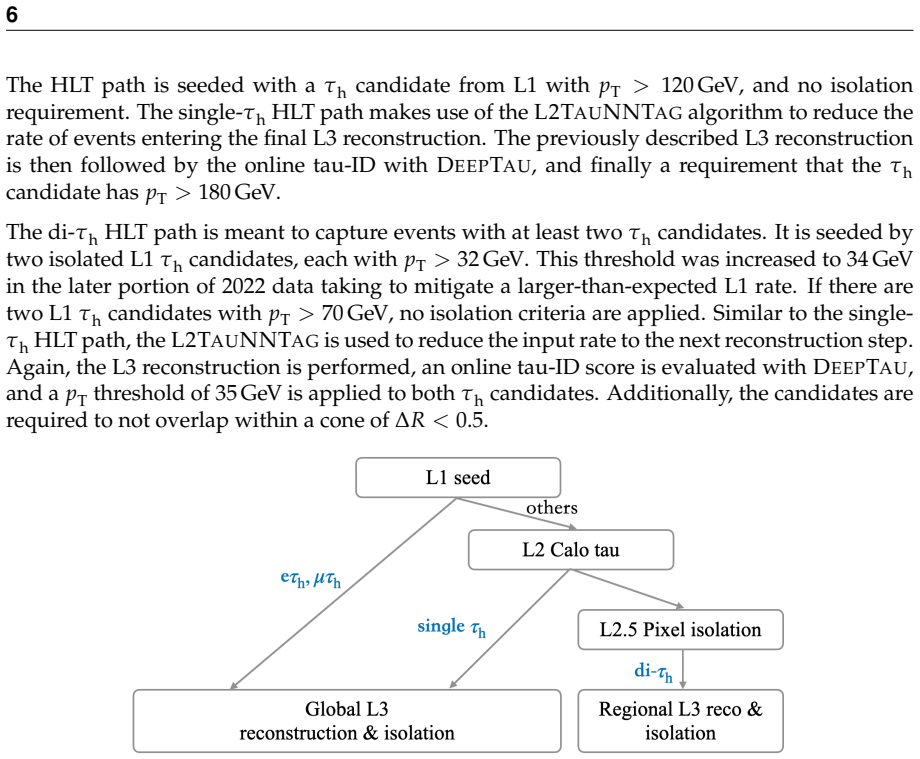
A series of machine-learning algorithms with high identification efficiency and low computational cost have been incorporated into the high-level trigger for hadronically decaying tau leptons. The trigger performance is summarized using data collected by the CMS experiment in proton-proton collisions at √s = 13.6 TeV in 2022−2023, corresponding to an integrated luminosity of 62 fb^{-1}.
What carries the argument
Machine-learning algorithms for tau identification that operate at the high-level trigger stage to separate genuine tau leptons from quark- and gluon-initiated jets.
If this is right
- Higher trigger efficiency for processes involving hadronic tau decays.
- Lower computational cost allows more trigger paths to run simultaneously.
- Effective discrimination against jets even in high pileup environments.
- Validated performance metrics drawn directly from 62 fb^{-1} of 2022-2023 collision data.
- Improved data acquisition rate for tau-based physics measurements and searches.
Where Pith is reading between the lines
- The approach could extend to other trigger objects facing similar identification challenges in future higher-luminosity runs.
- Wider adoption of low-cost ML at the trigger level may free resources for additional physics channels.
- Real-data performance validation sets a template for testing similar algorithms in upcoming detector upgrades.
- Success here could reduce selection biases in tau-related analyses across multiple experiments.
Load-bearing premise
The machine-learning models trained on simulation or limited data will maintain high efficiency and low fake rates when applied to the full range of real collision conditions including varying pileup and detector aging.
What would settle it
Observing a large drop in identification efficiency or a sharp rise in fake rates from jets when the algorithms run on real data, compared to simulation predictions, would falsify the performance claim.
Figures



read the original abstract
The trigger system of the CMS detector is pivotal in the acquisition of data for physics measurements and searches. Studies of final states characterized by hadronic decays of tau leptons require the reconstruction and the identification of genuine tau leptons against quark- and gluon-initiated jets at the trigger level. This is a difficult task, particularly as improvements to the LHC have resulted in an increased number of interactions per bunch crossing in recent years. To address this challenge, a series of machine-learning algorithms with high identification efficiency and low computational cost have been incorporated into the high-level trigger for hadronically decaying tau leptons. In this paper, these developments and the trigger performance are summarized using data collected by the CMS experiment in proton-proton collisions at $\sqrt{s}$ = 13.6 TeV in 2022$-$2023, corresponding to an integrated luminosity of 62 fb$^{-1}$.
Editorial analysis
A structured set of objections, weighed in public.
Circularity Check
No significant circularity in experimental performance report
full rationale
This is an experimental paper summarizing the incorporation of machine-learning algorithms into the CMS high-level trigger for hadronic tau leptons and reporting their performance measured directly on real proton-proton collision data from 2022-2023. There is no claimed derivation chain involving predictions or first-principles results that reduce to the inputs by construction. The performance metrics are evaluated on actual data, providing independent validation rather than self-referential fitting.
Axiom & Free-Parameter Ledger
axioms (1)
- domain assumption Standard Monte Carlo simulation of detector response and pileup accurately models real collision data for trigger efficiency studies
Lean theorems connected to this paper
-
IndisputableMonolith/Cost/FunctionalEquation.leanwashburn_uniqueness_aczel unclear?
unclearRelation between the paper passage and the cited Recognition theorem.
a series of machine-learning algorithms with high identification efficiency and low computational cost have been incorporated into the high-level trigger for hadronically decaying tau leptons
-
IndisputableMonolith/Foundation/RealityFromDistinction.leanreality_from_one_distinction unclear?
unclearRelation between the paper passage and the cited Recognition theorem.
The performance is evaluated using pp collision data collected in 2022–2023 at a center-of-mass energy of 13.6 TeV
What do these tags mean?
- matches
- The paper's claim is directly supported by a theorem in the formal canon.
- supports
- The theorem supports part of the paper's argument, but the paper may add assumptions or extra steps.
- extends
- The paper goes beyond the formal theorem; the theorem is a base layer rather than the whole result.
- uses
- The paper appears to rely on the theorem as machinery.
- contradicts
- The paper's claim conflicts with a theorem or certificate in the canon.
- unclear
- Pith found a possible connection, but the passage is too broad, indirect, or ambiguous to say the theorem truly supports the claim.
Reference graph
Works this paper leans on
-
[1]
Observation of the Higgs boson decay to a pair of tau leptons with the CMS detector
CMS Collaboration, “Observation of the Higgs boson decay to a pair ofτleptons with the CMS detector”,Phys. Lett. B779(2018) 283, doi:10.1016/j.physletb.2018.02.004,arXiv:1708.00373. References 21
work page internal anchor Pith review Pith/arXiv arXiv doi:10.1016/j.physletb.2018.02.004 2018
-
[2]
CMS Collaboration, “Search for Higgs boson pair production in events with two bottom quarks and two tau leptons in proton–proton collisions at √s=13 TeV”,Phys. Lett. B 778(2018) 101,doi:10.1016/j.physletb.2018.01.001,arXiv:1707.02909
work page internal anchor Pith review Pith/arXiv arXiv doi:10.1016/j.physletb.2018.01.001 2018
-
[3]
ATLAS Collaboration, “Cross-section measurements of the Higgs boson decaying into a pair ofτ-leptons in proton-proton collisions at √s=13 TeV with the ATLAS detector”, Phys. Rev. D99(2019) 072001,doi:10.1103/PhysRevD.99.072001, arXiv:1811.08856
work page internal anchor Pith review Pith/arXiv arXiv doi:10.1103/physrevd.99.072001 2019
-
[4]
ATLAS Collaboration, “Search for resonant and non-resonant Higgs boson pair production in the b¯bτ+τ− decay channel in pp collisions at √s=13 TeV with the ATLAS detector”,Phys. Rev. Lett.121(2018) 191801, doi:10.1103/PhysRevLett.121.191801,arXiv:1808.00336. [Erratum: doi:10.1103/PhysRevLett.122.089901,Phys. Rev. Lett. 122 (2019) 089901]
work page internal anchor Pith review Pith/arXiv arXiv doi:10.1103/physrevlett.121.191801 2018
-
[5]
ATLAS Collaboration, “Test of CP invariance in vector-boson fusion production of the Higgs boson in the H→ττchannel in proton−proton collisions at √s=13 TeV with the ATLAS detector”,Phys. Lett. B805(2020) 135426, doi:10.1016/j.physletb.2020.135426,arXiv:2002.05315
-
[6]
CMS Collaboration, “Measurement of the production cross section of a Higgs boson with large transverse momentum in its decays to a pair ofτleptons in proton-proton collisions at √s=13 TeV”,Phys. Lett. B857(2024) 138964, doi:10.1016/j.physletb.2024.138964,arXiv:2403.20201
-
[7]
CMS Collaboration, “Search for Higgs boson pairs decaying to WW*WW*, WW*ττ, and ττττin proton-proton collisions at √s=13 TeV”,JHEP07(2023) 095, doi:10.1007/JHEP07(2023)095,arXiv:2206.10268
-
[8]
CMS Collaboration, “Observation ofγγ→ττin proton-proton collisions and limits on the anomalous electromagnetic moments of theτlepton”,Rept. Prog. Phys.87(2024) 107801,doi:10.1088/1361-6633/ad6fcb,arXiv:2406.03975
-
[9]
ATLAS Collaboration, “Observation of theγγ→ττprocess in Pb+Pb collisions and constraints on theτ-lepton anomalous magnetic moment with the ATLAS detector”, Phys. Rev. Lett.131(2023) 151802,doi:10.1103/PhysRevLett.131.151802, arXiv:2204.13478
-
[10]
Measurement of theτlepton polarization in Z boson decays in proton-proton collisions at √s=13 TeV
CMS Collaboration, “Measurement of theτlepton polarization in Z boson decays in proton-proton collisions at √s=13 TeV”,JHEP01(2024) 101, doi:10.1007/JHEP01(2024)101,arXiv:2309.12408
-
[11]
ATLAS Collaboration, “Measurement ofτpolarisation inZ/γ ∗ →ττdecays in proton-proton collisions at √s=8 TeV with the ATLAS detector”,Eur. Phys. J. C78 (2018) 163,doi:10.1140/epjc/s10052-018-5619-1,arXiv:1709.03490
work page internal anchor Pith review Pith/arXiv arXiv doi:10.1140/epjc/s10052-018-5619-1 2018
-
[12]
ATLAS Collaboration, “Measurement ofτpolarization inW→τνdecays with the ATLAS detector in pp collisions at √s=7 TeV”,Eur. Phys. J. C72(2012) 2062, doi:10.1140/epjc/s10052-012-2062-6,arXiv:1204.6720
work page internal anchor Pith review Pith/arXiv arXiv doi:10.1140/epjc/s10052-012-2062-6 2012
-
[13]
CMS Collaboration, “Searches for additional Higgs bosons and for vector leptoquarks in ττfinal states in proton-proton collisions at √s=13 TeV”,JHEP07(2023) 073, doi:10.1007/JHEP07(2023)073,arXiv:2208.02717. 22
-
[14]
ATLAS Collaboration, “Search for heavy Higgs bosons decaying into two tau leptons with the ATLAS detector using pp collisions at √s=13 TeV”,Phys. Rev. Lett.125(2020) 051801,doi:10.1103/PhysRevLett.125.051801,arXiv:2002.12223
-
[15]
Particle Data Group, S. Navas et al., “Review of particle physics”,Phys. Rev. D110 (2024) 030001,doi:10.1103/PhysRevD.110.030001
-
[16]
CMS experiment at the LHC: Commissioning and early physics
CMS Collaboration, “The CMS experiment at the CERN LHC”,JINST3(2008) S08004, doi:10.1088/1748-0221/3/08/S08004,arXiv:1003.4038
work page internal anchor Pith review Pith/arXiv arXiv doi:10.1088/1748-0221/3/08/s08004 2008
-
[17]
Development of the CMS detector for the CERN LHC Run 3
CMS Collaboration, “Development of the CMS detector for the CERN LHC Run 3”, JINST19(2024) P05064,doi:10.1088/1748-0221/19/05/P05064, arXiv:2309.05466
-
[18]
CMS Collaboration, “Performance of reconstruction and identification ofτleptons decaying to hadrons andν τ in pp collisions at √s=13 TeV”,JINST13(2018) P10005, doi:10.1088/1748-0221/13/10/P10005,arXiv:1809.02816
work page internal anchor Pith review Pith/arXiv arXiv doi:10.1088/1748-0221/13/10/p10005 2018
-
[19]
Performance of the CMS Level-1 trigger in proton-proton collisions at √s=13 TeV
CMS Collaboration, “Performance of the CMS Level-1 trigger in proton-proton collisions at √s=13 TeV”,JINST15(2020) P10017, doi:10.1088/1748-0221/15/10/P10017,arXiv:2006.10165
-
[20]
CMS Collaboration, “The CMS trigger system”,JINST12(2017) P01020, doi:10.1088/1748-0221/12/01/P01020,arXiv:1609.02366
work page internal anchor Pith review Pith/arXiv arXiv doi:10.1088/1748-0221/12/01/p01020 2017
-
[21]
Performance of the CMS high-level trigger during LHC Run 2
CMS Collaboration, “Performance of the CMS high-level trigger during LHC Run 2”, JINST19(2024) P11021,doi:10.1088/1748-0221/19/11/P11021, arXiv:2410.17038
-
[22]
Electron and photon reconstruction and identification with the CMS experiment at the CERN LHC
CMS Collaboration, “Electron and photon reconstruction and identification with the CMS experiment at the CERN LHC”,JINST16(2021) P05014, doi:10.1088/1748-0221/16/05/P05014,arXiv:2012.06888
-
[23]
CMS Collaboration, “Performance of the CMS muon detector and muon reconstruction with proton-proton collisions at √s=13 TeV”,JINST13(2018) P06015, doi:10.1088/1748-0221/13/06/P06015,arXiv:1804.04528
work page internal anchor Pith review Pith/arXiv arXiv doi:10.1088/1748-0221/13/06/p06015 2018
-
[24]
Description and performance of track and primary-vertex reconstruction with the CMS tracker
CMS Collaboration, “Description and performance of track and primary-vertex reconstruction with the CMS tracker”,JINST9(2014) P10009, doi:10.1088/1748-0221/9/10/P10009,arXiv:1405.6569
work page internal anchor Pith review Pith/arXiv arXiv doi:10.1088/1748-0221/9/10/p10009 2014
-
[25]
CMS technical design report for the Phase 1 upgrade of the hadron calorimeter
CMS Collaboration, “CMS technical design report for the Phase 1 upgrade of the hadron calorimeter”, Technical Report CERN-LHCC-2012-015, CMS-TDR-010, 2012
work page 2012
-
[26]
Performance of the CMS Phase-1 pixel detector with Run 3 data
CMS Collaboration, “Performance of the CMS Phase-1 pixel detector with Run 3 data”, CMS Detector Performance Note CMS-DP-2022-047, 2022
work page 2022
-
[27]
Commissioning CMS online reconstruction with GPUs
CMS Collaboration, “Commissioning CMS online reconstruction with GPUs”, CMS Detector Performance Note CMS-DP-2023-004, 2022
work page 2023
-
[28]
CMS BRIL Collaboration, “The pixel luminosity telescope: a detector for luminosity measurement at CMS using silicon pixel sensors”,Eur. Phys. J. C83(2023) 673, doi:10.1140/epjc/s10052-023-11713-6,arXiv:2206.08870. References 23
-
[29]
Run 3 luminosity measurements with the pixel luminosity telescope
CMS Collaboration, “Run 3 luminosity measurements with the pixel luminosity telescope”, inProceedings of 41st International Conference on High Energy physics, p. 936. 2022.doi:10.22323/1.414.0936
-
[30]
CMS Collaboration, “Upgraded CMS fast beam condition monitor for LHC Run 3 online luminosity and beam induced background measurements”, inProc. 11th Int. Beam Instrum. Conf., p. 540. 2022.doi:10.18429/JACoW-IBIC2022-TH2C2
-
[31]
Particle-flow reconstruction and global event description with the CMS detector
CMS Collaboration, “Particle-flow reconstruction and global event description with the CMS detector”,JINST12(2017) P10003,doi:10.1088/1748-0221/12/10/P10003, arXiv:1706.04965
work page internal anchor Pith review Pith/arXiv arXiv doi:10.1088/1748-0221/12/10/p10003 2017
-
[32]
Technical proposal for the Phase-II upgrade of the CMS detector
D. Contardo et al., “Technical proposal for the Phase-II upgrade of the CMS detector”, CMS Technical Design Review CMS-TDR-15-02, 2015. doi:10.17181/CERN.VU8I.D59J
-
[33]
The anti-k_t jet clustering algorithm
M. Cacciari, G. P . Salam, and G. Soyez, “The anti-kT jet clustering algorithm”,JHEP04 (2008) 063,doi:10.1088/1126-6708/2008/04/063,arXiv:0802.1189
work page internal anchor Pith review Pith/arXiv arXiv doi:10.1088/1126-6708/2008/04/063 2008
-
[34]
M. Cacciari, G. P . Salam, and G. Soyez, “FastJet user manual”,Eur. Phys. J. C72(2012) 1896,doi:10.1140/epjc/s10052-012-1896-2,arXiv:1111.6097
work page internal anchor Pith review Pith/arXiv arXiv doi:10.1140/epjc/s10052-012-1896-2 2012
-
[35]
Pileup mitigation at CMS in 13 TeV data
CMS Collaboration, “Pileup mitigation at CMS in 13 TeV data”,JINST15(2020) P09018, doi:10.1088/1748-0221/15/09/P09018,arXiv:2003.00503
-
[36]
Pileup Per Particle Identification
D. Bertolini, P . Harris, M. Low, and N. Tran, “Pileup per particle identification”,JHEP10 (2014) 059,doi:10.1007/JHEP10(2014)059,arXiv:1407.6013
work page internal anchor Pith review Pith/arXiv arXiv doi:10.1007/jhep10(2014)059 2014
-
[37]
Jet energy scale and resolution in the CMS experiment in pp collisions at 8 TeV
CMS Collaboration, “Jet energy scale and resolution in the CMS experiment in pp collisions at 8 TeV”,JINST12(2017) P02014, doi:10.1088/1748-0221/12/02/P02014,arXiv:1607.03663
work page internal anchor Pith review Pith/arXiv arXiv doi:10.1088/1748-0221/12/02/p02014 2017
-
[38]
CMS Collaboration, “Performance of electron reconstruction and selection with the CMS detector in proton-proton collisions at √s=8TeV”,JINST10(2015) P06005, doi:10.1088/1748-0221/10/06/P06005,arXiv:1502.02701
work page internal anchor Pith review Pith/arXiv arXiv doi:10.1088/1748-0221/10/06/p06005 2015
-
[39]
CMS Collaboration, “Performance of missing transverse momentum reconstruction in proton-proton collisions at √s=13 TeV using the CMS detector”,JINST14(2019) P07004,doi:10.1088/1748-0221/14/07/P07004,arXiv:1903.06078
work page internal anchor Pith review Pith/arXiv arXiv doi:10.1088/1748-0221/14/07/p07004 2019
-
[40]
Performance of tau-lepton reconstruction and identification in CMS
CMS Collaboration, “Performance ofτ-lepton reconstruction and identification in CMS”, JINST7(2012) P01001,doi:10.1088/1748-0221/7/01/P01001, arXiv:1109.6034
work page internal anchor Pith review Pith/arXiv arXiv doi:10.1088/1748-0221/7/01/p01001 2012
-
[41]
Reconstruction and identification of tau lepton decays to hadrons and tau neutrino at CMS
CMS Collaboration, “Reconstruction and identification ofτlepton decays to hadrons and ντ at CMS”,JINST11(2016) P01019,doi:10.1088/1748-0221/11/01/P01019, arXiv:1510.07488
work page internal anchor Pith review Pith/arXiv arXiv doi:10.1088/1748-0221/11/01/p01019 2016
-
[42]
CMS Collaboration, “Performance of the DeepTau algorithm for the discrimination of taus against jets, electron, and muons”, CMS Detector Performance Note CMS-DP-2019-033, 2019
work page 2019
-
[43]
Identification of hadronic tau lepton decays using a deep neural network
CMS Collaboration, “Identification of hadronic tau lepton decays using a deep neural network”,JINST17(2022) P07023,doi:10.1088/1748-0221/17/07/P07023, arXiv:2201.08458. 24
-
[44]
Luminosity measurement in proton-proton collisions at 13.6 TeV in 2022 at CMS
CMS Collaboration, “Luminosity measurement in proton-proton collisions at 13.6 TeV in 2022 at CMS”, CMS Physics Analysis Summary CMS-PAS-LUM-22-001, 2024
work page 2022
-
[45]
CMS Collaboration, “Measurement of the offline integrated luminosity for the CMS proton-proton collision dataset recorded in 2023”, CMS Detector Performance Note CMS-DP-2024-068, 2024
work page 2023
-
[46]
Luminosity determination using Z boson production at the CMS experiment
CMS Collaboration, “Luminosity determination using Z boson production at the CMS experiment”,Eur. Phys. J. C84(2024) 26, doi:10.1140/epjc/s10052-023-12268-2,arXiv:2309.01008
-
[47]
Precision luminosity measurement in proton-proton collisions at√s=13 TeV in 2015 and 2016 at CMS
CMS Collaboration, “Precision luminosity measurement in proton-proton collisions at√s=13 TeV in 2015 and 2016 at CMS”,Eur. Phys. J. C81(2021) 800, doi:10.1140/epjc/s10052-021-09538-2,arXiv:2104.01927
-
[48]
J. Alwall et al., “The automated computation of tree-level and next-to-leading order differential cross sections, and their matching to parton shower simulations”,JHEP07 (2014) 079,doi:10.1007/JHEP07(2014)079,arXiv:1405.0301
work page internal anchor Pith review Pith/arXiv arXiv doi:10.1007/jhep07(2014)079 2014
-
[49]
J. Alwall et al., “Comparative study of various algorithms for the merging of parton showers and matrix elements in hadronic collisions”,Eur. Phys. J. C53(2008) 473, doi:10.1140/epjc/s10052-007-0490-5,arXiv:0706.2569
work page internal anchor Pith review Pith/arXiv arXiv doi:10.1140/epjc/s10052-007-0490-5 2008
-
[50]
T. Sj ¨ostrand et al., “An introduction to PYTHIA 8.2”,Comput. Phys. Commun.191(2015) 159,doi:10.1016/j.cpc.2015.01.024,arXiv:1410.3012
work page internal anchor Pith review Pith/arXiv arXiv doi:10.1016/j.cpc.2015.01.024 2015
-
[51]
A New Method for Combining NLO QCD with Shower Monte Carlo Algorithms
P . Nason, “A new method for combining NLO QCD with shower Monte Carlo algorithms”,JHEP11(2004) 040,doi:10.1088/1126-6708/2004/11/040, arXiv:hep-ph/0409146
work page internal anchor Pith review Pith/arXiv arXiv doi:10.1088/1126-6708/2004/11/040 2004
-
[52]
Matching NLO QCD computations with Parton Shower simulations: the POWHEG method
S. Frixione, P . Nason, and C. Oleari, “Matching NLO QCD computations with parton shower simulations: the POWHEG method”,JHEP11(2007) 070, doi:10.1088/1126-6708/2007/11/070,arXiv:0709.2092
work page internal anchor Pith review Pith/arXiv arXiv doi:10.1088/1126-6708/2007/11/070 2007
-
[53]
A general framework for implementing NLO calculations in shower Monte Carlo programs: the POWHEG BOX
S. Alioli, P . Nason, C. Oleari, and E. Re, “A general framework for implementing NLO calculations in shower Monte Carlo programs: the POWHEG BOX”,JHEP06(2010) 043, doi:10.1007/JHEP06(2010)043,arXiv:1002.2581
work page internal anchor Pith review Pith/arXiv arXiv doi:10.1007/jhep06(2010)043 2010
-
[54]
Top-pair production and decay at NLO matched with parton showers
J. M. Campbell, R. K. Ellis, P . Nason, and E. Re, “Top-pair production and decay at NLO matched with parton showers”,JHEP04(2015) 114, doi:10.1007/JHEP04(2015)114,arXiv:1412.1828
work page internal anchor Pith review Pith/arXiv arXiv doi:10.1007/jhep04(2015)114 2015
-
[55]
A Positive-Weight Next-to-Leading-Order Monte Carlo for Heavy Flavour Hadroproduction
S. Frixione, P . Nason, and G. Ridolfi, “A positive-weight next-to-leading-order Monte Carlo for heavy flavour hadroproduction”,JHEP09(2007) 126, doi:10.1088/1126-6708/2007/09/126,arXiv:0707.3088
work page internal anchor Pith review Pith/arXiv arXiv doi:10.1088/1126-6708/2007/09/126 2007
-
[56]
NLO Higgs boson production via vector-boson fusion matched with shower in POWHEG
P . Nason and C. Oleari, “NLO Higgs boson production via vector-boson fusion matched with shower in POWHEG”,JHEP02(2010) 037,doi:10.1007/JHEP02(2010)037, arXiv:0911.5299
work page internal anchor Pith review Pith/arXiv arXiv doi:10.1007/jhep02(2010)037 2010
-
[57]
Extraction and validation of a new set of CMS PYTHIA8 tunes from underlying-event measurements
CMS Collaboration, “Extraction and validation of a new set of CMS PYTHIA8 tunes from underlying-event measurements”,Eur. Phys. J. C80(2020) 4, doi:10.1140/epjc/s10052-019-7499-4,arXiv:1903.12179. References 25
-
[58]
Universal Interface of TAUOLA Technical and Physics Documentation
N. Davidson et al., “Universal interface of TAUOLA technical and physics documentation”,Comput. Phys. Commun.183(2012) 821, doi:10.1016/j.cpc.2011.12.009,arXiv:1002.0543
work page internal anchor Pith review Pith/arXiv arXiv doi:10.1016/j.cpc.2011.12.009 2012
-
[59]
Parton distributions for the LHC Run II
NNPDF Collaboration, “Parton distributions for the LHC Run II”,JHEP04(2015) 040, doi:10.1007/JHEP04(2015)040,arXiv:1410.8849
work page internal anchor Pith review Pith/arXiv arXiv doi:10.1007/jhep04(2015)040 2015
-
[60]
Parton distributions from high-precision collider data
NNPDF Collaboration, “Parton distributions from high-precision collider data”,Eur. Phys. J. C77(2017) 663,doi:10.1140/epjc/s10052-017-5199-5, arXiv:1706.00428
work page internal anchor Pith review Pith/arXiv arXiv doi:10.1140/epjc/s10052-017-5199-5 2017
-
[61]
GEANT4 Collaboration, “GEANT4—A simulation toolkit”,Nucl. Instrum. Meth. A506 (2003) 250,doi:10.1016/S0168-9002(03)01368-8
-
[62]
Performance of Level-1 trigger e/gamma and tau in Run 3
CMS Collaboration, “Performance of Level-1 trigger e/gamma and tau in Run 3”, CMS Detector Performance Note CMS-DP-2023-008, 2023
work page 2023
-
[63]
Heterogeneous reconstruction of tracks and primary vertices with the CMS pixel tracker
A. Bocci et al., “Heterogeneous reconstruction of tracks and primary vertices with the CMS pixel tracker”,Front. Big Data3(2020) 601728, doi:10.3389/fdata.2020.601728,arXiv:2008.13461
-
[64]
Performance of Run-3 HLT track reconstruction
CMS Collaboration, “Performance of Run-3 HLT track reconstruction”, CMS Detector Performance Note CMS-DP-2022-014, 2022
work page 2022
-
[65]
Adam: A Method for Stochastic Optimization
D. P . Kingma and J. Ba, “Adam: A method for stochastic optimization”, in3rd International Conference on Learning Representations, ICLR. 2014.arXiv:1412.6980
work page internal anchor Pith review Pith/arXiv arXiv 2014
-
[66]
Identification of tau leptons using a convolutional neural network with domain adaptation
CMS Collaboration, “Identification of tau leptons using a convolutional neural network with domain adaptation”,JINST20(2025) P12032, doi:10.1088/1748-0221/20/12/P12032,arXiv:2511.05468
-
[67]
I. J. Goodfellow, Y. Bengio, and A. Courville, “Deep Learning”. MIT Press, Cambridge, MA, USA, 2016.http://www.deeplearningbook.org. ISBN 978-0262035613
work page 2016
-
[68]
CMS RPC efficiency measurement using the tag-and-probe method
CMS Collaboration, “CMS RPC efficiency measurement using the tag-and-probe method”,JINST14(2019) C10020,doi:10.1088/1748-0221/14/10/C10020. 26 27 A The CMS Collaboration Yerevan Physics Institute, Yerevan, Armenia A. Hayrapetyan, V . Makarenko , A. Tumasyan1 Institut f ¨ ur Hochenergiephysik, Vienna, Austria W. Adam , L. Benato , T. Bergauer , M. Dragicev...
discussion (0)
Sign in with ORCID, Apple, or X to comment. Anyone can read and Pith papers without signing in.