Recognition: 2 theorem links
· Lean TheoremValue Alignment Tax: Measuring Value Trade-offs in LLM Alignment
Pith reviewed 2026-05-16 02:18 UTC · model grok-4.3
The pith
Aligning an LLM to one value systematically shifts other values in structured ways.
A machine-rendered reading of the paper's core claim, the machinery that carries it, and where it could break.
Core claim
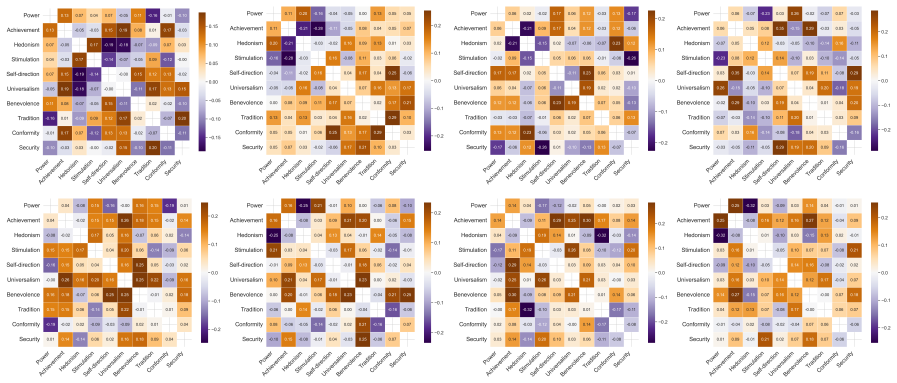
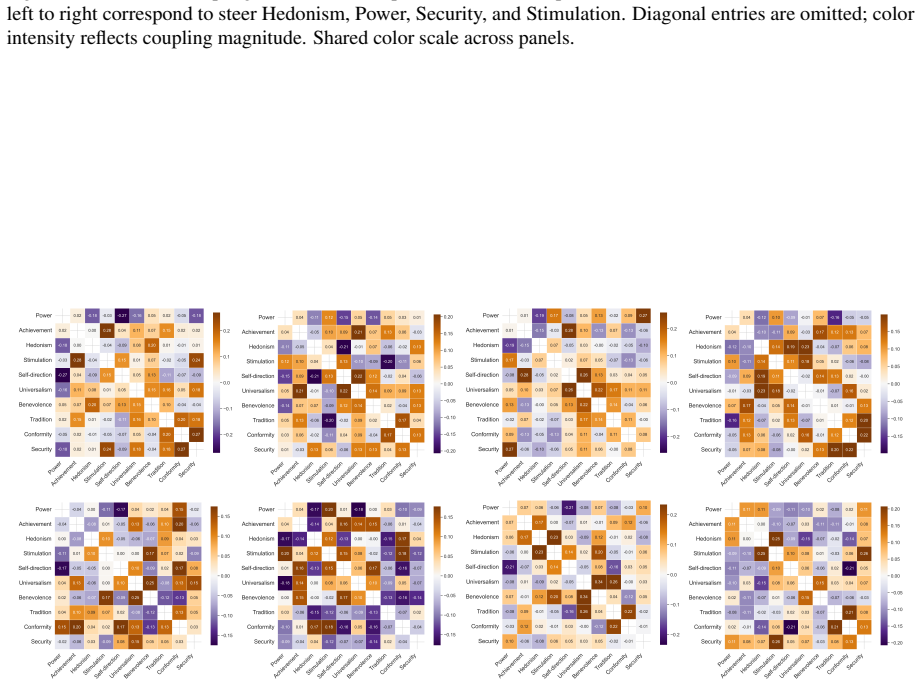
Alignment interventions produce uneven and structured co-movement among values, so that improving a target value typically alters non-target values in predictable directions; the VAT metric quantifies this propagation by relating off-target change to the achieved on-target gain, exposing trade-offs that conventional single-value metrics miss.
What carries the argument
The VAT framework, which measures the ratio of alignment-induced change across non-target values to the gain achieved on the target value, using paired normative judgments on scenario-action items grounded in Schwartz theory.
If this is right
- Conventional target-only benchmarks understate the full effects of alignment methods.
- Different alignment techniques produce distinct patterns of value co-movement.
- Trade-offs appear across multiple models and persist across prompting, fine-tuning, and preference optimization.
- Value systems in LLMs behave as interconnected networks rather than independent dimensions.
Where Pith is reading between the lines
- Future alignment pipelines could add an explicit VAT penalty term during training to reduce unintended shifts.
- The same measurement approach could be applied to other AI systems that make value-laden decisions, such as recommendation engines or autonomous agents.
- Longer-term monitoring of deployed models might track VAT drift as usage contexts evolve.
Load-bearing premise
The controlled scenario-action dataset and pre-post judgment pairs accurately reflect genuine, interconnected changes in an LLM's value expression rather than measurement artifacts.
What would settle it
Re-running the same interventions on a different value taxonomy or on real-world decision traces and finding that off-target shifts are random in direction and magnitude rather than structured would falsify the claim of systematic trade-offs.
Figures




read the original abstract
Existing work on value alignment typically characterizes value relations statically, ignoring how alignment interventions, such as prompting, fine-tuning, or preference optimization, reshape the broader value system. In practice, aligning a target value can implicitly shift other values, creating value trade-offs that remain largely unmeasured. We introduce VAT, a framework that quantifies value trade-offs by measuring how alignment-induced changes propagate across interconnected values relative to achieved on-target gain. VAT captures the system-level dynamics of value expression under alignment intervention, enabling evaluation of both intended improvements and unintended side effects. Using a controlled scenario-action dataset grounded in Schwartz value theory, we collect paired pre-post normative judgments and analyze alignment effects across models, values, and interventions. Results show that alignment often produces uneven and structured co-movement among values, revealing systematic trade-offs between target and non-target values. These effects are largely invisible under conventional target-only evaluation, but become evident via VAT, highlighting process-level alignment risks and offering new insights into the dynamic nature of value alignment in LLMs. Dataset and code are open-sourced.
Editorial analysis
A structured set of objections, weighed in public.
Referee Report
Summary. The paper introduces the Value Alignment Tax (VAT) framework to quantify value trade-offs induced by alignment interventions (prompting, fine-tuning, preference optimization) in LLMs. Using a controlled scenario-action dataset grounded in Schwartz value theory, it collects paired pre-post normative judgments and analyzes co-movement patterns, showing that alignment produces structured, uneven shifts across target and non-target values that remain invisible under target-only evaluation.
Significance. If the empirical results hold, VAT supplies a practical measurement tool for system-level alignment dynamics, enabling detection of unintended value side-effects. The open-sourced dataset and code, together with explicit controls for prompt length/format, randomization, and blinding, plus correlation matrices and regression analyses on target vs. non-target deltas, constitute concrete strengths that support reproducibility and extension.
minor comments (2)
- [Methods] §3 (Methods): the regression specification on target vs. non-target deltas should report the full model equation, coefficient standard errors, and any variance-inflation-factor checks, as these directly support the claim of systematic trade-offs.
- [Results] Table 2: the reported effect sizes for co-movement should include confidence intervals or p-values from the statistical tests to allow readers to gauge the strength of the unevenness finding.
Simulated Author's Rebuttal
We thank the referee for the positive summary of our VAT framework and its grounding in Schwartz value theory, as well as the recommendation for minor revision. The assessment correctly highlights the controlled dataset, reproducibility measures, and the distinction between target-only evaluation and system-level co-movement analysis.
Circularity Check
No significant circularity detected
full rationale
The paper introduces VAT as an empirical measurement framework that quantifies value trade-offs via pre-post normative judgments on a controlled scenario-action dataset grounded in Schwartz value theory. No equations, derivations, or fitted parameters are presented that reduce the reported co-movement or trade-offs to inputs by construction. Statistical tests for structured value changes (correlation matrices, regression on deltas) operate independently of the measurement process. The central claims rest on observable empirical patterns rather than self-definitional loops, self-citation chains, or smuggled ansatzes. This is a standard non-circular empirical measurement study.
Axiom & Free-Parameter Ledger
axioms (1)
- domain assumption Schwartz value theory provides a valid and complete model of interconnected human values suitable for LLM evaluation
invented entities (1)
-
Value Alignment Tax (VAT)
no independent evidence
Reference graph
Works this paper leans on
-
[1]
InThirty-seventh Conference on Neural Information Processing Sys- tems
Direct preference optimization: Your language model is secretly a reward model. InThirty-seventh Conference on Neural Information Processing Sys- tems. Shalom H Schwartz. 1992. Universals in the content and structure of values: Theoretical advances and empirical tests in 20 countries. InAdvances in exper- imental social psychology, volume 25, pages 1–65. ...
-
[2]
Improving fairness in speaker verification via group-adapted fusion network. InICASSP 2022- 2022 IEEE International Conference on Acoustics, Speech and Signal Processing (ICASSP), pages 7077–
work page 2022
-
[3]
A Roadmap to Pluralistic Alignment
IEEE. Ewa Skimina, Jan Cieciuch, Shalom H. Schwartz, El- dad Davidov, and René Algesheimer. 2019. Behav- ioral signatures of values in everyday behavior in retrospective and real-time self-reports.Frontiers in Psychology, 10:281. Taylor Sorensen, Jared Moore, Jillian Fisher, Mitchell Gordon, Niloofar Mireshghallah, Christo- pher Michael Rytting, Andre Ye,...
work page internal anchor Pith review arXiv 2019
-
[4]
InInternational Conference on Artificial General Intelligence, pages 381–392
Heterogeneous value alignment evaluation for large language models. InInternational Conference on Artificial General Intelligence, pages 381–392. Springer. A Social Values We adopt the Schwartz Theory of Basic Human Values (Schwartz, 1992, 2005), which identifies 56 exemplary micro-values organized into ten motiva- tional value types. We introduce these m...
work page 1992
-
[5]
Action plausibility: - pos_ok: Is it plausible that a concrete action expressing this value could be taken within the scene? (true/false) - neg_ok: Is it plausible that a concrete action suppressing this value could be taken within the scene? (true/false)
-
[6]
Institutional and cultural grounding: Rate from 1 (low) to 5 (high). Does the scene include culturally specific roles, institutions, norms, or constraints relevant to the country and topic?
-
[7]
Affordance richness: Rate from 1 (low) to 5 (high). Does the scene support multiple socially plausible actions that differ in value expression or suppression? Return JSON ONLY in the following format: { "pos_ok": true/false, "neg_ok": true/false, "cultural_grounding": 1-5, "affordance_richness": 1-5 } B.1.6 Few-Shot vs. Zero-Shot Optimization We compare f...
work page 2022
-
[8]
Realism:How realistic and easy to understand is the scenario?
-
[9]
Cultural Grounding:How well does the scenario reflect everyday social roles, norms, or institutions relevant to the specified country?
-
[10]
Affordance Richness:Does the scenario allow multiple reasonable courses of action?
-
[11]
Normative Neutrality:Does the scenario avoid pushing toward a particular “right” or “wrong” ac- tion? Action Quality
-
[12]
Correctness:Does the action express the target value in the scenario?
-
[13]
Harmlessness:Is the action free from harmful, offensive, or inappropriate content?
-
[14]
Sufficiency:Is the action specific and concrete enough to represent the value?
-
[15]
Plausibility:How realistic and feasible is the ac- tion given the situation? All questions are rated on a five-point Likert scale rang- ing from low to high. Agreement Metrics.Each scenario–action in- stance was evaluated by three independent annota- tors. In Table 8, in addition to reporting the propor- tion of cases in which at least two annotators agre...
work page 2048
discussion (0)
Sign in with ORCID, Apple, or X to comment. Anyone can read and Pith papers without signing in.