Recognition: 3 theorem links
· Lean TheoremVimRAG: Navigating Massive Visual Context in Retrieval-Augmented Generation via Multimodal Memory Graph
Pith reviewed 2026-05-15 22:45 UTC · model grok-4.3
The pith
VimRAG structures multimodal reasoning as a dynamic directed acyclic graph to prioritize pivotal visual evidence in retrieval-augmented generation.
A machine-rendered reading of the paper's core claim, the machinery that carries it, and where it could break.
Core claim
VimRAG establishes that representing the reasoning trajectory as a dynamic directed acyclic graph enables precise evaluation of memory node significance via topological position, which in turn supports dynamic allocation of high-resolution tokens to critical visual evidence and facilitates fine-grained credit assignment through graph-guided policy optimization.
What carries the argument
A dynamic directed acyclic graph that structures agent states and multimodal evidence, with topological positions determining the significance for visual memory encoding and policy optimization.
If this is right
- Improved performance on diverse multimodal RAG benchmarks involving long visual contexts.
- More efficient use of tokens by prioritizing pivotal evidence over trivial clues.
- Enhanced ability to handle iterative reasoning scenarios with information-sparse visual data.
- Disentangled step-wise validity assessment leading to better overall trajectory rewards.
Where Pith is reading between the lines
- This graph-based approach may extend to other agentic systems dealing with high-dimensional data streams.
- Potential for combining with existing RAG techniques to further reduce computational overhead in visual reasoning.
- Could inform designs for memory management in long-context multimodal models beyond RAG.
Load-bearing premise
That the topological position of nodes in the dynamic DAG accurately reflects the importance of the associated multimodal evidence for successful reasoning.
What would settle it
Demonstrating that a version of VimRAG without the topological modulation in memory encoding achieves equivalent performance on the benchmarks, or identifying a task where linear history methods consistently outperform the graph-structured approach.
Figures



read the original abstract
Effectively retrieving, reasoning, and understanding multimodal information remains a critical challenge for agentic systems. Traditional Retrieval-augmented Generation (RAG) methods rely on linear interaction histories, which struggle to handle long-context tasks, especially those involving information-sparse yet token-heavy visual data in iterative reasoning scenarios. To bridge this gap, we introduce VimRAG, a framework tailored for multimodal Retrieval-augmented Reasoning across text, images, and videos. Inspired by our systematic study, we model the reasoning process as a dynamic directed acyclic graph that structures the agent states and retrieved multimodal evidence. Building upon this structured memory, we introduce a Graph-Modulated Visual Memory Encoding mechanism, with which the significance of memory nodes is evaluated via their topological position, allowing the model to dynamically allocate high-resolution tokens to pivotal evidence while compressing or discarding trivial clues. To implement this paradigm, we propose a Graph-Guided Policy Optimization strategy. This strategy disentangles step-wise validity from trajectory-level rewards by pruning memory nodes associated with redundant actions, thereby facilitating fine-grained credit assignment. Extensive experiments demonstrate that VimRAG consistently achieves state-of-the-art performance on diverse multimodal RAG benchmarks. The code is available at https://github.com/Alibaba-NLP/VRAG.
Editorial analysis
A structured set of objections, weighed in public.
Referee Report
Summary. The paper introduces VimRAG, a framework for multimodal retrieval-augmented reasoning over text, images, and videos. It models the agent's reasoning process as a dynamic directed acyclic graph (DAG) of states and retrieved multimodal evidence, proposes a Graph-Modulated Visual Memory Encoding scheme that allocates high-resolution tokens according to each node's topological position in the DAG, and introduces Graph-Guided Policy Optimization to separate step-wise validity from trajectory-level rewards via pruning of redundant nodes. Extensive experiments are reported to show consistent state-of-the-art performance on diverse multimodal RAG benchmarks.
Significance. If the core mechanisms are shown to work as described, the work offers a concrete way to move beyond linear interaction histories in long-context multimodal agents. The graph-structured memory and topology-driven token allocation could reduce the quadratic cost of visual tokens while preserving reasoning fidelity, which would be a useful contribution to agentic RAG systems that must handle sparse but token-heavy visual evidence over many steps.
major comments (2)
- [Graph-Modulated Visual Memory Encoding] The central efficiency claim rests on the assertion that topological position within the constructed DAG reliably signals semantic importance for token allocation. No ablation, correlation analysis, or counter-example study is presented to demonstrate that early central nodes are not merely artifacts of retrieval order while decisive visual clues appear in later leaves. Without such verification the claimed advantage over linear-history baselines cannot be isolated from graph-construction heuristics.
- [Graph-Guided Policy Optimization] The Graph-Guided Policy Optimization is described as disentangling step-wise validity from trajectory rewards by pruning redundant nodes, yet no quantitative results (e.g., credit-assignment accuracy, policy-gradient variance, or comparison against standard PPO) are shown to confirm that the pruning step improves learning rather than simply discarding useful trajectories.
minor comments (2)
- [Abstract] The abstract refers to a 'systematic study' that motivated the DAG design, but the study itself is not summarized or referenced with concrete findings.
- [Experiments] Figure captions and table headers should explicitly state the number of runs, random seeds, and statistical tests used to support the SOTA claims.
Simulated Author's Rebuttal
We thank the referee for the constructive feedback. We address each major comment below and will revise the manuscript to include the requested empirical validations.
read point-by-point responses
-
Referee: [Graph-Modulated Visual Memory Encoding] The central efficiency claim rests on the assertion that topological position within the constructed DAG reliably signals semantic importance for token allocation. No ablation, correlation analysis, or counter-example study is presented to demonstrate that early central nodes are not merely artifacts of retrieval order while decisive visual clues appear in later leaves. Without such verification the claimed advantage over linear-history baselines cannot be isolated from graph-construction heuristics.
Authors: We agree that isolating the contribution of topological position from retrieval-order artifacts is necessary. In the revised manuscript we will add: (1) an ablation replacing topology-based token allocation with retrieval-order-based allocation, (2) Pearson correlation between node centrality metrics and human-annotated semantic importance on a 100-example subset, and (3) qualitative counter-examples where decisive visual evidence resides in leaf nodes. These additions will demonstrate that the reported gains are not solely due to graph-construction heuristics. revision: yes
-
Referee: [Graph-Guided Policy Optimization] The Graph-Guided Policy Optimization is described as disentangling step-wise validity from trajectory rewards by pruning redundant nodes, yet no quantitative results (e.g., credit-assignment accuracy, policy-gradient variance, or comparison against standard PPO) are shown to confirm that the pruning step improves learning rather than simply discarding useful trajectories.
Authors: We acknowledge the absence of direct optimization diagnostics. The revision will include: (1) policy-gradient variance measurements with and without the pruning step, (2) credit-assignment accuracy evaluated on synthetic trajectories with known per-step rewards, and (3) a head-to-head comparison against standard PPO on the same multimodal RAG benchmarks. These metrics will quantify whether pruning improves learning stability beyond trajectory discarding. revision: yes
Circularity Check
No significant circularity; claims rest on experimental benchmarks
full rationale
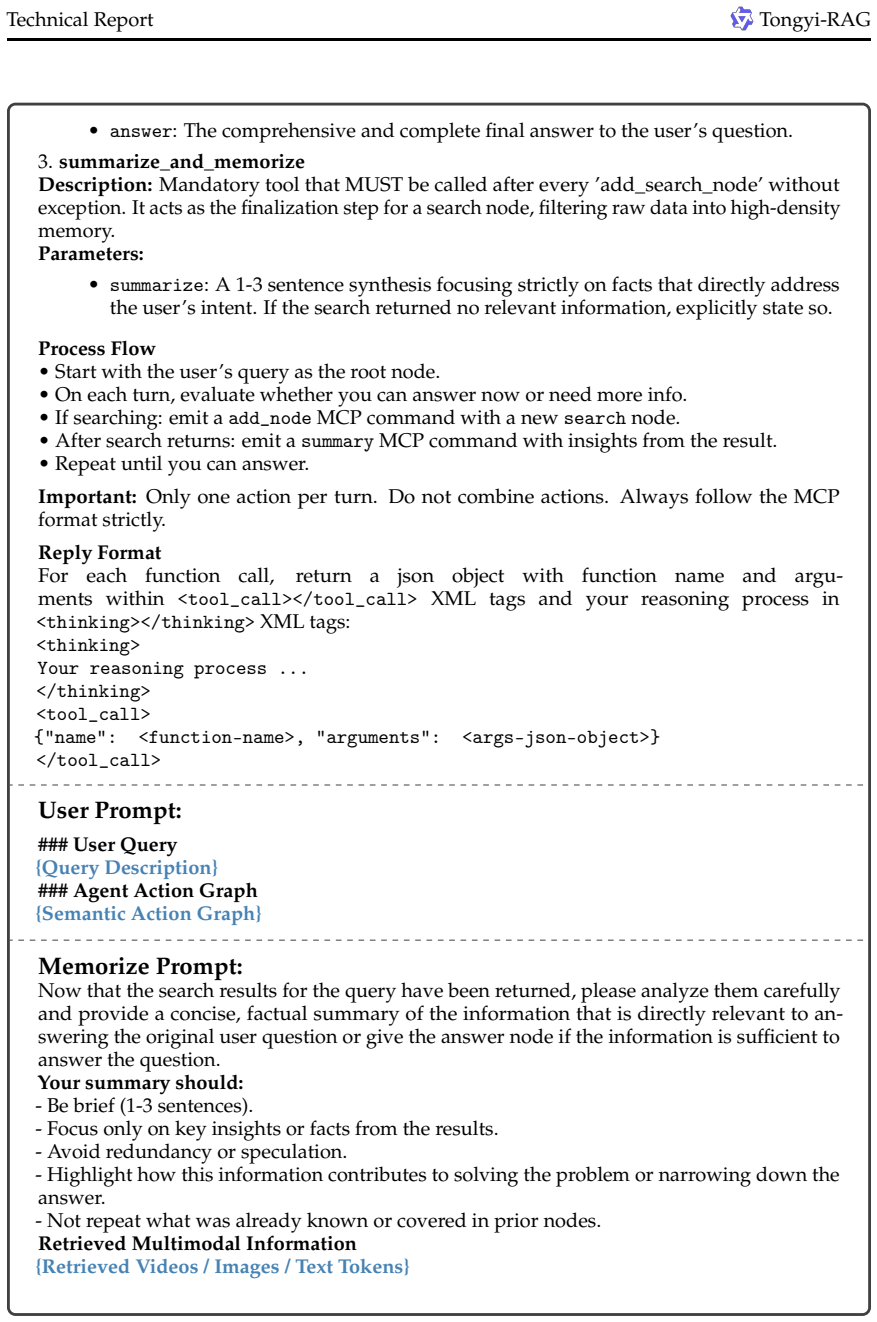
The paper introduces VimRAG by modeling agent reasoning as a dynamic DAG and proposing Graph-Modulated Visual Memory Encoding that assigns tokens based on topological position, plus Graph-Guided Policy Optimization for credit assignment. These are design choices whose validity is asserted via extensive experiments on multimodal RAG benchmarks rather than any closed mathematical derivation. No equations, fitted parameters renamed as predictions, self-definitional loops, or load-bearing self-citations appear in the provided text; the SOTA performance claim is therefore independent of the modeling steps and does not reduce to its own inputs by construction.
Axiom & Free-Parameter Ledger
invented entities (3)
-
Multimodal Memory Graph
no independent evidence
-
Graph-Modulated Visual Memory Encoding
no independent evidence
-
Graph-Guided Policy Optimization
no independent evidence
Lean theorems connected to this paper
-
IndisputableMonolith/Cost/FunctionalEquation.leanwashburn_uniqueness_aczel matches?
matchesMATCHES: this paper passage directly uses, restates, or depends on the cited Recognition theorem or module.
significance of memory nodes is evaluated via their topological position, allowing the model to dynamically allocate high-resolution tokens to pivotal evidence
-
IndisputableMonolith/Foundation/BranchSelection.leanbranch_selection matches?
matchesMATCHES: this paper passage directly uses, restates, or depends on the cited Recognition theorem or module.
Ω(mi,k)=Eint(mi,k)+γ∑vj∈Child(vi)Ω(vj) ... out-degree of node vi ... recursive feedback
-
IndisputableMonolith/Foundation/ArithmeticFromLogic.leanembed_injective echoes?
echoesECHOES: this paper passage has the same mathematical shape or conceptual pattern as the Recognition theorem, but is not a direct formal dependency.
Graph-Guided Policy Optimization ... pruning memory nodes associated with redundant actions ... critical path from the root to the answer node
What do these tags mean?
- matches
- The paper's claim is directly supported by a theorem in the formal canon.
- supports
- The theorem supports part of the paper's argument, but the paper may add assumptions or extra steps.
- extends
- The paper goes beyond the formal theorem; the theorem is a base layer rather than the whole result.
- uses
- The paper appears to rely on the theorem as machinery.
- contradicts
- The paper's claim conflicts with a theorem or certificate in the canon.
- unclear
- Pith found a possible connection, but the passage is too broad, indirect, or ambiguous to say the theorem truly supports the claim.
Reference graph
Works this paper leans on
-
[1]
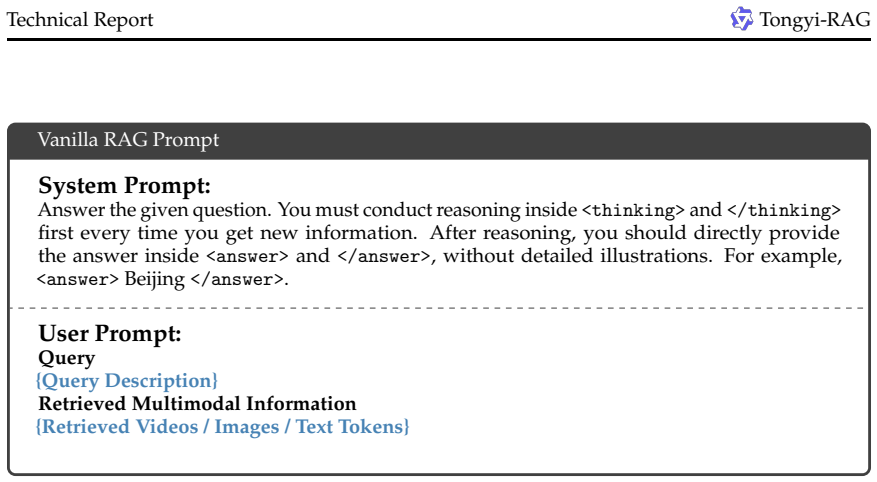
Vanilla RAG. During the retrieval phase, it directly uses the original question to search for relevant text, images and videos, which are then inserted into the context to answer the question. Please refer to Appendix J.3 for the detailed prompt
-
[2]
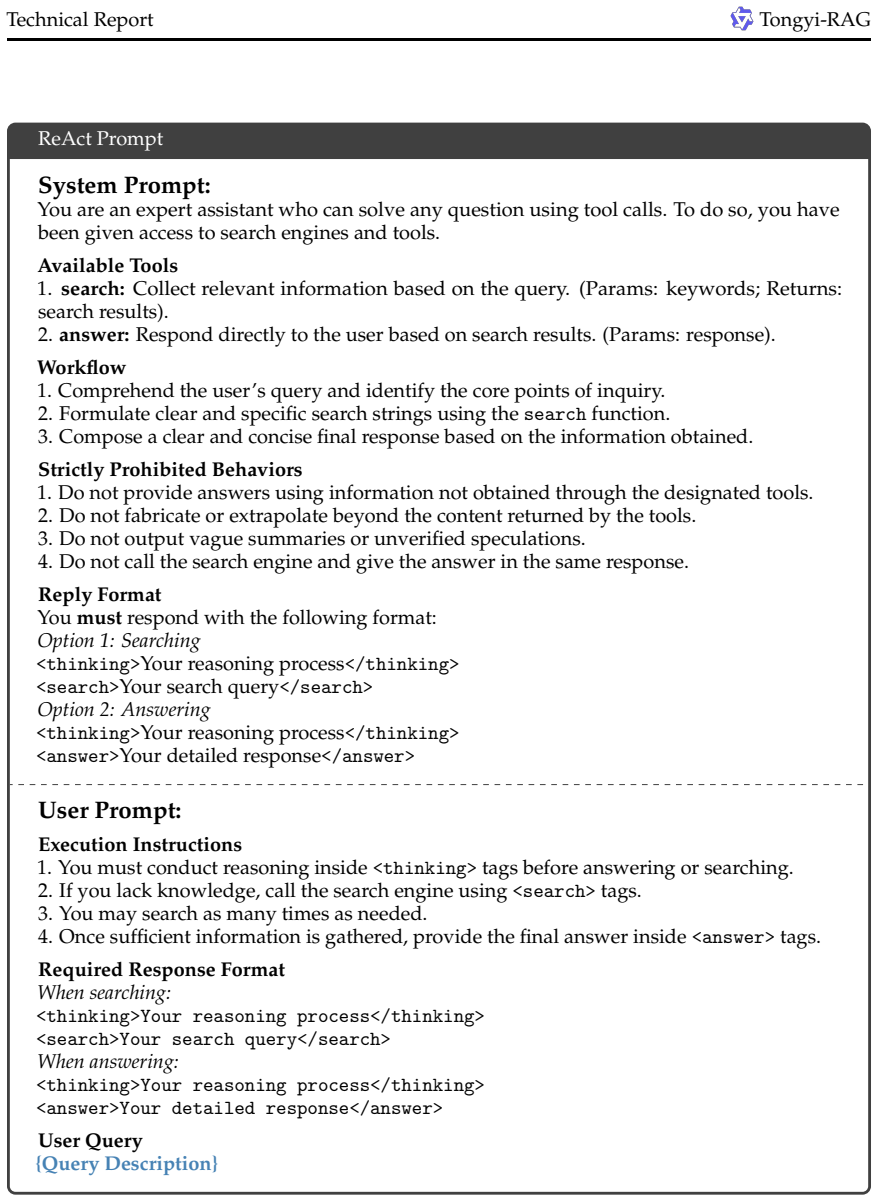
ReAct RAGYao et al. (2022). The method prompts the RAG agent using a Thought-Action- Observation loop format. Please refer to Appendix J.4 for the detailed prompt
work page 2022
-
[3]
VideoRAGJeong et al. (2025). This method performs frame selection to extract the informa- tion required for inference. We use GVE Guo et al. (2025) to compute similarity between frames and the query. Although this method is designed for video, embedding model allows us to apply the same coarse-to-fine granularity strategy to both text and images, serving ...
work page 2025
-
[4]
UniversalRAGYeo et al. (2025). It introduces RAG within cross -modal corpora by formulat- ing the task as a routing problem. We use Qwen3VL-8B (4B) as the router to align different settings, and the prompts are borrowed from the original code to ensure a fair comparison
work page 2025
-
[5]
MemAgentYu et al. (2025a). We implement this method by sequentially feeding the long-context search results into the model’s context. Specifically, we directly use the original question to retrieve relevant text, images, and videos, treat the retrieved results understand- ing as a long-context multimodal understanding task, and then use MemAgent to proces...
-
[6]
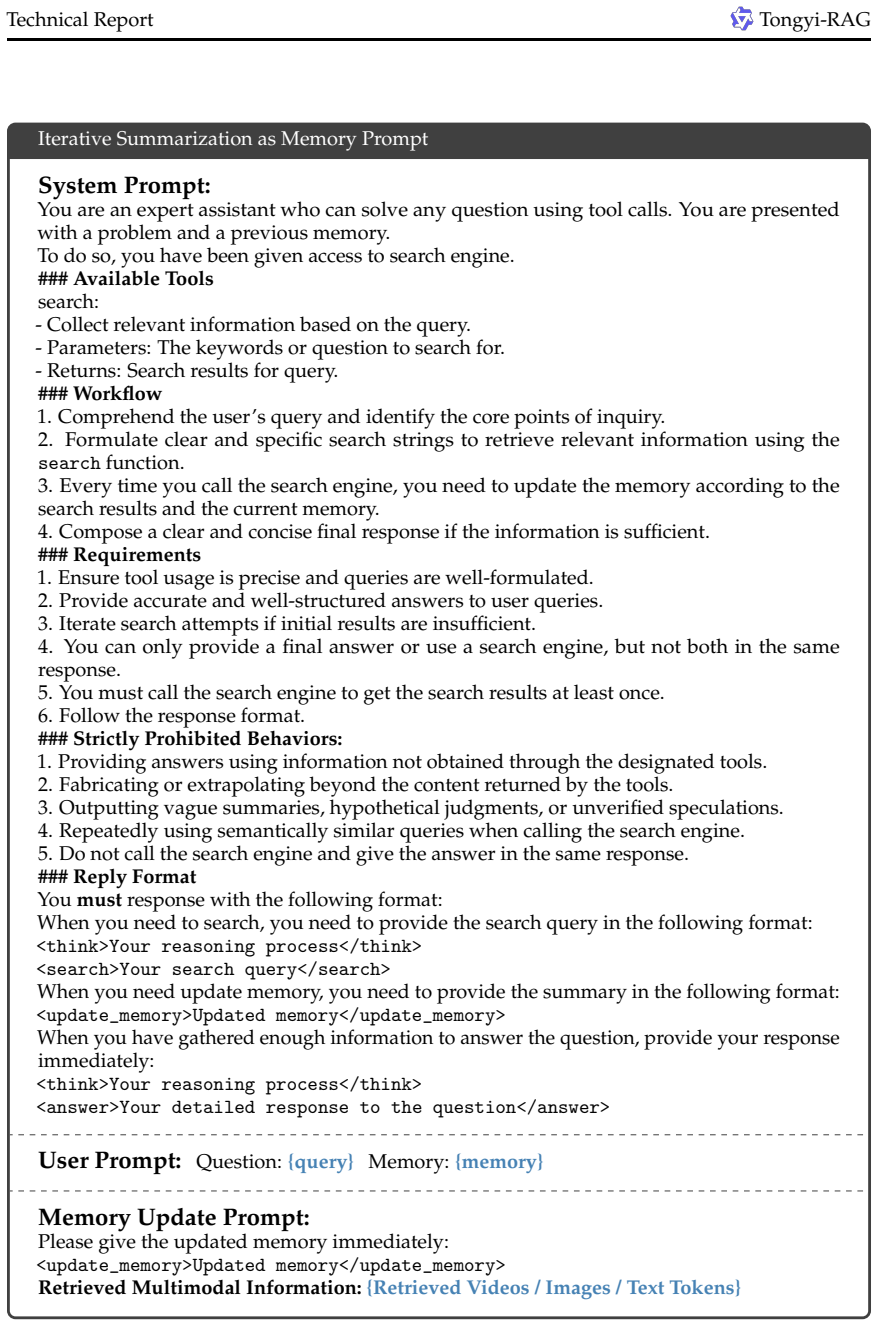
Mem1Zhou et al. (2025). This approach updates its memory through a cyclical retrieval-then-memorization process. It is a context -management paradigm that is nat- urally well-suited for RAG tasks. This method is highly similar to our pilot study in Section 2.2 and follows an iterative summarization paradigm. An approximate version of this effect can be ac...
work page 2025
-
[7]
HotpotQAYang et al. (2018) is a large-scale dataset focused on multi-hop question an- swering that requires reasoning across multiple documents. It contains approximately 113,000 Wikipedia-based question-answer pairs. Unlike datasets constrained by pre-existing knowledge bases, it features diverse natural language questions and provides sentence-level sup...
work page 2018
-
[8]
SQuADRajpurkar et al. (2016) is a large-scale reading comprehension dataset consisting of over 100,000 questions created by crowdworkers on a set of Wikipedia articles. Unlike pre- vious datasets that relied on multiple-choice answers or cloze-style tasks, SQuAD requires the model to select a specific segment of text (span) from the reading passage as the...
work page 2016
-
[9]
(2022) is a multimodal dataset designed to mimic open-domain web search scenarios
WebQAChang et al. (2022) is a multimodal dataset designed to mimic open-domain web search scenarios. It consists of questions that require multi-hop reasoning over both text snippets and images to find the correct answer. Unlike standard VQA tasks where the image is the primary context, WebQA treats images and text as valid knowledge sources that need to ...
work page 2022
-
[10]
(2023) is a dataset for document visual question answering focused on understanding slides
SlideVQATanaka et al. (2023) is a dataset for document visual question answering focused on understanding slides. It contains over 2,600 slide decks with more than 52,000 slide images and 14,500 questions that require complex reasoning skills such as single-hop, multi- hop, and numerical reasoning. The dataset is designed to support various reasoning type...
work page 2023
-
[11]
MMLongbenchMa et al. (2024) is a dataset designed to evaluate the document under- standing capabilities of VLMs with an emphasis on long-context, multi-modal documents composed of text, images, charts, tables, and layout structures
work page 2024
-
[12]
(2025c) is a benchmark specifically designed to evaluate long video understanding capabilities
LVBenchWang et al. (2025c) is a benchmark specifically designed to evaluate long video understanding capabilities. Unlike datasets focused on short clips, it comprises 103 publicly sourced videos with an average duration of approximately 68 minutes, covering diverse categories such as movies, documentaries, and sports. The dataset contains 1,549 manually ...
-
[13]
WikiHowQA with HowTo100MBolotova-Baranova et al. (2023); Miech et al. (2019); Jeong et al. (2025) is a composite benchmark constructed to evaluate video-based retrieval and generation tasks. It combines high-quality, human-written instructional questions and answers from the WikiHowQA dataset with the HowTo100M corpus, which consists of millions of instru...
work page 2023
-
[14]
Synthetic QA with HowTo100MJeong et al. (2025); Miech et al. (2019) is a dataset automati- cally generated to address the lack of training data containing query-video-answer triples for RAG systems. Built upon the HowTo100M corpus, it uses advanced Large Vision-Language Models to create diverse question-answer pairs grounded in specific videos. The questi...
work page 2025
-
[15]
XVBenchis a benchmark designed to address the lack of evaluation standards for cross- video understanding. We construct this dataset using a comprehensive pipeline in Figure 7 19 Technical Report Tongyi-RAG that performs fine-grained video segmentation, detailed captioning, and reasoning-graph construction powered by Qwen3-Max. To ensure the quality and a...
-
[17]
Formulate clear and specific search strings using thesearchfunction
-
[18]
Compose a clear and concise final response based on the information obtained. Strictly Prohibited Behaviors
-
[19]
Do not provide answers using information not obtained through the designated tools
-
[20]
Do not fabricate or extrapolate beyond the content returned by the tools
-
[21]
Do not output vague summaries or unverified speculations
-
[22]
Do not call the search engine and give the answer in the same response. Reply Format Youmustrespond with the following format: Option 1: Searching <thinking>Your reasoning process</thinking> <search>Your search query</search> Option 2: Answering <thinking>Your reasoning process</thinking> <answer>Your detailed response</answer> User Prompt: Execution Instructions
-
[23]
You must conduct reasoning inside<thinking>tags before answering or searching
-
[24]
If you lack knowledge, call the search engine using<search>tags
-
[25]
You may search as many times as needed
-
[26]
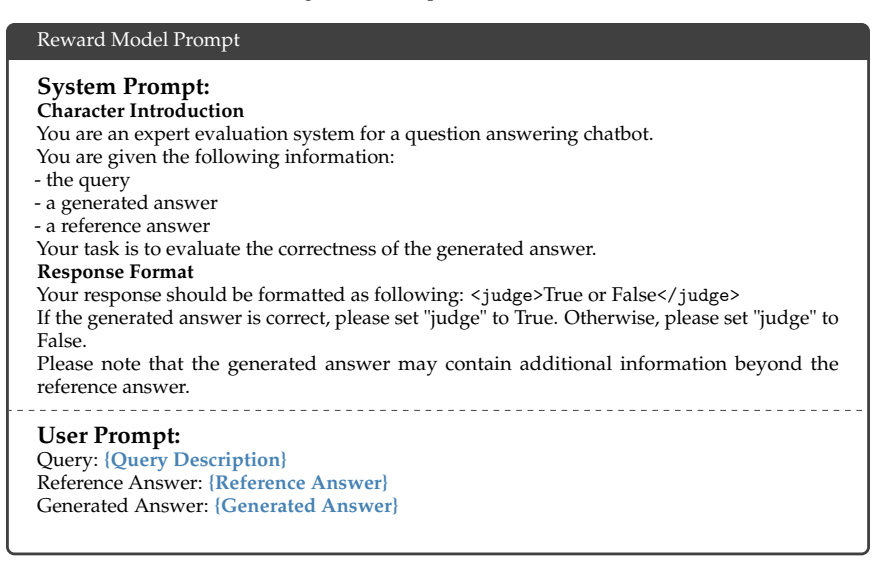
judge" to True. Otherwise, please set
Once sufficient information is gathered, provide the final answer inside<answer>tags. Required Response Format When searching: <thinking>Your reasoning process</thinking> <search>Your search query</search> When answering: <thinking>Your reasoning process</thinking> <answer>Your detailed response</answer> User Query {Query Description} Figure 10: Prompt of...
-
[27]
Comprehend the user’s query and identify the core points of inquiry
-
[28]
Formulate clear and specific search strings to retrieve relevant information using the searchfunction
-
[29]
Every time you call the search engine, you need to update the memory according to the search results and the current memory
-
[30]
Compose a clear and concise final response if the information is sufficient. ### Requirements
-
[31]
Ensure tool usage is precise and queries are well-formulated
-
[32]
Provide accurate and well-structured answers to user queries
-
[33]
Iterate search attempts if initial results are insufficient
-
[34]
You can only provide a final answer or use a search engine, but not both in the same response
-
[35]
You must call the search engine to get the search results at least once
-
[36]
### Strictly Prohibited Behaviors:
Follow the response format. ### Strictly Prohibited Behaviors:
-
[37]
Providing answers using information not obtained through the designated tools
-
[38]
Fabricating or extrapolating beyond the content returned by the tools
-
[39]
Outputting vague summaries, hypothetical judgments, or unverified speculations
-
[40]
Repeatedly using semantically similar queries when calling the search engine
-
[41]
Do not call the search engine and give the answer in the same response. ### Reply Format Youmustresponse with the following format: When you need to search, you need to provide the search query in the following format: <think>Your reasoning process</think> <search>Your search query</search> When you need update memory, you need to provide the summary in t...
-
[49]
Once you believe you have enough information to answer the question, please output an add_answer_nodefunction call. Available Tools 1.add_search_node Description:Creates a new search node in the graph. This tool should be used to issue a search query to an external engine. Each node must have a unique, summarized ID reflecting its intent. Parameters: •id ...
-
[50]
You can only add one node per turn
-
[51]
Each search node must: (a) Have a unique id (title) that is a short, descriptive phrase summarizing the query intent; (b) Be connected to its parent via a directed edge (specify parent_id); (c) Contain a query field with the actual search string; (d) The query must be substantially different from prior ones
-
[52]
After issuing a search query, you will receive results. Then, you must summarize the relevant content from those results into a concise summary (which will be added externally to the node)
-
[53]
You must decide at each step whether to: Answer directly (output an answer node), OR Search (output asearchnode with a new query)
-
[54]
Queries must be substantially different from prior ones—avoid redundancy or rephrasing the same idea
-
[55]
When generating asearchnode, use theadd_search_nodefunction
-
[56]
When receiving search results, you can summarize the results with the summary_search_nodefunction
-
[57]
Once you believe you have enough information to answer the question, please output an add_answer_nodefunction call. Available Tools 1.add_search_node Description:Creates a new search node in the graph. This tool should be used to issue a search query to an external engine. Each node must have a unique, summarized ID reflecting its intent. Parameters: •id ...
discussion (0)
Sign in with ORCID, Apple, or X to comment. Anyone can read and Pith papers without signing in.