Recognition: 1 theorem link
· Lean TheoremHigher Connection in Open String Field Theory
Pith reviewed 2026-05-15 22:53 UTC · model grok-4.3
The pith
Open string field theory admits a 2-form connection on its space of classical solutions that produces new gauge-invariant observables.
A machine-rendered reading of the paper's core claim, the machinery that carries it, and where it could break.
Core claim
We define a 2-form connection in the space of classical solutions of the bosonic open string field theory, using the open string star product and integration. The corresponding higher holonomies and the 3-form curvature are new observables invariant under the infinite-dimensional gauge algebra of open string field theory. The definition is analogous to that of Berry phase in quantum mechanics and is motivated by recent studies on higher Berry phase in condensed matter physics and quantum field theory. We suggest identifying this 2-form connection with the Kalb-Ramond B-field of the closed string background at least in favorable situations.
What carries the argument
The 2-form connection on the space of classical solutions, built from the open string star product and integration, which generates higher holonomies and a 3-form curvature invariant under gauge transformations.
If this is right
- Higher holonomies along paths in solution space become new gauge-invariant observables.
- The 3-form curvature supplies a topological invariant for families of classical solutions.
- The connection can be identified with the Kalb-Ramond B-field in suitable limits of the theory.
- Sigma models whose target is the moduli space of conformal boundary conditions inherit this connection as background data.
Where Pith is reading between the lines
- The same algebraic construction might extend to other field theories equipped with a star product and integration, yielding higher-form connections there.
- If the B-field identification holds beyond favorable cases, it could provide a direct way to extract closed-string geometry from open-string data.
- The sketched sigma models on the moduli space could be used to study renormalization-group flows between different boundary conditions.
Load-bearing premise
The defined 2-form connection must be well-defined and non-trivial on the space of classical solutions and match the Kalb-Ramond field in favorable cases.
What would settle it
An explicit computation for a known solution such as the tachyon vacuum showing that the proposed 2-form connection either vanishes or changes under a gauge transformation would disprove the construction.
Figures

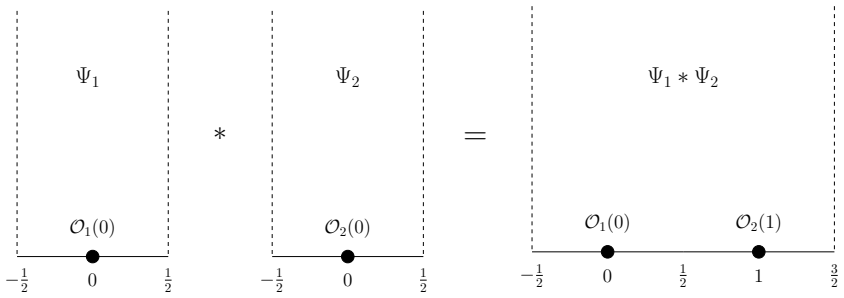
read the original abstract
We define a 2-form connection in the space of classical solutions of the bosonic open string field theory, using the open string star product and integration. The corresponding higher holonomies and the 3-form curvature are new observables invariant under the infinite-dimensional gauge algebra of open string field theory. The definition is analogous to that of Berry phase in quantum mechanics and is motivated by recent studies on higher Berry phase in condensed matter physics and quantum field theory. We suggest identifying this 2-form connection with the Kalb-Ramond $B$-field of the closed string background at least in favorable situations. Also discussed are sigma models whose target space is the moduli space of conformal boundary conditions of a two-dimensional CFT with the $B$-field given by a cousin of this 2-form connection.
Editorial analysis
A structured set of objections, weighed in public.
Referee Report
Summary. The manuscript defines a 2-form connection on the space of classical solutions of bosonic open string field theory, constructed from the open-string star product and integration operation. From this connection the authors extract higher holonomies and a 3-form curvature, which are asserted to be invariant under the infinite-dimensional gauge algebra of OSFT. The construction is presented as the direct analogue of the Berry phase (and higher Berry phases) and is motivated by recent condensed-matter and QFT literature. The paper conjectures that the connection can be identified with the Kalb-Ramond B-field of the closed-string background in favorable cases and briefly discusses sigma models whose target space is the moduli space of conformal boundary conditions equipped with a cousin of this connection.
Significance. If the invariance and well-definedness of the construction are established, the work supplies a new class of gauge-invariant observables built purely from the algebraic data of OSFT. These observables could furnish a string-field-theoretic origin for the B-field and supply geometric structures on the space of classical solutions that are not visible in the usual BRST cohomology. The formal parallel with higher Berry phases is a strength and may open routes to higher-gauge-theoretic formulations inside string theory. The absence of free parameters in the definition and the use of only standard OSFT operations are positive features.
major comments (2)
- §2.3, Definition (2.7): the 2-form connection is introduced by direct substitution of the star product and integration into the Berry-phase formula; the manuscript must explicitly verify that the resulting object is independent of the choice of representative within a gauge orbit and that the 3-form curvature satisfies the expected Bianchi identity under the full OSFT gauge transformations, not merely under the linearized BRST operator.
- §4.1, Claim of identification with the Kalb-Ramond field: the suggestion that the defined connection reproduces the closed-string B-field is stated as a conjecture. Because this identification is central to the physical interpretation, the paper should supply at least one explicit, non-trivial example (e.g., constant B-field background or a known marginal deformation) where the two objects can be compared directly.
minor comments (2)
- The abstract and introduction introduce the terms 'higher holonomies' and '3-form curvature' without a one-sentence reminder of their definitions; a brief parenthetical gloss would improve readability for readers outside the immediate subfield.
- §5, sigma-model discussion: the target-space metric on the moduli space of boundary conditions is left implicit; a short remark on how the metric is induced from the OSFT inner product would clarify the construction.
Simulated Author's Rebuttal
We thank the referee for the careful reading and constructive comments on our manuscript. The points raised will help improve the rigor and physical interpretation of the work. We respond to each major comment below.
read point-by-point responses
-
Referee: §2.3, Definition (2.7): the 2-form connection is introduced by direct substitution of the star product and integration into the Berry-phase formula; the manuscript must explicitly verify that the resulting object is independent of the choice of representative within a gauge orbit and that the 3-form curvature satisfies the expected Bianchi identity under the full OSFT gauge transformations, not merely under the linearized BRST operator.
Authors: We agree that an explicit verification under the full nonlinear gauge transformations is required for completeness. The original manuscript established invariance under the linearized BRST operator using the standard OSFT operations. In the revised version we will add a direct computation demonstrating that the 2-form connection is independent of the choice of representative in a gauge orbit and that the 3-form curvature satisfies the Bianchi identity under the complete OSFT gauge algebra, relying on the associativity of the star product and the cyclicity of the integration. revision: yes
-
Referee: §4.1, Claim of identification with the Kalb-Ramond field: the suggestion that the defined connection reproduces the closed-string B-field is stated as a conjecture. Because this identification is central to the physical interpretation, the paper should supply at least one explicit, non-trivial example (e.g., constant B-field background or a known marginal deformation) where the two objects can be compared directly.
Authors: We acknowledge that the identification remains conjectural and that a concrete example would strengthen the physical motivation. In the revised manuscript we will include an explicit non-trivial example: the constant B-field background realized via a marginal deformation of the boundary CFT. We will solve for the corresponding classical string-field solution, compute the 2-form connection explicitly, and compare it directly with the known Kalb-Ramond field of the sigma-model background. revision: yes
Circularity Check
No significant circularity: definition-based construction using standard OSFT operations
full rationale
The paper's central contribution is the explicit definition of a 2-form connection on the space of classical solutions via the open-string star product and integration, directly analogous to the Berry phase construction. This definition is introduced by fiat using the pre-existing algebraic structures of bosonic OSFT (star product, integration, gauge algebra) without any reduction to fitted parameters, self-referential equations, or load-bearing self-citations. The higher holonomies and 3-form curvature are then derived as consequences of this definition and shown to be gauge-invariant by direct computation. The suggested identification with the Kalb-Ramond B-field is explicitly labeled a conjecture rather than a derived equivalence. No step in the provided chain (abstract through the described construction) collapses by construction to its own inputs; the work is therefore self-contained against external benchmarks.
Axiom & Free-Parameter Ledger
axioms (1)
- domain assumption Existence and structure of the space of classical solutions in bosonic open string field theory
invented entities (1)
-
2-form connection on SFT solution space
no independent evidence
Lean theorems connected to this paper
-
IndisputableMonolith/Cost/FunctionalEquation.leanwashburn_uniqueness_aczel unclear?
unclearRelation between the paper passage and the cited Recognition theorem.
Bij(λ) = ∫ Ψ∗ ∂Ψ/∂λi ∗ ∂Ψ/∂λj − (i↔j)
What do these tags mean?
- matches
- The paper's claim is directly supported by a theorem in the formal canon.
- supports
- The theorem supports part of the paper's argument, but the paper may add assumptions or extra steps.
- extends
- The paper goes beyond the formal theorem; the theorem is a base layer rather than the whole result.
- uses
- The paper appears to rely on the theorem as machinery.
- contradicts
- The paper's claim conflicts with a theorem or certificate in the canon.
- unclear
- Pith found a possible connection, but the passage is too broad, indirect, or ambiguous to say the theorem truly supports the claim.
Forward citations
Cited by 1 Pith paper
-
Recursive-algebraic solution of the closed string tachyon vacuum equation
A seam-graded expansion turns the closed string tachyon vacuum equation algebraic at every order, reducing it to matrix inversions in the zero-momentum scalar sector.
Reference graph
Works this paper leans on
-
[1]
O. Aharony, N. Seiberg, and Y . Tachikawa,Reading between the lines of four-dimensional gauge theories,JHEP08(2013) 115, [arXiv:1305.0318]. 1
-
[2]
TFT construction of RCFT correlators I: Partition functions
J. Fuchs, I. Runkel, and C. Schweigert,TFT construction of RCFT correlators 1. Partition functions,Nucl. Phys. B646(2002) 353–497, [hep-th/0204148]. 2
work page internal anchor Pith review Pith/arXiv arXiv 2002
-
[3]
TFT construction of RCFT correlators II: Unoriented world sheets
J. Fuchs, I. Runkel, and C. Schweigert,TFT construction of RCFT correlators. 2. Unoriented world sheets,Nucl. Phys. B678(2004) 511–637, [hep-th/0306164]. 2
work page internal anchor Pith review Pith/arXiv arXiv 2004
-
[4]
TFT construction of RCFT correlators III: Simple currents
J. Fuchs, I. Runkel, and C. Schweigert,TFT construction of RCFT correlators. 3. Simple currents,Nucl. Phys. B694(2004) 277–353, [hep-th/0403157]. 2
work page internal anchor Pith review Pith/arXiv arXiv 2004
-
[5]
TFT construction of RCFT correlators IV: Structure constants and correlation functions
J. Fuchs, I. Runkel, and C. Schweigert,TFT construction of RCFT correlators IV: Structure constants and correlation functions,Nucl. Phys. B715(2005) 539–638, [hep-th/0412290]. 2
work page internal anchor Pith review Pith/arXiv arXiv 2005
-
[6]
TFT construction of RCFT correlators V: Proof of modular invariance and factorisation
J. Fjelstad, J. Fuchs, I. Runkel, and C. Schweigert,TFT construction of RCFT correlators. V . Proof of modular invariance and factorisation,Theor. Appl. Categor.16(2006) 342–433, [hep-th/0503194]. 2
work page internal anchor Pith review Pith/arXiv arXiv 2006
-
[7]
G. W. Moore and N. Seiberg,Classical and Quantum Conformal Field Theory,Commun. Math. Phys.123(1989) 177. 2
work page 1989
-
[8]
Witten,Quantum Field Theory and the Jones Polynomial,Commun
E. Witten,Quantum Field Theory and the Jones Polynomial,Commun. Math. Phys.121 (1989) 351–399. 2, 6
work page 1989
-
[9]
S. Elitzur, G. W. Moore, A. Schwimmer, and N. Seiberg,Remarks on the Canonical Quantization of the Chern-Simons-Witten Theory,Nucl. Phys. B326(1989) 108–134. 2 18
work page 1989
-
[10]
Surface operators in 3d Topological Field Theory and 2d Rational Conformal Field Theory
A. Kapustin and N. Saulina,Surface operators in 3d Topological Field Theory and 2d Rational Conformal Field Theory,arXiv:1012.0911. 2
work page internal anchor Pith review Pith/arXiv arXiv
-
[11]
K. Roumpedakis, S. Seifnashri, and S.-H. Shao,Higher Gauging and Non-invertible Condensation Defects,Commun. Math. Phys.401(2023), no. 3 3043–3107, [arXiv:2204.02407]. 2
- [12]
-
[13]
A. B. Zamolodchikov,Irreversibility of the Flux of the Renormalization Group in a 2D Field Theory,JETP Lett.43(1986) 730–732. 2, 16
work page 1986
-
[14]
Seiberg,Observations on the Moduli Space of Superconformal Field Theories,Nucl
N. Seiberg,Observations on the Moduli Space of Superconformal Field Theories,Nucl. Phys. B303(1988) 286–304. 2, 16
work page 1988
-
[15]
Kutasov,Geometry on the Space of Conformal Field Theories and Contact Terms, Phys
D. Kutasov,Geometry on the Space of Conformal Field Theories and Contact Terms, Phys. Lett. B220(1989) 153–158. 2, 16
work page 1989
-
[16]
Witten,Noncommutative Geometry and String Field Theory,Nucl
E. Witten,Noncommutative Geometry and String Field Theory,Nucl. Phys. B268(1986) 253–294. 2, 5, 6, 7
work page 1986
-
[17]
Analytic solution for tachyon condensation in open string field theory
M. Schnabl,Analytic solution for tachyon condensation in open string field theory,Adv. Theor. Math. Phys.10(2006), no. 4 433–501, [hep-th/0511286]. 2, 7, 14
work page internal anchor Pith review Pith/arXiv arXiv 2006
-
[18]
Erler,Four lectures on analytic solutions in open string field theory,Phys
T. Erler,Four lectures on analytic solutions in open string field theory,Phys. Rept.980 (2022) 1–95, [arXiv:1912.00521]. 2, 6, 11
-
[19]
String Field Theory Solution for Any Open String Background
T. Erler and C. Maccaferri,String Field Theory Solution for Any Open String Background, JHEP10(2014) 029, [arXiv:1406.3021]. 2, 11
work page internal anchor Pith review Pith/arXiv arXiv 2014
-
[20]
Solutions from boundary condition changing operators in open string field theory
M. Kiermaier, Y . Okawa, and P. Soler,Solutions from boundary condition changing operators in open string field theory,JHEP03(2011) 122, [arXiv:1009.6185]. 2, 11
work page internal anchor Pith review Pith/arXiv arXiv 2011
-
[21]
T. Erler and C. Maccaferri,String field theory solution for any open string background. Part II,JHEP01(2020) 021, [arXiv:1909.11675]. 2, 7, 10, 11, 14
-
[22]
D. Z. Freedman, S. B. Giddings, J. A. Shapiro, and C. B. Thorn,The Nonplanar One Loop Amplitude in Witten’s String Field Theory,Nucl. Phys. B298(1988) 253. 3
work page 1988
-
[23]
Ghost Structure and Closed Strings in Vacuum String Field Theory
D. Gaiotto, L. Rastelli, A. Sen, and B. Zwiebach,Ghost structure and closed strings in vacuum string field theory,Adv. Theor. Math. Phys.6(2003) 403–456, [hep-th/0111129]. 3, 4
work page internal anchor Pith review Pith/arXiv arXiv 2003
-
[24]
’t Hooft,A Planar Diagram Theory for Strong Interactions,Nucl
G. ’t Hooft,A Planar Diagram Theory for Strong Interactions,Nucl. Phys. B72(1974)
work page 1974
-
[25]
J. M. Maldacena,The LargeNlimit of superconformal field theories and supergravity, Adv. Theor. Math. Phys.2(1998) 231–252, [hep-th/9711200]. 3
work page internal anchor Pith review Pith/arXiv arXiv 1998
-
[26]
Anti De Sitter Space And Holography
E. Witten,Anti de Sitter space and holography,Adv. Theor. Math. Phys.2(1998) 253–291, [hep-th/9802150]. 3 19
work page internal anchor Pith review Pith/arXiv arXiv 1998
-
[27]
S. S. Gubser, I. R. Klebanov, and A. M. Polyakov,Gauge theory correlators from noncritical string theory,Phys. Lett. B428(1998) 105–114, [hep-th/9802109]. 3
work page internal anchor Pith review Pith/arXiv arXiv 1998
-
[28]
A paradigm of open/closed duality: Liouville D-branes and the Kontsevich model
D. Gaiotto and L. Rastelli,A Paradigm of open / closed duality: Liouville D-branes and the Kontsevich model,JHEP07(2005) 053, [hep-th/0312196]. 3
work page internal anchor Pith review Pith/arXiv arXiv 2005
-
[29]
J. McGreevy and H. L. Verlinde,Strings from tachyons: The c=1 matrix reloaded,JHEP 12(2003) 054, [hep-th/0304224]. 3
work page internal anchor Pith review Pith/arXiv arXiv 2003
-
[30]
Closed Strings as Imaginary D-branes
D. Gaiotto, N. Itzhaki, and L. Rastelli,Closed strings as imaginary D-branes,Nucl. Phys. B688(2004) 70–100, [hep-th/0304192]. 3
work page internal anchor Pith review Pith/arXiv arXiv 2004
-
[31]
S. B. Giddings, E. J. Martinec, and E. Witten,Modular Invariance in String Field Theory, Phys. Lett. B176(1986) 362–368. 3
work page 1986
- [32]
-
[33]
On the Gauge Theory/Geometry Correspondence
R. Gopakumar and C. Vafa,On the gauge theory / geometry correspondence,Adv. Theor. Math. Phys.3(1999) 1415–1443, [hep-th/9811131]. 3
work page internal anchor Pith review Pith/arXiv arXiv 1999
-
[34]
R. Gopakumar and E. A. Mazenc,Deriving the Simplest Gauge-String Duality – I: Open-Closed-Open Triality,arXiv:2212.05999. 3
-
[35]
Marginal deformations in string field theory
E. Fuchs, M. Kroyter, and R. Potting,Marginal deformations in string field theory,JHEP 09(2007) 101, [arXiv:0704.2222]. 3, 11
work page internal anchor Pith review Pith/arXiv arXiv 2007
-
[36]
Exact marginality in open string field theory: a general framework
M. Kiermaier and Y . Okawa,Exact marginality in open string field theory: A General framework,JHEP11(2009) 041, [arXiv:0707.4472]. 3, 11
work page internal anchor Pith review Pith/arXiv arXiv 2009
-
[37]
Analytic Solutions for Marginal Deformations in Open String Field Theory
M. Kiermaier, Y . Okawa, L. Rastelli, and B. Zwiebach,Analytic solutions for marginal deformations in open string field theory,JHEP01(2008) 028, [hep-th/0701249]. 3, 11, 12
work page internal anchor Pith review Pith/arXiv arXiv 2008
-
[38]
Comments on Marginal Deformations in Open String Field Theory
M. Schnabl,Comments on marginal deformations in open string field theory,Phys. Lett. B 654(2007) 194–199, [hep-th/0701248]. 3, 11, 12
work page internal anchor Pith review Pith/arXiv arXiv 2007
-
[39]
Observables of String Field Theory
A. Hashimoto and N. Itzhaki,Observables of string field theory,JHEP01(2002) 028, [hep-th/0111092]. 4
work page internal anchor Pith review Pith/arXiv arXiv 2002
-
[40]
The closed string tadpole in open string field theory
I. Ellwood,The Closed string tadpole in open string field theory,JHEP08(2008) 063, [arXiv:0804.1131]. 4
work page internal anchor Pith review Pith/arXiv arXiv 2008
- [41]
-
[42]
M. V . Berry,Quantal phase factors accompanying adiabatic changes,Proc. Roy. Soc. Lond. A392(1984) 45–57. 4
work page 1984
-
[43]
A. Y . Kitaev,Differential forms on the space of statistical mechanical lattice models,talk at Between Topology and Quantum Field Theory: a conference in celebration of Dan Freed’s 60th birthday(2019) [https://web.ma.utexas.edu/topqft/talkslides/kitaev.pdf]. 4 20
work page 2019
-
[44]
A. Kapustin and L. Spodyneiko,Higher-dimensional generalizations of Berry curvature, Phys. Rev. B101(2020), no. 23 235130, [arXiv:2001.03454]. 4
-
[45]
P.-S. Hsin, A. Kapustin, and R. Thorngren,Berry phase in quantum field theory: Diabolical points and boundary phenomena,Phys. Rev. B102(Dec, 2020) 245113. 4
work page 2020
-
[46]
S. Ohyama and S. Ryu,Higher structures in matrix product states,Phys. Rev. B109 (2024), no. 11 115152, [arXiv:2304.05356]. 5, 8
-
[47]
A. Kapustin and L. Spodyneiko,Higher-dimensional generalizations of the Thouless charge pump,arXiv:2003.09519. 5
-
[48]
C. Córdova, D. S. Freed, H. T. Lam, and N. Seiberg,Anomalies in the Space of Coupling Constants and Their Dynamical Applications I,SciPost Phys.8(2020), no. 1 001, [arXiv:1905.09315]. 5
-
[49]
C. Córdova, D. S. Freed, H. T. Lam, and N. Seiberg,Anomalies in the Space of Coupling Constants and Their Dynamical Applications II,SciPost Phys.8(2020), no. 1 002, [arXiv:1905.13361]. 5
-
[50]
A. Kapustin and N. Sopenko,Local Noether theorem for quantum lattice systems and topological invariants of gapped states,J. Math. Phys.63(2022), no. 9 091903, [arXiv:2201.01327]. 5
-
[51]
Y . Choi and K. Ohmori,Higher Berry phase of fermions and index theorem,JHEP09 (2022) 022, [arXiv:2205.02188]. 5
-
[52]
P.-S. Hsin and Z. Wang,On topology of the moduli space of gapped Hamiltonians for topological phases,J. Math. Phys.64(2023), no. 4 041901, [arXiv:2211.16535]. 5
- [53]
- [54]
-
[55]
A. Beaudry, M. Hermele, J. Moreno, M. J. Pflaum, M. Qi, and D. D. Spiegel,Homotopical foundations of parametrized quantum spin systems,Rev. Math. Phys.36(2024), no. 09 2460003, [arXiv:2303.07431]. 5
- [56]
- [57]
-
[58]
K. Shiozaki, N. Heinsdorf, and S. Ohyama,Higher Berry curvature from matrix product states,Phys. Rev. B112(2025), no. 3 035154, [arXiv:2305.08109]. 5
- [59]
- [60]
-
[61]
A. Artymowicz, A. Kapustin, and N. Sopenko,Quantization of the Higher Berry Curvature and the Higher Thouless Pump,Commun. Math. Phys.405(2024), no. 8 191, [arXiv:2305.06399]. 5, 11
-
[62]
Geiko,Parametrized topological phases in 1d and T-duality,arXiv:2412.20905
R. Geiko,Parametrized topological phases in 1d and T-duality,arXiv:2412.20905. 5
-
[63]
N. Manjunath and D. V . Else,Anomalous continuous symmetries and quantum topology of Goldstone modes,Phys. Rev. B111(2025), no. 12 125151, [arXiv:2410.05268]. 5
-
[64]
K. Shiozaki,Equivariant Parameter Families of Spin Chains: A Discrete MPS Formulation,SciPost Phys.20(2026) 024, [arXiv:2507.19932]. 5
-
[65]
X. Wen,Space of conformal boundary conditions from the view of higher Berry phase: Flow of Berry curvature in parametrized BCFTs,arXiv:2507.12546. 5
-
[66]
S. Ohyama and S. Ryu,Higher Berry phase from projected entangled pair states in (2+1) dimensions,Phys. Rev. B111(2025), no. 4 045112, [arXiv:2405.05325]. 5
-
[67]
A. Prakash and S. A. Parameswaran,Charge pumps, boundary modes, and the necessity of unnecessary criticality,Phys. Rev. B112(2025), no. 24 L241117, [arXiv:2408.15351]. 5
-
[68]
K. Inamura and S. Ohyama,1+1d SPT phases with fusion category symmetry: interface modes and non-abelian Thouless pump,arXiv:2408.15960. 5
- [69]
-
[70]
In search of diabolical critical points
N. Manjunath and D. V . Else,In search of diabolical critical points, arXiv:2601.10783. 5
work page internal anchor Pith review Pith/arXiv arXiv
-
[71]
N. Drukker, Z. Kong, and P. Kravchuk,Nonlinearly Realised Defect Symmetries and Anomalies,arXiv:2512.15913. 5
-
[72]
Z. Komargodski, F. K. Popov, and B. C. Rayhaun,Defect Anomalies, a Spin-Flux Duality, and Boson-Kondo Problems,arXiv:2508.14963. 5
-
[73]
C. Copetti,’t Hooft Anomalies and Defect Conformal Manifolds: Topological Signatures from Modulated Effective Actions,arXiv:2507.15466. 5 22
-
[74]
K. Inamura and S. Ohyama,Generalized cluster states in 2+1d: non-invertible symmetries, interfaces, and parameterized families,arXiv:2601.08615. 5
-
[75]
S. Ohyama and K. Inamura,Parameterized families of 2+1dG-cluster states, arXiv:2601.08616. 5
-
[76]
T. D. Brennan and K. Intriligator,Generalized Families of QFTs,arXiv:2602.09105. 5
work page internal anchor Pith review Pith/arXiv arXiv
-
[77]
Closed String Field Theory: Quantum Action and the BV Master Equation
B. Zwiebach,Closed string field theory: Quantum action and the B-V master equation, Nucl. Phys. B390(1993) 33–152, [hep-th/9206084]. 5
work page internal anchor Pith review Pith/arXiv arXiv 1993
-
[78]
BV Master Action for Heterotic and Type II String Field Theories
A. Sen,BV Master Action for Heterotic and Type II String Field Theories,JHEP02 (2016) 087, [arXiv:1508.05387]. 5
work page internal anchor Pith review Pith/arXiv arXiv 2016
-
[79]
Stettinger,Sliver frame stubs in open string field theory via auxiliary fields,Phys
G. Stettinger,Sliver frame stubs in open string field theory via auxiliary fields,Phys. Rev. D111(2025), no. 10 106019, [arXiv:2410.16228]. 5
-
[80]
Stettinger,A boundary term for open string field theory,JHEP05(2025) 226, [arXiv:2411.15123]
G. Stettinger,A boundary term for open string field theory,JHEP05(2025) 226, [arXiv:2411.15123]. 5
discussion (0)
Sign in with ORCID, Apple, or X to comment. Anyone can read and Pith papers without signing in.