Recognition: no theorem link
Distributed Quantum Gaussian Processes for Multi-Agent Systems
Pith reviewed 2026-05-15 21:41 UTC · model grok-4.3
The pith
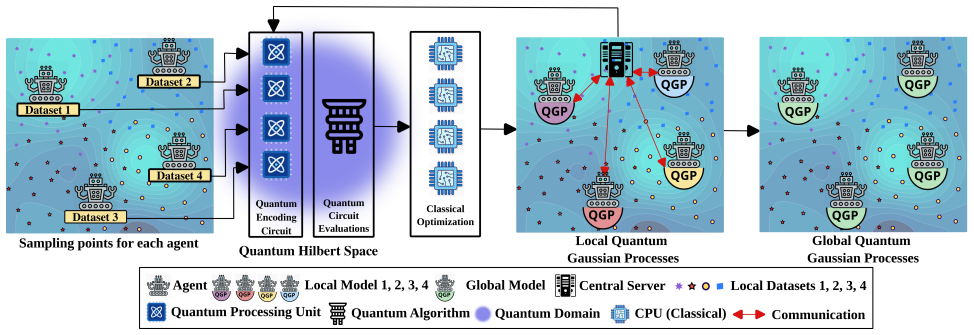
A distributed quantum Gaussian process method uses a Riemannian consensus algorithm to let multiple agents combine local quantum-kernel models into a global predictor that captures correlations beyond classical kernels.
A machine-rendered reading of the paper's core claim, the machinery that carries it, and where it could break.
Core claim
The authors establish that a Distributed Quantum Gaussian Process (DQGP) framework, solved by the Distributed consensus Riemannian Alternating Direction Method of Multipliers (DR-ADMM), aggregates local agent models—each built with a quantum kernel—into a single effective global model, thereby increasing both modeling expressivity and scalability compared with classical Gaussian processes.
What carries the argument
The DR-ADMM algorithm, which performs distributed consensus optimization on the Riemannian manifold induced by quantum kernel embeddings to fuse local agent models into a global Gaussian process.
If this is right
- Agents can share only model parameters rather than raw data while still producing a coherent global probabilistic model.
- The quantum embedding step supplies expressivity gains that remain unavailable to any classical kernel choice.
- The method applies directly to non-stationary real-world signals such as terrain elevation without requiring stationarity assumptions.
- When quantum hardware becomes available, the same algorithm structure is expected to deliver computational speedups over classical distributed GPs.
- The framework separates the quantum kernel evaluation from the consensus step, allowing incremental addition of new agents.
Where Pith is reading between the lines
- The same consensus structure could be reused for other kernel methods such as support vector machines or Gaussian process regression in sensor networks.
- Testing on actual quantum processors would reveal whether the embedding step yields measurable runtime gains once decoherence and gate costs are accounted for.
- The approach suggests a path toward hybrid quantum-classical multi-agent systems in robotics where each robot maintains a local quantum model of its surroundings.
Load-bearing premise
Quantum kernels actually embed data so that they reveal correlations classical kernels cannot reach, and the distributed Riemannian optimizer converges to a useful global model.
What would settle it
Running identical experiments on the same elevation and synthetic datasets with a classical distributed Gaussian process baseline and finding no improvement in predictive accuracy or wall-clock scaling would falsify the central claim.
Figures


read the original abstract
Gaussian Processes (GPs) are a powerful tool for probabilistic modeling, but their performance is often constrained in complex, large-scale real-world domains due to the limited expressivity of classical kernels. Quantum computing offers the potential to overcome this limitation by embedding data into exponentially large Hilbert spaces, capturing complex correlations that remain inaccessible to classical computing approaches. In this paper, we propose a Distributed Quantum Gaussian Process (DQGP) method in a multi-agent setting to enhance modeling capabilities and scalability. To address the challenging non-Euclidean optimization problem, we develop a Distributed consensus Riemannian Alternating Direction Method of Multipliers (DR-ADMM) algorithm that aggregates local agent models into a global model. We evaluate the efficacy of our method through numerical experiments conducted on a quantum simulator in classical hardware. We use real-world, non-stationary elevation datasets of NASA's Shuttle Radar Topography Mission and synthetic datasets generated by Quantum Gaussian Processes. Beyond modeling advantages, our framework highlights potential computational speedups that quantum hardware may provide, particularly in Gaussian processes and distributed optimization.
Editorial analysis
A structured set of objections, weighed in public.
Referee Report
Summary. The paper proposes a Distributed Quantum Gaussian Process (DQGP) framework for multi-agent systems that replaces classical kernels with quantum kernels to embed data in high-dimensional Hilbert spaces. It introduces a Distributed consensus Riemannian Alternating Direction Method of Multipliers (DR-ADMM) algorithm to solve the resulting non-Euclidean consensus optimization problem across agents, and reports numerical results from classical simulation of the quantum circuits on NASA SRTM elevation data and synthetic datasets generated from quantum GPs.
Significance. If the central claims hold, the work would demonstrate a concrete route to combining quantum kernel expressivity with distributed optimization, potentially improving modeling of non-stationary spatial data while preserving the probabilistic calibration of GPs. The use of Riemannian ADMM on the quantum kernel manifold and the simulator-based evaluation on real elevation data are concrete strengths that could be built upon once hardware implementations become feasible.
major comments (2)
- [§4.2] §4.2, Eq. (12)–(15): the DR-ADMM iteration is stated without a convergence guarantee or iteration complexity bound under the Riemannian manifold constraint; because the global model is obtained solely by this aggregation step, the absence of such analysis leaves the claim that local models are successfully combined into an effective global model unverified.
- [§5.3] §5.3, Table 2: the reported RMSE and NLPD improvements over classical baselines are shown only for the quantum-simulated kernel; no ablation isolating the contribution of the quantum feature map versus the distributed optimizer is provided, making it impossible to attribute gains to the quantum component that is central to the paper’s motivation.
minor comments (2)
- [§3.1] The notation for the quantum feature map Φ(x) is introduced in §3.1 but never explicitly related to the kernel matrix entries used in the GP likelihood; a short derivation or reference would clarify the embedding.
- [Figure 3] Figure 3 caption states “convergence after 50 iterations” but the plotted curves stop at iteration 40; the figure and caption should be aligned.
Simulated Author's Rebuttal
We thank the referee for the detailed and constructive review. We address each major comment below and describe the revisions we will make to strengthen the manuscript.
read point-by-point responses
-
Referee: [§4.2] §4.2, Eq. (12)–(15): the DR-ADMM iteration is stated without a convergence guarantee or iteration complexity bound under the Riemannian manifold constraint; because the global model is obtained solely by this aggregation step, the absence of such analysis leaves the claim that local models are successfully combined into an effective global model unverified.
Authors: We acknowledge that the manuscript does not supply a formal convergence guarantee or iteration complexity bound for DR-ADMM on the Riemannian manifold. The paper’s emphasis is on the formulation of the distributed quantum GP framework and its practical performance under quantum simulation. In all reported experiments the iterates converged reliably to a stable consensus solution, which we document with additional convergence curves in the revision. We will insert a brief discussion in §4.2 noting the empirical convergence behavior and explicitly listing the derivation of rigorous manifold-constrained bounds as an open direction for future work. revision: partial
-
Referee: [§5.3] §5.3, Table 2: the reported RMSE and NLPD improvements over classical baselines are shown only for the quantum-simulated kernel; no ablation isolating the contribution of the quantum feature map versus the distributed optimizer is provided, making it impossible to attribute gains to the quantum component that is central to the paper’s motivation.
Authors: The referee correctly identifies the absence of an ablation that separates the quantum kernel from the distributed optimizer. In the revised manuscript we will add two new sets of experiments to §5.3: (i) a centralized quantum GP versus the distributed quantum GP to isolate the effect of the consensus step, and (ii) a distributed classical GP versus the distributed quantum GP to isolate the effect of the quantum feature map. The updated Table 2 and accompanying text will report these results so that the source of the observed gains can be attributed more precisely. revision: yes
Circularity Check
No significant circularity in derivation chain
full rationale
The paper proposes a Distributed Quantum Gaussian Process (DQGP) method paired with a DR-ADMM algorithm for multi-agent consensus optimization. The abstract and description frame this as a new modeling approach evaluated via classical simulation of quantum circuits on real NASA elevation data and synthetic QGP-generated datasets. No load-bearing derivation step reduces a claimed prediction to a fitted parameter by construction, invokes a self-citation for uniqueness, or smuggles an ansatz through prior work. The central claims rest on the proposed algorithms and external empirical validation rather than self-referential definitions or renaming of known results, making the derivation self-contained.
Axiom & Free-Parameter Ledger
Reference graph
Works this paper leans on
- [1]
-
[2]
Frank Arute, Kunal Arya, Ryan Babbush, Dave Bacon, Joseph C Bardin, Rami Barends, Rupak Biswas, Sergio Boixo, Fernando GSL Brandao, David A Buell, et al
-
[3]
Nature574, 7779 (2019), 505–510
Quantum supremacy using a programmable superconducting processor. Nature574, 7779 (2019), 505–510
work page 2019
-
[4]
Marcello Benedetti, Erika Lloyd, Stefan Sack, and Mattia Fiorentini. 2019. Pa- rameterized quantum circuits as machine learning models.Quantum science and technology4, 4 (2019), 043001
work page 2019
-
[5]
Stephen Boyd, Neal Parikh, Eric Chu, Borja Peleato, and Jonathan Eckstein. 2011. Distributed Optimization and Statistical Learning via the Alternating Direction Method of Multipliers. Vol. 3
work page 2011
-
[6]
Marco Cerezo, Andrew Arrasmith, Ryan Babbush, Simon C Benjamin, Suguru Endo, Keisuke Fujii, Jarrod R McClean, Kosuke Mitarai, Xiao Yuan, Lukasz Cincio, et al. 2021. Variational quantum algorithms.Nature Reviews Physics3, 9 (2021), 625–644
work page 2021
-
[7]
Tsung-Hui Chang, Mingyi Hong, and Xiangfeng Wang. 2014. Multi-agent dis- tributed optimization via inexact consensus ADMM.IEEE Transactions on Signal Processing63, 2 (2014), 482–497
work page 2014
-
[8]
Kuan-Cheng Chen, Samuel Yen-Chi Chen, Chen-Yu Liu, and Kin K Leung. 2025. Quantum-train-based distributed multi-agent reinforcement learning. In2025 IEEE Symposium for Multidisciplinary Computational Intelligence Incubators (MCII Companion). IEEE, 1–5
work page 2025
-
[9]
Meng-Han Chen, Chao-Hua Yu, Jian-Liang Gao, Kai Yu, Song Lin, Gong-De Guo, and Jing Li. 2022. Quantum algorithm for Gaussian process regression.Physical Review A106, 1 (2022), 012406
work page 2022
-
[10]
Weizhe Chen, Roni Khardon, and Lantao Liu. 2024. Adaptive robotic information gathering via non-stationary Gaussian processes.The International Journal of Robotics Research43, 4 (2024), 405–436
work page 2024
-
[11]
Jack Cunningham and Jun Zhuang. 2025. Investigating and mitigating barren plateaus in variational quantum circuits: a survey.Quantum Information Process- ing24, 2 (2025), 48
work page 2025
-
[12]
Marc Deisenroth and Jun Wei Ng. 2015. Distributed gaussian processes. In International conference on machine learning. PMLR, 1481–1490
work page 2015
-
[13]
Ahmad Farooq, Cristian A Galvis-Florez, and Simo Särkkä. 2024. Quantum- assisted Hilbert-space Gaussian process regression.Physical Review A109, 5 (2024), 052410
work page 2024
-
[14]
Tom G Farr, Paul A Rosen, Edward Caro, Robert Crippen, Riley Duren, Scott Hensley, Michael Kobrick, Mimi Paller, Ernesto Rodriguez, Ladislav Roth, et al
-
[15]
The shuttle radar topography mission.Reviews of geophysics45, 2 (2007)
work page 2007
- [16]
-
[17]
Zoubin Ghahramani. 2013. Bayesian non-parametrics and the probabilistic approach to modelling.Philosophical Transactions of the Royal Society A: Mathe- matical, Physical and Engineering Sciences371, 1984 (2013), 20110553
work page 2013
-
[18]
Elies Gil-Fuster, Jens Eisert, and Vedran Dunjko. 2024. On the expressivity of embedding quantum kernels.Machine Learning: Science and Technology5, 2 (2024), 025003
work page 2024
-
[19]
Ian Glendinning. 2005. The bloch sphere. InQIA meeting. Vienna
work page 2005
-
[20]
Gian Giacomo Guerreschi and Anne Y Matsuura. 2019. QAOA for Max-Cut requires hundreds of qubits for quantum speed-up.Scientific reports9, 1 (2019), 6903
work page 2019
-
[21]
Teiko Heinosaari, Daniel Reitzner, and Peter Stano. 2008. Notes on joint measur- ability of quantum observables.Foundations of Physics38, 12 (2008), 1133–1147
work page 2008
-
[22]
Hsin-Yuan Huang, Michael Broughton, Masoud Mohseni, Ryan Babbush, Sergio Boixo, Hartmut Neven, and Jarrod R McClean. 2021. Power of data in quantum machine learning.Nature communications12, 1 (2021), 2631
work page 2021
-
[23]
Thomas Hubregtsen, David Wierichs, Elies Gil-Fuster, Peter-Jan HS Derks, Paul K Faehrmann, and Johannes Jakob Meyer. 2022. Training quantum embedding kernels on near-term quantum computers.Physical Review A106, 4 (2022), 042431
work page 2022
-
[24]
Motonobu Kanagawa, Philipp Hennig, Dino Sejdinovic, and Bharath K Sriperum- budur. 2018. Gaussian processes and kernel methods: A review on connections and equivalences.arXiv preprint arXiv:1807.02582(2018)
work page internal anchor Pith review Pith/arXiv arXiv 2018
-
[25]
George P Kontoudis and Daniel J Stilwell. 2021. Decentralized nested Gaussian processes for multi-robot systems. InIEEE International Conference on Robotics and Automation. 8881–8887
work page 2021
-
[26]
George P Kontoudis and Daniel J Stilwell. 2023. Decentralized federated learning using Gaussian processes. InIEEE International Symposium on Multi-Robot and Multi-Agent Systems. 1–7
work page 2023
-
[27]
George P Kontoudis and Daniel J Stilwell. 2024. Scalable, federated Gaussian process training for decentralized multi-agent systems.IEEE Access12 (2024), 77800–77815
work page 2024
-
[28]
George P Kontoudis and Daniel J Stilwell. 2025. Multi-Agent Federated Learning Using Covariance-Based Nearest Neighbor Gaussian Processes.IEEE Transactions on Machine Learning in Communications and Networking4 (2025), 115–138
work page 2025
-
[29]
David A Kreplin and Marco Roth. 2024. Reduction of finite sampling noise in quantum neural networks.Quantum8 (2024), 1385
work page 2024
-
[30]
David A Kreplin, Moritz Willmann, Jan Schnabel, Frederic Rapp, Manuel Hagelüken, and Marco Roth. 2025. sQUlearn: a Python library for quantum machine learning.IEEE Software(2025)
work page 2025
-
[31]
Gaweł I Kuś, Sybrand van der Zwaag, and Miguel A Bessa. 2021. Sparse quantum Gaussian processes to counter the curse of dimensionality.Quantum Machine Intelligence3, 1 (2021), 6
work page 2021
-
[32]
Martin Larocca, Supanut Thanasilp, Samson Wang, Kunal Sharma, Jacob Bia- monte, Patrick J Coles, Lukasz Cincio, Jarrod R McClean, Zoë Holmes, and Marco Cerezo. 2025. Barren plateaus in variational quantum computing.Nature Reviews Physics(2025), 1–16
work page 2025
-
[33]
2018.Introduction to Riemannian manifolds
John M Lee. 2018.Introduction to Riemannian manifolds. Vol. 2. Springer
work page 2018
- [34]
-
[35]
Yongdo Lim and Miklós Pálfia. 2012. Matrix power means and the Karcher mean. Journal of Functional Analysis262, 4 (2012), 1498–1514
work page 2012
-
[36]
Haitao Liu, Jianfei Cai, Yi Wang, and Yew Soon Ong. 2018. Generalized Robust Bayesian Committee Machine for Large-scale Gaussian Process Regression. In International Conference on Machine Learning. 3131–3140
work page 2018
-
[37]
Haitao Liu, Yew-Soon Ong, Xiaobo Shen, and Jianfei Cai. 2020. When Gaussian process meets big data: A review of scalable GPs.IEEE Transactions on Neural Networks and Learning Systems31, 11 (2020), 4405–4423
work page 2020
-
[38]
Seth Lloyd. 2010. Quantum algorithm for solving linear systems of equations. In APS March Meeting Abstracts, Vol. 2010. D4–002
work page 2010
-
[39]
Sergei Manzhos and Manabu Ihara. 2024. Degeneration of kernel regression with Matern kernels into low-order polynomial regression in high dimension.The Journal of Chemical Physics160, 2 (2024)
work page 2024
-
[40]
Jarrod R McClean, Sergio Boixo, Vadim N Smelyanskiy, Ryan Babbush, and Hartmut Neven. 2018. Barren plateaus in quantum neural network training landscapes.Nature communications9, 1 (2018), 4812
work page 2018
-
[41]
Rhea Parekh, Andrea Ricciardi, Ahmed Darwish, and Stephen DiAdamo. 2021. Quantum algorithms and simulation for parallel and distributed quantum com- puting. InIEEE/ACM Intern. Workshop on Quantum Computing Software. 9–19
work page 2021
-
[42]
Soohyun Park, Jae Pyoung Kim, Chanyoung Park, Soyi Jung, and Joongheon Kim
-
[43]
Quantum multi-agent reinforcement learning for autonomous mobility cooperation.IEEE Communications Magazine62, 6 (2023), 106–112
work page 2023
-
[44]
Taylor L Patti, Khadijeh Najafi, Xun Gao, and Susanne F Yelin. 2021. Entanglement devised barren plateau mitigation.Physical Review Research3, 3 (2021), 033090
work page 2021
- [45]
-
[46]
John Preskill. 2018. Quantum computing in the NISQ era and beyond.Quantum 2 (2018), 79
work page 2018
-
[47]
Frederic Rapp and Marco Roth. 2024. Quantum gaussian process regression for bayesian optimization.Quantum Machine Intelligence6, 1 (2024), 5
work page 2024
-
[48]
Stefan H Sack, Raimel A Medina, Alexios A Michailidis, Richard Kueng, and Maksym Serbyn. 2022. Avoiding barren plateaus using classical shadows.PRX Quantum3, 2 (2022), 020365
work page 2022
-
[49]
Maria Schuld and Nathan Killoran. 2019. Quantum machine learning in feature Hilbert spaces.Physical review letters122, 4 (2019), 040504
work page 2019
-
[50]
Maria Schuld and Francesco Petruccione. 2021. Quantum models as kernel methods. InMachine Learning with Quantum Computers. Springer, 217–245
work page 2021
-
[51]
2011.Gaussian process regression analysis for functional data
Jian Qing Shi and Taeryon Choi. 2011.Gaussian process regression analysis for functional data. CRC press
work page 2011
-
[52]
Alistair WR Smith, AJ Paige, and MS Kim. 2023. Faster variational quantum algorithms with quantum kernel-based surrogate models.Quantum Science and Technology8, 4 (2023), 045016
work page 2023
-
[53]
David Wierichs, Josh Izaac, Cody Wang, and Cedric Yen-Yu Lin. 2022. General parameter-shift rules for Quantum gradients.Quantum6 (2022), 677
work page 2022
- [54]
-
[55]
2006.Gaussian processes for machine learning
Christopher KI Williams and Carl Edward Rasmussen. 2006.Gaussian processes for machine learning. Vol. 2. MIT press Cambridge, MA
work page 2006
- [56]
-
[57]
Ang Xie, Feng Yin, Yue Xu, Bo Ai, Tianshi Chen, and Shuguang Cui. 2019. Dis- tributed Gaussian processes hyperparameter optimization for big data using proximal ADMM.IEEE Signal Processing Letters26, 8 (2019), 1197–1201
work page 2019
-
[58]
Paolo Zanardi and Nikola Paunković. 2006. Ground state overlap and quantum phase transitions.Physical Review E—Statistical, Nonlinear, and Soft Matter Physics 74, 3 (2006), 031123
work page 2006
-
[59]
Zhikuan Zhao, Jack K Fitzsimons, and Joseph F Fitzsimons. 2019. Quantum- assisted Gaussian process regression.Physical Review A99, 5 (2019), 052331
work page 2019
discussion (0)
Sign in with ORCID, Apple, or X to comment. Anyone can read and Pith papers without signing in.