Helium superluminous SN 2021bnw : an explosion of a massive star with a pre-outburst
Pith reviewed 2026-05-15 21:19 UTC · model grok-4.3
The pith
SLSN 2021bnw was a core-collapse explosion of a star with initial mass of at least 61 solar masses, aided by magnetorotational effects and circumstellar interaction.
A machine-rendered reading of the paper's core claim, the machinery that carries it, and where it could break.
Core claim
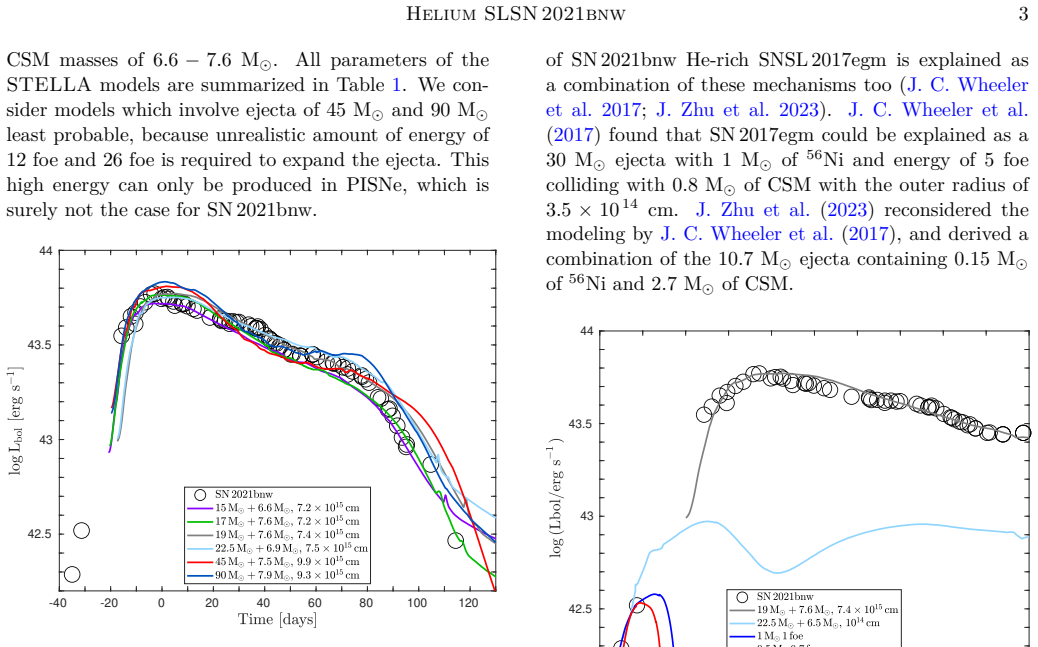
Best-fit models include 15-22.5 solar masses of ejecta enriched with 1.7 solar masses of nickel-56 and carrying 4 foe of energy, colliding with 7 solar masses of circumstellar matter, which match the observed light curve. The early data can be explained as cooling of an expanding shell of 0.5 solar masses and 0.7 foe. We tend to exclude a pulsational pair-instability origin for SLSN 2021bnw and conclude that it was preferably a core-collapse explosion of a star with initial mass of not less than 61 solar masses aided by magnetorotational effects.
What carries the argument
STELLA hydrodynamics radiative-transfer simulations that fit the light curve to radioactive heating, explosion energy, and collision with circumstellar material.
If this is right
- A star of initial mass at least 61 solar masses can end its life as a helium-rich superluminous supernova via core collapse.
- Magnetorotational effects can supply the extra energy needed to match the observed brightness in such events.
- About 7 solar masses of circumstellar material is required to power the main light curve through interaction.
- The very early light curve traces the cooling of a thin, fast-expanding shell ejected shortly before explosion.
Where Pith is reading between the lines
- Other helium-rich superluminous supernovae that resist magnetar fits may be explained by the same core-collapse plus circumstellar-interaction channel.
- Very massive stars can apparently retain enough helium until core collapse under conditions that also produce dense pre-explosion mass loss.
- Late-time spectra or remnant searches could test for the expected nickel and magnetorotational signatures.
Load-bearing premise
The specific combination of ejecta mass, nickel mass, explosion energy, and circumstellar mass is the unique physical solution and the simulations capture all relevant physics without major systematic bias.
What would settle it
A successful fit of the same light curve using a pulsational pair-instability model or a pure magnetar-powered model with substantially different parameters would falsify the core-collapse plus circumstellar-interaction solution.
Figures
read the original abstract
Superluminous supernovae (SLSNe) remain an intriguing topic in supernova (SN) transient astronomy. While the majority of SLSNe are shown to be explained by energy streaming from the newly born magnetar, there are others which are powered by different mechanisms. We analyse the pseudo-bolometric light curve of the nearby helium-rich SLSN 2021bnw. We built models and run hydrodynamics radiative-transfer simulations with STELLA. Our best-fit models include 15-22.5 Msun of ejecta enriched with 1.7 Msun of 56 Ni and carrying energy of 4 foe, and colliding w ith 7 Msun of circumstellar matter which match the observed light curve very well. The early data can be explained as cooling of an expanding shell with the mass of 0.5 Msun and kinetic energy of 0.7 foe. We tend to exclude a pulsational pair-instability (PPISN) origin for SLSN 2021bnw. Instead we conclude that SLSN 2021bnw was preferably a core-collapse explosion of a star with the initial mass of not less than 61 Msun aided by magnetorotational effects.
Editorial analysis
A structured set of objections, weighed in public.
Referee Report
Summary. The paper analyzes the pseudo-bolometric light curve of the helium-rich superluminous supernova SN 2021bnw using hydrodynamics and radiative-transfer simulations with the STELLA code. It presents best-fit models consisting of 15-22.5 solar masses of ejecta enriched with 1.7 solar masses of 56Ni and carrying 4 foe of energy, interacting with 7 solar masses of circumstellar material, which match the observed light curve. The early data are explained by cooling of a 0.5 solar mass expanding shell with 0.7 foe kinetic energy. The authors exclude a pulsational pair-instability supernova origin and conclude that SN 2021bnw was a core-collapse explosion of a star with initial mass of at least 61 solar masses, aided by magnetorotational effects.
Significance. If the parameter combination is demonstrated to be unique and the mapping from ejecta mass to ZAMS mass is robust under quantified uncertainties, this would provide a concrete alternative to the magnetar model for at least one helium-rich SLSN and useful constraints on pre-explosion mass loss in very massive stars. The deployment of full 1D hydro plus radiative-transfer simulations is a methodological strength that allows direct comparison to the observed light curve.
major comments (3)
- [Abstract] Abstract: the statement that the models with ejecta mass 15-22.5 Msun, 1.7 Msun 56Ni, 4 foe, and 7 Msun CSM 'match the observed light curve very well' is not accompanied by any quantitative goodness-of-fit metric or residual plot, nor by a demonstration that other physically plausible combinations (different Ni mass, lower energy, or pure magnetar powering) cannot achieve comparable agreement.
- [Abstract] Abstract and modeling description: the inference that the progenitor had ZAMS mass not less than 61 Msun rests on the adopted ejecta-mass range without any presented stellar-evolution grid, explicit mass-loss prescription, or uncertainty quantification on the ejecta-to-ZAMS mapping; this step is load-bearing for the central claim.
- [Abstract] Abstract: the exclusion of a PPISN origin is asserted without any specific PPISN model light curve, spectral comparison, or feature (e.g., expected nickel mass or expansion velocity) shown to be inconsistent with the data.
minor comments (1)
- [Abstract] The abstract contains the typographical error 'w ith' (should read 'with').
Simulated Author's Rebuttal
We thank the referee for the careful and constructive review. We address each major comment below, indicating the revisions we will make to strengthen the manuscript.
read point-by-point responses
-
Referee: [Abstract] Abstract: the statement that the models with ejecta mass 15-22.5 Msun, 1.7 Msun 56Ni, 4 foe, and 7 Msun CSM 'match the observed light curve very well' is not accompanied by any quantitative goodness-of-fit metric or residual plot, nor by a demonstration that other physically plausible combinations (different Ni mass, lower energy, or pure magnetar powering) cannot achieve comparable agreement.
Authors: We agree that a quantitative goodness-of-fit metric and residual analysis would improve the presentation. In the revised manuscript we will add the reduced chi-squared value for the best-fit model together with a residual plot. Our parameter survey showed that combinations with substantially different nickel masses or explosion energies fail to reproduce the peak luminosity, rise time and late-time slope simultaneously; we will add a short summary of these trials. Pure magnetar models are disfavored by the helium-rich spectra and the required magnetar parameters, but we will expand the discussion to make this comparison explicit. revision: yes
-
Referee: [Abstract] Abstract and modeling description: the inference that the progenitor had ZAMS mass not less than 61 Msun rests on the adopted ejecta-mass range without any presented stellar-evolution grid, explicit mass-loss prescription, or uncertainty quantification on the ejecta-to-ZAMS mapping; this step is load-bearing for the central claim.
Authors: We acknowledge that the ZAMS-mass inference requires additional supporting material. The ejecta-mass range is obtained directly from the STELLA fits; we will add a reference to published stellar-evolution grids for massive helium stars, state the adopted wind mass-loss prescription, and include a brief discussion of the uncertainties in the ejecta-to-ZAMS mapping. revision: partial
-
Referee: [Abstract] Abstract: the exclusion of a pulsational pair-instability supernova origin is asserted without any specific PPISN model light curve, spectral comparison, or feature (e.g., expected nickel mass or expansion velocity) shown to be inconsistent with the data.
Authors: We will revise the text to provide a more explicit justification. We will compare the derived nickel mass (1.7 solar masses) and expansion velocities to the lower nickel yields and distinct light-curve morphologies predicted by published PPISN models, thereby clarifying why a PPISN origin is disfavored. revision: yes
Circularity Check
No significant circularity; standard parameter fitting with independent simulation content
full rationale
The paper describes building models and running STELLA hydrodynamics radiative-transfer simulations to identify best-fit parameters (ejecta mass 15-22.5 Msun, 1.7 Msun Ni, 4 foe, 7 Msun CSM) that reproduce the observed light curve. This is standard forward modeling rather than a claimed prediction that reduces to the inputs by construction. The progenitor mass inference (>=61 Msun ZAMS) follows from mapping the fitted ejecta mass under standard assumptions, but no self-definitional loop, fitted quantity renamed as prediction, or load-bearing self-citation is exhibited in the text. The simulations supply independent physical content, so the derivation chain does not collapse to tautology.
Axiom & Free-Parameter Ledger
free parameters (6)
- ejecta mass =
15-22.5 Msun
- nickel-56 mass =
1.7 Msun
- explosion energy =
4 foe
- CSM mass =
7 Msun
- pre-outburst shell mass =
0.5 Msun
- shell kinetic energy =
0.7 foe
axioms (2)
- domain assumption STELLA hydrodynamics and radiative-transfer code accurately models supernova ejecta and circumstellar interaction
- domain assumption Core-collapse mechanism aided by magnetorotational effects can produce the required explosion energy in stars above 61 solar masses
Lean theorems connected to this paper
-
IndisputableMonolith/Cost/FunctionalEquationwashburn_uniqueness_aczel unclear?
unclearRelation between the paper passage and the cited Recognition theorem.
Our best-fit models include 15-22.5 Msun of ejecta enriched with 1.7 Msun of 56Ni and carrying energy of 4 foe, and colliding with 7 Msun of circumstellar matter which match the observed light curve very well.
What do these tags mean?
- matches
- The paper's claim is directly supported by a theorem in the formal canon.
- supports
- The theorem supports part of the paper's argument, but the paper may add assumptions or extra steps.
- extends
- The paper goes beyond the formal theorem; the theorem is a base layer rather than the whole result.
- uses
- The paper appears to rely on the theorem as machinery.
- contradicts
- The paper's claim conflicts with a theorem or certificate in the canon.
- unclear
- Pith found a possible connection, but the passage is too broad, indirect, or ambiguous to say the theorem truly supports the claim.
Reference graph
Works this paper leans on
-
[1]
Aloy, M. Á., & Obergaulinger, M. 2021, MNRAS, 500, 4365, doi: 10.1093/mnras/staa3273
-
[2]
Barkat, Z., Rakavy, G., & Sack, N. 1967, Physical Review Letters, 18, 379, doi: 10.1103/PhysRevLett.18.379
-
[3]
Bisnovatyi-Kogan, G. S., & Kazhdan, Y. M. 1967, Soviet Ast., 10, 604
work page 1967
-
[4]
Bisnovatyi-Kogan, G. S., Popov, I. P., & Samokhin, A. A. 1976, Ap&SS, 41, 287, doi: 10.1007/BF00646184
-
[5]
2000, ApJ, 532, 1132, doi: 10.1086/308588
Iwamoto, K. 2000, ApJ, 532, 1132, doi: 10.1086/308588
-
[6]
Blinnikov, S. I., Dunina-Barkovskaya, N. V., & Nadyozhin, D. K. 1996, ApJS, 106, 171, doi: 10.1086/192334
-
[7]
Blinnikov, S. I., Eastman, R., Bartunov, O. S., Popolitov, V. A., & Woosley, S. E. 1998, ApJ, 496, 454, doi: 10.1086/305375
-
[8]
Blondin, S., Blinnikov, S., Callan, F. P., et al. 2022, A&A, 668, A163, doi: 10.1051/0004-6361/202244134
-
[9]
2023, MNRAS, 520, 5622, doi: 10.1093/mnras/stad496
Bugli, M., Guilet, J., Foglizzo, T., & Obergaulinger, M. 2023, MNRAS, 520, 5622, doi: 10.1093/mnras/stad496
-
[10]
2021, MNRAS, 507, 443, doi: 10.1093/mnras/stab2161
Bugli, M., Guilet, J., & Obergaulinger, M. 2021, MNRAS, 507, 443, doi: 10.1093/mnras/stab2161
-
[11]
Bugli, M., Guilet, J., Obergaulinger, M., Cerdá-Durán, P., & Aloy, M. A. 2020, MNRAS, 492, 58, doi: 10.1093/mnras/stz3483
-
[12]
Crowther, P. A. 2007, ARA&A, 45, 177, doi: 10.1146/annurev.astro.45.051806.110615
-
[13]
Ertl, T., Woosley, S. E., Sukhbold, T., & Janka, H. T. 2020, ApJ, 890, 51, doi: 10.3847/1538-4357/ab6458
-
[14]
Fadeyev, Y. A., & Novikova, M. F. 2004, Astronomy Letters, 30, 707, doi: 10.1134/1.1808057
-
[15]
The nearby He-rich superluminous supernova SN 2021bnw at photospheric phases
Fiore, A., Kozyreva, A., Yan, L., et al. 2026, arXiv e-prints, arXiv:2602.12948. https://arxiv.org/abs/2602.12948
work page internal anchor Pith review Pith/arXiv arXiv 2026
-
[16]
Fowler, W. A., & Hoyle, F. 1964, ApJS, 9, 201, doi: 10.1086/190103
-
[17]
2018, MNRAS, 476, 1853, doi: 10.1093/mnras/sty369
Fuller, J., & Ro, S. 2018, MNRAS, 476, 1853, doi: 10.1093/mnras/sty369
-
[18]
2012, Science, 337, 927, doi: 10.1126/science.1203601 Gräfener, G
Gal-Yam, A. 2012, Science, 337, 927, doi: 10.1126/science.1203601 Gräfener, G. 2021, A&A, 647, A13, doi: 10.1051/0004-6361/202040037
-
[19]
2021, MNRAS, 501, 2764, doi: 10.1093/mnras/staa3819
Obergaulinger, M. 2021, MNRAS, 501, 2764, doi: 10.1093/mnras/staa3819
-
[20]
Heger, A., & Woosley, S. E. 2002, ApJ, 567, 532, doi: 10.1086/338487
-
[21]
2004, A&A, 425, 649, doi: 10.1051/0004-6361:20041095
Hirschi, R., Meynet, G., & Maeder, A. 2004, A&A, 425, 649, doi: 10.1051/0004-6361:20041095
-
[22]
2025, MNRAS, 543, 2796, doi: 10.1093/mnras/staf1470
Hirschi, R., Goodman, K., Meynet, G., et al. 2025, MNRAS, 543, 2796, doi: 10.1093/mnras/staf1470
-
[23]
1994, ApJL, 437, L115, doi: 10.1086/187696
Iwamoto, K., Nomoto, K., Höflich, P., et al. 1994, ApJL, 437, L115, doi: 10.1086/187696
-
[24]
Kasen, D., Woosley, S. E., & Heger, A. 2011, ApJ, 734, 102, doi: 10.1088/0004-637X/734/2/102 8 A. Kozyreva, et al
-
[25]
Kozyreva, A. 2026a, PISN light curve collection computed with hydrodynamics radiative-transfer code STELLA, 1.0 Zenodo, doi: 10.5281/zenodo.18421741
-
[26]
Kozyreva, A. 2026b, Helium superluminous SN 2021bnw: an explosion of a massive star with a pre-outburst, 1.0 Zenodo, doi: 10.5281/zenodo.18406187
-
[27]
2021, ApJ, 915, 80, doi: 10.3847/1538-4357/abfcbe
Leung, S.-C., Fuller, J., & Nomoto, K. 2021, ApJ, 915, 80, doi: 10.3847/1538-4357/abfcbe
-
[28]
2019, ApJ, 887, 72, doi: 10.3847/1538-4357/ab4fe5
Leung, S.-C., Nomoto, K., & Blinnikov, S. 2019, ApJ, 887, 72, doi: 10.3847/1538-4357/ab4fe5
-
[29]
Collapsars - Gamma-Ray Bursts and Explosions in "Failed Supernovae"
MacFadyen, A. I., & Woosley, S. E. 1999, ApJ, 524, 262, doi: 10.1086/307790
-
[30]
2019, ApJ, 882, 36, doi: 10.3847/1538-4357/ab3426
Marchant, P., Renzo, M., Farmer, R., et al. 2019, ApJ, 882, 36, doi: 10.3847/1538-4357/ab3426
-
[31]
2023, A&A, 679, A137, doi: 10.1051/0004-6361/202347514
Hirschi, R. 2023, A&A, 679, A137, doi: 10.1051/0004-6361/202347514
-
[32]
Matzner, C. D., & Ro, S. 2021, ApJ, 908, 23, doi: 10.3847/1538-4357/abd03b
-
[33]
A., Deng , J., Nomoto , K., et al
Mazzali, P. A., Deng, J., Nomoto, K., et al. 2006, Nature, 442, 1018, doi: 10.1038/nature05081
-
[34]
2005, A&A, 429, 581, doi: 10.1051/0004-6361:20047106
Meynet, G., & Maeder, A. 2005, A&A, 429, 581, doi: 10.1051/0004-6361:20047106
-
[35]
The origin of the dust in high-redshift quasars: the case of SDSS J1148+5251
Moriya, T., Tominaga, N., Blinnikov, S. I., Baklanov, P. V., & Sorokina, E. I. 2011, MNRAS, 415, 199, doi: 10.1111/j.1365-2966.2011.18689.x
-
[36]
Moriya, T. J., Blinnikov, S. I., Tominaga, N., et al. 2013, MNRAS, 428, 1020, doi: 10.1093/mnras/sts075
-
[37]
Moriya, T. J., Chen, T.-W., & Langer, N. 2017, The Astrophysical Journal, 835, 177, doi: 10.3847/1538-4357/835/2/177
-
[38]
J., Marchant, P., & Blinnikov, S
Moriya, T. J., Marchant, P., & Blinnikov, S. I. 2020, A&A, 641, L10, doi: 10.1051/0004-6361/202038903
-
[39]
Moriya, T. J., Sorokina, E. I., & Chevalier, R. A. 2018, Space Science Review, 214, 59, doi: 10.1007/s11214-018-0493-6 Müller, B. 2024, arXiv e-prints, arXiv:2403.18952, doi: 10.48550/arXiv.2403.18952
-
[40]
M., Taubenberger, S., Blinnikov, S., Sorokina, E., & Hillebrandt, W
Noebauer, U. M., Taubenberger, S., Blinnikov, S., Sorokina, E., & Hillebrandt, W. 2016, MNRAS, 463, 2972, doi: 10.1093/mnras/stw2197
-
[41]
Obergaulinger, M., & Aloy, M. Á. 2021, MNRAS, 503, 4942, doi: 10.1093/mnras/stab295
-
[42]
2020, in Handbook of Nuclear Physics
Obergaulinger, M., & Reichert, M. 2020, in Handbook of Nuclear Physics. ISBN: 978-981-15-8818-1. Springer, 90, doi: 10.1007/978-981-15-8818-1_90-1
-
[43]
Poidevin, F., Omand, C. M. B., Könyves-Tóth, R., et al. 2023, MNRAS, 521, 5418, doi: 10.1093/mnras/stad830
-
[44]
2021, MNRAS, 503, 2108, doi: 10.1093/mnras/stab614
Powell, J., Müller, B., & Heger, A. 2021, MNRAS, 503, 2108, doi: 10.1093/mnras/stab614
-
[45]
Quataert, E., & Shiode, J. 2012, MNRAS, 423, L92, doi: 10.1111/j.1745-3933.2012.01264.x
-
[46]
Rahman, N., Janka, H.-T., Stockinger, G., & Woosley, S. E. 2022, MNRAS, 512, 4503, doi: 10.1093/mnras/stac758
-
[47]
, year = 1967, month = jun, volume =
Rakavy, G., & Shaviv, G. 1967, ApJ, 148, 803, doi: 10.1086/149204
-
[48]
2024, MNRAS, 529, 3197, doi: 10.1093/mnras/stae561
Reichert, M., Bugli, M., Guilet, J., et al. 2024, MNRAS, 529, 3197, doi: 10.1093/mnras/stae561
-
[49]
Reichert, M., Obergaulinger, M., Aloy, M. Á., et al. 2023, MNRAS, 518, 1557, doi: 10.1093/mnras/stac3185
-
[50]
2020, A&A, 640, A56, doi: 10.1051/0004-6361/202037710
Renzo, M., Farmer, R., Justham, S., et al. 2020, A&A, 640, A56, doi: 10.1051/0004-6361/202037710
-
[51]
M., Agarwal, A., Barnes, J., et al
Siegel, D. M., Agarwal, A., Barnes, J., et al. 2022, ApJ, 941, 100, doi: 10.3847/1538-4357/ac8d04
-
[52]
Siegel, D. M., Barnes, J., & Metzger, B. D. 2019, Nature, 569, 241, doi: 10.1038/s41586-019-1136-0
-
[53]
2017, ApJ, 835, 266, doi: 10.3847/1538-4357/835/2/266
Tolstov, A., Nomoto, K., Blinnikov, S., et al. 2017, ApJ, 835, 266, doi: 10.3847/1538-4357/835/2/266
-
[54]
2026, MNRAS, doi: 10.1093/mnras/stag626
Varma, V., & Müller, B. 2026, MNRAS, doi: 10.1093/mnras/stag626
-
[55]
2025, MNRAS, 544, 3846, doi: 10.1093/mnras/staf1860
Varma, V., Müller, B., & Hirschi, R. 2025, MNRAS, 544, 3846, doi: 10.1093/mnras/staf1860
-
[56]
Vink, J. S. 2015, in Astrophysics and Space Science Library, Vol. 412, Very Massive Stars in the Local Universe, ed. J. S. Vink, 77, doi: 10.1007/978-3-319-09596-7_4
-
[57]
Wagoner, R. V. 1969, ARA&A, 7, 553, doi: 10.1146/annurev.aa.07.090169.003005
-
[58]
C., Chatzopoulos, E., Vinkó, J., & Tuminello, R
Wheeler, J. C., Chatzopoulos, E., Vinkó, J., & Tuminello, R. 2017, ApJL, 851, L14, doi: 10.3847/2041-8213/aa9d84
-
[59]
E., Hirschi, R., Varma, V., et al
Whitehead, E. E., Hirschi, R., Varma, V., et al. 2026, MNRAS, 546, staf2245, doi: 10.1093/mnras/staf2245
-
[60]
Woosley, S. E. 2017, ApJ, 836, 244, doi: 10.3847/1538-4357/836/2/244
-
[61]
Woosley, S. E., Heger, A., & Weaver, T. A. 2002, Reviews of Modern Physics, 74, 1015, doi: 10.1103/RevModPhys.74.1015
-
[62]
Yadav, N., Müller, B., Janka, H. T., Melson, T., & Heger, A. 2020, ApJ, 890, 94, doi: 10.3847/1538-4357/ab66bb
-
[63]
2020, arXiv e-prints, arXiv:2006.13758
Yan, L., Perley, D., Schulze, S., et al. 2020, arXiv e-prints, arXiv:2006.13758. https://arxiv.org/abs/2006.13758
-
[64]
2010, ApJL, 717, L62, doi: 10.1088/2041-8205/717/1/L62
Yoon, S.-C., & Cantiello, M. 2010, ApJL, 717, L62, doi: 10.1088/2041-8205/717/1/L62
-
[65]
2016, Monthly Notices of the Royal Astronomical Society, 457, 351, doi: 10.1093/mnras/stv3002
Yoshida, T., Umeda, H., Maeda, K., & Ishii, T. 2016, Monthly Notices of the Royal Astronomical Society, 457, 351, doi: 10.1093/mnras/stv3002
-
[66]
2013, MNRAS, 433, 1114, doi: 10.1093/mnras/stt794
Yusof, N., Hirschi, R., Meynet, G., et al. 2013, MNRAS, 433, 1114, doi: 10.1093/mnras/stt794
-
[67]
2023, ApJ, 949, 23, doi: 10.3847/1538-4357/acc2c3
Zhu, J., Jiang, N., Dong, S., et al. 2023, ApJ, 949, 23, doi: 10.3847/1538-4357/acc2c3
discussion (0)
Sign in with ORCID, Apple, or X to comment. Anyone can read and Pith papers without signing in.