Recognition: 2 theorem links
· Lean TheoremSymbolic recovery of PDEs from measurement data
Pith reviewed 2026-05-15 21:42 UTC · model grok-4.3
The pith
If a physical law fits inside a rational-function network, noiseless complete data recovers it exactly as the sparsest parameterization.
A machine-rendered reading of the paper's core claim, the machinery that carries it, and where it could break.
Core claim
If there exists an admissible physical law that is expressible within the symbolic network architecture, then in the limit of noiseless and complete measurements, symbolic networks recover a physical law within the PDE model that is representable by the architecture. Moreover, the recovered law corresponds to a regularization-minimizing parameterization. Under an additional identifiability condition, the unique true physical law is recovered.
What carries the argument
Symbolic networks composed of rational functions combined with arithmetic operations, which serve as the hypothesis class for representing candidate physical laws inside the PDE model.
If this is right
- L1 regularization on the network parameters yields sparse, interpretable symbolic expressions for the recovered PDE.
- The reconstruction holds at the continuous level, so discretization errors can be analyzed separately after the function-space result.
- An identifiability condition on the architecture guarantees that the recovered law is the unique true physical law.
- The same network class generalizes earlier ParFam and EQL architectures while preserving the recovery property.
Where Pith is reading between the lines
- The continuous-level guarantee suggests the method could be combined with existing numerical PDE solvers to refine recovered laws on discrete grids.
- Similar recovery arguments might apply to ordinary differential equations or algebraic relations if the network architecture is adjusted accordingly.
- In practice, the regularization-minimizing property could be used to rank multiple candidate laws when several are consistent with the data.
Load-bearing premise
The true physical law must be exactly expressible using rational functions and arithmetic operations inside the chosen network architecture.
What would settle it
A counterexample in which complete noiseless measurements of a simple known PDE, such as the heat equation, are fed to the network yet it returns a different or non-symbolic expression would falsify the reconstruction claim.
Figures




read the original abstract
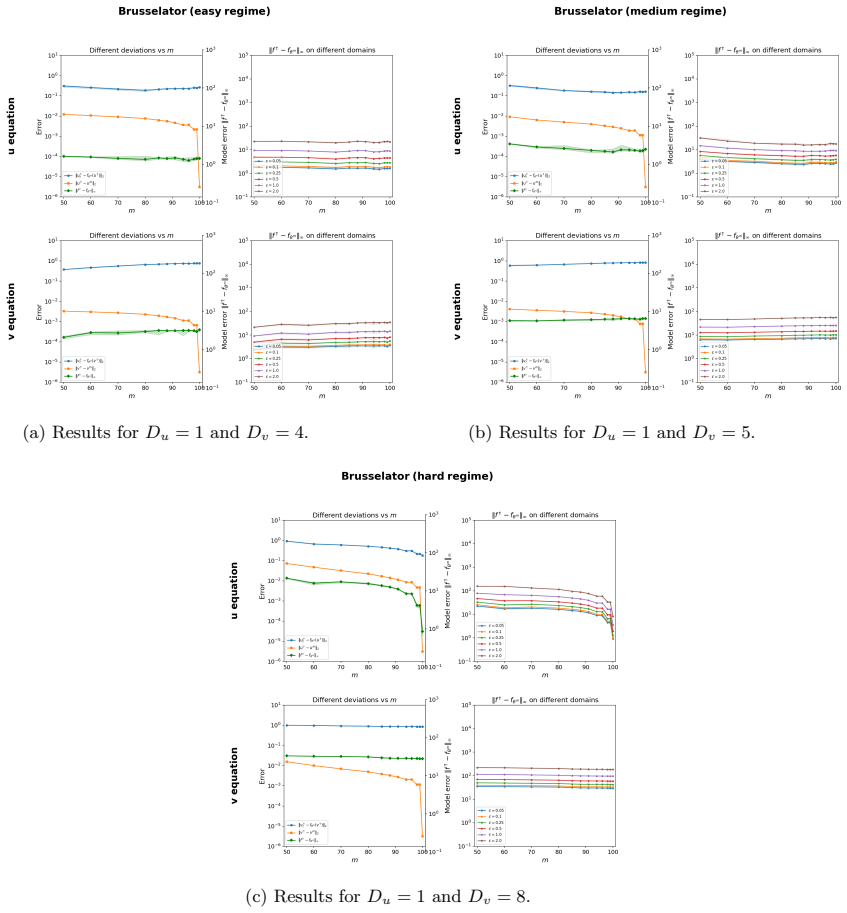
Models based on partial differential equations (PDEs) are powerful for describing a wide range of complex phenomena in the natural sciences. Accurately identifying the PDE model, which represents the underlying physical law, is essential for a proper understanding of the problem. This reconstruction typically relies on indirect and noisy measurements of the system's state and, without specifically tailored methods, rarely yields symbolic expressions, thereby limiting interpretability. In this work, we address this limitation by considering neural network architectures based on rational functions for the symbolic representation of physical laws. These networks combine the approximation power of rational functions with the flexibility to represent arithmetic operations, and generalize ParFam and EQL-type architectures used in symbolic regression for physical law learning. We further establish regularity results for these symbolic networks. Our main contribution is a reconstruction result showing that, if there exists an admissible physical law that is expressible within the symbolic network architecture, then in the limit of noiseless and complete measurements, symbolic networks recover a physical law within the PDE model that is representable by the architecture. Moreover, the recovered law corresponds to a regularization-minimizing parameterization, promoting interpretability and sparsity in case of $L^1$-regularization. Under an additional identifiability condition, the unique true physical law is recovered. These reconstruction and regularity results are derived at the continuous level prior to discretization due to a formulation in function space. Empirical results using the ParFam architecture are consistent with the theoretical findings and suggest the feasibility of reconstructing interpretable physical laws in practice.
Editorial analysis
A structured set of objections, weighed in public.
Referee Report
Summary. The paper proposes neural network architectures based on rational functions (generalizing ParFam and EQL) for symbolic recovery of PDEs from indirect noisy measurements. It establishes regularity results for these networks and proves a reconstruction theorem in function space: if an admissible physical law is expressible in the architecture, then noiseless complete measurements recover a representable law that is regularization-minimizing (e.g., via L1 for sparsity); uniqueness holds under an additional identifiability condition. Results precede discretization, with empirical consistency checks using ParFam.
Significance. If the conditional reconstruction theorem holds, the work supplies a rigorous function-space foundation for interpretable symbolic PDE discovery, linking neural approximation power to sparsity-promoting regularization. This strengthens scientific machine learning by providing guarantees absent in purely empirical symbolic regression, with potential impact on physics-informed modeling where symbolic forms aid understanding.
major comments (2)
- [Main reconstruction result] Reconstruction theorem (function-space formulation): the claim that the recovered law is regularization-minimizing follows from the architecture and L1 penalty, but the proof must explicitly verify that the minimizer coincides with the true law under only the expressibility assumption; any hidden dependence on discretization or measurement completeness should be stated with a precise error bound.
- [Regularity results] Regularity results: the function-space regularity (prior to discretization) is central to avoiding discretization artifacts, yet the specific spaces (e.g., Sobolev or Besov) and the approximation rates for rational-function networks are not compared to classical results on rational approximation; this weakens the claim that the continuous-level derivation is fully rigorous.
minor comments (2)
- Notation for the symbolic network layers (rational blocks and arithmetic operations) should be defined once and used consistently to prevent confusion with standard feed-forward layers.
- [Empirical results] The empirical section would benefit from explicit quantitative metrics (recovery error, sparsity level) and direct comparison against SINDy-style PDE methods on the same benchmark problems.
Simulated Author's Rebuttal
We thank the referee for the constructive comments, which help clarify the presentation of our function-space results. We respond to each major comment below.
read point-by-point responses
-
Referee: [Main reconstruction result] Reconstruction theorem (function-space formulation): the claim that the recovered law is regularization-minimizing follows from the architecture and L1 penalty, but the proof must explicitly verify that the minimizer coincides with the true law under only the expressibility assumption; any hidden dependence on discretization or measurement completeness should be stated with a precise error bound.
Authors: The theorem is stated and proved entirely in function space under the assumption of noiseless and complete measurements; consequently there is no discretization dependence and the reconstruction error is identically zero in this limit. The proof already shows that, whenever an admissible law lies in the architecture, the L1-regularized minimizer within the architecture recovers a representable law, and uniqueness follows from the additional identifiability condition. To make the argument fully explicit we will insert a short clarifying paragraph immediately after the theorem statement that isolates the expressibility assumption and confirms the zero-error bound in the continuous limit. revision: partial
-
Referee: [Regularity results] Regularity results: the function-space regularity (prior to discretization) is central to avoiding discretization artifacts, yet the specific spaces (e.g., Sobolev or Besov) and the approximation rates for rational-function networks are not compared to classical results on rational approximation; this weakens the claim that the continuous-level derivation is fully rigorous.
Authors: We agree that an explicit comparison would strengthen the claim. The regularity results are obtained in Sobolev spaces; we will revise the relevant section to state the precise Sobolev regularity assumed for the target PDE and to include a brief comparison of the approximation rates achieved by the rational-function networks with classical results on rational approximation in Sobolev and Besov spaces. revision: yes
Circularity Check
Reconstruction theorem self-contained in function space; no circular reduction
full rationale
The central claim is a conditional reconstruction theorem derived at the continuous function-space level prior to any discretization. It states that if an admissible physical law exists and is expressible inside the symbolic network architecture (rational functions plus arithmetic operations), then noiseless complete measurements yield recovery of a representable law that is regularization-minimizing. This mathematical result does not reduce any quantity to a fitted parameter defined by the same data, nor does it rely on self-citation chains for its load-bearing steps; uniqueness is invoked only under an explicit additional identifiability condition. Regularity results for the networks are established separately. Empirical consistency checks are presented as supporting evidence but are not part of the derivation chain. The theorem is therefore self-contained and does not exhibit any of the enumerated circularity patterns.
Axiom & Free-Parameter Ledger
axioms (2)
- domain assumption Existence of an admissible physical law expressible within the rational-function network architecture
- standard math Standard Sobolev or similar function-space regularity for the PDE solutions and measurements
Lean theorems connected to this paper
-
IndisputableMonolith/Cost/FunctionalEquation.leanwashburn_uniqueness_aczel unclear?
unclearRelation between the paper passage and the cited Recognition theorem.
Our main contribution is a reconstruction result showing that, if there exists an admissible physical law that is expressible within the symbolic network architecture, then ... the recovered law corresponds to a regularization-minimizing parameterization
-
IndisputableMonolith/Foundation/RealityFromDistinction.leanreality_from_one_distinction unclear?
unclearRelation between the paper passage and the cited Recognition theorem.
symbolic networks ... rational functions ... generalize ParFam and EQL-type architectures
What do these tags mean?
- matches
- The paper's claim is directly supported by a theorem in the formal canon.
- supports
- The theorem supports part of the paper's argument, but the paper may add assumptions or extra steps.
- extends
- The paper goes beyond the formal theorem; the theorem is a base layer rather than the whole result.
- uses
- The paper appears to rely on the theorem as machinery.
- contradicts
- The paper's claim conflicts with a theorem or certificate in the canon.
- unclear
- Pith found a possible connection, but the passage is too broad, indirect, or ambiguous to say the theorem truly supports the claim.
Reference graph
Works this paper leans on
-
[1]
Christian Aarset, Martin Holler, and Tram Thi Ngoc Nguyen. Learning-informed parameter identifi- cation in nonlinear time-dependent PDEs.Applied Mathematics & Optimization, 88(3), August 2023. doi:10.1007/s00245-023-10044-y
-
[2]
Robert Acar. Identification of the coefficient in elliptic equations.SIAM Journal on Control and Optimization, 31(5):1221–1244, September 1993.doi:10.1137/0331058
-
[3]
Robert A. Adams and John J. F. Fournier.Sobolev Spaces. Elsevier, Amsterdam, 2003
work page 2003
-
[4]
Giovanni Alessandrini. An identification problem for an elliptic equation in two variables.Annali di Matematica Pura ed Applicata, 145(1):265–295, December 1986.doi:10.1007/bf01790543
-
[5]
Luigi Ambrosio. Well posedness of ODE’s and continuity equations with nonsmooth vector fields, and applications.Revista Matem´ atica Complutense, 30(3):427–450, August 2017.doi:10.1007/ s13163-017-0244-3
work page 2017
-
[6]
Dimitrios Angelis, Filippos Sofos, and Theodoros E. Karakasidis. Artificial intelligence in physi- cal sciences: Symbolic regression trends and perspectives.Archives of Computational Methods in Engineering, 30(6):3845–3865, Jul 2023.doi:10.1007/s11831-023-09922-z
-
[7]
D.A. Augusto and H.J.C. Barbosa. Symbolic regression via genetic programming. InProceedings. Vol.1. Sixth Brazilian Symposium on Neural Networks, SBRN-00. IEEE Comput. Soc, 2000.doi: 10.1109/sbrn.2000.889734. 40
-
[8]
Kamyar Azizzadenesheli, Nikola Kovachki, Zongyi Li, Miguel Liu-Schiaffini, Jean Kossaifi, and Anima Anandkumar. Neural operators for accelerating scientific simulations and design.Nature Reviews Physics, 6(5):320–328, April 2024.doi:10.1038/s42254-024-00712-5
-
[9]
H. T. Banks and K. Kunisch.Estimation Techniques for Distributed Parameter Systems. Birkh¨ auser Boston, 1989.doi:10.1007/978-1-4612-3700-6
-
[10]
G. K. Batchelor.An Introduction to Fluid Dynamics. Cambridge Mathematical Library. Cambridge University Press, 2000.doi:10.1017/CBO9780511800955
-
[11]
R. Bellman and K.J. ˚Astr¨ om. On structural identifiability.Mathematical Biosciences, 7(3–4):329–339, April 1970.doi:10.1016/0025-5564(70)90132-x
-
[12]
Peter Benner, Serkan Gugercin, and Karen Willcox. A survey of projection-based model reduction methods for parametric dynamical systems.SIAM Review, 57(4):483–531, January 2015.doi:10. 1137/130932715
work page 2015
-
[13]
Kaushik Bhattacharya, Bamdad Hosseini, Nikola B. Kovachki, and Andrew M. Stuart. Model reduc- tion and neural networks for parametric PDEs.The SMAI Journal of computational mathematics, 7:121–157, July 2021.doi:10.5802/smai-jcm.74
-
[14]
L. Biggio, T. Bendinelli, A. Neitz, A. Lucchi, and G. Parascandolo. Neural symbolic regression that scales. InProceedings of 38th International Conference on Machine Learning (ICML 2021), volume 139 ofProceedings of Machine Learning Research, pages 936–945. PMLR, July 2021. URL: https://proceedings.mlr.press/v139/biggio21a.html
work page 2021
-
[15]
Nicolas Boull´ e, Yuji Nakatsukasa, and Alex Townsend. Rational neural networks. In H. Larochelle, M. Ranzato, R. Hadsell, M.F. Balcan, and H. Lin, editors,Advances in Neural Information Processing Systems, volume 33, pages 14243–14253. Curran Associates, Inc., 2020. URL:https://proceedings. neurips.cc/paper_files/paper/2020/file/a3f390d88e4c41f2747bfa2f1...
work page 2020
-
[16]
Chapter 3 - A mathematical guide to operator learning
Nicolas Boull´ e and Alex Townsend. Chapter 3 - A mathematical guide to operator learning. In Sid- dhartha Mishra and Alex Townsend, editors,Numerical Analysis Meets Machine Learning, volume 25 ofHandbook of Numerical Analysis, pages 83–125. Elsevier, 2024.doi:10.1016/bs.hna.2024.05.003
-
[17]
Steven L. Brunton and J. Nathan Kutz. Promising directions of machine learning for partial differential equations.Nature Computational Science, 4(7):483–494, June 2024.doi:10.1038/ s43588-024-00643-2
work page 2024
-
[18]
Steven L. Brunton, Joshua L. Proctor, and J. Nathan Kutz. Discovering governing equations from data by sparse identification of nonlinear dynamical systems.Proceedings of the National Academy of Sciences, 113(15):3932–3937, 2016.doi:10.1073/pnas.1517384113
-
[19]
Elia Bru´ e and Quoc-Hung Nguyen. Sobolev estimates for solutions of the transport equation and ODE flows associated to non-Lipschitz drifts.Mathematische Annalen, 380(1–2):855–883, April 2020. doi:10.1007/s00208-020-01988-5
-
[20]
Alexander L. Bukhgeim and Gunther Uhlmann. Recovering a potential from partial Cauchy data. Communications in Partial Differential Equations, 27(3–4):653–668, January 2002.doi:10.1081/ pde-120002868
work page 2002
-
[21]
J. R. Cannon and Paul DuChateau. An inverse problem for a nonlinear diffusion equation.SIAM Journal on Applied Mathematics, 39(2):272–289, October 1980.doi:10.1137/0139024
-
[22]
Identifiability Challenges in Sparse Linear Ordinary Differential Equations
Cecilia Casolo, S¨ oren Becker, and Niki Kilbertus. Identifiability challenges in sparse linear ordinary differential equations.ArXiv preprint arXiv:2506.09816, 2025.doi:10.48550/arXiv.2506.09816
work page internal anchor Pith review Pith/arXiv arXiv doi:10.48550/arxiv.2506.09816 2025
-
[23]
Constantin Christof and Julia Kowalczyk. On the identification and optimization of nonsmooth superposition operators in semilinear elliptic PDEs.ESAIM: Control, Optimisation and Calculus of Variations, 30:16, 2024.doi:10.1051/cocv/2023091
-
[24]
C. Cobelli and J. J. DiStefano. Parameter and structural identifiability concepts and ambiguities: a critical review and analysis.American Journal of Physiology-Regulatory, Integrative and Comparative Physiology, 239(1):R7–R24, July 1980.doi:10.1152/ajpregu.1980.239.1.r7. 41
-
[25]
Josephson, Joao Goncalves, Kenneth L
Cristina Cornelio, Sanjeeb Dash, Vernon Austel, Tyler R. Josephson, Joao Goncalves, Kenneth L. Clarkson, Nimrod Megiddo, Bachir El Khadir, and Lior Horesh. Combining data and theory for derivable scientific discovery with AI-Descartes.Nature Communications, 14(1), April 2023.doi: 10.1038/s41467-023-37236-y
-
[26]
Design of the monodomain model by artificial neural networks
S´ ebastien Court and Karl Kunisch. Design of the monodomain model by artificial neural networks. Discrete and Continuous Dynamical Systems, 42(12):6031–6061, 2022.doi:10.3934/dcds.2022137
-
[27]
Interpretable Machine Learning for Science with PySR and SymbolicRegression.jl
Miles Cranmer. Interpretable machine learning for science with PySR and SymbolicRegression.jl. ArXiv preprint arXiv:2305.01582, 2023.doi:10.48550/arXiv.2305.01582
work page internal anchor Pith review Pith/arXiv arXiv doi:10.48550/arxiv.2305.01582 2023
-
[28]
Tim De Ryck and Siddhartha Mishra. Numerical analysis of physics-informed neural networks and related models in physics-informed machine learning.Acta Numerica, 33:633–713, July 2024.doi: 10.1017/s0962492923000089
-
[29]
R. J. DiPerna and P. L. Lions. Ordinary differential equations, transport theory and Sobolev spaces. Inventiones Mathematicae, 98(3):511–547, October 1989.doi:10.1007/bf01393835
-
[30]
J. DiStefano and C. Cobelli. On parameter and structural identifiability: Nonunique observability/re- constructibility for identifiable systems, other ambiguities, and new definitions.IEEE Transactions on Automatic Control, 25(4):830–833, August 1980.doi:10.1109/tac.1980.1102439
-
[31]
Guozhi Dong, Michael Hinterm¨ uller, and Kostas Papafitsoros. Optimization with learning-informed differential equation constraints and its applications.ESAIM: Control, Optimisation and Calculus of Variations, 28:3, 2022.doi:10.1051/cocv/2021100
-
[32]
Guozhi Dong, Michael Hinterm¨ uller, and Kostas Papafitsoros. A descent algorithm for the optimal control of ReLU neural network informed PDEs based on approximate directional derivatives.SIAM Journal on Optimization, 34(3):2314–2349, July 2024.doi:10.1137/22m1534420
-
[33]
Guozhi Dong, Michael Hinterm¨ uller, Kostas Papafitsoros, and Kathrin V¨ olkner. First-order conditions for the optimal control of learning-informed nonsmooth PDEs.Numerical Functional Analysis and Optimization, 46(7):505–539, April 2025.doi:10.1080/01630563.2025.2488796
-
[34]
Paul DuChateau and William Rundell. Unicity in an inverse problem for an unknown reaction term in a reaction-diffusion equation.Journal of Differential Equations, 59(2):155–164, September 1985. doi:10.1016/0022-0396(85)90152-4
-
[35]
Herbert Egger, Jan-Frederik Pietschmann, and Matthias Schlottbom. Identification of nonlinear heat conduction laws.Journal of Inverse and Ill-posed Problems, 23(5):429–437, December 2014. doi:10.1515/jiip-2014-0030
-
[36]
Mathe- matics and Its Applications
Heinz W Engl, Martin Hanke, and Gunther Neubauer.Regularization of Inverse Problems. Mathe- matics and Its Applications. Springer, Dordrecht, Netherlands, 1996
work page 1996
-
[37]
Evans.Partial Differential Equations
Lawrence C. Evans.Partial Differential Equations. American Mathematical Society, Heidelberg, 2010
work page 2010
-
[38]
Ali Feizmohammadi, Yavar Kian, and Gunther Uhlmann. Partial data inverse problems for reaction- diffusion and heat equations.ArXiv preprint arXiv:2406.01387, 2024.doi:10.48550/ARXIV.2406. 01387
-
[39]
Craig R. Gin, Daniel E. Shea, Steven L. Brunton, and J. Nathan Kutz. DeepGreen: Deep learning of Green’s functions for nonlinear boundary value problems.Scientific Reports, 11(1), November 2021. doi:10.1038/s41598-021-00773-x
-
[40]
David J. Griffiths and Darrell F. Schroeter.Introduction to Quantum Mechanics. Cambridge Univer- sity Press, Cambridge, 2018.doi:10.1017/9781316995433
-
[41]
Robust identifiability for symbolic recovery of differential equations
Hillary Hauger, Philipp Scholl, and Gitta Kutyniok. Robust identifiability for symbolic recovery of differential equations. InICASSP 2025 - 2025 IEEE International Conference on Acoustics, Speech and Signal Processing (ICASSP), pages 1–5, 2025.doi:10.1109/ICASSP49660.2025.10887720. 42
-
[42]
Niklas Heim, Tom´ aˇ s Pevn´ y, and V´ aclavˇSm´ ıdl. Neural power units. In H. Larochelle, M. Ranzato, R. Hadsell, M.F. Balcan, and H. Lin, editors,Advances in Neural Information Processing Systems, volume 33, pages 6573–6583. Curran Associates, Inc., 2020. URL:https://proceedings.neurips. cc/paper_files/paper/2020/file/48e59000d7dfcf6c1d96ce4a603ed738-Paper.pdf
work page 2020
-
[43]
Springer Dordrecht, 2009.doi:10.1007/978-1-4020-8839-1
Michael Hinze, Rene Pinnau, Michael Ulbrich, and Stefan Ulbrich.Optimization with PDE Con- straints. Springer Dordrecht, 2009.doi:10.1007/978-1-4020-8839-1
-
[44]
Martin Holler and Erion Morina. On the growth of the parameters of a class of approximating ReLU neural networks.ArXiv preprint arXiv:2406.14936, 2024.doi:10.48550/arXiv.2406.14936
-
[45]
Martin Holler and Erion Morina. On uniqueness in structured model learning.ArXiv preprint arXiv:2410.22009, 2024.doi:10.48550/arXiv.2410.22009
-
[46]
Martin Holler and Erion Morina.C 1-approximation with rational functions and rational neural net- works.ArXiv preprint arXiv:2508.19672, 2025.doi:10.48550/arXiv.2508.19672
-
[47]
Physically consistent model learning for reaction-diffusion systems
Martin Holler and Erion Morina. Physically consistent model learning for reaction-diffusion systems. ArXiv preprint arXiv:2512.14240, 2025.doi:10.48550/arXiv.2512.14240
-
[48]
Deep generative symbolic regression
Samuel Holt, Zhaozhi Qian, and Mihaela van der Schaar. Deep generative symbolic regression. In The Eleventh International Conference on Learning Representations, 2023. URL:https://arxiv. org/abs/2401.00282
-
[49]
V. Isakov. On uniqueness in inverse problems for semilinear parabolic equations.Archive for Rational Mechanics and Analysis, 124(1):1–12, 1993.doi:10.1007/bf00392201
-
[50]
Courier Corporation, New York, 2009
Nathan Jacobson.Basic Algebra I - Second Edition. Courier Corporation, New York, 2009
work page 2009
-
[51]
Daijun Jiang, Yikan Liu, and Masahiro Yamamoto. Inverse source problem for the hyperbolic equation with a time-dependent principal part.Journal of Differential Equations, 262(1):653–681, January 2017.doi:10.1016/j.jde.2016.09.036
-
[52]
Kaipio and Erkki Somersalo.Statistical and Computational Inverse Problems
Jari P. Kaipio and Erkki Somersalo.Statistical and Computational Inverse Problems. Springer New York, 2005.doi:10.1007/b138659
-
[53]
Barbara Kaltenbacher. Regularization based on all-at-once formulations for inverse problems.SIAM Journal on Numerical Analysis, 54(4):2594–2618, 2016.doi:10.1137/16M1060984
-
[54]
Barbara Kaltenbacher and Tram T. N. Nguyen. Discretization of parameter identification in PDEs using neural networks.Inverse Problems, 38(12):124007, 2022.doi:10.1088/1361-6420/ac9c25
-
[55]
Barbara Kaltenbacher and William Rundell. The inverse problem of reconstructing reaction–diffusion systems.Inverse Problems, 36(6):065011, May 2020.doi:10.1088/1361-6420/ab8483
-
[56]
Barbara Kaltenbacher and William Rundell. On the simultaneous recovery of the conductivity and the nonlinear reaction term in a parabolic equation.Inverse Problems and Imaging, 14(5):939–966, 2020.doi:10.3934/ipi.2020043
-
[57]
Barbara Kaltenbacher and William Rundell. On uniqueness and reconstruction of a nonlinear diffusion term in a parabolic equation.Journal of Mathematical Analysis and Applications, 500(2):125145, August 2021.doi:10.1016/j.jmaa.2021.125145
-
[58]
Barbara Kaltenbacher and William Rundell. Reconstruction of space-dependence and nonlinearity of a reaction term in a subdiffusion equation.Inverse Problems, 41(5):055008, April 2025.doi: 10.1088/1361-6420/adcb67
-
[59]
End-to- end symbolic regression with transformers
Pierre-alexandre Kamienny, St´ ephane d'Ascoli, Guillaume Lample, and Francois Charton. End-to- end symbolic regression with transformers. In S. Koyejo, S. Mohamed, A. Agarwal, D. Belgrave, K. Cho, and A. Oh, editors,Advances in Neural Information Processing Systems, volume 35, pages 10269–10281. Curran Associates, Inc., 2022. URL:https://proceedings.neur...
work page 2022
-
[60]
Lipschitz and H¨ older stable determination of nonlinear terms for elliptic equations
Yavar Kian. Lipschitz and H¨ older stable determination of nonlinear terms for elliptic equations. Nonlinearity, 36(2):1302–1322, January 2023.doi:10.1088/1361-6544/acafcd. 43
-
[61]
Yavar Kian and Gunther Uhlmann. Recovery of nonlinear terms for reaction diffusion equations from boundary measurements.Archive for Rational Mechanics and Analysis, 247(1), January 2023. doi:10.1007/s00205-022-01831-y
-
[62]
Adam: A Method for Stochastic Optimization
Diederik P. Kingma and Jimmy Ba. Adam: A method for stochastic optimization. InProceedings of the 3rd International Conference on Learning Representations (ICLR), 2015. URL:https://arxiv. org/abs/1412.6980
work page internal anchor Pith review Pith/arXiv arXiv 2015
-
[63]
Michael V. Klibanov. Carleman estimates for global uniqueness, stability and numerical methods for coefficient inverse problems.jiip, 21(4):477–560, August 2013.doi:10.1515/jip-2012-0072
-
[64]
Ian Knowles. Parameter identification for elliptic problems.Journal of Computational and Applied Mathematics, 131(1–2):175–194, June 2001.doi:10.1016/s0377-0427(00)00275-2
-
[65]
Kovachki, Samuel Lanthaler, and Andrew M
Nikola B. Kovachki, Samuel Lanthaler, and Andrew M. Stuart. Chapter 9 - operator learning: Al- gorithms and analysis. In Siddhartha Mishra and Alex Townsend, editors,Numerical Analysis Meets Machine Learning, volume 25 ofHandbook of Numerical Analysis, pages 419–467. Elsevier, 2024. doi:10.1016/bs.hna.2024.05.009
-
[66]
William La Cava, Bogdan Burlacu, Marco Virgolin, Michael Kommenda, Patryk Orzechowski, Fabr´ ıcio Olivetti de Fran¸ ca, Ying Jin, and Jason H Moore. Contemporary symbolic regression methods and their relative performance.Advances in Neural Information Processing Systems, 2021(DB1):1–16,
work page 2021
-
[67]
URL:https://datasets-benchmarks-proceedings.neurips.cc/paper_files/paper/2021/ file/c0c7c76d30bd3dcaefc96f40275bdc0a-Paper-round1.pdf
work page 2021
-
[68]
Extrapolation and learning equations
Christoph Lampert and Georg Martius. Extrapolation and learning equations. In5th International Conference on Learning Representations, ICLR 2017 - Workshop Track Proceedings. International Conference on Learning Representations, 24–26 Apr 2017. URL:https://arxiv.org/pdf/1610. 02995
work page 2017
-
[69]
Fourier Neural Operator for Parametric Partial Differential Equations
Zongyi Li, Nikola Kovachki, Kamyar Azizzadenesheli, Burigede Liu, Kaushik Bhattacharya, Andrew Stuart, and Anima Anandkumar. Fourier neural operator for parametric partial differential equations. ArXiv preprint arXiv:2010.08895, 2020.doi:10.48550/arXiv.2010.08895
work page internal anchor Pith review Pith/arXiv arXiv doi:10.48550/arxiv.2010.08895 2010
-
[70]
Lu Lu, Pengzhan Jin, Guofei Pang, Zhongqiang Zhang, and George Em Karniadakis. Learning nonlinear operators via DeepONet based on the universal approximation theorem of operators.Nature Machine Intelligence, 3(3):218–229, March 2021.doi:10.1038/s42256-021-00302-5
-
[71]
Hongyu Miao, Xiaohua Xia, Alan S. Perelson, and Hulin Wu. On identifiability of nonlinear ode models and applications in viral dynamics.SIAM Review, 53(1):3–39, January 2011.doi:10.1137/ 090757009
work page 2011
-
[72]
Symbolic regression via deep reinforcement learning enhanced genetic programming seeding
Terrell Mundhenk, Mikel Landajuela, Ruben Glatt, Claudio P Santiago, Daniel faissol, and Bren- den K Petersen. Symbolic regression via deep reinforcement learning enhanced genetic programming seeding. In M. Ranzato, A. Beygelzimer, Y. Dauphin, P.S. Liang, and J. Wortman Vaughan, ed- itors,Advances in Neural Information Processing Systems, volume 34, pages...
work page 2021
-
[73]
Murray.Mathematical Biology: I
J.D. Murray.Mathematical Biology: I. An Introduction. Springer New York, 2002.doi:10.1007/ b98868
work page 2002
-
[74]
Murray.Mathematical Biology: II: Spatial Models and Biomedical Applications
J.D. Murray.Mathematical Biology: II: Spatial Models and Biomedical Applications. Springer New York, 2003.doi:10.1007/b98869
-
[75]
Adrian I. Nachman. Global uniqueness for a two-dimensional inverse boundary value problem.The Annals of Mathematics, 143(1):71, January 1996.doi:10.2307/2118653
-
[76]
Derick Nganyu Tanyu, Jianfeng Ning, Tom Freudenberg, Nick Heilenk¨ otter, Andreas Rademacher, Uwe Iben, and Peter Maass. Deep learning methods for partial differential equations and related parameter identification problems.Inverse Problems, 39(10):103001, August 2023.doi:10.1088/ 1361-6420/ace9d4. 44
work page 2023
-
[77]
Tram Thi Ngoc Nguyen. Sequential bi-level regularized inversion with application to hidden reaction law discovery.Inverse Problems, 41(6):065015, June 2025.doi:10.1088/1361-6420/addf73
-
[78]
Springer, Berlin, Heidelberg, 2015.doi:10.1007/978-3-319-19500-1
Benoˆ ıt Perthame.Parabolic Equations in Biology - Growth, reaction, movement and diffusion. Springer, Berlin, Heidelberg, 2015.doi:10.1007/978-3-319-19500-1
-
[79]
Brenden K. Petersen, Mikel Landajuela, T. Nathan Mundhenk, Claudio P. Santiago, Soo K. Kim, and Joanne T. Kim. Deep symbolic regression: Recovering mathematical expressions from data via risk-seeking policy gradients. InThe Ninth International Conference on Learning Representations,
- [80]
discussion (0)
Sign in with ORCID, Apple, or X to comment. Anyone can read and Pith papers without signing in.