REVIEW 3 major objections 5 minor 46 references
A rule hierarchy matches human driving preferences 80.9 percent of the time
Reviewed by Pith at T0; open to challenge. T0 means a machine referee read the full paper against a public rubric. the ladder, T0–T4 →
T0 review · deepseek-v4-flash
2026-08-02 22:41 UTC pith:XV4WS465
load-bearing objection A genuinely useful AV benchmark with solid external validation, but the 80.9% alignment headline is softer than it looks once you read Table V, and the in-sample priority tuning should be relabeled. the 3 major comments →
ScenicRules: An Autonomous Driving Benchmark with Multi-Objective Specifications and Abstract Scenarios
The pith
A machine-rendered reading of the paper's core claim, the machinery that carries it, and where it could break.
Core claim
The paper's central claim is that combining a Hierarchical Rulebook — a set of rule groups with explicit pairwise priorities, where each rule carries a temporal-logic formula and a violation score — with Scenic programs as abstract scenario models yields a benchmark that is both interpretable and aligned with real driving behavior. On a public dataset of human trajectory preferences, the base rulebook achieves 80.9±1.8% agreement; scenario-specific priority tuning reaches 85.97%, matching brute-force permutation search. Under simulation-based falsification, the benchmark produces hundreds of distinct combinations of violated rules across common and near-accident scenarios, demonstrating that
What carries the argument
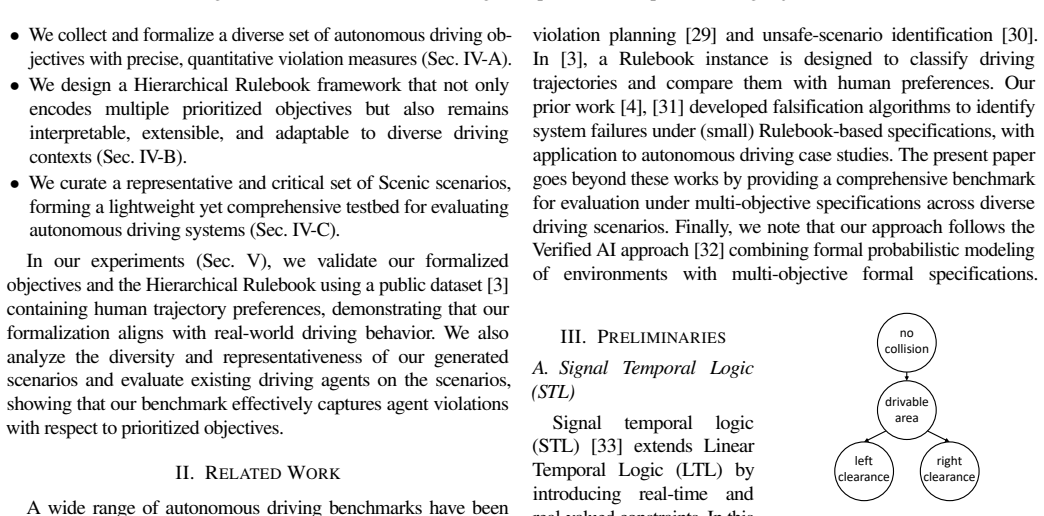
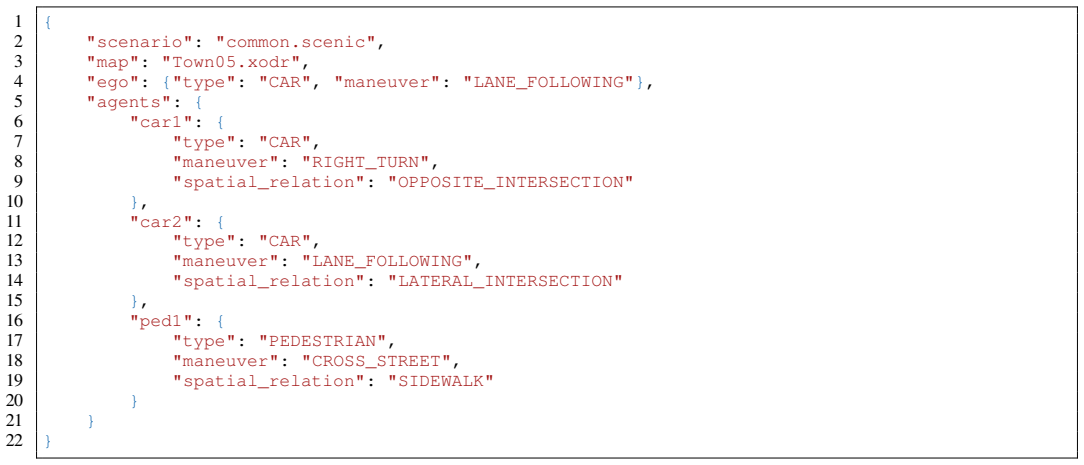
The central machinery is the Hierarchical Rulebook: rules are grouped by function (safety-critical, road compliance, safety-enhancing, precautionary, social interpretability, progress, comfort), and priorities are assigned between groups rather than among individual rules, which would otherwise require navigating more than 10^35 possible orderings. Each rule's violation is quantified by a violation score, and the error value of a trajectory is a priority-weighted sum of violated rules. Around this sits the scenario layer: a k-center greedy selector picks a compact set of representative Scenic programs (encoded as Hamming vectors) from more than a million possible combinations, and a falsifie
Load-bearing premise
The benchmark's agreement with human judgments rests on the authors' specific choices of rule formalizations, group priority orderings, and threshold parameters; the paper's own results show that a different equally reasonable encoding can drop agreement from 80.9% to as low as 70.8%.
What would settle it
Re-run the human-preference evaluation with the sum-based vehicle-clearance formalization in place of the default max-based one, using an independent set of preference labels not involved in tuning. If agreement holds near 80%, the formalization choice is not load-bearing; if it falls toward the paper's reported 70.8%, the benchmark's headline alignment is sensitive to that encoding.
If this is right
- Agents can be compared by which prioritized rule they violate first, revealing qualitatively different failure modes in the same scenario.
- The rule set and violation scores are extensible: users can add custom rules or swap formalizations, and the paper shows such swaps change evaluation outcomes.
- The scenario-selection procedure guarantees that every maneuver/spatial-relation combination in the covered space is within Hamming distance 2 of a selected scenario, so a small suite covers a large space.
- Context-specific priorities can be learned from human preference data, converging in two greedy iterations to the same accuracy as exhaustive search.
- The benchmark exercises every collected rule: falsification found at least one violation of each objective across the scenario suite.
Where Pith is reading between the lines
- Because the paper's Table V shows roughly a ten-point swing in human agreement when clearance is formalized as a sum rather than a maximum, the benchmark's headline number is tied to a specific encoding; a standardized 'formalization card' would make results portable across implementations.
- The near-accident scenarios are generated from collision reports through an LLM-assisted pipeline, so the suite's realism inherits the quality of those reports and prompts; an obvious test is whether independently reconstructed programs produce similar falsification findings.
- The roughly 80% agreement ceiling is close to the dataset's reported inter-annotator agreement, suggesting a single static rulebook may already be near saturation; modeling a distribution over rulebooks, or per-scenario attribution of responsibility, could push alignment higher.
- The evaluation machinery could be reused beyond driving — for robot navigation or human-robot interaction — wherever objectives conflict and priorities need to be explicit.
Editorial analysis
A structured set of objections, weighed in public.
Referee Report
Summary. The paper introduces ScenicRules, a benchmark for autonomous driving that pairs a multi-objective, priority-based specification framework (Hierarchical Rulebook, extending the prior Rulebook structure) with formal scenario models written in the Scenic language. It contributes a collection of 19 formalized driving objectives, a group-based hierarchical priority structure, a curated set of common and near-accident Scenic scenarios (the latter generated from natural-language collision reports via an LLM-assisted pipeline), and experimental results on the Reasonable Crowd dataset showing 80.9±1.8% agreement between the rulebook-induced preferences and human preferences, comparable to published RF/LR baselines. It also demonstrates falsification-based failure discovery on the scenario suite.
Significance. If the reported alignment is robust, ScenicRules would be a valuable and extensible evaluation instrument: it combines explicit priority relations among objectives with an expressive, formally grounded scenario language, and it is validated against external human judgments. The paper ships a repository and reports the base human-agreement result with cross-validated error bars, explicitly acknowledging the ~84% human-human agreement ceiling. The coreset-based scenario selection and the demonstration of diverse joint failure modes are also useful contributions. However, the central alignment claim depends on specific rule formalizations and priority choices, and the sensitivity evidence in the paper itself substantially tempers the contribution's strength.
major comments (3)
- [Sec. V-A(d), Table V] The headline claim that the formalized objectives and Hierarchical Rulebooks 'align well' with human judgments is not robust to equally defensible formalization choices. Table V shows that changing clearance aggregation from max to sum lowers accuracy from 80.97% to 70.80%, heading-based classification gives 78.35%, and centroid-based correct-side gives 79.07%. The default choices are not given an independent, principled justification; they appear to be the ones yielding the highest number. Since the paper's central external-validation claim rests on this encoding, the authors should either provide a rule-based or behavioral argument for the defaults, or report the accuracy as a range and soften the claim. A 10-point swing across plausible formalizations means the current claim of 'alignment' is overstated.
- [Sec. V-A(c), Table IV] The context-aware priority tuning experiment is performed in-sample. Table IV reports 85.97% accuracy after greedy priority permutation search, matching brute force, but this optimization is conducted on the same evaluation dataset used to compute the accuracy. Consequently, the result does not provide evidence that human preferences are genuinely context-dependent in a generalizable sense; it demonstrates overfitting to the Reasonable Crowd scenarios. To support the claim of validation, the authors should use held-out trajectories or nested cross-validation when optimizing priorities and report the resulting out-of-sample accuracy.
- [Sec. V-A(a), Table III] The statement that 'our rulebook is designed independently of the dataset and generalizes to arbitrary scenarios' is not fully supported. While the base rulebook itself is not trained on the labels, its formalization choices (e.g., the priority ordering in Fig. 4 and the threshold values in Table I) were selected by the authors, and the 'w/ parameter' variant is explicitly tuned on the same 5-fold splits. At minimum, the independence claim should be restricted to the base rulebook and should acknowledge that the rule set and priorities are still a human-authored encoding rather than a purely principled or learned one. Please clarify the exact status of the base versus optimized results.
minor comments (5)
- [Table I, Rule 7] The VS formula for Rule 7 appears to be a copy-paste error from Rule 6: it reads 'max_{t,k,i}(a0,i(t)-Aack)', which uses an acceleration threshold, whereas the rule is about vehicle time-to-collision and should involve T_vehicle,ttc. Please correct the formula and verify the implementation matches the intended semantics.
- [Definition 2] The example '23+20=9' is missing superscript formatting; it should read 2^3 + 2^0 = 9. Please fix the typesetting.
- [Abstract / Sec. I] The claim of being 'the first benchmark' to combine rulebooks with Scenic is strong given the authors' prior work [4] and other Scenic-driven falsification tools. Consider qualifying the novelty (e.g., 'first comprehensive benchmark' or 'first benchmark that additionally...') to avoid overclaim.
- [Sec. V-Ba, Table VI] The coverage claim would be more informative if the authors reported the distribution of Hamming distances (e.g., how many scenarios are at distance 0, 1, 2) instead of only the maximum distance. The current table shows full categorical coverage, but the 'max distance 2' is the only quantitative summary.
- [Appendix E] The appendix notes that LLM-generated programs contain minor syntax errors requiring manual refinement. Please state how many of the 27 near-accident programs required human correction and whether the reported falsification results are based on the corrected versions. This is relevant for reproducibility.
Circularity Check
Central 80.9% alignment is externally grounded, but the 85.97% context-dependent accuracy is an in-sample fit of the same optimization objective.
specific steps
-
fitted input called prediction
[Sec. V-Ac / Table IV / Algorithm 1 (Appendix B)]
"The algorithm employs an iterative greedy strategy. First, it calculates the baseline agreement rate between the initial rulebook and the human-labeled dataset (Line 2) using the evaluateAgreement function. ... If a swap yields a rate higher than the current best ... the configuration is updated. ... As shown in T able IV, scenario-specific rulebooks achieve higher accuracy than a monolithic rulebook, validating that human preferences are context-dependent."
Algorithm 1 returns B*_M only when no group swap can increase evaluateAgreement(B*_M, L) on the labeled dataset L. Table IV's reported 'Accuracy (%)' for scenario-specific rulebooks is exactly this same evaluateAgreement objective on L. Therefore the 85.97% figure is the maximized value of the function used to select the rulebook, so reporting it as evidence that human preferences are context-dependent is not an independent validation: the rulebook was chosen to produce that number. This is in-sample fitting presented as confirming evidence, though it is peripheral to the base 80.9% result.
full rationale
The paper's main alignment claim, 80.9±1.8% agreement with human trajectory preferences on the Reasonable Crowd dataset, is grounded in an external dataset and is claimed to come from a rulebook designed independently of the dataset. That is genuine external evidence and not circular. Algorithm 2's parameter tuning is evaluated with 5-fold cross-validation, so it is not itself a direct self-fit. The paper's self-citations to prior Rulebook, Scenic, and VerifAI work are used as definitions and tools, not as the proof of the benchmark's validity, so they are not load-bearing circularity. The formalization-sensitivity results in Table V are a robustness concern for the headline claim, but they are not a definitional collapse because the alternative formalizations are not fit to the same objective; they show the result is choice-dependent rather than that the derivation reduces to its inputs. The clearest circular step is the context-aware priority optimization in Table IV / Algorithm 1, where the reported accuracy is the very objective being maximized on the same labels. This overstates the evidence for context-dependence, but it does not invalidate the externally grounded base result.
Axiom & Free-Parameter Ledger
free parameters (4)
- Rule thresholds (TTC limits, clearance distances, acknowledgment thresholds, speed-limit V_limit) =
Greedily tuned via Algorithm 2 on Reasonable Crowd labels; tuned values not reported in text
- Baseline hierarchical priority ordering of rule groups (Fig. 4) =
Hand-specified: safety-critical before road-compliance before safety-enhancing before social-interpretability before pre
- Scenario budget k=100 for k-center coreset selection (per configuration) =
100
- Per-scenario optimized priority ordering (Table IV) =
85.08% (adjacent swaps) / 85.97% (arbitrary swaps), matching brute-force search
axioms (6)
- standard math STL semantics and quantitative robustness (Appendix A) correctly quantify violation severity
- domain assumption Rulebook error value with exponential weights 2^(m_r) (Def. 2, from [4]) is the right aggregation of priority-weighted violations
- domain assumption Reasonable Crowd dataset [3], aggregated via Bradley-Terry, provides ground-truth human driving preference
- domain assumption Human driving preferences are representable by a preorder over rule groups (the hierarchical-rulebook class)
- domain assumption MetaDrive faithfully realizes the Scenic scenarios and agent behaviors as specified
- domain assumption Scenario diversity is captured by the discrete attribute encoding (ego/adversary maneuver + spatial relation) with Hamming distance
invented entities (1)
-
Hierarchical Rulebook B_M (rule groups with inter-group and intra-group priorities)
independent evidence
read the original abstract
Developing autonomous driving systems for complex traffic environments requires balancing multiple objectives, such as avoiding collisions, obeying traffic rules, and making efficient progress. In many situations, these objectives cannot be satisfied simultaneously, and explicit priority relations naturally arise. Also, driving rules require context, so it is important to formally model the environment scenarios within which such rules apply. Existing benchmarks for evaluating autonomous vehicles lack such combinations of multi-objective prioritized rules and formal environment models. In this work, we introduce ScenicRules, a benchmark for evaluating autonomous driving systems in stochastic environments under prioritized multi-objective specifications. We first formalize a diverse set of objectives to serve as quantitative evaluation metrics. Next, we design a Hierarchical Rulebook framework that encodes multiple objectives and their priority relations in an interpretable and adaptable manner. We then construct a compact yet representative collection of scenarios spanning diverse driving contexts and near-accident situations, formally modeled in the Scenic language. Experimental results show that our formalized objectives and Hierarchical Rulebooks align well with human driving judgments and that our benchmark effectively exposes agent failures with respect to the prioritized objectives. Our benchmark can be accessed at https://github.com/BerkeleyLearnVerify/ScenicRules/.
Figures





Reference graph
Works this paper leans on
-
[1]
How W aymo’s driverless technology avoided scooter rider who fell into Austin road,
KXAN Austin, “How W aymo’s driverless technology avoided scooter rider who fell into Austin road,” 2024. [Online]. A vailable: https: //youtu.be/h7PGrAlPELc?si=ZkURWsldNjSi3OKQ
2024
-
[2]
A. Elluswamy, “Tesla’s approach to autonomy,” 2025. [Online]. A vailable: https://x.com/aelluswamy/status/1981644831790379245
arXiv 2025
-
[3]
The Reasonable Crowd: T owards evidence-based and interpretable models of driving behavior,
B. Helou, A. Dusi, A. Collin, N. Mehdipour, Z. Chen, C. Lizarazo, C. Belta, T . W ongpiromsarn, R. D. T ebbens, and O. Beijbom, “The Reasonable Crowd: T owards evidence-based and interpretable models of driving behavior,” in IEEE/RSJ International Conference on Intelligent Robots and Systems (IROS), 2021, pp. 6708–6715
2021
-
[4]
Dynamic, multi-objective specification and falsification of autonomous CPS,
K. K.-C. Chang, K. Xu, E. Kim, A. Sangiovanni-Vincentelli, and S. A. Seshia, “Dynamic, multi-objective specification and falsification of autonomous CPS, ” inInternational Conference on Runtime V erification (RV). Springer, 2024, pp. 40–58
2024
-
[5]
Addressing the IEEE A V test challenge with Scenic and V erifAI,
K. Viswanadha, F . Indaheng, J. W ong, E. Kim, E. Kalvan, Y . Pant, D. J. Fremont, and S. A. Seshia, “ Addressing the IEEE A V test challenge with Scenic and V erifAI,” inIEEE International Conference on Artificial Intelligence T esting (AIT est). IEEE, 2021, pp. 136–142
2021
-
[6]
On a formal model of safe and scalable self-driving cars,
S. Shalev-Shwartz, S. Shammah, and A. Shashua, “On a formal model of safe and scalable self-driving cars, ”arXiv preprint arXiv:1708.06374, 2017
Pith/arXiv arXiv 2017
-
[7]
Objective metrics of comfort: Developing a driving style for highly automated vehicles,
H. Bellem, T . Schönenberg, J. F . Krems, and M. Schrauf, “Objective metrics of comfort: Developing a driving style for highly automated vehicles,” Transportation Research P art F: Traffic Psychology and Behaviour, vol. 41, pp. 45–54, 2016
2016
-
[8]
Formalization of intersection traffic rules in temporal logic,
S. Maierhofer, P . Moosbrugger, and M. Althoff, “Formalization of intersection traffic rules in temporal logic,” inIEEE Intelligent V ehicles Symposium (IV). IEEE, 2022, pp. 1135–1144
2022
-
[9]
Large scale interactive motion forecasting for autonomous driving: The W aymo Open Motion Dataset,
S. Ettinger, S. Cheng, B. Caine, C. Liu, H. Zhao, S. Pradhan, Y . Chai, B. Sapp, C. R. Qi, Y . Zhouet al., “Large scale interactive motion forecasting for autonomous driving: The W aymo Open Motion Dataset,” inIEEE/CVF International Conference on Computer V ision (ICCV), 2021, pp. 9710–9719
2021
-
[10]
Argoverse 2: Next genera- tion datasets for self-driving perception and forecasting,
B. Wilson, W . Qi, T . Agarwal, J. Lambert, J. Singh, S. Khandelwal, B. Pan, R. Kumar, A. Hartnett, J. K. Ponteset al., “ Argoverse 2: Next genera- tion datasets for self-driving perception and forecasting,”arXiv preprint arXiv:2301.00493, 2023
Pith/arXiv arXiv 2023
-
[11]
nuScenes: A multimodal dataset for autonomous driving,
H. Caesar, V . Bankiti, A. H. Lang, S. V ora, V . E. Liong, Q. Xu, A. Krishnan, Y . Pan, G. Baldan, and O. Beijbom, “nuScenes: A multimodal dataset for autonomous driving,” inIEEE/CVF Conference on Computer V ision and P attern Recognition (CVPR), 2020, pp. 11 621–11 631
2020
-
[12]
One thousand and one hours: Self-driving motion prediction dataset,
J. Houston, G. Zuidhof, L. Bergamini, Y . Y e, L. Chen, A. Jain, S. Omari, V . Iglovikov, and P . Ondruska, “One thousand and one hours: Self-driving motion prediction dataset, ” inConference on Robot Learning (CoRL). PMLR, 2021, pp. 409–418
2021
-
[13]
T owards learning- based planning: The nuPlan benchmark for real-world autonomous driving,
N. Karnchanachari, D. Geromichalos, K. S. T an, N. Li, C. Eriksen, S. Y aghoubi, N. Mehdipour, G. Bernasconi, W . K. Fong, Y . Guoet al., “T owards learning- based planning: The nuPlan benchmark for real-world autonomous driving, ” in IEEE International Conference on Robotics and Automation (ICRA). IEEE, 2024, pp. 629–636
2024
-
[14]
nuPlan: A closed-loop ML-based planning benchmark for autonomous vehicles,
H. Caesar, J. Kabzan, K. S. T an, W . K. Fong, E. W olff, A. Lang, L. Fletcher, O. Beijbom, and S. Omari, “nuPlan: A closed-loop ML-based planning benchmark for autonomous vehicles, ”arXiv preprint arXiv:2106.11810, 2021
Pith/arXiv arXiv 2021
-
[15]
CommonRoad: Composable benchmarks for motion planning on roads,
M. Althoff, M. Koschi, and S. Manzinger, “CommonRoad: Composable benchmarks for motion planning on roads,” inIEEE Intelligent V ehicles Symposium (IV). IEEE, 2017, pp. 719–726
2017
-
[16]
NA VSIM: Data-driven non- reactive autonomous vehicle simulation and benchmarking,
D. Dauner, M. Hallgarten, T . Li, X. W eng, Z. Huang, Z. Y ang, H. Li, I. Gilitschenski, B. Ivanovic, M. Pavoneet al., “NA VSIM: Data-driven non- reactive autonomous vehicle simulation and benchmarking,”Advances in Neural Information Processing Systems, vol. 37, pp. 28 706–28 719, 2024
2024
-
[17]
M3CAD: T owards generic cooperative autonomous driving benchmark,
M. Zhu, Y . Zhu, Y . Zhu, Q. Chen, D. Qu, S. Fu, and Q. Y ang, “M3CAD: T owards generic cooperative autonomous driving benchmark, ”arXiv preprint arXiv:2505.06746, 2025
arXiv 2025
-
[18]
Liability, ethics, and culture-aware behavior specification using rulebooks,
A. Censi, K. Slutsky, T . W ongpiromsarn, D. Y ershov, S. Pendleton, J. Fu, and E. Frazzoli, “Liability, ethics, and culture-aware behavior specification using rulebooks, ” inInternational Conference on Robotics and Automation (ICRA). IEEE, 2019, pp. 8536–8542
2019
-
[19]
W . Zhan, L. Sun, D. W ang, H. Shi, A. Clausse, M. Naumann, J. Kummerle, H. Konigshof, C. Stiller, A. de La Fortelleet al., “INTERACTION dataset: An international, adversarial and cooperative motion dataset in interactive driving scenarios with semantic maps, ”arXiv preprint arXiv:1910.03088, 2019
Pith/arXiv arXiv 1910
-
[20]
SceNDD: A scenario-based naturalistic driving dataset,
A. Prabu, N. Ranjan, L. Li, R. Tian, S. Chien, Y . Chen, and R. Sherony, “SceNDD: A scenario-based naturalistic driving dataset,” inIEEE 25th International Conference on Intelligent Transportation Systems (ITSC). IEEE, 2022, p. 4363–4368
2022
-
[21]
scenario.center: Methods from real-world data to a scenario database,
M. Schuldes, C. Glasmacher, and L. Eckstein, “scenario.center: Methods from real-world data to a scenario database, ” inIEEE Intelligent V ehicles Symposium (IV). IEEE, 2024, pp. 1119–1126
2024
-
[22]
A coreset selection of coreset selection literature: Introduction and recent advances,
B. B. Moser, A. S. Shanbhag, S. Frolov, F . Raue, J. Folz, and A. Dengel, “ A coreset selection of coreset selection literature: Introduction and recent advances, ”arXiv preprint arXiv:2505.17799, 2025
arXiv 2025
-
[23]
Active learning for convolutional neural networks: A core-set approach,
O. Sener and S. Savarese, “ Active learning for convolutional neural networks: A core-set approach, ”arXiv preprint arXiv:1708.00489, 2017
Pith/arXiv arXiv 2017
-
[24]
Scenic: A language for scenario specification and data generation,
D. J. Fremont, E. Kim, T . Dreossi, S. Ghosh, X. Y ue, A. L. Sangiovanni- Vincentelli, and S. A. Seshia, “Scenic: A language for scenario specification and data generation,”Machine Learning, vol. 112, no. 10, pp. 3805–3849, 2023
2023
-
[25]
Scenic: A language for scenario specification and scene generation,
D. J. Fremont, T . Dreossi, S. Ghosh, X. Y ue, A. L. Sangiovanni-Vincentelli, and S. A. Seshia, “Scenic: A language for scenario specification and scene generation, ” inACM SIGPLAN Conference on Programming Language Design and Implementation (PLDI), June 2019
2019
-
[26]
A survey on autonomous driving datasets: Statistics, annotation 8 quality, and a future outlook,
M. Liu, E. Y urtsever, J. Fossaert, X. Zhou, W . Zimmer, Y . Cui, B. L. Zagar, and A. C. Knoll, “ A survey on autonomous driving datasets: Statistics, annotation 8 quality, and a future outlook, ”IEEE Transactions on Intelligent V ehicles (T -IV), 2024
2024
-
[27]
Carla autonomous driving challenge
CARLA, “Carla autonomous driving challenge.” [Online]. A vailable: https://leaderboard.carla.org/challenge/
-
[28]
Pseudo-simulation for autonomous driving,
W . Cao, M. Hallgarten, T . Li, D. Dauner, X. Gu, C. W ang, Y . Miron, M. Aiello, H. Li, I. Gilitschenski, B. Ivanovic, M. Pavone, A. Geiger, and K. Chitta, “Pseudo-simulation for autonomous driving, ” inConference on Robot Learning (CoRL), 2025
2025
-
[29]
Example applications of IEEE std 2846-2022 to formal safety-related models,
“Example applications of IEEE std 2846-2022 to formal safety-related models, ”
2022
-
[30]
Safety of the intended driving behavior using rulebooks,
A. Collin, A. Bilka, S. Pendleton, and R. D. Tebbens, “Safety of the intended driving behavior using rulebooks,” inIEEE Intelligent V ehicles Symposium (IV), 2020, pp. 136–143
2020
-
[31]
Parallel and multi-objective falsification with Scenic and V erifAI,
K. Viswanadha, E. Kim, F . Indaheng, D. J. Fremont, and S. A. Seshia, “Parallel and multi-objective falsification with Scenic and V erifAI,” inInternational Conference on Runtime V erification (RV). Springer, 2021, pp. 265–276
2021
-
[32]
T oward verified artificial intelligence,
S. A. Seshia, D. Sadigh, and S. S. Sastry, “T oward verified artificial intelligence, ” Communications of the ACM, vol. 65, no. 7, pp. 46–55, 2022
2022
-
[33]
Monitoring temporal properties of continuous signals,
O. Maler and D. Nickovic, “Monitoring temporal properties of continuous signals, ” inInternational Symposium on F ormal T echniques in Real-Time and F ault-T olerant Systems (FTRTFT). Springer, 2004, pp. 152–166
2004
-
[34]
Robust satisfaction of temporal logic over real-valued signals,
A. Donzé and O. Maler, “Robust satisfaction of temporal logic over real-valued signals,” inInternational Conference on F ormal Modeling and Analysis of Timed Systems (FORMATS). Springer, 2010, pp. 92–106
2010
-
[35]
Robustness of temporal logic specifications for continuous-time signals,
G. E. Fainekos and G. J. Pappas, “Robustness of temporal logic specifications for continuous-time signals, ”Theoretical Computer Science, vol. 410, no. 42, pp. 4262–4291, 2009
2009
-
[36]
CARLA: An open urban driving simulator,
A. Dosovitskiy, G. Ros, F . Codevilla, A. Lopez, and V . Koltun, “CARLA: An open urban driving simulator, ” inConference on Robot Learning (CoRL), 2017, pp. 1–16
2017
-
[37]
MetaDrive: Composing diverse driving scenarios for generalizable reinforcement learning,
Q. Li, Z. Peng, Z. Xue, Q. Zhang, and B. Zhou, “MetaDrive: Composing diverse driving scenarios for generalizable reinforcement learning,”arXiv preprint arXiv:2109.12674, 2021
Pith/arXiv arXiv 2021
-
[38]
A001035: Number of partially ordered sets (“posets
N. J. A. Sloane, “ A001035: Number of partially ordered sets (“posets”) with n labeled elements. ” [Online]. A vailable: https://oeis.org/A001035
-
[39]
Error detecting and error correcting codes,
R. W . Hamming, “Error detecting and error correcting codes, ”The Bell System T echnical Journal, vol. 29, no. 2, pp. 147–160, 1950
1950
-
[40]
Autonomous vehicle collision reports
California Department of Motor V ehicles, “ Autonomous vehicle collision reports. ” [Online]. A vailable: https://www.dmv.ca.gov/portal/vehicle-industry- services/autonomous-vehicles/autonomous-vehicle-collision-reports/
-
[41]
ScenicNL: Generating probabilistic scenario programs from natural language,
K. Elmaaroufi, D. Shanker, A. Cismaru, M. V azquez-Chanlatte, A. Sangiovanni- Vincentelli, M. Zaharia, and S. A. Seshia, “ScenicNL: Generating probabilistic scenario programs from natural language,” in1st Conference on Language Modeling (COLM), 2024
2024
-
[42]
G. Comanici, E. Bieber, M. Schaekermann, I. Pasupat, N. Sachdeva, I. Dhillon, M. Blistein, O. Ram, D. Zhang, E. Rosenet al., “Gemini 2.5: Pushing the frontier with advanced reasoning, multimodality, long context, and next generation agentic capabilities, ”arXiv preprint arXiv:2507.06261, 2025
Pith/arXiv arXiv 2025
-
[43]
Proximal policy optimization algorithms,
J. Schulman, F . W olski, P . Dhariwal, A. Radford, and O. Klimov, “Proximal policy optimization algorithms, ”arXiv preprint arXiv:1707.06347, 2017
Pith/arXiv arXiv 2017
-
[44]
V erifAI: A toolkit for the formal design and analysis of artificial intelligence-based systems,
T . Dreossi, D. J. Fremont, S. Ghosh, E. Kim, H. Ravanbakhsh, M. V azquez- Chanlatte, and S. A. Seshia, “V erifAI: A toolkit for the formal design and analysis of artificial intelligence-based systems,” inInternational Conference on Computer Aided V erification (CA V). Springer, 2019, pp. 432–442
2019
-
[45]
Rank analysis of incomplete block designs: I. the method of paired comparisons,
R. A. Bradley and M. E. T erry, “Rank analysis of incomplete block designs: I. the method of paired comparisons, ”Biometrika, vol. 39, no. 3/4, pp. 324–345, 1952. APPENDIXA DETAILEDDEFINITIONS OFSIGNALTEMPORALLOGIC(STL) In this section, we provide the formal definitions of Signal Temporal Logic (STL) [33]: LetT denote the time domain, and x:T→R n be a sig...
1952
-
[2023]
A vailable: https://ieeexplore.ieee.org/document/10051644
[Online]. A vailable: https://ieeexplore.ieee.org/document/10051644
discussion (0)
Sign in with ORCID, Apple, or X to comment. Anyone can read and Pith papers without signing in.