Recognition: no theorem link
Online Single-Channel Audio-Based Sound Speed Estimation for Robust Multi-Channel Audio Control
Pith reviewed 2026-05-15 21:18 UTC · model grok-4.3
The pith
Sound speed can be estimated online from a single microphone by minimizing mismatch between measured audio and a parametric acoustic model during normal multichannel playback.
A machine-rendered reading of the paper's core claim, the machinery that carries it, and where it could break.
Core claim
An online estimator recovers sound speed from single-channel observations during general multichannel playback by minimizing the structured mismatch between the recorded signal and the output of a parametric propagation model; simulations confirm that the estimates track true speed variations across input types and that feeding them back into a sound zone control algorithm reduces spatial errors compared with using a fixed nominal speed.
What carries the argument
Mismatch minimization between single-channel measurement and a parametric acoustic propagation model, with sound speed as the free parameter.
If this is right
- The estimator runs continuously during ordinary playback, eliminating separate calibration phases.
- Tracking remains accurate across different audio signals without requiring special test tones.
- Using the estimates to correct propagation distances measurably improves sound zone control performance.
- Only one additional microphone is needed, lowering hardware requirements for robust multi-channel systems.
Where Pith is reading between the lines
- Consumer devices with built-in microphones could adapt sound fields in real time to changing room conditions.
- The single-channel formulation may extend to other acoustic parameters if the model is expanded to include them.
- Integration into adaptive filters could allow joint estimation of speed and other slowly varying room properties.
Load-bearing premise
The main reason the measured audio differs from the model is variation in sound speed, and the model is accurate enough that one microphone channel yields a unique speed estimate.
What would settle it
Run the estimator on recorded data where room reflections or loudspeaker nonlinearity dominate the error; if the recovered speed deviates systematically from the known true value or multiple speeds produce equally low mismatch, the method fails.
Figures
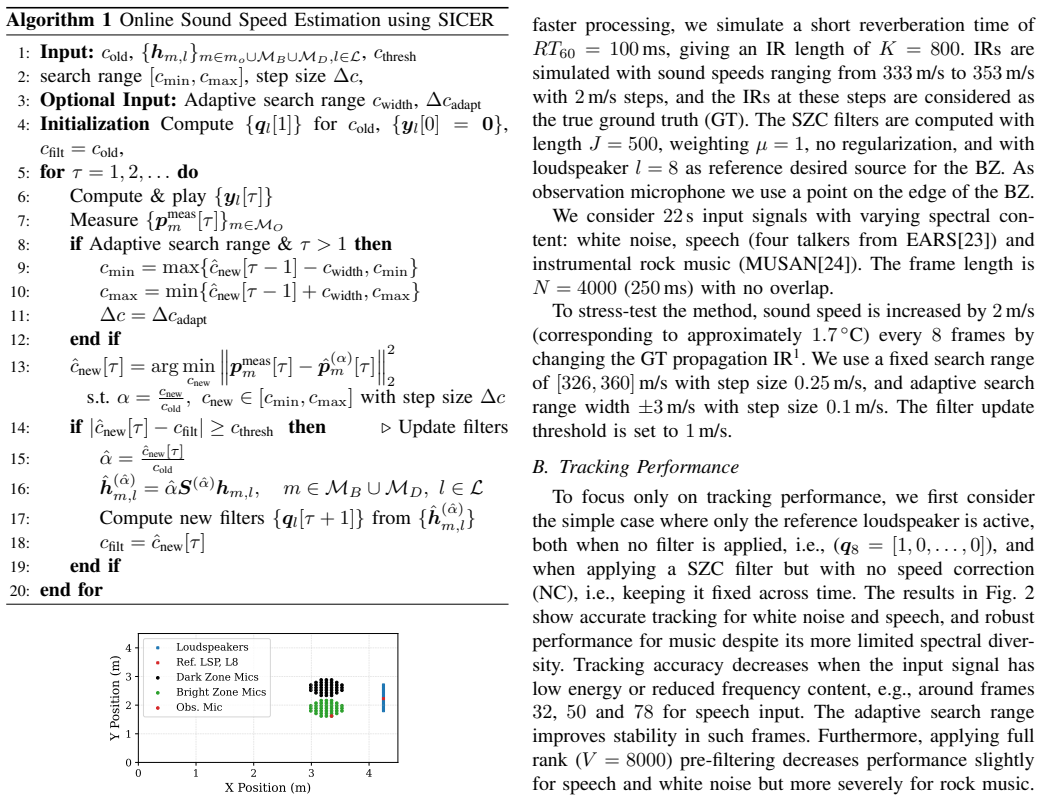


read the original abstract
Robust spatial audio control relies on accurate acoustic propagation models, yet environmental variations, especially changes in the speed of sound, cause systematic mismatches that degrade performance. Existing methods either assume known sound speed, require multiple microphones, or rely on separate calibration, making them impractical for systems with minimal sensing. We propose an online sound speed estimator that operates during general multichannel audio playback and requires only a single observation microphone. The method exploits the structured effect of sound speed on the reproduced signal and estimates it by minimizing the mismatch between the measured audio and a parametric acoustic model. Simulations show accurate tracking of sound speed for diverse input signals and improved spatial control performance when the estimates are used to compensate propagation errors in a sound zone control framework.
Editorial analysis
A structured set of objections, weighed in public.
Referee Report
Summary. The manuscript proposes an online sound speed estimator for multi-channel audio systems that requires only a single observation microphone during normal playback. It minimizes the mismatch between the measured signal and a parametric acoustic propagation model whose sound-speed parameter is the estimation target, with simulations used to demonstrate accurate tracking across diverse inputs and improved performance when the estimates are fed into a sound-zone control framework.
Significance. If the estimator can be shown to recover sound speed uniquely from single-channel data, the approach would meaningfully reduce hardware requirements for adaptive spatial audio control. The online, signal-agnostic operation is a practical strength, and the simulation-based demonstration of control improvement is a positive indicator. However, the absence of identifiability analysis and quantitative error metrics limits the immediate significance until those elements are strengthened.
major comments (3)
- [§3.2] §3.2, Eq. (7)–(9): the mismatch cost is minimized with respect to sound speed alone, yet no identifiability analysis, Hessian evaluation, or sensitivity study is supplied to show that the minimum remains unique when unmodeled effects (reflection coefficients, microphone response, loudspeaker directivity) are present. This directly affects the central claim that a single channel suffices for reliable estimation.
- [§4] §4, simulation results: the abstract and results section state “accurate tracking” and “improved control performance,” but no quantitative metrics (RMSE, bias, convergence time, or statistics over multiple trials and SNR conditions) or input-signal specifications are reported, preventing assessment of the robustness asserted in the abstract.
- [§5] §5, control framework: the performance gain is shown only for the proposed estimator versus a fixed incorrect sound speed; an ablation against alternative single-channel estimators or joint estimation of additional parameters is missing, so the incremental benefit attributable to the sound-speed estimator cannot be isolated.
minor comments (3)
- [§2] The parametric model definition in §2 would benefit from an explicit block diagram showing the signal path from loudspeaker to single microphone.
- Notation for the time-of-flight term linear in 1/c should be introduced once and used consistently; occasional reuse of c for both speed and a generic constant is confusing.
- Figure captions should list the exact room dimensions, loudspeaker positions, and input-signal class used for each simulation panel.
Simulated Author's Rebuttal
We thank the referee for the constructive comments, which help strengthen the manuscript. We address each major point below with specific revisions.
read point-by-point responses
-
Referee: [§3.2] §3.2, Eq. (7)–(9): the mismatch cost is minimized with respect to sound speed alone, yet no identifiability analysis, Hessian evaluation, or sensitivity study is supplied to show that the minimum remains unique when unmodeled effects (reflection coefficients, microphone response, loudspeaker directivity) are present. This directly affects the central claim that a single channel suffices for reliable estimation.
Authors: We agree that a formal identifiability analysis is needed to support the central claim. In the revised manuscript, we will add an analysis of the cost function, including evaluation of its Hessian at the minimum and a sensitivity study to unmodeled effects such as reflection coefficients, microphone response, and loudspeaker directivity. This will demonstrate uniqueness under the model's assumptions and quantify robustness to practical mismatches. revision: yes
-
Referee: [§4] §4, simulation results: the abstract and results section state “accurate tracking” and “improved control performance,” but no quantitative metrics (RMSE, bias, convergence time, or statistics over multiple trials and SNR conditions) or input-signal specifications are reported, preventing assessment of the robustness asserted in the abstract.
Authors: We acknowledge the absence of quantitative metrics limits assessment of the results. In the revised Section 4, we will report RMSE, bias, convergence times, and statistics across multiple trials and SNR conditions. Input-signal specifications (e.g., signal types, durations, and frequency content) will also be detailed to substantiate the claims of accurate tracking and robustness. revision: yes
-
Referee: [§5] §5, control framework: the performance gain is shown only for the proposed estimator versus a fixed incorrect sound speed; an ablation against alternative single-channel estimators or joint estimation of additional parameters is missing, so the incremental benefit attributable to the sound-speed estimator cannot be isolated.
Authors: We agree that isolating the estimator's contribution requires additional comparisons. In the revision, we will include ablations against alternative single-channel estimators where feasible and discuss the scope of joint estimation of other parameters. This will better highlight the incremental benefit of the proposed approach over a fixed sound speed. revision: partial
Circularity Check
No circularity: standard parameter estimation from acoustic model mismatch
full rationale
The derivation consists of minimizing a mismatch cost between single-channel observations and a parametric propagation model whose structure (time-of-flight or phase terms linear in 1/c) is taken from established acoustic theory rather than fitted to the target data. The estimate of c is the argmin of that cost; it is not defined in terms of itself, nor is any prediction forced by construction from the inputs. No self-citation chain is invoked to justify uniqueness or the model form, and the abstract reports simulation tracking as external validation. The procedure is therefore self-contained against external benchmarks and receives the default non-circularity finding.
Axiom & Free-Parameter Ledger
axioms (1)
- domain assumption Acoustic propagation between loudspeakers and a single observation microphone can be represented by a parametric model whose dominant variable is sound speed.
Reference graph
Works this paper leans on
-
[1]
VAST Approach:The filters are derived by minimizing the weighted mean-squared error between the desired and reproduced signals ξ(q) =q TRBq+µq TRDq−2q TrB +∥d B∥2 2 ,(8) whereµis a weighting parameter,r B =H T BdB, and RB =H BHT B andR D =H DHT D are the spatial covariance matrices corresponding to the BZ and DZ[19]. Using the Variable-Span Trade-off (V A...
-
[2]
Temperature Robust Active-Compensated Sound Field Reproduc- tion Using Impulse Response Shaping,
T. Betlehem, L. Krishnan, and P. Teal, “Temperature Robust Active-Compensated Sound Field Reproduc- tion Using Impulse Response Shaping,” inProc. IEEE Int. Conf. Acoust., Speech Signal Process., Apr. 2018, pp. 481–485
work page 2018
-
[3]
On the Influence of Transfer Function Noise on Sound Zone Control in a Room,
M. B. Møller, J. K. Nielsen, E. Fernandez-Grande, and S. K. Olesen, “On the Influence of Transfer Function Noise on Sound Zone Control in a Room,”IEEE/ACM Trans. Audio, Speech Lang. Process., vol. 27, no. 9, pp. 1405–1418, 2019
work page 2019
-
[4]
P. Coleman, P. J. B. Jackson, M. Olik, M. Møller, M. Olsen, and J. A. Pedersen, “Acoustic contrast, planarity and robustness of sound zone methods using a circular loudspeaker array,”J. Acoust. Soc. Amer., vol. 135, no. 4, pp. 1929–1940, Apr. 2014
work page 1929
-
[5]
Robust Fixed- Filter Sound Zone Control with Audio-Based Position Tracking,
S. S. Bhattacharjee, A. J. Fuglsig, F. Christensen, J. R. Jensen, and M. Græsbøll Christensen, “Robust Fixed- Filter Sound Zone Control with Audio-Based Position Tracking,” inProc. IEEE Int. Conf. Acoust., Speech Signal Process., Apr. 2025, pp. 1–5
work page 2025
-
[6]
Sound Speed Perturbation Robust Audio: Im- pulse Response Correction and Sound Zone Con- trol,
S. S. Bhattacharjee, J. R. Jensen, and M. G. Chris- tensen, “Sound Speed Perturbation Robust Audio: Im- pulse Response Correction and Sound Zone Con- trol,”IEEE/ACM Trans. Audio, Speech Lang. Process., vol. 33, pp. 2008–2020, 2025
work page 2008
-
[7]
D. Caviedes Nozal, F. M. Heuchel, F. T. Agerkvist, and J. Brunskog, “The effect of atmospheric conditions on sound propagation and its impact on the outdoor sound field control,” inINTER-NOISE and NOISE-CON Congress and Conference Proceedings, vol. 259, 2019, pp. 7211–7220
work page 2019
-
[8]
Large-scale out- door sound field control,
F. M. Heuchel, D. Caviedes-Nozal, J. Brunskog, F. T. Agerkvist, and E. Fernandez-Grande, “Large-scale out- door sound field control,”J. Acoust. Soc. Amer., vol. 148, no. 4, pp. 2392–2402, Oct. 2020
work page 2020
-
[9]
Spatial covariance estimation for sound field reproduction us- ing kernel ridge regression,
J. Brunnstrom, M. B. Møller, J. Østergaard, T. van Waterschoot, M. Moonen, and F. Elvander, “Spatial covariance estimation for sound field reproduction us- ing kernel ridge regression,” inProc. European Signal Process. Conf., Sep. 2025
work page 2025
-
[10]
J. Zhang, L. Shi, M. G. Christensen, W. Zhang, L. Zhang, and J. Chen, “CGMM-Based Sound Zone Gen- eration Using Robust Pressure Matching With ATF Per- turbation Constraints,”IEEE/ACM Trans. Audio, Speech Lang. Process., vol. 31, pp. 3331–3345, 2023
work page 2023
-
[11]
M. Hu, L. Shi, H. Zou, M. G. Christensen, and J. Lu, “Sound zone control with fixed acoustic contrast and simultaneous tracking of acoustic transfer functions,”J. Acoust. Soc. Amer., vol. 153, no. 5, p. 2538, May 2023
work page 2023
-
[12]
An Alternating Mode Strategy for Adaptive Sound Field Control and Acoustic Path Tracking,
J. Zhang, J. Xie, D. Shi, W. Zhang, J. Chen, and J. Benesty, “An Alternating Mode Strategy for Adaptive Sound Field Control and Acoustic Path Tracking,” in Asia Pacific Signal and Inf. Process. Asso. Annu. Sum- mit and Conf., Oct. 2025, p. 422
work page 2025
-
[13]
TDOA-Based Speed of Sound Estimation for Air Tem- perature and Room Geometry Inference,
P. Annibale, J. Filos, P. A. Naylor, and R. Rabenstein, “TDOA-Based Speed of Sound Estimation for Air Tem- perature and Room Geometry Inference,”IEEE/ACM Trans. Audio, Speech Lang. Process., vol. 21, no. 2, pp. 234–246, Feb. 2013
work page 2013
-
[14]
A. Mahajan and M. Walworth, “3D position sensing using the differences in the time-of-flights from a wave source to various receivers,”IEEE Trans. Robot. Autom., vol. 17, no. 1, pp. 91–94, Feb. 2001
work page 2001
-
[15]
Simultaneous Localization of a Mobile Robot and Multiple Sound Sources Using a Microphone Array,
J.-S. Hu, C.-Y . Chan, C.-K. Wang, M.-T. Lee, and C.-Y . Kuo, “Simultaneous Localization of a Mobile Robot and Multiple Sound Sources Using a Microphone Array,” Adv. Robotics, vol. 25, no. 1-2, pp. 135–152, Jan. 2011
work page 2011
-
[16]
A review of the state- of-the-art approaches in detecting time-of-flight in room impulse responses,
C. Othmani, N. S. Dokhanchi, S. Merchel, A. V ogel, M. E. Altinsoy, and C. V oelker, “A review of the state- of-the-art approaches in detecting time-of-flight in room impulse responses,”Sensors and Actuators A: Physical, vol. 374, Aug. 2024
work page 2024
-
[17]
Passive acoustic measurements of wind velocity and sound speed in air,
O. A. Godin, V . G. Irisov, and M. I. Charnotskii, “Passive acoustic measurements of wind velocity and sound speed in air,”J. Acoust. Soc. Amer., vol. 135, no. 2, EL68–EL74, Jan. 2014
work page 2014
-
[18]
The direct esti- mation of sound speed using pulse–echo ultrasound,
M. E. Anderson and G. E. Trahey, “The direct esti- mation of sound speed using pulse–echo ultrasound,” J. Acoust. Soc. Amer., vol. 104, no. 5, pp. 3099–3106, Nov. 1998
work page 1998
-
[19]
Time domain optimization of filters used in a loudspeaker array for personal audio,
M. F. S. G ´alvez, S. J. Elliott, and J. Cheer, “Time domain optimization of filters used in a loudspeaker array for personal audio,”IEEE/ACM Trans. Audio, Speech Lang. Process., vol. 23, no. 11, pp. 1869–1878, 2015
work page 2015
-
[20]
A unified approach to generating sound zones using variable span linear filters,
T. Lee, J. K. Nielsen, J. R. Jensen, and M. G. Chris- tensen, “A unified approach to generating sound zones using variable span linear filters,” inProc. IEEE Int. Conf. Acoust., Speech Signal Process., 2018, pp. 491– 495
work page 2018
-
[21]
M. G. Christensen,Introduction to Audio Processing. Cham: Springer International Publishing, 2019
work page 2019
-
[22]
Fast Generation of Sound Zones Using Variable Span Trade-Off Filters in the DFT-Domain,
T. Lee, L. Shi, J. K. Nielsen, and M. G. Christensen, “Fast Generation of Sound Zones Using Variable Span Trade-Off Filters in the DFT-Domain,”IEEE/ACM Trans. Audio, Speech Lang. Process., vol. 29, pp. 363– 378, 2021
work page 2021
-
[23]
E. A. Habets,Room impulse response generator, Oct. 2020
work page 2020
-
[24]
EARS: An anechoic fullband speech dataset benchmarked for speech enhancement and dere- verberation,
J. Richter et al., “EARS: An anechoic fullband speech dataset benchmarked for speech enhancement and dere- verberation,” inISCA Interspeech, 2024, pp. 4873– 4877
work page 2024
-
[25]
MUSAN: A Music, Speech, and Noise Corpus
D. Snyder, G. Chen, and D. Povey,MUSAN: A Music, Speech, and Noise Corpus, arXiv:1510.08484v1, 2015
work page internal anchor Pith review Pith/arXiv arXiv 2015
discussion (0)
Sign in with ORCID, Apple, or X to comment. Anyone can read and Pith papers without signing in.