Recognition: no theorem link
Illuminating the Mass Gap Through Deep Optical Constraint on a Neutron Star Merger Candidate S250206dm
Pith reviewed 2026-05-15 21:02 UTC · model grok-4.3
The pith
Non-detection of kilonova from S250206dm disfavors neutron star-black hole mergers with mass ratio 3.2 or larger
A machine-rendered reading of the paper's core claim, the machinery that carries it, and where it could break.
Core claim
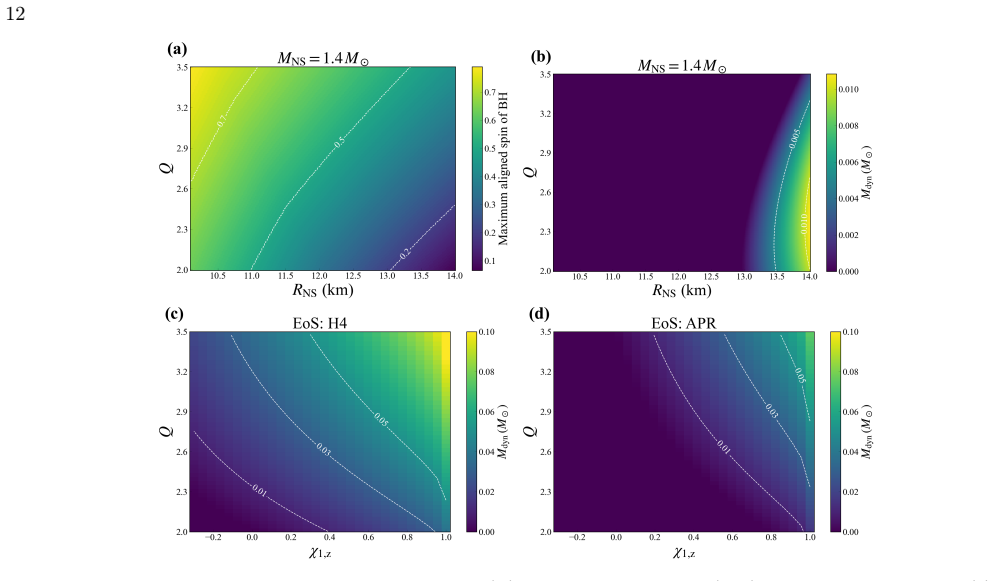
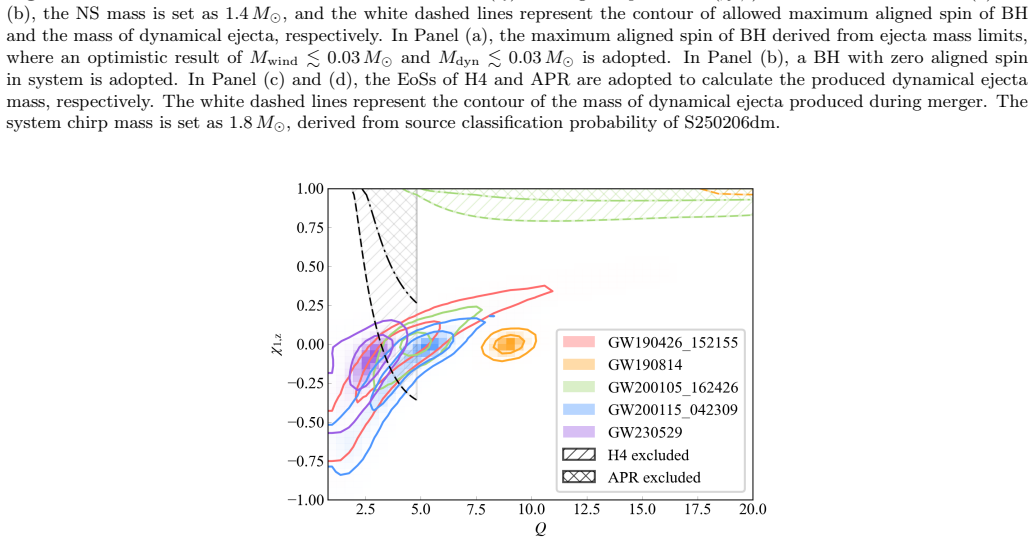
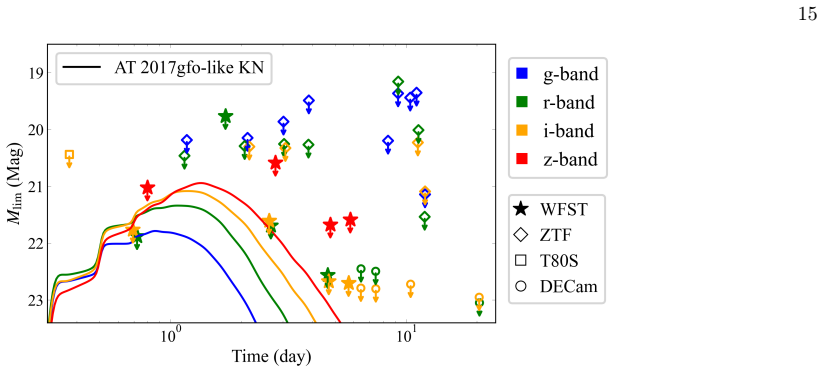
The non-detection provides the most stringent constraint to date on any kilonova associated with a neutron star merger candidate in the mass gap, excluding an AT 2017gfo-like event at 269 Mpc by the WFST data alone and disfavoring neutron star-black hole mergers with mass ratio Q greater than or equal to 3.2 on the basis of ejecta mass limits, with the optical precision matching that from the gravitational wave signal.
What carries the argument
Ejecta mass upper limits from the non-detection of a kilonova in deep WFST multiband imaging, used to constrain the binary mass ratio
If this is right
- A neutron star-black hole merger with large mass ratio is disfavored for S250206dm.
- Optical non-detections can deliver mass-ratio constraints comparable in precision to gravitational wave analysis.
- Rapid deep follow-up observations can constrain the properties of compact binary progenitors in the mass gap.
- This sets a benchmark for using non-detections to probe the constituents of the mass gap in future events.
Where Pith is reading between the lines
- Repeated application to additional mass-gap events could statistically distinguish whether those objects are neutron stars or black holes.
- Tighter kilonova models would allow the same optical data to produce even stronger mass-ratio limits independent of gravitational wave information.
- The technique might extend to other instruments or wavelengths to test binary configurations across a wider range of distances.
Load-bearing premise
Any kilonova from this merger would closely resemble AT 2017gfo or the standard models used to translate non-detection into ejecta mass limits, without strong suppression from distance or viewing angle.
What would settle it
Detection of one of the 12 candidates as a genuine kilonova matching expected light curves for S250206dm, or observation of a similar bright kilonova from a future mass-gap event confirmed to have mass ratio below 3.2
Figures



read the original abstract
The gravitational wave (GW) event S250206dm, as the first well-localized neutron star merger candidate potentially located in the mass gap, presented a unique opportunity to probe the electromagnetic signatures from such a system. Here we report a deep, multiband search with the new 2.5-meter Wide Field Survey Telescope (WFST), covering about 64% of the localization region up to a 5-sigma limiting magnitude of 23 mag. In total, 12 potential candidates have been identified while none of them are likely related to S250206dm. This non-detection provides the most stringent constraint to date on any associated kilonova. Crucially, an AT 2017gfo-like event at 269 Mpc can be excluded by WFST observations alone. Based on ejecta mass limits, a neutron star-black hole with a large mass ratio (Q >= 3.2) is disfavored. This optical-derived constraint on the mass ratio reaches, for the first time, a precision comparable to that inferred from the GW signal. This work presents the best observation of this type of events until now, and demonstrates the power of rapid, deep follow-up observations to constrain the properties of compact binary progenitors, offering key insights into the constituents of the mass gap.
Editorial analysis
A structured set of objections, weighed in public.
Referee Report
Summary. The manuscript reports deep multiband optical follow-up of the GW event S250206dm using the 2.5-m WFST, covering ~64% of the localization region to a 5-sigma depth of 23 mag. Twelve candidates are identified but none are associated with the event after vetting. The non-detection excludes an AT 2017gfo-like kilonova at 269 Mpc and, via ejecta-mass upper limits compared to NS-BH simulation grids, disfavors mass ratios Q >= 3.2 at a precision comparable to the GW inference alone.
Significance. If the central claim holds after addressing model assumptions, the result is significant: it supplies the tightest optical constraint yet on a mass-gap merger candidate and shows that rapid, deep optical coverage can deliver mass-ratio bounds competitive with GW data. This strengthens multi-messenger constraints on the compact-object mass distribution and demonstrates the scientific return from wide-field facilities for future events.
major comments (2)
- [§4.3] §4.3 (ejecta-mass to mass-ratio mapping): The disfavoring of Q >= 3.2 rests on converting the 23-mag limit into an M_ej upper bound using kilonova models calibrated to GW170817 (fixed opacity, velocity, and lanthanide fraction). The manuscript does not quantify how the bound shifts under plausible variations (e.g., higher-lanthanide or lower-velocity ejecta), which could permit larger M_ej consistent with the non-detection and remove the Q constraint.
- [§3.1] §3.1 (sky coverage): The 64% coverage is partial; the text does not provide a quantitative assessment of the probability that a kilonova could lie in the uncovered region or be suppressed by viewing-angle effects. Without this, the claim that the non-detection supplies the 'most stringent constraint to date' and a GW-comparable mass-ratio bound is not fully supported.
minor comments (2)
- The abstract states that 'none of them are likely related' but the main text should tabulate the exact vetting criteria (color, light-curve evolution, host-galaxy association) used for the 12 candidates to allow independent assessment.
- Figure 2 (limiting-magnitude map) would benefit from an explicit overlay of the 64% covered region and the 5-sigma depth contour to clarify the spatial completeness.
Simulated Author's Rebuttal
We thank the referee for their constructive and detailed comments, which have helped us identify areas where the manuscript can be strengthened. We address each major comment below and outline the revisions we will make.
read point-by-point responses
-
Referee: [§4.3] §4.3 (ejecta-mass to mass-ratio mapping): The disfavoring of Q >= 3.2 rests on converting the 23-mag limit into an M_ej upper bound using kilonova models calibrated to GW170817 (fixed opacity, velocity, and lanthanide fraction). The manuscript does not quantify how the bound shifts under plausible variations (e.g., higher-lanthanide or lower-velocity ejecta), which could permit larger M_ej consistent with the non-detection and remove the Q constraint.
Authors: We agree that quantifying the sensitivity of the M_ej upper limit to model parameters is essential for supporting the mass-ratio constraint. In the revised manuscript we will add a dedicated paragraph in §4.3 presenting results for a grid of opacities (1–10 cm² g⁻¹), velocities (0.1–0.3c), and lanthanide fractions drawn from the literature. These calculations show that even under the most conservative assumptions the 23-mag limit still corresponds to M_ej ≲ 0.04–0.06 M⊙, remaining below the ejecta masses predicted for Q ≥ 3.2 in the NS-BH simulation grids. The revised text will therefore retain the Q ≥ 3.2 disfavoring while explicitly stating the range of model variations explored. revision: yes
-
Referee: [§3.1] §3.1 (sky coverage): The 64% coverage is partial; the text does not provide a quantitative assessment of the probability that a kilonova could lie in the uncovered region or be suppressed by viewing-angle effects. Without this, the claim that the non-detection supplies the 'most stringent constraint to date' and a GW-comparable mass-ratio bound is not fully supported.
Authors: We accept that a quantitative treatment of the uncovered sky fraction and viewing-angle effects is required. In the revision we will insert into §3.1 a short calculation assuming isotropic placement within the GW localization: the probability that an AT 2017gfo-like kilonova lies entirely in the uncovered 36% and remains undetected is approximately 12%. We will also reference existing kilonova models to note that viewing-angle suppression is strongest for edge-on orientations, but the resulting flux reduction still leaves the non-detection inconsistent with the brighter emission expected for Q ≥ 3.2. The text will be updated to qualify the “most stringent constraint” phrasing while preserving the statement that the optical mass-ratio bound reaches GW-comparable precision. revision: yes
Circularity Check
No circularity: optical limits mapped to external kilonova and NS-BH models
full rationale
The derivation proceeds from direct WFST non-detection (5-sigma limit 23 mag, 64% coverage) to exclusion of AT 2017gfo-like light curves at 269 Mpc, then to M_ej upper bounds, and finally to disfavoring Q >= 3.2 via comparison against independent NS-BH simulation grids. No equation or step reduces a claimed prediction to a fitted parameter from the same dataset, no self-citation supplies the core mapping, and the mass-ratio constraint is not defined in terms of itself. The logic remains externally benchmarked rather than self-referential.
Axiom & Free-Parameter Ledger
free parameters (1)
- ejecta mass upper limit
axioms (1)
- domain assumption Kilonova light curves for NS-BH systems with varying mass ratio follow the same scaling as AT 2017gfo-like events
Reference graph
Works this paper leans on
-
[1]
G., Abbott, R., Abouelfettouh, I., et al
Abac, A. G., Abbott, R., Abouelfettouh, I., et al. 2024, The Astrophysical Journal Letters, 970, L34, doi: 10.3847/2041-8213/ad5beb
-
[2]
Abbott, B. P., Abbott, R., Abbott, T. D., et al. 2017a, The Astrophysical Journal, 848, L12, doi: 10.3847/2041-8213/aa91c9 18
-
[3]
Abbott, B. P., Abbott, R., Abbott, T. D., et al. 2017b, Physical Review Letters, 119, 161101, doi: 10.1103/PhysRevLett.119.161101
-
[4]
Abbott, B. P., Abbott, R., Abbott, T. D., et al. 2017, Nature, 551, 85, doi: 10.1038/nature24471
-
[5]
Abbott, R., Abbott, T. D., Abraham, S., et al. 2021, Physical Review X, 11, 021053, doi: 10.1103/PhysRevX.11.021053
-
[6]
Abbott, R., Abbott, T. D., Acernese, F., et al. 2023, Physical Review X, 13, 041039, doi: 10.1103/PhysRevX.13.041039
-
[7]
2020, Astronomy & Astrophysics, 643, A113, doi: 10.1051/0004-6361/202037669
Ackley, K., Amati, L., Barbieri, C., et al. 2020, Astronomy & Astrophysics, 643, A113, doi: 10.1051/0004-6361/202037669
-
[8]
2025, arXiv e-prints, doi: 10.48550/arXiv.2507.00357
Ahumada, T., Anand, S., Bulla, M., et al. 2025, arXiv e-prints, doi: 10.48550/arXiv.2507.00357
-
[9]
Akmal, A., Pandharipande, V. R., & Ravenhall, D. G. 1998, Phys. Rev. C, 58, 1804, doi: 10.1103/PhysRevC.58.1804
-
[10]
Anand, S., Coughlin, M. W., Kasliwal, M. M., et al. 2020, Nature Astronomy, 5, 46, doi: 10.1038/s41550-020-1183-3
-
[11]
Andreoni, I., Goldstein, D. A., Kasliwal, M. M., et al. 2020, The Astrophysical Journal, 890, 131, doi: 10.3847/1538-4357/ab6a1b Astropy Collaboration, Robitaille, T. P., Tollerud, E. J., et al. 2013, A&A, 558, A33, doi: 10.1051/0004-6361/201322068 Astropy Collaboration, Price-Whelan, A. M., Sipőcz, B. M., et al. 2018, AJ, 156, 123, doi: 10.3847/1538-3881...
-
[12]
Barbieri, C., Salafia, O. S., Colpi, M., et al. 2019, The Astrophysical Journal Letters, 887, L35, doi: 10.3847/2041-8213/ab5c1e
-
[13]
2021, Monthly Notices of the Royal Astronomical Society, 500, 1633, doi: 10.1093/mnras/staa2587
Beck, R., Szapudi, I., Flewelling, H., et al. 2021, Monthly Notices of the Royal Astronomical Society, 500, 1633, doi: 10.1093/mnras/staa2587
-
[14]
Becker, A. 2015, HOTPANTS: High Order Transform of PSF ANd Template Subtraction„ Astrophysics Source Code Library, record ascl:1504.004 http://ascl.net/1504.004
work page 2015
-
[15]
Bellm, E. C., Kulkarni, S. R., Graham, M. J., et al. 2019, Publications of the Astronomical Society of the Pacific, 131, 018002, doi: 10.1088/1538-3873/aaecbe
-
[16]
2006, in Astronomical Society of the Pacific Conference Series, Vol
Berthier, J., Vachier, F., Thuillot, W., et al. 2006, in Astronomical Society of the Pacific Conference Series, Vol. 351, Astronomical Data Analysis Software and Systems XV, ed. C. Gabriel, C. Arviset, D. Ponz, & S. Enrique, 367
work page 2006
-
[17]
Bertin, E. 2010, SWarp: Resampling and Co-adding FITS Images Together„ Astrophysics Source Code Library, record ascl:1010.068 http://ascl.net/1010.068
work page 2010
-
[18]
An Overview of the LSST Image Processing Pipelines
Bosch, J., AlSayyad, Y., Armstrong, R., et al. 2018, arXiv e-prints. http://ascl.net/1812.03248
work page internal anchor Pith review Pith/arXiv arXiv 2018
-
[19]
2019, Monthly Notices of the Royal Astronomical Society, 489, 5037, doi: 10.1093/mnras/stz2495
Bulla, M. 2019, Monthly Notices of the Royal Astronomical Society, 489, 5037, doi: 10.1093/mnras/stz2495
-
[20]
2023, Monthly Notices of the Royal Astronomical Society, 520, 2558, doi: 10.1093/mnras/stad232
Bulla, M. 2023, Monthly Notices of the Royal Astronomical Society, 520, 2558, doi: 10.1093/mnras/stad232
-
[21]
2025, arXiv e-prints, doi: 10.48550/arXiv.2501.15018
Cai, M., Xu, Z., Fan, L., et al. 2025, arXiv e-prints, doi: 10.48550/arXiv.2501.15018
-
[22]
Chambers, K. C., Magnier, E. A., Metcalfe, N., et al. 2016, arXiv e-prints, arXiv:1612.05560, doi: 10.48550/arXiv.1612.05560
work page internal anchor Pith review Pith/arXiv arXiv doi:10.48550/arxiv.1612.05560 2016
-
[23]
Data Release 1 of the Dark Energy Spectroscopic Instrument
Collaboration, D., Abdul-Karim, M., Adame, A. G., et al. 2025, Data Release 1 of the Dark Energy Spectroscopic Instrument, https://arxiv.org/abs/2503.14745
work page internal anchor Pith review Pith/arXiv arXiv 2025
-
[24]
2023, Nature, doi: 10.1038/d41586-023-03013-6
Conroy, G. 2023, Nature, doi: 10.1038/d41586-023-03013-6
-
[25]
W., Dietrich, T., Antier, S., et al
Coughlin, M. W., Dietrich, T., Antier, S., et al. 2020, Monthly Notices of the Royal Astronomical Society, 492, 863, doi: 10.1093/mnras/stz3457
-
[26]
Coulter, D. A., Foley, R. J., Kilpatrick, C. D., et al. 2017, Science, 358, 1556, doi: 10.1126/science.aap9811 Dálya, G., Díaz, R., Bouchet, F. R., et al. 2022, Monthly Notices of the Royal Astronomical Society, 514, 1403, doi: 10.1093/mnras/stac1443 D’Avanzo, P., Campana, S., Salafia, O. S., et al. 2018, Astronomy & Astrophysics, 613, L1, doi: 10.1051/00...
-
[27]
2021, Nature, 596, 353, doi: 10.1038/s41586-021-03711-z
Deng, L., Yang, F., Chen, X., et al. 2021, Nature, 596, 353, doi: 10.1038/s41586-021-03711-z
-
[28]
Dietrich, T., Coughlin, M. W., Pang, P. T. H., et al. 2020, Science, 370, 1450, doi: 10.1126/science.abb4317
-
[29]
Eichler, D., Livio, M., Piran, T., & Schramm, D. N. 1989, Nature, 340, 126, doi: 10.1038/340126a0
-
[30]
Flaugher, B., Diehl, H. T., Honscheid, K., et al. 2015, The Astronomical Journal, 150, 150, doi: 10.1088/0004-6256/150/5/150
-
[31]
Fong, W.-f., Nugent, A. E., Dong, Y., et al. 2022, The Astrophysical Journal, 940, 56, doi: 10.3847/1538-4357/ac91d0 Förster, F., Cabrera-Vives, G., Castillo-Navarrete, E., et al. 2021, The Astronomical Journal, 161, 242, doi: 10.3847/1538-3881/abe9bc
-
[32]
Foucart, F., Hinderer, T., & Nissanke, S. 2018, Physical Review D, 98, 081501, doi: 10.1103/PhysRevD.98.081501 Gaia Collaboration, Vallenari, A., Brown, A. G. A., et al. 2023, Astronomy & Astrophysics, 674, A1, doi: 10.1051/0004-6361/202243940 19
-
[33]
2021, in American Astronomical Society Meeting Abstracts, Vol
Gal-Yam, A. 2021, in American Astronomical Society Meeting Abstracts, Vol. 237, American Astronomical Society Meeting Abstracts, 423.05
work page 2021
-
[34]
2017, The Astrophysical Journal, 837, 50, doi: 10.3847/1538-4357/aa5be3
Gao, H., Zhang, B., Lü, H.-J., & Li, Y. 2017, The Astrophysical Journal, 837, 50, doi: 10.3847/1538-4357/aa5be3
-
[35]
Glendenning, N. K., & Moszkowski, S. A. 1991, Phys. Rev. Lett., 67, 2414, doi: 10.1103/PhysRevLett.67.2414
-
[36]
2017, ApJ, 848, L14, doi: 10.3847/2041-8213/aa8f41
Goldstein, A., Veres, P., Burns, E., et al. 2017, ApJ, 848, L14, doi: 10.3847/2041-8213/aa8f41
-
[37]
Gompertz, B. P., Nicholl, M., Smith, J. C., et al. 2023, Monthly Notices of the Royal Astronomical Society, 526, 4585, doi: 10.1093/mnras/stad2990
-
[38]
Graham, M. J., Kulkarni, S. R., Bellm, E. C., et al. 2019, Publications of the Astronomical Society of the Pacific, 131, 078001, doi: 10.1088/1538-3873/ab006c
-
[39]
Green, G. M. 2018, Journal of Open Source Software, 3, 695, doi: 10.21105/joss.00695
-
[40]
Harris, C. R., Millman, K. J., van der Walt, S. J., et al. 2020, Nature, 585, 357, doi: 10.1038/s41586-020-2649-2
-
[41]
2022, The Astrophysical Journal, 936, 157, doi: 10.3847/1538-4357/ac7394
Hu, L., Wang, L., Chen, X., & Yang, J. 2022, The Astrophysical Journal, 936, 157, doi: 10.3847/1538-4357/ac7394
-
[42]
2025, The Astrophysical Journal Letters, 990, L46, doi: 10.3847/2041-8213/adfd49
Hu, L., Cabrera, T., Palmese, A., et al. 2025, The Astrophysical Journal Letters, 990, L46, doi: 10.3847/2041-8213/adfd49
-
[43]
Hunter, J. D. 2007, Computing in Science & Engineering, 9, 90, doi: 10.1109/MCSE.2007.55
-
[44]
2017, Nature, 551, 80, doi: 10.1038/nature24453
Ramirez-Ruiz, E. 2017, Nature, 551, 80, doi: 10.1038/nature24453
-
[45]
M., Anand, S., Ahumada, T., et al
Kasliwal, M. M., Anand, S., Ahumada, T., et al. 2020, The Astrophysical Journal, 905, 145, doi: 10.3847/1538-4357/abc335
-
[46]
2020, The Astrophysical Journal, 889, 171, doi: 10.3847/1538-4357/ab61f6
Kawaguchi, K., Shibata, M., & Tanaka, M. 2020, The Astrophysical Journal, 889, 171, doi: 10.3847/1538-4357/ab61f6
-
[47]
2023, Physical Review Research, 5, 013168, doi: 10.1103/PhysRevResearch.5.013168
Kedia, A., Ristic, M., O’Shaughnessy, R., et al. 2023, Physical Review Research, 5, 013168, doi: 10.1103/PhysRevResearch.5.013168
-
[48]
2025, joshspeagle/dynesty: v3.0.0, v3.0.0 Zenodo, doi: 10.5281/zenodo.17268284
Koposov, S., Speagle, J., Barbary, K., et al. 2025, joshspeagle/dynesty: v3.0.0, v3.0.0 Zenodo, doi: 10.5281/zenodo.17268284
-
[49]
2021, The Astrophysical Journal, 910, 116, doi: 10.3847/1538-4357/abe1b5 Krüger, C
Korobkin, O., Wollaeger, R., Fryer, C., et al. 2021, The Astrophysical Journal, 910, 116, doi: 10.3847/1538-4357/abe1b5 Krüger, C. J., & Foucart, F. 2020, Physical Review D, 101, 103002, doi: 10.1103/PhysRevD.101.103002
-
[50]
Lattimer, J. M., Mackie, F., Ravenhall, D. G., & Schramm, D. N. 1977, ApJ, 213, 225, doi: 10.1086/155148
-
[51]
Lattimer, J. M., & Schramm, D. N. 1974, ApJL, 192, L145, doi: 10.1086/181612
- [52]
-
[53]
2025, Astronomy & Astrophysics, 693, A105, doi: 10.1051/0004-6361/202348581
Liu, Y., Fan, L., Hu, L., et al. 2025, Astronomy & Astrophysics, 693, A105, doi: 10.1051/0004-6361/202348581
-
[54]
2023, The Astrophysical Journal, 947, 59, doi: 10.3847/1538-4357/acc73b
Liu, Z.-Y., Lin, Z.-Y., Yu, J.-M., et al. 2023, The Astrophysical Journal, 947, 59, doi: 10.3847/1538-4357/acc73b
-
[55]
Liu, Z. Y., He, L., Zhao, W., et al. 2025, GRB Coordinates Network, 39249, 1 Lukošiute, K., Raaijmakers, G., Doctor, Z., Soares-Santos, M., & Nord, B. 2022, Monthly Notices of the Royal Astronomical Society, 516, 1137, doi: 10.1093/mnras/stac2342
-
[56]
Magnier, Eugene. A., Schlafly, Edward. F., Finkbeiner, D. P., et al. 2020, The Astrophysical Journal Supplement Series, 251, 6, doi: 10.3847/1538-4365/abb82a
-
[57]
Metzger, B. D. 2020, Living Reviews in Relativity, 23, 1, doi: 10.1007/s41114-019-0024-0
-
[58]
2020, Physics Reports, 886, 1, doi: 10.1016/j.physrep.2020.08.008
Nakar, E. 2020, Physics Reports, 886, 1, doi: 10.1016/j.physrep.2020.08.008
-
[59]
Paek, G. S. H., Im, M., Jeong, M., et al. 2025, GRB Coordinates Network, 39241, 1
work page 2025
-
[60]
2017, Nature, 551, 67, doi: 10.1038/nature24298
Pian, E., D’Avanzo, P., Benetti, S., et al. 2017, Nature, 551, 67, doi: 10.1038/nature24298
-
[61]
Pillas, M., Antier, S., Ackley, K., et al. 2025, arXiv e-prints, doi: 10.48550/arXiv.2503.15422 Planck Collaboration, Aghanim, N., Akrami, Y., et al. 2020, A&A, 641, A6, doi: 10.1051/0004-6361/201833910
-
[62]
2021, The Astrophysical Journal, 922, 269, doi: 10.3847/1538-4357/ac222d
Raaijmakers, G., Nissanke, S., Foucart, F., et al. 2021, The Astrophysical Journal, 922, 269, doi: 10.3847/1538-4357/ac222d
-
[63]
Ryan, G., Eerten, H. v., Piro, L., & Troja, E. 2020, The Astrophysical Journal, 896, 166, doi: 10.3847/1538-4357/ab93cf
-
[64]
2017, ApJ, 848, L15, doi: 10.3847/2041-8213/aa8f94
Savchenko, V., Ferrigno, C., Kuulkers, E., et al. 2017, ApJ, 848, L15, doi: 10.3847/2041-8213/aa8f94
-
[65]
Schlafly, E. F., & Finkbeiner, D. P. 2011, The Astrophysical Journal, 737, 103, doi: 10.1088/0004-637X/737/2/103
work page internal anchor Pith review doi:10.1088/0004-637x/737/2/103 2011
-
[66]
Shappee, B. J., Simon, J. D., Drout, M. R., et al. 2017, Science, 358, 1574, doi: 10.1126/science.aaq0186
-
[67]
Shingles, L., Smith, K. W., Young, D. R., et al. 2021, Transient Name Server AstroNote, 7, 1 20
work page 2021
-
[68]
Singer, L. P., Chen, H.-Y., Holz, D. E., et al. 2016a, The Astrophysical Journal Letters, 829, L15, doi: 10.3847/2041-8205/829/1/L15
-
[69]
Singer, L. P., Chen, H.-Y., Holz, D. E., et al. 2016b, The Astrophysical Journal Supplement Series, 226, 10, doi: 10.3847/0067-0049/226/1/10
-
[70]
2004, in American Institute of Physics Conference Series, Vol
Skilling, J. 2004, in American Institute of Physics Conference Series, Vol. 735, Bayesian Inference and Maximum Entropy Methods in Science and Engineering: 24th International Workshop on Bayesian Inference and Maximum Entropy Methods in Science and Engineering, ed. R. Fischer, R. Preuss, & U. V. Toussaint (AIP), 395–405, doi: 10.1063/1.1835238
-
[71]
Smith, K. W., Smartt, S. J., Young, D. R., et al. 2020, Publications of the Astronomical Society of the Pacific, 132, 085002, doi: 10.1088/1538-3873/ab936e
-
[72]
Smith, K. W., Angus, C. R., Young, D. R., et al. 2025, GRB Coordinates Network, 39211, 1
work page 2025
-
[73]
Speagle, J. S. 2020, MNRAS, 493, 3132, doi: 10.1093/mnras/staa278
-
[74]
2025, GRB Coordinates Network, 39256, 1
Stein, R., Karambelkar, V., Frostig, D., et al. 2025, GRB Coordinates Network, 39256, 1
work page 2025
-
[75]
Tanvir, N. R., Levan, A. J., González-Fernández, C., et al. 2017, The Astrophysical Journal, 848, L27, doi: 10.3847/2041-8213/aa90b6
-
[76]
Tonry, J. L., Denneau, L., Heinze, A. N., et al. 2018, Publications of the Astronomical Society of the Pacific, 130, 064505, doi: 10.1088/1538-3873/aabadf
work page internal anchor Pith review doi:10.1088/1538-3873/aabadf 2018
-
[77]
2017, Nature, 551, 71, doi: 10.1038/nature24290
Troja, E., Piro, L., Van Eerten, H., et al. 2017, Nature, 551, 71, doi: 10.1038/nature24290
-
[78]
Rapid source classification and distance estimation for compact binary mergers with PyCBC live
Villa-Ortega, V., Dent, T., & Curiel Barroso, A. 2022, Monthly Notices of the Royal Astronomical Society, 515, 5718, doi: 10.1093/mnras/stac2120
-
[79]
Virtanen, P., Gommers, R., Oliphant, T. E., et al. 2020, Nature Methods, 17, 261, doi: 10.1038/s41592-019-0686-2
- [80]
discussion (0)
Sign in with ORCID, Apple, or X to comment. Anyone can read and Pith papers without signing in.