Kinetic Route to Helicity-Constrained Decay
Pith reviewed 2026-05-15 20:37 UTC · model grok-4.3
The pith
A source-compensated history-dependent helicity density satisfies an exact local balance identity and produces time-independent Saffman plateaus in kinetic plasma decay.
A machine-rendered reading of the paper's core claim, the machinery that carries it, and where it could break.
Core claim
Through 2D3V PIC simulations of freely decaying sub-ion turbulence, intermittent localized regions with E·B ≠ 0 are statistically associated with decreases in the fixed-gauge structure-integrated magnetic-helicity diagnostic and with a decline of the Saffman helicity-variance plateau value IH. Motivated by these observations, the authors define a source-compensated, history-dependent helicity density that satisfies an exact local balance identity by construction. This definition enables Saffman-type two-point correlation integrals that, under standard flux-decorrelation assumptions, exhibit intermediate-scale plateaus that remain roughly time-independent. In the simulations these plateaus do
What carries the argument
The source-compensated, history-dependent helicity density, constructed to satisfy an exact local balance identity and thereby support time-independent Saffman correlation plateaus.
If this is right
- Saffman-type integrals built from the new density develop roughly time-independent plateaus at intermediate scales.
- Under single-scale self-similarity the plateau behavior reproduces the two-dimensional decay constraint BL ~ const.
- Initially net-helical configurations rapidly form mixed-sign helicity patches, lowering the global fractional helicity.
- The observed decay over the kinetic interval follows the cancellation-dominated scaling rather than a purely helical cascade.
Where Pith is reading between the lines
- The compensated density may be useful for tracking helicity evolution in other plasma regimes where local sources or sinks appear, such as driven turbulence or reconnection layers.
- Extension to fully three-dimensional geometries would test whether the plateau invariance survives the additional degrees of freedom.
- The approach could clarify how kinetic-scale dissipation couples to large-scale magnetic structure preservation in astrophysical plasmas.
- Similar compensation constructions might be applied to other quadratic invariants whose local conservation is broken by non-ideal terms.
Load-bearing premise
Standard flux-decorrelation assumptions together with approximate single-scale self-similarity link the observed plateau invariance to the two-dimensional decay constraint BL constant and to cancellation-dominated scaling.
What would settle it
If the intermediate-scale plateaus of the proposed Saffman integrals vary substantially over the measured kinetic interval instead of remaining approximately invariant, the connection between the new helicity density and the two-dimensional decay constraint would not hold.
Figures



read the original abstract
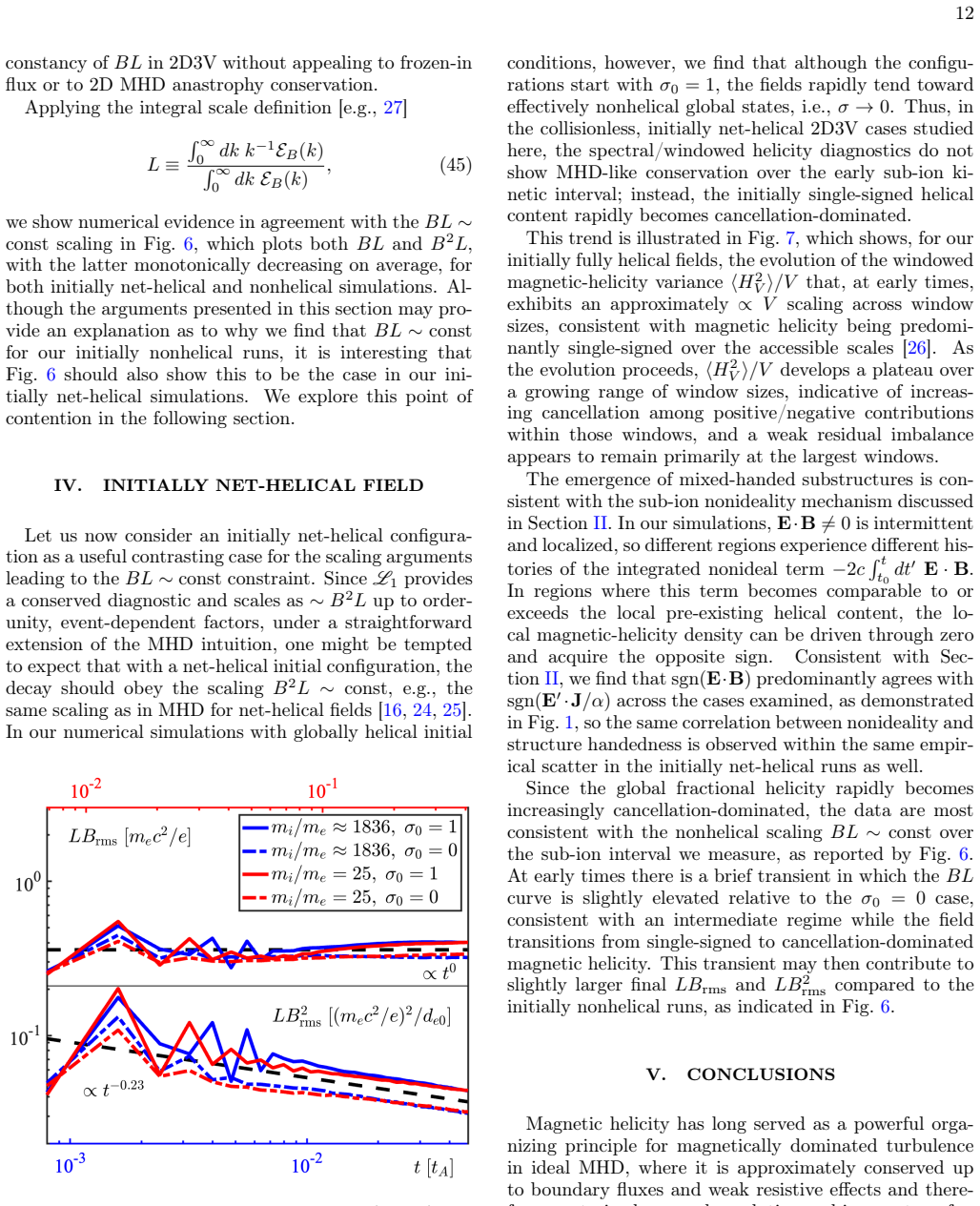
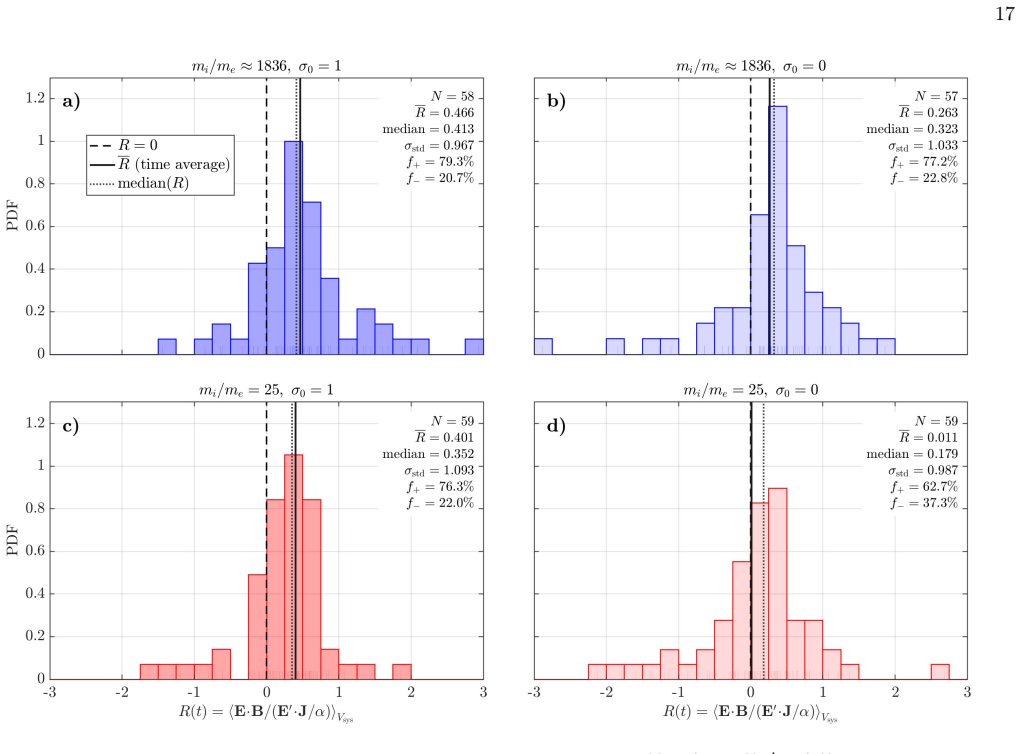
Through 2D3V PIC simulations of freely decaying sub-ion turbulence, intermittent localized regions with $\mathbf{E} \cdot \mathbf{B} \neq 0$ are found, in the early electron-scale interaction phase, to be statistically associated with decreases in $|H_{V_s}|$, the fixed-gauge structure-integrated magnetic-helicity diagnostic. This structure-level behavior coincides with a decline of the Saffman helicity-variance plateau value $I_H$. Motivated by these observations, we propose a source-compensated, history-dependent helicity density that satisfies an exact local balance identity by construction, enabling Saffman-type two-point correlation integrals which, under standard flux-decorrelation assumptions, can exhibit intermediate-scale plateaus that are roughly time-independent. In the simulations, such plateaus are observed to remain approximately invariant over the measured kinetic interval even as $I_H$ evolves during the early kinetic stage. Under approximate single-scale self-similarity, the plateau behavior of the magnetic integral is consistent with the 2D decay constraint $BL \sim \text{const}$. For initially net-helical configurations, we observe rapid development of mixed-signed magnetic-helicity patches and a decrease of the global fractional helicity, such that the decay over the kinetic interval is again most consistent with the cancellation-dominated scaling constraint.
Editorial analysis
A structured set of objections, weighed in public.
Referee Report
Summary. The manuscript reports 2D3V PIC simulations of freely decaying sub-ion turbulence in which intermittent regions with E·B ≠ 0 are statistically linked to decreases in the fixed-gauge helicity diagnostic |H_Vs| and the Saffman helicity-variance integral I_H. Motivated by these observations, the authors introduce a source-compensated, history-dependent helicity density constructed to satisfy an exact local balance identity. Saffman-type two-point correlation integrals of this density are shown to develop intermediate-scale plateaus that remain approximately time-independent in the simulations. Under standard flux-decorrelation and approximate single-scale self-similarity assumptions, this plateau invariance is argued to be consistent with the 2D decay constraint BL ∼ const; for initially net-helical cases the simulations additionally exhibit mixed-sign helicity patches and a decline in global fractional helicity consistent with cancellation-dominated scaling.
Significance. If the flux-decorrelation and self-similarity assumptions can be substantiated in the kinetic regime, the work supplies a concrete kinetic mechanism that extends Saffman-type helicity constraints beyond MHD, with potential relevance to decay laws in space and laboratory plasmas. The construction of a helicity density obeying an exact local identity by design is a clear technical strength, and the direct comparison of the resulting integrals against simulation data provides a falsifiable test of the proposed route.
major comments (2)
- [Discussion of plateau behavior and 2D decay constraint] In the section linking the observed plateau invariance to the 2D decay constraint BL ∼ const: the argument rests on standard flux-decorrelation assumptions and approximate single-scale self-similarity, yet no verification or sensitivity test of these assumptions is provided for the sub-ion kinetic regime where the simulations operate. If decorrelation times become comparable to the evolution time of the integral, plateau constancy does not enforce the claimed scaling.
- [Proposal of the helicity density and Saffman integrals] In the presentation of the source-compensated helicity density: while the exact local balance identity holds by construction, the subsequent claim that the resulting Saffman integrals exhibit time-independent plateaus is tested only against the specific simulation data; the manuscript does not explore how sensitive the plateau invariance is to the precise form of the compensation term or to variations in initial conditions.
minor comments (1)
- [Definition of the helicity density] Notation for the new helicity density and its relation to the conventional H_Vs should be introduced with an explicit equation number to avoid ambiguity when the integrals are later defined.
Simulated Author's Rebuttal
We thank the referee for the constructive report and for recognizing the technical strengths of the helicity-density construction and its comparison to simulation data. We address each major comment below, indicating where revisions have been made to strengthen the discussion of assumptions and robustness.
read point-by-point responses
-
Referee: In the section linking the observed plateau invariance to the 2D decay constraint: the argument rests on standard flux-decorrelation assumptions and approximate single-scale self-similarity, yet no verification or sensitivity test of these assumptions is provided for the sub-ion kinetic regime where the simulations operate. If decorrelation times become comparable to the evolution time of the integral, plateau constancy does not enforce the claimed scaling.
Authors: We agree that direct verification of the flux-decorrelation assumption in the sub-ion regime would strengthen the link to the BL ∼ const scaling. In the revised manuscript we have added a new paragraph that estimates decorrelation times from the measured two-point correlation functions and the sub-ion spectral slopes. These estimates remain shorter than the observed evolution time of the Saffman integrals throughout the kinetic interval, providing indirect support for the assumptions within the simulated parameter range. We also emphasize that the empirical invariance of the plateau while I_H continues to evolve is itself consistent with the scaling under the stated approximations. revision: yes
-
Referee: In the presentation of the source-compensated helicity density: while the exact local balance identity holds by construction, the subsequent claim that the resulting Saffman integrals exhibit time-independent plateaus is tested only against the specific simulation data; the manuscript does not explore how sensitive the plateau invariance is to the precise form of the compensation term or to variations in initial conditions.
Authors: The compensation term is fixed by the requirement that the helicity density obey the exact local balance identity obtained from the induction equation; any other choice would violate this identity. To address sensitivity to initial conditions we have performed an additional analysis on a zero-net-helicity run and confirmed that the intermediate-scale plateaus remain approximately time-independent. This result and a short clarifying statement on the uniqueness of the compensation have been incorporated into the revised text. revision: yes
Circularity Check
Helicity density defined by construction to satisfy local balance identity; plateau invariance observed independently in simulations
specific steps
-
self definitional
[Abstract]
"we propose a source-compensated, history-dependent helicity density that satisfies an exact local balance identity by construction, enabling Saffman-type two-point correlation integrals which, under standard flux-decorrelation assumptions, can exhibit intermediate-scale plateaus that are roughly time-independent."
The helicity density is introduced specifically so that it satisfies the exact local balance identity by construction. This makes the balance satisfaction a definitional feature of the proposed quantity rather than a result derived from the underlying plasma equations or dynamics.
full rationale
The paper explicitly constructs a source-compensated helicity density to satisfy an exact local balance identity by construction. This matches the self-definitional pattern at the proposal step. However, the subsequent claims of time-independent plateaus and consistency with the BL ~ const decay constraint rest on independent PIC simulation observations plus explicitly stated flux-decorrelation and self-similarity assumptions, rather than reducing tautologically to the definition. No self-citation load-bearing steps, fitted-input predictions, or ansatz smuggling are identified. The central empirical content therefore remains independent of the definitional choice.
Axiom & Free-Parameter Ledger
axioms (2)
- domain assumption Standard flux-decorrelation assumptions
- domain assumption Approximate single-scale self-similarity
invented entities (1)
-
source-compensated, history-dependent helicity density
no independent evidence
Lean theorems connected to this paper
-
IndisputableMonolith/Cost/FunctionalEquation.leanwashburn_uniqueness_aczel unclear?
unclearRelation between the paper passage and the cited Recognition theorem.
we propose a source-compensated, history-dependent helicity density that satisfies an exact local balance identity by construction, enabling Saffman-type two-point correlation integrals which, under standard flux-decorrelation assumptions, can exhibit intermediate-scale plateaus that are roughly time-independent
-
IndisputableMonolith/Foundation/AlexanderDuality.leanalexander_duality_circle_linking unclear?
unclearRelation between the paper passage and the cited Recognition theorem.
Under approximate single-scale self-similarity, the plateau behavior of the magnetic integral is consistent with the 2D decay constraint BL ~ const
What do these tags mean?
- matches
- The paper's claim is directly supported by a theorem in the formal canon.
- supports
- The theorem supports part of the paper's argument, but the paper may add assumptions or extra steps.
- extends
- The paper goes beyond the formal theorem; the theorem is a base layer rather than the whole result.
- uses
- The paper appears to rely on the theorem as machinery.
- contradicts
- The paper's claim conflicts with a theorem or certificate in the canon.
- unclear
- Pith found a possible connection, but the passage is too broad, indirect, or ambiguous to say the theorem truly supports the claim.
Reference graph
Works this paper leans on
-
[1]
=I H(t= 0)(=I Le (t= 0)for initially zero flow), derived in Appendix B. Also included are the power-law scalings:∝t−0.87 form i/me = 25and∝t −0.89 form i/me ≈1836(dash-dotted black, fitted using theB 4 rms data) and∝t 0 (dashed black). The insets zoom in on the vertical axis range∈[1/2,2]×16/9. structures inherit a comparatively narrow distribution of exc...
-
[2]
explicitly frames the “relative canonical helicity” as a gauge-invariant quantity when canonical vorticity flux crosses boundaries, and argues that while species helici- ties can exchange, the total relative canonical helicity is globally invariant in that idealized framework. However, inthefullykineticVlasov-Maxwellsetting, thereisgener- ally no reason f...
-
[3]
Sd−1 (2π)d A2e2ka−1 c ×2−(a+9)/2Γ a−1 2 .(B17) With⟨|B| 2⟩Vsys =B 2 rms, then, with our convention |Bk|2 =F(k), B2 rms,0 = 1 4 Sd−1 (2π)d Z ∞ 0 dk k d−1F0(k) = 1 8 Sd−1 (2π)d ×Aek(a+d+1)/2 c Γ a+d+ 1 4 .(B18) Substituting Eq. B18 into Eq. B17 yields IH(t= 0)≃(1−σ 2 0)(2π)d Sd−1 B4 rms,0k−(d+2) c ×2−(a−3)/2 Γ( a−1 2 ) Γ2( a+d+1 4 ) .(B19) Equation B19 give...
-
[4]
4 and 5 as the black dotted lines
[(mec2/e)4] = 16/9, which we use as a reference value for comparison in Figs. 4 and 5 as the black dotted lines. For the finite-Mthin-ring initialization used in the sim- ulations, Eq. B19 should be interpreted as an isotropic- continuum reference estimate. The corresponding dis- crete expression is obtained by replacing the continuum integrals with sums ...
-
[5]
Component decomposition and fluid-limit reductions We decomposeL ι into four separate source- compensated componentsL ι,l, withl∈ {1,2,3,4}, that obey their own respective continuity-type equations anal- ogous to Eq. 32, ∂tLι,l +∇ ·F ι,l = 0,(D1) with (Lι,∇ ·F ι) = 4X l=1 (Lι,l,∇ ·F ι,l),(D2) and it is straightforward to verify that this is satisfied with...
-
[6]
Gauge properties It is worthwhile to check whetherL ι andL ι,l are gauge-invariant under the transformationsA→A ′ = A+∇χandcφ→cφ ′ =cφ−∂ tχ. For the magnetic com- ponent, the time-integrated source term2c R t t0 dt′ E·B is gauge invariant, soδχL1 =δ χ(A·B) = (∇χ)·B= ∇ ·(χB), where∇ ·B= 0. One obtains Z V ddx δ χLι = I ∂V χΩΩΩι ·dS,(D7a) Z V ddx δ χL1 = I ...
-
[7]
W. M. Elsasser, Hydromagnetic dynamo theory, Re- views of Modern Physics28, 135–163 (1956)
work page 1956
-
[8]
L. Woltjer, A theorem on force-free magnetic fields, Proceedings of the National Academy of Sciences44, 489–491 (1958)
work page 1958
-
[9]
M.A.BergerandG.B.Field,Thetopologicalproperties of magnetic helicity, Journal of Fluid Mechanics147, 133–148 (1984)
work page 1984
-
[10]
A.H.Boozer,Helicitycontentandtokamakapplications of helicity, The Physics of Fluids29, 4123–4130 (1986)
work page 1986
-
[11]
V. I. Arnold and B. A. Khesin,Topological Methods in Hydrodynamics(Springer International Publishing, 2021)
work page 2021
-
[12]
H. K. Moffatt, The degree of knottedness of tangled vortex lines, Journal of Fluid Mechanics35, 117–129 (1969)
work page 1969
-
[13]
Series A: Mathematical and Physical Sciences439, 411–429 (1992)
H.K.MoffattandR.L.Ricca,Helicityandthecălugăre- anu invariant, Proceedings of the Royal Society of Lon- don. Series A: Mathematical and Physical Sciences439, 411–429 (1992)
work page 1992
-
[14]
J. B. Taylor, Relaxation of toroidal plasma and genera- tion of reverse magnetic fields, Physical Review Letters 33, 1139–1141 (1974)
work page 1974
-
[15]
J. B. Taylor, Relaxation and magnetic reconnection in plasmas, Reviews of Modern Physics58, 741–763 (1986)
work page 1986
-
[16]
H. Ji, S. C. Prager, and J. S. Sarff, Conservation of mag- netic helicity during plasma relaxation, Physical Review Letters74, 2945–2948 (1995)
work page 1995
-
[17]
H. Y. Guo, A. L. Hoffman, K. E. Miller, and L. C. Steinhauer, Flux conversion and evidence of relaxation in a high-βplasma formed by high-speed injection into a mirror confinement structure, Physical Review Letters 92, 10.1103/physrevlett.92.245001 (2004)
-
[18]
E. G. Blackman, Magnetic helicity and large scale mag- netic fields: A primer, inMulti-scale Structure Forma- tion and Dynamics in Cosmic Plasmas(Springer New York, 2016) p. 59–91
work page 2016
- [19]
-
[20]
D. Biskamp and W.-C. Müller, Decay laws for three- dimensional magnetohydrodynamic turbulence, Physi- cal Review Letters83, 2195–2198 (1999)
work page 1999
-
[21]
W.-C. Müller and D. Biskamp, Scaling properties of three-dimensional magnetohydrodynamic turbulence, Physical Review Letters84, 475–478 (2000)
work page 2000
-
[22]
M. Christensson, M. Hindmarsh, and A. Brandenburg, Inverse cascade in decaying three-dimensional magne- tohydrodynamic turbulence, Physical Review E64, 10.1103/physreve.64.056405 (2001)
-
[23]
A. Alexakis, P. D. Mininni, and A. Pouquet, On the inverse cascade of magnetic helicity, The Astrophysical Journal640, 335–343 (2006)
work page 2006
-
[24]
A. Pouquet, D. Rosenberg, J. Stawarz, and R. Marino, Helicity dynamics, inverse, and bidirectional cascades in fluid and magnetohydrodynamic turbulence: A brief review, Earth and Space Science6, 351–369 (2019)
work page 2019
-
[25]
W. H. Matthaeus and D. Montgomery, Selective decay hypothesis at high mechanical and magnetic reynolds numbers, Annals of the New York Academy of Sciences 357, 203–222 (1980)
work page 1980
-
[26]
T. Stribling, W. H. Matthaeus, and S. Oughton, Mag- netic helicity in magnetohydrodynamic turbulence with a mean magnetic field, Physics of Plasmas2, 1437–1452 (1995)
work page 1995
-
[27]
R. Banerjee and K. Jedamzik, Evolution of cosmic magnetic fields: From the very early universe, to re- combination, to the present, Physical Review D70, 10.1103/physrevd.70.123003 (2004)
-
[28]
R. Durrer and A. Neronov, Cosmological magnetic fields: their generation, evolution and observa- tion, The Astronomy and Astrophysics Review21, 10.1007/s00159-013-0062-7 (2013)
-
[29]
K. Subramanian, The origin, evolution and signatures of primordial magnetic fields, Reports on Progress in Physics79, 076901 (2016)
work page 2016
-
[30]
G. B. Field and S. M. Carroll, Cosmological magnetic fields from primordial helicity, Physical Review D62, 10.1103/physrevd.62.103008 (2000)
-
[31]
C. Caprini and L. Sorbo, Adding helicity to inflationary magnetogenesis, Journal of Cosmology and Astroparti- cle Physics2014(10), 056–056
-
[32]
D. N. Hosking and A. A. Schekochihin, Reconnection- controlled decay of magnetohydrodynamic turbulence and the role of invariants, Physical Review X11, 10.1103/physrevx.11.041005 (2021)
-
[33]
H. Zhou, R. Sharma, and A. Brandenburg, Scal- ing of the hosking integral in decaying magnetically dominated turbulence, Journal of Plasma Physics88, 10.1017/s002237782200109x (2022)
-
[34]
A. Brandenburg and A. Banerjee, Turbulent magnetic decay controlled by two conserved quantities, Journal of Plasma Physics91, 10.1017/s0022377824001508 (2025)
-
[35]
K.J.Hew, D.N.Hosking, C.Federrath, J.R.Beattie, and N
J. K.J.Hew, D.N.Hosking, C.Federrath, J.R.Beattie, and N. Kriel, Conservation of magnetic-helicity fluctu- ations due to spatial decorrelation of fluxes in decaying mhd turbulence (2025)
work page 2025
-
[36]
A. Brandenburg and G. Larsson, Turbulence with mag- netic helicity that is absent on average, Atmosphere14, 932 (2023)
work page 2023
-
[38]
D. N. Hosking and A. A. Schekochihin, Cosmic-void ob- servations reconciled with primordial magnetogenesis, NatureCommunications14,10.1038/s41467-023-43258- 3 (2023)
- [39]
-
[40]
Living Reviews in Solar Physics , keywords =
R. Bruno and V. Carbone, The solar wind as a turbu- lence laboratory, Living Reviews in Solar Physics10, 10.12942/lrsp-2013-2 (2013)
-
[41]
O. Alexandrova, C. H. K. Chen, L. Sorriso-Valvo, T. S. Horbury, and S. D. Bale, Solar wind turbulence and the role of ion instabilities, Space Science Reviews178, 101–139 (2013)
work page 2013
-
[42]
D. Verscharen, K. G. Klein, and B. A. Maruca, The multi-scale nature of the solar wind, Living Reviews in Solar Physics16, 10.1007/s41116-019-0021-0 (2019)
-
[43]
F. Sahraoui, L. Hadid, and S. Huang, Magnetohydro- dynamic and kinetic scale turbulence in the near-earth space plasmas: a (short) biased review, Reviews of Modern Plasma Physics4, 10.1007/s41614-020-0040-2 (2020)
-
[44]
J. M. Finn and T. M. Antonsen, Jr, Magnetic helicity: what is it and what is it good for (1985)
work page 1985
-
[45]
K. Schindler, M. Hesse, and J. Birn, General mag- netic reconnection, parallel electric fields, and helicity, Journal of Geophysical Research: Space Physics93, 5547–5557 (1988)
work page 1988
-
[46]
H. Ji, M. Yamada, S. Hsu, and R. Kulsrud, Experimen- tal test of the sweet-parker model of magnetic reconnec- tion, Physical Review Letters80, 3256–3259 (1998)
work page 1998
-
[47]
E. Priest and T. Forbes,Magnetic Reconnection: MHD Theory and Applications(Cambridge University Press, 2000)
work page 2000
-
[48]
Biskamp,Magnetic Reconnection in Plasmas(Cam- bridge University Press, 2000)
D. Biskamp,Magnetic Reconnection in Plasmas(Cam- bridge University Press, 2000)
work page 2000
-
[49]
V. M. Vasyliunas, Theoretical models of magnetic field linemerging,ReviewsofGeophysics13,303–336(1975)
work page 1975
-
[50]
D. Biskamp, E. Schwarz, and J. F. Drake, Two-fluid theory of collisionless magnetic reconnection, Physics of Plasmas4, 1002–1009 (1997)
work page 1997
-
[51]
M. A. Shay, J. F. Drake, B. N. Rogers, and R. E. Den- ton, Alfvénic collisionless magnetic reconnection and the hall term, Journal of Geophysical Research: Space Physics106, 3759–3772 (2001)
work page 2001
-
[52]
Y. V. Khotyaintsev, D. B. Graham, C. Norgren, and A. Vaivads, Collisionless magnetic reconnection and waves: Progress review, Frontiers in Astronomy and Space Sciences6, 10.3389/fspas.2019.00070 (2019)
-
[53]
Y.-H. Liu, M. Hesse, K. Genestreti, R. Nakamura, J. L. Burch, P. A. Cassak, N. Bessho, J. P. Eastwood, T. Phan, M. Swisdak, S. Toledo-Redondo, M. Hoshino, C. Norgren, H. Ji, and T. K. M. Nakamura, Ohm’s law, the reconnection rate, and energy conversion in colli- sionless magnetic reconnection, Space Science Reviews 221, 10.1007/s11214-025-01142-0 (2025)
-
[54]
E. G. Zweibel and M. Yamada, Magnetic reconnection inastrophysicalandlaboratoryplasmas,AnnualReview of Astronomy and Astrophysics47, 291–332 (2009)
work page 2009
-
[55]
M. Wan, W. H. Matthaeus, H. Karimabadi, V. Royter- shteyn, M. Shay, P. Wu, W. Daughton, B. Loring, and S. C. Chapman, Intermittent dissipation at ki- netic scales in collisionless plasma turbulence, Physi- calReview Letters109, 10.1103/physrevlett.109.195001 (2012)
-
[57]
J. M. TenBarge and G. G. Howes, Current sheets and collisionless damping in kinetic plasma turbulence, The Astrophysical Journal771, L27 (2013)
work page 2013
-
[58]
C. C. Haggerty, T. N. Parashar, W. H. Matthaeus, M. A. Shay, Y. Yang, M. Wan, P. Wu, and S. Ser- vidio, Exploring the statistics of magnetic reconnection x-points in kinetic particle-in-cell turbulence, Physics of Plasmas24, 10.1063/1.5001722 (2017)
-
[60]
S. Servidio, K. T. Osman, F. Valentini, D. Perrone, F. Califano, S. Chapman, W. H. Matthaeus, and P. Vel- tri, Proton kinetic effects in vlasov and solar wind tur- bulence, The Astrophysical Journal781, L27 (2014)
work page 2014
- [61]
- [62]
-
[63]
L. Sorriso-Valvo, D. Perrone, O. Pezzi, F. Valentini, S. Servidio, I. Zouganelis, and P. Veltri, Local energy transfer rate and kinetic processes: the fate of turbu- lent energy in two-dimensional hybrid vlasov–maxwell numerical simulations, Journal of Plasma Physics84, 10.1017/s0022377818000302 (2018)
-
[65]
K. T. Osman, W. H. Matthaeus, J. T. Gosling, A. Greco, S. Servidio, B. Hnat, S. C. Chapman, and T. D. Phan, Magnetic reconnection and intermittent turbulence in the solar wind, Physical Review Letters 112, 10.1103/physrevlett.112.215002 (2014)
-
[66]
A. Chasapis, A. Retinò, F. Sahraoui, A. Vaivads, Y. V. Khotyaintsev, D. Sundkvist, A. Greco, L. Sorriso-Valvo, and P. Canu, Thin current sheets and associated elec- tron heating in turbulent space plasma, The Astrophys- ical Journal804, L1 (2015)
work page 2015
-
[67]
A. Chasapis, Y. Yang, W. H. Matthaeus, T. N. Parashar, C. C. Haggerty, J. L. Burch, T. E. Moore, C. J. Pollock, J. Dorelli, D. J. Gershman, R. B. Tor- bert, and C. T. Russell, Energy conversion and collision- less plasma dissipation channels in the turbulent mag- netosheath observed by the magnetospheric multiscale mission, The Astrophysical Journal862, 32 (2018)
work page 2018
-
[68]
Z. Vörös, E. Yordanova, A. Varsani, K. J. Genestreti, Y. V. Khotyaintsev, W. Li, D. B. Graham, C. Nor- gren, R. Nakamura, Y. Narita, F. Plaschke, W. Magnes, W. Baumjohann, D. Fischer, A. Vaivads, E. Eriksson, P. Lindqvist, G. Marklund, R. E. Ergun, M. Leitner, M. P. Leubner, R. J. Strangeway, O. Le Contel, C. Pol- 22 lock, B. J. Giles, R. B. Torbert, J. L...
-
[70]
E. Yordanova, Z. Vörös, A. Varsani, D. B. Gra- ham, C. Norgren, Y. V. Khotyaintsev, A. Vaivads, E. Eriksson, R. Nakamura, P. Lindqvist, G. Marklund, R. E. Ergun, W. Magnes, W. Baumjohann, D. Fischer, F. Plaschke, Y. Narita, C. T. Russell, R. J. Strangeway, O.LeContel, C.Pollock, R.B.Torbert, B.J.Giles, J.L. Burch, L. A. Avanov, J. C. Dorelli, D. J. Gershm...
work page 2016
-
[71]
T. D. Phan, J. P. Eastwood, M. A. Shay, J. F. Drake, B. U. O. Sonnerup, M. Fujimoto, P. A. Cas- sak, M. Øieroset, J. L. Burch, R. B. Torbert, A. C. Rager, J. C. Dorelli, D. J. Gershman, C. Pollock, P. S. Pyakurel, C. C. Haggerty, Y. Khotyaintsev, B. Lavraud, Y. Saito, M. Oka, R. E. Ergun, A. Retino, O. Le Contel, M. R. Argall, B. L. Giles, T. E. Moore, F....
work page 2018
-
[72]
J. E. Stawarz, J. P. Eastwood, T. D. Phan, I. L. Gin- gell, M. A. Shay, J. L. Burch, R. E. Ergun, B. L. Giles, D. J. Gershman, O. L. Contel, P.-A. Lindqvist, C. T. Russell, R. J. Strangeway, R. B. Torbert, M. R. Argall, D. Fischer, W. Magnes, and L. Franci, Properties of the turbulence associated with electron-only magnetic reconnection in earth’s magneto...
work page 2019
-
[73]
P. Sharma Pyakurel, M. A. Shay, T. D. Phan, W. H. Matthaeus, J. F. Drake, J. M. TenBarge, C. C. Hag- gerty, K. G. Klein, P. A. Cassak, T. N. Parashar, M. Swisdak, and A. Chasapis, Transition from ion- coupled to electron-only reconnection: Basic physics and implications for plasma turbulence, Physics of Plas- mas26, 10.1063/1.5090403 (2019)
-
[74]
C. Vega, V. Roytershteyn, G. L. Delzanno, and S. Boldyrev, Electron-only reconnection in kinetic- alfvén turbulence, The Astrophysical Journal Letters 893, L10 (2020)
work page 2020
-
[75]
A. Mallet, The onset of electron-only re- connection, Journal of Plasma Physics86, 10.1017/s0022377819000941 (2020)
-
[76]
F. Califano, S. S. Cerri, M. Faganello, D. Laveder, M. Sisti, and M. W. Kunz, Electron-only reconnec- tion in plasma turbulence, Frontiers in Physics8, 10.3389/fphy.2020.00317 (2020)
-
[78]
H. R. Strauss, Nonlinear, three-dimensional magneto- hydrodynamics of noncircular tokamaks, The Physics of Fluids19, 134–140 (1976)
work page 1976
-
[79]
For the diagnostics used here,Ais reconstructed in pe- riodic Coulomb gauge fromB; details are given in Ap- pendix A
-
[80]
R. A. Treumann and W. Baumjohann, Collisionless magnetic reconnection in space plasmas, Frontiers in Physics1, 10.3389/fphy.2013.00031 (2013)
-
[81]
In the numerical diagnostics, we evaluateE ′ directly from the simulation fields asE′ =E+u e ×B/c; Eq. 5 is used to identify the kinetic terms supportingE′, not as the numerical prescription for computing it
-
[82]
Seehafer, Electric current helicity in the solar atmo- sphere, Solar Physics125, 219–232 (1990)
N. Seehafer, Electric current helicity in the solar atmo- sphere, Solar Physics125, 219–232 (1990)
work page 1990
-
[83]
M. Hagino and T. Sakurai, Latitude variation of helicity in solar active regions, Publications of the Astronomical Society of Japan56, 831–843 (2004)
work page 2004
-
[84]
A. A. Pevtsov, M. A. Berger, A. Nindos, A. A. Norton, and L. van Driel-Gesztelyi, Magnetic helicity, tilt, and twist, Space Science Reviews186, 285–324 (2014)
work page 2014
-
[85]
T. Wiegelmann and T. Sakurai, Solar force-free mag- netic fields, Living Reviews in Solar Physics9, 10.12942/lrsp-2012-5 (2012)
-
[86]
S. Zenitani, M. Hesse, A. Klimas, and M. Kuznetsova, New measure of the dissipation region in collisionless magnetic reconnection, Physical Review Letters106, 10.1103/physrevlett.106.195003 (2011)
discussion (0)
Sign in with ORCID, Apple, or X to comment. Anyone can read and Pith papers without signing in.