REVIEW 5 major objections 5 minor 10 cited by
Quantum processor simulates a confined meson's light cone in an SU(2) gauge theory on 60 lattice sites.
Reviewed by Pith at T0; open to challenge. T0 means a machine referee read the full paper against a public rubric. the ladder, T0–T4 →
T0 review · deepseek-v4-flash
2026-08-02 22:01 UTC pith:TYQBYHCL
load-bearing objection The engineering is real, but the claims overshoot: the QPU runs a large but effectively non-interacting fermion circuit, not the non-Abelian hadron dynamics promised in the title. the 5 major comments →
Observation of Robust and Coherent Non-Abelian Hadron Dynamics on Noisy Quantum Processors
The pith
A machine-rendered reading of the paper's core claim, the machinery that carries it, and where it could break.
Core claim
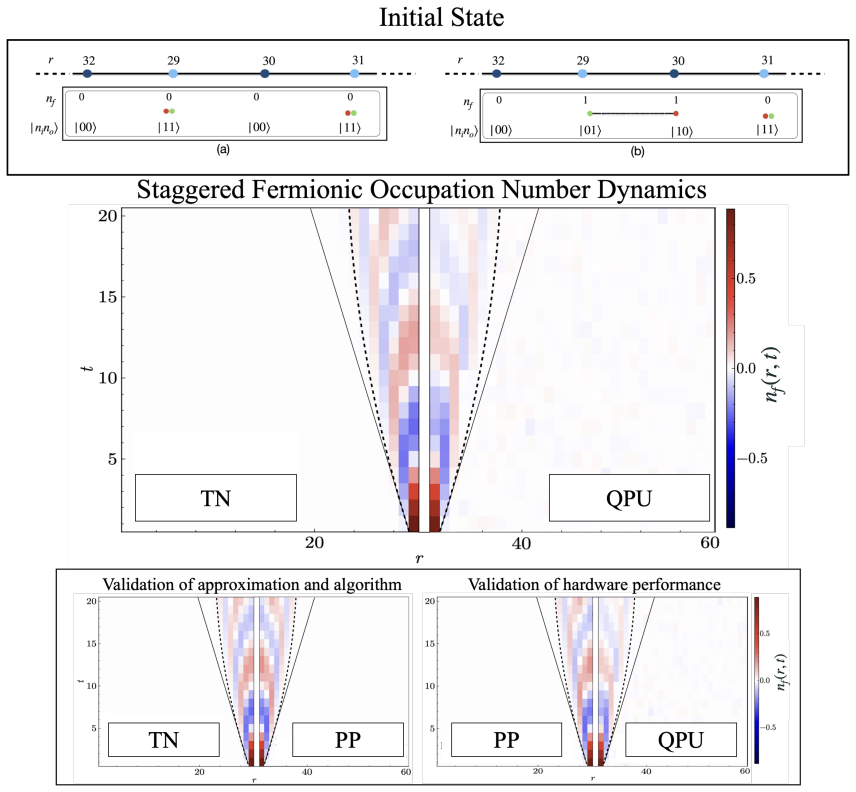
The paper claims that the quantum processor, running a Trotterized circuit for the weak-coupling LSH Hamiltonian on a 60-site staggered lattice (120 qubits), produces a particle-density signal whose subtracted heatmap shows a meson spreading inside a curved light cone, with internal red-blue oscillations at early times interpreted as hadronic breathing modes. The authors argue that this signal is coherent because it matches tensor-network simulations of the full LSH Hamiltonian and Pauli-propagation simulations of the noiseless circuit within the reported error bars, with only readout-error mitigation applied to the hardware data.
What carries the argument
The Loop-String-Hadron (LSH) encoding, which represents gauge-invariant degrees of freedom as local occupation numbers (loop flux, incoming/outgoing string ends) at each site, satisfying an Abelian Gauss law; combined with a weak-coupling approximation that freezes the background flux and replaces the full LSH interaction with a nearest-neighbor fermion hopping term with all flux prefactors set to unity. The circuit implements a Trotterized evolution of this approximate Hamiltonian with constant depth per step, using a zigzag qubit layout to minimize SWAPs.
Load-bearing premise
The weak-coupling approximation that reduces the full SU(2) LSH Hamiltonian to a nearest-neighbor fermion hopping term with all flux factors set to one is quantitatively faithful to the full theory in the probed time window—in particular, it does not remove the interaction that confines the meson.
What would settle it
Compare the measured particle-density heatmap for x=100 against the exact free-fermion solution of the hopping Hamiltonian on the same 60-site lattice with the same Trotter steps: if the two agree within the reported error bars, the observed signal is free-fermion propagation rather than non-Abelian hadron dynamics.
If this is right
- If correct, the result shows that real-time evolution of a non-Abelian gauge theory can be tracked on current noisy hardware across 25 Trotter steps without active error mitigation, within the weak-coupling regime.
- The differential measurement protocol (subtracting the strong-coupling vacuum evolution) removes systematic bias and boundary effects, so the same experimental design could be reused for other quench observables.
- The benchmarking suggests that as the coupling increases toward the continuum limit, classical tensor-network and Pauli-propagation methods degrade while the fixed-shot QPU signal remains stable—implying a window where quantum hardware gives the more reliable answer.
- The LSH encoding's locality, as exploited here, keeps Gauss's law exact in the circuit, so the same approach is expected to transfer to larger lattices and eventually to SU(3) lattice gauge theory.
Where Pith is reading between the lines
- The observed 'confined light cone' is also consistent with a non-interacting fermion hopping model; a decisive control is to run the same circuit with the flux degrees of freedom fully frozen and compare against the exact free-fermion evolution on the same lattice.
- The paper's runtime comparison (QPU constant 20 seconds per step versus growing classical times) uses a fixed shot budget and does not include transpilation and calibration overhead; a fair resource comparison would need the full wall-clock time for the QPU experiment.
- The agreement between TN (full LSH) and PP (approximated LSH) is used to validate the weak-coupling approximation, but for x=200 the TN itself breaks down after 10 steps, so that particular comparison cannot validate the approximation at the continuum end.
- If the weak-coupling Hamiltonian is genuinely the free-fermion hopping model, then any future claim of non-Abelian quantum advantage must demonstrate a departure from that model's predictions, for example through string-breaking at later times.
Editorial analysis
A structured set of objections, weighed in public.
Referee Report
Summary. The manuscript reports a quantum simulation of a (1+1)-dimensional SU(2) lattice gauge theory on a 156-qubit IBM processor using the Loop-String-Hadron (LSH) encoding. A 60-site staggered lattice (120 qubits) is evolved for up to 25 first-order Trotter steps in the weak-coupling regime x=100, with a differential measurement protocol and only measurement-error mitigation. The authors claim to observe the light-cone propagation of a confined meson, early-time internal ('breathing') oscillations, and to extract a breathing-mode frequency. They benchmark the hardware data against tensor-network (TN) simulations of the full LSH Hamiltonian and Pauli-propagation simulations of the noiseless circuit, and argue that classical methods encounter an entanglement/magic wall while the QPU remains robust, suggesting a path toward quantum advantage. The implemented circuit, however, is based on a weak-coupling approximation (Eqs. (26)-(28)) that freezes the flux (nl) degrees of freedom and reduces the interaction to independent fermionic hopping terms; the validation loop is partly self-consistent because the electric phase θ is chosen to match the TN bosonic cutoff (End Notes).
Significance. If the claims were substantiated, this would be a landmark: a physics-native, size-independent-depth encoding for a non-Abelian gauge theory, executed at a scale of 120 qubits and 17,660 two-qubit gates, with a measurement strategy that extracts coherent signal using only readout mitigation. The paper deserves credit for the LSH circuit construction, the scale of the hardware demonstration, the public data commitment, and the unusually transparent discussion of TN truncation errors (Supplementary Table 2). The authors also explicitly disclose the θ-cutoff matching in the End Notes. Nevertheless, the evidence as presented does not support the central claims: the abstract promises a quantitative breathing-mode frequency that never appears; the implemented Hamiltonian is a two-species fermion chain with the non-Abelian flux-string degrees frozen; and the TN validation is partly self-consistent. The significance is therefore conditional; in its current form the paper's physical conclusions are not established.
major comments (5)
- [Abstract; 'Observing Real-time Dynamics'] The abstract states that 'we extract a breathing-mode frequency as a spectroscopic observable,' but no frequency is reported anywhere in the main text, Methods, or Supplementary Information. There is no numerical value, no error bar, no fitting procedure, and no comparison with a theoretical expectation. This is a central quantitative claim and its absence is not a presentation issue. The authors must either report the extraction in full or remove/qualify the claim.
- [Methods, 'Approximations for weak coupling regime' and 'Building the Quantum Circuit'; Eqs. (26)-(28), (37), (41)] The unitary implemented on the QPU corresponds to the weak-coupling approximation, not to the LSH Hamiltonian (14)-(16). Under this approximation the flux numbers are frozen (nl(r) ≈ li - ni(1-no)), the square-root flux prefactors in (16) are set to 1, and H_I reduces to Eq. (28): independent hopping of the ni and no species. The electric term (26)/(41) is a static potential on (ni,no)=(0,1) sites plus a global phase. Consequently the approximate dynamics conserves Qi=Σni and Qo=Σno separately, and is at most a two-species fermion chain with density-density coupling; the non-Abelian flux-string degrees of freedom distinguishing SU(2) from an Abelian or free-fermion model are spectators. The only reported QPU observable is the site-resolved density n_f(r,t), which is insensitive to the dropped cross-species terms of (16). The light cone and oscillations of such a model are generic single-
- [End Notes (final paragraph)] The TN benchmark is partly self-consistent. The End Notes state that 'the value of the phase angle θ in the quantum algorithm is chosen to match this limitation on the cut-off' of the TN (bosonic cutoff SIX). θ controls the electric-energy phase in Eq. (42), i.e., the strength of the static confining potential; choosing it to match the truncated TN model removes the independence of the classical benchmark. Moreover, the weak-coupling approximation was justified by the condition li >> 1, while a cutoff at nl~6 is not in that regime; the validity condition of the approximation and the benchmark setup are in tension. An independent validation should set θ from the physical couplings without reference to the TN cutoff, and should demonstrate robustness of the observables to the cutoff/θ choice.
- ['Proof of Concept' (Fig. 7)] The validation of the approximate Hamiltonian against exact diagonalization of the full LSH Hamiltonian uses only the total particle number Σ_r n_f(r,t). This quantity is exactly conserved in both the full and the approximate dynamics (Methods, footnote 2), so the agreement in Fig. 7 carries no information about whether the approximation reproduces the spatial density profile, the light-cone shape, or the internal oscillations on which the paper's claims rest. The comparison should be repeated for observables that are not conserved, e.g., the site-resolved density n_f(r,t) or two-point correlators, for a system size and time where the approximate and full dynamics differ.
- ['Estimating Errors' (Eqs. (46)-(50)); Table 3; Table 1] The uncertainty quantification and the resource comparison favor the QPU by construction. The shared uncertainty band σ_shared is computed from the four methods including the QPU itself, so the statement that the QPU error bars 'enter the shaded region' at all time slices is partly tautological. Table 3 shows QPU errors exceeding the TN and PP-GPU errors by up to an order of magnitude at later times (e.g., 0.2397 vs 0.0114 at Trotter step 20). The runtime comparison in Table 1 fixes the QPU budget at 10,000 shots (20 s per Trotter step), so it compares fixed-shot measurement time against classical methods required to reach comparable accuracy; it does not establish an accuracy-matched resource advantage. The 'high-fidelity' and 'practical quantum advantage' claims should be re-quantified with the QPU excluded from the reference distribution.
minor comments (5)
- [Fig. 3 caption] The caption describes an initial 'zero-entanglement product state containing two baryons (total fermion number n_f=4)' that 'transitions the system to a single meson state (n_f=2)' at t=1. This is inconsistent with the meson initial state (n_f=1 at two sites) described in the text and with the conservation of the global charge Q. Please clarify whether this is a schematic of a different (baryonic) process.
- [Fig. 4 caption] The sentence 'The dynamics on the left half of the figure (lattice sites 0−29) are from one calculation, while the right half of the plot shows another' is confusing. Merging two different runs and using their agreement as validation of the exact theory needs clarification; at most it demonstrates reproducibility or mirror symmetry, not agreement with the exact theory.
- [Data Availability / Code Availability] The Data Availability section says the data are at a 'public GitHub repository' but gives no URL, and the code is available only 'upon reasonable request.' For a reproducibility-oriented manuscript, please provide the repository link and a DOI or versioned release.
- [Eqs. (29)-(32)] The scaled-time definitions contain presentation typos (e.g., 'W=2xa 3H') and the relation between the scaled time τ, the lattice spacing a, and the coupling x is easy to misread. Please give a clean derivation of τ and of the conversion rule for changed x.
- [Supplementary Table 2] The TN truncation errors for x=200 exceed 10^-3 already at step 10 and ~10^-2 at later steps. The main text states that the TN 'almost completely broke down' for x=200; please state the truncation-error threshold used to define breakdown, since the reported values alone do not set that threshold.
Circularity Check
The QPU-TN validation loop is partially closed: the quantum circuit's electric phase θ is explicitly matched to the TN bosonic cutoff, and the weak-coupling approximation is justified by same-author prior work [40]; real QPU execution and full-LSH TN data retain some independent content.
specific steps
-
fitted input called prediction
[End Notes, paragraph beginning 'A technical remark on imposing the bosonic cut-off in this computation is worth mentioning here']
"The TN algorithm can only work with a finite cut-off; we choose the value of the cut-off to be SIX for the TN benchmark. The value of the phase angle θ in the quantum algorithm is chosen to match this limitation on the cut-off."
The TN calculation is the paper's benchmark against the full LSH Hamiltonian (14)–(16). The phase angle θ enters the QPU electric term (Eq. 41) and is identified via Eq. 42 with the background flux/electric energy. By declaring θ 'chosen to match' the TN's finite flux cutoff, the benchmark's truncation is baked into the simulated circuit's Hamiltonian parameter. The subsequent QPU-TN agreement on the light-cone and breathing-mode observables is therefore partly fixed by construction, not an independent confirmation of the weak-coupling approximation or of the claimed non-Abelian dynamics.
-
self citation load bearing
[Main text, 'The Hamiltonian and Its Continuum Limit'; Methods, 'Approximations for weak coupling regime']
"This weak coupling approximate version of the LSH Hamiltonian has previously been developed in the context of analog simulation [40]. ... This approximation is valid [40] if we focus on the weak coupling regime x >> 1, and the off-diagonals contribute more to the dynamics."
The load-bearing reduction from the full SU(2) LSH Hamiltonian (14)–(16) to the implemented circuit Hamiltonian (26)–(28) is justified by citation [40], prior work by one of the present authors (Raychowdhury). The same reference supplies the 'valid' assertion for the weak-coupling regime on which the whole QPU experiment rests. Because the QPU implements exactly this approximate model, the claim that the hardware data show non-Abelian hadron dynamics depends on an in-house result; the independent TN check that could break this self-citation chain is weakened by the θ-matching identified in the previous step.
full rationale
The paper is not fully circular: the QPU is real 156-qubit hardware, the TN simulation runs the full LSH Hamiltonian, and the Pauli-propagation simulation is a separate noiseless-circuit check. Those elements give the work independent content. However, the central validation loop is partially closed. The quantum circuit's electric phase θ—which controls the only non-trivial electric contribution in the approximate Hamiltonian (Eqs. 40–42)—is explicitly 'chosen to match' the TN bosonic cutoff. Since the TN is the reference used to certify the weak-coupling approximation and the quantum algorithm, its truncation is encoded into the QPU Hamiltonian, making part of the QPU-TN agreement in the light-cone width and internal oscillation frequency a consequence of parameter matching rather than an emergent prediction. In addition, the weak-coupling approximation that converts the full SU(2) LSH Hamiltonian into the implemented hopping circuit is justified by same-author prior work [40], and the proof-of-concept comparison (Fig. 7) checks only the exactly conserved total particle number, so it does not independently constrain the spatial profile or oscillations. The weak-coupling circuit is also effectively a fermionic hopping model in a static potential, which is a significant physical-interpretation risk; this is not by itself circularity, but it heightens the importance of the benchmark, whose independence is compromised. These issues make the claim of observed non-Abelian hadron dynamics partially circular, while the genuine hardware execution and the full-LSH TN data prevent a score of 8 or higher.
Axiom & Free-Parameter Ledger
free parameters (3)
- li (incoming boundary flux) / effective flux value =
not reported; implicitly set so θ matches the TN bosonic cutoff
- θ (electric-energy phase angle) =
chosen to match the TN bosonic cutoff; θ = −δτ(nl/2 + 3/4)
- δτ (Trotter step) =
0.0015
axioms (6)
- standard math The LSH Hamiltonian (13) is exactly equivalent to the Kogut-Susskind Hamiltonian (4) for the same bosonic cutoff.
- ad hoc to paper Weak-coupling approximation: nl(r) ≈ li − ni(1−no) for li >> 0, square-root flux prefactors set to 1, and H_I reduces to Eq. (28).
- domain assumption Open boundary conditions with li >> 0 and global charge sector (B,q) = (0,0); the background flux contributes only a global phase h0_E.
- domain assumption TN simulation of the full LSH Hamiltonian with bosonic cutoff 2jmax=5 and bond dimension Dmax=200 is accurate up to the reported time window.
- domain assumption Pauli propagation with extrapolated term counts or coefficient cutoff 1e-5 reproduces the noiseless QPU circuit.
- domain assumption Differential measurement (subtracting SCV evolution from meson evolution) cancels systematic hardware biases.
read the original abstract
The real-time evolution of strongly interacting matter remains a frontier of fundamental physics, as classical simulations are hampered by exponential Hilbert space growth and rapid, unmanageable growth of quantum entanglement. This study reports the quantum simulation of hadron dynamics within a $(1+1)$-dimensional SU(2) lattice gauge theory using a 156-qubit IBM superconducting processor. Leveraging a hardware-efficient Loop-String-Hadron (LSH) encoding, we simulate the dynamics of the physical degrees of freedom on a $60$-site lattice in the weak-coupling regime, as a crucial step toward the continuum limit. The hardware data reveal confined meson propagation and early-time oscillations of the mesonic profile, from which we extract a breathing-mode frequency as a spectroscopic observable. Benchmarking against tensor-network simulations of the full LSH Hamiltonian and Pauli-propagation simulations of the noiseless circuit supports the validity of the physical approximation, the quantum algorithm and the observed dynamics within the accessible time window. These results show that physics-native encodings can enable scalable access to coherent non-Abelian real-time dynamics on noisy quantum hardware.
Figures




Forward citations
Cited by 10 Pith papers
-
Unified resonant-manifold framework for dynamical quantum phase transitions
A resonant-manifold framework unifies manifold and branch DQPTs by attributing them to resonances within the initial manifold and with a transitional manifold connected by low-order processes, shown in Z2 LGT quenches.
-
Tightening energy-based boson truncation bound using Monte Carlo-assisted methods
Monte Carlo-assisted tightening of the energy-based boson truncation bound substantially reduces volume dependence in (1+1)D scalar field theory and (2+1)D U(1) gauge theory.
-
Tightening energy-based boson truncation bound using Monte Carlo-assisted methods
A Monte Carlo-assisted analytic method tightens energy-based bounds on boson truncation errors, substantially reducing the volume dependence of the required cutoff in scalar and gauge theories.
-
Observation of glueball excitations and string breaking in a $2+1$D $\mathbb{Z}_2$ lattice gauge theory on a trapped-ion quantum computer
A trapped-ion quantum computer simulates 2+1D Z2 lattice gauge theory dynamics, revealing glueball excitations and multi-order string breaking.
-
Observation of genuine $2+1$D string dynamics in a U$(1)$ lattice gauge theory with a tunable plaquette term on a trapped-ion quantum computer
Quantum simulation on trapped ions shows that a plaquette term in a 2+1D U(1) gauge theory enables string propagation in the plane and extended matter creation, realizing genuine two-dimensional dynamics.
-
Role of flavor degrees of freedom in quantum simulations of disorder-free localization
In a flavor-extended Z2 lattice gauge theory, n=2 binary bond disorder yields only a long-lived nonergodic transient, whereas n=4 and n=8 multilevel disorder produce consistent many-body localization signatures; local...
-
String dynamics of a (2+1)D U(1) quantum link model on a digital quantum computer
Digital quantum simulations of string dynamics in a (2+1)D U(1) quantum link model on IBM hardware with up to 112 qubits agree with tensor networks at short times and thermal averages at long times.
-
Unified resonant-manifold framework for dynamical quantum phase transitions
A resonant-manifold framework unifies manifold and branch DQPTs by linking them to resonances within the initial manifold or a transitional manifold, with regularity tied to manifold multiplicity, shown in Z2 LGT quenches.
-
Tightening energy-based boson truncation bound using Monte Carlo-assisted methods
New analytic and Monte Carlo-assisted method tightens energy-based boson truncation bounds, reducing volume dependence in (1+1)D scalar and (2+1)D U(1) gauge theories.
-
Dynamics of entanglement entropy for a locally monitored lattice gauge theory
Local projective measurements of electric flux and mass density in a 1+1D Z2 gauge theory yield size-independent late-time entanglement saturation, indicating no measurement-induced phase transition in the no-click limit.
Reference graph
Works this paper leans on
-
[1]
Martinez, E. A.et al.Real-time dynamics of lattice gauge theories with a few-qubit quantum computer.Nature534, 516–519 (2016).1605.04570
Pith/arXiv arXiv 2016
-
[2]
Yang, B.et al.Observation of gauge invariance in a 71-site Bose–Hubbard quantum simulator.Nature587, 392–396 (2020).2003.08945
Pith/arXiv arXiv 2020
-
[3]
Mil, A.et al.A scalable realization of local U(1) gauge invariance in cold atomic mixtures.Science367, 1128–1130 (2020).1909.07641
Pith/arXiv arXiv 2020
-
[4]
Mildenberger, J., Mruczkiewicz, W., Halimeh, J. C., Jiang, Z. & Hauke, P. Confinement in aZ 2 lattice gauge theory on a quantum computer.Nature Phys.21, 312–317 (2025). 2203.08905
arXiv 2025
-
[5]
Meth, M.et al.Simulating two-dimensional lattice gauge theories on a qudit quantum computer.Nature Phys.21, 570–576 (2025).2310.12110
Pith/arXiv arXiv 2025
-
[6]
Cochran, T. A.et al.Visualizing dynamics of charges and strings in (2 + 1)D lattice gauge theories.Nature642, 315– 320 (2025).2409.17142
Pith/arXiv arXiv 2025
-
[7]
Zhou, Z.-Y.et al.Thermalization dynamics of a gauge the- ory on a quantum simulator.Science377, abl6277 (2022). 2107.13563
Pith/arXiv arXiv 2022
-
[8]
Mueller, N., Wang, T., Katz, O., Davoudi, Z. & Cetina, M. Quantum computing universal thermalization dynamics in a (2 + 1)D Lattice Gauge Theory.Nature Commun.16, 5492 (2025).2408.00069
arXiv 2025
-
[9]
15, 1168–1173 (2019).1901.07103
Schweizer, C.et al.Floquet approach toZ 2 lattice gauge the- ories with ultracold atoms in optical lattices.Nature Phys. 15, 1168–1173 (2019).1901.07103
Pith/arXiv arXiv 2019
-
[10]
Mueller, N.et al.Quantum Computation of Dynamical Quantum Phase Transitions and Entanglement Tomogra- phy in a Lattice Gauge Theory.PRX Quantum4, 030323 (2023).2210.03089
Pith/arXiv arXiv 2023
-
[11]
Farrell, R. C., Illa, M., Ciavarella, A. N. & Savage, M. J. Quantum simulations of hadron dynamics in the Schwinger model using 112 qubits.Phys. Rev. D109, 114510 (2024). 2401.08044
Pith/arXiv arXiv 2024
-
[12]
Davoudi, Z., Hsieh, C.-C. & Kadam, S. V. Scattering wave packets of hadrons in gauge theories: Preparation on a quan- tum computer.Quantum8, 1520 (2024).2402.00840
Pith/arXiv arXiv 2024
-
[13]
Cobos, J.et al.Real-Time Dynamics in a (2+1)-D Gauge Theory: The Stringy Nature on a Superconducting Quan- tum Simulator.arXiv preprint arXiv:2507.08088(2025). 2507.08088
Pith/arXiv arXiv 2025
-
[14]
Gonzalez-Cuadra, D.et al.Observation of string breaking on a (2 + 1)D Rydberg quantum simulator.Nature642, 321–326 (2025).2410.16558
Pith/arXiv arXiv 2025
-
[15]
Xiang, D.-S.et al.Real-time scattering and freeze-out dynamics in Rydberg-atom lattice gauge theory (2025). 2508.06639
Pith/arXiv arXiv 2025
-
[16]
Klco, N., Stryker, J. R. & Savage, M. J. SU(2) non-Abelian gauge field theory in one dimension on digital quantum com- puters.Phys. Rev. D101, 074512 (2020).1908.06935
Pith/arXiv arXiv 2020
-
[17]
Ciavarella, A., Klco, N. & Savage, M. J. Trailhead for quan- tum simulation of SU(3) Yang-Mills lattice gauge theory in the local multiplet basis.Phys. Rev. D103, 094501 (2021). 2101.10227
Pith/arXiv arXiv 2021
-
[18]
Y.et al.SU(2) hadrons on a quantum computer via a variational approach.Nature Commun.12, 6499 (2021)
Atas, Y. Y.et al.SU(2) hadrons on a quantum computer via a variational approach.Nature Commun.12, 6499 (2021). 2102.08920
Pith/arXiv arXiv 2021
-
[19]
Atas, Y. Y.et al.Simulating one-dimensional quantum chro- modynamics on a quantum computer: Real-time evolutions of tetra- and pentaquarks.Phys. Rev. Res.5, 033184 (2023). 2207.03473
Pith/arXiv arXiv 2023
-
[20]
Ciavarella, A. N. & Bauer, C. W. Quantum Simulation of SU(3) Lattice Yang-Mills Theory at Leading Order in Large-Nc Expansion.Phys. Rev. Lett.133, 111901 (2024). 2402.10265
Pith/arXiv arXiv 2024
-
[21]
C.et al.Preparations for quantum simulations of quantum chromodynamics in 1+1 dimensions
Farrell, R. C.et al.Preparations for quantum simulations of quantum chromodynamics in 1+1 dimensions. I. Axial gauge.Phys. Rev. D107, 054512 (2023).2207.01731
Pith/arXiv arXiv 2023
-
[22]
C.et al.Preparations for quantum simulations of quantum chromodynamics in 1+1 dimensions
Farrell, R. C.et al.Preparations for quantum simulations of quantum chromodynamics in 1+1 dimensions. II. Single- baryonβ-decay in real time.Phys. Rev. D107, 054513 (2023).2209.10781
Pith/arXiv arXiv 2023
-
[23]
Chernyshev, I. A.et al.Pathfinding quantum simulations of neutrinoless double-βdecay.Nature Commun.17, 1826 (2026).2506.05757
arXiv 2026
-
[24]
Bauer, C. W., Davoudi, Z., Klco, N. & Savage, M. J. Quan- tum simulation of fundamental particles and forces.Nature Rev. Phys.5, 420–432 (2023).2404.06298
Pith/arXiv arXiv 2023
-
[25]
Di Meglio, A.et al.Quantum Computing for High-Energy Physics: State of the Art and Challenges.PRX Quantum 5, 037001 (2024).2307.03236
Pith/arXiv arXiv 2024
-
[26]
Raychowdhury, I. & Stryker, J. R. Loop, string, and hadron dynamics in SU(2) Hamiltonian lattice gauge theories.Phys. Rev. D101, 114502 (2020).1912.06133
Pith/arXiv arXiv 2020
-
[27]
Berg, E. v. d., Minev, Z. K. & Temme, K. Model-free readout-error mitigation for quantum expectation values. Phys. Rev. A105, 032620 (2022).2012.09738
Pith/arXiv arXiv 2022
-
[28]
S., Jones, T., Teng, Y., Angrisani, A
Rudolph, M. S., Jones, T., Teng, Y., Angrisani, A. & Holmes, Z. Pauli Propagation: A Computational Frame- work for Simulating Quantum Systems.arXiv preprint arXiv:2505.21606(2025).2505.21606
Pith/arXiv arXiv 2025
-
[29]
Amorosso, R., Syritsyn, S. & Venugopalan, R. Entangle- ment entropy of a color flux tube in (2+1)D Yang-Mills the- ory.JHEP12, 177 (2024).2410.00112
Pith/arXiv arXiv 2024
-
[30]
Altmann, J., Dubla, A., Greco, V., Rossi, A. & Skands, P. Towards the understanding of heavy quarks hadronization: from leptonic to heavy-ion collisions.Eur. Phys. J. C85, 16 (2025).2405.19137
Pith/arXiv arXiv 2025
-
[31]
M¨ uller, B. & Sch¨ afer, A. Quark-Hadron Transition and En- tanglement (2022).2211.16265
Pith/arXiv arXiv 2022
-
[32]
Kogut, J. B. & Susskind, L. Hamiltonian Formulation of Wilson’s Lattice Gauge Theories.Phys. Rev. D11, 395– 408 (1975)
1975
-
[33]
J., Oitmaa, J
Hamer, C. J., Oitmaa, J. & Zheng, W.-H. Series analysis of U(1) and SU(2) lattice gauge theory in (2+1)-dimensions. Phys. Rev. D45, 4652–4658 (1992)
1992
-
[34]
Kim, Y.et al.Evidence for the utility of quantum computing before fault tolerance.Nature618, 500–505 (2023)
2023
-
[35]
Harmonic oscillator prepotentials in SU(2) lattice gauge theory.J
Mathur, M. Harmonic oscillator prepotentials in SU(2) lattice gauge theory.J. Phys. A38, 10015–10026 (2005). hep-lat/0403029
Pith/arXiv arXiv 2005
-
[36]
Loop Approach to Lattice Gauge Theories
Mathur, M. Loop Approach to Lattice Gauge Theories. Nucl. Phys. B779, 32–62 (2007).hep-lat/0702007. 16
Pith/arXiv arXiv 2007
-
[37]
Anishetty, R. & Raychowdhury, I. SU(2) lattice gauge the- ory: Local dynamics on nonintersecting electric flux loops. Phys. Rev. D90, 114503 (2014).1408.6331
Pith/arXiv arXiv 2014
-
[38]
Low energy spectrum of SU(2) lattice gauge theory: An alternate proposal via loop formulation
Raychowdhury, I. Low energy spectrum of SU(2) lattice gauge theory: An alternate proposal via loop formulation. Eur. Phys. J. C79, 235 (2019).1804.01304
Pith/arXiv arXiv 2019
-
[39]
Davoudi, Z., Shaw, A. F. & Stryker, J. R. General quantum algorithms for Hamiltonian simulation with applications to a non-Abelian lattice gauge theory.Quantum7, 1213 (2023). 2212.14030
Pith/arXiv arXiv 2023
-
[40]
Dasgupta, R. & Raychowdhury, I. Cold-atom quantum sim- ulator for string and hadron dynamics in non-Abelian lattice gauge theory.Phys. Rev. A105, 023322 (2022).2009.13969
Pith/arXiv arXiv 2022
-
[41]
Muller, B. & Schafer, A. Entropy Creation in Relativistic Heavy Ion Collisions.Int. J. Mod. Phys. E20, 2235–2267 (2011).1110.2378
Pith/arXiv arXiv 2011
-
[42]
Ebner, L.et al.Entanglement properties of SU(2) gauge theory.Commun. Phys.8, 368 (2025).2411.04550
arXiv 2025
-
[43]
Mathew, E.et al.Tensor-network toolbox for prob- ing dynamics of non-Abelian gauge theories.PoSLA T- TICE2024, 472 (2025).2501.18301
Pith/arXiv arXiv 2025
-
[44]
Das, D.et al.Eigenstate Thermalization in 1+1- Dimensional SU(2) Lattice Gauge Theory Coupled with Dy- namical Fermions (2025).2509.18269
Pith/arXiv arXiv 2025
-
[45]
Raychowdhury, I.Prepotential Formulation of Lattice Gauge Theories. Ph.D. thesis, Calcutta U. (2013)
2013
-
[46]
Kadam, S. V., Raychowdhury, I. & Stryker, J. R. Loop- string-hadron formulation of an su(3) gauge theory with dynamical quarks.Phys. Rev. D107, 094513 (2023). URLhttps://link.aps.org/doi/10.1103/PhysRevD.107. 094513
-
[47]
V., Naskar, A., Raychowdhury, I
Kadam, S. V., Naskar, A., Raychowdhury, I. & Stryker, J. R. Loop-string-hadron approach to su(3) lattice yang-mills the- ory: Hilbert space of a trivalent vertex.Phys. Rev. D111, 074516 (2025). URLhttps://link.aps.org/doi/10.1103/ PhysRevD.111.074516
2025
-
[48]
V., Naskar, A., Raychowdhury, I
Kadam, S. V., Naskar, A., Raychowdhury, I. & Stryker, J. R. Loop-string-hadron approach to su(3) lattice yang- mills theory, ii: Operator representation for the trivalent vertex (2025). URLhttps://arxiv.org/abs/2512.11796. 2512.11796
arXiv 2025
-
[49]
URLhttps://arxiv.org/abs/2506.20658.2506.20658
Lanes, O.et al.A framework for quantum advantage (2025). URLhttps://arxiv.org/abs/2506.20658.2506.20658
Pith/arXiv arXiv 2025
-
[50]
Mathur, M., Raychowdhury, I. & Anishetty, R. SU(N) Ir- reducible Schwinger Bosons.J. Math. Phys.51, 093504 (2010).1003.5487
Pith/arXiv arXiv 2010
-
[51]
Anishetty, R., Mathur, M. & Raychowdhury, I. Irreducible SU(3) Schhwinger Bosons.J. Math. Phys.50, 053503 (2009).0901.0644
Pith/arXiv arXiv 2009
-
[52]
Anishetty, R., Mathur, M. & Raychowdhury, I. Prepotential formulation of SU(3) lattice gauge theory.J. Phys. A43, 035403 (2010).0909.2394
Pith/arXiv arXiv 2010
-
[53]
Raychowdhury, I. & Anishetty, R. Prepotential Formulation of Lattice Gauge Theory.PoSLA TTICE2014, 313 (2014). 1411.3068
Pith/arXiv arXiv 2014
-
[54]
Davoudi, Z., Raychowdhury, I. & Shaw, A. Search for efficient formulations for Hamiltonian simulation of non- Abelian lattice gauge theories.Phys. Rev. D104, 074505 (2021).2009.11802
Pith/arXiv arXiv 2021
-
[55]
Schollwoeck, U. The density-matrix renormalization group in the age of matrix product states.Annals Phys.326, 96– 192 (2011).1008.3477
Pith/arXiv arXiv 2011
-
[56]
Ba˜ nuls, M. C. Tensor Network Algorithms: A Route Map. Ann. Rev. Condensed Matter Phys.14, 173–191 (2023). 2205.10345
Pith/arXiv arXiv 2023
-
[57]
Ba˜ nuls, M. C. & Cichy, K. Review on Novel Methods for Lattice Gauge Theories.Rept. Prog. Phys.83, 024401 (2020).1910.00257
Pith/arXiv arXiv 2020
-
[58]
Fishman, M., White, S. R. & Stoudenmire, E. M. The ITen- sor Software Library for Tensor Network Calculations.Sci- Post Phys. Codebases4 (2022). URLhttps://scipost. org/10.21468/SciPostPhysCodeb.4
-
[59]
Fishman, M., White, S. R. & Stoudenmire, E. M. Code- base release 0.3 for ITensor.SciPost Phys. Codebases 4–r0.3 (2022). URLhttps://scipost.org/10.21468/ SciPostPhysCodeb.4-r0.3
2022
-
[60]
Paeckel, S.et al.Time-evolution methods for matrix- product states.Annals Phys.411, 167998 (2019).1901. 05824
2019
-
[61]
In2023 IEEE In- ternational Conference on Quantum Computing and Engi- neering (QCE), vol
Bayraktar, H.et al.cuquantum sdk: A high-performance library for accelerating quantum science. In2023 IEEE In- ternational Conference on Quantum Computing and Engi- neering (QCE), vol. 01, 1050–1061 (2023)
2023
-
[62]
cupauliprop: A high-performance library for pauli propagation quantum simulators
NVIDIA Corporation. cupauliprop: A high-performance library for pauli propagation quantum simulators. https://docs.nvidia.com/cuda/cuquantum/latest/ cupauliprop/overview.html(2026). NVIDIA cuQuantum documentation, accessed 2026-03-11. 17 Supplementary Information Supplementary Information Quantum simulation vs. classical simulation The details of the runt...
arXiv 2026
discussion (0)
Sign in with ORCID, Apple, or X to comment. Anyone can read and Pith papers without signing in.