Recognition: 2 theorem links
· Lean TheoremObservation of genuine 2+1D string dynamics in a U(1) lattice gauge theory with a tunable plaquette term on a trapped-ion quantum computer
Pith reviewed 2026-05-10 18:00 UTC · model grok-4.3
The pith
A tunable plaquette term enables genuine 2+1D string propagation and breaking in a quantum-simulated U(1) gauge theory.
A machine-rendered reading of the paper's core claim, the machinery that carries it, and where it could break.
Core claim
In a U(1) quantum link model realized on a trapped-ion quantum computer, the inclusion of a tunable plaquette term is required to observe the string propagating within the lattice plane and to see matter creation extend across the plane rather than remaining confined to the initial string path. Starting from far-from-equilibrium configurations on a 5 by 4 matter-site lattice, signatures of genuine 2+1D dynamics, including string-segment annihilation accompanied by electron-positron pair production, appear only when the plaquette term is nonzero.
What carries the argument
The tunable plaquette term in the U(1) quantum link model, which endows the gauge field with independent dynamics and permits propagation of photon-like excitations across the two-dimensional lattice.
If this is right
- String-breaking dynamics can now be studied in two spatial dimensions on programmable quantum hardware.
- Dynamical gauge fields and photon-like excitations become accessible in lattice gauge simulations that were previously restricted to one dimension.
- The shallow-circuit Trotter implementation scales to the largest reported string-breaking simulation on 51 qubits.
- Resonant regimes allow direct observation of string annihilation paired with particle-pair creation across the lattice.
Where Pith is reading between the lines
- The same plaquette-term control could be used to interpolate continuously between one- and two-dimensional regimes in a single experimental setup.
- Extending the lattice size would allow quantitative comparison with classical methods in regimes where 2+1D string dynamics become classically intractable.
- The approach suggests a path to simulating related phenomena such as flux-tube evolution in higher-dimensional or non-Abelian gauge theories.
Load-bearing premise
Observed differences in planar string propagation and extended matter creation are produced by the plaquette term enabling 2+1D gauge-field dynamics rather than by experimental artifacts or incomplete modeling of the one-dimensional case.
What would settle it
A measurement on the same device showing that the probability of the string leaving its initial plane and the spatial extent of matter creation remain unchanged when the plaquette term is set to zero versus nonzero.
Figures



read the original abstract
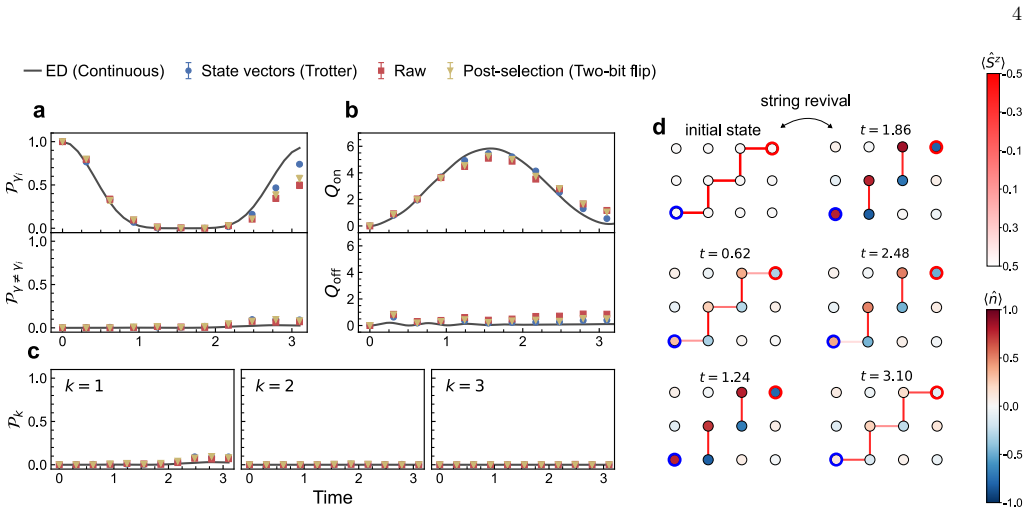
Quantum simulations of high-energy physics in $2+1$D can probe dynamical phenomena nonexistent in one spatial dimension and access regimes that are challenging for existing classical simulation methods. For string dynamics -- relevant to hadronization -- a plaquette term is required to realize genuine $2+1$D behavior, as it endows the gauge field with dynamics and enables the propagation of photon-like excitations. Here, we realize a U$(1)$ quantum link model of quantum electrodynamics in two spatial dimensions with a tunable plaquette term on a \texttt{Quantinuum System Model H2} quantum computer. We implement, to our knowledge, the largest quantum simulation of string-breaking dynamics reported to date, on a $5 \times 4$ matter-site square lattice using $51$ qubits. The simulation uses a shallow circuit design with a two-qubit gate depth of $28$ per Trotter step and up to $1540$ entangling gates. Starting from far-from-equilibrium string configurations, we measure the probability for the string to propagate within the lattice plane and find signatures of genuine $2+1$D dynamics only when the plaquette term is present. In a resonant regime, we observe the annihilation of string segments accompanied by the production of electron--positron pairs that screen them. We further find that, only with a nonzero plaquette term, matter creation extends across the lattice plane rather than remaining confined to the initial string path. These results experimentally realize string breaking and demonstrate the emergence of dynamical gauge fields in two spatial dimensions, establishing a route to photon-like propagation in programmable quantum simulators of gauge theories.
Editorial analysis
A structured set of objections, weighed in public.
Referee Report
Summary. The manuscript reports an experimental realization of a U(1) quantum link model for 2+1D QED on a trapped-ion quantum computer (Quantinuum H2), using a 5x4 matter-site lattice with 51 qubits. Starting from far-from-equilibrium string configurations, the authors implement Trotterized time evolution with a tunable plaquette term (two-qubit gate depth 28 per step, up to 1540 entangling gates) and measure string propagation probabilities and matter creation. They claim signatures of genuine 2+1D dynamics—including in-plane string spreading and transverse electron-positron pair production—appear only when the plaquette term is present, while the plaquette-off case remains confined to 1D-like behavior along the initial string path; resonant string breaking with pair screening is also reported.
Significance. If the central experimental distinction holds, the work is significant because it provides the largest reported quantum simulation of string-breaking dynamics in a gauge theory and directly demonstrates the emergence of dynamical gauge-field degrees of freedom in two spatial dimensions. The shallow-circuit design and programmable tunability of the plaquette term establish a concrete route toward simulating photon-like excitations and hadronization phenomena that are inaccessible to 1D models and challenging for classical methods at larger volumes.
major comments (1)
- [Experimental implementation and control experiments] The load-bearing claim is that differences in string propagation probability and transverse matter creation are due exclusively to the plaquette term enabling 2+1D gauge dynamics. The abstract and methods description of the 28-gate-depth circuit on the 5x4 lattice do not include explicit validation that the plaquette-off Hamiltonian is realized with equivalent effective noise, calibration drift, and Trotter-error accumulation as the plaquette-on case; without hardware-noise-injected classical 1D benchmarks or side-by-side error-model comparisons, differential artifacts could suppress spreading and mimic the reported 2+1D signature.
minor comments (2)
- [Abstract and introduction] The abstract states 'to our knowledge, the largest' simulation; a brief quantitative comparison to prior trapped-ion or superconducting gauge-theory experiments (e.g., qubit count, gate depth, lattice size) would strengthen this claim in the main text.
- [Theory and observables] Notation for the tunable plaquette coupling and the precise definition of the 'string propagation probability' observable should be introduced with an equation reference in the main text rather than only in supplementary material.
Simulated Author's Rebuttal
We thank the referee for their careful reading and constructive feedback on our manuscript. We address the major comment on experimental controls and validation below, and have revised the manuscript to incorporate additional analyses as suggested.
read point-by-point responses
-
Referee: [Experimental implementation and control experiments] The load-bearing claim is that differences in string propagation probability and transverse matter creation are due exclusively to the plaquette term enabling 2+1D gauge dynamics. The abstract and methods description of the 28-gate-depth circuit on the 5x4 lattice do not include explicit validation that the plaquette-off Hamiltonian is realized with equivalent effective noise, calibration drift, and Trotter-error accumulation as the plaquette-on case; without hardware-noise-injected classical 1D benchmarks or side-by-side error-model comparisons, differential artifacts could suppress spreading and mimic the reported 2+1D signature.
Authors: We agree that explicit validation of comparable noise conditions between the plaquette-on and plaquette-off cases is essential to support the central claim. In our implementation, setting the plaquette coupling to zero removes the corresponding two-qubit gates from each Trotter step while retaining the full depth of the matter and electric-field terms; the resulting circuit for the plaquette-off case is therefore slightly shallower. To address potential differential artifacts, we have added a new appendix containing (i) hardware-noise-injected classical simulations of the plaquette-off (effectively 1D) dynamics using an error model fitted to Quantinuum H2 calibration data and (ii) side-by-side comparisons of effective noise rates, calibration drift estimates, and accumulated Trotter error for both cases. These controls confirm that the observed in-plane string propagation and transverse matter creation cannot be reproduced by noise differences alone. The revised manuscript now includes these benchmarks and a brief discussion in the Methods section. revision: yes
Circularity Check
No circularity: direct experimental measurements on quantum hardware
full rationale
The paper reports hardware measurements of string propagation probabilities and matter creation on a 5x4 lattice using a trapped-ion device, comparing cases with and without the tunable plaquette term. No derivation chain, fitted parameters, or self-referential equations exist; the central claim rests on observed differences in measured data rather than any constructed or renamed quantity. Self-citations, if present, are not load-bearing for the observational result, which is externally falsifiable via the quantum computer runs themselves.
Axiom & Free-Parameter Ledger
axioms (2)
- domain assumption The U(1) quantum link model with tunable plaquette term accurately captures the target 2+1D gauge theory dynamics.
- domain assumption The shallow Trotterized circuit on the trapped-ion hardware implements the time evolution with sufficient fidelity to reveal the claimed dynamical signatures.
Lean theorems connected to this paper
-
IndisputableMonolith/Foundation/AlexanderDuality.leanalexander_duality_circle_linking unclear?
unclearRelation between the paper passage and the cited Recognition theorem.
We realize a U(1) quantum link model of quantum electrodynamics in two spatial dimensions with a tunable plaquette term... signatures of genuine 2+1D dynamics only when the plaquette term is present.
What do these tags mean?
- matches
- The paper's claim is directly supported by a theorem in the formal canon.
- supports
- The theorem supports part of the paper's argument, but the paper may add assumptions or extra steps.
- extends
- The paper goes beyond the formal theorem; the theorem is a base layer rather than the whole result.
- uses
- The paper appears to rely on the theorem as machinery.
- contradicts
- The paper's claim conflicts with a theorem or certificate in the canon.
- unclear
- Pith found a possible connection, but the passage is too broad, indirect, or ambiguous to say the theorem truly supports the claim.
Forward citations
Cited by 4 Pith papers
-
Non-Abelian String-Breaking Dynamics on a Qudit Quantum Computer
First experimental quantum simulation of genuine non-Abelian string breaking in an SU(2) pure gauge theory on a qudit trapped-ion computer, resolving oscillations and coherent breaking driven by plaquette interactions.
-
Tightening energy-based boson truncation bound using Monte Carlo-assisted methods
Monte Carlo-assisted tightening of the energy-based boson truncation bound substantially reduces volume dependence in (1+1)D scalar field theory and (2+1)D U(1) gauge theory.
-
Tightening energy-based boson truncation bound using Monte Carlo-assisted methods
A Monte Carlo-assisted analytic method tightens energy-based bounds on boson truncation errors, substantially reducing the volume dependence of the required cutoff in scalar and gauge theories.
-
The nonlocal magic of a holographic Schwinger pair
Holographic Schwinger pair creation generates nonlocal magic for spacetime dimensions d>2, as shown by a non-flat entanglement spectrum that can be read from the probe brane free energy.
Reference graph
Works this paper leans on
-
[1]
diagonal
By equating this to the energy of the original unbroken segment, we obtain the resonance condition 2m = ℓg. Notably, within the staggered particle frame- work, the number of links in any breakable string segment must always be odd. We first analyze the on-resonance case, where string breaking is energetically allowed and gives rise to rich 2 + 1D dynamics...
-
[2]
1a, we demonstrate—on quantum hardware—the rich dynamics generated by the presence of an explicit plaquette term
Starting from a diagonal string as shown in Fig. 1a, we demonstrate—on quantum hardware—the rich dynamics generated by the presence of an explicit plaquette term. To validate our hardware results, we compare Trotterized TN simulation data—obtained using the Qiskit matrix product state (MPS) method with a fixed bond dimension of 800, continuous-time TN sim...
-
[3]
Weinberg,The Quantum Theory of Fields(Cambridge University Press, 1995)
S. Weinberg,The Quantum Theory of Fields(Cambridge University Press, 1995)
1995
-
[4]
Weinberg, The Making of the standard model, Eur
S. Weinberg, The Making of the standard model, Eur. Phys. J. C34, 5 (2004), arXiv:hep-ph/0401010
-
[5]
Peskin and D
M. Peskin and D. Schroeder,An Introduction To Quan- tum Field Theory(CRC Press, 2018)
2018
-
[6]
R. K. Ellis, W. J. Stirling, and B. R. Webber,QCD and Collider Physics(Cambridge University Press, 2003)
2003
-
[7]
Kogut and L
J. Kogut and L. Susskind, Hamiltonian formulation of wilson’s lattice gauge theories, Physical Review D11, 395 (1975)
1975
-
[8]
J. B. Kogut, An introduction to lattice gauge theory and spin systems, Rev. Mod. Phys.51, 659 (1979)
1979
-
[9]
H. J. Rothe,Lattice Gauge Theories: An Introduction (Fourth Edition)(World Scientific Publishing Company, 2012)
2012
-
[10]
K. G. Wilson, Confinement of quarks, Physical Review D10, 2445 (1974)
1974
-
[11]
K. G. Wilson, Quarks and strings on a lattice, inNew Phenomena in Subnuclear Physics: Part A, edited by A. Zichichi (Springer US, Boston, MA, 1977) pp. 69–142
1977
-
[12]
X. Wen,Quantum Field Theory of Many-Body Sys- tems:From the Origin of Sound to an Origin of Light and Electrons: From the Origin of Sound to an Origin of Light and Electrons, Oxford Graduate Texts (OUP Oxford, 2004)
2004
-
[13]
Balents, Spin liquids in frustrated magnets, Nature 464, 199 (2010)
L. Balents, Spin liquids in frustrated magnets, Nature 464, 199 (2010)
2010
-
[14]
Savary and L
L. Savary and L. Balents, Quantum spin liquids: A review, Reports on Progress in Physics80, 016502 (2016- 11)
2016
-
[15]
Kleinert,Gauge Fields in Condensed Matter: Vol
H. Kleinert,Gauge Fields in Condensed Matter: Vol. 1: Superflow and Vortex Lines (Disorder Fields, Phase Transitions) Vol. 2: Stresses and Defects (Differential Geometry, Crystal Melting)(World Scientific, 1989)
1989
-
[16]
Fradkin,Field Theories of Condensed Matter Physics (Cambridge University Press, 2013)
E. Fradkin,Field Theories of Condensed Matter Physics (Cambridge University Press, 2013)
2013
-
[17]
Smith, J
A. Smith, J. Knolle, D. L. Kovrizhin, and R. Moessner, Disorder-free localization, Phys. Rev. Lett.118, 266601 (2017)
2017
-
[18]
Brenes, M
M. Brenes, M. Dalmonte, M. Heyl, and A. Scardicchio, Many-body localization dynamics from gauge invariance, Phys. Rev. Lett.120, 030601 (2018)
2018
-
[19]
Smith, J
A. Smith, J. Knolle, R. Moessner, and D. L. Kovrizhin, Absence of ergodicity without quenched disorder: From quantum disentangled liquids to many-body localization, Phys. Rev. Lett.119, 176601 (2017)
2017
-
[20]
Karpov, R
P. Karpov, R. Verdel, Y.-P. Huang, M. Schmitt, and M. Heyl, Disorder-free localization in an interacting 2d lattice gauge theory, Phys. Rev. Lett.126, 130401 (2021)
2021
-
[21]
J. Sous, B. Kloss, D. M. Kennes, D. R. Reichman, and A. J. Millis, Phonon-induced disorder in dynamics of optically pumped metals from nonlinear electron-phonon coupling, Nature Communications12, 5803 (2021)
2021
-
[22]
Chakraborty, M
N. Chakraborty, M. Heyl, P. Karpov, and R. Moessner, Disorder-free localization transition in a two-dimensional lattice gauge theory, Phys. Rev. B106, L060308 (2022)
2022
-
[23]
J. C. Halimeh, L. Homeier, H. Zhao, A. Bohrdt, F. Grusdt, P. Hauke, and J. Knolle, Enhancing disorder- free localization through dynamically emergent local symmetries, PRX Quantum3, 020345 (2022)
2022
-
[24]
F. M. Surace, P. P. Mazza, G. Giudici, A. Lerose, A. Gambassi, and M. Dalmonte, Lattice gauge theories and string dynamics in rydberg atom quantum simula- tors, Phys. Rev. X10, 021041 (2020)
2020
-
[25]
H. Lang, P. Hauke, J. Knolle, F. Grusdt, and J. C. Halimeh, Disorder-free localization with stark gauge pro- tection, Phys. Rev. B106, 174305 (2022)
2022
-
[26]
Desaules, D
J.-Y. Desaules, D. Banerjee, A. Hudomal, Z. Papi´ c, A. Sen, and J. C. Halimeh, Weak ergodicity breaking in the schwinger model, Phys. Rev. B107, L201105 (2023)
2023
-
[27]
Desaules, A
J.-Y. Desaules, A. Hudomal, D. Banerjee, A. Sen, Z. Papi´ c, and J. C. Halimeh, Prominent quantum many- body scars in a truncated schwinger model, Phys. Rev. B107, 205112 (2023)
2023
-
[28]
A. S. Aramthottil, U. Bhattacharya, D. Gonz´ alez- Cuadra, M. Lewenstein, L. Barbiero, and J. Zakrzewski, Scar states in deconfined z2 lattice gauge theories, Phys. Rev. B106, L041101 (2022)
2022
-
[29]
P. S. Tarabunga, E. Tirrito, T. Chanda, and M. Dal- monte, Many-body magic via pauli-markov chains—from criticality to gauge theories, PRX Quantum4, 040317 (2023)
2023
-
[30]
Desaules, G.-X
J.-Y. Desaules, G.-X. Su, I. P. McCulloch, B. Yang, Z. Papi´ c, and J. C. Halimeh, Ergodicity Breaking Un- der Confinement in Cold-Atom Quantum Simulators, Quantum8, 1274 (2024)
2024
-
[31]
Desaules, T
J.-Y. Desaules, T. Iadecola, and J. C. Halimeh, Mass- assisted local deconfinement in a confinedz2 lattice gauge theory, Phys. Rev. B112, 014301 (2025)
2025
-
[32]
Hudomal, J.-Y
A. Hudomal, J.-Y. Desaules, B. Mukherjee, G.-X. Su, J. C. Halimeh, and Z. Papi´ c, Driving quantum many- body scars in the pxp model, Phys. Rev. B106, 104302 (2022)
2022
-
[33]
J. Jeyaretnam, T. Bhore, J. J. Osborne, J. C. Halimeh, and Z. Papi´ c, Hilbert space fragmentation at the origin of disorder-free localization in the lattice schwinger model, Communications Physics8, 172 (2025), arXiv:2409.08320 [quant-ph]
-
[34]
Smith, Z
R. Smith, Z. Papi´ c, and A. Hallam, Nonstabilizerness in kinetically constrained rydberg atom arrays, Phys. Rev. B111, 245148 (2025)
2025
-
[35]
P. R. N. Falc˜ ao, P. Sierant, J. Zakrzewski, and E. Tir- rito, Nonstabilizerness dynamics in many-body localized systems, Phys. Rev. Lett.135, 240404 (2025)
2025
-
[36]
G. Esposito, S. Cepollaro, L. Cappiello, and A. Hamma, Magic of discrete lattice gauge the- ories, International Journal of Geometric Meth- ods in Modern Physics22, 2550003 (2025), https://doi.org/10.1142/S0219887825500033
-
[37]
A. N. Ciavarella, C. W. Bauer, and J. C. Halimeh, Generic hilbert space fragmentation in kogut-susskind lattice gauge theories, Phys. Rev. D112, L091501 (2025)
2025
- [38]
-
[39]
Steinegger, D
J. Steinegger, D. Banerjee, E. Huffman, and L. Ram- melm¨ uller, Geometric fragmentation and anomalous ther- malization in cubic dimer model, Phys. Rev. D112, 114512 (2025)
2025
-
[40]
Ebner, A
L. Ebner, A. Sch¨ afer, C. Seidl, B. M¨ uller, and X. Yao, Entanglement entropy of (2 + 1)-dimensional SU(2) lat- tice gauge theory on plaquette chains, Phys. Rev. D110, 014505 (2024)
2024
-
[41]
J. C. Halimeh, L. Barbiero, P. Hauke, F. Grusdt, and A. Bohrdt, Robust quantum many-body scars in lattice 8 gauge theories, Quantum7, 1004 (2023)
2023
-
[42]
Iadecola and M
T. Iadecola and M. Schecter, Quantum many-body scar states with emergent kinetic constraints and finite- entanglement revivals, Phys. Rev. B101, 024306 (2020)
2020
-
[43]
Banerjee and A
D. Banerjee and A. Sen, Quantum scars from zero modes in an abelian lattice gauge theory on ladders, Phys. Rev. Lett.126, 220601 (2021)
2021
-
[44]
Biswas, D
S. Biswas, D. Banerjee, and A. Sen, Scars from pro- tected zero modes and beyond in U(1) quantum link and quantum dimer models, SciPost Phys.12, 148 (2022)
2022
-
[45]
A. Daniel, A. Hallam, J.-Y. Desaules, A. Hudomal, G.- X. Su, J. C. Halimeh, and Z. Papi´ c, Bridging quantum criticality via many-body scarring, Physical Review B 107, 10.1103/physrevb.107.235108 (2023)
-
[46]
I. Sau, P. Stornati, D. Banerjee, and A. Sen, Sublattice scars and beyond in two-dimensional U(1) quantum link lattice gauge theories, Phys. Rev. D109, 034519 (2024)
2024
-
[47]
J. Osborne, I. P. McCulloch, and J. C. Halimeh, Quan- tum many-body scarring in$2+1$d gauge theories with dynamical matter (2024), arXiv:2403.08858 [cond-mat, physics:hep-lat, physics:quant-ph]
-
[48]
Budde, M
T. Budde, M. Krstic Marinkovic, and J. C. Pinto Barros, Quantum many-body scars for arbitrary integer spin in 2 + 1D abelian gauge theories, Phys. Rev. D110, 094506 (2024)
2024
-
[49]
G. Calaj´ o, G. Cataldi, M. Rigobello, D. Wanisch, G. Mag- nifico, P. Silvi, S. Montangero, and J. C. Halimeh, Quan- tum many-body scarring in a non-abelian lattice gauge theory, Physical Review Research7, 10.1103/physrevre- search.7.013322 (2025)
-
[50]
Hartse, L
J. Hartse, L. Fidkowski, and N. Mueller, Stabilizer scars, Phys. Rev. Lett.135, 060402 (2025)
2025
-
[51]
Disorder-Free Localization and Fragmentation in a Non-Abelian Lattice Gauge Theory
G. Cataldi, G. Calaj´ o, P. Silvi, S. Montangero, and J. C. Halimeh, Disorder-free localization and fragmen- tation in a non-abelian lattice gauge theory (2025), arXiv:2505.04704 [cond-mat.quant-gas]
work page internal anchor Pith review Pith/arXiv arXiv 2025
- [52]
-
[53]
E. Zohar, Quantum simulation of lattice gauge theories in more than one space dimension—requirements, chal- lenges and methods, Philosophical Transactions of the Royal Society A: Mathematical, Physical and Engineer- ing Sciences380, 20210069 (2021)
2021
- [54]
-
[55]
Creutz, L
M. Creutz, L. Jacobs, and C. Rebbi, Monte carlo study of abelian lattice gauge theories, Physical Review D20, 1915 (1979)
1915
-
[56]
Creutz, Monte carlo study of quantized su(2) gauge theory, Physical Review D21, 2308 (1980)
M. Creutz, Monte carlo study of quantized su(2) gauge theory, Physical Review D21, 2308 (1980)
1980
-
[57]
Creutz, L
M. Creutz, L. Jacobs, and C. Rebbi, Monte carlo com- putations in lattice gauge theories, Physics Reports95, 201 (1983)
1983
-
[58]
Creutz,Lattice Gauge Theory and Monte Carlo Meth- ods, Tech
M. Creutz,Lattice Gauge Theory and Monte Carlo Meth- ods, Tech. Rep. BNL-42086 (Brookhaven National Lab. (BNL), Upton, NY (United States), 1988)
1988
-
[59]
Creutz, Lattice gauge theories and monte carlo algo- rithms, Nuclear Physics B - Proceedings Supplements 10, 1 (1989)
M. Creutz, Lattice gauge theories and monte carlo algo- rithms, Nuclear Physics B - Proceedings Supplements 10, 1 (1989)
1989
-
[60]
Montvay and G
I. Montvay and G. M¨ unster,Quantum Fields on a Lat- tice, Cambridge Monographs on Mathematical Physics (Cambridge University Press, 1994)
1994
-
[61]
T. D. Kieu and C. J. Griffin, Monte carlo simulations with indefinite and complex-valued measures, Phys. Rev. E49, 3855 (1994)
1994
-
[62]
D. C. Hackett, K. Howe, C. Hughes, W. Jay, E. T. Neil, and J. N. Simone, Digitizing gauge fields: Lattice monte carlo results for future quantum computers, Physical Review A99, 062341 (2019)
2019
-
[63]
H. D. Trottier, String breaking by dynamical fermions in three-dimensional lattice qcd, Physical Review D60, 034506 (1999)
1999
-
[64]
Nagata, Finite-density lattice qcd and sign problem: Current status and open problems, Progress in Particle and Nuclear Physics127, 103991 (2022)
K. Nagata, Finite-density lattice qcd and sign problem: Current status and open problems, Progress in Particle and Nuclear Physics127, 103991 (2022)
2022
-
[65]
Schollw¨ ock, The density-matrix renormalization group, Rev
U. Schollw¨ ock, The density-matrix renormalization group, Rev. Mod. Phys.77, 259 (2005)
2005
-
[66]
Schollw¨ ock, The density-matrix renormalization group in the age of matrix product states, Annals of Physics January 2011 Special Issue,326, 96 (2011)
U. Schollw¨ ock, The density-matrix renormalization group in the age of matrix product states, Annals of Physics January 2011 Special Issue,326, 96 (2011)
2011
-
[67]
Or´ us, A practical introduction to tensor networks: Ma- trix product states and projected entangled pair states, Annals of Physics349, 117 (2014)
R. Or´ us, A practical introduction to tensor networks: Ma- trix product states and projected entangled pair states, Annals of Physics349, 117 (2014)
2014
-
[68]
Or´ us, Tensor networks for complex quantum systems, Nature Reviews Physics1, 538 (2019)
R. Or´ us, Tensor networks for complex quantum systems, Nature Reviews Physics1, 538 (2019)
2019
-
[69]
Paeckel, T
S. Paeckel, T. K¨ ohler, A. Swoboda, S. R. Manmana, U. Schollw¨ ock, and C. Hubig, Time-evolution methods for matrix-product states, Annals of Physics411, 167998 (2019)
2019
-
[70]
Montangero,Introduction to Tensor Network Methods: Numerical Simulations of Low-Dimensional Many-Body Quantum Systems(Springer International Publishing, Cham, 2018)
S. Montangero,Introduction to Tensor Network Methods: Numerical Simulations of Low-Dimensional Many-Body Quantum Systems(Springer International Publishing, Cham, 2018)
2018
-
[71]
G. Magnifico, G. Cataldi, M. Rigobello, P. Maj- cen, D. Jaschke, P. Silvi, and S. Montangero, Ten- sor networks for lattice gauge theories beyond one di- mension: A roadmap (2024), arXiv:2407.03058 [cond- mat, physics:hep-lat, physics:hep-th, physics:physics, physics:quant-ph]
-
[72]
Byrnes and Y
T. Byrnes and Y. Yamamoto, Simulating lattice gauge theories on a quantum computer, Physical Review A73, 022328 (2006)
2006
-
[73]
Dalmonte and S
M. Dalmonte and S. Montangero, Lattice gauge theory simulations in the quantum information era, Contempo- rary Physics57, 388 (2016)
2016
-
[74]
Zohar, J
E. Zohar, J. I. Cirac, and B. Reznik, Quantum simu- lations of lattice gauge theories using ultracold atoms in optical lattices, Reports on Progress in Physics79, 014401 (2015)
2015
-
[75]
Aidelsburger, L
M. Aidelsburger, L. Barbiero, A. Bermudez, T. Chanda, A. Dauphin, D. Gonz´ alez-Cuadra, P. a. R. Grzybowski, S. Hands, F. Jendrzejewski, J. J¨ unemann, G. Juzeli¯ unas, V. Kasper, A. Piga, S.-J. Ran, M. Rizzi, G. Sierra, L. Tagliacozzo, E. Tirrito, T. V. Zache, J. Zakrzewski, E. Zohar, and M. Lewenstein, Cold atoms meet lattice gauge theory, Philosophical...
2021
-
[76]
Barata, X
J. Barata, X. Du, M. Li, W. Qian, and C. A. Salgado, Medium induced jet broadening in a quantum computer, Phys. Rev. D106, 074013 (2022)
2022
-
[77]
N. Klco, A. Roggero, and M. J. Savage, Standard model physics and the digital quantum revolution: Thoughts about the interface, Reports on Progress in Physics85, 9 064301 (2022)
2022
-
[78]
Barata, X
J. Barata, X. Du, M. Li, W. Qian, and C. A. Salgado, Quantum simulation of in-medium qcd jets: Momentum broadening, gluon production, and entropy growth, Phys. Rev. D108, 056023 (2023)
2023
- [79]
-
[80]
C. W. Bauer, Z. Davoudi, A. B. Balantekin, T. Bhat- tacharya, M. Carena, W. A. de Jong, P. Draper, A. El-Khadra, N. Gemelke, M. Hanada, D. Kharzeev, H. Lamm, Y.-Y. Li, J. Liu, M. Lukin, Y. Meurice, C. Monroe, B. Nachman, G. Pagano, J. Preskill, E. Ri- naldi, A. Roggero, D. I. Santiago, M. J. Savage, I. Sid- diqi, G. Siopsis, D. Van Zanten, N. Wiebe, Y. Ya...
2023
discussion (0)
Sign in with ORCID, Apple, or X to comment. Anyone can read and Pith papers without signing in.